This sheet covers the electrochemistry class 12 formulas from NCERT Chemistry Part I, Chapter 2: cell potential and the Nernst equation, the links between cell potential, Gibbs energy and equilibrium constant, resistivity, conductivity and molar conductivity, Kohlrausch’s law, and the quantitative laws of electrolysis.
Each formula is grouped by topic, with the meaning and unit of every symbol, a line on when to use it, and worked examples with original numbers. For the detailed explanations and derivations behind these formulas, start from the Class 12 Chemistry formulas hub.
Formulas at a Glance
The table below lists every formula on this page. Symbols and units are explained in the next section; conditions are in When to Use Each Formula.
| Purpose (what you are finding) | Formula |
|---|---|
| Cell emf from the two half-cell potentials | \( E_{\text{cell}} = E_{\text{right}} – E_{\text{left}} \) |
| Standard cell potential | \( E^\circ_{\text{cell}} = E^\circ_{\text{cathode}} – E^\circ_{\text{anode}} \) |
| Electrode potential at any concentration (Nernst) | \( E_{(\text{M}^{n+}/\text{M})} = E^\circ_{(\text{M}^{n+}/\text{M})} – \frac{RT}{nF} \ln \frac{1}{[\text{M}^{n+}]} \) |
| Cell potential at any concentration (Nernst) | \( E_{\text{cell}} = E^\circ_{\text{cell}} – \frac{RT}{nF} \ln Q \) |
| Nernst equation at 298 K (derived: log form of the general Nernst equation) | \( E_{\text{cell}} = E^\circ_{\text{cell}} – \frac{0.059\ \text{V}}{n} \log Q \) |
| Equilibrium constant from standard cell potential | \( E^\circ_{\text{cell}} = \frac{2.303RT}{nF} \log K_c \) |
| Equilibrium constant at 298 K (derived from the general relation) | \( E^\circ_{\text{cell}} = \frac{0.059\ \text{V}}{n} \log K_c \) |
| Gibbs energy from cell emf | \( \Delta_r G = -nFE_{\text{cell}} \) |
| Standard Gibbs energy from standard emf | \( \Delta_r G^\circ = -nFE^\circ_{\text{cell}} \) |
| Standard Gibbs energy from equilibrium constant | \( \Delta_r G^\circ = -RT \ln K \) |
| Resistance of a conductor or solution column | \( R = \rho \frac{l}{A} \) |
| Conductance from resistance | \( G = \frac{1}{R} = \kappa \frac{A}{l} \) |
| Cell constant | \( G^* = \frac{l}{A} = R\kappa \) |
| Conductivity from cell constant and resistance | \( \kappa = \frac{G^*}{R} \) |
| Molar conductivity from conductivity | \( \Lambda_m = \frac{\kappa}{c} \) |
| Molar conductivity as conductance of one-mole volume | \( \Lambda_m = \kappa V \) |
| Molar conductivity in S cm² mol⁻¹ (practical units) | \( \Lambda_m = \frac{\kappa \times 1000}{\text{molarity}} \) |
| Strong electrolyte: molar conductivity vs concentration | \( \Lambda_m = \Lambda_m^\circ – A c^{1/2} \) |
| Kohlrausch law of independent migration of ions | \( \Lambda_m^\circ = \nu_+ \lambda_+^\circ + \nu_- \lambda_-^\circ \) |
| Degree of dissociation of a weak electrolyte | \( \alpha = \frac{\Lambda_m}{\Lambda_m^\circ} \) |
| Dissociation constant of a weak electrolyte | \( K_a = \frac{c\alpha^2}{1-\alpha} \) |
| Charge passed | \( Q = It \) |
| Faraday constant | \( F = N_A e \approx 96500\ \text{C mol}^{-1} \) |
| Mass deposited at an electrode (derived from the charge–mole relation) | \( m = \frac{MQ}{nF} \) |
All Formulas, Grouped by Topic
Galvanic Cells
The cell emf is the difference between the electrode potentials of the two half-cells. By convention the anode is written on the left and the cathode on the right (NCERT, p. 33):
\[ E_{\text{cell}} = E_{\text{right}} – E_{\text{left}} \]
For standard conditions, the same rule is written using the cathode and anode potentials (NCERT, p. 58):
\[ E^\circ_{\text{cell}} = E^\circ_{\text{cathode}} – E^\circ_{\text{anode}} \]
The standard hydrogen electrode (SHE) is assigned zero potential at all temperatures, so a cell with SHE on the left measures the right half-cell’s standard potential directly: \( E^\circ = E^\circ_R – 0 = E^\circ_R \) (NCERT, p. 34).
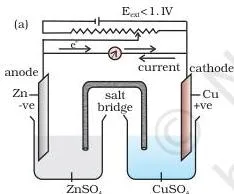
In the Daniell cell shown above, zinc is the anode (left) and copper the cathode (right). Using the standard electrode potentials from Table 2.1, \( E^\circ_{\text{cell}} = 0.34\ \text{V} – (-0.76\ \text{V}) = 1.10\ \text{V} \) (NCERT, p. 35).
Nernst Equation
For a metal electrode \( \text{M}^{n+}/\text{M} \), the potential at any concentration of \( \text{M}^{n+} \) is (NCERT, p. 36):
\[ E_{(\text{M}^{n+}/\text{M})} = E^\circ_{(\text{M}^{n+}/\text{M})} – \frac{RT}{nF} \ln \frac{1}{[\text{M}^{n+}]} \]
For a general cell reaction \( a\text{A} + b\text{B} \rightarrow c\text{C} + d\text{D} \), the Nernst equation is (NCERT, p. 38):
\[ E_{\text{cell}} = E^\circ_{\text{cell}} – \frac{RT}{nF} \ln Q \]
where the reaction quotient is \( Q = \dfrac{[\text{C}]^c [\text{D}]^d}{[\text{A}]^a [\text{B}]^b} \).
At 298 K, substituting \( R = 8.314\ \text{J K}^{-1}\text{mol}^{-1} \), \( F = 96487\ \text{C mol}^{-1} \) and converting \( \ln \) to \( \log_{10} \) gives the form used in most numericals (NCERT, p. 38):
\[ E_{\text{cell}} = E^\circ_{\text{cell}} – \frac{0.059\ \text{V}}{n} \log Q \quad (\text{at } 298\ \text{K}) \]
Equilibrium Constant from Nernst Equation
At equilibrium the cell delivers no current, so \( E_{\text{cell}} = 0 \) and the reaction quotient becomes \( K_c \) (NCERT, p. 39):
\[ E^\circ_{\text{cell}} = \frac{2.303RT}{nF} \log K_c \]
At 298 K this reduces to the form used in calculations:
\[ E^\circ_{\text{cell}} = \frac{0.059\ \text{V}}{n} \log K_c \quad (\text{at } 298\ \text{K}) \]
Electrochemical Cell and Gibbs Energy of the Reaction
The reversible work done by a galvanic cell equals the decrease in Gibbs energy (NCERT, p. 40):
\[ \Delta_r G = -nFE_{\text{cell}} \]
\[ \Delta_r G^\circ = -nFE^\circ_{\text{cell}} \]
The standard Gibbs energy also fixes the equilibrium constant (NCERT, p. 40):
\[ \Delta_r G^\circ = -RT \ln K \]
Note that \( E_{\text{cell}} \) is intensive but \( \Delta_r G \) is extensive: doubling the reaction doubles \( n \) and doubles \( \Delta_r G \).
Conductance of Electrolytic Solutions
The resistance of a conductor or a solution column is proportional to its length and inversely proportional to its area of cross-section (NCERT, p. 41):
\[ R = \rho \frac{l}{A} \]
Conductance is the inverse of resistance (NCERT, p. 41):
\[ G = \frac{1}{R} = \kappa \frac{A}{l} \]
Useful unit relations (NCERT, p. 41):
\[ 1\ \Omega\ \text{m} = 100\ \Omega\ \text{cm}, \qquad 1\ \text{S cm}^{-1} = 100\ \text{S m}^{-1} \]
Measurement of the Conductivity of Ionic Solutions
The ratio \( l/A \) of a conductivity cell is its cell constant \( G^* \). It is found by measuring the resistance of a KCl solution of known conductivity (NCERT, p. 43):
\[ G^* = \frac{l}{A} = R\kappa \]
Once \( G^* \) is known, the conductivity of any solution follows from its measured resistance (NCERT, p. 44):
\[ \kappa = \frac{G^*}{R} \]
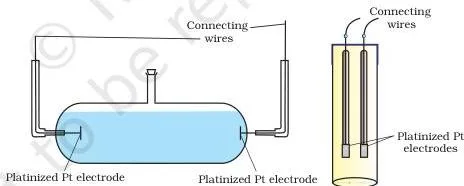
The conductivity cell shown above fixes \( G^* \) through the distance \( l \) between the platinum electrodes and their area of cross-section \( A \). Molar conductivity is then defined as (NCERT, p. 44):
\[ \Lambda_m = \frac{\kappa}{c} \]
With \( \kappa \) in S cm⁻¹ and concentration as molarity, the practical form is:
\[ \Lambda_m\ (\text{S cm}^2\ \text{mol}^{-1}) = \frac{\kappa\ (\text{S cm}^{-1}) \times 1000\ (\text{cm}^3\ \text{L}^{-1})}{\text{molarity}\ (\text{mol L}^{-1})} \]
Unit conversion: \( 1\ \text{S m}^2\ \text{mol}^{-1} = 10^4\ \text{S cm}^2\ \text{mol}^{-1} \) (NCERT, p. 44).
Variation of Conductivity and Molar Conductivity with Concentration
Molar conductivity is also the conductance of the volume \( V \) of solution containing one mole of electrolyte (NCERT, p. 46):
\[ \Lambda_m = \kappa V \]
For strong electrolytes, \( \Lambda_m \) increases slowly with dilution and follows (NCERT, p. 47):
\[ \Lambda_m = \Lambda_m^\circ – A c^{1/2} \]
A plot of \( \Lambda_m \) against \( c^{1/2} \) is a straight line with intercept \( \Lambda_m^\circ \) and slope \( -A \). Weak electrolytes rise steeply on dilution, so their \( \Lambda_m^\circ \) cannot be found by extrapolation (NCERT, p. 49).
Kohlrausch Law of Independent Migration of Ions
Limiting molar conductivity is the sum of the independent contributions of the cation and anion (NCERT, p. 48):
\[ \Lambda_m^\circ = \nu_+ \lambda_+^\circ + \nu_- \lambda_-^\circ \]
For example, \( \Lambda_m^\circ(\text{CaCl}_2) = \lambda^\circ(\text{Ca}^{2+}) + 2\lambda^\circ(\text{Cl}^-) \). The law is used to obtain \( \Lambda_m^\circ \) of weak electrolytes, e.g. \( \Lambda_m^\circ(\text{HAc}) = \Lambda_m^\circ(\text{HCl}) + \Lambda_m^\circ(\text{NaAc}) – \Lambda_m^\circ(\text{NaCl}) \) (NCERT, p. 50).
Weak Electrolytes: Degree of Dissociation
For a weak electrolyte at concentration \( c \), the degree of dissociation is approximated by the ratio of molar conductivities (NCERT, p. 49):
\[ \alpha = \frac{\Lambda_m}{\Lambda_m^\circ} \]
and the dissociation constant follows from the dilution law (NCERT, p. 49):
\[ K_a = \frac{c\alpha^2}{1-\alpha} = \frac{c\Lambda_m^2}{\Lambda_m^\circ(\Lambda_m^\circ – \Lambda_m)} \]
Faraday’s Laws of Electrolysis
The charge passed is the product of current and time (NCERT, p. 51):
\[ Q = It \]
One mole of electrons carries one faraday (NCERT, p. 51):
\[ F = N_A e = 96487\ \text{C mol}^{-1} \approx 96500\ \text{C mol}^{-1} \]
The mass deposited or liberated at an electrode follows from the stoichiometry of the electrode reaction (NCERT, p. 52):
\[ m = \frac{MQ}{nF} = \frac{MIt}{nF} \]
First law: the amount of chemical reaction is proportional to the charge passed. Second law: masses liberated by the same charge are proportional to their chemical equivalent weights (NCERT, p. 51).
What Each Symbol Means
| Symbol | What it means | Unit |
|---|---|---|
| \( E_{\text{cell}} \) | Cell potential (emf when no current is drawn) | volt (V) |
| \( E^\circ_{\text{cell}} \) | Standard cell potential (all species at 1 M, gases at 1 bar) | V |
| \( E_{\text{right}}, E_{\text{left}} \) | Electrode potentials of the right and left half-cells | V |
| \( E^\circ_{\text{cathode}}, E^\circ_{\text{anode}} \) | Standard electrode potentials of cathode and anode | V |
| \( E_{(\text{M}^{n+}/\text{M})} \) | Electrode potential of a metal electrode at concentration \( [\text{M}^{n+}] \) | V |
| \( R \) | Gas constant (in Nernst and Gibbs equations) | J K⁻¹ mol⁻¹ (8.314) |
| \( T \) | Temperature | kelvin (K) |
| \( n \) | Number of electrons transferred in the balanced cell reaction | dimensionless (a count) |
| \( F \) | Faraday constant | C mol⁻¹ (96487 ≈ 96500) |
| \( Q \) | Reaction quotient (in the Nernst equation) | dimensionless |
| \( K_c \) | Equilibrium constant (concentration based) | dimensionless |
| \( \Delta_r G, \Delta_r G^\circ \) | Gibbs energy of reaction; standard Gibbs energy | J mol⁻¹ (often kJ mol⁻¹) |
| \( \rho \) | Resistivity (specific resistance) | Ω m |
| \( l \) | Length of the conductor or solution column | m (or cm) |
| \( A \) | Area of cross-section | m² (or cm²) |
| \( R \) (resistance) | Electrical resistance (in conductance and electrolysis) | ohm (Ω) |
| \( G \) | Conductance | siemens (S = Ω⁻¹) |
| \( \kappa \) | Conductivity (specific conductance) | S m⁻¹ (or S cm⁻¹) |
| \( G^* \) | Cell constant | m⁻¹ (or cm⁻¹) |
| \( \Lambda_m \) | Molar conductivity | S m² mol⁻¹ (or S cm² mol⁻¹) |
| \( \Lambda_m^\circ \) | Limiting molar conductivity (zero concentration / infinite dilution) | S m² mol⁻¹ |
| \( c \) | Concentration of the electrolyte | mol m⁻³ or mol L⁻¹ |
| \( V \) | Volume of solution containing one mole of electrolyte | m³ |
| \( \nu_+, \nu_- \) | Number of cations / anions produced per formula unit | dimensionless |
| \( \lambda_+^\circ, \lambda_-^\circ \) | Limiting molar conductivities of the cation and anion | S m² mol⁻¹ |
| \( \alpha \) | Degree of dissociation | dimensionless |
| \( K_a \) | Dissociation constant of a weak acid | mol L⁻¹ |
| \( Q \) (charge) | Quantity of electricity passed | coulomb (C) |
| \( I \) | Current | ampere (A) |
| \( t \) | Time | second (s) |
| \( m \) | Mass of substance deposited or liberated | g |
| \( M \) | Molar mass of the substance | g mol⁻¹ |
| \( N_A \) | Avogadro constant | mol⁻¹ (6.02 × 10²³) |
| \( e \) | Charge on one electron | C (1.6021 × 10⁻¹⁹) |
Note that \( R \) and \( Q \) each carry two meanings in this chapter — the context tells you which one is meant. See Common Mistakes to Avoid.
When to Use Each Formula
| Formula | When to use it |
|---|---|
| \( E_{\text{cell}} = E_{\text{right}} – E_{\text{left}} \) | You have both half-cell reduction potentials and need the cell emf. Anode on the left, cathode on the right. |
| Nernst equation (any form) | Concentrations are not 1 M — the cell is not under standard conditions. |
| \( \frac{0.059}{n} \log Q \) form | The question says 298 K and gives concentrations in mol L⁻¹. |
| \( E^\circ_{\text{cell}} = \frac{2.303RT}{nF} \log K_c \) | You need the equilibrium constant from \( E^\circ_{\text{cell}} \), or \( E^\circ_{\text{cell}} \) from \( K_c \). |
| \( \Delta_r G = -nFE_{\text{cell}} \) | Convert cell emf to Gibbs energy; a negative \( \Delta_r G \) means the reaction is spontaneous. |
| \( \Delta_r G^\circ = -RT \ln K \) | Relate standard Gibbs energy to the equilibrium constant. |
| \( R = \rho l/A \) | Resistance of a conductor or a solution column of known length and area. |
| \( G = 1/R = \kappa A/l \) | Conductance from resistance; definition of conductance. |
| \( G^* = l/A = R\kappa \) | Find the cell constant using a KCl solution of known conductivity. |
| \( \kappa = G^*/R \) | Conductivity of an unknown solution from its measured resistance. |
| \( \Lambda_m = \kappa/c \) | Molar conductivity from measured conductivity and concentration. |
| \( \Lambda_m = \Lambda_m^\circ – A c^{1/2} \) | Strong electrolytes: plot \( \Lambda_m \) against \( c^{1/2} \), extrapolate to zero concentration for \( \Lambda_m^\circ \). |
| Kohlrausch law | \( \Lambda_m^\circ \) of a weak electrolyte, which cannot be found by extrapolation. |
| \( \alpha = \Lambda_m/\Lambda_m^\circ \) | Degree of dissociation of a weak electrolyte at concentration \( c \). |
| \( K_a = c\alpha^2/(1-\alpha) \) | Dissociation constant of a weak electrolyte from \( \alpha \) and \( c \). |
| \( Q = It \) | Charge passed when current (A) and time (s) are known. |
| \( m = MQ/(nF) \) | Mass deposited or liberated at an electrode during electrolysis. |
Worked Examples
Three examples covering the main uses of these formulas: the Nernst equation, the equilibrium constant, and electrolysis. For practice on the textbook’s own questions, work through the NCERT exercises; the chemistry formulas index collects formula sheets for other chapters.
Example 1: Nernst equation at 298 K
Step 1: Identify the cell and the number of electrons.
For \( \text{Zn(s)} | \text{Zn}^{2+}(0.02\ \text{M}) || \text{Ag}^+(0.5\ \text{M}) | \text{Ag(s)} \), the reaction is \( \text{Zn} + 2\text{Ag}^+ \rightarrow \text{Zn}^{2+} + 2\text{Ag} \), so \( n = 2 \).
- Step 1: Find \( E^\circ_{\text{cell}} \) from the standard electrode potentials: \( E^\circ_{\text{cell}} = E^\circ_{\text{Ag}^+/\text{Ag}} – E^\circ_{\text{Zn}^{2+}/\text{Zn}} = 0.80\ \text{V} – (-0.76\ \text{V}) = 1.56\ \text{V} \).
- Step 2: Write the Nernst equation at 298 K and substitute:
\[ E_{\text{cell}} = E^\circ_{\text{cell}} – \frac{0.059}{n} \log \frac{[\text{Zn}^{2+}]}{[\text{Ag}^+]^2} = 1.56 – \frac{0.059}{2} \log \frac{0.02}{(0.5)^2} \]
\[ = 1.56 – 0.0295 \log(0.08) = 1.56 – 0.0295(-1.097) = 1.56 + 0.032 = 1.59\ \text{V} \]
Final answer: \( E_{\text{cell}} = 1.59\ \text{V} \).
Example 2: Equilibrium constant from standard cell potential
Step 1: A cell reaction transfers \( n = 2 \) electrons and has \( E^\circ_{\text{cell}} = 0.65\ \text{V} \) at 298 K.
Use the equilibrium form of the Nernst equation:
\[ \log K_c = \frac{nE^\circ_{\text{cell}}}{0.059} = \frac{2 \times 0.65}{0.059} = 22.03 \]
Step 2: Convert to \( K_c \):
\[ K_c = 10^{22.03} \approx 1.1 \times 10^{22} \]
Final answer: \( K_c \approx 1.1 \times 10^{22} \).
Example 3: Mass deposited during electrolysis
Step 1: A current of 2.0 A is passed through a \( \text{CuSO}_4 \) solution for 25 minutes.
Convert time to seconds: \( t = 25 \times 60 = 1500\ \text{s} \).
- Step 1: Charge passed: \( Q = It = 2.0 \times 1500 = 3000\ \text{C} \).
- Step 2: The cathode reaction is \( \text{Cu}^{2+} + 2e^- \rightarrow \text{Cu} \), so \( n = 2 \) and \( M = 63\ \text{g mol}^{-1} \).
\[ m = \frac{MQ}{nF} = \frac{63 \times 3000}{2 \times 96500} = \frac{189000}{193000} = 0.98\ \text{g} \]
Final answer: \( 0.98\ \text{g} \) of copper is deposited.
Common Mistakes to Avoid
These are the errors students actually make when applying this chapter’s formulas.
| Mistake | Correct rule | How to check your answer |
|---|---|---|
| Writing \( E_{\text{cell}} = E_{\text{left}} – E_{\text{right}} \), or calling the negative electrode the cathode. | \( E_{\text{cell}} = E_{\text{cathode}} – E_{\text{anode}} = E_{\text{right}} – E_{\text{left}} \), with the anode on the left. In a galvanic cell the anode is negative. | A spontaneous reaction must give \( E^\circ_{\text{cell}} \gt 0 \); a negative value means you swapped the electrodes. |
| Using \( n = 1 \) for \( \text{Zn} + 2\text{Ag}^+ \rightarrow \text{Zn}^{2+} + 2\text{Ag} \). | \( n \) is the number of electrons transferred in the balanced reaction as written — here 2. | Count electrons in the half-reactions: Zn loses 2, two Ag⁺ gain 2. |
| Confusing \( R \) (gas constant) with \( R \) (resistance), or \( Q \) (reaction quotient) with \( Q \) (charge). | In Nernst and Gibbs equations \( R = 8.314\ \text{J K}^{-1}\text{mol}^{-1} \) and \( Q \) is dimensionless; in conductance and electrolysis \( R \) is in Ω and \( Q \) in C. | The term \( RT/nF \) must come out in volts; the product \( R\kappa \) must come out in m⁻¹. |
| Mixing units in \( \Lambda_m = \kappa/c \): using \( \kappa \) in S cm⁻¹ with \( c \) in mol L⁻¹ without the 1000 factor. | \( \Lambda_m\ (\text{S cm}^2\ \text{mol}^{-1}) = \dfrac{\kappa\ (\text{S cm}^{-1}) \times 1000}{\text{molarity}\ (\text{mol L}^{-1})} \); or convert \( c \) to mol m⁻³ and use \( \kappa \) in S m⁻¹. | \( 1\ \text{S m}^2\ \text{mol}^{-1} = 10^4\ \text{S cm}^2\ \text{mol}^{-1} \); typical values are 100–150 S cm² mol⁻¹. |
| Using the \( 0.059/n \) form at any temperature. | \( 0.059\ \text{V} = 2.303RT/F \) only at 298 K; otherwise use \( \frac{2.303RT}{nF} \log Q \). | The question must state 298 K (or 25 °C) before you use 0.059. |
| In electrolysis, taking \( n = 1 \) for a divalent ion such as \( \text{Cu}^{2+} \), \( \text{Zn}^{2+} \) or \( \text{Mg}^{2+} \). | Each mole of \( \text{Cu}^{2+} \) needs \( 2F \); charge \( = nF \) per mole of metal deposited. | Use \( m = MQ/(nF) \); for Cu, \( n = 2 \), so the mass is half what \( n = 1 \) would give. |
Frequently Asked Questions
When do I use the 0.059 form and when the general Nernst form?
Use \( E = E^\circ – \frac{0.059}{n} \log Q \) only at 298 K. The general form is \( E = E^\circ – \frac{RT}{nF} \ln Q \); the 0.059 comes from substituting \( R = 8.314\ \text{J K}^{-1}\text{mol}^{-1} \), \( F = 96487\ \text{C mol}^{-1} \) and \( T = 298\ \text{K} \), and the factor 2.303 converts \( \ln \) to \( \log_{10} \).
Why does molar conductivity increase on dilution while conductivity decreases?
Conductivity \( \kappa \) falls on dilution because the number of ions per unit volume decreases. Molar conductivity \( \Lambda_m = \kappa/c \) rises because the volume containing one mole of electrolyte increases, and for weak electrolytes the degree of dissociation also increases on dilution (NCERT, p. 46).
How do I find the limiting molar conductivity of a weak electrolyte?
You cannot extrapolate \( \Lambda_m \) against \( c^{1/2} \) for a weak electrolyte — the rise is steep, not a straight line. Use Kohlrausch’s law: \( \Lambda_m^\circ(\text{HAc}) = \lambda^\circ(\text{H}^+) + \lambda^\circ(\text{Ac}^-) \), usually obtained as \( \Lambda_m^\circ(\text{HCl}) + \Lambda_m^\circ(\text{NaAc}) – \Lambda_m^\circ(\text{NaCl}) \) (NCERT, p. 50).
What is the difference between cell potential and standard cell potential?
\( E^\circ_{\text{cell}} \) is the standard cell potential when all dissolved species are at 1 M and gases at 1 bar. \( E_{\text{cell}} \) is the potential at the actual concentrations, given by the Nernst equation. At equilibrium \( E_{\text{cell}} = 0 \), and the Nernst equation becomes \( E^\circ_{\text{cell}} = \frac{0.059}{n} \log K_c \) at 298 K.
Reference: NCERT Class 12 Chemistry textbook (Rationalised NCERT), chapter Electrochemistry. You can verify any formula in the official textbook, available from ncert.nic.in.
Explore Class 12 Chemistry Formulas
More for this chapter:
Class 12 Chemistry on LearnCBSE: