
These Solutions Class 12 notes condense the entire NCERT chapter into one revision page: types of solutions, the seven concentration units, Henry’s law, Raoult’s law, ideal and non-ideal solutions, the four colligative properties and the van’t Hoff factor – with every formula, its units, and stepwise solved examples.
Use it from top to bottom the night before the board exam, or jump straight to the formula table and worked examples if you only need to re-check numbers. Every definition and equation is grounded in the NCERT Class 12 Chemistry textbook (Part 1, Chapter 1: Solutions), with page references so you can verify any line.
This page belongs to the Class 12 Chemistry notes collection inside the CBSE notes library. The next chapter in the same book, electrochemistry, builds directly on the concentration and molar-mass ideas introduced here.
What Is a Solution? Types and Composition
A solution is a homogeneous mixture of two or more components, meaning its composition and properties are uniform throughout (NCERT, p. 1). A binary solution contains exactly two components.
The component present in the largest quantity is the solvent; it decides the physical state of the solution. The remaining components are solutes. This chapter focuses on liquid solutions, with gases or solids dissolved in a liquid.
| Type of solution | Solute | Solvent | Common example |
|---|---|---|---|
| Gaseous | Gas | Gas | Oxygen + nitrogen (air) |
| Liquid | Gas | Chloroform in nitrogen gas | |
| Solid | Gas | Camphor in nitrogen gas | |
| Liquid | Gas | Liquid | Oxygen dissolved in water |
| Liquid | Liquid | Ethanol dissolved in water | |
| Solid | Liquid | Glucose dissolved in water | |
| Solid | Gas | Solid | Solution of hydrogen in palladium |
| Liquid | Solid | Amalgam of mercury with sodium | |
| Solid | Solid | Copper dissolved in gold |
The three rows students forget are the unusual combinations: hydrogen in palladium (gas solute in solid solvent), chloroform in nitrogen gas (liquid in gas) and camphor in nitrogen gas (solid in gas).
Concentration Units: Mass %, Mole Fraction, Molarity and Molality
Concentration can be stated qualitatively as dilute or concentrated, but numerical problems need a quantitative unit. NCERT lists seven expressions (NCERT, pp. 2–5).
| Unit | Meaning | Formula | Unit | Common use |
|---|---|---|---|---|
| Mass percentage (w/w) | Mass of component per 100 units of solution mass | \( \frac{\text{mass of component}}{\text{total mass of solution}} \times 100 \) | % | Industrial chemical applications |
| Volume percentage (v/v) | Volume of component per 100 units of solution volume | \( \frac{\text{volume of component}}{\text{total volume of solution}} \times 100 \) | % | Liquid solutions, antifreeze |
| Mass by volume (w/v) | Mass of solute in 100 mL of solution | \( \frac{\text{mass of solute (g)}}{\text{volume of solution (mL)}} \times 100 \) | g per 100 mL | Medicine and pharmacy |
| Parts per million (ppm) | Parts of component per \( 10^6 \) parts of solution | \( \frac{\text{parts of component}}{\text{total parts of all components}} \times 10^6 \) | ppm | Pollutants in water and air |
| Mole fraction (x) | Moles of one component ÷ total moles | \( x_i = \frac{n_i}{n_1 + n_2 + \dots + n_i} \) | unitless | Vapour pressure and gas-mixture calculations |
| Molarity (M) | Moles of solute per litre of solution | \( M = \frac{\text{moles of solute}}{\text{volume of solution in litre}} \) | mol L⁻¹ | Laboratory solutions |
| Molality (m) | Moles of solute per kg of solvent | \( m = \frac{\text{moles of solute}}{\text{mass of solvent in kg}} \) | mol kg⁻¹ | Temperature-independent work |
Which units change with temperature? Mass %, ppm, mole fraction and molality are independent of temperature, but molarity is a function of temperature. The reason is simple: volume expands when a solution is heated, while mass does not (NCERT, p. 5).
Mole fractions obey a sum rule: \( x_1 + x_2 + \dots = 1 \) (NCERT, eq. 1.7, p. 3). So if \( x_1 = 0.25 \), then \( x_2 = 0.75 \) — always compute the second fraction as \( 1 – x_1 \) to avoid rounding gaps.
Solubility: Like Dissolves Like and the Effects of Temperature and Pressure
Solubility is the maximum amount of a substance that can dissolve in a specified amount of solvent at a specified temperature (NCERT, p. 5). The master rule is like dissolves like: polar solutes dissolve in polar solvents (NaCl and sugar in water), while non-polar solutes dissolve in non-polar solvents (naphthalene and anthracene in benzene).
- Saturated solution: no more solute can dissolve at the given temperature and pressure; it holds the maximum solute.
- Unsaturated solution: more solute can still dissolve at the same temperature.
Dissolution and crystallisation run at equal rates in a saturated solution — a state of dynamic equilibrium (NCERT, p. 6):
\[ \text{Solute} + \text{Solvent} \rightleftharpoons \text{Solution} \quad (1.10) \]
- Effect of temperature: by Le Chatelier’s principle, endothermic dissolution (\( \Delta_{\text{sol}} H \gt 0 \)) becomes more soluble on heating; exothermic dissolution (\( \Delta_{\text{sol}} H \lt 0 \)) becomes less soluble (NCERT, p. 6).
- Effect of pressure: practically no effect on solids in liquids, because solids and liquids are highly incompressible (NCERT, p. 6).
Henry’s Law: Solubility of Gases in Liquids
Gases behave differently from solids. Henry’s law states that at constant temperature, the solubility of a gas in a liquid is directly proportional to the partial pressure of the gas present above the surface of the liquid or solution (NCERT, p. 7). Its working form is:
\[ p = K_H x \quad (1.11) \]
Here \( p \) is the partial pressure of the gas in the vapour phase, \( x \) is its mole fraction in the solution, and \( K_H \) is the Henry’s law constant. At a given pressure, a higher \( K_H \) means lower solubility, because the same pressure buys fewer moles of dissolved gas (NCERT, p. 7).
| Gas | Temperature (K) | \( K_H \) (kbar) |
|---|---|---|
| N₂ | 293 | 76.48 |
| N₂ | 303 | 88.84 |
| O₂ | 293 | 34.86 |
| O₂ | 303 | 46.82 |
| CO₂ | 298 | 1.67 |
Both N₂ and O₂ have higher \( K_H \) at 303 K than at 293 K, meaning their solubility falls as temperature rises. This is why aquatic species are more comfortable in cold water than in warm water (NCERT, p. 7).
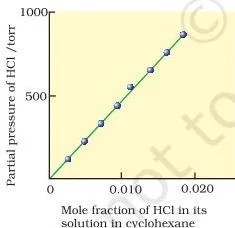
Figure 1.1 shows the mechanism behind Henry’s law: compressing the gas above the solution increases the number of gas particles striking the surface, so more gas dissolves until a new dynamic equilibrium is reached.
Henry’s law explains three real phenomena (NCERT, p. 8):
- Soft drinks: bottles are sealed under high CO₂ pressure to force more gas into the drink.
- The bends: scuba divers breathing air at high pressure dissolve extra N₂ in blood; on surfacing, released nitrogen forms bubbles in blood and blocks capillaries.
- Anoxia: at high altitude the partial pressure of O₂ is low, so blood oxygen drops and climbers become weak and unable to think clearly.
Effect of temperature on gases: gas dissolution resembles condensation and releases heat, so it is exothermic. By Le Chatelier’s principle, heating drives the gas out of solution — solubility decreases with rise in temperature (NCERT, p. 9).
Vapour Pressure and Raoult’s Law
Vapour pressure is the pressure exerted by the vapour of a liquid over its liquid phase at equilibrium (NCERT, p. 12). For a binary solution of two volatile liquids, Raoult’s law states that the partial vapour pressure of each component is directly proportional to its mole fraction in the solution (NCERT, p. 9):
\[ p_1 = p_1^\circ x_1 \quad (1.12), \qquad p_2 = p_2^\circ x_2 \quad (1.13) \]
where \( p_1^\circ \) and \( p_2^\circ \) are the vapour pressures of the pure components. By Dalton’s law of partial pressures, the total is the sum (NCERT, pp. 9–10):
\[ p_{\text{total}} = x_1 p_1^\circ + x_2 p_2^\circ = p_1^\circ + (p_2^\circ – p_1^\circ) x_2 \quad (1.15, 1.16) \]
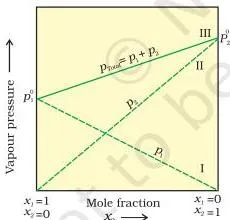
Figure 1.3 carries two exam takeaways. First, all three lines are straight — p₁, p₂ and p_total each vary linearly with mole fraction. Second, p_total always lies between \( p_1^\circ \) and \( p_2^\circ \); if component 2 is more volatile, total pressure rises as \( x_2 \) increases.
The vapour phase is not equal in composition to the liquid. Using Dalton’s law, the mole fraction of component i in the vapour phase is:
\[ y_i = \frac{p_i}{p_{\text{total}}} \quad (1.17, 1.18, 1.19) \]
Key inference: at equilibrium, the vapour phase is always richer in the more volatile component (NCERT, p. 11). This is frequently tested as a one-line assertion.
Henry’s law is a special case of Raoult’s law. Both state that the partial pressure of a volatile component is proportional to its mole fraction; Henry’s law applies to a gas dissolved in a liquid, with proportionality constant \( K_H \). When \( K_H = p_i^\circ \), Henry’s law collapses to Raoult’s law (NCERT, p. 12).
Solutions of solids in liquids: when the solute is non-volatile, only the solvent contributes to the vapour pressure, so Raoult’s law reduces to \( p_1 = x_1 p_1^\circ \) (NCERT, eq. 1.20, p. 12). The vapour pressure drops because solute particles occupy part of the surface, reducing the number of solvent molecules that can escape.
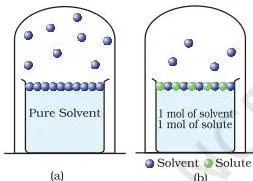
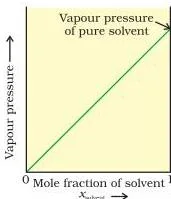
Figure 1.4 shows why the drop happens, and Figure 1.5 shows the linear law for this case. This decrease in vapour pressure is the doorway into the colligative properties.
Ideal and Non-Ideal Solutions: Deviations and Azeotropes
Ideal solutions obey Raoult’s law over the entire range of concentration and also satisfy (NCERT, p. 13):
\[ \Delta_{\text{mix}} H = 0, \qquad \Delta_{\text{mix}} V = 0 \quad (1.21) \]
No heat is absorbed or evolved on mixing, and the final volume equals the sum of the component volumes. This happens at the molecular level when A–A, B–B and A–B interactions are nearly equal. Examples: n-hexane + n-heptane, benzene + toluene, bromoethane + chloroethane. Perfectly ideal solutions are rare.
| Feature | Ideal solution | Positive deviation | Negative deviation |
|---|---|---|---|
| Obeys Raoult’s law? | Yes, at all concentrations | No — vapour pressure higher than predicted | No — vapour pressure lower than predicted |
| A–B interaction vs A–A, B–B | Nearly equal | Weaker than A–A and B–B | Stronger than A–A and B–B |
| Molecular picture | Molecules behave in the mixture as in the pure liquids | Molecules escape more easily than from the pure state | Molecules are held back more strongly |
| Examples | Benzene + toluene; n-hexane + n-heptane | Ethanol + acetone (H-bonds broken); CS₂ + acetone | Phenol + aniline; chloroform + acetone (H-bond forms) |
| Azeotrope if deviation is large | None | Minimum boiling azeotrope | Maximum boiling azeotrope |
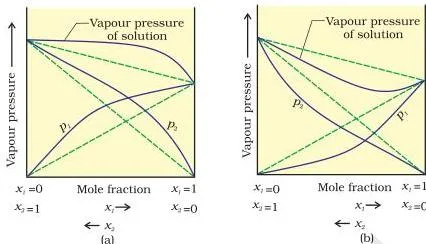
Figure 1.6 is the quickest way to read a deviation question. In (a) the curve bulges above the straight ideal line — particles escape easily, so vapour pressure is higher. In (b) the curve dips below the ideal line — stronger A–B attraction holds particles back, so vapour pressure is lower.
Azeotropes are binary mixtures with the same composition in the liquid and vapour phase, so they boil at constant temperature and cannot be separated by fractional distillation (NCERT, p. 14).
- Minimum boiling azeotrope: formed by a large positive deviation. Example: ethanol–water, which on distillation gives about 95% ethanol by volume — beyond that composition, no further separation occurs.
- Maximum boiling azeotrope: formed by a large negative deviation. Example: nitric acid–water, about 68% HNO₃ by mass, boiling point 393.5 K.
Colligative Properties: Four Properties, One Idea
Colligative properties depend on the number of solute particles relative to the total number of particles present in the solution, and not on the nature or identity of the solute (NCERT, p. 15). The name comes from Latin co (together) and ligare (to bind).
- Relative lowering of vapour pressure
- Elevation of boiling point
- Depression of freezing point
- Osmotic pressure
Mnemonic — REDO: Relative lowering, Elevation of boiling point, Depression of freezing point, Osmotic pressure. If you can REDO the four properties, you can redo every molar-mass problem this chapter sets, because each property offers an independent route to the molar mass of the solute.
Relative Lowering of Vapour Pressure
Starting from \( p_1 = x_1 p_1^\circ \) (eq. 1.22), the reduction in vapour pressure is (NCERT, p. 15):
\[ \Delta p_1 = p_1^\circ – p_1 = p_1^\circ (1 – x_1) = x_2 p_1^\circ \quad (1.23, 1.24) \]
Dividing by \( p_1^\circ \) gives the result you quote in exams:
\[ \frac{p_1^\circ – p_1}{p_1^\circ} = x_2 \quad (1.25) \]
Shortcut worth a mark: the relative lowering of vapour pressure is numerically equal to the mole fraction of the solute — no proportionality constant is needed (NCERT, p. 15).
For dilute solutions, mole fractions become simple mole ratios, then mass ratios (NCERT, eq. 1.27, 1.28, p. 16):
\[ \frac{p_1^\circ – p_1}{p_1^\circ} = \frac{n_2}{n_1} = \frac{w_2 \times M_1}{M_2 \times w_1} \]
so the molar mass \( M_2 \) of the solute can be found from known masses and the measured vapour pressures.
Elevation of Boiling Point
A liquid boils when its vapour pressure equals atmospheric pressure. Because a solution’s vapour pressure is lower, it must be heated above the normal boiling point before it boils (NCERT, p. 16). This rise is the elevation of boiling point:
\[ \Delta T_b = T_b – T_b^\circ = K_b m \quad (1.29, 1.30) \]
Here m is molality and \( K_b \) is the molal elevation constant (ebullioscopic constant), with unit K kg mol⁻¹ (NCERT, p. 17). From Table 1.3: water \( K_b = 0.52 \), benzene \( K_b = 2.53 \).
The molar-mass form (NCERT, eq. 1.33, p. 17):
\[ M_2 = \frac{1000 \times w_2 \times K_b}{\Delta T_b \times w_1} \]
The 1000 appears because molality uses the solvent mass in kilograms while \( w_1 \) is measured in grams.
Depression of Freezing Point
A substance freezes when the vapour pressure of its liquid phase equals the vapour pressure of its solid phase. Since a solution’s vapour pressure is lower, this match happens at a lower temperature — hence depression of freezing point (NCERT, p. 18):
\[ \Delta T_f = T_f^\circ – T_f = K_f m \quad (1.34) \]
\( K_f \) is the molal depression constant (cryoscopic constant), unit K kg mol⁻¹. From Table 1.3: water \( K_f = 1.86 \), benzene \( K_f = 5.12 \). The molar-mass form mirrors the boiling-point one (NCERT, eq. 1.36, p. 19):
\[ M_2 = \frac{K_f \times w_2 \times 1000}{\Delta T_f \times w_1} \]
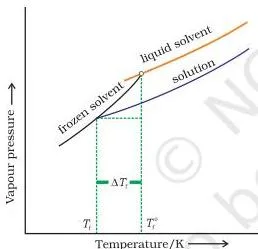
Figure 1.8 shows the whole mechanism in one picture: the solution’s vapour pressure curve sits below the solvent’s, so the solid–liquid equilibrium is reached at a lower temperature.
Real-life hook: the same \( \Delta T_f = K_f m \) formula explains why salt is spread on icy roads — salt lowers the freezing point of water, so ice melts.
Adding salt to cooking water raises its boiling point by the parallel \( \Delta T_b = K_b m \) rule; the kitchen effect is small, but the maths is identical to a board numerical. Car antifreeze is a 35% (v/v) ethylene glycol solution that lowers the freezing point of water to 255.4 K (NCERT, p. 2).
For advanced problems, the constants themselves can be derived from the solvent’s properties (NCERT, eq. 1.37, 1.38, p. 19):
\[ K_f = \frac{R \times M_1 \times T_f^2}{1000 \times \Delta_{\text{fus}} H}, \qquad K_b = \frac{R \times M_1 \times T_b^2}{1000 \times \Delta_{\text{vap}} H} \]
Osmosis, Osmotic Pressure and Reverse Osmosis
A semipermeable membrane lets small solvent molecules pass through its submicroscopic pores but hinders larger solute molecules. Osmosis is the flow of solvent through such a membrane from the solvent side to the solution side (NCERT, p. 20).
Memory hook — water follows the solute: solvent molecules always flow from lower solute concentration to higher solute concentration, from dilute to concentrated — never the reverse.
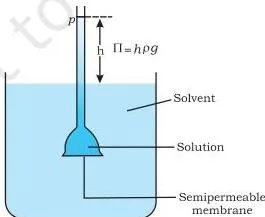
Figure 1.9 shows the classic demonstration: only solvent crosses the membrane, so the solution level climbs and the flow continues until equilibrium is attained.
Osmotic pressure is the excess pressure that must be applied to the solution to just stop the flow of solvent (NCERT, p. 20). For dilute solutions:
\[ \Pi = C R T \quad (1.39) \]
Here \( C \) is the molarity (mol L⁻¹) — osmotic pressure is the colligative property that uses molarity instead of molality, because it is tied to the volume of solution. If \( w_2 \) grams of solute of molar mass \( M_2 \) are present in volume \( V \) litres:
\[ M_2 = \frac{w_2 R T}{\Pi V} \quad (1.42) \]
Use \( R = 0.083\ \text{L bar mol}^{-1}\text{K}^{-1} \) when \( \Pi \) is in bar.
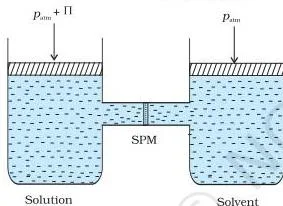
Figure 1.10 illustrates the definition itself: apply exactly the osmotic pressure and the solvent flow stops; apply more, and the direction of flow reverses.
- Isotonic: same osmotic pressure, no net osmosis. Example: 0.9% (mass/volume) NaCl — normal saline, safe to inject intravenously.
- Hypertonic: higher salt concentration; water flows out of cells and they shrink.
- Hypotonic: lower salt concentration; water flows into cells and they swell (NCERT, p. 22).
Water retention after salty food causes puffiness called edema (NCERT, p. 22).
Reverse osmosis: if a pressure larger than the osmotic pressure is applied to the solution side, pure solvent flows out of the solution through the membrane. This is used for desalination of sea water (NCERT, p. 23).
Why osmotic pressure for macromolecules: it is measured near room temperature (proteins and polymers are unstable when heated), and its magnitude stays large even for very dilute solutions, so a small sample gives a measurable effect (NCERT, p. 21).
Abnormal Molar Masses and the van’t Hoff Factor
Consider one mole of KCl in water. It dissociates into K⁺ and Cl⁻, giving roughly two moles of particles. The colligative effect doubles, so the molar mass calculated from \( \Delta T_b \) comes out half the true value — this is an abnormal molar mass (NCERT, p. 23).
The van’t Hoff factor \( i \) corrects for this. It is defined as (NCERT, p. 24):
\[ i = \frac{\text{Normal molar mass}}{\text{Abnormal molar mass}} = \frac{\text{Observed colligative property}}{\text{Calculated colligative property}} = \frac{\text{moles of particles after change}}{\text{moles of particles before change}} \]
- \( i \gt 1 \): dissociation. KCl ≈ 2, K₂SO₄ ≈ 3 for complete dissociation.
- \( i \lt 1 \): association. Ethanoic acid dimerises in benzene, so \( i \approx 0.5 \).
Including \( i \) modifies every colligative formula (NCERT, p. 24):
\[ \frac{p_1^\circ – p_1}{p_1^\circ} = i \cdot \frac{n_2}{n_1}, \qquad \Delta T_b = i K_b m, \qquad \Delta T_f = i K_f m, \qquad \Pi = \frac{i n_2 R T}{V} \]
| Salt | \( i \) at 0.1 m | \( i \) at 0.01 m | \( i \) at 0.001 m | \( i \) for complete dissociation |
|---|---|---|---|---|
| NaCl | 1.87 | 1.94 | 1.97 | 2.00 |
| KCl | 1.85 | 1.94 | 1.98 | 2.00 |
| MgSO₄ | 1.21 | 1.53 | 1.82 | 2.00 |
| K₂SO₄ | 2.32 | 2.70 | 2.84 | 3.00 |
The trend in Table 1.4 is exam-friendly: as the solution becomes more dilute, \( i \) rises towards the complete-dissociation value because interionic attractions weaken (NCERT, p. 24).
Worked Examples: Stepwise Solved Problems
Three original-number problems covering the most common board question types. The method is named first, and every step carries its units.
Example 1: Mole Fraction and Molarity
Method: mole fraction from eq.
1.5, molarity from eq.
1.8.
Problem: 54 g of glucose (\( C_6H_{12}O_6 \), molar mass \( 180\ \text{g mol}^{-1} \)) is dissolved in 450 mL of water (density \( 1.0\ \text{g mL}^{-1} \)).
The final volume of the solution is 480 mL.
Calculate (a) the mole fraction of glucose and of water, (b) the molarity of the solution.
Step 1: Mass of water = \( 450\ \text{mL} \times 1.0\ \text{g mL}^{-1} = 450\ \text{g} \).
Step 2: Moles of glucose = \( 54\ \text{g} \div 180\ \text{g mol}^{-1} = 0.30\ \text{mol} \).
Moles of water = \( 450\ \text{g} \div 18\ \text{g mol}^{-1} = 25.0\ \text{mol} \).
Step 3: Mole fraction of glucose:
\[ x_{\text{glucose}} = \frac{0.30}{0.30 + 25.0} = \frac{0.30}{25.30} = 0.0119 \approx 0.012 \]
Step 4: The sum rule gives water directly:
\[ x_{\text{water}} = 1 – 0.0119 = 0.988 \]
Step 5: Molarity uses the volume of the solution in litres, not the water volume:
\[ M = \frac{0.30\ \text{mol}}{0.480\ \text{L}} = 0.625\ \text{mol L}^{-1} \]
Final answer: \( x_{\text{glucose}} = 0.012 \), \( x_{\text{water}} = 0.988 \) (sum = 1.000 ✓), \( M = 0.625\ \text{mol L}^{-1} \).
Example 2: Boiling-Point Elevation to Molar Mass
Method: \( \Delta T_b = K_b m \) and \( M_2 = \frac{1000 \times w_2 \times K_b}{\Delta T_b \times w_1} \) (eq. 1.33).
Problem: 2.4 g of a non-volatile, non-electrolyte solute is dissolved in 80 g of benzene.
The solution boils at 354.03 K while pure benzene boils at 353.23 K.
Given \( K_b = 2.53\ \text{K kg mol}^{-1} \) for benzene, find the molar mass of the solute.
Step 1: Find the elevation:
\[ \Delta T_b = 354.03\ \text{K} – 353.23\ \text{K} = 0.80\ \text{K} \]
Step 2: Substitute into eq.
1.33 with w₂ in g, w₁ in g, Kb in K kg mol⁻¹:
\[ M_2 = \frac{1000 \times 2.4\ \text{g} \times 2.53\ \text{K kg mol}^{-1}}{0.80\ \text{K} \times 80\ \text{g}} = \frac{6072}{64} = 94.9\ \text{g mol}^{-1} \]
Final answer: \( M_2 = 94.9\ \text{g mol}^{-1} \). Sanity check: molality = 0.80/2.53 = 0.316 mol kg⁻¹, and 2.4 g ÷ 94.9 g mol⁻¹ = 0.0253 mol over 0.080 kg gives the same molality ✓
Example 3: Osmotic Pressure to Molar Mass
Method: \( M_2 = \frac{w_2 R T}{\Pi V} \) (eq. 1.42), with R chosen to match the pressure unit.
Problem: 150 cm³ of an aqueous solution contains 0.90 g of a protein.
Its osmotic pressure at 300 K is \( 6.5 \times 10^{-3} \) bar.
Calculate the molar mass of the protein.
(R = \( 0.083\ \text{L bar mol}^{-1}\text{K}^{-1} \)) Step 1: Convert volume to litres:
\[ V = 150\ \text{cm}^3 \times \frac{1\ \text{L}}{1000\ \text{cm}^3} = 0.150\ \text{L} \]
Step 2: Substitute with Π in bar and R in L bar mol⁻¹ K⁻¹:
\[ M_2 = \frac{0.90\ \text{g} \times 0.083\ \text{L bar mol}^{-1}\text{K}^{-1} \times 300\ \text{K}}{6.5 \times 10^{-3}\ \text{bar} \times 0.150\ \text{L}} \]
\[ = \frac{22.41}{9.75 \times 10^{-4}} = 2.30 \times 10^{4}\ \text{g mol}^{-1} \]
Final answer: \( M_2 = 2.30 \times 10^{4}\ \text{g mol}^{-1} \). Sanity check: proteins have molar masses in the tens of thousands, so this is the right order of magnitude ✓
Common Mistakes: Error, Correction and Why
Seven slips cost real marks in this chapter. Learn the correction, not just the error.
| Mistake | Correct rule | How to check your answer |
|---|---|---|
| Molarity uses the volume of solvent | Molarity = moles of solute ÷ volume of solution in litres (eq. 1.8) | Read the question: was the final solution volume given after mixing? |
| Molality uses the mass of solution | Molality = moles of solute ÷ mass of solvent in kg (eq. 1.9) | Convert the solvent mass to kg by dividing by 1000 before substituting. |
| Using molality in \( \Pi = C R T \) | Use molarity (mol L⁻¹) — osmotic pressure is tied to solution volume | Π in bar, C in mol L⁻¹, R = 0.083 L bar mol⁻¹ K⁻¹ — three units must match. |
| Forgetting the van’t Hoff factor for electrolytes | Multiply: \( \Delta T_b = i K_b m \), \( \Delta T_f = i K_f m \), \( \Pi = i n_2 R T / V \) | KCl gives ~2 particles: expect i ≈ 2, never 1. |
| Mixing up \( K_H \) units (bar vs kbar) | Convert before substituting: 76.48 kbar = 76,480 bar | p and \( K_H \) must share the same pressure unit. |
| Computing both mole fractions from scratch | Use the sum rule: \( x_2 = 1 – x_1 \) | Check that \( x_1 + x_2 = 1 \) at the end. |
| Treating molarity as constant at every temperature | Molarity changes with temperature; use molality or mole fraction when T is specified | Remember volume expands on heating, mass does not. |
Exam Notes: Where the Marks Are
Observed patterns from this chapter, written with an examiner’s mindset. These are not predictions — they are the places marks are usually awarded or lost.
- State the laws in words. Henry’s law and Raoult’s law are definition questions; the clause directly proportional to mole fraction is what earns the mark (NCERT, pp. 7, 9).
- Write the units of \( K_b \) and \( K_f \): K kg mol⁻¹. The unit is often a separate mark (NCERT, p. 17).
- The fastest 2-marker: \( \frac{p_1^\circ – p_1}{p_1^\circ} = x_2 \) — write it the moment you see a non-volatile solute (NCERT, p. 15).
- Pick R for osmotic pressure: \( R = 0.083\ \text{L bar mol}^{-1}\text{K}^{-1} \) when Π is in bar; the unit match earns the mark (NCERT, p. 22).
- Show the two conversions in every colligative molar-mass sum: grams → moles and grams → kilograms. These steps carry partial credit even if the arithmetic slips.
- Vapour phase inference: the vapour phase is richer in the more volatile component — frequently tested as a one-line assertion (NCERT, p. 11).
Every constant and law quoted on this page comes from the official Class 12 Chemistry Part I textbook, available free from the NCERT website.
Revision Summary: Solutions Class 12 Notes in One Screen
| Topic | Law / formula | Key values to remember | NCERT page |
|---|---|---|---|
| Types of solutions | 9 solute–solvent state combinations | Hydrogen in palladium (gas in solid) | p. 1 |
| Concentration units | Seven expressions | Molarity is the only temperature-dependent unit | pp. 2–5 |
| Henry’s law | \( p = K_H x \) | Higher \( K_H \) → lower solubility | p. 7 |
| Raoult’s law (volatile pair) | \( p_1 = x_1 p_1^\circ \), \( p_{\text{total}} = x_1 p_1^\circ + x_2 p_2^\circ \) | Total pressure linear in \( x_2 \) | p. 9 |
| Raoult’s law (non-volatile solute) | \( p_1 = x_1 p_1^\circ \) | Vapour pressure drops | p. 12 |
| Ideal vs non-ideal | \( \Delta_{\text{mix}} H = 0 \), \( \Delta_{\text{mix}} V = 0 \) for ideal | Benzene + toluene ideal; ethanol + acetone shows deviation | p. 13 |
| Azeotropes | Large deviations | Min boiling: ethanol–water ~95%; max boiling: HNO₃–water 68%, bp 393.5 K | p. 14 |
| Relative lowering of vapour pressure | \( \frac{p_1^\circ – p_1}{p_1^\circ} = x_2 \) | Equal to solute mole fraction | p. 15 |
| Elevation of boiling point | \( \Delta T_b = K_b m \) | Water 0.52; benzene 2.53 | pp. 16–17 |
| Depression of freezing point | \( \Delta T_f = K_f m \) | Water 1.86; benzene 5.12 | pp. 18–19 |
| Osmotic pressure | \( \Pi = C R T \) | Uses molarity, not molality | p. 21 |
| van’t Hoff factor | \( i = \frac{M_{\text{normal}}}{M_{\text{abnormal}}} \) | KCl ≈ 2; K₂SO₄ ≈ 3; ethanoic acid in benzene ≈ 0.5 | p. 24 |
If you remember nothing else: the four colligative properties spell REDO; the van’t Hoff factor i multiplies every colligative formula for dissociating or associating solutes; molarity is the only temperature-dependent unit; and osmotic pressure is the only colligative property that uses molarity.
For other chapters in the same book, browse the Class 12 notes index.
FAQs: Quick Answers for Last-Minute Revision
Why does molarity change with temperature while molality and mole fraction do not?
Molarity is defined per litre of solution (eq. 1.8), and volume expands when a solution is heated — so the per-litre value changes. Mass %, ppm, mole fraction and molality are all defined on masses, which do not change with temperature (NCERT, p. 5).
What is the difference between Henry’s law and Raoult’s law?
Both laws say the partial pressure of a volatile component is directly proportional to its mole fraction. Henry’s law governs a gas dissolved in a liquid, with constant \( K_H \) that depends on the gas and temperature. Raoult’s law governs volatile components of a solution, with the constant equal to the pure component’s vapour pressure \( p_i^\circ \).
Raoult’s law is a special case of Henry’s law when \( K_H = p_i^\circ \) (NCERT, p. 12).
Why is the observed molar mass of an ionic solute like KCl lower than the true molar mass?
KCl dissociates into K⁺ and Cl⁻, so one mole of solute produces about two moles of particles. Colligative properties count particles, so \( \Delta T_b \) and \( \Delta T_f \) double; since molar mass sits in the denominator of the \( M_2 \) formulas, doubling the property halves the calculated molar mass (NCERT, p. 23).
How can I predict whether a solution shows positive or negative deviation from Raoult’s law?
Compare the A–B interaction with the A–A and B–B interactions. If A–B is weaker, molecules escape more easily, vapour pressure is higher than ideal → positive deviation (ethanol + acetone breaks hydrogen bonds). If A–B is stronger, molecules are held back, vapour pressure is lower → negative deviation (chloroform + acetone forms a hydrogen bond) (NCERT, pp. 13–14).
Which colligative property is best for finding the molar mass of a protein and why?
Osmotic pressure. It is measured near room temperature, which suits proteins and polymers that are unstable when heated, and its magnitude is large even for very dilute solutions, so a small sample gives a measurable effect (NCERT, p. 21).
Reference: NCERT Class 12 Chemistry textbook, chapter Solutions.
Explore Class 12 Chemistry Notes
Class 12 Chemistry on LearnCBSE:
Related chapters:
Official source: download the NCERT textbook free from ncert.nic.in.