
Coordination Compounds is Unit 5 of the Class 12 Chemistry NCERT textbook (Chemistry Part I). These coordination compounds class 12 notes compress the whole chapter into one revision-friendly page.
You get Werner’s theory, nomenclature, isomerism, Valence Bond Theory, Crystal Field Theory, colours, metal carbonyls and applications. Worked examples use fresh numbers, and the tables at the end let you recall the entire unit in two minutes before a test.
Werner’s Theory: What the Cobalt–Ammonia Experiments Revealed
Alfred Werner (1866–1919) prepared many cobalt(III) chloride–ammonia compounds and treated each with excess silver nitrate in the cold. He counted how many moles of silver chloride precipitated per mole of complex (NCERT, p. 1).
| Compound (1 mol) | Colour | AgCl precipitated |
|---|---|---|
| \( CoCl_3 \cdot 6NH_3 \) | Yellow | 3 mol |
| \( CoCl_3 \cdot 5NH_3 \) | Purple | 2 mol |
| \( CoCl_3 \cdot 4NH_3 \) | Green | 1 mol |
| \( CoCl_3 \cdot 4NH_3 \) | Violet | 1 mol |
The pattern forces the conclusion that six groups — chlorides, ammonia molecules, or a mix — always stay bonded to cobalt. Only chlorides outside that set precipitate as silver chloride. Werner named this fixed count of six the secondary valence, and the ionisable chloride count the primary valence (NCERT, p. 1).
The conductivities of the solutions confirm the ion counts: the yellow complex behaves as a 1:3 electrolyte, purple as a 1:2, and green and violet as 1:1 electrolytes. The square-bracket notation in modern formulas comes straight from this: everything inside the bracket is the non-dissociating unit.
Green and violet share the formula \( CoCl_3 \cdot 4NH_3 \) but differ in properties — an early example of isomerism.
Werner’s four postulates (1898):
- Metals show two types of linkages in coordination compounds — primary and secondary.
- The primary valence is normally ionisable and is satisfied by negative ions.
- The secondary valence is non-ionisable, satisfied by neutral molecules or negative ions, equals the coordination number, and is fixed for a metal.
- The groups bound by secondary linkages occupy a characteristic spatial arrangement — the coordination polyhedron (octahedral, tetrahedral, square planar).
| Valence | Modern term | Character |
|---|---|---|
| Primary | Oxidation state | Ionic, ionisable, satisfied by negative ions |
| Secondary | Coordination number | Covalent, non-ionisable, fixed for the metal |
Double salt vs complex: both form when stable compounds combine in a stoichiometric ratio, but on dissolving in water a double salt splits completely into simple ions, while a complex ion stays intact.
Carnallite \( KCl \cdot MgCl_2 \cdot 6H_2O \), Mohr’s salt \( FeSO_4 \cdot (NH_4)_2SO_4 \cdot 6H_2O \) and potash alum \( KAl(SO_4)_2 \cdot 12H_2O \) dissociate; \( [Fe(CN)_6]^{4-} \) in \( K_4[Fe(CN)_6] \) does not break into \( Fe^{2+} \) and \( CN^- \) (NCERT, p. 3).
Key Terms in Coordination Chemistry: Definitions with Examples
Learn these eight terms as a set — every question in the chapter relies on at least one of them (NCERT, pp. 4–5).
| Term | Meaning | Example |
|---|---|---|
| Coordination entity | A central metal atom/ion bonded to a fixed number of ions or molecules | \( [CoCl_3(NH_3)_3] \), \( [Fe(CN)_6]^{4-} \) |
| Central atom/ion | The atom/ion at the centre holding the ligands in a fixed arrangement; a Lewis acid | \( Ni^{2+} \) in \( [NiCl_2(H_2O)_4] \) |
| Ligand | Ion or molecule bound to the central atom/ion | \( Cl^- \), \( H_2O \), \( NH_3 \), proteins |
| Coordination number (CN) | Number of ligand donor atoms directly bonded to the metal | \( [PtCl_6]^{2-} \) has CN 6 |
| Coordination sphere | Central atom + its ligands inside square brackets | \( [Fe(CN)_6]^{4-} \) in \( K_4[Fe(CN)_6] \) |
| Coordination polyhedron | Spatial arrangement of ligand atoms around the central atom | Octahedral, square planar, tetrahedral |
| Oxidation number | Charge the metal would carry if ligands left with their electron pairs; shown as a Roman numeral | Cu in \( [Cu(CN)_4]^{3-} \) is +1, written Cu(I) |
| Homoleptic / heteroleptic | One kind of donor group / more than one kind | \( [Co(NH_3)_6]^{3+} \) / \( [Co(NH_3)_4Cl_2]^+ \) |
Misconception autopsy — coordination number vs oxidation number. Students often think they are the same number; they are different quantities measured the same way? No. CN counts how many ligand donor atoms are bonded (geometry); oxidation number is the formal charge left on the metal if the ligands were removed with their electron pairs.
Oxalate \( C_2O_4^{2-} \) is didentate, so in \( [Fe(C_2O_4)_3]^{3-} \) the CN is 6 (three ligands × two donor atoms each), but the oxidation number of Fe is +3. Three oxalates carry −6 charge; to give the complex a −3 charge, Fe must be +3. One number describes bonding, the other describes formal charge — never confuse them.
Three exam-critical distinctions to remember:
- CN counts donor atoms, not ligand molecules. In \( [Fe(C_2O_4)_3]^{3-} \) and \( [Co(en)_3]^{3+} \) the CN is 6 even though only three ligand molecules are present, because oxalate and en are didentate.
- CN counts sigma bonds only. A ligand-to-metal π bond never adds to the coordination number.
- Oxidation number is always written as a Roman numeral in parentheses after the metal name, never as an Arabic number.
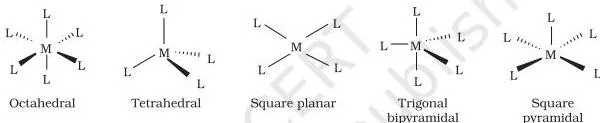
This diagram shows the three polyhedra you must recognise instantly. Octahedral complexes (six ligands) are by far the most common for transition metals, square planar appears for \( d^8 \) metals like \( Pt^{2+} \), and tetrahedral appears for smaller coordination numbers. When a question says the complex is \( [Co(NH_3)_6]^{3+} \), picture the octahedron from Fig. 5.1 (NCERT, p. 5).
Ligand Types: Unidentate to Ambidentate and the Chelate Effect
Ligands are classified by how many donor atoms they use to bind a metal (denticity) and by which atom they bind through (NCERT, pp. 4–5).
| Ligand type | Definition | Examples |
|---|---|---|
| Unidentate | Binds through one donor atom | \( Cl^- \), \( H_2O \), \( NH_3 \) |
| Didentate | Binds through two donor atoms | ethane-1,2-diamine (en), \( C_2O_4^{2-} \) |
| Polydentate | Binds through several donor atoms | \( N(CH_2CH_2NH_2)_3 \) |
| Hexadentate | A polydentate ligand with six donors | \( EDTA^{4-} \) (two N + four O atoms) |
| Chelate | Di- or polydentate ligand using two or more donors on one metal | \( [Co(en)_3]^{3+} \) — en chelates |
| Ambidentate | Two different donor atoms; either can bind | \( NO_2^- \) (N or O), \( SCN^- \) (S or N) |
The chelate effect: chelate complexes are more stable than similar complexes built from unidentate ligands, because a di- or polydentate ligand grips the metal through several donor atoms at once. This stability is why a didentate ligand such as EDTA is used to trap metal ions in titrations and therapy.
Writing Formulas and IUPAC Names Step by Step
Nomenclature follows IUPAC rules (NCERT, pp. 6–8). Writing a formula:
- Central atom first, then ligands in alphabetical order (charge is ignored).
- Polyatomic ligands and ligand abbreviations go in parentheses; the whole entity goes in square brackets.
- No space between metal and ligands inside the bracket; the charge is a right superscript, number before sign (e.g. \( [Co(CN)_6]^{3-} \)).
- Counter-ion charges balance the complex ion’s charge.
Writing a name:
- Cation named first, in both cationic and anionic complexes.
- Ligands named alphabetically before the metal; anionic ligands end in –o (chlorido, oxidanido).
- Neutral ligands mostly keep their names except aqua for \( H_2O \), ammine for \( NH_3 \), carbonyl for CO, nitrosyl for NO.
- Prefixes di, tri, tetra — but use bis, tris, tetrakis when the ligand name itself contains a numerical prefix, with the ligand in parentheses.
- Oxidation state as a Roman numeral in parentheses.
- Anionic complex: metal name ends in –ate (ferrate for Fe, cobaltate for Co); cationic complex uses the element name.
Memory device table for ligand names — the four neutral ligands with special names:
| Ligand formula | Ligand name in the complex | Remember it as |
|---|---|---|
| \( H_2O \) | aqua | it’s like “aqua” water |
| \( NH_3 \) | ammine | two m’s — ammine, not amine |
| CO | carbonyl | carbon + yl |
| NO | nitrosyl | nitro + syl |
Worked naming example: name \( [Co(NH_3)_4Cl_2]^+ \). Ammonia is neutral and named ammine; chloride is anionic and named chlorido. Ligands alphabetical: ammine before chlorido. Four ammonias = tetraammine, two chlorides = dichlorido. Charge on the complex is +1, all ligands neutral except the two chlorides (−2 each = −4? No, two chlorides = −2), so cobalt must be +3. Name: tetraamminedichloridocobalt(III).
The amine–ammine trap: write ammine for \( NH_3 \) in a complex. “Amine” means an organic \( -NH_2 \) group and costs you the mark.
Isomerism in Coordination Compounds: A Complete Map
Isomers share the same formula but differ in arrangement. Two branches: stereoisomerism (same bonds, different spatial arrangement) and structural isomerism (different bonds) (NCERT, p. 8).
| Type | What differs | Example pair |
|---|---|---|
| Geometrical (cis/trans) | Position of identical ligands relative to each other | cis- and trans-\( [Pt(NH_3)_2Cl_2] \) |
| Geometrical (fac/mer) | Face vs meridian occupation in \( [Ma_3b_3] \) | fac- and mer-\( [Co(NH_3)_3(NO_2)_3] \) |
| Optical | Non-superimposable mirror images (d/l) | d- and l-\( [Co(en)_3]^{3+} \) |
| Linkage | Ambidentate ligand binds through different atom | \( [Co(NH_3)_5(NO_2)]Cl_2 \) red vs yellow |
| Coordination | Ligands exchange between cation and anion | \( [Co(NH_3)_6][Cr(CN)_6] \) vs \( [Cr(NH_3)_6][Co(CN)_6] \) |
| Ionisation | Counter ion displaces a ligand | \( [Co(NH_3)_5SO_4]Br \) vs \( [Co(NH_3)_5Br]SO_4 \) |
| Solvate (hydrate) | Solvent molecule inside or outside the sphere | \( [Cr(H_2O)_6]Cl_3 \) violet vs \( [Cr(H_2O)_5Cl]Cl_2 \cdot H_2O \) grey-green |
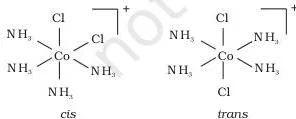
In a square planar complex \( [MX_2L_2] \), the two X ligands can sit adjacent (cis) or opposite (trans). The same thinking applies to octahedral \( [MX_2L_4] \) and to complexes with didentate ligands such as \( [CoCl_2(en)_2] \) (NCERT, pp. 8–9).
![Octahedral complex [Co(NH3)3(NO2)3] in its facial form with three identical ligands on one face and meridional form spread across the meridian](https://www.learncbse.net/images/werner-s-theory-of-coordination-compounds-the-facial-fac-and-meridional-mer-isomers-of-co-nh-no.webp "Coordination Compounds Class 12 Notes: Full Chapter Revision")
For octahedral \( [Ma_3b_3] \), when the three identical ligands occupy adjacent corners of one face it is the fac isomer; when they sit around the meridian it is mer. The reason tetrahedral complexes show no geometrical isomerism is that every ligand position is equivalent relative to the others — there is no “adjacent” vs “opposite” distinction (NCERT, p. 9).
![Mirror-image pair of the cis isomer of [PtCl2(en)2]2+ that cannot be superimposed on each other, showing optical isomerism](https://www.learncbse.net/images/werner-s-theory-of-coordination-compounds-optical-isomers-d-and-l-of-cis-ptcl-en.webp "Coordination Compounds Class 12 Notes: Full Chapter Revision")
Optical isomers are mirror images that cannot be superimposed (chiral molecules). They rotate plane-polarised light — d to the right, l to the left. Optical activity is common in octahedral complexes with didentate ligands, like \( [Co(en)_3]^{3+} \). In \( [PtCl_2(en)_2]^{2+} \), only the cis form is optically active; the trans form has a plane of symmetry (NCERT, p. 9).
Valence Bond Theory: Geometry, Hybridisation and Magnetic Behaviour
VBT says the metal ion hybridises its (n−1)d, ns, np orbitals (inner) or ns, np, nd orbitals (outer) to match the ligand geometry, and each hybrid orbital accepts an electron pair from a ligand (NCERT, pp. 11–12). Table 5.2 gives the pairings:
| Coordination number | Hybridisation | Geometry |
|---|---|---|
| 4 | \( sp^3 \) | Tetrahedral |
| 4 | \( dsp^2 \) | Square planar |
| 5 | \( sp^3d \) | Trigonal bipyramidal |
| 6 | \( sp^3d^2 \) | Octahedral |
| 6 | \( d^2sp^3 \) | Octahedral |
The inner vs outer orbital call decides everything. Measure the magnetic moment, count unpaired electrons, and the hybridisation (hence geometry) follows. Here is the comparison table for the two complexes you will be asked about again and again:
| Property | \( [Co(NH_3)_6]^{3+} \) | \( [CoF_6]^{3-} \) |
|---|---|---|
| Oxidation state of Co | +3 | +3 |
| d configuration | \( 3d^6 \) | \( 3d^6 \) |
| Ligand strength | \( NH_3 \) strong field | \( F^- \) weak field |
| Electrons paired up | Yes — all six pair into three 3d orbitals | No — four electrons stay unpaired |
| Hybridisation | \( d^2sp^3 \) (inner) | \( sp^3d^2 \) (outer) |
| Type | Inner orbital / low spin / spin paired | Outer orbital / high spin / spin free |
| Magnetic behaviour | Diamagnetic | Paramagnetic (4 unpaired) |
![Orbital energy diagram of Co3+ showing 3d electrons paired up and the d2sp3 hybridisation that makes [Co(NH3)6]3+ an inner orbital diamagnetic complex](https://www.learncbse.net/images/werner-s-theory-of-coordination-compounds-co-nh-inner-orbital-or-low-spin-complex.webp "Coordination Compounds Class 12 Notes: Full Chapter Revision")
![Orbital diagram of Co3+ in [CoF6]3- using outer 4d orbitals in sp3d2 hybridisation leaving four unpaired electrons, an outer orbital paramagnetic complex](https://www.learncbse.net/images/werner-s-theory-of-coordination-compounds-cof-outer-orbital-or-high-spin-complex.webp "Coordination Compounds Class 12 Notes: Full Chapter Revision")
In \( [Co(NH_3)_6]^{3+} \) the six \( 3d \) electrons pair up, emptying two \( 3d \) orbitals for \( d^2sp^3 \). In \( [CoF_6]^{3-} \) fluoride is too weak to force pairing, so the hybridisation uses the outer \( 4d \) orbital as \( sp^3d^2 \) and leaves four unpaired electrons (NCERT, p. 12).
The other classic predictions:
- \( [NiCl_4]^{2-} \), \( Ni^{2+} \) is \( 3d^8 \), \( sp^3 \) tetrahedral, paramagnetic (2 unpaired).
- \( [Ni(CO)_4] \), Ni is zero oxidation state \( 3d^{10} \), tetrahedral, diamagnetic — CO forces pairing.
- \( [Ni(CN)_4]^{2-} \), \( dsp^2 \) square planar, diamagnetic — the strong-field cyanide pairs all electrons.
Magnetic data for octahedral ions \( d^4 \)–\( d^6 \) confirm this: \( [Mn(CN)_6]^{3-} \) has 2 unpaired electrons (inner), \( [MnCl_6]^{3-} \) has 4 (outer); \( [Fe(CN)_6]^{3-} \) has 1, \( [FeF_6]^{3-} \) has 5; \( [CoF_6]^{3-} \) has 4, \( [Co(C_2O_4)_3]^{3-} \) is diamagnetic (NCERT, p. 13).
Limitations of VBT (NCERT, p. 14): it relies on many assumptions; it does not give a quantitative interpretation of magnetic data; it cannot explain colour; it gives no quantitative account of thermodynamic or kinetic stability; it cannot reliably distinguish tetrahedral from square planar in 4-coordinate complexes; and it does not distinguish weak from strong ligands.
Crystal Field Theory: d-Orbital Splitting, Spectrochemical Series and Colour
CFT treats the metal–ligand bond as purely electrostatic: anionic ligands are point charges and neutral molecules are point dipoles. In a free ion the five \( d \) orbitals are degenerate, but the ligand field removes that degeneracy (NCERT, p. 14).
Octahedral splitting
In an octahedral field, the \( d_{x^2-y^2} \) and \( d_{z^2} \) orbitals point straight at the ligands and are pushed up in energy; the \( d_{xy} \), \( d_{xz} \), \( d_{yz} \) orbitals point between the axes and drop. The two higher orbitals form the \( e_g \) set, the three lower form the \( t_{2g} \) set.
Each \( e_g \) orbital rises by \( \frac{3}{5}\Delta_o \), each \( t_{2g} \) falls by \( \frac{2}{5}\Delta_o \), where \( \Delta_o \) is the octahedral crystal field splitting energy.
High spin vs low spin (\( d^4 \) to \( d^7 \))
For the fourth (and later) electrons, the choice is between pairing in \( t_{2g} \) (costing the pairing energy P) or entering \( e_g \) (costing \( \Delta_o \)). Compare the two energies (NCERT, pp. 15–16):
- If \( \Delta_o \lt P \) — weak field ligand → high spin complex, e.g. \( t_{2g}^3e_g^1 \) for \( d^4 \).
- If \( \Delta_o \gt P \) — strong field ligand → low spin complex, e.g. \( t_{2g}^4e_g^0 \) for \( d^4 \).
Tetrahedral splitting
The splitting pattern is inverted and roughly half: \( \Delta_t = \frac{4}{9}\Delta_o \). Because the gap is small, low-spin tetrahedral complexes are rare. Also, tetrahedral complexes lack a centre of symmetry, so the \( g \) subscript is not used — you write \( t_2 \) and \( e \), not \( t_{2g} \) and \( e_g \) (NCERT, p. 16).
Spectrochemical series and a mnemonic
The experimentally determined order of increasing field strength is (NCERT, p. 15):
\( I^- \lt Br^- \lt SCN^- \lt Cl^- \lt S^{2-} \lt F^- \lt OH^- \lt C_2O_4^{2-} \lt H_2O \lt NCS^- \lt edta^{4-} \lt NH_3 \lt en \lt CN^- \lt CO \) Mnemonic: “In Bombay, Some Chefs Serve Fresh Oily Chutney; Hot Naan Eaten Next Evening — Cold Curry!”
The first letter of each word tracks the order: I, Br, SCN, Cl, S, F, OH, oxalate, H₂O, NCS, EDTA, NH₃, en, CN, CO. The practical rule from the series: \( CO \) and \( CN^- \) are at the strong end, halides and water at the weak end.
Colour in coordination compounds
A complex appears coloured because it absorbs some wavelengths of white light; the colour you see is complementary to the one absorbed. Table 5.3 pairs absorbed colour with observed colour (NCERT, p. 17).
| Coordination entity | Absorbed (nm) | Absorbed colour | Observed colour |
|---|---|---|---|
| \( [CoCl(NH_3)_5]^{2+} \) | 535 | Yellow | Violet |
| \( [Co(NH_3)_6]^{3+} \) | 475 | Blue | Yellow orange |
| \( [Cu(H_2O)_4]^{2+} \) | 600 | Red | Blue |
| \( [Ti(H_2O)_6]^{3+} \) | 498 | Blue green | Violet |
Take \( [Ti(H_2O)_6]^{3+} \): \( Ti^{3+} \) is \( 3d^1 \), so one electron sits in \( t_{2g} \). Absorbing blue-green light (498 nm) excites it to \( e_g \) — this is the d–d transition — and the leftover light makes the complex appear violet (NCERT, p. 16).
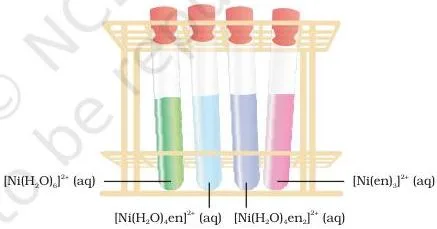
Adding the didentate ligand en to green \( [Ni(H_2O)_6]^{2+} \) step by step raises the field strength, so the absorption shifts and the colour runs green → pale blue → blue/purple → violet (NCERT, p. 17).
The same idea explains why anhydrous \( CuSO_4 \) is white but \( CuSO_4 \cdot 5H_2O \) is blue — without coordinated water there is no ligand field, hence no splitting and no colour.
Metal Carbonyls and Why Coordination Compounds Matter
Homoleptic carbonyls contain only CO ligands. Their shapes are fixed and simple (NCERT, p. 19):
| Carbonyl | Geometry |
|---|---|
| \( Ni(CO)_4 \) | Tetrahedral |
| \( Fe(CO)_5 \) | Trigonal bipyramidal |
| \( Cr(CO)_6 \) | Octahedral |
| \( Mn_2(CO)_{10} \) | Two square pyramidal \( Mn(CO)_5 \) units joined by an Mn–Mn bond |
| \( Co_2(CO)_8 \) | Co–Co bond bridged by two CO groups |
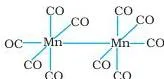
Synergic bonding is the special feature of metal carbonyls. The M–C σ bond forms when CO’s lone pair donates into a vacant metal orbital; the M–C π bond forms when a filled metal \( d \) orbital donates electron density into CO’s vacant antibonding \( \pi^* \) orbital.
Each donation strengthens the other — the synergic effect — which is why these M–C bonds are so stable (NCERT, p. 19).
Applications you must be able to list (NCERT, pp. 19–20):
- Analysis: colour reactions of metal ions with chelating reagents (EDTA, DMG, α-nitroso-β-naphthol, cupron); hardness of water estimated by titration with \( Na_2EDTA \).
- Extraction/metallurgy: gold and silver dissolve as \( [Au(CN)_2]^- \) in cyanide + oxygen + water; gold is recovered by adding zinc.
- Purification: impure nickel is converted to volatile \( [Ni(CO)_4] \) and decomposed to pure nickel.
- Biology: chlorophyll (Mg), haemoglobin (Fe, oxygen carrier), vitamin B₁₂ (Co), enzymes like carboxypeptidase A and carbonic anhydrase.
- Industry: Wilkinson catalyst \( [(Ph_3P)_3RhCl] \) hydrogenates alkenes.
- Electroplating: smoother silver and gold coatings from \( [Ag(CN)_2]^- \) and \( [Au(CN)_2]^- \).
- Photography: hypo solution fixes the film by forming \( [Ag(S_2O_3)_2]^{3-} \).
- Medicine: chelate therapy removes toxic metals — D-penicillamine for excess copper, desferrioxime B for iron, EDTA for lead poisoning; cis-platin inhibits tumour growth.
Worked Examples: Naming, Formulas and Magnetic Predictions Done Stepwise
These three skills carry most of the chapter’s marks. Each example below uses original numbers so you can follow the full method, not just the answer.
Example 1: Formula from the name — calcium trioxalatoferrate(III)
Step 1: Identify the complex anion and its charge.
Trioxalato means three oxalate ligands; each \( C_2O_4^{2-} \) carries −2, so the ligands contribute \( 3 \times (-2) = -6 \).
Step 2: The name says iron(III), so Fe is +3.
Complex charge: \( +3 + (-6) = -3 \).
\[ [Fe(C_2O_4)_3]^{3-} \]
Step 3: Balance with calcium.
Calcium is \( Ca^{2+} \), so two \( [Fe(C_2O_4)_3]^{3-} \) ions need three \( Ca^{2+} \) ions to be neutral.
\[ Ca_3[Fe(C_2O_4)_3]_2 \]
Final answer: \( Ca_3[Fe(C_2O_4)_3]_2 \).
Example 2: Oxidation number of Pt in \( [Pt(NH_3)_4Cl_2]^{2+} \)
Step 1: Assign known charges.
Ammonia is neutral (0 each); each chloride is −1, so two chlorides give −2; the whole ion is +2.
Step 2: Let the oxidation number of Pt be \( x \).
Set up the sum.
\[ x + 4(0) + 2(-1) = +2 \]
Step 3: Solve for \( x \).
\[ x – 2 = +2 \Rightarrow x = +4 \]
Final answer: Pt is in the +4 oxidation state, written platinum(IV).
Example 3: Predicting geometry from magnetic data
Step 1: A nickel(II) complex of formula \( NiL_4 \) is measured diamagnetic.
\( Ni^{2+} \) is \( 3d^8 \), so it has eight d electrons; diamagnetism means all of them are paired.
Step 2: For all eight to pair, one \( 3d \) orbital must stay empty to participate in \( dsp^2 \) hybridisation.
Hence the geometry is square planar, not tetrahedral (tetrahedral \( sp^3 \) would leave two unpaired electrons).
Conclusion: \( NiL_4 \) is \( dsp^2 \), square planar, diamagnetic.
- Step 1: Now compute the spin-only magnetic moment of a \( d^5 \) ion such as \( Mn^{2+} \), using \( \mu = \sqrt{n(n+2)} \) BM, where \( n \) is the number of unpaired electrons.
- Step 2: For \( Mn^{2+} \) (\( 3d^5 \)), all five electrons remain unpaired: \( n = 5 \).
\[ \mu = \sqrt{5(5+2)} = \sqrt{35} \approx 5.92\ \text{BM} \]
Step 3: A measured moment of about 5.9 BM therefore points to five unpaired electrons, which for a 4-coordinate complex means \( sp^3 \) tetrahedral geometry — the same logic NCERT uses for \( [MnBr_4]^{2-} \) in Example 5.7.
Final answer: \( \mu \approx 5.92 \) BM, indicating tetrahedral \( sp^3 \) geometry for the \( d^5 \) ion.
Common Mistakes That Cost Marks
| Students write | Correct is | How to check your answer |
|---|---|---|
| “amine” for \( NH_3 \) | “ammine” — the ligand name in a complex | Amine is an organic \( -NH_2 \) group; ammine has two m’s |
| Ligands ordered by charge | Alphabetical order, charge ignored | In \( [Co(NH_3)_4Cl_2]^+ \) ammine comes before chlorido because a < c |
| “Coordination number = number of ligands” | CN = number of donor atoms | \( [Fe(C_2O_4)_3]^{3-} \) has 3 ligands but CN 6 (oxalate is didentate) |
| Counting π bonds toward CN | CN counts sigma bonds only | Metal–carbonyl M–C π bonds do not add to CN |
| Using di/tri when ligand name has a prefix | Use bis/tris/tetrakis with parentheses | \( [NiCl_2(PPh_3)_2] \) is dichloridobis(triphenylphosphine)nickel(II) |
| \( sp^3d^2 \) for \( [Co(NH_3)_6]^{3+} \) | \( d^2sp^3 \) — inner orbital | Strong ligands pair the \( 3d \) electrons, vacating inner d orbitals |
| Element name for an anionic complex metal | Name ends in −ate | \( [Fe(CN)_6]^{4-} \) is ferrate(II), not iron(II); cobaltate for Co |
| \( NO_2^- \) always binds through N | Ambidentate — binds N (nitrito-N) or O (nitrito-O) | \( [Co(NH_3)_5(NO_2)]Cl_2 \) exists in yellow (N-bound) and red (O-bound) forms |
Exam Pointers: What CBSE Paper Setters Look For
These are observed question shapes from the chapter’s exercise set (Exercises 5.1–5.31, NCERT pp. 21–23) — patterns the board repeats, not predictions of specific questions.
- Direct name/formula pairs: “write the formula” from a name (Exercise 5.6) and “write the IUPAC name” from a formula (Exercise 5.7). Practice both directions — the traps are ligand endings and bis/tris prefixes.
- Oxidation-number computation: presented as “specify the oxidation numbers of the metals” (Exercise 5.5). Show the charge balance step by step, as in Example 2 above.
- Same metal, different ligands — compare magnetism: \( [Fe(CN)_6]^{4-} \) vs \( [Fe(H_2O)_6]^{2+} \) colour (Exercise 5.21), \( [Cr(NH_3)_6]^{3+} \) paramagnetic vs \( [Ni(CN)_4]^{2-} \) diamagnetic (Exercise 5.19). Strong-field ligand → pairing → fewer unpaired electrons.
- Predict geometry from magnetic moment: Example 5.7 logic with \( [MnBr_4]^{2-} \), and the measured-moment problems (Exercises 5.14, 5.15). The 5.9 BM reading picks tetrahedral over square planar.
- Identify isomer type from two formulas: Exercises 5.3 and 5.8. Recognise ionisation (counter ion swaps with a ligand) and solvate (water moves in or out of the bracket) immediately.
- Explain colour with a d–d transition: the violet \( [Ti(H_2O)_6]^{3+} \) case (Exercise 5.25) and \( [Ni(H_2O)_6]^{2+} \) green vs \( [Ni(CN)_4]^{2-} \) colourless (Exercise 5.20).
- One application question: the role in biological systems, medicinal chemistry, analytical chemistry, or extraction/metallurgy (Exercise 5.27). Know the molecule for each role.
- The sequestration case: when excess \( KCN \) is added to \( CuSO_4 \), no \( CuS \) precipitate forms on passing \( H_2S \) because \( Cu^{2+} \) is locked up in a stable cyano complex, so free \( Cu^{2+} \) ions are unavailable (Exercise 5.14).
To verify every formula, figure and nomenclature rule against the source, the official NCERT Chemistry Part I textbook pages for Unit 5 (Coordination Compounds) are the reference to check before the exam.
Coordination Compounds Class 12 Notes: Two-Minute Revision Tables
Table 1 — Key terms in one line each:
| Term | One-line meaning | Example |
|---|---|---|
| Coordination entity | Metal + its fixed set of ligands | \( [Fe(CN)_6]^{4-} \) |
| Coordination number | Number of ligand donor atoms bonded | 6 in \( [PtCl_6]^{2-} \) |
| Coordination sphere | Bracket contents + counter ions outside | \( [Fe(CN)_6]^{4-} \) with \( K^+ \) |
| Coordination polyhedron | Geometry of ligand atoms around metal | Octahedral, square planar, tetrahedral |
| Oxidation number | Charge if ligands left with their electron pairs | Cu(I) in \( [Cu(CN)_4]^{3-} \) |
| Homoleptic vs heteroleptic | One kind vs more than one kind of ligand | \( [Co(NH_3)_6]^{3+} \) vs \( [Co(NH_3)_4Cl_2]^+ \) |
Table 2 — Isomerism at a glance:
| Isomer type | What differs | Example pair |
|---|---|---|
| Geometrical | Spatial position of ligands | cis/trans \( [Pt(NH_3)_2Cl_2] \) |
| Optical | Mirror images not superimposable | d/l \( [Co(en)_3]^{3+} \) |
| Linkage | Ambidentate atom changes | N-bound vs O-bound \( NO_2^- \) |
| Coordination | Ligands swap between cation/anion | \( [Co(NH_3)_6][Cr(CN)_6] \) isomers |
| Ionisation | Counter ion displaces a ligand | \( [Co(NH_3)_5SO_4]Br \) vs \( [Co(NH_3)_5Br]SO_4 \) |
| Solvate | Solvent in or out of the sphere | \( [Cr(H_2O)_6]Cl_3 \) vs \( [Cr(H_2O)_5Cl]Cl_2 \cdot H_2O \) |
Table 3 — VBT outcomes for the classic set:
| Complex | Hybridisation | Inner/outer | Unpaired e⁻ | Magnetic |
|---|---|---|---|---|
| \( [Co(NH_3)_6]^{3+} \) | \( d^2sp^3 \) | Inner | 0 | Diamagnetic |
| \( [CoF_6]^{3-} \) | \( sp^3d^2 \) | Outer | 4 | Paramagnetic |
| \( [Ni(CN)_4]^{2-} \) | \( dsp^2 \) | — | 0 | Diamagnetic |
| \( [NiCl_4]^{2-} \) | \( sp^3 \) | — | 2 | Paramagnetic |
| \( [Ni(CO)_4] \) | \( sp^3 \) | — | 0 | Diamagnetic |
| \( [Fe(CN)_6]^{3-} \) | \( d^2sp^3 \) | Inner | 1 | Weakly paramagnetic |
| \( [FeF_6]^{3-} \) | \( sp^3d^2 \) | Outer | 5 | Strongly paramagnetic |
Table 4 — Applications and the compound involved:
| Application | Coordination compound | Role |
|---|---|---|
| Water hardness | \( Ca^{2+} \)– / \( Mg^{2+} \)–EDTA | Titration with \( Na_2EDTA \) |
| Gold extraction | \( [Au(CN)_2]^- \) | Dissolves gold; recovered with Zn |
| Nickel purification | \( [Ni(CO)_4] \) | Volatile, decomposed to pure Ni |
| Chlorophyll | Mg complex | Photosynthesis |
| Haemoglobin | Fe complex | Oxygen carrier |
| Vitamin B₁₂ | Co complex | Anti-pernicious anaemia factor |
| Hydrogenation | \( [(Ph_3P)_3RhCl] \) | Wilkinson catalyst |
| Photography | \( [Ag(S_2O_3)_2]^{3-} \) | Hypo fixes the film |
| Lead poisoning | EDTA chelate | Chelate therapy |
| Tumour treatment | cis-platin | Inhibits tumour growth |
Once you can reproduce Tables 1–4, you have covered the whole chapter’s factual core. Pair that with the worked examples above and you are ready for the numerical and reasoning questions.
Frequently Asked Questions on Coordination Compounds
Why is \( [Co(NH_3)_6]^{3+} \) diamagnetic while \( [CoF_6]^{3-} \) is paramagnetic though both are octahedral cobalt(III) complexes?
Because ammonia is a strong-field ligand and fluoride a weak-field one. In \( [Co(NH_3)_6]^{3+} \) the six \( 3d \) electrons pair up into three orbitals, vacating two \( 3d \) orbitals for \( d^2sp^3 \) (inner orbital, no unpaired electrons, diamagnetic). In \( [CoF_6]^{3-} \) fluoride cannot force pairing, so hybridisation uses the outer \( 4d \) orbital as \( sp^3d^2 \) and four electrons stay unpaired (paramagnetic) (NCERT, p. 12).
What is the difference between coordination number and oxidation number?
Coordination number is the count of ligand donor atoms bonded to the metal — it describes geometry and is determined only by sigma bonds. Oxidation number is the formal charge left on the metal if all ligands were removed with their electron pairs; it is written as a Roman numeral.
For a didentate ligand like oxalate, \( [Fe(C_2O_4)_3]^{3-} \) has CN 6 but oxidation number +3 (NCERT, pp. 4–5).
Why do tetrahedral complexes not show geometrical isomerism?
In a tetrahedron every vertex is equivalent to every other vertex relative to the central atom, so there is no “adjacent” versus “opposite” arrangement of two identical unidentate ligands. The cis/trans distinction that drives geometrical isomerism simply does not exist (NCERT, p. 9).
Why is \( [NiCl_4]^{2-} \) paramagnetic but \( [Ni(CO)_4] \) diamagnetic when both are tetrahedral?
Nickel is in the +2 state in \( [NiCl_4]^{2-} \) (\( 3d^8 \), two unpaired electrons) but zero oxidation state in \( [Ni(CO)_4 \)] (\( 3d^{10} \), all paired). CO is a strong-field ligand that also forces the electrons to pair up; chloride is too weak to pair them. Hence one is paramagnetic and the other diamagnetic (NCERT, p. 18, Intext 5.6).
How do I decide whether a \( d^4 \) to \( d^7 \) complex is high spin or low spin?
Compare the octahedral splitting energy \( \Delta_o \) with the pairing energy P. If \( \Delta_o \lt P \), the ligand is weak-field, electrons resist pairing, and you get a high-spin complex (e.g. \( t_{2g}^3e_g^1 \) for \( d^4 \)).
If \( \Delta_o \gt P \), the ligand is strong-field, electrons pair in \( t_{2g} \), and you get a low-spin complex (e.g. \( t_{2g}^4e_g^0 \)) (NCERT, pp. 15–16).
Why does a \( CuSO_4 \) solution give no copper sulphide precipitate after adding excess KCN and passing \( H_2S \)?
Excess cyanide sequesters the copper as a stable coordination entity, so there is no free \( Cu^{2+} \) left in solution to react with \( H_2S \) to form \( CuS \). The metal is locked inside the complex and cannot give its usual ionic test (NCERT, p. 21, Exercise 5.14).
Reference: NCERT Class 12 Chemistry textbook (Chemistry Part I), Unit 5 Coordination Compounds.
Explore Class 12 Chemistry Notes
Class 12 Chemistry on LearnCBSE:
Related chapters: