This sheet collects the Chemical Kinetics Class 12 formulas from the NCERT Chemistry textbook (chapter 3): rate of a reaction, rate law and rate constant, order and molecularity, integrated rate equations for zero and first order reactions, half-life, the Arrhenius equation and the collision theory.
Each formula is grouped by the chapter’s sub-topics, with the meaning and unit of every symbol. A “when to use” note and three original worked examples follow. Browse the Class 12 Chemistry Formulas collection for other chapters. Formulas follow the Rationalised NCERT Class 12 Chemistry textbook, available on the NCERT website.
Formulas at a Glance
The table below lists every formula on this page; each symbol is explained in the next section.
| Purpose (what you are finding) | Formula |
|---|---|
| Average rate of a reaction | \( r_{\text{av}} = -\frac{\Delta[R]}{\Delta t} = \frac{\Delta[P]}{\Delta t} \) |
| Instantaneous rate of a reaction | \( r_{\text{inst}} = -\frac{d[R]}{dt} = \frac{d[P]}{dt} \) |
| Rate when stoichiometric coefficients are not 1 | \( \text{Rate} = -\frac{1}{a}\frac{\Delta[A]}{\Delta t} = -\frac{1}{b}\frac{\Delta[B]}{\Delta t} = \frac{1}{c}\frac{\Delta[C]}{\Delta t} = \frac{1}{d}\frac{\Delta[D]}{\Delta t} \) |
| Rate law (experimental rate expression) | \( \text{Rate} = k[A]^x[B]^y \) |
| Overall order of reaction (from the rate law) | \( n = x + y \) |
| Rate constant (rearranged rate law) | \( k = \frac{\text{Rate}}{[A]^x[B]^y} \) |
| Zero order: concentration of reactant at time t | \( [R] = [R]_0 – kt \) |
| Zero order: rate constant | \( k = \frac{[R]_0 – [R]}{t} \) |
| First order: integrated rate law (natural log form) | \( \ln[R] = \ln[R]_0 – kt \) |
| First order: rate constant (base-10 log form) | \( k = \frac{2.303}{t}\log\frac{[R]_0}{[R]} \) |
| First order: rate constant (natural log form) | \( k = \frac{1}{t}\ln\frac{[R]_0}{[R]} \) |
| First order: concentration remaining at time t | \( [R] = [R]_0e^{-kt} \) |
| First order: rate constant from two instants | \( k = \frac{1}{t_2 – t_1}\ln\frac{[R]_1}{[R]_2} \) |
| First order gas reaction, from total pressure (derived form; for \( A(g) \rightarrow B(g) + C(g) \) only) | \( k = \frac{2.303}{t}\log\frac{p_i}{2p_i – p_t} \) |
| Half-life: zero order | \( t_{1/2} = \frac{[R]_0}{2k} \) |
| Half-life: first order | \( t_{1/2} = \frac{0.693}{k} \) |
| Arrhenius equation (temperature dependence of k) | \( k = Ae^{-E_a/RT} \) |
| Arrhenius equation: linear (ln form) | \( \ln k = \ln A – \frac{E_a}{RT} \) |
| Arrhenius equation: two temperatures | \( \log\frac{k_2}{k_1} = \frac{E_a}{2.303R}\left(\frac{1}{T_1} – \frac{1}{T_2}\right) \) |
| Collision theory rate (with steric factor) | \( \text{Rate} = PZ_{AB}e^{-E_a/RT} \) |
All Chemical Kinetics Class 12 Formulas, Grouped by Topic
The chapter groups its formulas under five sub-topics: rate of a reaction, rate expression and order, integrated rate equations, half-life, and the temperature dependence of the rate. The list follows that order.
Rate of a Chemical Reaction
The rate of a reaction is the change in concentration of a reactant or product per unit time (NCERT, p. 2). For \( R \rightarrow P \) at constant volume, the average rate is:
\[ r_{\text{av}} = -\frac{\Delta[R]}{\Delta t} = \frac{\Delta[P]}{\Delta t} \]
The minus sign makes the rate positive, because \( \Delta[R] \) itself is negative. The instantaneous rate, obtained as \( \Delta t \) approaches zero, is:
\[ r_{\text{inst}} = -\frac{d[R]}{dt} = \frac{d[P]}{dt} \]
When the stoichiometric coefficients are not all 1, each term is divided by its own coefficient (NCERT, p. 3). For \( 2\text{HI(g)} \rightarrow \text{H}_2\text{(g)} + \text{I}_2\text{(g)} \):
\[ \text{Rate} = -\frac{1}{2}\frac{\Delta[\text{HI}]}{\Delta t} = \frac{\Delta[\text{H}_2]}{\Delta t} = \frac{\Delta[\text{I}_2]}{\Delta t} \]
Units of rate: \( \text{mol L}^{-1}\text{s}^{-1} \) when concentrations are in mol L⁻¹, and \( \text{atm s}^{-1} \) for gaseous reactions measured by partial pressures (NCERT, p. 3).
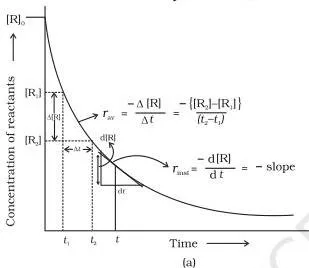
The graph shows why the two rates differ: the slope of the tangent at a chosen time gives \( r_{\text{inst}} \), while the slope of the line joining two points on the curve gives \( r_{\text{av}} \) for that interval.
Rate Expression, Rate Constant and Order
For a general reaction \( aA + bB \rightarrow cC + dD \), the rate law relates the rate to the concentrations of the reactants (NCERT, p. 6):
\[ \text{Rate} = k[A]^x[B]^y \]
The exponents x and y may happen to equal the coefficients a and b, but usually do not — the rate law must be determined experimentally (NCERT, p. 7). Example from the chapter: for \( \text{CHCl}_3 + \text{Cl}_2 \rightarrow \text{CCl}_4 + \text{HCl} \), the experimental rate law is \( \text{Rate} = k[\text{CHCl}_3][\text{Cl}_2]^{1/2} \).
The overall order is the sum of the exponents (NCERT, p. 8):
\[ \text{Order} = x + y \]
Order can be 0, 1, 2, 3 or even a fraction. For example, \( \text{Rate} = k[A]^{1/2}[B]^{3/2} \) is second order, while \( \text{Rate} = k[A]^{3/2}[B]^{-1} \) is half order (NCERT, p. 8).
Rearranging the rate law gives the rate constant k (NCERT, p. 9):
\[ k = \frac{\text{Rate}}{[A]^x[B]^y} \]
| Order of reaction | Units of rate constant \( k \) |
|---|---|
| 0 | \( \text{mol L}^{-1}\text{s}^{-1} \) |
| 1 | \( \text{s}^{-1} \) |
| 2 | \( \text{mol}^{-1}\text{L s}^{-1} \) |
These follow from writing \( k = \frac{\text{concentration}}{\text{time}} \times \frac{1}{(\text{concentration})^n} \), where \( n \) is the order (NCERT, p. 9).
- Order is an experimental quantity; it can be zero, a whole number or a fraction, and it applies to elementary as well as complex reactions (NCERT, p. 9).
- Molecularity is the number of reacting species that must collide simultaneously in one elementary step; it is 1, 2 or 3 and is defined only for elementary reactions (NCERT, p. 9).
- For a complex reaction, the overall rate is set by the slowest step, called the rate determining step (NCERT, p. 10).
Zero Order Reactions
In a zero order reaction the rate is independent of the concentration of the reactant. Integrating the differential rate law gives (NCERT, p. 11):
\[ [R] = [R]_0 – kt \]
\[ k = \frac{[R]_0 – [R]}{t} \]
A plot of \( [R] \) against t is a straight line with slope \( -k \) and intercept \( [R]_0 \) (NCERT, p. 11). Example: decomposition of ammonia on a hot platinum surface at high pressure (NCERT, p. 12).
First Order Reactions
In a first order reaction the rate is proportional to the first power of the reactant concentration. The integrated forms are (NCERT, p. 12):
\[ \ln[R] = \ln[R]_0 – kt \]
\[ [R] = [R]_0e^{-kt} \]
\[ k = \frac{2.303}{t}\log\frac{[R]_0}{[R]} = \frac{1}{t}\ln\frac{[R]_0}{[R]} \]
When the concentrations are known at two times \( t_1 \) and \( t_2 \), the rate constant is (NCERT, p. 12):
\[ k = \frac{1}{t_2 – t_1}\ln\frac{[R]_1}{[R]_2} \]
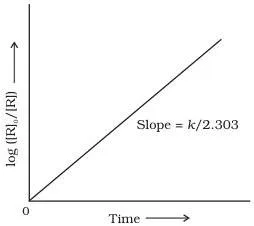
The straight-line plot of \( \ln[R] \) vs t, with slope \( -k \), is the quick graphical test for first order kinetics (NCERT, p. 14).
For a gaseous first order reaction \( A(g) \rightarrow B(g) + C(g) \) followed by total pressure, the integrated law becomes (NCERT, p. 14):
\[ k = \frac{2.303}{t}\log\frac{p_i}{p_A} \quad \text{with} \quad p_A = 2p_i – p_t \]
Here \( p_i \) is the initial pressure of A and \( p_t \) the total pressure at time t. For other stoichiometry, express \( p_A \) using the reaction’s own mole ratios — in the chapter’s worked example for \( 2\text{N}_2\text{O}_5 \rightarrow 2\text{N}_2\text{O}_4 + \text{O}_2 \), \( p_{\text{N}_2\text{O}_5} = 3p_i – 2p_t \).
Radioactive decay follows first order kinetics (NCERT, p. 14). A reaction of higher true order that follows first order kinetics because one reactant is in large excess is called a pseudo first order reaction; examples are the hydrolysis of ethyl acetate and the inversion of cane sugar in excess water (NCERT, p. 18).
Half-Life of a Reaction
The half-life \( t_{1/2} \) is the time in which the concentration of a reactant falls to half its initial value (NCERT, p. 16).
\[ \text{Zero order: } t_{1/2} = \frac{[R]_0}{2k} \]
\[ \text{First order: } t_{1/2} = \frac{0.693}{k} \]
For a zero order reaction \( t_{1/2} \propto [R]_0 \); for a first order reaction \( t_{1/2} \) is independent of \( [R]_0 \) (NCERT, p. 16). A useful first order result: the time for 99.9% completion is 10 times \( t_{1/2} \) (NCERT, p. 16).
Temperature Dependence of the Rate of a Reaction
The Arrhenius equation describes how the rate constant depends on temperature (NCERT, p. 18):
\[ k = Ae^{-E_a/RT} \]
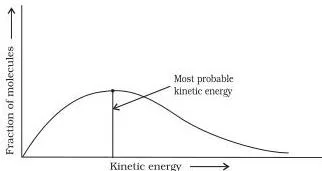
\( A \) is the Arrhenius factor (also called the frequency factor or pre-exponential factor), \( E_a \) is the activation energy in J mol⁻¹, \( R = 8.314\ \text{J K}^{-1}\text{mol}^{-1} \) and T is in kelvin. The factor \( e^{-E_a/RT} \) is the fraction of molecules with kinetic energy greater than \( E_a \) (NCERT, p. 19). Taking natural logarithms (NCERT, p. 20):
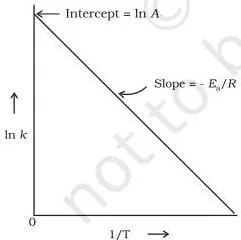
\[ \ln k = \ln A – \frac{E_a}{RT} \]
So \( \ln k \) vs \( 1/T \) is a straight line with slope \( -E_a/R \) and intercept \( \ln A \) (NCERT, p. 20). Between two temperatures \( T_1 \) and \( T_2 \) (NCERT, p. 20):
\[ \log\frac{k_2}{k_1} = \frac{E_a}{2.303R}\left(\frac{1}{T_1} – \frac{1}{T_2}\right) \]
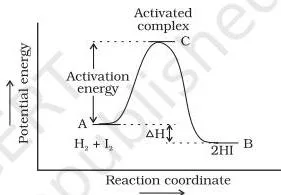
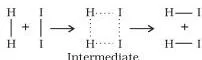
\( E_a \) is the energy required to form the activated complex — the unstable intermediate shown here for the reaction \( \text{H}_2 + \text{I}_2 \rightarrow 2\text{HI} \) (NCERT, p. 19).
The potential energy diagram shows the activation energy as the barrier between reactants and products; the activated complex sits at the peak (NCERT, p. 19).
The distribution curve explains why a rise of 10 K nearly doubles the rate constant: at higher temperature a larger fraction of molecules has energy equal to or above \( E_a \) (NCERT, p. 19).
A catalyst increases the rate without permanent chemical change by providing an alternate pathway of lower activation energy; it does not change the Gibbs energy or the equilibrium constant of the reaction (NCERT, p. 22).
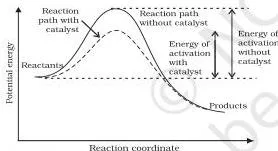
As the diagram shows, the catalysed path has a lower potential energy barrier, so the rate is faster at the same temperature (NCERT, p. 22).
Collision Theory of Chemical Reactions
Collision theory expresses the rate of a bimolecular elementary reaction \( A + B \rightarrow \) Products in terms of the collision frequency (NCERT, p. 22):
\[ \text{Rate} = Z_{AB}e^{-E_a/RT} \]
\( Z_{AB} \) is the collision frequency of A and B, and \( e^{-E_a/RT} \) is the fraction of molecules with energy equal to or greater than \( E_a \). Because not every collision has the correct orientation, a steric factor P is introduced (NCERT, p. 23):
\[ \text{Rate} = PZ_{AB}e^{-E_a/RT} \]
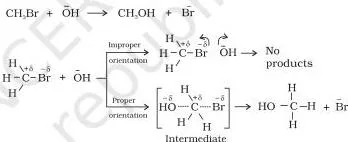
Only collisions with sufficient energy (the threshold energy) and proper orientation are effective. Proper orientation leads to bond formation; improper orientation makes the molecules bounce back unchanged (NCERT, p. 23).
What Each Symbol Means
Every symbol used in the formulas above, with its meaning and its unit or nature. Concentration is always molar concentration, written in square brackets.
| Symbol | What it means | Unit / nature |
|---|---|---|
| \( [R], [P] \) | molar concentration of the reactant R, product P | mol L⁻¹ |
| \( [R]_0 \) | initial concentration of the reactant at t = 0 | mol L⁻¹ |
| \( [R]_1, [R]_2 \) | concentration of the reactant at times \( t_1 \) and \( t_2 \) | mol L⁻¹ |
| \( t, t_1, t_2 \) | time; the two instants in the two-point formula | s (also min or h in problems) |
| \( \Delta t \) | time interval \( t_2 – t_1 \) | s |
| \( r_{\text{av}} \) | average rate of reaction over an interval | mol L⁻¹ s⁻¹ |
| \( r_{\text{inst}} \) | instantaneous rate of reaction at an instant | mol L⁻¹ s⁻¹ |
| \( k \) | rate constant, the proportionality constant in the rate law | first order: s⁻¹; zero order: mol L⁻¹ s⁻¹; second order: mol⁻¹ L s⁻¹ |
| \( [A], [B] \) | molar concentrations of reactants A and B in the rate law | mol L⁻¹ |
| \( x, y \) | orders with respect to A and B, the exponents in the rate law | dimensionless |
| \( n \) | overall order, \( x + y \) | dimensionless |
| \( a, b, c, d \) | stoichiometric coefficients in \( aA + bB \rightarrow cC + dD \) | dimensionless |
| \( t_{1/2} \) | half-life: time for the concentration to fall to half its initial value | s |
| \( p_i \) | initial pressure of the gaseous reactant at t = 0 | atm (or bar) |
| \( p_t \) | total pressure of the gaseous mixture at time t | atm |
| \( p_A \) | partial pressure of reactant A at time t | atm |
| \( E_a \) | activation energy: energy needed to form the activated complex | J mol⁻¹ (often kJ mol⁻¹) |
| \( R \) | gas constant | 8.314 J K⁻¹ mol⁻¹ |
| \( T, T_1, T_2 \) | absolute temperatures | K |
| \( A \) | Arrhenius factor (frequency factor / pre-exponential factor) | same unit as k |
| \( Z_{AB} \) | collision frequency of A and B | collisions per second per unit volume |
| \( P \) | steric (probability) factor accounting for proper orientation | dimensionless |
| \( e \) | base of natural logarithms, \( \approx 2.718 \) | dimensionless |
When to Use Each Formula
One line per formula or group — the situation in which you should reach for it, and the condition it requires.
| Formula | Use it when… | Condition to check |
|---|---|---|
| \( r_{\text{av}} = -\frac{\Delta[R]}{\Delta t} \) | you have concentrations at two times and want the rate over that interval | \( \Delta[R] \) is negative, so the minus sign makes the rate positive |
| \( r_{\text{inst}} = -\frac{d[R]}{dt} \) | you need the rate at one instant — the slope of the tangent on the [R] vs t curve | tangent drawn correctly at time t (NCERT, p. 3) |
| Rate divided by coefficients | the balanced equation has coefficients \( \neq 1 \), e.g. \( 2\text{HI} \rightarrow \text{H}_2 + \text{I}_2 \) | divide each species’ change by its own coefficient |
| \( \text{Rate} = k[A]^x[B]^y \) | a rate law is given or asked for | it must come from experimental data, never from the balanced equation |
| \( n = x + y \) | you need the overall order from a rate law | the sum can be zero, a whole number or a fraction |
| Units of k | you want the unit of k for a given order, or to identify the order from the unit of k | s⁻¹ \( \rightarrow \) first order; mol⁻¹ L s⁻¹ \( \rightarrow \) second order; mol L⁻¹ s⁻¹ \( \rightarrow \) zero order |
| \( [R] = [R]_0 – kt \) | the reaction is zero order, so the rate is independent of concentration | [R] vs t must plot as a straight line (e.g. NH₃ on Pt at high pressure) |
| \( \ln[R] = \ln[R]_0 – kt \) | you know \( [R]_0 \), [R] and t and want k | the reaction is first order |
| \( [R] = [R]_0e^{-kt} \) | you need the concentration remaining after time t | t and k in matching time units (s, min or h) |
| \( k = \frac{2.303}{t}\log\frac{[R]_0}{[R]} \) | problems give percentage decomposed or fraction remaining | use base-10 log; 2.303 = ln 10 |
| \( k = \frac{1}{t_2 – t_1}\ln\frac{[R]_1}{[R]_2} \) | you know concentrations at two times, not necessarily t = 0 | both concentrations belong to the same reaction |
| \( k = \frac{2.303}{t}\log\frac{p_i}{p_A} \) | a gaseous first order reaction \( A(g) \rightarrow B(g) + C(g) \) is followed by total pressure | \( p_A = 2p_i – p_t \) for this 1 \( \rightarrow \) 2 mole stoichiometry; derive \( p_A \) separately for other cases |
| \( t_{1/2} = \frac{[R]_0}{2k} \) | you need the half-life of a zero order reaction | k in mol L⁻¹ s⁻¹; half-life grows with initial concentration |
| \( t_{1/2} = \frac{0.693}{k} \) | you need the half-life of a first order reaction, or k from a given half-life | k in s⁻¹; half-life is independent of concentration |
| \( k = Ae^{-E_a/RT} \) | you need k at one temperature when \( E_a \) or A is known | T in kelvin; \( E_a \) in J mol⁻¹ |
| \( \log\frac{k_2}{k_1} = \frac{E_a}{2.303R}\left(\frac{1}{T_1} – \frac{1}{T_2}\right) \) | two rate constants at two temperatures are given; find \( E_a \), A or a new k | convert \( {}^\circ\text{C} \) to K first; rule of thumb — a 10 K rise nearly doubles k |
| \( \text{Rate} = PZ_{AB}e^{-E_a/RT} \) | collision-theory questions involving orientation and the steric factor | P accounts for proper orientation; deviations are large for complex molecules |
The chapter summarises the two integrated rate laws in one compact table (NCERT, p. 16). It is worth memorising as a whole:
| Order | Differential rate law | Integrated rate law | Straight-line plot | Half-life | Units of k |
|---|---|---|---|---|---|
| 0 | \( -\frac{d[R]}{dt} = k \) | \( kt = [R]_0 – [R] \) | [R] vs t | \( \frac{[R]_0}{2k} \) | mol L⁻¹ s⁻¹ |
| 1 | \( -\frac{d[R]}{dt} = k[R] \) | \( [R] = [R]_0e^{-kt} \) or \( kt = \ln\frac{[R]_0}{[R]} \) | ln[R] vs t | \( \frac{0.693}{k} \) | s⁻¹ |
Worked Examples
The three examples below use original numbers, following the same substitution style as the other chemistry formula sheets on the site. For practice on the textbook’s own questions: Exercises 3.1–3.12 test the rate law, order and units of k; 3.13–3.21 test the integrated equations, half-life and the gas-pressure form; 3.22–3.30 test the Arrhenius equation.
A full-marks numerical answer names the formula first, substitutes values with units, then quotes the final value with its unit.
Worked Example 1: Rate constant of a first order reaction
A first order reaction has initial concentration \( 0.80\ \text{mol L}^{-1} \). After 40 minutes it falls to \( 0.20\ \text{mol L}^{-1} \). Calculate the rate constant.
- Step 1: The reaction is first order and \( [R]_0 \), [R] and t are known, so use \( k = \frac{2.303}{t}\log\frac{[R]_0}{[R]} \).
- Step 2: Substitute values with units.
The concentration ratio is dimensionless, so the unit of k comes from 1/t only.
\[ k = \frac{2.303}{40\ \text{min}}\log\frac{0.80\ \text{mol L}^{-1}}{0.20\ \text{mol L}^{-1}} = \frac{2.303}{40\ \text{min}}\log 4 \]
Step 3: \( \log 4 = 0.6021 \).
\[ k = \frac{2.303 \times 0.6021}{40}\ \text{min}^{-1} = 3.47 \times 10^{-2}\ \text{min}^{-1} \]
Final answer: \( k = 3.47 \times 10^{-2}\ \text{min}^{-1} \). The unit min⁻¹ confirms a first order reaction.
Worked Example 2: Half-life and time to reach a given fraction
The rate constant of a first order reaction is \( 2.31 \times 10^{-2}\ \text{s}^{-1} \). Find (i) the half-life and (ii) the time needed for the concentration to become one-eighth of its initial value.
Step 1: For a first order reaction, use \( t_{1/2} = \frac{0.693}{k} \).
\[ t_{1/2} = \frac{0.693}{2.31 \times 10^{-2}\ \text{s}^{-1}} = 30\ \text{s} \]
Step 2: Falling to one-eighth means three halvings: \( 1 \rightarrow \frac{1}{2} \rightarrow \frac{1}{4} \rightarrow \frac{1}{8} \).
So the time is \( 3 \times 30 = 90\ \text{s} \).
Step 3 (check): The log form gives the same answer:
\[ t = \frac{2.303}{k}\log\frac{[R]_0}{[R]} = \frac{2.303}{2.31 \times 10^{-2}}\log 8 = 90\ \text{s} \]
Final answer: \( t_{1/2} = 30\ \text{s} \); time to one-eighth of the initial concentration = \( 90\ \text{s} \).
Worked Example 3: Activation energy from two rate constants
The rate constant of a reaction is \( 1.5 \times 10^{-3}\ \text{s}^{-1} \) at 310 K and \( 6.0 \times 10^{-3}\ \text{s}^{-1} \) at 330 K. Calculate the activation energy in kJ mol⁻¹.
Step 1: Use the two-temperature Arrhenius form \( \log\frac{k_2}{k_1} = \frac{E_a}{2.303R}\left(\frac{1}{T_1} – \frac{1}{T_2}\right) \).
Both temperatures are already in kelvin.
Step 2: \( \log\frac{6.0 \times 10^{-3}}{1.5 \times 10^{-3}} = \log 4 = 0.6021 \).
Rearrange for \( E_a \):
\[ E_a = 2.303R\ \frac{T_1T_2}{T_2 – T_1}\ \log\frac{k_2}{k_1} \]
Step 3: Substitute \( R = 8.314\ \text{J K}^{-1}\text{mol}^{-1} \), \( T_1 = 310\ \text{K} \), \( T_2 = 330\ \text{K} \).
\[ E_a = 2.303 \times 8.314 \times \frac{310 \times 330}{330 – 310} \times 0.6021\ \text{J mol}^{-1} \]
\[ E_a = 19.15 \times 5115 \times 0.6021 = 5.90 \times 10^4\ \text{J mol}^{-1} = 59.0\ \text{kJ mol}^{-1} \]
Final answer: \( E_a \approx 59.0\ \text{kJ mol}^{-1} \). The unit follows because R carries J mol⁻¹ and the temperature factor is dimensionless.
Common Mistakes to Avoid
The errors below are specific to applying kinetics formulas; each row gives the correction and a check you can run on your own answer.
| Mistake | Correct rule | How to check your answer |
|---|---|---|
| Writing the order from the balanced equation — e.g. calling \( \text{CHCl}_3 + \text{Cl}_2 \rightarrow \text{CCl}_4 + \text{HCl} \) second order from its coefficients. | The rate law is experimental. For that reaction \( \text{Rate} = k[\text{CHCl}_3][\text{Cl}_2]^{1/2} \), so the order is 1.5 (NCERT, p. 7). | Take the exponents from the given rate law, never from the coefficients. |
| Omitting the stoichiometric coefficient: writing the rate of \( 2\text{HI} \rightarrow \text{H}_2 + \text{I}_2 \) as \( -\Delta[\text{HI}]/\Delta t \). | Divide each species’ rate by its own coefficient: \( \text{Rate} = -\frac{1}{2}\frac{\Delta[\text{HI}]}{\Delta t} = \frac{\Delta[\text{H}_2]}{\Delta t} = \frac{\Delta[\text{I}_2]}{\Delta t} \). | All three expressions must give the same numerical rate. |
| Mixing log₁₀ and ln — keeping the 2.303 factor while using a natural log. | \( k = \frac{1}{t}\ln\frac{[R]_0}{[R]} = \frac{2.303}{t}\log_{10}\frac{[R]_0}{[R]} \). Use 2.303 only with base-10 log. | Work the same problem both ways; the two answers must match. |
| Putting temperature in \( {}^\circ\text{C} \) into the Arrhenius equation. | T must be in kelvin: \( T(\text{K}) = t({}^\circ\text{C}) + 273 \). | Convert every temperature before substituting; \( T_2 \gt T_1 \) must give a positive \( E_a \). |
| Using \( t_{1/2} = 0.693/k \) for a zero order reaction. | First order: \( t_{1/2} = \frac{0.693}{k} \). Zero order: \( t_{1/2} = \frac{[R]_0}{2k} \). | Check the unit of k: s⁻¹ \( \rightarrow \) first order; mol L⁻¹ s⁻¹ \( \rightarrow \) zero order. |
| Confusing \( p_i \) (initial pressure) with \( p_t \) (total pressure at time t) in the gas-phase formula. | \( p_A = 2p_i – p_t \) for \( A(g) \rightarrow B(g) + C(g) \); for other stoichiometry use the reaction’s mole ratios, e.g. \( p_{\text{N}_2\text{O}_5} = 3p_i – 2p_t \) for \( 2\text{N}_2\text{O}_5 \rightarrow 2\text{N}_2\text{O}_4 + \text{O}_2 \). | At t = 0, \( p_t = p_i \), so the formula must reduce to \( p_A = p_i \). |
| Reporting a negative rate of reaction. | \( \Delta[R] \) is negative for a reactant, so \( \text{Rate} = -\frac{\Delta[R]}{\Delta t} \) is positive. | A rate is always positive; if yours is negative, recheck the sign. |
Frequently Asked Questions
Can the order of a reaction be predicted from the balanced equation?
No. The rate law must be found experimentally (NCERT, p. 7). The exponents x and y in \( \text{Rate} = k[A]^x[B]^y \) need not match the stoichiometric coefficients.
Molecularity, the number of species colliding in one elementary step, is limited to 1, 2 or 3 and applies only to elementary reactions, whereas order can be zero, a whole number or a fraction (NCERT, p. 9).
Why does the first order rate constant formula contain 2.303?
Because \( 2.303 = \ln 10 \), the factor that converts natural logarithms to base-10 logarithms. The two forms \( k = \frac{1}{t}\ln\frac{[R]_0}{[R]} \) and \( k = \frac{2.303}{t}\log\frac{[R]_0}{[R]} \) are identical; the 2.303 appears only when the log is base 10.
Does the half-life of a reaction depend on the initial concentration?
For a first order reaction, no: \( t_{1/2} = 0.693/k \) is independent of \( [R]_0 \). For a zero order reaction, yes: \( t_{1/2} = [R]_0/(2k) \) is directly proportional to the initial concentration (NCERT, p. 16).
What is a pseudo first order reaction?
A reaction of higher true order that behaves as first order because one reactant is present in large excess, so its concentration stays almost constant during the reaction. Chapter examples: the hydrolysis of ethyl acetate and the inversion of cane sugar, both carried out with water in large excess (NCERT, p. 18).
Reference: NCERT Class 12 Chemistry textbook, chapter Chemical Kinetics.
Explore Class 12 Chemistry Formulas
More for this chapter:
Class 12 Chemistry on LearnCBSE:
Related chapters: