
Revising Composition and Structure of Atmosphere for a Class 11 Geography test?
This page condenses the chapter into one revision sheet: the three components of the air — gases, water vapour and dust particles — plus the five layers of the atmosphere with their heights and temperature behaviour, the key numbers worth memorising, a worked lapse-rate example, common mistakes and answer blueprints for the textbook’s exercises.
These notes follow the rationalised NCERT textbook for the 2026-27 session (Class 11 Fundamentals of Physical Geography, Chapter 7). This page is part of the Class 11 Geography notes; you can also browse the full Class 11 notes or the CBSE Notes library.
Chapter 7 Roadmap: Composition, Structure and the Elements
Chapter 7 is the opening block of the Climate unit of Fundamentals of Physical Geography. That unit as a whole covers atmosphere, insolation and heat budget, pressure belts and winds, precipitation, and world climates. This chapter teaches only the atmosphere block, in three parts:
| Chapter block | What it explains | Why it matters |
|---|---|---|
| Composition | gases, water vapour and dust particles | these three components drive temperature, clouds and all weather |
| Structure | five layers from troposphere to exosphere | each layer behaves differently with height and has a different job |
| Elements of weather and climate | temperature, pressure, winds, humidity, clouds and precipitation | listed here; Chapters 8, 9 and 10 treat them in detail |
The elements thread continues in the notes for the chapter on water in the atmosphere, where clouds and precipitation return. Other chapters of the same book, such as landforms and their evolution, have separate revision notes. You can verify the chapter text and figures on the official NCERT textbook page for Chapter 7 of Fundamentals of Physical Geography.
What the Atmosphere Is Made Of: Gases, Water Vapour and Dust Particles
The atmosphere is a mixture of different gases that envelopes the earth all round. It is colourless and odourless, felt only when it blows as wind. Air matters directly to survival — we breathe every few seconds — and 99 per cent of the total mass of the atmosphere lies within 32 km of the surface.
It carries life-giving oxygen for humans and animals and carbon dioxide for plants. The atmosphere is composed of gases, water vapour and dust particles.
The Gases: Nitrogen, Oxygen, Carbon Dioxide and Ozone
- Nitrogen — the major constituent of the atmosphere, the gas with the largest share of the air.
- Oxygen — life-giving for humans and animals, but almost negligible in quantity at 120 km of height.
- Carbon dioxide — meteorologically very important: transparent to incoming solar radiation but opaque to outgoing terrestrial radiation. It absorbs part of the terrestrial radiation and reflects part back toward the surface, which makes it largely responsible for the greenhouse effect. Its volume has been rising in recent decades because of the burning of fossil fuels, and this has raised the temperature of the air.
- Ozone — found between 10 and 50 km above the earth; acts as a filter that absorbs the sun’s ultraviolet rays and prevents them from reaching the surface.
Water Vapour: The Blanket Gas That Shrinks with Height
- A variable gas that decreases with altitude.
- Up to 4 per cent of the air by volume in the warm wet tropics; less than 1 per cent in dry cold deserts and polar regions; it also decreases from the equator toward the poles.
- It absorbs part of the insolation (incoming solar radiation) and preserves the earth’s radiated heat — acting like a blanket that keeps the earth neither too cold nor too hot.
- It also contributes to the stability and instability of the air.
Dust Particles: The Seeds of Clouds
- Sources: sea salts, fine soil, smoke-soot, ash, pollen, dust and disintegrated meteor particles.
- Generally concentrated in the lower layers; convectional air currents can carry them to great heights.
- Concentration is higher in subtropical and temperate regions than in equatorial and polar regions.
- Key role: dust and salt particles act as hygroscopic nuclei around which water vapour condenses to produce clouds.
The Five Layers of the Atmosphere: Troposphere to Exosphere
The column of atmosphere is divided into five layers depending on the temperature condition. Density behaves differently: it is highest near the surface and decreases with altitude. Figure 7.1 shows this vertical layering.
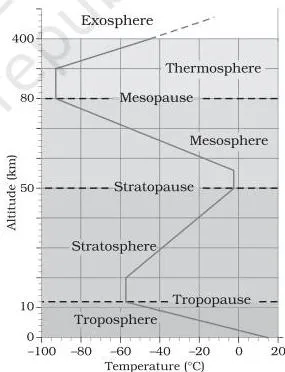
Working upward from the ground:
Troposphere — the lowermost layer. Its average height is 13 km: about 8 km near the poles and about 18 km at the equator. It is thickest at the equator because strong convectional currents transport heat to great heights.
It contains dust particles and water vapour; all changes in climate and weather take place here, and temperature decreases at the rate of \(1^\circ\text{C}\) for every \(165\ \text{m}\). It is the most important layer for all biological activity.
Tropopause — the zone separating the troposphere from the stratosphere, where the temperature is nearly constant (hence the name “pause”). Its air temperature is about \(-80^\circ\text{C}\) over the equator and about \(-45^\circ\text{C}\) over the poles.
Stratosphere — above the tropopause, extending up to 50 km. Its one critical feature is the ozone layer, which absorbs ultraviolet radiation and shields life on the earth from this intense, harmful energy.
Mesosphere — above the stratosphere, up to 80 km. Temperature decreases again with altitude, reaching about \(-100^\circ\text{C}\) at 80 km. Its upper limit is the mesopause.
Ionosphere (thermosphere region) — the zone between 80 and 400 km. It contains electrically charged particles called ions, and radio waves transmitted from the earth are reflected back to the earth here. Temperature starts increasing with height in this layer.
Exosphere — the uppermost layer, above the thermosphere. Very little is known about it: its contents are extremely rarefied, and it gradually merges with outer space.
Although every layer influences us, geographers are mainly concerned with the first two layers.
Layer by Layer: Height, Temperature and Defining Feature
One table consolidates the five layers — the fastest way to revise the vertical structure.
| Layer | Approximate height | Temperature behaviour | Defining feature |
|---|---|---|---|
| Troposphere | average 13 km; about 8 km near the poles; about 18 km at the equator | decreases at \(1^\circ\text{C}\) per \(165\ \text{m}\) | all weather changes; dust and water vapour; most important for biological activity |
| Tropopause | the separating zone between troposphere and stratosphere | nearly constant; about \(-80^\circ\text{C}\) over the equator and \(-45^\circ\text{C}\) over the poles | boundary zone that gives the “pause” its name |
| Stratosphere | above the tropopause up to 50 km | not stated in the chapter text | contains the ozone layer, which absorbs ultraviolet radiation |
| Mesosphere | above the stratosphere up to 80 km | decreases again to about \(-100^\circ\text{C}\) at 80 km | mesopause at its upper limit |
| Ionosphere / thermosphere region | 80 to 400 km | temperature increases with height | ions reflect radio waves back to earth |
| Exosphere | uppermost layer above the thermosphere | not stated in the chapter text | extremely rarefied; gradually merges with outer space |
Where You Meet This Chapter in Daily Life
- Radio communication — the ionosphere reflects radio waves from the earth back to the earth, which is how transmitted signals come back to the ground.
- Sun protection — ozone between 10 and 50 km absorbs the sun’s ultraviolet rays, shielding life from harmful energy.
- Cloud formation — water vapour condenses around dust and salt particles (hygroscopic nuclei), so particles in the air give clouds their starting point.
- Fuel burning and warming — burning fossil fuels raises the volume of carbon dioxide, strengthening the greenhouse effect and warming the air.
Key Terms Defined: The Atmosphere’s Vocabulary
Student-friendly definitions, short enough to memorise:
| Term | Meaning | Where it matters |
|---|---|---|
| Atmosphere | the mixture of gases enveloping the earth; colourless and odourless; 99 per cent of its mass lies within 32 km of the surface | the subject of the whole chapter |
| Greenhouse effect | carbon dioxide absorbs part of the terrestrial radiation and reflects some back toward the surface, trapping heat | links rising carbon dioxide to warming air |
| Insolation | the incoming solar radiation from the sun, a part of which water vapour absorbs | water vapour’s blanket effect |
| Terrestrial radiation | the outgoing radiation given off by the earth; carbon dioxide is opaque to it | why carbon dioxide traps heat instead of letting it escape |
| Hygroscopic nuclei | dust and salt particles around which water vapour condenses to produce clouds | the main job of dust particles |
| Tropopause | the zone separating the troposphere from the stratosphere, where temperature is nearly constant | the first “pause” in the temperature structure |
| Mesopause | the upper limit of the mesosphere at about 80 km | marks the top of the cooling mesosphere |
| Ionosphere | the 80-400 km zone containing electrically charged particles called ions | reflects radio waves back to earth |
Key Numbers at a Glance: The Chapter’s Data Box
This chapter has no formulas; its revision value is in the numbers below. Treat this table as your night-before-exam sheet:
| Fact | Value as the chapter states it |
|---|---|
| Mass of the atmosphere within 32 km of the surface | 99 per cent |
| Oxygen becomes almost negligible at | 120 km |
| Carbon dioxide and water vapour are found only up to | 90 km |
| Ozone is found between | 10 and 50 km |
| Water vapour in the warm wet tropics | up to 4 per cent of the air by volume |
| Water vapour in deserts and polar regions | less than 1 per cent |
| Troposphere height | average 13 km; about 8 km near the poles; about 18 km at the equator |
| Tropospheric lapse rate | temperature falls \(1^\circ\text{C}\) per \(165\ \text{m}\) |
| Tropopause temperature | about \(-80^\circ\text{C}\) over the equator; about \(-45^\circ\text{C}\) over the poles |
| Stratosphere | extends up to 50 km |
| Mesosphere | up to 80 km; about \(-100^\circ\text{C}\) at 80 km |
| Ionosphere | between 80 and 400 km |
Worked Example: Predicting Air Temperature with the Lapse Rate
Method: the tropospheric lapse rate. The rule applies only inside the troposphere, where the chapter fixes the rate.
Problem: the surface temperature at sea level is \(30^\circ\text{C}\).
What is the air temperature at 1650 m in the troposphere?
- Step 1: State the rate — temperature drops \(1^\circ\text{C}\) for every \(165\ \text{m}\) of height.
- Step 2: Find the total cooling for a 1650 m climb.
\[ 1650 \div 165 = 10 \]
Step 3: The air cools by \(10^\circ\text{C}\).
Subtract this from the surface temperature.
\[ 30^\circ\text{C} – 10^\circ\text{C} = 20^\circ\text{C} \]
Final answer: the air temperature at 1650 m is \(20^\circ\text{C}\).
Practice, with working: surface temperature \(25^\circ\text{C}\), height 990 m.
- Step 1: Cooling for 990 m: \(990 \div 165 = 6\), so the air cools by \(6^\circ\text{C}\).
- Step 2: Subtract from the surface temperature.
\[ 25^\circ\text{C} – 6^\circ\text{C} = 19^\circ\text{C} \]
Final answer: the air temperature at 990 m is \(19^\circ\text{C}\).
Caution: this rate holds only in the troposphere. Above it, temperature behaviour changes layer by layer, so never extend the rate upward.
Common Mistakes in This Chapter, With Corrections
| Students write | Correct rule | How to check your answer |
|---|---|---|
| “Temperature decreases in every layer.” | It decreases in the troposphere and mesosphere and increases in the ionosphere; it is nearly constant at the tropopause. Never write “everywhere”. | Go layer by layer and write increase / decrease / constant for each one before answering. |
| “The tropopause is coldest over the poles.” | The reverse: about \(-80^\circ\text{C}\) over the equator versus about \(-45^\circ\text{C}\) over the poles. | Recall that the equatorial tropopause sits far higher than the polar one. |
| “Carbon dioxide is opaque to incoming solar radiation.” | It is transparent to incoming solar radiation and opaque to outgoing terrestrial radiation — that is exactly why it traps heat. | Attach each adjective to the correct direction: transparent = incoming, opaque = outgoing. |
| “Ozone exists only in the stratosphere.” | The chapter places ozone between 10 and 50 km; the stratosphere’s ozone layer is the part that absorbs ultraviolet rays. | Ask which height band (10-50 km) the ozone lies in. |
| “Dust particles are concentrated high in the atmosphere.” | They concentrate in the lower layers; convectional currents may carry them to great heights. | Remember “concentrate low, carried high”. |
| “Oxygen becomes negligible at 90 km.” | 120 km; 90 km is the limit for carbon dioxide and water vapour. | Fix the three heights before the exam: 120 (oxygen), 90 (CO₂ and water vapour), 10-50 (ozone). |
| “The ionosphere is a sixth layer above the exosphere.” | The five layers are troposphere, stratosphere, mesosphere, thermosphere and exosphere; the ionosphere is the electrically charged 80-400 km zone. | Count the chapter’s five-layer list, then place the ionosphere inside it. |
Why the tropopause is colder over the hot equator: the reason is height, not surface climate. The troposphere reaches about 18 km over the equator but only about 8 km near the poles, and higher up means far colder air.
That is exactly why the equatorial tropopause sits at about \(-80^\circ\text{C}\) while the polar one sits at about \(-45^\circ\text{C}\).
Exam Notes: Answering the End of Chapter Questions
The chapter’s exercises ask three things: five multiple-choice questions, four short answers of about 30 words, and two longer answers of about 150 words (one on composition, one draw-and-label on structure). These are the answer blueprints — the shape a complete answer takes — so you can practise writing the final text yourself.
Multiple-choice key with reasons
| Question | Correct option | One-line reason |
|---|---|---|
| Gas that constitutes the major portion of the atmosphere | Nitrogen | Nitrogen is the major constituent of the atmosphere. |
| Atmospheric layer important for human beings | Troposphere | All weather changes and all biological activity are centred here. |
| Sea salt, pollen, ash, smoke-soot and fine soil are associated with | Dust particles | All of these are sources of dust particles. |
| Oxygen is in negligible quantity at | 120 km | The chapter fixes oxygen’s limit at 120 km. |
| Transparent to incoming solar radiation, opaque to outgoing terrestrial radiation | Carbon dioxide | This double behaviour is what makes carbon dioxide a greenhouse gas. |
Skeletons for the 30-word answers
- Define the atmosphere: the mixture of gases enveloping the earth, with life-giving oxygen and carbon dioxide; 99 per cent of its mass lies within 32 km; colourless and odourless.
- Elements of weather and climate: temperature, pressure, winds, humidity, clouds and precipitation.
- Composition of the atmosphere: gases, water vapour and dust particles.
- Why the troposphere matters: all changes in climate and weather take place here; it contains dust particles and water vapour; it is the most important layer for all biological activity.
Structure for the 150-word composition answer
- Paragraph 1 — gases: nitrogen is the major gas; oxygen is almost negligible at 120 km; carbon dioxide’s greenhouse role; ozone between 10 and 50 km filters ultraviolet rays.
- Paragraph 2 — water vapour: a variable gas that decreases with altitude; from up to 4 per cent in the warm wet tropics to below 1 per cent in deserts and polar regions; its blanket effect; its role in stability and instability.
- Paragraph 3 — dust particles: sources (sea salts, fine soil, smoke-soot, ash, pollen, meteor dust); concentration in the lower layers; hygroscopic nuclei on which water vapour condenses into clouds.
Label checklist for the draw-and-label structure answer
- Use Figure 7.1 on this page as the model.
- Draw the five layers in order: troposphere, stratosphere, mesosphere, thermosphere and exosphere.
- Mark the tropopause between the troposphere and the stratosphere, and the mesopause at the top of the mesosphere.
- Label the heights you know: troposphere average 13 km (about 8 km at the poles, 18 km at the equator); stratosphere up to 50 km; mesosphere up to 80 km; ionosphere between 80 and 400 km.
- Describe each layer in one or two lines — what happens to temperature and what the layer is known for.
A complete answer to the structure question pairs the labelled diagram with a layer-by-layer description; a complete composition answer uses one paragraph per component.
Revision Recap: The Whole Chapter in One Screen
Memory device for layer order from the surface upward: Tiny Students Must Take Exercises — Troposphere, Stratosphere, Mesosphere, Thermosphere, Exosphere. The two pauses to remember: the tropopause (between troposphere and stratosphere) and the mesopause (upper limit of the mesosphere).
- Composition = gases + water vapour + dust particles.
- Carbon dioxide drives the greenhouse effect; ozone filters ultraviolet rays; water vapour is the blanket gas; dust and salt particles are the hygroscopic nuclei for clouds.
- Layers at a glance: troposphere (13 km average; falls \(1^\circ\text{C}\) per 165 m) · tropopause (nearly constant; \(-80^\circ\text{C}\) equator, \(-45^\circ\text{C}\) poles) · stratosphere (up to 50 km; ozone layer) · mesosphere (up to 80 km; \(-100^\circ\text{C}\) at its top) · ionosphere / thermosphere (80-400 km; ions reflect radio waves) · exosphere (rarefied; merges with space).
- Elements of weather and climate: temperature, pressure, winds, humidity, clouds and precipitation.
Before the exam, be able to: name the three components with one role each; list the five layers in order with approximate heights; state the lapse rate of \(1^\circ\text{C}\) per 165 m; explain why carbon dioxide and ozone matter; and redraw and label Figure 7.1 from memory (five layers, tropopause, mesopause).
FAQs on Composition and Structure of Atmosphere
Why is the troposphere the most important layer of the atmosphere for human beings?
It is the lowermost layer, so all changes in climate and weather take place inside it. It also contains the dust particles and water vapour that drive those changes, and it is the most important layer for all biological activity — the layer in which we live and breathe.
Why is the tropopause colder over the equator than over the poles?
Because it is much higher there. The troposphere reaches about 18 km over the equator but only about 8 km near the poles, and higher up means colder air. That is why the tropopause is about \(-80^\circ\text{C}\) over the equator but only about \(-45^\circ\text{C}\) over the poles.
What is the difference between the thermosphere and the ionosphere?
The thermosphere is the name used in the chapter’s five-layer list. The description of that same height zone (80 to 400 km) calls it the ionosphere because it contains electrically charged particles called ions. It is this charged condition that lets the layer reflect radio waves back to earth, and temperature here increases with height.
Up to what heights are oxygen, carbon dioxide and water vapour found in the atmosphere?
Oxygen becomes almost negligible at 120 km. Carbon dioxide and water vapour are found only up to 90 km from the surface. Ozone is separate: it lies between 10 and 50 km.
Why do dust particles matter for cloud formation?
Dust and salt particles act as hygroscopic nuclei. Water vapour condenses around these nuclei, and that condensation produces clouds. Without particles in the air, water vapour would have nothing to condense around.
At what rate does temperature fall as we go up in the troposphere?
Temperature decreases at the rate of \(1^\circ\text{C}\) for every 165 m of height. So a climb of 1650 m cools the air by \(10^\circ\text{C}\).
Reference: NCERT Class 11 Fundamentals of Physical Geography textbook, chapter Composition and Structure of Atmosphere.
Explore Class 11 Geography Notes
- Class 11 Geography Notes
- Class 11 CBSE Notes
- CBSE Notes for Classes 9 to 12
- Previous: Landforms and Their Evolution
- Next: Water in the Atmosphere
Class 11 Geography on LearnCBSE:
Related chapters:
- Water (oceans) notes