
This page gives you the exercise 8.1 class 10 maths ncert solutions — all 11 questions of Exercise 8.1 from the Introduction to Trigonometry chapter, solved step by step.
Each solution opens with the reasoning behind the method, shows the full working with units, and closes with a common-error warning so you can check your own attempt. Work through them in order: Question 1 teaches you to swap opposite and adjacent when the angle changes, and most of what follows builds on that single idea.
Study the ratio definitions in the concepts box first, then attempt each question before reading its solution.
Exercise 8.1 Solutions
What this exercise teaches. Exercise 8.1 is the first set of ratio problems in the chapter.
It asks you to pull the six trigonometric ratios out of a named right triangle using the Pythagoras theorem (Q1-Q5, Q10), prove that equal ratios force equal acute angles (Q6), simplify expressions with the identity \(\sin^2 A + \cos^2 A = 1\) (Q7-Q9), and judge true/false statements about the limits of ratio values (Q11).
Only what these 11 questions need. In a right triangle with right angle at B, the acute angle A fixes six ratios (NCERT pp. 115-116). The side opposite A faces it, the side adjacent to A is the leg that forms the angle, and AC is always the hypotenuse.
| Ratio | Side fraction | Abbreviation |
|---|---|---|
| sine of A | \( \frac{\text{opposite}}{\text{hypotenuse}} = \frac{BC}{AC} \) | sin A |
| cosine of A | \( \frac{\text{adjacent}}{\text{hypotenuse}} = \frac{AB}{AC} \) | cos A |
| tangent of A | \( \frac{\text{opposite}}{\text{adjacent}} = \frac{BC}{AB} \) | tan A |
| cosecant of A | \( \frac{\text{hypotenuse}}{\text{opposite}} = \frac{AC}{BC} \) | cosec A |
| secant of A | \( \frac{\text{hypotenuse}}{\text{adjacent}} = \frac{AC}{AB} \) | sec A |
| cotangent of A | \( \frac{\text{adjacent}}{\text{opposite}} = \frac{AB}{BC} \) | cot A |
Reciprocal relations (p.116): \(\cosec A = 1/\sin A\), \(\sec A = 1/\cos A\), \(\cot A = 1/\tan A\), and tan A = sin A / cos A (with cot A = cos A / sin A). These turn Q4 and Q7 into simple flips.
Pythagoras (p.118): \( AB^2 + BC^2 = AC^2 \). Whenever one ratio is given, label the two known sides as multiples of a common positive number k and use Pythagoras for the third side.
Fundamental identity (p.128): \( \sin^2 A + \cos^2 A = 1 \), together with \( 1 + \tan^2 A = \sec^2 A \) and \( 1 + \cot^2 A = \cosec^2 A \). Q7, Q8 and Q9 lean on the first one.
Two remarks that decide answers: sin A is an abbreviation for “the sine of angle A”, never a product of sin and A (p.117); and since the hypotenuse is the longest side of a right triangle, sin A and cos A are always less than or equal to 1 (p.118).
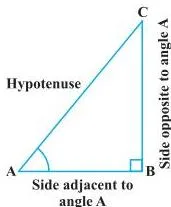
The three side names stay fixed only while the angle stays the same. Figure 8.4 labels them for angle A; Figure 8.5 below shows the same triangle when angle C is measured instead.
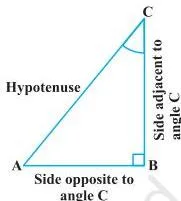
When you switch from angle A to angle C, the side opposite the new angle is the one that was adjacent before, while the hypotenuse never changes. Question 1 is nothing but this swap.
Question 1: In triangle ABC, right-angled at B, AB = 24 cm, BC = 7 cm. Determine : (i) sin A, cos A (ii) sin C, cos C
- (i) sin A, cos A
- (ii) sin C, cos C
When the angle changes from A to C, the labels “opposite” and “adjacent” exchange places, but the hypotenuse never changes. The same two legs of this triangle simply swap roles between part (i) and part (ii).
Step 1 — find the third side.
The right angle is at B, so AC is the hypotenuse.
By Pythagoras, \(AC^2 = AB^2 + BC^2 = 24^2 + 7^2 = 576 + 49 = 625\).
\[ AC = \sqrt{625} = 25\ \text{cm} \]
Part (i) — angle A: opposite = BC = 7 cm, adjacent = AB = 24 cm, hypotenuse = 25 cm.
\[ \sin A = \frac{7}{25}, \quad \cos A = \frac{24}{25} \]
Part (ii) — angle C: now opposite = AB = 24 cm and adjacent = BC = 7 cm.
The hypotenuse stays 25 cm.
\[ \sin C = \frac{24}{25}, \quad \cos C = \frac{7}{25} \]
Final answer: (i) \(\sin A = \frac{7}{25}\), \(\cos A = \frac{24}{25}\); (ii) \(\sin C = \frac{24}{25}\), \(\cos C = \frac{7}{25}\).
Common error: carrying the same “opposite” side into both parts. Opposite always faces the angle you are measuring. Spotting the 7-24-25 triple saves writing a full Pythagoras line.
Question 2: In Fig. 8.13, find tan P – cot R.

The question hands you the side lengths in the diagram, so read them off before doing any ratio. Tan and cot are reciprocal ratios, but here they are taken at two different angles, and the 5-12-13 side lengths make the two values equal — so their difference collapses to zero.
Step 1 — confirm the hypotenuse.
Right angle at Q, so \(PR^2 = PQ^2 + QR^2 = 12^2 + 5^2 = 169\), giving PR = 13.
Step 2 — tan P: at angle P, opposite = QR = 5, adjacent = PQ = 12, so \(\tan P = 5/12\).
Step 3 — cot R: at angle R, adjacent = QR = 5, opposite = PQ = 12, so \(\cot R = 5/12\).
\[ \tan P – \cot R = \frac{5}{12} – \frac{5}{12} = 0 \]
Final answer: \(\tan P – \cot R = 0\).
Common error: putting PR into either ratio — it is the hypotenuse, never a leg. If you do not get 0, you have swapped the legs for angle R.
Question 3: If sin A = 3/4, calculate cos A and tan A.
sin A = 3/4 fixes the ratio opposite : hypotenuse = 3 : 4, not the actual lengths. Label the sides with a scale factor k, let Pythagoras supply the missing leg, and the k will cancel out of every ratio — which is why the triangle’s size never matters.
Step 1 — label the sides.
Opposite = 3k, hypotenuse = 4k.
Step 2 — third side by Pythagoras.
\[ \text{adjacent} = \sqrt{(4k)^2 – (3k)^2} = \sqrt{16k^2 – 9k^2} = \sqrt{7}\ k \]
Step 3 — write the ratios.
\[ \cos A = \frac{\sqrt{7}k}{4k} = \frac{\sqrt{7}}{4}, \qquad \tan A = \frac{3k}{\sqrt{7}k} = \frac{3}{\sqrt{7}} = \frac{3\sqrt{7}}{7} \]
Final answer: \(\cos A = \frac{\sqrt{7}}{4}\), \(\tan A = \frac{3\sqrt{7}}{7}\).
Common error: writing the third side as 7 instead of \(\sqrt{7}\) — the subtraction gives the square of the side, so the side itself is the root. Setting k = 1 mentally shortens the working.
Question 4: Given 15 cot A = 8, find sin A and sec A.
cot A is the reciprocal of tan A, so the condition is really telling you that tan A = 15/8 — the opposite and adjacent sides are in the ratio 15 : 8. Flipping to tan first keeps the sides labelled correctly.
Step 1 — flip to tan.
\(15 \cot A = 8\) gives \(\cot A = 8/15\), hence \(\tan A = 15/8\).
So opposite = 15k, adjacent = 8k.
Step 2 — hypotenuse.
\[ AC = \sqrt{(15k)^2 + (8k)^2} = \sqrt{225k^2 + 64k^2} = 17k \]
Step 3 — requested ratios.
\[ \sin A = \frac{15k}{17k} = \frac{15}{17}, \qquad \sec A = \frac{17k}{8k} = \frac{17}{8} \]
Final answer: \(\sin A = \frac{15}{17}\), \(\sec A = \frac{17}{8}\).
Common error: reading the condition as cot A = 15/8, or quoting sec A as hypotenuse over opposite. Secant is the reciprocal of cosine — hypotenuse over adjacent. The 8-15-17 triple appears again in Q5’s cousin.
Question 5: Given sec theta = 13/12, calculate all other trigonometric ratios.
sec θ = hypotenuse/adjacent = 13/12, so the hypotenuse is 13k and the adjacent side is 12k. Pythagoras gives the third side, and every remaining ratio is a side fraction or the reciprocal of one you already have.
Step 1 — label and find the third side.
Hypotenuse = 13k, adjacent = 12k, so \(\text{opposite} = \sqrt{(13k)^2 – (12k)^2} = \sqrt{25k^2} = 5k\) (the 5-12-13 triple).
Step 2 — write all six.
- \(\sin \theta = \frac{\text{opposite}}{\text{hypotenuse}} = \frac{5k}{13k} = \frac{5}{13}\)
- \(\cos \theta = \frac{\text{adjacent}}{\text{hypotenuse}} = \frac{12k}{13k} = \frac{12}{13}\)
- \(\tan \theta = \frac{\text{opposite}}{\text{adjacent}} = \frac{5k}{12k} = \frac{5}{12}\)
- \(\cot \theta = \frac{1}{\tan \theta} = \frac{12}{5}\)
- \(\sec \theta = \frac{13}{12}\) (given)
- \(\cosec \theta = \frac{1}{\sin \theta} = \frac{13}{5}\)
Final answer: sin θ = 5/13, cos θ = 12/13, tan θ = 5/12, cot θ = 12/5, sec θ = 13/12, cosec θ = 13/5.
Common error: swapping which leg is opposite (5k) and which is adjacent (12k). Cross-check with tan θ = sin θ / cos θ and with the identity check below.
Question 6: If angle A and angle B are acute angles such that cos A = cos B, then show that angle A = angle B.
Equal cosine ratios mean the two right triangles have corresponding sides in the same proportion. That forces the triangles to be similar, and similar triangles have equal angles — the same structure the textbook proves in Example 2 for equal sines (p.119).
Step 1 — set up the triangles.
Consider \(\Delta ABC\) right-angled at B, so \(\cos A = \frac{AB}{AC}\).
Let \(\Delta PQR\) be right-angled at Q, with the acute angle P standing for the question’s angle B, so \(\cos P = \frac{PQ}{PR}\).
Step 2 — equal ratios give proportional sides.
Given \(\cos A = \cos B\) i.e.
\(\cos A = \cos P\), we have \(AB/AC = PQ/PR\), so \(AB/PQ = AC/PR = k\) for some positive k.
Step 3 — the third side matches too.
By Pythagoras, \(BC = \sqrt{AC^2 – AB^2}\) and \(QR = \sqrt{PR^2 – PQ^2}\).
\[ \frac{BC}{QR} = \frac{\sqrt{k^2 PR^2 – k^2 PQ^2}}{\sqrt{PR^2 – PQ^2}} = k \]
Step 4 — similarity.
All three side ratios match, so \(\Delta ABC \sim \Delta PQR\) by the SSS criterion (Theorem 6.4).
Corresponding acute angles are equal, giving \(\angle A = \angle P = \angle B\).
Hence proved: \(\angle A = \angle B\).
Common error: asserting equal angles from equal cosines without the proportionality argument. A full-mark answer shows the side-ratio chain and ends by naming the similarity criterion used.
Question 7: If cot theta = 7/8, evaluate : (i) (1 + sin theta)(1 – sin theta) / (1 + cos theta)(1 – cos theta), (ii) cot^2 theta
- (i) \(\frac{(1 + \sin \theta)(1 – \sin \theta)}{(1 + \cos \theta)(1 – \cos \theta)}\)
- (ii) \(\cot^2 \theta\)
\((1 + \sin \theta)(1 – \sin \theta)\) is a difference of squares equal to \(1 – \sin^2 \theta = \cos^2 \theta\), and the denominator collapses to \(\sin^2 \theta\) the same way. The identity \(\sin^2 \theta + \cos^2 \theta = 1\) does the work, so the whole fraction reduces to cot²θ without even using the triangle.
Part (i): apply the difference of squares.
\[ \frac{(1 + \sin \theta)(1 – \sin \theta)}{(1 + \cos \theta)(1 – \cos \theta)} = \frac{1 – \sin^2 \theta}{1 – \cos^2 \theta} = \frac{\cos^2 \theta}{\sin^2 \theta} = \cot^2 \theta \]
Part (ii): cot θ = 7/8, so \(\cot^2 \theta = (7/8)^2\).
\[ \cot^2 \theta = \frac{49}{64} \]
Final answer: (i) \(\frac{49}{64}\), (ii) \(\frac{49}{64}\). Both parts agree — that agreement is your check.
Common error: expanding the brackets into four terms instead of seeing the difference of squares, or mistaking cot²θ for 2 cot θ. cot²θ means (cot θ)², exactly 49/64.
Question 8: If 3 cot A = 4, check whether (1 – tan^2 A) / (1 + tan^2 A) = cos^2 A – sin^2 A or not.
A “check whether” question is decided by building the triangle the condition describes and evaluating both sides with the same three side lengths. The equality either holds for this A or it does not — comparing the two numbers is the only honest proof.
Step 1 — find the sides.
\(3 \cot A = 4\) gives \(\cot A = 4/3\), so \(\tan A = 3/4\).
Opposite = 3k, adjacent = 4k, hypotenuse = 5k.
Step 2 — ratios needed.
\(\sin A = 3/5\), \(\cos A = 4/5\), \(\tan A = 3/4\).
Step 3 — left side.
\[ \frac{1 – \tan^2 A}{1 + \tan^2 A} = \frac{1 – \frac{9}{16}}{1 + \frac{9}{16}} = \frac{\frac{7}{16}}{\frac{25}{16}} = \frac{7}{25} \]
Step 4 — right side.
\[ \cos^2 A – \sin^2 A = \left(\frac{4}{5}\right)^2 – \left(\frac{3}{5}\right)^2 = \frac{16}{25} – \frac{9}{25} = \frac{7}{25} \]
Final answer: both sides equal \(\frac{7}{25}\), so the statement is true for this A.
Common error: stopping after computing one side. The sentence is true only when both sides reduce to the same number — bring both to denominator 25 and compare.
Question 9: In triangle ABC, right-angled at B, if tan A = 1/sqrt(3), find the value of: (i) sin A cos C + cos A sin C (ii) cos A cos C – sin A sin C
- (i) sin A cos C + cos A sin C
- (ii) cos A cos C – sin A sin C
The two acute angles of a right triangle are complementary: A + C = 90°. So each ratio of C is the swapped ratio of A — sin C = cos A and cos C = sin A. Once you see that, you only need the three sides of the triangle.
Step 1 — sides of the triangle.
tan A = 1/√3 means opposite : adjacent = 1 : √3, so sides are k and √3k.
\[ AC = \sqrt{(\sqrt{3}k)^2 + (k)^2} = \sqrt{4k^2} = 2k \]
Step 2 — ratios of A.
\(\sin A = \frac{k}{2k} = \frac{1}{2}\), \(\cos A = \frac{\sqrt{3}k}{2k} = \frac{\sqrt{3}}{2}\).
Step 3 — complementary swap.
Since A + C = 90°, \(\sin C = \cos A = \frac{\sqrt{3}}{2}\) and \(\cos C = \sin A = \frac{1}{2}\).
Part (i):
\[ \sin A \cos C + \cos A \sin C = \frac{1}{2}\cdot\frac{1}{2} + \frac{\sqrt{3}}{2}\cdot\frac{\sqrt{3}}{2} = \frac{1}{4} + \frac{3}{4} = 1 \]
Part (ii):
\[ \cos A \cos C – \sin A \sin C = \frac{\sqrt{3}}{2}\cdot\frac{1}{2} – \frac{1}{2}\cdot\frac{\sqrt{3}}{2} = 0 \]
Final answer: (i) 1, (ii) 0.
Common error: substituting the wrong fractions for sin C and cos C. In any right triangle these two expressions give 1 and 0 — a fast sanity check — because they match sin 90° and cos 90°.
Question 10: In triangle PQR, right-angled at Q, PR + QR = 25 cm and PQ = 5 cm. Determine the values of sin P, cos P and tan P.
Two sides are unknown but their sum is fixed, so name one side x and let the sum write the other as 25 − x. Pythagoras then turns the condition into an equation in which the x² terms cancel, leaving a one-step solve.
Step 1 — name the sides.
The right angle is at Q, so PR is the hypotenuse.
Let QR = x cm, then PR = (25 − x) cm.
Step 2 — Pythagoras.
\(PQ^2 + QR^2 = PR^2\), so \(5^2 + x^2 = (25 – x)^2\).
\[ 25 + x^2 = 625 – 50x + x^2 \implies 25 = 625 – 50x \implies 50x = 600 \]
Step 3 — the sides.
\(x = 12\), so QR = 12 cm and PR = 25 − 12 = 13 cm (the 5-12-13 triple).
Step 4 — ratios of P.
Opposite = QR = 12, adjacent = PQ = 5, hypotenuse = 13.
\[ \sin P = \frac{12}{13}, \quad \cos P = \frac{5}{13}, \quad \tan P = \frac{12}{5} \]
Final answer: sin P = 12/13, cos P = 5/13, tan P = 12/5.
Common error: treating PR as a leg of angle P. PR is the hypotenuse because it faces the right angle Q. List which side is which before substituting, and keep cm through the working.
Question 11: State whether the following are true or false. Justify your answer. (i) The value of tan A is always less than 1. (ii) sec A = 12/5 for some value of angle A. (iii) cos A is the abbreviation used for the cosecant of angle A. (iv) cot A is the product of cot and A. (v) sin theta = 4/3 for some angle theta.
- (i) The value of tan A is always less than 1.
- (ii) sec A = 12/5 for some value of angle A.
- (iii) cos A is the abbreviation used for the cosecant of angle A.
- (iv) cot A is the product of cot and A.
- (v) sin θ = 4/3 for some angle θ.
One contrast settles the numerical statements: sine and cosine never exceed 1 for an acute angle, because the hypotenuse is the longest side; secant and cosecant, being their reciprocals, never drop below 1. The other two statements are about what the symbols mean, not about numbers.
Part (i): False.
\(\tan A = \frac{\text{opposite}}{\text{adjacent}}\) easily exceeds 1 when the opposite side is longer than the adjacent — for example any triangle with opposite = 2k and adjacent = k gives tan A = 2.
So “always less than 1” is wrong.
Part (ii): True.
\(\sec A = \frac{\text{hypotenuse}}{\text{adjacent}} \geq 1\) for any acute angle.
Since 12/5 = 2.4 is greater than 1, a triangle with hypotenuse 12k and adjacent 5k exists — the third side \(\sqrt{144 – 25}\,k = \sqrt{119}\,k\) is valid.
So such an acute angle A exists.
Part (iii): False.
cos A is the abbreviation for “the cosine of angle A”.
The cosecant of A is abbreviated cosec A, a different ratio entirely.
Part (iv): False.
cot A is an abbreviation for “the cotangent of angle A”; “cot” separated from A has no meaning, so it can never be a product (NCERT remark, p.117).
Part (v): False.
\(\sin \theta = \frac{\text{opposite}}{\text{hypotenuse}} \leq 1\) because the hypotenuse is the longest side.
Since 4/3 is greater than 1, no such acute angle θ exists (p.118).
Final answer: (i) False, (ii) True, (iii) False, (iv) False, (v) False.
The trap is (ii): students answer False because they assume every ratio is a fraction below 1. Keep the reciprocal pairs in mind — sine and cosine stay at or below 1, secant and cosecant stay at or above 1 — and each statement settles instantly.
How to approach Exercise 8.1 problems
Nearly every question in this exercise is solved by the same three moves. Master them once and the whole exercise follows.
- Label the triangle for the angle you are measuring. Mark the side opposite that angle, the side adjacent to it, and the hypotenuse. Change the angle and the labels change — Question 1’s entire lesson.
- When one ratio is given, write the two known sides as multiples of a single positive number k and let Pythagoras supply the third side. This is the method of Q3, Q4 and Q5, and of Example 1 on p.118.
- Pull the requested ratios as side fractions, then check with the identity \(\sin^2 A + \cos^2 A = 1\). If your sine and cosine do not square to 1, one of them is wrong.
Pythagorean triples worth memorising
A short list of triples lets you spot the hypotenuse in seconds — the numbers appear throughout Questions 1, 2, 4, 5 and 10.
| Triple | Legs : hypotenuse | Where it appears |
|---|---|---|
| 3-4-5 | 3, 4 : 5 | scaled by k in many problems |
| 5-12-13 | 5, 12 : 13 | Q2, Q5, Q10 |
| 7-24-25 | 7, 24 : 25 | Q1 |
| 8-15-17 | 8, 15 : 17 | Q4 |
Worked example with fresh numbers
Try: if sin A = 15/17, find tan A and cot A. The k-method runs exactly as in Q3-Q5.
- Step 1: opposite = 15k, hypotenuse = 17k.
- Step 2: adjacent \( = \sqrt{(17k)^2 – (15k)^2} = \sqrt{64k^2} = 8k\).
- Step 3: \(\tan A = \frac{15k}{8k} = \frac{15}{8}\), \(\cot A = \frac{8}{15}\).
Check: cos A = 8/17 and \((15/17)^2 + (8/17)^2 = (225 + 64)/289 = 1\).
Boundary facts that decide answers
- sin A and cos A are always ≤ 1 for an acute angle — the hypotenuse is the longest side (p.118).
- sec A and cosec A are always ≥ 1 for acute angles, since they are reciprocals of cos and sin.
- sin A is an abbreviation, never a product. “sin” separated from A has no meaning (p.117).
- tan A = sin A / cos A and cot A = cos A / sin A (p.116) — the cleanest route through Q7 and Q8.
Exercise 8.2 (link) builds directly on these ratio definitions — it moves from “given a ratio, find the rest” to exact values at 30°, 45° and 60°.
Frequently asked questions
Why does the value of sin A stay the same no matter how big the triangle is?
Because the triangle’s shape, not its size, decides the ratios. For a fixed acute angle A, every right triangle containing it is similar to every other (AA similarity, p.116), so the side lengths are in the same proportion. The ratio opposite/hypotenuse therefore comes out identical whether the triangle is huge or tiny.
Which side is opposite and which side is adjacent when I change the angle?
The opposite side faces the angle and never touches it; the adjacent side is the leg that forms the angle together with the hypotenuse; the hypotenuse is always across from the right angle and never takes either label. Change the angle and opposite and adjacent swap — that is Question 1’s whole point.
Can sin A or cos A ever be greater than 1?
No. The hypotenuse is the longest side of a right triangle, so a leg divided by the hypotenuse is always less than 1. Secant and cosecant, being reciprocals, are the opposite: always at least 1 (p.118).
How do I find all six trigonometric ratios when only one ratio is given?
Set the two known sides as multiples of a common factor k, use Pythagoras to solve for the third side, then write each ratio as a side fraction. This is exactly the method of Example 1 on p.118 — tan A = 4/3 became sides 3k, 4k and 5k.
What is the difference between sin²A and sin⁻¹A?
sin²A means (sin A)², the square of the sine — just like cot²θ in Question 7. sin⁻¹A is a completely different notation meaning “inverse sine”, which you meet in higher classes and which is not the same as 1/sin A. The reciprocal of sin A is cosec A (note on p.117).
Practise the next exercise
Exercise 8.2 replaces “given a ratio, find the rest” with the exact values of sin, cos and tan at 0°, 30°, 45°, 60° and 90° using Table 8.1 (p.125). Nothing in it is harder than the ratio work above — it simply asks you to read the value for a given angle. Solve the Exercise 8.2 solutions next, or browse all of Chapter 8’s solutions.
Every question on this page is reproduced word for word from the official NCERT Class 10 Mathematics Chapter 8 PDF, so you can check each ratio, triple and formula against the source text page by page. For the rest of the syllabus, see the Class 10 Maths page, and the Class 10 notes page inside the CBSE notes library.
The same triple-spotting skill powers the distance formula in Chapter 7 Coordinate Geometry, and Chapter 9 Some Applications of Trigonometry puts these very ratios to work on heights and distances.
Reference: NCERT Class 10 Mathematics textbook, chapter Introduction to Trigonometry.
Explore Class 10 Maths NCERT Solutions
More for this chapter:
Class 10 Maths on LearnCBSE:
Related chapters: