
This page gives you the exercise 5.3 class 10 maths ncert solutions — all 20 questions of the “Sum of First n Terms of an AP” exercise, solved step by step.
Each answer opens with the principle that picks the right formula and why it applies, then shows the full working with units carried through every step, and closes with a quick check or the common error to avoid.
The questions are reproduced exactly as printed, so you can work beside your textbook and match every sub-part. Use the table of contents to jump to any question, and the method recap at the end when you need the two sum formulas side by side before attempting a problem.
Work the working yourself before reading the solution — the lesson sticks when you make the formula choice, not when you copy it.
Exercise 5.3 Class 10 Maths NCERT Solutions
What this exercise teaches: Exercise 5.3 is the practice ground for the sum of the first \(n\) terms of an AP (NCERT pp. 69–71).
It moves from direct substitution into the two sum formulas (Questions 1–2), to recovering a missing quantity — \(a\), \(d\), \(n\) or the last term — from the formulas (Questions 3–9), to the powerful idea that a sum formula alone can hand you every individual term (Questions 10–11), and finally to multiples, odd numbers and life-based word problems (Questions 12–20).
Concepts you need for these 20 questions (NCERT pp. 65–68):
- Sum of the first \(n\) terms: \( S = \frac{n}{2}[2a + (n-1)d] \) — used when the first term \(a\), common difference \(d\) and \(n\) are known.
- Sum using the last term: \( S = \frac{n}{2}(a + l) \) — used when the first and last terms are known and \(d\) is not needed.
- nth term: \( a_n = a + (n-1)d \), with \(l = a_n\) for the last term.
- The remark: \( a_n = S_n – S_{n-1} \) — the nth term is the difference of the sums to \(n\) and to \((n-1)\) terms. This is the tool Questions 10 and 11 test.
- Four quantities, three needed: the formula \( S = \frac{n}{2}[2a + (n-1)d] \) holds \(S, a, d, n\); knowing any three gives the fourth.
Question 1: Find the sum of the following APs:
(i) 2, 7, 12, …, to 10 terms.
(ii) -37, -33, -29, …, to 12 terms.
(iii) 0.6, 1.7, 2.8, …, to 100 terms.
(iv) \( \frac{1}{15}, \frac{1}{12}, \frac{1}{10}, \dots \), to 11 terms.
Concept: In every part we know \(a\), \(d\) and \(n\), so one formula does all the work: \( S = \frac{n}{2}[2a + (n-1)d] \). Pull \(a\) and \(d\) from the first two terms, then substitute.
Part (i): \(a = 2\), \(d = 7 – 2 = 5\), \(n = 10\).
\[ S = \frac{10}{2}[2(2) + (10-1)(5)] = 5[4 + 45] = 5 \times 49 = 245 \]
Part (ii): \(a = -37\), \(d = -33 – (-37) = 4\), \(n = 12\).
\[ S = \frac{12}{2}[2(-37) + (12-1)(4)] = 6[-74 + 44] = 6 \times (-30) = -180 \]
Part (iii): \(a = 0.6\), \(d = 1.7 – 0.6 = 1.1\), \(n = 100\).
\[ S = \frac{100}{2}[2(0.6) + 99(1.1)] = 50[1.2 + 108.9] = 50 \times 110.1 = 5505 \]
Part (iv): \(a = \frac{1}{15}\), \(d = \frac{1}{12} – \frac{1}{15} = \frac{5-4}{60} = \frac{1}{60}\), \(n = 11\).
\[ S = \frac{11}{2}\left[2\left(\frac{1}{15}\right) + 10\left(\frac{1}{60}\right)\right] = \frac{11}{2}\left[\frac{2}{15} + \frac{1}{6}\right] = \frac{11}{2}\left[\frac{4+5}{30}\right] = \frac{11}{2} \times \frac{3}{10} = \frac{33}{20} \]
Answers: (i) 245, (ii) \(-180\), (iii) 5505, (iv) \( \frac{33}{20} \).
Common error: In part (ii), students write \(d = -33 – (-37) = -4\).
The second term minus the first is \((-33) – (-37) = +4\).
Always subtract the earlier term: \(d = a_2 – a_1\).
Question 2: Find the sums given below :
(i) \( 7 + 10\frac{1}{2} + 14 + \dots + 84 \) (ii) \( 34 + 32 + 30 + \dots + 10 \) (iii) \( -5 + (-8) + (-11) + \dots + (-230) \)
Concept: These sums give you the first term and last term but not the count \(n\). So first use \( a_n = a + (n-1)d \) to find \(n\), then apply \( S = \frac{n}{2}(a + l) \) — the form that needs the last term, not \(d\).
Part (i): \(a = 7\), \(d = 10\frac{1}{2} – 7 = \frac{7}{2}\), \(l = 84\).
\[ 84 = 7 + (n-1)\left(\frac{7}{2}\right) \Rightarrow 77 = \frac{7}{2}(n-1) \Rightarrow n – 1 = 22 \Rightarrow n = 23 \]
\[ S = \frac{23}{2}(7 + 84) = \frac{23 \times 91}{2} = \frac{2093}{2} \]
Part (ii): \(a = 34\), \(d = 32 – 34 = -2\), \(l = 10\).
\[ 10 = 34 + (n-1)(-2) \Rightarrow -24 = -2(n-1) \Rightarrow n = 13 \]
\[ S = \frac{13}{2}(34 + 10) = \frac{13 \times 44}{2} = 13 \times 22 = 286 \]
Part (iii): \(a = -5\), \(d = -8 – (-5) = -3\), \(l = -230\).
\[ -230 = -5 + (n-1)(-3) \Rightarrow -225 = -3(n-1) \Rightarrow n = 76 \]
\[ S = \frac{76}{2}(-5 + (-230)) = 38 \times (-235) = -8930 \]
Answers: (i) \( \frac{2093}{2} \), (ii) 286, (iii) \(-8930\).
Check: In (i), the 23rd term is \(7 + 22 \times 3.5 = 84\), which tallies with the given last term — the count \(n\) is correct before the sum is trusted.
Question 3: In an AP:
(i) given \( a = 5, d = 3, a_n = 50 \), find \(n\) and \(S_n\).
(ii) given \( a = 7, a_{13} = 35 \), find \(d\) and \(S_{13}\).
(iii) given \( a_{12} = 37, d = 3 \), find \(a\) and \(S_{12}\).
(iv) given \( a_3 = 15, S_{10} = 125 \), find \(d\) and \(a_{10}\).
(v) given \( d = 5, S_9 = 75 \), find \(a\) and \(a_9\).
(vi) given \( a = 2, d = 8, S_n = 90 \), find \(n\) and \(a_n\).
(vii) given \( a = 8, a_n = 62, S_n = 210 \), find \(n\) and \(d\).
(viii) given \( a_n = 4, d = 2, S_n = -14 \), find \(n\) and \(a\).
(ix) given \( a = 3, n = 8, S = 192 \), find \(d\).
(x) given \( l = 28, S = 144 \), and there are total 9 terms. Find \(a\).
Concept: With any three of \(S, a, d, n\) known, the fourth follows. Write the quantity you need, then decide which formula contains it. When two unknowns appear (as in iv, v, vii, viii), form a small pair of equations from the nth-term and sum formulas.
Part (i): \(50 = 5 + (n-1)(3) \Rightarrow 45 = 3(n-1) \Rightarrow n = 16\).
Then \[ S_{16} = \frac{16}{2}[2(5) + 15(3)] = 8(10 + 45) = 440 \]
Part (ii): \(35 = 7 + 12d \Rightarrow d = \frac{28}{12} = \frac{7}{3}\).
The sum form \(S = \frac{n}{2}(a + l)\) is quickest:
\[ S_{13} = \frac{13}{2}(7 + 35) = \frac{13 \times 42}{2} = 273 \]
Part (iii): \(37 = a + 11(3) \Rightarrow a = 4\).
\[ S_{12} = \frac{12}{2}[2(4) + 11(3)] = 6(8 + 33) = 246 \]
Part (iv): \(a_3 = a + 2d = 15\) and \(S_{10} = \frac{10}{2}[2a + 9d] = 125 \Rightarrow 2a + 9d = 25\).
Substituting \(a = 15 – 2d\): \(2(15-2d) + 9d = 25 \Rightarrow 5d = -5 \Rightarrow d = -1\), so \(a = 17\).
Then \(a_{10} = 17 + 9(-1) = 8\).
Part (v): \(S_9 = \frac{9}{2}[2a + 8(5)] = 75 \Rightarrow 9a + 180 = 75 \Rightarrow a = -\frac{105}{9} = -\frac{35}{3}\).
Then \(a_9 = -\frac{35}{3} + 8(5) = \frac{-35 + 120}{3} = \frac{85}{3}\).
Part (vi): \(90 = \frac{n}{2}[4 + 8(n-1)] = \frac{n}{2}[8n – 4] = 4n^2 – 2n\), giving \(2n^2 – n – 45 = 0 = (2n + 9)(n – 5)\).
So \(n = 5\) (\(n = -9/2\) rejected).
Then \(a_5 = 2 + 4(8) = 34\).
Part (vii): \(S_n = \frac{n}{2}(8 + 62) = 35n = 210 \Rightarrow n = 6\).
Then \(62 = 8 + 5d \Rightarrow d = \frac{54}{5}\).
Part (viii): \(4 = a + 2(n-1) \Rightarrow a = 6 – 2n\).
And \(S_n = \frac{n}{2}[2a + 2(n-1)] = n(a + n – 1) = -14\), so \(n(6 – 2n + n – 1) = n(5 – n) = -14 \Rightarrow n^2 – 5n – 14 = 0 \Rightarrow (n-7)(n+2) = 0 \Rightarrow n = 7\).
Hence \(a = 6 – 14 = -8\).
Part (ix): \(192 = \frac{8}{2}[2(3) + 7d] = 4(6 + 7d) = 24 + 28d \Rightarrow d = \frac{168}{28} = 6\).
Part (x): \(S = \frac{n}{2}(a + l) \Rightarrow 144 = \frac{9}{2}(a + 28) \Rightarrow a + 28 = 32 \Rightarrow a = 4\).
Answers: (i) \(n = 16, S_{16} = 440\); (ii) \(d = \frac{7}{3}, S_{13} = 273\); (iii) \(a = 4, S_{12} = 246\); (iv) \(d = -1, a_{10} = 8\); (v) \(a = -\frac{35}{3}, a_9 = \frac{85}{3}\); (vi) \(n = 5, a_n = 34\); (vii) \(n = 6, d = \frac{54}{5}\); (viii) \(n = 7, a = -8\); (ix) \(d = 6\); (x) \(a = 4\).
Common error: In (v) many students stop at \(a = -35/3\) and forget the question also asks for \(a_9\).
And in (viii), the root \(n = -2\) must be discarded — a term count can never be negative.
Question 4: How many terms of the AP : 9, 17, 25, . . . must be taken to give a sum of 636?
Concept: Here \(a\), \(d\) and the target sum are given and \(n\) is unknown, so substituting into \( S = \frac{n}{2}[2a + (n-1)d] \) produces a quadratic equation in \(n\) — solve it and keep only the positive whole-number root.
\[ 636 = \frac{n}{2}[18 + (n-1)(8)] = \frac{n}{2}(10 + 8n) = 4n^2 + 5n \]
\[ 4n^2 + 5n – 636 = 0 \Rightarrow n = \frac{-5 \pm \sqrt{25 + 4 \times 4 \times 636}}{8} = \frac{-5 \pm \sqrt{10201}}{8} = \frac{-5 \pm 101}{8} \]
The negative root \(n = -\frac{106}{8} = -\frac{53}{4}\) is rejected, leaving \(n = \frac{96}{8} = 12\).
Answer: 12 terms of the AP must be taken.
Check: The 12th term is \(9 + 11 \times 8 = 97\), so \(S_{12} = \frac{12}{2}(9 + 97) = 6 \times 106 = 636\).
The arithmetic verifies itself.
Question 5: The first term of an AP is 5, the last term is 45 and the sum is 400. Find the number of terms and the common difference.
Concept: Because the first and last terms are both given, use \( S = \frac{n}{2}(a + l) \) first — it avoids \(d\) entirely and yields \(n\) directly. Then return to \(a_n = a + (n-1)d\) for \(d\).
\[ 400 = \frac{n}{2}(5 + 45) = 25n \Rightarrow n = 16 \]
\[ 45 = 5 + (16-1)d \Rightarrow 15d = 40 \Rightarrow d = \frac{8}{3} \]
Answer: \(n = 16\) terms and \(d = \frac{8}{3}\).
Common error: Substituting \(l = 45\) into the bracket where \(a\) belongs.
Label \(a = 5\) and \(l = 45\) before you write the formula.
Question 6: The first and the last terms of an AP are 17 and 350 respectively. If the common difference is 9, how many terms are there and what is their sum?
Concept: The last term is the anchor: set \(l = a + (n-1)d\) to count the terms, then the sum form \(S = \frac{n}{2}(a + l)\) takes over for the total.
\[ 350 = 17 + (n-1)(9) \Rightarrow 333 = 9(n-1) \Rightarrow n = 38 \]
\[ S = \frac{38}{2}(17 + 350) = 19 \times 367 = 6973 \]
Answer: 38 terms, sum \(= 6973\).
Check: \(S = \frac{n}{2}(a+l)\) gives a whole number only when \(n(a+l)\) is even — here \(38 \times 367\) is even, so 6973 is consistent.
Question 7: Find the sum of first 22 terms of an AP in which \( d = 7 \) and 22nd term is 149.
Concept: The 22nd term gives a first, recover \(a\): it is the one missing ingredient for the sum formula \( S = \frac{n}{2}[2a + (n-1)d] \).
\[ 149 = a + (22-1)(7) = a + 147 \Rightarrow a = 2 \]
\[ S_{22} = \frac{22}{2}[2(2) + (22-1)(7)] = 11(4 + 147) = 11 \times 151 = 1661 \]
Answer: The sum of the first 22 terms is 1661.
Shortcut check: Once \(a = 2\) is found, the last term is already known to be 149, so \(S_{22} = \frac{22}{2}(2 + 149) = 11 \times 151 = 1661\) — the same answer, faster.
Question 8: Find the sum of first 51 terms of an AP whose second and third terms are 14 and 18 respectively.
Concept: Two consecutive terms give the common difference directly: \(d = a_3 – a_2\). Back-substitute to find \(a\), then sum the 51 terms.
\[ d = 18 – 14 = 4; \quad a + d = 14 \Rightarrow a = 10 \]
\[ S_{51} = \frac{51}{2}[2(10) + (51-1)(4)] = \frac{51}{2}[20 + 200] = \frac{51 \times 220}{2} = 51 \times 110 = 5610 \]
Answer: The sum of the first 51 terms is 5610.
Common error: Taking the third term as \(a\) — the AP starts at 10, not 14.
Always work back to the first term before summing.
Question 9: If the sum of first 7 terms of an AP is 49 and that of 17 terms is 289, find the sum of first \( n \) terms.
Concept: Two given sums create two equations in the two unknowns \(a\) and \(d\). Solve the small simultaneous pair, then write \(S_n\) as a formula in \(n\).
\[ S_7 = \frac{7}{2}[2a + 6d] = 49 \Rightarrow a + 3d = 7 \]
\[ S_{17} = \frac{17}{2}[2a + 16d] = 289 \Rightarrow a + 8d = 17 \]
\[ 5d = 10 \Rightarrow d = 2, \quad a = 1 \]
\[ S_n = \frac{n}{2}[2(1) + (n-1)(2)] = \frac{n}{2}[2n] = n^2 \]
Answer: \( S_n = n^2 \).
Interpretation: The answer says the sum of the first \(n\) terms of the AP \(1, 3, 5, 7, \dots\) is always a perfect square — worth remembering, because the odd numbers sum to squares.
Question 10: Show that \( a_1, a_2, \dots, a_n, \dots \) form an AP where \( a_n \) is defined as below :
(i) \( a_n = 3 + 4n \) (ii) \( a_n = 9 – 5n \) Also find the sum of the first 15 terms in each case.
Concept: The cleanest proof that a sequence is an AP is to show \(a_n – a_{n-1}\) is a constant independent of \(n\) — that constant is the common difference. Write down \(a_{n-1}\) by replacing \(n\) with \(n-1\), then subtract.
Part (i): \(a_n = 3 + 4n\), so \(a_{n-1} = 3 + 4(n-1) = 4n – 1\).
\[ a_n – a_{n-1} = (3 + 4n) – (4n – 1) = 4 \quad \text{(constant)} \]
So it is an AP with \(d = 4\), \(a = a_1 = 7\).
\[ S_{15} = \frac{15}{2}[2(7) + (15-1)(4)] = \frac{15}{2}[14 + 56] = 15 \times 35 = 525 \]
Part (ii): \(a_n = 9 – 5n\), so \(a_{n-1} = 9 – 5(n-1) = 14 – 5n\).
\[ a_n – a_{n-1} = (9 – 5n) – (14 – 5n) = -5 \quad \text{(constant)} \]
So it is an AP with \(d = -5\), \(a = a_1 = 4\).
\[ S_{15} = \frac{15}{2}[2(4) + (15-1)(-5)] = \frac{15}{2}[8 – 70] = 15 \times (-31) = -465 \]
Answers: (i) AP with \(d = 4\), \(S_{15} = 525\); (ii) AP with \(d = -5\), \(S_{15} = -465\).
Common error: Expanding \(9 – 5(n-1)\) as \(9 – 5n – 5\) instead of \(9 – 5n + 5\).
The minus outside the bracket flips both signs inside.
Question 11: If the sum of the first \( n \) terms of an AP is \( 4n – n^2 \), what is the first term (that is \( S_1 \))? What is the sum of first two terms? What is the second term? Similarly, find the 3rd, the 10th and the \( n \)th terms.
Concept: This question exists to test the remark \( a_n = S_n – S_{n-1} \) (NCERT p. 66): each individual term is the difference of consecutive partial sums. The first term is simply \(S_1\).
\[ S_1 = 4(1) – 1^2 = 3 \Rightarrow a_1 = 3 \]
\[ S_2 = 4(2) – 2^2 = 4; \quad a_2 = S_2 – S_1 = 4 – 3 = 1 \]
\[ S_3 = 4(3) – 3^2 = 3; \quad a_3 = S_3 – S_2 = 3 – 4 = -1 \]
\[ S_{10} = 4(10) – 10^2 = -60; \quad S_9 = 4(9) – 9^2 = -45; \quad a_{10} = -60 – (-45) = -15 \]
\[ a_n = S_n – S_{n-1} = (4n – n^2) – [4(n-1) – (n-1)^2] = (4n – n^2) – (6n – 5 – n^2) = 5 – 2n \]
Answers: First term \(= 3\), sum of first two terms \(= 4\), second term \(= 1\), third term \(= -1\), tenth term \(= -15\), nth term \(= 5 – 2n\).
Check: The formula \(a_n = 5 – 2n\) reproduces the earlier terms: \(a_1 = 3\), \(a_2 = 1\), \(a_3 = -1\), \(a_{10} = -15\).
Everything fits.
Question 12: Find the sum of the first 40 positive integers divisible by 6.
Concept: The positive multiples of 6 are \(6, 12, 18, \dots\) — an AP with \(a = 6\), \(d = 6\). The 40th term is the 40th multiple, \(6 \times 40 = 240\).
\[ S_{40} = \frac{40}{2}[2(6) + (40-1)(6)] = 20[12 + 234] = 20 \times 246 = 4920 \]
Answer: The sum is 4920.
Shortcut: You could also pull 6 out as a factor: \(6(1 + 2 + \dots + 40) = 6 \times \frac{40 \times 41}{2} = 6 \times 820 = 4920\).
Same result, quick mental check.
Question 13: Find the sum of the first 15 multiples of 8.
Concept: Multiples of 8 form the AP \(8, 16, 24, \dots\) with \(a = 8\), \(d = 8\), and the 15th multiple is \(8 \times 15 = 120\).
\[ S_{15} = \frac{15}{2}[2(8) + (15-1)(8)] = \frac{15}{2}[16 + 112] = \frac{15 \times 128}{2} = 960 \]
Answer: The sum is 960.
Pattern worth noting: Since the first 15 multiples of 8 are \(8 \times (1, 2, \dots, 15)\), the sum is \(8 \times \frac{15 \times 16}{2} = 8 \times 120 = 960\).
Question 14: Find the sum of the odd numbers between 0 and 50.
Concept: The odd numbers from 1 to 49 form an AP with \(a = 1\), \(d = 2\). Count them first, then sum using \(S = \frac{n}{2}(a + l)\).
\[ 49 = 1 + (n-1)(2) \Rightarrow n = 25 \]
\[ S = \frac{25}{2}(1 + 49) = \frac{25 \times 50}{2} = 625 \]
Answer: The sum is 625.
Check: The sum of the first \(n\) odd numbers is always \(n^2\) (seen in Question 9), and \(25^2 = 625\).
The answer is self-verifying.
Question 15: A contract on construction job specifies a penalty for delay of completion beyond a certain date as follows: ₹ 200 for the first day, ₹ 250 for the second day, ₹ 300 for the third day, etc., the penalty for each succeeding day being ₹ 50 more than for the preceding day. How much money the contractor has to pay as penalty, if he has delayed the work by 30 days?
Concept: The daily penalties \(200, 250, 300, \dots\) are an AP with \(a = 200\), \(d = 50\). The total penalty over 30 days is simply the sum of its first 30 terms.
\[ S_{30} = \frac{30}{2}[2(200) + (30-1)(50)] = 15[400 + 1450] = 15 \times 1850 = 27750 \]
Answer: The contractor pays ₹ 27,750 as penalty.
Common error: Using \(n = 29\) or forgetting that day 30’s penalty is \(200 + 29 \times 50 = 1650\).
The 30th day is included, so the count is 30, not 29.
Question 16: A sum of ₹ 700 is to be used to give seven cash prizes to students of a school for their overall academic performance. If each prize is ₹ 20 less than its preceding prize, find the value of each of the prizes.
Concept: The prizes fall in an AP with a negative common difference \(d = -20\) and \(n = 7\). Their total is ₹ 700. Solve for the first prize \(a\), then list all seven.
\[ 700 = \frac{7}{2}[2a + (7-1)(-20)] = \frac{7}{2}[2a – 120] = 7(a – 60) \]
\[ a – 60 = 100 \Rightarrow a = 160 \]
Answer: The prizes are ₹ 160, ₹ 140, ₹ 120, ₹ 100, ₹ 80, ₹ 60 and ₹ 40.
Check: \(160 + 140 + \dots + 40 = \frac{7}{2}(160 + 40) = \frac{7 \times 200}{2} = 700\).
The total matches the budget.
Question 17: In a school, students thought of planting trees in and around the school to reduce air pollution. It was decided that the number of trees, that each section of each class will plant, will be the same as the class, in which they are studying, e.g., a section of Class I will plant 1 tree, a section of Class II will plant 2 trees and so on till Class XII. There are three sections of each class. How many trees will be planted by the students?
Concept: Each class plants 3 times its class number (one section each). The per-class counts are \(1, 2, 3, \dots, 12\) multiplied by 3, so sum \(1 + 2 + \dots + 12\) and triple it.
\[ 1 + 2 + \dots + 12 = \frac{12}{2}(1 + 12) = 6 \times 13 = 78 \]
\[ \text{Total trees} = 3 \times 78 = 234 \]
Answer: 234 trees will be planted.
Common error: Forgetting the three sections and answering 78.
The phrase “three sections of each class” is the whole point — read the question for its multiplier.
Question 18: A spiral is made up of successive semicircles, with centres alternately at A and B, starting with centre at A, of radii 0.5 cm, 1.0 cm, 1.5 cm, 2.0 cm, . . . as shown in Fig. 5.4. What is the total length of such a spiral made up of thirteen consecutive semicircles? (Take \( \pi = \frac{22}{7} \))
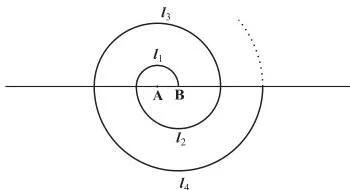
Concept: Each piece of the spiral in Fig. 5.4 is a semicircle, whose length is \( \pi r \) (half of \(2\pi r\)). The hint states the lengths are \(l_1, l_2, l_3, \dots\) with centres alternating at A, B, A, B, …. Because the radii \(0.5, 1.0, 1.5, \dots\) form an AP, so do the semicircle lengths — first term \( \pi(0.5) \), common difference \( \pi(0.5) \).
Step 1: The 13th radius is \(0.5 + 12 \times 0.5 = 6.5\) cm.
Sum the 13 radii:
\[ 0.5 + 1.0 + 1.5 + \dots + 6.5 = \frac{13}{2}[2(0.5) + (13-1)(0.5)] = \frac{13}{2}[1 + 6] = \frac{13 \times 7}{2} = \frac{91}{2} = 45.5 \]
Step 2: Multiply by \(\pi\) to convert the sum of radii into the total length:
\[ \text{Total length} = \pi \times 45.5 = \frac{22}{7} \times \frac{91}{2} = 11 \times 13 = 143 \ \text{cm} \]
Answer: The total length of the spiral is \(143\) cm.
Common error: Using full-circle length \(2\pi r\) instead of \( \pi r \).
A semicircle is half a circle — forgetting the factor \(\frac{1}{2}\) gives double the correct answer.
Question 19: 200 logs are stacked in the following manner: 20 logs in the bottom row, 19 in the next row, 18 in the row next to it and so on (see Fig. 5.5). In how many rows are the 200 logs placed and how many logs are in the top row?

Concept: The row counts \(20, 19, 18, \dots\) form an AP with \(a = 20\), \(d = -1\). The total number of logs is a partial sum of this AP set equal to 200; solving gives the row count, and the last term is the top row.
\[ 200 = \frac{n}{2}[2(20) + (n-1)(-1)] = \frac{n}{2}[41 – n] \]
\[ 400 = 41n – n^2 \Rightarrow n^2 – 41n + 400 = 0 \Rightarrow (n-16)(n-25) = 0 \]
Both \(n = 16\) and \(n = 25\) solve the equation, but \(n = 25\) would make the top row \(20 + 24(-1) = -4\) logs — impossible.
So \(n = 16\).
\[ \text{Top row} = 20 + (16-1)(-1) = 5 \]
Answer: 16 rows, with 5 logs in the top row.
Common error: Accepting both roots without testing.
In sum problems with negative \(d\), a quadratic in \(n\) can give two valid-looking answers — reject the one that makes the final term (here a log count) negative.
Question 20: In a potato race, a bucket is placed at the starting point, which is 5 m from the first potato, and the other potatoes are placed 3 m apart in a straight line. There are ten potatoes in the line (see Fig. 5.6). A competitor starts from the bucket, picks up the nearest potato, runs back with it, drops it in the bucket, runs back to pick up the next potato, runs to the bucket to drop it in, and she continues in the same way until all the potatoes are in the bucket. What is the total distance the competitor has to run?

Concept: Each potato is fetched and returned, so every trip is twice the potato’s distance from the bucket. The one-way distances are \(5, 8, 11, \dots\) m — an AP — so the round-trip distances \(10, 16, 22, \dots\) m also form an AP with \(a = 10\), \(d = 6\).
\[ S_{10} = \frac{10}{2}[2(10) + (10-1)(6)] = 5[20 + 54] = 5 \times 74 = 370 \]
Answer: The competitor runs a total of 370 m.
Check with the hint: First potato: \(2 \times 5 = 10\) m; second: \(2 \times (5+3) = 16\) m.
The AP \(10, 16, 22, \dots\) matches the hint, so the set-up is correct before the sum is trusted.
Method Recap: Choosing the Right Sum Formula
Before attempting any sum-of-AP question, decide which formula fits the quantities you are given. The comparison below shows when each one applies.
| Formula | When to use it | Quantities you need |
|---|---|---|
| \( S = \frac{n}{2}[2a + (n-1)d] \) | First term \(a\), common difference \(d\), count \(n\) all known | \(a, d, n\) |
| \( S = \frac{n}{2}(a + l) \) | First term \(a\) and last term \(l\) known — \(d\) not needed | \(a, l, n\) |
| \( S = \frac{n(n+1)}{2} \) | Sum of the first \(n\) positive integers — the special case \(a = 1, l = n\) | \(n\) only |
The core formula holds four quantities, \(S, a, d, n\), and any three of them give the fourth (NCERT Section 5.4, p. 66). Two further tools appear repeatedly in this exercise: the nth term \(a_n = a + (n-1)d\), and the remark \(a_n = S_n – S_{n-1}\) (NCERT p. 66), which is exactly what Question 11 exploits.
From the summary (NCERT p. 72), if \(a, b, c\) are in AP then \(b = \frac{a+c}{2}\) — the arithmetic mean of \(a\) and \(c\).
Worked example with new numbers
Find the sum of the first 20 terms of the AP \(3, 7, 11, \dots\). Here \(a = 3\), \(d = 7 – 3 = 4\), \(n = 20\) — all three known, so use \(S = \frac{n}{2}[2a + (n-1)d]\):
\[ S_{20} = \frac{20}{2}[2(3) + (20-1)(4)] = 10(6 + 76) = 10 \times 82 = 820 \]
Check: The 20th term is \(3 + 19 \times 4 = 79\), so using the other form, \(S_{20} = \frac{20}{2}(3 + 79) = 10 \times 82 = 820\). Both formulas agree.
When a sum question gives two values of n
When \(a\) is positive and \(d\) is negative, positive and negative terms partially cancel, so the same sum can belong to two different counts. NCERT Example 13 (p. 67) shows this for the AP \(24, 21, 18, \dots\) whose sum is 78: solving gives \(n = 4\) or \(n = 13\), and both are admissible because the terms from the 5th to the 13th add to zero.
In other problems (like Question 19 of this exercise) a root must be rejected because it forces an impossible final term — always test each root in the context.
Mistakes students actually make in Exercise 5.3
| Mistake | Correct rule | How to check your answer |
|---|---|---|
| Discarding the wrong root of the quadratic in \(n\) | \(n\) must be a positive whole number; reject negative or fractional roots, but keep a positive root even if it feels large | Substitute each root back into the AP — with negative \(d\), two roots can both be correct for the same sum |
| Putting the last term \(l\) where the first term \(a\) belongs | \(l\) is the nth term; \(a\) is always the first. Only \(S = \frac{n}{2}(a+l)\) pairs them | Label \(a\) and \(l\) in the question before substituting |
| Confusing the two sum formulas | Use \( \frac{n}{2}[2a+(n-1)d] \) when \(d\) is known, \( \frac{n}{2}(a+l) \) when the last term is known | Write down the quantities you have; the formula must contain only those |
| Sign slips on a negative common difference | \(d = a_2 – a_1\) includes the sign: for \(34, 32, 30, \dots\), \(d = -2\) | Recompute the second term from your \(d\) — it must match the printed term |
Once you are comfortable here, the chapter’s optional Exercise 5.4 moves on to harder applications. For the rest of the chapter’s theory, see the class 10 maths notes; for the quadratics this exercise keeps producing, the quadratic equations class 10 notes review the factorisation and formula methods.
The full set of class 10 notes and CBSE notes are there too, and the geometry chapter that follows, triangles class 10 notes, builds on the same algebraic confidence.
Frequently Asked Questions on Exercise 5.3
How do I know which sum formula to use — \( S = \frac{n}{2}[2a + (n-1)d] \) or \( S = \frac{n}{2}(a + l) \)?
Look at what the question gives you. If you know the first term \(a\), the common difference \(d\) and the number of terms \(n\), use \( S = \frac{n}{2}[2a + (n-1)d] \). If you know the first term \(a\) and the last term \(l\) — and especially if \(d\) is not mentioned — use \( S = \frac{n}{2}(a + l) \), which never needs \(d\).
In questions like 5 and 6 the last term is given precisely so this shorter form applies first.
Why does an AP sum question sometimes give two values of n, like 4 and 13?
When the first term is positive and the common difference is negative, the AP rises then crosses zero, so later terms are negative. Some positive and negative terms cancel, letting two different numbers of terms reach the same sum.
NCERT Example 13 shows the AP \(24, 21, 18, \dots\) with sum 78 gives \(n = 4\) or \(n = 13\), because the terms from the 5th to the 13th add to zero. Both are admissible there; in other questions (like Question 19) one root is rejected because it makes a final term impossible.
How can I find the nth term when only the sum formula like \( S_n = 4n – n^2 \) is given?
Use the remark \( a_n = S_n – S_{n-1} \). The first term is \(S_1\), and every later term is the difference of two consecutive partial sums. For \(S_n = 4n – n^2\): \(a_1 = S_1 = 3\), \(a_2 = S_2 – S_1 = 4 – 3 = 1\), and in general \(a_n = (4n – n^2) – [4(n-1) – (n-1)^2] = 5 – 2n\). This is exactly the method Question 11 tests.
Which three quantities must I know before I can use the sum formula?
Any three of the four quantities \(S, a, d, n\) (NCERT p. 66). If you know \(a, d, n\), substitute straight into \( S = \frac{n}{2}[2a + (n-1)d] \). If you know \(S\) and only two of the others, form an equation in the missing one — a quadratic when the missing quantity is \(n\), as in Questions 3(vi), 3(viii) and 4.
The general rule: one equation for one missing quantity, two equations when both \(a\) and \(d\) are missing.
Every question solved here is taken word for word from the official NCERT Class 10 Mathematics textbook PDF for Chapter 5, so you can check any question number or formula of Exercise 5.3 against the source document page by page before the exam.
Reference: NCERT Class 10 Mathematics textbook, chapter Arithmetic Progressions.
Explore Class 10 Maths NCERT Solutions
More for this chapter:
Class 10 Maths on LearnCBSE:
Related chapters: