This page gives the complete Exercise 4.1 Class 10 Maths NCERT Solutions for the chapter Quadratic Equations, with every part worked out for the current 2026-27 session.
The exercise has just two questions, but they matter far out of proportion to their length: Question 1 trains you to recognise a quadratic equation even when it arrives disguised inside brackets and cubes, and Question 2 trains you to turn an ordinary word problem into the standard form \( ax^2 + bx + c = 0 \).
Work through both here, and every later exercise in the chapter becomes easier.
Exercise 4.1 Class 10 Maths NCERT Solutions
Exercise 4.1 has two quite different jobs. Question 1 gives you eight equations, some already in standard form and some hidden inside products, squares and cubes, and asks you to check which ones are quadratic. Question 2 gives you four real-life situations and asks you to represent each as a quadratic equation — without solving it.
There are no in-text questions inside this exercise; the two numbered questions are the whole exercise.
By the end you should be comfortable with two skills that the whole chapter builds on: spotting a quadratic equation after simplification, and translating words into the form \( ax^2 + bx + c = 0 \) (NCERT, p. 4).
Concepts this exercise actually needs
A quadratic equation in the variable \( x \) is an equation of the form \( ax^2 + bx + c = 0 \), where \( a, b, c \) are real numbers and \( a \neq 0 \) (NCERT, p. 2). When the terms are written in descending order of their degrees, we get the standard form of the equation.
- The two questions are separate skills. Question 1 asks is this a quadratic equation? — a yes/no check. Question 2 asks build the equation from a situation — a translation task. Forming an equation is not the same as solving it.
- Simplify before you judge. An equation that looks quadratic may simplify to linear when the \( x^2 \) terms cancel, and an equation that looks cubic may turn out quadratic when the \( x^3 \) terms cancel. The NCERT remark after Example 2 makes this exact point (NCERT, pp. 2-3).
- How the check works. Expand every bracket on both sides, simplify, and compare what remains with \( ax^2 + bx + c = 0 \). If the highest surviving power of \( x \) is 2 and \( a \neq 0 \), it is quadratic.
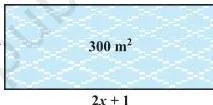
The prayer hall in Fig. 4.1 is the chapter’s opening model of how a real situation becomes a quadratic equation (NCERT, p. 1). With breadth \( x \) m and length \( (2x + 1) \) m, the area statement \( x(2x + 1) = 300 \) simplifies to \( 2x^2 + x – 300 = 0 \). Exercise 4.1 has no figure to solve, but Question 2 uses exactly this same translate-and-simplify routine on four fresh situations.
Question 1: Check whether the following are quadratic equations :
The eight equations to test are:
- (i) \( (x + 1)^2 = 2(x – 3) \)
- (ii) \( x^2 – 2x = (-2)(3 – x) \)
- (iii) \( (x – 2)(x + 1) = (x – 1)(x + 3) \)
- (iv) \( (x – 3)(2x + 1) = x(x + 5) \)
- (v) \( (2x – 1)(x – 3) = (x + 5)(x – 1) \)
- (vi) \( x^2 + 3x + 1 = (x – 2)^2 \)
- (vii) \( (x + 2)^3 = 2x(x^2 – 1) \)
- (viii) \( x^3 – 4x^2 – x + 1 = (x – 2)^3 \)
The test is always the same: expand both sides, simplify, and ask what degree survives. A quadratic needs an \( x^2 \) term with a non-zero coefficient that does not cancel out during simplification.
Part (i): Expand both sides.
\( (x + 1)^2 = x^2 + 2x + 1 \) and \( 2(x – 3) = 2x – 6 \).
\[ x^2 + 2x + 1 = 2x – 6 \;\Rightarrow\; x^2 + 7 = 0 \]
This is of the form \( ax^2 + bx + c = 0 \) with \( a = 1, b = 0, c = 7 \). Yes, a quadratic equation.
Part (ii): Distribute the right side carefully — the minus sign multiplies both terms.
\( (-2)(3 – x) = -6 + 2x \).
\[ x^2 – 2x = -6 + 2x \;\Rightarrow\; x^2 – 4x + 6 = 0 \]
\( a = 1, b = -4, c = 6 \). Yes, a quadratic equation.
Part (iii): Multiply out both pairs of brackets.
\( (x – 2)(x + 1) = x^2 – x – 2 \) and \( (x – 1)(x + 3) = x^2 + 2x – 3 \).
\[ x^2 – x – 2 = x^2 + 2x – 3 \;\Rightarrow\; -3x + 1 = 0 \]
The \( x^2 \) terms cancel, leaving a linear equation. No, not a quadratic equation.
Part (iv): Expand both sides.
\( (x – 3)(2x + 1) = 2x^2 – 5x – 3 \) and \( x(x + 5) = x^2 + 5x \).
\[ 2x^2 – 5x – 3 = x^2 + 5x \;\Rightarrow\; x^2 – 10x – 3 = 0 \]
\( a = 1, b = -10, c = -3 \). Yes, a quadratic equation.
Part (v): Expand both sides.
\( (2x – 1)(x – 3) = 2x^2 – 7x + 3 \) and \( (x + 5)(x – 1) = x^2 + 4x – 5 \).
\[ 2x^2 – 7x + 3 = x^2 + 4x – 5 \;\Rightarrow\; x^2 – 11x + 8 = 0 \]
\( a = 1, b = -11, c = 8 \). Yes, a quadratic equation.
Part (vi): Expand the square.
\( (x – 2)^2 = x^2 – 4x + 4 \).
\[ x^2 + 3x + 1 = x^2 – 4x + 4 \;\Rightarrow\; 7x – 3 = 0 \]
The \( x^2 \) terms cancel, leaving a linear equation. No, not a quadratic equation.
Part (vii): Use \( (a + b)^3 = a^3 + 3a^2b + 3ab^2 + b^3 \).
Here \( (x + 2)^3 = x^3 + 6x^2 + 12x + 8 \) and \( 2x(x^2 – 1) = 2x^3 – 2x \).
\[ x^3 + 6x^2 + 12x + 8 = 2x^3 – 2x \;\Rightarrow\; x^3 – 6x^2 – 14x – 8 = 0 \]
The \( x^3 \) term survives — the equation is cubic, degree 3. No, not a quadratic equation.
Part (viii): Use \( (a – b)^3 = a^3 – 3a^2b + 3ab^2 – b^3 \).
Here \( (x – 2)^3 = x^3 – 6x^2 + 12x – 8 \).
\[ x^3 – 4x^2 – x + 1 = x^3 – 6x^2 + 12x – 8 \;\Rightarrow\; 2x^2 – 13x + 9 = 0 \]
The \( x^3 \) terms cancel on both sides, leaving \( a = 2, b = -13, c = 9 \). Yes, a quadratic equation.
Common error: judging an equation before simplifying. Parts (iii) and (vi) look quadratic but collapse to linear, while part (viii) looks cubic yet becomes quadratic. The safest check is always the same: after simplifying, read off the highest power of \( x \) that survives.
Question 2: Represent the following situations in the form of quadratic equations :
The four situations are:
- (i) The area of a rectangular plot is \( 528 \text{ m}^2 \). The length of the plot (in metres) is one more than twice its breadth. We need to find the length and breadth of the plot.
- (ii) The product of two consecutive positive integers is 306. We need to find the integers.
- (iii) Rohan’s mother is 26 years older than him. The product of their ages (in years) 3 years from now will be 360. We would like to find Rohan’s present age.
- (iv) A train travels a distance of 480 km at a uniform speed. If the speed had been 8 km/h less, then it would have taken 3 hours more to cover the same distance. We need to find the speed of the train.
The instruction is represent — translate the words into symbols and simplify to the standard form \( ax^2 + bx + c = 0 \). You are not solving for the roots here; that work begins in Exercise 4.2. In each part the marks sit with naming the unknown and writing the final standard form.
Part (i): Let the breadth be \( x \) metres.
Then the length, one more than twice the breadth, is \( (2x + 1) \) metres.
Area \( = \) length \( \times \) breadth.
\[ x(2x + 1) = 528 \;\Rightarrow\; 2x^2 + x – 528 = 0 \]
The quadratic equation is \( 2x^2 + x – 528 = 0 \), with \( a = 2, b = 1, c = -528 \).
Part (ii): Let the first integer be \( x \).
The next consecutive integer is \( x + 1 \).
Their product is given as 306.
\[ x(x + 1) = 306 \;\Rightarrow\; x^2 + x – 306 = 0 \]
The quadratic equation is \( x^2 + x – 306 = 0 \).
Part (iii): Let Rohan’s present age be \( x \) years.
His mother is \( x + 26 \).
Three years from now their ages are \( x + 3 \) and \( x + 29 \).
Their product is 360.
\[ (x + 3)(x + 29) = 360 \;\Rightarrow\; x^2 + 32x + 87 = 360 \;\Rightarrow\; x^2 + 32x – 273 = 0 \]
The quadratic equation is \( x^2 + 32x – 273 = 0 \).
Part (iv): Let the train’s speed be \( v \) km/h.
Time \( = \) distance \( \div \) speed, so the original time is \( 480/v \) hours and the time at \( v – 8 \) km/h is \( 480/(v – 8) \) hours.
A slower speed takes 3 hours more.
\[ \frac{480}{v – 8} = \frac{480}{v} + 3 \]
Multiply through by \( v(v – 8) \) to clear the denominators.
\[ 480v = 480(v – 8) + 3v(v – 8) \]
\[ 480v = 480v – 3840 + 3v^2 – 24v \;\Rightarrow\; 3v^2 – 24v – 3840 = 0 \]
\[ \Rightarrow\; v^2 – 8v – 1280 = 0 \]
Dividing by 3 gives the quadratic equation \( v^2 – 8v – 1280 = 0 \).
Checking strategy: read your final equation back against the words. In (iv), ask: does \( 480/(v – 8) = 480/v + 3 \) say “8 km/h less means 3 hours more”? In (i), does \( x(2x + 1) = 528 \) match “one more than twice the breadth”? If the translation comes back word-for-word, the signs are almost certainly right.
Method Recap: The Standard Form Check and the Word-to-Equation Routine
Both skills in this exercise reduce to two short routines you can reuse in every later exercise (NCERT, p. 2).
For checking whether an equation is quadratic
- Expand every bracket on both sides of the equals sign.
- Simplify each side fully, bringing all terms to one side.
- Compare with \( ax^2 + bx + c = 0 \). If the highest surviving power of \( x \) is 2, it is quadratic.
- Watch for cancellation — the \( x^2 \) (or \( x^3 \)) terms may vanish during simplification.
For turning a word problem into a quadratic equation
- Name the unknown and say what it represents (breadth, age, speed, integer).
- Write the relation in words — “area = length × breadth”, “time = distance ÷ speed”.
- Translate with symbols and simplify to \( ax^2 + bx + c = 0 \).
- Stop at the equation — this exercise asks you to represent, not solve.
Worked example with fresh numbers
An equation can look quadratic and not be. Try \( 4x(x – 1) = (2x + 1)^2 – 5 \). Expand both sides:
\[ 4x^2 – 4x = 4x^2 + 4x – 4 \]
\[ \Rightarrow\; -8x + 4 = 0 \]
The \( x^2 \) terms cancel completely, leaving a linear equation. So this is not a quadratic equation, even though it started with \( x^2 \) on both sides. The same lesson drove parts (iii) and (vi) of Question 1.
This exercise prepares the ground for solving equations; the full set of Class 10 Maths revision notes keeps all the chapter’s routines in one place.
Where Students Lose Marks in Exercise 4.1
The table below sorts every part of Question 1 into quadratic and not-quadratic, with the reason in one line.
| Part | Simplified form | Quadratic? | Reason |
|---|---|---|---|
| (i) | \( x^2 + 7 = 0 \) | Yes | \( x^2 \) survives with \( a = 1 \) |
| (ii) | \( x^2 – 4x + 6 = 0 \) | Yes | \( x^2 \) survives with \( a = 1 \) |
| (iii) | \( -3x + 1 = 0 \) | No | \( x^2 \) cancels, degree 1 |
| (iv) | \( x^2 – 10x – 3 = 0 \) | Yes | \( x^2 \) survives with \( a = 1 \) |
| (v) | \( x^2 – 11x + 8 = 0 \) | Yes | \( x^2 \) survives with \( a = 1 \) |
| (vi) | \( 7x – 3 = 0 \) | No | \( x^2 \) cancels, degree 1 |
| (vii) | \( x^3 – 6x^2 – 14x – 8 = 0 \) | No | \( x^3 \) survives, degree 3 |
| (viii) | \( 2x^2 – 13x + 9 = 0 \) | Yes | \( x^3 \) cancels, \( x^2 \) survives |
The slips that cost marks, and how to catch them
| Mistake | Correct rule | How to check your answer |
|---|---|---|
| Expanding only one side of the equation, then comparing | Expand both sides fully before comparing anything | Write the expanded LHS and RHS separately, then join them with \( = \) |
| Declaring an equation quadratic before simplifying | The \( x^2 \) terms may cancel (parts iii, vi) or appear only after expansion (part viii) | Simplify fully, then read the highest surviving power of \( x \) |
| Mishandling signs such as \( (-2)(3 – x) \) | The minus multiplies both terms: \( (-2)(3 – x) = -6 + 2x \) | Write the bracket product out in full before simplifying |
| Treating every \( x^3 \) equation as non-quadratic without checking | Check whether \( x^3 \) cancels — part viii becomes quadratic, part vii stays cubic | Compare the cube terms on both sides before moving them |
| Solving Question 2 instead of stopping at the equation | The word “represent” means form the equation in standard form only | Finish at \( ax^2 + bx + c = 0 \); do not find roots (that is Exercise 4.2) |
What Comes After Exercise 4.1
Exercise 4.1 puts every equation into standard form; Exercise 4.2 then takes those equations and finds their roots by splitting the middle term and factorising (NCERT, p. 5). Later, Section 4.4 introduces the discriminant \( b^2 – 4ac \) and the quadratic formula, which tells you whether roots are real and distinct, equal, or absent (NCERT, p. 7).
This chapter also stands on the pair of linear equations in two variables you studied in Chapter 3, and it feeds the arithmetic progressions of Chapter 5. The full CBSE notes library keeps all of these together.
Every equation and worked example on this page is taken word for word from the official NCERT Class 10 Mathematics Chapter 4 PDF, which you can open and check equation by equation against the source: NCERT Class 10 Mathematics Chapter 4 — Quadratic Equations (jemh104.pdf).
FAQs on Exercise 4.1 Quadratic Equations
Why is \( (x + 2)^3 = x^3 – 4 \) a quadratic equation even though it has an \( x^3 \) term?
Because the \( x^3 \) terms cancel. Expanding gives \( x^3 + 6x^2 + 12x + 8 = x^3 – 4 \). Subtract \( x^3 \) from both sides and you get \( 6x^2 + 12x + 12 = 0 \), or \( x^2 + 2x + 2 = 0 \) — a quadratic. The degree is decided by what survives simplification, not by what appears on the page first (NCERT, pp. 2-3).
If the \( x^2 \) terms cancel when I simplify, is the equation still quadratic?
No. When the \( x^2 \) terms cancel, what remains is a linear equation, so it is not quadratic. That is exactly what happens in parts (iii) and (vi) of Question 1, which both simplify to linear form. The standard-form check settles it every time.
Question 2 says “represent” — why should I stop after forming the equation instead of solving it?
Because forming and solving are separate skills, and this exercise asks for the first one only. In an exam, the marks for Question 2 sit with defining the unknown and writing the final standard form \( ax^2 + bx + c = 0 \).
Finding the roots is a different exercise — you will do exactly that in Exercise 4.2, so there is no credit to be gained by solving here.
How do I set up the train problem in Question 2 (iv) using speed and time?
Start from \( \text{time} = \text{distance} \div \text{speed} \). If the speed is \( v \) km/h, the original time is \( 480/v \) hours. At 8 km/h less, the time is \( 480/(v – 8) \) hours, which is 3 hours more. So \( 480/(v – 8) = 480/v + 3 \), and clearing denominators gives \( v^2 – 8v – 1280 = 0 \) (NCERT, p. 4).
You can also find this and the other chapter pages in the Class 10 chapter notes.
Reference: NCERT Class 10 Mathematics textbook, chapter Quadratic Equations.
Explore Class 10 Maths NCERT Solutions
More for this chapter:
Class 10 Maths on LearnCBSE:
Related chapters: