
These exercise 6.1 class 10 maths NCERT solutions solve all three questions of the Triangles chapter step by step. This short exercise tests one core idea: what makes two figures — and two polygons — similar.
We start with the exact definition and the two conditions you must check, then work through every part of every question, and finish with a three-step checking method you can reuse through the whole chapter.
Every question is reproduced exactly as printed in the official textbook, so you can verify any answer against the official NCERT Class 10 Mathematics chapter PDF (jemh106.pdf). These solutions are part of our Class 10 study resources.
What Exercise 6.1 Teaches: Similar Figures and Polygons
Exercise 6.1 is the opening lesson of the Triangles chapter. It asks you to decide which figures are similar and which are not, purely from the definition of similar figures — you do not yet need any of the triangle criteria that appear in later exercises (NCERT, p. 2).
The chapter first recalls that two figures are congruent if they have the same shape and the same size. It then defines similar figures as figures that have the same shape but not necessarily the same size (NCERT, p. 1). So every congruent figure is similar, but the reverse is not true.
The three questions cover: a fill-in-the-blanks set on circles, squares, equilateral triangles and polygons; a give-examples question; and one figure-based question on two quadrilaterals. All three force you to apply the same two conditions, so master those before solving.
Key Rules Before You Solve: The Definition of Similar Figures
Two polygons of the same number of sides are similar when two conditions hold together (NCERT, p. 2):
- Corresponding angles are equal.
- Corresponding sides are in the same ratio (that is, proportional).
That common side ratio is called the scale factor (or Representative Fraction) of the two polygons (NCERT, p. 2).
Why two conditions? One condition alone can look convincing and still fail. The figure below shows a square and a rectangle: every corresponding angle is \( 90^\circ \), so the first condition holds — yet the two are not similar.
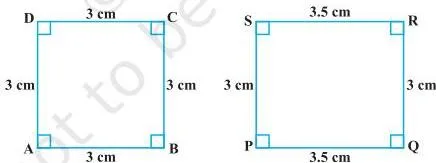
The same trap works in reverse: a square and a rhombus have their sides in the same ratio, yet their angles differ, so they are not similar either (NCERT, p. 2). In short, both conditions must hold at once — equal angles alone is never enough, and proportional sides alone is never enough.
Why it matters here: for triangles, the two conditions are interchangeable — if one holds, the other follows (Theorems 6.3 to 6.5). That is why later exercises are easier. But Exercise 6.1 deals with polygons, so you must check both conditions every time (NCERT, p. 13).
Worked example: Check whether triangles with sides 4, 6, 8 and 6, 9, 12 are similar.
Step 1: List corresponding sides and write each ratio in the same order.
\[ \frac{4}{6} = \frac{2}{3}, \quad \frac{6}{9} = \frac{2}{3}, \quad \frac{8}{12} = \frac{2}{3} \]
Step 2: Every pair of corresponding sides is in the same ratio \( \frac{2}{3} \).
Conclusion: The triangles are similar (SSS), with scale factor 2 : 3.
The table below contrasts the two ideas this exercise depends on:
| Feature | Congruent figures | Similar figures |
|---|---|---|
| Same shape | Yes | Yes |
| Same size | Yes | Not necessarily |
| Symbol | \( \cong \) | \( \sim \) |
| Example | Two circles of the same radius | Two circles of different radii |
Every congruent pair is similar, but similar pairs need not be congruent (NCERT, p. 2; p. 25).
Exercise 6.1 Class 10 Maths NCERT Solutions (All Questions Solved)
Question 1: Fill in the blanks using the correct word given in brackets :
(i) All circles are _______. (congruent, similar) (ii) All squares are _______. (similar, congruent) (iii) All _______ triangles are similar. (isosceles, equilateral) (iv) Two polygons of the same number of sides are similar, if (a) their corresponding angles are _______ and (b) their corresponding sides are _______. (equal, proportional)
Answer: Similarity is about shape, not size. Two figures are similar when one is an exact scale copy of the other — same angles, and all sides enlarged or reduced by one common factor. Congruence goes further and also demands the same size.
Part (i): All circles are similar. Every circle has the same shape; only its radius differs, so any two circles are scale copies of each other.
Part (ii): All squares are similar. Every square has four equal sides and four equal \( 90^\circ \) angles, and two squares differ only in size.
Part (iii): All equilateral triangles are similar, because every equilateral triangle has all angles equal to \( 60^\circ \). Any two equilateral triangles are scale copies of each other.
Part (iv): The two conditions from the definition are (a) corresponding angles are equal and (b) corresponding sides are proportional (NCERT, p. 2; p. 6).
Student tip: The trap is in (iii). Isosceles triangles are not all similar — one can have angles \( 40^\circ, 70^\circ, 70^\circ \) and another \( 50^\circ, 65^\circ, 65^\circ \), so their shapes differ. Only equilateral triangles, with all angles fixed at \( 60^\circ \), are guaranteed similar.
Question 2: Give two different examples of pair of
(i) similar figures.
(ii) non-similar figures.
Answer: The test is “same shape, any size”. For similar figures that means an identical shape at a different scale; for non-similar figures, a change in shape.
Part (i) similar figures — Example 1: two circles of different radii, say 2 cm and 4 cm. Same circular shape, different size.
Part (i) similar figures — Example 2: two equilateral triangles of different side lengths, say 3 cm and 5 cm. Each has all angles \( 60^\circ \), so the larger is a scaled copy of the smaller.
Part (ii) non-similar figures — Example 1: a circle and a square. Their shapes are entirely different.
Part (ii) non-similar figures — Example 2: a rectangle and a rhombus. A rectangle has four right angles, while a rhombus (unless it is a square) does not, so the shapes differ.
Student tip: The question asks for two different examples in each part, so label them “Example 1” and “Example 2”. For part (i), never give two figures of the same size with different shapes — that pair is non-similar, not similar.
Question 3: State whether the following quadrilaterals are similar or not:
Fig. 6.8
Answer: For two quadrilaterals to be similar, both conditions must hold — corresponding angles equal and corresponding sides in the same ratio. One condition alone is never enough; that is the whole point of this exercise.
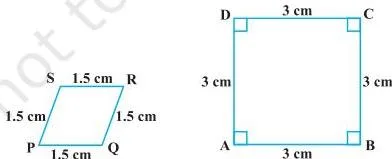
In Fig. 6.8, the two quadrilaterals have their corresponding angles equal — each angle is \( 90^\circ \). So the first condition holds. But when you compare the corresponding sides, the marked lengths are not in the same ratio: the ratio of one pair of sides differs from the ratio of the other pair.
The second condition therefore fails, exactly as it does for the square and rectangle of Fig. 6.6.
Verdict: The quadrilaterals are not similar (NCERT, p. 6).
Student tip: Never decide similarity by eye — two figures can look alike and still fail the ratio check. Always compare the marked (or measured) lengths of corresponding sides and check every pair of corresponding angles.
Method Recap: How to Check Whether Two Polygons Are Similar
Turn the definition into a reusable three-step checklist, taken from the chapter summary (NCERT, p. 25):
- Same number of sides — a pentagon and a hexagon can never be similar.
- Corresponding angles equal — match each vertex of one polygon to its partner in the other and check all angles.
- Corresponding sides in the same ratio — divide each side of the first polygon by the corresponding side of the second; all quotients must be equal. That common quotient is the scale factor.
All three must hold. For triangles only, equal angles OR proportional sides alone is enough (AAA/AA, SSS, SAS criteria), because one condition forces the other. For general polygons — which is exactly what Exercise 6.1 tests — you need both conditions (NCERT, p. 13).
Here is how the common families behave:
| Figure family | Are all members similar? | Why |
|---|---|---|
| Circles | Yes | Same shape, different radii |
| Squares | Yes | Four equal sides and equal angles |
| Equilateral triangles | Yes | All angles \( 60^\circ \) |
| Isosceles triangles | No | Angles vary with the base angles |
| Rectangles | No | Length-to-breadth ratio varies |
Common slips in one-mark and fill-in-the-blank questions
Questions like those in Exercise 6.1 test the exact wording similar versus congruent. The slips students make most often in board exams:
| Mistake | Correct rule | How to check your answer |
|---|---|---|
| Judging similarity by eye | Apply the two conditions, never “looks similar” | List corresponding angles and side ratios on paper |
| Accepting equal angles alone (square vs rectangle) | Both conditions must hold | Check that corresponding sides are in the same ratio |
| Accepting proportional sides alone (square vs rhombus) | Both conditions must hold | Check that corresponding angles are equal |
| Saying “all isosceles triangles are similar” | Only equilateral triangles are all similar | Two isosceles triangles can have different angles |
In the next exercises the focus moves to triangles, where the Basic Proportionality Theorem (Theorem 6.1) and the AAA, AA, SSS and SAS similarity criteria let you decide similarity with far less checking. You can prepare those with our Class 10 Maths notes and the worked solutions for Arithmetic Progressions (Chapter 5) and Coordinate Geometry (Chapter 7).
Frequently Asked Questions
Are all squares similar to each other?
Yes. Every square has four equal sides and four right angles, so any two squares differ only in size. Each side of one square is in the same ratio to the corresponding side of the other, and all angles match — both similarity conditions hold (NCERT, p. 2).
Why are two rectangles not always similar even when all their angles are equal?
All rectangles have four right angles, so the first condition (equal corresponding angles) always holds. But two rectangles are similar only when their length-to-breadth ratios are the same. A 6 × 3 rectangle and an 8 × 2 rectangle have equal angles yet different side ratios, so they are not similar (NCERT, p. 2).
What is the difference between congruent figures and similar figures?
Congruent figures have the same shape and the same size. Similar figures have the same shape but not necessarily the same size. Every congruent pair is similar, but a similar pair need not be congruent (NCERT, p. 1; p. 25).
How can I check whether two polygons are similar in an exam question?
Check three things in order: the polygons must have the same number of sides; their corresponding angles must be equal; and their corresponding sides must be in the same ratio. If all three hold, the polygons are similar, and that common side ratio is the scale factor.
For triangles you may use the shortcut criteria (AAA, SSS, SAS), but for general polygons you must check both conditions (NCERT, p. 25).
Reference: NCERT Class 10 Mathematics textbook, chapter Triangles.
Explore Class 10 Maths NCERT Solutions
More for this chapter:
Class 10 Maths on LearnCBSE:
Related chapters: