This is the complete set of exercise 4.3 class 10 maths NCERT solutions for the 2026-27 session: every question of Exercise 4.3 of Chapter 4 (Quadratic Equations), reproduced exactly as printed in the textbook and solved step by step.
Each answer opens with the idea behind the method — why the sign of the discriminant decides the nature of the roots, how equal-root questions are reversed into a condition on k, and when a real-life design is actually possible — then gives the full working and a warning about the one mistake students make most often on that question.
Exercise 4.3 Class 10 Maths NCERT Solutions
Exercise 4.3 (NCERT, p. 10) has five numbered questions and no separate intext questions. All five questions test one skill: judging the roots of a quadratic equation by its discriminant \( b^2 – 4ac \).
- Question 1 applies the three discriminant cases directly — no real roots, two equal real roots, two distinct real roots.
- Question 2 works backwards: you are told the roots are equal, so you set the discriminant to zero and solve for k.
- Questions 3–5 turn real designs into quadratic equations (a mango grove, two friends’ ages, a rectangular park) and use the discriminant to decide whether the situation is even possible.
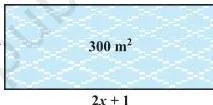
The chapter opens with the same rectangle-to-equation step that Q3 and Q5 repeat: a prayer hall of breadth x m and length \( (2x + 1) \) m has area \( 2x^2 + x \), which is set equal to 300 to build the quadratic \( 2x^2 + x – 300 = 0 \) (NCERT, p. 1).
For quick revision of the supporting ideas, see the Class 10 Maths notes and the full Class 10 notes hub. The skill of turning a sentence into an equation is the same one you practised in Chapter 3 notes on pair of linear equations — there the relationships were linear, here the product makes them quadratic.
Key ideas: discriminant, quadratic formula and nature of roots
Everything in this exercise runs on four ideas from the chapter (NCERT, p. 7).
- Standard form: a quadratic equation in x is \( ax^2 + bx + c = 0 \), where \( a, b, c \) are real numbers and \( a \neq 0 \).
- Root / solution: a real number \( \alpha \) is a root if \( a\alpha^2 + b\alpha + c = 0 \). The zeroes of the polynomial and the roots of the equation are the same.
- Quadratic formula: \( x = \dfrac{-b \pm \sqrt{b^2 – 4ac}}{2a} \), provided \( b^2 – 4ac \geq 0 \).
- Discriminant: \( b^2 – 4ac \) decides the nature of the roots before you solve.
| Discriminant \( b^2 – 4ac \) | Nature of roots | Example from Q1 |
|---|---|---|
| \( \gt 0 \) | Two distinct real roots | \( 2x^2 – 6x + 3 \), D = 12 |
| \( = 0 \) | Two equal real roots | \( 3x^2 – 4\sqrt{3}x + 4 \), D = 0 |
| \( \lt 0 \) | No real roots | \( 2x^2 – 3x + 5 \), D = −31 |
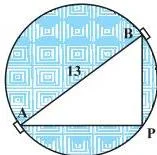
The pole-gates figure (Example 8, NCERT, p. 8) shows exactly how a discriminant answers an “is it possible?” question. The equation built from the distances had \( b^2 – 4ac = 7^2 – 4(1)(-60) = 289 \gt 0 \), so the pole could be erected. Q3–Q5 of the exercise use the same logic: check the discriminant first, then solve.
Question 1: Find the nature of the roots of the following quadratic equations. If the real roots exist, find them:
(i) \( 2x^2 – 3x + 5 = 0 \) (ii) \( 3x^2 – 4\sqrt{3}x + 4 = 0 \) (iii) \( 2x^2 – 6x + 3 = 0 \)
Concept: decide the nature of the roots before you solve. The sign of the discriminant \( D = b^2 – 4ac \) alone decides it: two distinct real roots when \( D \gt 0 \), two equal real roots when \( D = 0 \), no real roots when \( D \lt 0 \). Only when \( D \geq 0 \) do you apply the quadratic formula to actually find them.
Part (i): Here \( a = 2 \), \( b = -3 \), \( c = 5 \).
\[ D = (-3)^2 – 4(2)(5) = 9 – 40 = -31 \lt 0 \]
Since \( D \lt 0 \), there are no real roots, so there is nothing to find — no real x makes the left side equal to zero.
Part (ii): Here \( a = 3 \), \( b = -4\sqrt{3} \), \( c = 4 \).
\[ D = (-4\sqrt{3})^2 – 4(3)(4) = 48 – 48 = 0 \]
With \( D = 0 \) there are two equal real roots, both equal to \( -b/2a \):
\[ x = \frac{-b}{2a} = \frac{4\sqrt{3}}{6} = \frac{2\sqrt{3}}{3} \]
Final answer: both roots are \( \dfrac{2\sqrt{3}}{3} \) (equivalently \( \dfrac{2}{\sqrt{3}} \)).
Part (iii): Here \( a = 2 \), \( b = -6 \), \( c = 3 \).
\[ D = (-6)^2 – 4(2)(3) = 36 – 24 = 12 \gt 0 \]
Since \( D \gt 0 \), there are two distinct real roots.
The quadratic formula gives:
\[ x = \frac{6 \pm \sqrt{12}}{4} = \frac{6 \pm 2\sqrt{3}}{4} = \frac{3 \pm \sqrt{3}}{2} \]
Final answer: the roots are \( \dfrac{3 + \sqrt{3}}{2} \) and \( \dfrac{3 – \sqrt{3}}{2} \).
Common error: sign handling in the discriminant. \( (-3)^2 = +9 \) and \( (-4\sqrt{3})^2 = +48 \), both positive. A lost minus sign converts a real-root case into an imaginary one — square the whole negative coefficient, sign included, before comparing with \( 4ac \).
Question 2: Find the values of k for each of the following quadratic equations, so that they have two equal roots.
(i) \( 2x^2 + kx + 3 = 0 \) (ii) \( kx(x – 2) + 6 = 0 \)
Concept: two equal roots is exactly the condition discriminant = 0. Instead of solving for x, you set \( D = 0 \) and solve for k — the equation stays unsolved, and that is the point.
Part (i): Here \( a = 2 \), \( b = k \), \( c = 3 \). Equal roots mean \( D = 0 \):
\[ k^2 – 4(2)(3) = 0 \Rightarrow k^2 – 24 = 0 \Rightarrow k^2 = 24 \]
\[ k = \pm \sqrt{24} = \pm 2\sqrt{6} \]
Final answer: \( k = 2\sqrt{6} \) or \( k = -2\sqrt{6} \).
Part (ii): First expand the bracket — a step students skip. \( kx(x – 2) + 6 = 0 \) becomes \[ kx^2 – 2kx + 6 = 0 \]
so \( a = k \), \( b = -2k \), \( c = 6 \).
Equal roots mean \( D = 0 \):
\[ (-2k)^2 – 4(k)(6) = 0 \Rightarrow 4k^2 – 24k = 0 \Rightarrow 4k(k – 6) = 0 \]
Thus \( k = 0 \) or \( k = 6 \).
But \( k = 0 \) makes the “quadratic” equation \( 0x^2 – 0x + 6 = 0 \), which has no \( x^2 \) term at all — the standard form requires \( a \neq 0 \).
Discard \( k = 0 \).
Final answer: \( k = 6 \).
Common error: two traps here. First, read the coefficient of x correctly after expansion — it is \( -2k \), not \( -2 \). Second, discard \( k = 0 \): a quadratic equation must have a non-zero coefficient of \( x^2 \).
Question 3: Is it possible to design a rectangular mango grove whose length is twice its breadth, and the area is 800 m²? If so, find its length and breadth.
Concept: in word problems the variable carries a physical meaning, and that meaning decides which root survives. Here the variable is a breadth, so a negative value is meaningless even if the algebra allows it.
Let the breadth be \( x \) m, so the length is \( 2x \) m.
Area of a rectangle is length times breadth:
\[ 2x \cdot x = 800 \Rightarrow 2x^2 = 800 \Rightarrow x^2 = 400 \]
\[ x = \pm 20 \]
The negative root \( x = -20 \) satisfies the algebra but not a real grove — a breadth cannot be negative.
So \( x = 20 \).
Final answer: it is possible: breadth \( = 20 \) m and length \( = 2 \times 20 = 40 \) m.
How to check: verify with the question’s own words — \( 40 \times 20 = 800 \) m² and \( 40 = 2 \times 20 \). If both statements hold, the solution is right.
Question 4: Is the following situation possible? If so, determine their present ages. The sum of the ages of two friends is 20 years. Four years ago, the product of their ages in years was 48.
Concept: “Is it possible?” is answered completely by the discriminant. A negative discriminant means the quadratic has no real roots, so no real ages satisfy the situation — the answer is simply that it cannot happen.
Let the present ages be \( x \) and \( 20 – x \) years.
Four years ago they were \( x – 4 \) and \( 20 – x – 4 = 16 – x \).
Their product was 48:
\[ (x – 4)(16 – x) = 48 \]
Expand the left side carefully:
\[ 16x – x^2 – 64 + 4x = 48 \Rightarrow -x^2 + 20x – 64 = 48 \Rightarrow x^2 – 20x + 112 = 0 \]
Now check the discriminant with \( a = 1 \), \( b = -20 \), \( c = 112 \):
\[ D = (-20)^2 – 4(1)(112) = 400 – 448 = -48 \lt 0 \]
Final answer: since \( D \lt 0 \), the equation has no real roots; the situation is not possible.
Common error: do not hunt for factor pairs of 48 — that is not the question. The negative discriminant is the complete answer. Also keep the sign straight in the expansion: \( 16x – x^2 – 64 + 4x \) simplifies to \( -x^2 + 20x – 64 \), and multiplying by \( -1 \) gives \( x^2 – 20x + 112 = 0 \).
Question 5: Is it possible to design a rectangular park of perimeter 80 m and area 400 m²? If so, find its length and breadth.
Concept: when two quantities have a fixed sum and a fixed product, they are the roots of one quadratic equation. The length and breadth of the rectangle have sum 40 (from the perimeter) and product 400 (the area), so they are the roots of \( t^2 – 40t + 400 = 0 \).
Perimeter \( = 2(l + b) = 80 \), so \( l + b = 40 \).
Area \( lb = 400 \).
So length and breadth are the two numbers whose sum is 40 and product is 400 — the roots of \[ t^2 – 40t + 400 = 0 \]
Discriminant with \( a = 1 \), \( b = -40 \), \( c = 400 \):
\[ D = (-40)^2 – 4(1)(400) = 1600 – 1600 = 0 \]
Equal roots, both given by \[ t = \frac{-b}{2a} = \frac{40}{2} = 20 \]
Final answer: length = 20 m and breadth = 20 m. The “rectangle” is actually a square, and the design is possible: perimeter \( 4 \times 20 = 80 \) m and area \( 20 \times 20 = 400 \) m² both check out.
Common error: two equal roots here simply mean the two dimensions are equal. Do not panic when length and breadth come out the same — check that the perimeter and area still match the question before doubting the answer.
How to check your roots: substitution and sum-product method
Two quick ways to confirm any root without re-solving the whole equation (NCERT, p. 5 and p. 7).
- Substitution: a root \( \alpha \) satisfies the equation — plug it in and check that the left side becomes zero.
- Sum and product: for \( ax^2 + bx + c = 0 \), sum of roots \( = -b/a \) and product of roots \( = c/a \).
Worked mini-example with new numbers. Take \( 3x^2 – 7x + 2 = 0 \), whose roots are \( \frac{1}{3} \) and 2.
- Sum check: \( \frac{1}{3} + 2 = \frac{7}{3} \), and \( -b/a = \frac{7}{3} \) — match.
- Product check: \( \frac{1}{3} \times 2 = \frac{2}{3} \), and \( c/a = \frac{2}{3} \) — match.
Both checks agree, so the pair is confirmed — faster than substituting twice. The same sum-and-product shortcut reappears when you study Chapter 5 arithmetic progressions notes, where terms are built from a constant difference.
Where students slip in Exercise 4.3
| Mistake | Correct rule | How to check your answer |
|---|---|---|
| Taking \( (-3)^2 \) as \( -9 \) in the discriminant (Q1(i)) | A negative coefficient squared is positive: \( (-3)^2 = +9 \) | Square the number and the sign together, then subtract \( 4ac \) |
| Reading \( kx^2 – 2kx + 6 \) as \( b = -2 \) instead of \( b = -2k \) (Q2(ii)) | Expand first: \( a = k \), \( b = -2k \), \( c = 6 \) | Write the a, b, c line after expansion, before substituting |
| Accepting \( x = -20 \) as a breadth (Q3) | Length, breadth and ages cannot be negative | Ask “does this value make sense for the variable?” |
| Calling Q4 “unsolvable” instead of “impossible” | No real roots (\( D \lt 0 \)) means the situation cannot happen at all | State it plainly: negative discriminant → situation impossible |
| Dropping \( k = 0 \) without reason (Q2(ii)) | A quadratic must have \( a \neq 0 \); here \( k = 0 \) removes the \( x^2 \) term | Check what the equation becomes if \( k = 0 \) — it is not quadratic |
The three design questions follow one pattern, which makes them easy to revise together.
| Question | Situation | Equation built | Verdict |
|---|---|---|---|
| Q3 mango grove | length = 2 × breadth, area 800 m² | \( 2x^2 = 800 \), so \( x^2 = 400 \) | possible — breadth 20 m, length 40 m |
| Q4 ages | sum of ages 20, product 4 years ago = 48 | \( x^2 – 20x + 112 = 0 \), D = −48 | impossible — no real roots |
| Q5 park | perimeter 80 m, area 400 m² | \( t^2 – 40t + 400 = 0 \), D = 0 | possible — 20 m × 20 m square |
Practice problems with new numbers
These two are original self-test items, not NCERT questions, built on the same discriminant pipeline as Q1.
Practice 1: Find the nature of the roots of \( 4x^2 – 12x + 9 = 0 \), and find the roots if they are real. With \( a = 4 \), \( b = -12 \), \( c = 9 \):
\[ D = (-12)^2 – 4(4)(9) = 144 – 144 = 0 \]
So there are two equal real roots, and \[ x = \frac{-b}{2a} = \frac{12}{8} = \frac{3}{2} \]
Answer: equal real roots, both \( \dfrac{3}{2} \).
Practice 2: Find the nature of the roots of \( 2x^2 – 5x – 3 = 0 \), and find them. Check yourself: \( D = 25 + 24 = 49 \gt 0 \), so two distinct real roots; the roots are \( 3 \) and \( -\dfrac{1}{2} \). Verify with the sum: \( 3 + (-\frac{1}{2}) = \frac{5}{2} = -b/a \), and the product \( 3 \times (-\frac{1}{2}) = -\frac{3}{2} = c/a \).
Every question solved on this page is taken word for word from the official NCERT Class 10 Mathematics Chapter 4 PDF — open jemh104.pdf to check each worked answer against the printed source, page by page, with no sign-up needed.
Frequently asked questions about Exercise 4.3
Why does 2x² − 3x + 5 = 0 have no real roots?
Because its discriminant is negative. With \( a = 2 \), \( b = -3 \), \( c = 5 \), \( D = (-3)^2 – 4(2)(5) = 9 – 40 = -31 \lt 0 \). A negative discriminant means no real number exists whose square is \( -31 \) inside the quadratic formula, so the equation has no real roots.
Why is k = 0 rejected when solving kx(x − 2) + 6 = 0 for equal roots?
Because a quadratic equation must have \( a \neq 0 \). Expanding gives \( kx^2 – 2kx + 6 = 0 \), so \( a = k \). If \( k = 0 \), the equation collapses to \( 6 = 0 \), which is not quadratic at all — only \( k = 6 \) survives.
In question 4, the product of ages four years ago is 48, so why is the situation impossible?
The product being a “nice” number does not matter. The equation \( x^2 – 20x + 112 = 0 \) has discriminant \( 400 – 448 = -48 \lt 0 \), so no real \( x \) satisfies it. There is no pair of real ages whose sum is 20 and whose product four years ago was 48.
How can I check my roots in Exercise 4.3 without re-solving the equation?
Use two checks. Substitution: put each root back into the equation and confirm the left side becomes zero. Faster still, use sum and product: for \( ax^2 + bx + c = 0 \), the roots add to \( -b/a \) and multiply to \( c/a \). Matching both confirms the pair without re-solving.
What does it mean when a quadratic equation has two equal roots?
Two equal roots (\( D = 0 \)) mean both roots equal \( -b/2a \), so the parabola just touches the x-axis at one point. You saw it in Q1(ii) with both roots \( \frac{2\sqrt{3}}{3} \) and in Q5, where the “rectangle” became a square with both dimensions 20 m.
Explore more class-by-class help in the CBSE notes index.
Reference: NCERT Class 10 Mathematics textbook, chapter 4 (Quadratic Equations).
Explore Class 10 Maths NCERT Solutions
More for this chapter:
Class 10 Maths on LearnCBSE:
Related chapters: