Looking for exercise 4.2 class 10 maths ncert solutions? You have come to the right place. This page solves every question of NCERT Exercise 4.2 (Quadratic Equations, Class 10) using the factorisation method from Section 4.3 of the textbook, with complete working, a substitution check for each root, and the common errors students actually make.
The exercise has six questions: one factorisation set with five parts, then four word problems. There are no separate intext questions, so all six are solved below. Each solution gives the reasoning first, then the working, then a check of the answer.
Exercise 4.2 Class 10 Maths NCERT Solutions
Exercise 4.2 of the Quadratic Equations chapter applies one idea — the factorisation method of Section 4.3 — to two kinds of problems. Question 1 gives five quadratic equations to solve by splitting the middle term.
Questions 2 to 6 are word problems: you translate a real-life situation into a quadratic equation, solve it by factorisation, and then reject any root that does not fit the situation, such as a negative length or a negative count.
Question 2 has two valid answers; Questions 3 and 4 each give a pair of numbers; Questions 5 and 6 each have one root rejected. The exercise carries no separate intext questions, so the six questions below are the complete set.
Concepts You Need Before Solving Exercise 4.2
A quadratic equation in the variable x has the standard form \( ax^2 + bx + c = 0 \), where a, b, c are real numbers and \( a \neq 0 \) (NCERT, p. 2).
A real number \( \alpha \) is a root of \( ax^2 + bx + c = 0 \) if \( a\alpha^2 + b\alpha + c = 0 \). The roots of the equation are exactly the zeroes of the polynomial \( ax^2 + bx + c \), and a quadratic equation can have at most two roots (NCERT, p. 5).
The tool that does all the work is the zero product property: if two real factors multiply to zero, then at least one of them must be zero. So once the equation is written as \( (px + q)(rx + s) = 0 \), you can set \( px + q = 0 \) and \( rx + s = 0 \) separately and solve each line.
The four-step routine used in every question:
- Write the equation in standard form \( ax^2 + bx + c = 0 \).
- Find two numbers whose sum is b and whose product is \( a \times c \).
- Split bx into those two terms, then group and factor.
- Set each factor to zero and solve for x.
Try this fresh example before the exercise: \( 2x^2 – 7x + 6 = 0 \). We need two numbers adding to \( -7 \) and multiplying to \( 2 \times 6 = 12 \): the pair is \( -3 \) and \( -4 \), because \( (-3) + (-4) = -7 \) and \( (-3)(-4) = 12 \).
\[ 2x^2 – 7x + 6 = 2x^2 – 3x – 4x + 6 = x(2x – 3) – 2(2x – 3) = (x – 2)(2x – 3) \]
So the roots are \( x = 2 \) and \( x = \frac{3}{2} \). Notice the sign check many students skip: before grouping, multiply the two split numbers. Here \( (-3)(-4) = 12 \), which must equal \( a \times c = 12 \) — the product check confirms the pair is right.
When the two linear factors come out identical — as in \( (x – 1)^2 = 0 \) — both factors give the same root, so the equation has two equal roots. You must still write the root twice; a quadratic always has two roots counting repeats (NCERT, p. 5). Equal roots appear in Q1(iv) and Q1(v).
Question 1: Find the roots of the following quadratic equations by factorisation:
- \( \text{(i)} \quad x^2 – 3x – 10 = 0 \)
- \( \text{(ii)} \quad 2x^2 + x – 6 = 0 \)
- \( \text{(iii)} \quad \sqrt{2}x^2 + 7x + 5\sqrt{2} = 0 \)
- \( \text{(iv)} \quad 2x^2 – x + \frac{1}{8} = 0 \)
- \( \text{(v)} \quad 100x^2 – 20x + 1 = 0 \)
Answer: Every part uses the same idea: split the middle term so the two new terms multiply to \( a \times c \), factor by grouping, then set each factor to zero.
Part (i): For \( x^2 – 3x – 10 = 0 \), find two numbers adding to \( -3 \) and multiplying to \( 1 \times (-10) = -10 \).
The pair is \( -5 \) and \( +2 \), because \( (-5) + 2 = -3 \) and \( (-5)(2) = -10 \).
\[ x^2 – 3x – 10 = x^2 – 5x + 2x – 10 = x(x – 5) + 2(x – 5) = (x – 5)(x + 2) \]
Setting each factor to zero gives \( x – 5 = 0 \) or \( x + 2 = 0 \).
Roots: \( x = 5 \) or \( x = -2 \).
Check: \( 5^2 – 3(5) – 10 = 25 – 15 – 10 = 0 \) and \( (-2)^2 – 3(-2) – 10 = 4 + 6 – 10 = 0 \).
Both roots satisfy the original equation.
Part (ii): For \( 2x^2 + x – 6 = 0 \), look for two numbers adding to \( +1 \) and multiplying to \( 2 \times (-6) = -12 \).
The pair is \( +4 \) and \( -3 \), since \( 4 + (-3) = 1 \) and \( (4)(-3) = -12 \).
\[ 2x^2 + x – 6 = 2x^2 + 4x – 3x – 6 = 2x(x + 2) – 3(x + 2) = (2x – 3)(x + 2) \]
So \( 2x – 3 = 0 \) or \( x + 2 = 0 \).
Roots: \( x = \frac{3}{2} \) or \( x = -2 \).
Check: \( 2\left(\frac{3}{2}\right)^2 + \frac{3}{2} – 6 = \frac{9}{2} + \frac{3}{2} – 6 = 0 \) and \( 2(4) – 2 – 6 = 0 \).
Part (iii): For \( \sqrt{2}x^2 + 7x + 5\sqrt{2} = 0 \), two numbers must add to \( 7 \) and multiply to \( \sqrt{2} \times 5\sqrt{2} = 10 \).
The pair is \( 5 \) and \( 2 \), because \( 5 + 2 = 7 \) and \( (5)(2) = 10 \).
\[ \sqrt{2}x^2 + 7x + 5\sqrt{2} = \sqrt{2}x^2 + 5x + 2x + 5\sqrt{2} \]
\[ = \sqrt{2}x(x + \sqrt{2}) + 5(x + \sqrt{2}) = (\sqrt{2}x + 5)(x + \sqrt{2}) \]
Now \( \sqrt{2}x + 5 = 0 \) or \( x + \sqrt{2} = 0 \).
Roots: \( x = -\frac{5}{\sqrt{2}} \) or \( x = -\sqrt{2} \).
Check: for \( x = -\sqrt{2} \), \( \sqrt{2}(2) + 7(-\sqrt{2}) + 5\sqrt{2} = 2\sqrt{2} – 7\sqrt{2} + 5\sqrt{2} = 0 \).
The surd root \( -5/\sqrt{2} \) may also be written \( -\frac{5\sqrt{2}}{2} \).
Part (iv): The constant is a fraction, so multiply the whole equation by 8 first: \( 16x^2 – 8x + 1 = 0 \).
This never changes the roots.
Now find two numbers adding to \( -8 \) and multiplying to \( 16 \times 1 = 16 \): the pair is \( -4 \) and \( -4 \).
\[ 16x^2 – 8x + 1 = 16x^2 – 4x – 4x + 1 = 4x(4x – 1) – 1(4x – 1) = (4x – 1)(4x – 1) \]
The two factors are identical, so both give the same root.
Roots: \( x = \frac{1}{4} \) and \( x = \frac{1}{4} \) (equal roots).
Check: \( 2\left(\frac{1}{4}\right)^2 – \frac{1}{4} + \frac{1}{8} = \frac{1}{8} – \frac{1}{4} + \frac{1}{8} = 0 \).
Part (v): For \( 100x^2 – 20x + 1 = 0 \), find two numbers adding to \( -20 \) and multiplying to \( 100 \times 1 = 100 \): the pair is \( -10 \) and \( -10 \).
\[ 100x^2 – 20x + 1 = 100x^2 – 10x – 10x + 1 = 10x(10x – 1) – 1(10x – 1) = (10x – 1)(10x – 1) \]
Roots: \( x = \frac{1}{10} \) and \( x = \frac{1}{10} \) (equal roots).
Check: \( 100\left(\frac{1}{10}\right)^2 – 20\left(\frac{1}{10}\right) + 1 = 1 – 2 + 1 = 0 \).
Before you write the factors, multiply the two split numbers together. If the product is not \( a \times c \), you have picked the wrong pair or the wrong signs — fix it before grouping. A wrong sign hiding inside a grouped factor is very hard to spot afterwards.
For parts (iv) and (v), do not write a single root; the factors repeat, so each equation has two equal roots.
Question 2: Solve the problems given in Example 1.
The stem refers to Example 1 of the textbook (NCERT, p. 2), which sets up two situations without solving them:
- (i) John and Jivanti together have 45 marbles. Both lose 5 marbles each, and the product of the marbles they now have is 124. Find how many marbles they had to start with.
- (ii) A cottage industry produces a certain number of toys in a day. The cost of production of each toy (in rupees) was found to be 55 minus the number of toys produced that day. The total cost that day was ₹ 750. Find the number of toys produced.
Answer: Both parts were already translated into quadratic equations in Example 1; your job is to finish the factorisation and interpret the roots.
Part (i) marbles: Let John’s starting marbles be x, so Jivanti had \( 45 – x \).
After losing 5 each, John has \( x – 5 \) and Jivanti has \( 40 – x \).
Their product is 124:
\[ (x – 5)(40 – x) = 124 \]
\[ 40x – x^2 – 200 + 5x = 124 \Rightarrow -x^2 + 45x – 200 = 124 \Rightarrow x^2 – 45x + 324 = 0 \]
Split \( -45x \) as \( -9x – 36x \), since \( (-9)(-36) = 324 = 1 \times 324 \) and \( -9 + (-36) = -45 \).
\[ x^2 – 9x – 36x + 324 = x(x – 9) – 36(x – 9) = (x – 9)(x – 36) = 0 \]
Roots: \( x = 9 \) or \( x = 36 \). If John had 9 marbles, Jivanti had 36; if John had 36, Jivanti had 9. Both arrangements satisfy the story, so both are valid.
Part (ii) toys: Let x be the number of toys produced.
The cost per toy is \( 55 – x \) rupees, so the total cost is \( x(55 – x) = 750 \):
\[ 55x – x^2 = 750 \Rightarrow x^2 – 55x + 750 = 0 \]
Split \( -55x \) as \( -25x – 30x \), since \( (25)(30) = 750 \) and \( -25 + (-30) = -55 \).
\[ x^2 – 25x – 30x + 750 = x(x – 25) – 30(x – 25) = (x – 25)(x – 30) = 0 \]
Answer: \( x = 25 \) or \( x = 30 \) toys. If 25 toys, the cost per toy is \( 55 – 25 = \) ₹ 30; if 30 toys, the cost per toy is \( 55 – 30 = \) ₹ 25. Both pairs give a total of ₹ 750.
The marble story does not tell you who had more, so do not reject either root. In the toy problem, state both the number of toys and the cost per toy — stopping at \( x = 25 \) or \( 30 \) without the price loses a mark. A quick check: \( 25 \times 30 = 750 \) and \( 30 \times 25 = 750 \).
Question 3: Find two numbers whose sum is 27 and product is 182.
Answer: This question type — two numbers given through their sum and product — is a favourite short-answer item, so form the quadratic equation properly instead of guessing by trial.
Let one number be x.
Since the sum is 27, the other number is \( 27 – x \).
Their product is 182:
\[ x(27 – x) = 182 \Rightarrow 27x – x^2 = 182 \Rightarrow x^2 – 27x + 182 = 0 \]
Split \( -27x \) as \( -13x – 14x \), since \( (13)(14) = 182 \) and \( -13 + (-14) = -27 \).
\[ x^2 – 13x – 14x + 182 = x(x – 13) – 14(x – 13) = (x – 13)(x – 14) = 0 \]
Answer: \( x = 13 \) or \( x = 14 \), so the two numbers are 13 and 14.
Check: \( 13 + 14 = 27 \) and \( 13 \times 14 = 182 \), which matches the question exactly.
The most common slip here is a sign error when expanding \( x(27 – x) \): write \( 27x – x^2 \), then move everything to one side to get \( x^2 – 27x + 182 = 0 \). If you keep \( -x^2 + 27x – 182 = 0 \), multiply through by \( -1 \) before splitting the middle term — it makes the factor pair far easier to spot.
Question 4: Find two consecutive positive integers, sum of whose squares is 365.
Answer: The phrase “positive integers” is part of the question, not decoration — it will decide which root you keep.
Let the smaller integer be n, so the next consecutive integer is \( n + 1 \).
The sum of their squares is 365:
\[ n^2 + (n + 1)^2 = 365 \]
\[ n^2 + n^2 + 2n + 1 = 365 \Rightarrow 2n^2 + 2n + 1 = 365 \Rightarrow 2n^2 + 2n – 364 = 0 \]
Divide through by 2 to simplify: \( n^2 + n – 182 = 0 \).
Split \( +n \) as \( +14n – 13n \), since \( (14)(-13) = -182 \) and \( 14 + (-13) = 1 \).
\[ n^2 + 14n – 13n – 182 = n(n + 14) – 13(n + 14) = (n – 13)(n + 14) = 0 \]
So \( n = 13 \) or \( n = -14 \).
The value \( -14 \) is rejected because the integers must be positive.
Answer: The integers are 13 and 14.
Check: \( 13^2 + 14^2 = 169 + 196 = 365 \).
Do not stop at the quadratic. The equation gives \( n = -14 \) as a valid algebraic root, but \( -14 \) and \( -13 \) are consecutive integers whose squares do sum to 365 — the “positive” condition is what rejects the pair. State the rejection line in your answer; examiners award that step.
Question 5: The altitude of a right triangle is 7 cm less than its base. If the hypotenuse is 13 cm, find the other two sides.
Answer: This is a Pythagoras setup, the same structure as Example 8 in Section 4.4 (NCERT, p. 8), where a right angle and hypotenuse 13 lead to a quadratic equation.
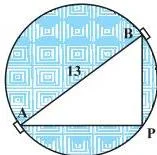
In a right triangle, the hypotenuse is always opposite the right angle and is the longest side. Example 8 shows exactly this pattern: the two legs differ by 7 and the hypotenuse is 13.
Let the base be x cm.
Then the altitude is \( x – 7 \) cm, and the hypotenuse is 13 cm.
By Pythagoras’ theorem, \( \text{(leg)}^2 + \text{(leg)}^2 = \text{(hypotenuse)}^2 \):
\[ x^2 + (x – 7)^2 = 13^2 \]
\[ x^2 + x^2 – 14x + 49 = 169 \Rightarrow 2x^2 – 14x – 120 = 0 \]
Divide through by 2: \( x^2 – 7x – 60 = 0 \).
Split \( -7x \) as \( -12x + 5x \), since \( (-12)(5) = -60 \) and \( -12 + 5 = -7 \).
\[ x^2 – 12x + 5x – 60 = x(x – 12) + 5(x – 12) = (x – 12)(x + 5) = 0 \]
So \( x = 12 \) or \( x = -5 \).
A length cannot be negative, so reject \( x = -5 \).
Answer: Base = 12 cm and altitude = \( 12 – 7 = 5 \) cm.
Check: \( 12^2 + 5^2 = 144 + 25 = 169 = 13^2 \).
The sides form the well-known 5-12-13 Pythagorean triple, which confirms the answer at a glance.
Two slips are common. First, swapping the roles: the altitude is 7 cm less than the base, so altitude = \( x – 7 \), never the reverse. Second, accepting \( x = -5 \): re-read “the other two sides” and remember lengths are positive, then write the rejection explicitly.
Question 6: A cottage industry produces a certain number of pottery articles in a day. It was observed on a particular day that the cost of production of each article (in rupees) was 3 more than twice the number of articles produced on that day. If the total cost of production on that day was ₹ 90, find the number of articles produced and the cost of each article.
Answer: Two unknowns are linked: the number of articles and the cost per article. Let one be x and express the other through it, then the total cost gives the equation.
Let x be the number of articles produced.
The cost per article is “3 more than twice the number”, so it is \( 2x + 3 \) rupees.
Total cost = number \( \times \) cost per article = 90:
\[ x(2x + 3) = 90 \Rightarrow 2x^2 + 3x = 90 \Rightarrow 2x^2 + 3x – 90 = 0 \]
Split \( +3x \) as \( +15x – 12x \), since \( (15)(-12) = -180 = 2 \times (-90) \) and \( 15 + (-12) = 3 \).
\[ 2x^2 + 15x – 12x – 90 = x(2x + 15) – 6(2x + 15) = (x – 6)(2x + 15) = 0 \]
So \( x = 6 \) or \( x = -\frac{15}{2} \).
The number of articles cannot be negative, so reject \( -\frac{15}{2} \).
Answer: 6 articles were produced, and each cost \( 2(6) + 3 = \) ₹ 15.
Check: \( 6 \times 15 = \) ₹ 90, matching the total given in the question.
The classic error is reading the cost as \( 2x – 3 \) instead of \( 2x + 3 \) — “3 more than twice” means add, not subtract. Also keep the rupee unit in the final answer: “₹ 15 per article”, not a bare 15. Verify with \( \text{articles} \times \text{cost per article} = \) total.
Method Recap: The Four-Step Factorisation Routine
Having seen all six questions, the routine should now feel automatic. Every equation in this exercise was solved by the same four steps: write in standard form, split the middle term so the product of the two new terms equals \( a \times c \), group and factor, then set each factor to zero.
The table below collects the splits used in Question 1. Before grouping, always multiply the two split numbers — the product must equal \( a \times c \) exactly, signs included.
| Part | Equation | Middle-term split | Why it works | Factors | Roots |
|---|---|---|---|---|---|
| (i) | \( x^2 – 3x – 10 = 0 \) | \( -5x + 2x \) | \( (-5)(2) = -10 = 1 \times (-10) \) | \( (x – 5)(x + 2) \) | \( 5, -2 \) |
| (ii) | \( 2x^2 + x – 6 = 0 \) | \( 4x – 3x \) | \( (4)(-3) = -12 = 2 \times (-6) \) | \( (2x – 3)(x + 2) \) | \( \frac{3}{2}, -2 \) |
| (iii) | \( \sqrt{2}x^2 + 7x + 5\sqrt{2} = 0 \) | \( 5x + 2x \) | \( (5)(2) = 10 = \sqrt{2} \times 5\sqrt{2} \) | \( (\sqrt{2}x + 5)(x + \sqrt{2}) \) | \( -\frac{5}{\sqrt{2}}, -\sqrt{2} \) |
| (iv) | \( 16x^2 – 8x + 1 = 0 \) (after \( \times 8 \)) | \( -4x – 4x \) | \( (-4)(-4) = 16 = 16 \times 1 \) | \( (4x – 1)^2 \) | \( \frac{1}{4}, \frac{1}{4} \) |
| (v) | \( 100x^2 – 20x + 1 = 0 \) | \( -10x – 10x \) | \( (-10)(-10) = 100 = 100 \times 1 \) | \( (10x – 1)^2 \) | \( \frac{1}{10}, \frac{1}{10} \) |
The word problems follow the same pattern — set up the equation, factorise, then decide which root the story accepts:
| Question | Unknown x | Equation formed | Roots | Rejected | Answer |
|---|---|---|---|---|---|
| 2(i) | John’s marbles | \( x^2 – 45x + 324 = 0 \) | 9, 36 | — | John 9, Jivanti 36 (or reversed) |
| 2(ii) | Toys produced | \( x^2 – 55x + 750 = 0 \) | 25, 30 | — | 25 toys at ₹30, or 30 toys at ₹25 |
| 3 | One number | \( x^2 – 27x + 182 = 0 \) | 13, 14 | — | 13 and 14 |
| 4 | Smaller integer | \( n^2 + n – 182 = 0 \) | 13, \( -14 \) | \( -14 \) (not positive) | 13 and 14 |
| 5 | Base of triangle | \( x^2 – 7x – 60 = 0 \) | 12, \( -5 \) | \( -5 \) (negative length) | Base 12 cm, altitude 5 cm |
| 6 | Articles produced | \( 2x^2 + 3x – 90 = 0 \) | 6, \( -\frac{15}{2} \) | \( -\frac{15}{2} \) (negative count) | 6 articles at ₹15 each |
Try two fresh equations on your own, then check by substitution:
- \( 3x^2 – 5x – 2 = 0 \quad \)roots: \( x = 2 \) and \( x = -\frac{1}{3} \)
- \( 4x^2 – 12x + 9 = 0 \quad \)roots: \( x = \frac{3}{2} \) and \( \frac{3}{2} \) (equal roots, since \( (2x – 3)^2 = 0 \))
Common mistakes and how to catch them
| Mistake | Correct rule | How to check your answer |
|---|---|---|
| Choosing a factor pair with the wrong signs when splitting the middle term | The two split numbers must add to b and multiply to \( a \times c \), signs included | Multiply the two split numbers; the product must equal \( a \times c \) exactly |
| Writing only one root when the factors are equal | A quadratic has two roots; when factors repeat, write the same root twice | Count the linear factors — each factor gives one root |
| Accepting a negative root in a word problem | Reject roots that make a length, count or integer negative | Check every root against the story, not just the equation |
| Answering without units or without the quantity asked | State the final answer with its unit (cm, rupees, articles) | Re-read the question and confirm each named quantity appears in your answer |
Frequently Asked Questions on Exercise 4.2
How do I choose the right pair of factors when splitting the middle term?
For \( ax^2 + bx + c = 0 \), you need two numbers that add to b and multiply to \( a \times c \), signs included. Example: in \( x^2 – 3x – 10 \), b is \( -3 \) and \( a \times c = -10 \); the pair is \( -5 \) and \( +2 \) because \( -5 + 2 = -3 \) and \( (-5)(2) = -10 \).
Whenever a candidate pair fails, check the product first — flip a sign or swap the pair until \( \text{sum} = b \) and \( \text{product} = a \times c \) both hold.
Why do we reject negative roots in Questions 3 to 6 of Exercise 4.2?
In word problems the unknown stands for a real quantity: a number of articles, a side length, a count. A negative count or length has no physical meaning. Question 3 happens to give two positive roots, so nothing is rejected there; in Question 4 (\( -14 \)), Question 5 (\( -5 \)) and Question 6 (\( -\frac{15}{2} \)) the negative root fails the situation, not the equation.
The condition in the question — positive integers, side lengths — is the reason for the rejection.
How do I solve \( 2x^2 – x + \frac{1}{8} = 0 \) when the constant term is a fraction?
Multiply the whole equation by 8 to clear the fraction: \( 16x^2 – 8x + 1 = 0 \). This never changes the roots. Now split \( -8x \) as \( -4x – 4x \) because \( (-4)(-4) = 16 = 16 \times 1 \), factor to \( (4x – 1)^2 = 0 \), and read the equal root \( x = \frac{1}{4} \). Multiplying by a common denominator only removes the fractions — the factorisation routine is unchanged.
What does it mean that the roots are equal in Question 1(v)?
The two linear factors are identical: \( (10x – 1)(10x – 1) = 0 \). Each factor gives \( x = \frac{1}{10} \), so the equation has two equal roots, both \( \frac{1}{10} \). A quadratic never has just one root — when the factors repeat, you list the root twice. Question 1(iv) behaves the same way with \( x = \frac{1}{4} \).
Does Question 2 need me to solve both problems from Example 1, the marbles and the toys?
Yes. Example 1 in the textbook (NCERT, p. 2) sets up two situations mathematically without solving them. Question 2 asks you to finish the job: factorise \( x^2 – 45x + 324 = 0 \) for the marbles and \( x^2 – 55x + 750 = 0 \) for the toys. Both are solved fully above, each with a check and an interpretation of the roots in the story.
Once factorisation is comfortable, the next chapter, Arithmetic Progressions, uses the same equation-solving skills. If you need the algebra that came just before, the Pair of Linear Equations in Two Variables chapter covers system-solving methods. For revision of the whole syllabus, browse the Class 10 Maths notes, the wider Class 10 notes, or the full set of CBSE revision notes.
Every question and worked step on this page is taken from the official NCERT Class 10 Mathematics textbook — open the Quadratic Equations chapter PDF to verify any equation against the printed pages before your exam.
Reference: NCERT Class 10 Mathematics textbook, chapter Quadratic Equations.
Explore Class 10 Maths NCERT Solutions
More for this chapter:
Class 10 Maths on LearnCBSE:
Related chapters: