
If you are working through Exercise 2.2 Class 10 Maths NCERT Solutions for the Polynomials chapter, this page gives you every part of both questions solved concept first, verified, and finished with the slip that catches most students.
The 2026-27 rationalised NCERT edition ends this chapter right here: it contains only Exercise 2.1 and Exercise 2.2 plus the Section 2.4 summary, so solving these two questions completes the chapter.
Question 1 asks you to find the zeroes of six quadratic polynomials and verify the coefficient relationship; Question 2 turns the method around and asks you to build a polynomial from a given sum and product. Each part below is solved with the reasoning a teacher would give at the board.
To use the page, read the short principle line before each solution, follow the worked steps, and then check the common-error note so you do not repeat the mistake in your own homework. The full chapter PDF is available with the verbatim questions, the worked answers, and the graph figures, and no sign up is needed to open it.
Reference: NCERT Class 10 Mathematics textbook, chapter Polynomials.
Exercise 2.2 Class 10 Maths NCERT Solutions: Finding Zeroes of Quadratic Polynomials (Q1)
This exercise teaches the core skill of Chapter 2: finding the zeroes of a quadratic polynomial by factorisation, then proving the zeroes tie back to the coefficients. Every part below applies one method, taken from Section 2.3 of the textbook (NCERT, pp. 19-23).
Factorise the polynomial by splitting the middle term, set each factor equal to zero, and then check that the sum and product of the zeroes match the formulas.
The formulas this exercise uses, for a polynomial \(ax^{2}+bx+c\) with zeroes \(\alpha\) and \(\beta\):
- Sum of zeroes: \(\alpha+\beta=-\frac{b}{a}\)
- Product of zeroes: \(\alpha\beta=\frac{c}{a}\)
- Factorisation: split the middle term \(bx\) into two parts whose product equals \(a\times c\).
Question 1: Find the zeroes of the following quadratic polynomials and verify the relationship between the zeroes and the coefficients.
- \(x^{2}-2x-8\)
- \(4s^{2}-4s+1\)
- \(6x^{2}-3-7x\)
- \(4u^{2}+8u\)
- \(t^{2}-15\)
- \(3x^{2}-x-4\)
The principle for each part is the same: a quadratic polynomial equals zero exactly at its factors, so factorising gives the zeroes directly. The verification step shows the zeroes are not random numbers but are fixed by the coefficients \(a\), \(b\) and \(c\), which is the relationship Section 2.3 develops (NCERT, p. 19).
Part (i): Split the middle term \(-2x\) into two parts whose product equals \(1\times(-8)=-8\), which is \(-4x\) and \(+2x\).
\[ x^{2}-2x-8=x^{2}-4x+2x-8=x(x-4)+2(x-4)=(x-4)(x+2) \]
Set each factor to zero: \(x-4=0\) gives \(x=4\), and \(x+2=0\) gives \(x=-2\).
So the zeroes are \(4\) and \(-2\).
Verification: Here \(a=1\), \(b=-2\), \(c=-8\).
\[ \text{Sum}=4+(-2)=2=\frac{-(-2)}{1}=\frac{-b}{a}\quad\checkmark \]
\[ \text{Product}=4\times(-2)=-8=\frac{-8}{1}=\frac{c}{a}\quad\checkmark \]
Part (ii): Split \(-4s\) into two parts whose product equals \(4\times1=4\), which is \(-2s\) and \(-2s\).
\[ 4s^{2}-4s+1=4s^{2}-2s-2s+1=2s(2s-1)-1(2s-1)=(2s-1)(2s-1) \]
Since both factors are identical, the polynomial is a perfect square, so both zeroes are equal.
Set \(2s-1=0\), giving \(s=\frac{1}{2}\).
The zeroes are \(\frac{1}{2}\) and \(\frac{1}{2}\).
Verification: Here \(a=4\), \(b=-4\), \(c=1\).
\[ \text{Sum}=\frac{1}{2}+\frac{1}{2}=1=\frac{-(-4)}{4}=\frac{-b}{a}\quad\checkmark \]
\[ \text{Product}=\frac{1}{2}\times\frac{1}{2}=\frac{1}{4}=\frac{1}{4}=\frac{c}{a}\quad\checkmark \]
Part (iii): The terms are not written in standard order.
First rearrange the polynomial as \(6x^{2}-7x-3\).
Now split \(-7x\) into two parts whose product equals \(6\times(-3)=-18\), which is \(-9x\) and \(+2x\).
\[ 6x^{2}-7x-3=6x^{2}-9x+2x-3=3x(2x-3)+1(2x-3)=(3x+1)(2x-3) \]
Set each factor to zero: \(3x+1=0\) gives \(x=-\frac{1}{3}\), and \(2x-3=0\) gives \(x=\frac{3}{2}\).
The zeroes are \(-\frac{1}{3}\) and \(\frac{3}{2}\).
Verification: Reading \(a\), \(b\), \(c\) from the rearranged form \(6x^{2}-7x-3\): \(a=6\), \(b=-7\), \(c=-3\).
\[ \text{Sum}=-\frac{1}{3}+\frac{3}{2}=\frac{-2+9}{6}=\frac{7}{6}=\frac{-(-7)}{6}=\frac{-b}{a}\quad\checkmark \]
\[ \text{Product}=-\frac{1}{3}\times\frac{3}{2}=-\frac{1}{2}=\frac{-3}{6}=\frac{c}{a}\quad\checkmark \]
Part (iv): There is no constant term, so take \(4u\) common directly.
\[ 4u^{2}+8u=4u(u+2) \]
Set each factor to zero: \(4u=0\) gives \(u=0\), and \(u+2=0\) gives \(u=-2\).
The zeroes are \(0\) and \(-2\).
Verification: Writing as \(4u^{2}+8u+0\), we get \(a=4\), \(b=8\), \(c=0\).
\[ \text{Sum}=0+(-2)=-2=\frac{-8}{4}=\frac{-b}{a}\quad\checkmark \]
\[ \text{Product}=0\times(-2)=0=\frac{0}{4}=\frac{c}{a}\quad\checkmark \]
Part (v): This is a difference of squares.
Apply the identity \(a^{2}-b^{2}=(a-b)(a+b)\).
\[ t^{2}-15=(t-\sqrt{15})(t+\sqrt{15}) \]
Set each factor to zero: \(t-\sqrt{15}=0\) gives \(t=\sqrt{15}\), and \(t+\sqrt{15}=0\) gives \(t=-\sqrt{15}\).
The zeroes are \(\sqrt{15}\) and \(-\sqrt{15}\).
Verification: Here \(a=1\), \(b=0\) (no \(t\) term), \(c=-15\).
\[ \text{Sum}=\sqrt{15}+(-\sqrt{15})=0=\frac{-0}{1}=\frac{-b}{a}\quad\checkmark \]
\[ \text{Product}=\sqrt{15}\times(-\sqrt{15})=-15=\frac{-15}{1}=\frac{c}{a}\quad\checkmark \]
Part (vi): Rearrange the terms in standard form first: \(3x^{2}-x-4\).
Split \(-x\) into two parts whose product equals \(3\times(-4)=-12\), which is \(-4x\) and \(+3x\).
\[ 3x^{2}-x-4=3x^{2}-4x+3x-4=x(3x-4)+1(3x-4)=(3x-4)(x+1) \]
Set each factor to zero: \(3x-4=0\) gives \(x=\frac{4}{3}\), and \(x+1=0\) gives \(x=-1\).
The zeroes are \(\frac{4}{3}\) and \(-1\).
Verification: Here \(a=3\), \(b=-1\), \(c=-4\).
\[ \text{Sum}=\frac{4}{3}+(-1)=\frac{4-3}{3}=\frac{1}{3}=\frac{-(-1)}{3}=\frac{-b}{a}\quad\checkmark \]
\[ \text{Product}=\frac{4}{3}\times(-1)=-\frac{4}{3}=\frac{-4}{3}=\frac{c}{a}\quad\checkmark \]
Final answers: (i) \(4,-2\); (ii) \(\frac{1}{2},\frac{1}{2}\); (iii) \(-\frac{1}{3},\frac{3}{2}\); (iv) \(0,-2\); (v) \(\sqrt{15},-\sqrt{15}\); (vi) \(\frac{4}{3},-1\).
The two slip-ups that cost marks here: in the sum formula the minus sign is attached to the b coefficient, not the whole fraction as an afterthought, so a positive \(b\) gives a negative sum.
And in part (iii) the polynomial is printed as \(6x^{2}-3-7x\) out of order; if you read off \(a\), \(b\), \(c\) without first rearranging to \(6x^{2}-7x-3\), your verification will not match. Always write the polynomial in standard form \(ax^{2}+bx+c\) before identifying the coefficients.
Exercise 2.2 Class 10 Maths NCERT Solutions: Forming Polynomials from Sum and Product (Q2)
Question 2 reverses the method of Question 1. You are given the sum of the zeroes and the product separately. The key identity from Example 4 in Section 2.3 (NCERT, p. 22) says that once the sum and product are known, the polynomial is fixed up to a non-zero multiplier. Setting \(k=1\) keeps the answer simplest and is the one to write first.
Question 2: Find a quadratic polynomial each with the given numbers as the sum and product of its zeroes respectively.
- \(\frac{1}{4},-1\)
- \(\sqrt{2},\frac{1}{3}\)
- \(0,\sqrt{5}\)
- \(1,1\)
- \(-\frac{1}{4},\frac{1}{4}\)
- \(4,1\)
The principle is that a quadratic with zeroes \(\alpha\) and \(\beta\) is \(k(x-\alpha)(x-\beta)=k\left[x^{2}-(\alpha+\beta)x+\alpha\beta\right]\). Setting \(k=1\) gives the cleanest polynomial: \(x^{2}-(\text{sum})x+(\text{product})\). The textbook explicitly notes that any non-zero scalar multiple of this polynomial is also a valid answer, so both forms are credited.
Part (i): Sum \(=\frac{1}{4}\), product \(=-1\).
\[ p(x)=x^{2}-\left(\frac{1}{4}\right)x+(-1)=x^{2}-\frac{1}{4}x-1 \]
Part (ii): Sum \(=\sqrt{2}\), product \(=\frac{1}{3}\).
\[ p(x)=x^{2}-\left(\sqrt{2}\right)x+\frac{1}{3}=x^{2}-\sqrt{2}\,x+\frac{1}{3} \]
\[ \text{Equivalent form: } 3x^{2}-3\sqrt{2}\,x+1 \]
Part (iii): Sum \(=0\), product \(=\sqrt{5}\).
Since the sum is zero, there is no \(x\) term.
\[ p(x)=x^{2}-(0)x+\sqrt{5}=x^{2}+\sqrt{5} \]
Part (iv): Sum \(=1\), product \(=1\).
\[ p(x)=x^{2}-(1)x+1=x^{2}-x+1 \]
Part (v): Sum \(=-\frac{1}{4}\), product \(=\frac{1}{4}\).
Note that when the sum itself is negative, the minus sign in front of the sum term turns it positive.
\[ p(x)=x^{2}-\left(-\frac{1}{4}\right)x+\frac{1}{4}=x^{2}+\frac{1}{4}x+\frac{1}{4} \]
\[ \text{Equivalent form: } 4x^{2}+x+1 \]
Part (vi): Sum \(=4\), product \(=1\).
\[ p(x)=x^{2}-(4)x+1=x^{2}-4x+1 \]
Final answers (each with leading coefficient 1): (i) \(x^{2}-\frac{1}{4}x-1\); (ii) \(x^{2}-\sqrt{2}\,x+\frac{1}{3}\); (iii) \(x^{2}+\sqrt{5}\); (iv) \(x^{2}-x+1\); (v) \(x^{2}+\frac{1}{4}x+\frac{1}{4}\); (vi) \(x^{2}-4x+1\). Any non-zero scalar multiple of these is also correct.
The frequent slip here is the double-sign error in the middle term. The template is \(x^{2}-(\text{sum})x+(\text{product})\), so a negative sum flips to a positive middle term, as in part (v). The second doubt is whether square roots and fractions may stay in the coefficients; the answer is yes.
Leave them as they are, or multiply through to clear them, but do not convert them to decimals.
Method Recap: Zero Coefficient Formulas and Verification
The two questions above rely on one rule, derived by comparing coefficients in the identity \(ax^{2}+bx+c=k(x-\alpha)(x-\beta)\). The standard form expands to \(kx^{2}-k(\alpha+\beta)x+k\alpha\beta\).
Equating the coefficient of \(x^{2}\) gives \(a=k\); equating the coefficient of \(x\) gives \(b=-k(\alpha+\beta)=-a(\alpha+\beta)\), which rearranges to \(\alpha+\beta=-\frac{b}{a}\); equating the constant term gives \(c=k\alpha\beta=a\alpha\beta\), giving \(\alpha\beta=\frac{c}{a}\).
A handy memory hook is (SBP): Sum takes B with a minus, Product takes C with no sign flip; both divide by the leading coefficient \(a\). The minus sign lives only on the sum formula.
The same idea extends to a cubic polynomial \(ax^{3}+bx^{2}+cx+d\) with zeroes \(\alpha,\beta,\gamma\) (NCERT, p. 22):
- \(\alpha+\beta+\gamma=\frac{-b}{a}\)
- \(\alpha\beta+\beta\gamma+\gamma\alpha=\frac{c}{a}\)
- \(\alpha\beta\gamma=\frac{-d}{a}\)
Notice the pattern: for the cubic, the sum and the triple product each carry a minus sign, while the pairwise sum does not. These cubic formulas are part of the chapter content; the starred Example 5, which verifies them numerically, is marked in the textbook as not from the examination point of view (NCERT, p. 22).
Homework Check Table: All Six Q1 Polynomials
Use this table to check your Question 1 working at a glance. Each row lists the polynomial, the standard-form coefficients, the zeroes, the sum, the product, and whether both verification formulas hold.
| Polynomial | \(a,b,c\) | Zeroes \(\alpha,\beta\) | Sum \(=\frac{-b}{a}\) | Product \(=\frac{c}{a}\) | Verified |
|---|---|---|---|---|---|
| \(x^{2}-2x-8\) | \(1,-2,-8\) | \(4,-2\) | \(2\) | \(-8\) | Yes |
| \(4s^{2}-4s+1\) | \(4,-4,1\) | \(\frac{1}{2},\frac{1}{2}\) | \(1\) | \(\frac{1}{4}\) | Yes |
| \(6x^{2}-7x-3\) | \(6,-7,-3\) | \(-\frac{1}{3},\frac{3}{2}\) | \(\frac{7}{6}\) | \(-\frac{1}{2}\) | Yes |
| \(4u^{2}+8u\) | \(4,8,0\) | \(0,-2\) | \(-2\) | \(0\) | Yes |
| \(t^{2}-15\) | \(1,0,-15\) | \(\sqrt{15},-\sqrt{15}\) | \(0\) | \(-15\) | Yes |
| \(3x^{2}-x-4\) | \(3,-1,-4\) | \(\frac{4}{3},-1\) | \(\frac{1}{3}\) | \(-\frac{4}{3}\) | Yes |
Worked Example: Apply the Method to a Fresh Polynomial
The textbook uses \(2x^{2}-8x+6\) in Section 2.3; here is a new polynomial worked the same way so you can practise on numbers the book does not use. Take \(2x^{2}-7x+3\).
Step 1: Find two numbers whose product equals \(a\times c=2\times3=6\) and whose sum equals the middle-term coefficient \(b=-7\).
Those numbers are \(-6\) and \(-1\).
Step 2: Split the middle term and factorise.
\[ 2x^{2}-7x+3=2x^{2}-6x-x+3=2x(x-3)-1(x-3)=(2x-1)(x-3) \]
Step 3: Set each factor to zero: \(2x-1=0\Rightarrow x=\frac{1}{2}\), and \(x-3=0\Rightarrow x=3\).
The zeroes are \(\frac{1}{2}\) and \(3\).
Step 4: Verify with the formulas, reading off \(a=2\), \(b=-7\), \(c=3\).
\[ \alpha+\beta=\frac{1}{2}+3=\frac{7}{2}=\frac{-(-7)}{2}=\frac{-b}{a}\quad\checkmark \]
\[ \alpha\beta=\frac{1}{2}\times3=\frac{3}{2}=\frac{3}{2}=\frac{c}{a}\quad\checkmark \]
Final answer: The zeroes of \(2x^{2}-7x+3\) are \(\frac{1}{2}\) and \(3\), and the coefficient relationship is verified for both the sum and the product.
Common Mistakes in This Exercise
| Mistake | Correct Rule | How to Check |
|---|---|---|
| Dropping the minus sign in the sum formula, reading \(\frac{b}{a}\) instead of \(-\frac{b}{a}\) | The minus sign is fixed: the sum always equals \(-\frac{b}{a}\), even when \(b\) is positive | Add your zeroes as plain numbers; if the result has the wrong sign versus \(-\frac{b}{a}\), you lost the minus sign |
| Forgetting to divide the constant term by \(a\), writing the product as just \(c\) | The product is \(\frac{c}{a}\), so when \(a\neq1\) you must divide | In part (ii), the product is \(\frac{1}{4}\), not \(1\); in part (vi), it is \(-\frac{4}{3}\), not \(-4\) |
| Treating the two equal zeroes in \(4s^{2}-4s+1\) as a single zero | A perfect-square quadratic has two equal zeroes; write the value twice | The degree tells the count of zeroes counting multiplicity; a degree-2 polynomial has two, equal or distinct |
| Skipping the rearrange step on parts printed out of order such as \(6x^{2}-3-7x\) | Rewrite in standard form \(ax^{2}+bx+c\) first, then read off the coefficients | After rearranging to \(6x^{2}-7x-3\), the coefficient \(b\) is \(-7\), not \(-3\) |
The broader revision path for this chapter is linked from our Class 10 Maths hub. The same factorisation method underpins Chapter 1 Real Numbers, and the graph reading skill you meet below prepares you for Chapter 3 Pair of Linear Equations in Two Variables, where a pair of straight lines is plotted on the same axes.
Geometrical Meaning of Zeroes: Reading Zeroes from Graphs
This section covers the chapter’s in-text material from Section 2.2, which Exercise 2.1 examines. The core idea from NCERT, p. 12 is that a zero of a polynomial \(p(x)\) equals the \(x\)-coordinate of the point where the graph of \(y=p(x)\) meets the \(x\)-axis (NCERT, p. 13).
For a straight line that meeting happens at one point; for a parabola it can happen at two points, at one point, or not at all; for a cubic curve it happens at most three times.
Linear Polynomial: One Zero, One Crossing
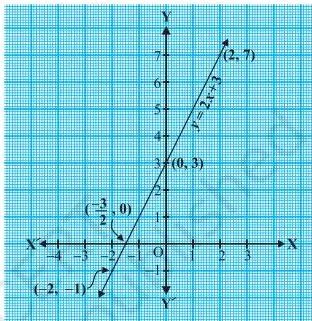
The graph of \(y=2x+3\) is a straight line meeting the \(x\)-axis at the single point \((-\frac{3}{2},0)\). That single crossing is what gives a linear polynomial exactly one zero, the value \(-\frac{b}{a}\) for \(ax+b\) (NCERT, p. 12).
Quadratic Polynomial: The Three Graph Cases
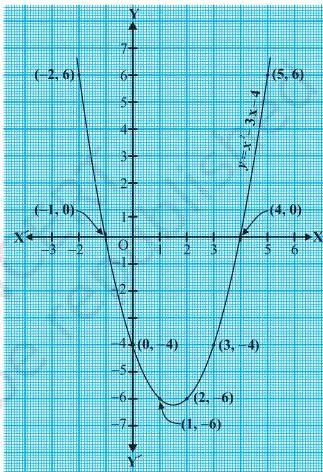
For a quadratic polynomial \(ax^{2}+bx+c\) the graph is a parabola. Its shape gives three possible cases (NCERT, p. 14), each tied to how many times the parabola meets the \(x\)-axis.
- Case (i): two distinct zeroes. The parabola cuts the axis at two distinct points; their \(x\)-coordinates are the two zeroes.
- Case (ii): one zero (two equal zeroes). The parabola just touches the axis at one point; the single \(x\)-coordinate is the repeated zero.
- Case (iii): no zero. The parabola sits entirely above or below the axis and never meets it; the polynomial has no real zeroes (NCERT, p. 15).
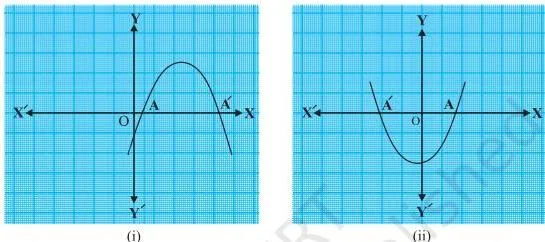
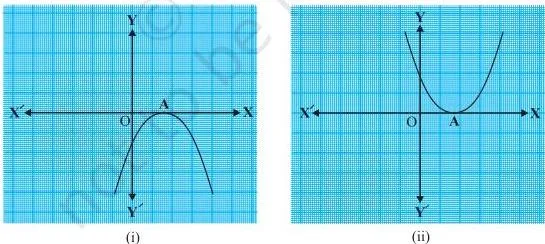
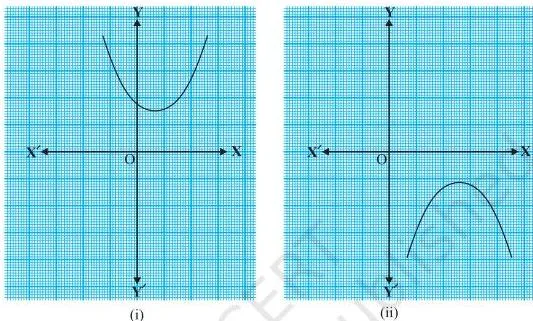
The no-zero case is what answers the common question, are there quadratics with no real zeroes? Yes, when the parabola does not cross the axis, so the polynomial never takes the value zero and has no real zero. You do not need algebra; the picture is enough.
Cubic Polynomial: At Most Three Zeroes
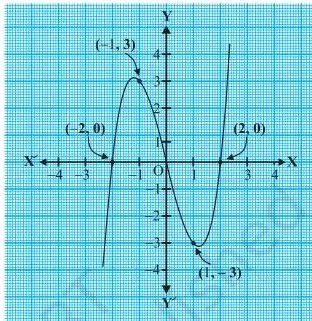
The graph of a cubic polynomial is a smooth S-shaped or W-shaped curve. The general rule from NCERT p. 17 is that a degree-\(n\) polynomial meets the \(x\)-axis in at most \(n\) points, so a cubic has at most three zeroes.
The graph of \(y=x^{3}\) meets the axis only once at the origin, showing one zero; \(y=x^{3}-x^{2}\) meets it at two points because the factor \(x^{2}\) gives a repeated zero at zero and a single zero at one (NCERT, p. 17).
Example 1 from the Textbook
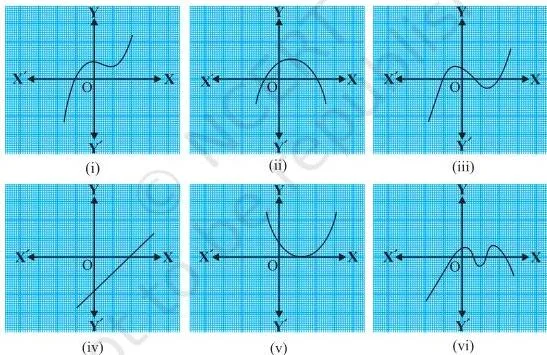
Example 1 (NCERT, p. 18) reads six given graphs and counts zeroes. The counting rule is mechanical once the principle is fixed: every crossing of the \(x\)-axis counts as one zero; a touching still counts as one (repeated, if it is a quadratic).
The textbook answers are: graph (i) has 1 zero, (ii) has 2 zeroes, (iii) has 3 zeroes, (iv) has 1 zero, (v) has 1 zero, and (vi) has 4 zeroes. Note that graph (vi) is from a polynomial of degree at least four, since it shows four crossings.
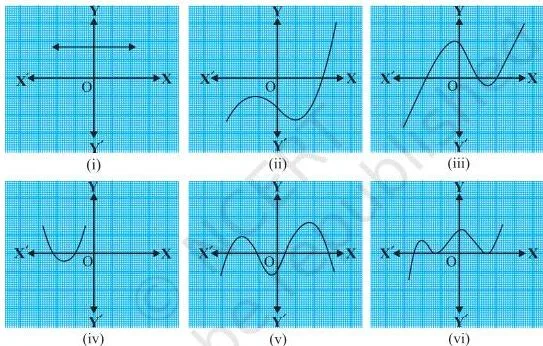
The figure above appears at the Exercise 2.1 question; this page stops at the counting rule itself, not at the worked counts. Each crossing is a zero, and the counting works exactly as in Example 1.
If you want to check a figure against the source, the full chapter is available as the official NCERT Chapter 2 Polynomials PDF at ncert.nic.in, where every graph and every exercise question is printed verbatim.
Practice Problems: Apply the Zero Coefficient Method (With Answers)
Try these three polynomials using the same method as above. The answers are hidden one paragraph below so you can attempt the working first. Check that the factorisation, the zeroes, and the sum and product verification all match what is written below.
- Find the zeroes of \(2x^{2}+x-6\) and verify the coefficient relationship.
- Find the zeroes of \(x^{2}-7x+12\) and verify the coefficient relationship.
- Find the zeroes of \(3x^{2}-4x-4\) and verify the coefficient relationship.
Worked Answers
Problem 1: \(2x^{2}+x-6\).
The product of the coefficient of \(x^{2}\) and the constant term is \(2\times(-6)=-12\), so split the middle term into \(-3x\) and \(+4x\).
\[ 2x^{2}+x-6=2x^{2}-3x+4x-6=x(2x-3)+2(2x-3)=(2x-3)(x+2) \]
Set each factor to zero: \(2x-3=0\Rightarrow x=\frac{3}{2}\), and \(x+2=0\Rightarrow x=-2\).
The zeroes are \(\frac{3}{2}\) and \(-2\).
Verification: \(a=2\), \(b=1\), \(c=-6\).
\[ \text{Sum}=\frac{3}{2}+(-2)=\frac{3-4}{2}=-\frac{1}{2}=\frac{-(1)}{2}=\frac{-b}{a}\quad\checkmark \]
\[ \text{Product}=\frac{3}{2}\times(-2)=-3=\frac{-6}{2}=\frac{c}{a}\quad\checkmark \]
Problem 2: \(x^{2}-7x+12\).
Here \(a\times c=12\) and the middle-term coefficient is \(-7\), so split into \(-3x\) and \(-4x\).
\[ x^{2}-7x+12=x^{2}-3x-4x+12=x(x-3)-4(x-3)=(x-3)(x-4) \]
Set each factor to zero: \(x-3=0\Rightarrow x=3\), and \(x-4=0\Rightarrow x=4\).
The zeroes are \(3\) and \(4\).
Verification: \(a=1\), \(b=-7\), \(c=12\).
\[ \text{Sum}=3+4=7=\frac{-(-7)}{1}=\frac{-b}{a}\quad\checkmark \]
\[ \text{Product}=3\times4=12=\frac{12}{1}=\frac{c}{a}\quad\checkmark \]
Problem 3: \(3x^{2}-4x-4\).
Here \(a\times c=3\times(-4)=-12\), so split into \(-6x\) and \(+2x\).
\[ 3x^{2}-4x-4=3x^{2}-6x+2x-4=3x(x-2)+2(x-2)=(3x+2)(x-2) \]
Set each factor to zero: \(3x+2=0\Rightarrow x=-\frac{2}{3}\), and \(x-2=0\Rightarrow x=2\).
The zeroes are \(-\frac{2}{3}\) and \(2\).
Verification: \(a=3\), \(b=-4\), \(c=-4\).
\[ \text{Sum}=-\frac{2}{3}+2=\frac{-2+6}{3}=\frac{4}{3}=\frac{-(-4)}{3}=\frac{-b}{a}\quad\checkmark \]
\[ \text{Product}=-\frac{2}{3}\times2=-\frac{4}{3}=\frac{-4}{3}=\frac{c}{a}\quad\checkmark \]
Solutions: Problem 1 zeroes \(\frac{3}{2}\), \(-2\); Problem 2 zeroes \(3\), \(4\); Problem 3 zeroes \(-\frac{2}{3}\), \(2\). All three verified cleanly against the coefficient formulas.
FAQs: Zeroes, Sum and Product in Exercise 2.2
How do you find the zeroes of a quadratic polynomial in Exercise 2.2?
Split the middle term so that the two parts multiply to \(a\times c\) and add to \(b\). Factorise into two linear factors, set each equal to zero, and solve. The values of \(x\) you get are the zeroes. Verification uses \(\alpha+\beta=-\frac{b}{a}\) and \(\alpha\beta=\frac{c}{a}\).
What is the formula for the sum and product of zeroes of a quadratic polynomial?
For a quadratic \(ax^{2}+bx+c\) with zeroes \(\alpha\) and \(\beta\), the sum is \(\alpha+\beta=\frac{-b}{a}\) and the product is \(\alpha\beta=\frac{c}{a}\). The minus sign lives only on the sum formula; the product formula carries no sign change.
How do you form a quadratic polynomial when the sum and product of its zeroes are given?
Use the template \(x^{2}-(\text{sum})x+(\text{product})\). If the sum is \(S\) and the product is \(P\), the simplest polynomial is \(x^{2}-Sx+P\). Any non-zero scalar multiple \(k(x^{2}-Sx+P)\) is also correct, so \(3x^{2}-3Sx+3P\) is equally valid; write the simplest one first.
Why do some quadratic polynomials have no zeroes at all?
When the parabola \(y=ax^{2}+bx+c\) lies entirely above or entirely below the \(x\)-axis, it never meets the axis, so there is no real \(x\) for which the polynomial equals zero. In algebra terms, the discriminant \(b^{2}-4ac\) is negative. Geometrically, Case (iii) in the textbook shows exactly this situation in the figure above.
Is the division algorithm for polynomials still in the current Class 10 NCERT book?
No. In the rationalised edition this chapter contains only Exercise 2.1, Exercise 2.2, and the Section 2.4 summary. The division algorithm has been removed, and Example 5 is marked in the textbook as not from the examination point of view. Older guides may still include those problems, but they are not part of the current 2026-27 NCERT edition.
Can the sum and product of zeroes be fractions or square roots, as in parts (ii) and (iii) of Question 2?
Yes. The formulas \(\frac{-b}{a}\) and \(\frac{c}{a}\) produce fractions whenever \(a\) is not 1, and the same is true when you build a polynomial from a fractional or surd sum and product. Keep the fraction or the surd as it is; do not convert it to a decimal.
Parts (ii) and (iii) of Question 2 are good examples where the coefficients stay as surds.
Reference: NCERT Class 10 Mathematics textbook, chapter Polynomials.
Explore Class 10 Maths NCERT Solutions
More for this chapter:
Class 10 Maths on LearnCBSE:
Related chapters: