
This page gives step-by-step exercise 12.1 class 10 maths ncert solutions for all nine questions on the surface areas of combined solids. Each answer opens with the key idea, shows the complete working in cm², m² or mm², and ends with a common-error warning so you can check your homework before the next class.
Use the page the way the chapter suggests: read the formula table and the hidden-face rule first, then work each question. The questions below follow the textbook order exactly, so you can move through them one by one.
If you want the printed source in front of you, the official NCERT Class 10 Mathematics Chapter 12 PDF (jemh112) holds the Exercise 12.1 questions on pages 166–167 together with the Fig 12.10 and Fig 12.11 diagrams these solutions read from, and opening it needs no sign-up.
Exercise 12.1 Solutions
Exercise 12.1 applies the core idea of Section 12.2 (NCERT, pp. 162–166): break a combined solid into basic solids — cube, cuboid, cylinder, cone, hemisphere — and add only the curved and flat areas still exposed after joining. The chapter’s four worked examples (the lattu, the decorative block, the rocket and the bird-bath) are the models for these nine questions.
Unless stated otherwise, take \( \pi = \frac{22}{7} \).
Exercise 12.1 has no intext questions, so none are added here. This page solves exactly the nine textbook questions below; the volume questions belong to Exercise 12.2 and are not borrowed in.
If you want the complete formula list for the chapter in one place, the Class 10 Maths notes keep every surface-area form together.
What each question is testing
- Q1–Q3: direct formula application — split the solid, then add the exposed curved surfaces.
- Q4 and Q5: the cube–hemisphere pair — both depend on spotting the face a hemisphere covers or removes.
- Q6 and Q9: figure questions — two identical halves merge into one full sphere of curved area.
- Q7: a two-part word problem — canvas area first, then its cost at the given rate.
- Q8: the only removal question, and the only one asking you to round the final area.
Exercise 12.1 Class 10 Maths NCERT Solutions: Formulas and the Hidden-Face Rule
The formulas this exercise needs
CSA means curved surface area; TSA means total surface area.
| Solid | Formulas you need |
|---|---|
| Cube, edge \( a \) | TSA \( = 6a^2 \), volume \( = a^3 \) |
| Cuboid, sides \( l, b, h \) | Surface area \( = 2(lb + bh + hl) \) |
| Cylinder, radius \( r \), height \( h \) | CSA \( = 2\pi rh \) |
| Cone, radius \( r \), slant height \( l \) | CSA \( = \pi rl \), with \( l = \sqrt{r^2 + h^2} \) |
| Hemisphere, radius \( r \) | CSA \( = 2\pi r^2 \), TSA \( = 3\pi r^2 \) |
The hidden-face rule
When two solids are joined, their touching faces vanish from the outer surface. So the total surface area of the combined solid is the sum of the curved and flat areas still exposed — never the sum of the whole total surface areas of the parts (NCERT, p. 162).
The chapter repeats this warning after Example 1 (NCERT, p. 164): the top’s total surface area is not the sum of the total surface areas of the cone and hemisphere.

Figure 12.2 shows the idea at its simplest. The container is a cylinder with a hemisphere at each end, and from the outside you can see only the curved surfaces — the two domes and the tube wall. Its surface area is one cylinder CSA plus two hemisphere CSAs.
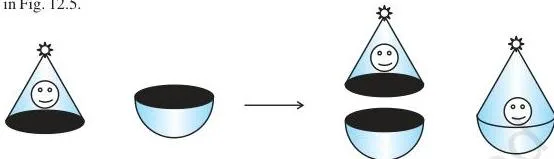
Figure 12.5 shows the same rule for the toy you build in Question 3 and Example 1 (NCERT, pp. 163–164). You bring the flat faces of the cone and hemisphere together, so both flat circles disappear; only the cone’s curved surface plus the hemisphere’s curved surface remain.
Matching radii and hidden heights
Joined parts must share one radius. The chapter notes on p. 163 that you take the cone’s base radius equal to the hemisphere’s radius so the toy has a smooth surface.
Because a hemisphere’s height equals its radius, the height of the solid sitting on top is found by subtracting that radius from the total height — this subtraction is the hidden-height step.
The circle areas you subtract and add here build directly on Chapter 11 Areas Related to Circles notes, which cover the base \( \pi r^2 \) formulas in detail.
The four-step method
- Name the basic solids in the object.
- Find the common radius and any hidden height — subtract the hemisphere’s radius from the total height to get the cone or cylinder height.
- List which curved and flat surfaces stay exposed, and which are covered or removed.
- Add the exposed areas and subtract the covered ones, with \( \pi = \frac{22}{7} \) unless stated.
Which faces stay uncovered
| Object | Faces covered or removed | Faces you must add |
|---|---|---|
| Hollow vessel (Q2) | open top, no base | cylinder inner wall + hemisphere inner bowl |
| Cone on hemisphere (Q3) | both flat base circles | cone CSA + hemisphere CSA |
| Cube with hemisphere (Q4) | circular part of top face | 6 cube faces − circle + hemisphere CSA |
| Cylinder with scooped ends (Q9) | both flat circular bases | cylinder wall + two hemisphere domes |
| Tent (Q7) | ground circle | cylinder wall + conical roof |
Common mistakes and how to check
| Mistake | Correct rule | How to check your answer |
|---|---|---|
| Q1: adding all 12 faces of the two cubes | the join hides one face of each cube, so 10 faces remain | 10 × 16 cm² = 160 cm² |
| Q2: treating 13 cm as the cylinder’s height | hemisphere height equals its radius: 13 − 7 = 6 cm | 2πr(h + r) = 572 cm² |
| Q3: using 15.5 cm as the cone height | cone height = 15.5 − 3.5 = 12 cm | the 3.5–12–12.5 triple is exact, not rounded |
| Q8: forgetting the new inner cone surface | a hollowed cavity exposes a curved surface you must add | wall + base + cone CSA = 17.6 ≈ 18 cm² |
| Q8: rounding 17.6 before the end | keep exact 22/7 values, round once at the end | 154/5 = 17.6, then round to 18 cm² |
Question 1: 2 cubes each of volume 64 cm³ are joined end to end. Find the surface area of the resulting cuboid.
Joining two cubes hides the faces that touch — one face of each cube disappears inside the new solid. So the cuboid shows 10 exposed faces, not 12, and that is the whole idea this question teaches.
Step 1: Find the edge of each cube.
Volume \( a^3 = 64\ \text{cm}^3 \), so \( a = \sqrt[3]{64} = 4\ \text{cm} \).
Step 2: Two 4 cm cubes joined end to end give a cuboid of dimensions \( 8\ \text{cm} \times 4\ \text{cm} \times 4\ \text{cm} \).
\[ \text{Surface area} = 2(lb + bh + hl) = 2(8 \times 4 + 4 \times 4 + 4 \times 8)\ \text{cm}^2 \]
\[ = 2(32 + 16 + 32)\ \text{cm}^2 = 2(80)\ \text{cm}^2 = 160\ \text{cm}^2 \]
Final answer: The surface area of the cuboid is \( 160\ \text{cm}^2 \).
Question 2: A vessel is in the form of a hollow hemisphere mounted by a hollow cylinder. The diameter of the hemisphere is 14 cm and the total height of the vessel is 13 cm. Find the inner surface area of the vessel.
The vessel is hollow, so only the surfaces you could touch from inside count: the cylinder’s inner wall and the hemisphere’s inner bowl. An open hollow vessel has no top and no base to add.
Step 1: Radius \( r = \frac{14}{2} = 7\ \text{cm} \).
The hemisphere’s height equals its radius, 7 cm, so the cylinder’s height is \( 13 – 7 = 6\ \text{cm} \).
Step 2: Add the inner curved surface of the cylinder and the inner curved surface of the hemisphere.
\[ \text{Inner area} = 2\pi rh + 2\pi r^2 \]
\[ = \left(2 \times \frac{22}{7} \times 7 \times 6\right) + \left(2 \times \frac{22}{7} \times 7 \times 7\right)\ \text{cm}^2 = 264 + 308 = 572\ \text{cm}^2 \]
Final answer: The inner surface area of the vessel is \( 572\ \text{cm}^2 \).
Question 3: A toy is in the form of a cone of radius 3.5 cm mounted on a hemisphere of same radius. The total height of the toy is 15.5 cm. Find the total surface area of the toy.
This toy is exactly the shape of the lattu in Example 1 (NCERT, pp. 163–164). Cone and hemisphere share radius 3.5 cm, and the cone’s base circle sits inside the toy, so only the two curved surfaces are exposed.
- Step 1: The cone’s height is the total height minus the hemisphere’s radius: \( h = 15.5 – 3.5 = 12\ \text{cm} \).
- Step 2: Find the slant height \( l = \sqrt{r^2 + h^2} \).
\[ l = \sqrt{3.5^2 + 12^2} = \sqrt{12.25 + 144} = \sqrt{156.25} = 12.5\ \text{cm} \]
Step 3: Add the curved surface of the hemisphere and the curved surface of the cone.
\[ \text{TSA} = 2\pi r^2 + \pi rl = \left(2 \times \frac{22}{7} \times 3.5 \times 3.5\right) + \left(\frac{22}{7} \times 3.5 \times 12.5\right)\ \text{cm}^2 \]
\[ = 77 + 137.5 = 214.5\ \text{cm}^2 \]
Final answer: The total surface area of the toy is \( 214.5\ \text{cm}^2 \).
Question 4: A cubical block of side 7 cm is surmounted by a hemisphere. What is the greatest diameter the hemisphere can have? Find the surface area of the solid.
A hemisphere resting on a square face cannot be wider than that face. So the greatest possible diameter equals the side of the cube, 7 cm, which fixes the radius at 3.5 cm — the same pattern as the decorative block in Example 2 (NCERT, pp. 164–165).
- Step 1: Greatest diameter \( = 7\ \text{cm} \), so \( r = 3.5\ \text{cm} \).
- Step 2: The circular region where the hemisphere touches the cube is covered, so subtract \( \pi r^2 \) from the cube and add the hemisphere’s curved surface \( 2\pi r^2 \).
\[ \text{Surface area} = 6a^2 – \pi r^2 + 2\pi r^2 = 294 + \pi r^2\ \text{cm}^2 \]
\[ = 294 + \left(\frac{22}{7} \times 3.5 \times 3.5\right)\ \text{cm}^2 = 294 + 38.5 = 332.5\ \text{cm}^2 \]
Final answer: The greatest diameter is \( 7\ \text{cm} \), and the surface area of the solid is \( 332.5\ \text{cm}^2 \).
Question 5: A hemispherical depression is cut out from one face of a cubical wooden block such that the diameter l of the hemisphere is equal to the edge of the cube. Determine the surface area of the remaining solid.
A depression removes a circular disc from one face and leaves half a sphere’s curved surface inside — two changes, not one. The cube’s edge and the hemisphere’s diameter are both \( l \), so the radius is \( \frac{l}{2} \).
- Step 1: Surface remaining \( = 6l^2 – \pi\left(\frac{l}{2}\right)^2 + 2\pi\left(\frac{l}{2}\right)^2 \).
- Step 2: Simplify.
The two hemisphere terms combine to \( +\pi\left(\frac{l}{2}\right)^2 \).
\[ \text{Remaining area} = 6l^2 + \frac{\pi l^2}{4}\ \text{cm}^2 \]
\[ = 6l^2 + \frac{11l^2}{14} = \frac{95l^2}{14}\ \text{cm}^2 \quad \text{(using } \pi = \tfrac{22}{7}\text{)} \]
Final answer: The surface area of the remaining solid is \( \dfrac{95l^2}{14}\ \text{cm}^2 \).
Question 6: A medicine capsule is in the shape of a cylinder with two hemispheres stuck to each of its ends (see Fig. 12.10). The length of the entire capsule is 14 mm and the diameter of the capsule is 5 mm. Find its surface area.
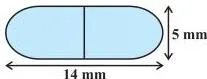
Figure 12.10 shows the capsule’s two hemispherical ends. Together they make one complete sphere, so their combined curved area is \( 4\pi r^2 \). The flat faces of the cylinder are exactly where the hemispheres sit, so they are covered and never added.
Step 1: Radius \( r = \frac{5}{2} = 2.5\ \text{mm} \).
The two radii take \( 2 \times 2.5 = 5\ \text{mm} \) of the length, so the cylinder’s length is \( 14 – 5 = 9\ \text{mm} \).
Step 2: Add the cylinder’s curved surface and the full sphere’s curved surface.
\[ \text{Surface area} = 2\pi rh + 4\pi r^2 = \left(2 \times \frac{22}{7} \times 2.5 \times 9\right) + \left(4 \times \frac{22}{7} \times 2.5 \times 2.5\right)\ \text{mm}^2 \]
\[ = \frac{990}{7} + \frac{550}{7} = \frac{1540}{7} = 220\ \text{mm}^2 \]
Final answer: The surface area of the capsule is \( 220\ \text{mm}^2 \).
Question 7: A tent is in the shape of a cylinder surmounted by a conical top. If the height and diameter of the cylindrical part are 2.1 m and 4 m respectively, and the slant height of the top is 2.8 m, find the area of the canvas used for making the tent. Also, find the cost of the canvas of the tent at the rate of ₹500 per m². (Note that the base of the tent will not be covered with canvas.)
The note is the trap: the tent stands on the ground, so its circular base is not covered with canvas. The canvas is only the cylindrical wall plus the conical roof — two curved surfaces.
- Step 1: Radius \( r = \frac{4}{2} = 2\ \text{m} \), cylinder height \( h = 2.1\ \text{m} \), cone slant height \( l = 2.8\ \text{m} \).
- Step 2: Add the curved surfaces of the cylinder and the cone.
\[ \text{Canvas area} = 2\pi rh + \pi rl = \left(2 \times \frac{22}{7} \times 2 \times 2.1\right) + \left(\frac{22}{7} \times 2 \times 2.8\right)\ \text{m}^2 \]
\[ = 26.4 + 17.6 = 44\ \text{m}^2 \]
Step 3: Multiply the area by the rate to get the cost.
\[ \text{Cost} = 44 \times 500 = \text{₹}22000 \]
Final answer: The canvas area is \( 44\ \text{m}^2 \), and the cost of the canvas is ₹22,000.
Question 8: From a solid cylinder whose height is 2.4 cm and diameter 1.4 cm, a conical cavity of the same height and same diameter is hollowed out. Find the total surface area of the remaining solid to the nearest cm².
The cavity has the same base disc as the cylinder’s end, so that whole circular base disappears as the cone is cut out. What remains is the outer cylindrical wall, the opposite circular base, and the new inner conical surface — three parts, and the new inner surface is the part students forget.
Step 1: Radius \( r = \frac{1.4}{2} = 0.7\ \text{cm} \).
The cone’s height equals the cylinder’s height, 2.4 cm, so the slant height is \[ l = \sqrt{0.7^2 + 2.4^2} = \sqrt{0.49 + 5.76} = \sqrt{6.25} = 2.5\ \text{cm} \]
Step 2: Add the cylinder’s curved surface, one circular base, and the cone’s curved surface.
\[ \text{TSA} = 2\pi rh + \pi r^2 + \pi rl \]
\[ = \left(2 \times \frac{22}{7} \times 0.7 \times 2.4\right) + \left(\frac{22}{7} \times 0.7 \times 0.7\right) + \left(\frac{22}{7} \times 0.7 \times 2.5\right)\ \text{cm}^2 \]
\[ = 10.56 + 1.54 + 5.5 = 17.6\ \text{cm}^2 \approx 18\ \text{cm}^2 \]
Final answer: The total surface area of the remaining solid is \( 18\ \text{cm}^2 \) to the nearest cm².
Question 9: A wooden article was made by scooping out a hemisphere from each end of a solid cylinder, as shown in Fig. 12.11. If the height of the cylinder is 10 cm, and its base is of radius 3.5 cm, find the total surface area of the article.
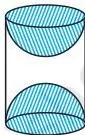
Figure 12.11 shows the result of scooping: both flat circular ends of the cylinder are removed and replaced by half a sphere’s curved surface each. Nothing flat remains on the ends, so the article is a tube with a bowl at each end.
- Step 1: Radius \( r = 3.5\ \text{cm} \), cylinder height \( h = 10\ \text{cm} \).
- Step 2: Add the cylinder’s curved surface and two hemisphere curved surfaces \( (2 \times 2\pi r^2 = 4\pi r^2) \).
\[ \text{TSA} = 2\pi rh + 4\pi r^2 = 2\pi r(h + 2r) \]
\[ = 2 \times \frac{22}{7} \times 3.5 \times (10 + 7) = 2 \times \frac{22}{7} \times 3.5 \times 17 = 22 \times 17 = 374\ \text{cm}^2 \]
Final answer: The total surface area of the article is \( 374\ \text{cm}^2 \).
Frequently Asked Questions
In Question 3, why do we subtract the hemisphere’s radius from the total height before finding the cone’s slant height?
Because the 15.5 cm total height includes the hemisphere’s own height sitting below the cone. A hemisphere’s height equals its radius (3.5 cm), so the cone’s true vertical height is \( 15.5 – 3.5 = 12\ \text{cm} \). The slant height formula \( l = \sqrt{r^2 + h^2} \) needs this genuine cone height; using 15.5 cm would give a wrong \( l \).
Why is the surface area of a combined solid not the sum of the total surface areas of its two parts?
Because joining hides the touching faces. When a cone and hemisphere are stuck base-to-base, each one’s flat circular face disappears inside and is no longer part of any outer surface. So you add only the curved surfaces that remain visible.
This is exactly why the chapter warns after Example 1 (NCERT, p. 164) that the top’s TSA is not the sum of the two whole TSAs.
In Question 4, why can the hemisphere’s greatest diameter only be 7 cm and not more?
Because the hemisphere must rest flat on a square face of the cube. If its diameter were larger than 7 cm, it would overhang the cube and the solid would no longer sit cleanly on that face. So the largest possible diameter equals the cube’s side, 7 cm, which fixes the radius at 3.5 cm.
In Question 8, why does the outer base area of the cylinder not appear in the final total surface area?
Because the conical cavity is hollowed out from one end and has the same diameter as the cylinder. Its circular base coincides exactly with that end of the cylinder, so the whole flat circle disappears — nothing ring-shaped is left to count. The remaining area is the outer wall, the opposite base, and the new inner conical surface.
In Question 7, why is the base of the tent left out of the canvas area?
Because the question states it: the base of the tent will not be covered with canvas. A tent stands on the ground, so its circular floor needs no canvas at all. You only add the cylindrical wall and the conical roof, giving 44 m².
Should I use 22/7 or 3.14 while solving Exercise 12.1?
Use 22/7, because the exercise preamble says “Unless stated otherwise, take \( \pi = \frac{22}{7} \).” Keep the 22/7 values as exact fractions while working and round only at the final step — in Question 8 you round 17.6 cm² to 18 cm² only at the very end.
These nine questions are all about surface area. The next exercise, Exercise 12.2 NCERT solutions, works on the very same combined solids but asks for their volumes instead — the sum of the volumes of the parts, with no faces disappearing from the total.
All chapters’ solutions and revision pages are gathered in the Class 10 study material hub, and the main CBSE notes index links every class and subject.
Reference: NCERT Class 10 Mathematics textbook, chapter Surface Areas and Volumes.
Explore Class 10 Maths NCERT Solutions
More for this chapter:
Class 10 Maths on LearnCBSE:
Related chapters:
Official source: download the NCERT textbook free from ncert.nic.in.