
The Bengal School and Cultural Nationalism class 12 chapter — Chapter 6 of the NCERT Fine Arts textbook An Introduction to Indian Art Part II — runs from page 84 to 97 (14 printed pages). It traces modern Indian painting from the Company School, through Raja Ravi Varma and the nationalist Bengal School, to Shantiniketan and the debate between Western and Indian modernism.
The official NCERT Class 12 Fine Arts Chapter 6 The Bengal School and Cultural Nationalism PDF is hosted by NCERT; open it to read the full chapter text with the book’s colour plates beside it. Below the download, this page maps the chapter’s sections, artists, paintings, techniques and exercise questions, with page references so you can follow along in the book.
| What the chapter holds | Count | Where it is used |
|---|---|---|
| Printed pages | 14 | |
| Figures with NCERT captions | 10 | |
| Exercise questions | 5 | answered in our NCERT Solutions |
| Official NCERT PDF | Download the chapter PDF | the chapter exactly as NCERT publishes it |
The Bengal School and Cultural Nationalism Class 12: What Is Inside This Chapter
This chapter is the hinge of the book’s story of modern Indian art. Before the British arrived, Indian art served religion and daily life — sculpture on temple walls, miniatures illustrating manuscripts, decoration on village mud houses (NCERT, p. 85).
The chapter then follows one chain of change: the Company School’s commissioned realism, Raja Ravi Varma’s academic oils, the nationalist Bengal School, Shantiniketan’s folk revival, and the argument over what “modernism” should mean in India.
Along the way it introduces seven artists, the institutions that shaped them, and six paintings read in detail on this page, from the Haripura posters to Abanindranath Tagore’s Journey’s End.
The chapter ends with a short exercise of five questions, from an album-making activity to commentary questions on the artists (pp. 90–91). The counts table on this page shows the chapter’s sections, figures and exercise questions at a glance.
The Key Concepts, in the Order the Chapter Teaches Them
This section follows the chapter’s own order, so you can read it with a finger on the textbook pages, and each idea builds on the one before it.
Company School of Painting (p. 85)
English officers in eighteenth-century India commissioned local artists to paint the people, flora and fauna around them — partly to document the country, partly for pleasure. Many of these artists had migrated from the courts of Murshidabad, Lucknow or Delhi (NCERT, p. 85).
Traditionally they worked from memory and rule books; their new patrons wanted close observation, a European habit. The mixture of the two became the Company School of Painting. The style was popular in Britain too, where sets of paintings were gathered into albums.
Raja Ravi Varma and the academic style (p. 86)
Photography entered India in the mid-nineteenth century and displaced the Company School as a way of documenting the world. What flourished instead, in British-run art schools, was the academic style — European oil painting used to show Indian subject matter.
The most successful academic painter worked outside those schools. Raja Ravi Varma, a self-taught artist of the Travancore Court in Kerala, imitated European paintings popular in Indian palaces and mastered academic realism for scenes from the Ramayana and Mahabharata. His works were copied as oleographs, sold in markets and hung in homes as calendar images (p. 86).
As nationalism grew, this style came to be seen as too Western for Indian myths — and the Bengal School arose in response.
The Bengal School: Abanindranath Tagore and E. B. Havell (pp. 86–87)
The book states plainly that the term Bengal School of Art is “not fully accurate”: the movement began in Calcutta but influenced artists across the country, including Shantiniketan (NCERT, p. 86). It was tied to the Swadeshi movement and led by Abanindranath Tagore (1871–1951), with the support of E. B. Havell (1861–1934), principal of the Calcutta School of Art.
Both men were critical of the colonial art schools and of European taste being imposed on Indians. They wanted painting that was Indian in subject and in style, and they prized Mughal and Pahari miniatures over Company or academic models (p. 87).
From 1896 they worked to Indianise art education at the Government Art School in Calcutta, and Abanindranath created the journal Indian Society of Oriental Art — an early major support of Swadeshi values in art. Younger artists such as Kshitindranath Majumdar and M. R. Chughtai followed his direction.
Shantiniketan and the Haripura posters (pp. 87–88)
Rabindranath Tagore invited Nandalal Bose, a student of Abanindranath, to head the painting department of Kala Bhavana, the art school of Visva-Bharati University at Shantiniketan — India’s first national art school (NCERT, p. 87). Bose turned to the folk art around him and to the language of art itself; he even illustrated Bengali primers with woodcuts.
Mahatma Gandhi asked him to paint panels for the Congress session at Haripura in 1937. The Haripura posters show villagers — a drummer, a farmer tilling, a woman churning milk — as lively, sketchy figures contributing their labour to nation building, echoing Gandhi’s vision of including the marginalised (p. 88). Kala Bhavana trained artists who spread this nationalist vision, such as K.
Venkatappa in South India.
The same pages introduce Jamini Roy. He trained at a colonial Art School, then rejected academic style for the flat, colourful folk painting of villages. He wanted art that was simple and easy to duplicate so it could reach a wider public (p. 88).
Pan-Asianism and the Bauhaus exhibition (p. 89)
After the Partition of Bengal in 1905, Swadeshi ideas peaked in art. Art historian Ananda Coomaraswamy joined Kakuzo Okakura, a Japanese nationalist visiting Rabindranath Tagore, whose pan-Asianism sought to unite India with other eastern nations against western imperialism. Two Japanese artists who came with him taught the wash technique at Shantiniketan, as an alternative to western oil.
Modern European art also travelled to India. In 1922 an exhibition of the German Bauhaus School — Paul Klee, Kandinsky and others — reached Calcutta. These artists had rejected academic realism and used an abstract language of squares, circles, lines and colour patches (p. 89).
The influence is clearest in Gaganendranath Tagore, Abanindranath’s brother, who used Cubist forms for interiors and made caricatures mocking rich Bengalis who blindly copied European ways.
Different concepts of modernism (pp. 89–90)
For now the chapter only establishes that the debate existed and was not racial: Benoy Sarkar, a Bengali intellectual, sided with European modernism, while E. B. Havell, an Englishman, argued for native art as the route to a true modern Indian art. The section on the two modernisms below explains this idea in full (pp. 89–90).
The Artists and Their Techniques: a Comparison
The chapter is organised around artists, and swapping one painter for another is the fastest way to lose marks. The table below fixes the main artists to a technique, dates, one named painting and a key influence, with the textbook page where the chapter discusses each.
| Artist | Dates | Technique / Style | One painting in this chapter | Key influence |
|---|---|---|---|---|
| Abanindranath Tagore | 1871–1951 | Invented the wash technique; soft, misty watercolour (pp. 87, 97) | Journey’s End (p. 97) | Mughal and Pahari miniatures; Swadeshi (p. 87) |
| Gaganendranath Tagore | 1869–1938 | Cubism — geometric patterns, jagged shapes (pp. 89, 94) | City in the Night (p. 94) | Modern western art, e.g. the Bauhaus exhibition (p. 89) |
| Nandalal Bose | — | Thick tempera in a bold folk style, broad brushwork (p. 91) | Tiller of the Soil (p. 91) | Patua folk painting, Ajanta; Gandhi’s village vision (pp. 87–88, 91) |
| Kshitindranath Majumdar | 1891–1975 | Wash technique; slender, rustic figures (p. 92) | Rasa-Lila (p. 92) | Bhakti Marga; Gita Govinda and Bhagvata Purana (p. 92) |
| Abdul Rehman Chughtai | 1899–1975 | Wash and tempera with calligraphic line (p. 93) | Radhika (p. 93) | Mughal manuscripts and old Persian paintings (p. 93) |
| Jamini Roy | 1887–1972 | Gouache in flat pat style; thick outlines (p. 96) | Woman with Child (p. 96) | Bengali folk pats; Bankura terracotta (p. 96) |
| Raja Ravi Varma (before the Bengal School) | — | Academic realism in oil (p. 86) | Rama Vanquishing the Pride of the Ocean (p. 95) | European academic painting; the Ramayana and Mahabharata (p. 86) |
The chapter prints dates for six of these artists; it does not state birth and death years for Nandalal Bose or Raja Ravi Varma, so those two cells are blank. Page references are to NCERT, An Introduction to Indian Art Part II.
Learning one identifying feature per artist — one technique, one painting — covers most of the chapter’s factual questions.
Figure Walkthrough: the Paintings the Chapter Discusses

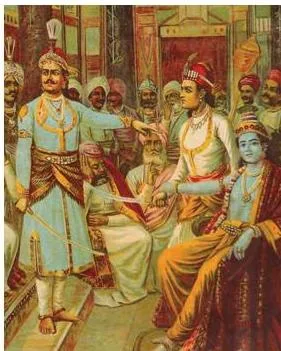
Each reproduced painting in this chapter works as a visual argument, and exam answers are rewarded for knowing what to see. The six figures below appear in the chapter; the reading under each one is written so you can reproduce it in your own words.
Tiller of the Soil: Nandalal Bose (p. 91)
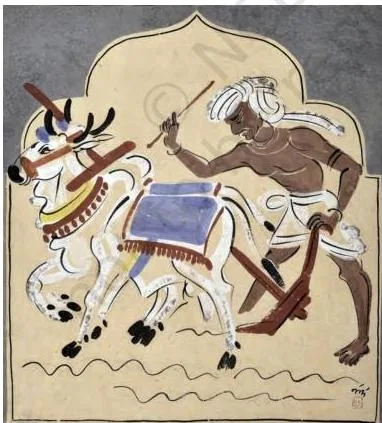
This panel turns an ordinary act — a farmer ploughing — into a political symbol. Bose first made pen-and-ink brush studies of local villagers, then painted in thick tempera with broad, bold brushwork that recalls the patua scroll painters (NCERT, p. 91).
The arch in the background and the strong formal design show what he took from the Ajanta wall paintings and sculptures. The message is Gandhi’s: the common villager stands at the centre of nation building.
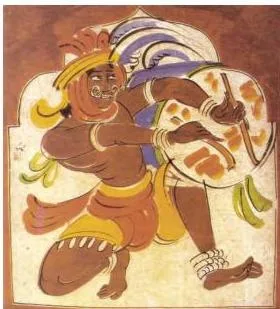
Dhaki: Nandalal Bose (p. 88)
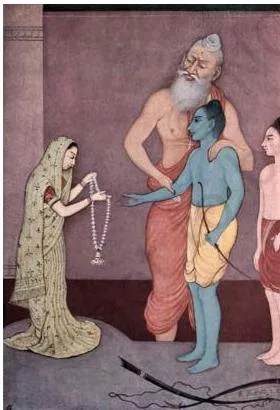
The Dhaki is a drummer, one of the Haripura posters Bose made for the 1937 Congress session. It carries the same idea as Tiller of the Soil: a lively, sketchy villager, caught mid-action, whose labour contributes to nation building (NCERT, p. 88). The energy comes from the folk style itself — deliberately simple, so art reaches everyone, not only the anglicised elite.
Rasa-Lila: Kshitindranath Majumdar (p. 92)
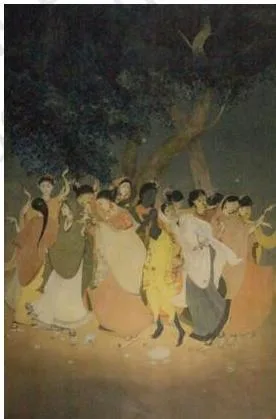
Majumdar carried the wash tradition forward with his own deviations: thin, slender figures, modest gestures and delicate watercolour (NCERT, p. 92). Here Krishna dances with Radha and the sakhis in a simple village setting, as described in the Bhagvata Purana and the Gita Govinda.
The figures and their clothes are drawn in simple, flowing lines — and because Krishna and the gopis share the same proportions, humans and God are brought to the same level.
Radhika: Abdul Rehman Chughtai (p. 93)
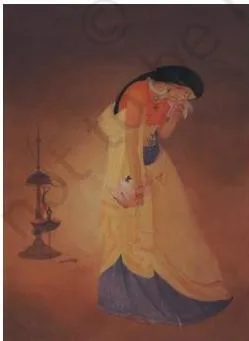
Chughtai, a descendant of Ustad Ahmed (the architect associated with the Taj Mahal), took the wash technique and added a calligraphic line typical of Mughal manuscripts and old Persian paintings (NCERT, p. 93).
Radhika walks away from a lighted lamp into a gloomy background, as if in a state of trance or remorse. The simplification of light and shade, and the lyrical quality of every line, are the painting’s finest details.
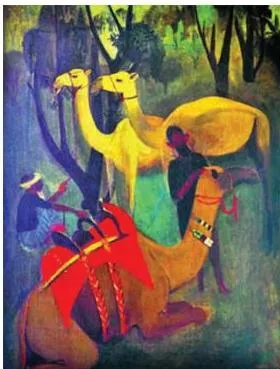
Journey’s End: Abanindranath Tagore (p. 97)
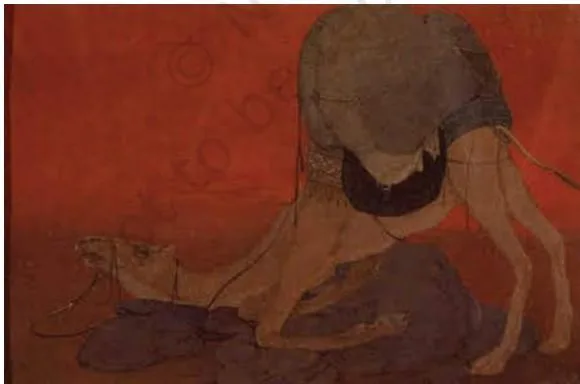
Painted in 1913, this watercolour is the chapter’s example of the wash technique Abanindranath developed — a method whose soft, misty, atmospheric effects suggest rather than state (NCERT, p. 97).
A camel lies collapsed against a red dusk, so the end of a day personifies the end of a journey. The camel’s fine lines and delicate tones carry the symbolic and literary weight, and the whole work shows the Mughal and Pahari miniature influence he wanted to revive (p. 87).
Rama Vanquishing the Pride of the Ocean: Raja Ravi Varma (p. 95)
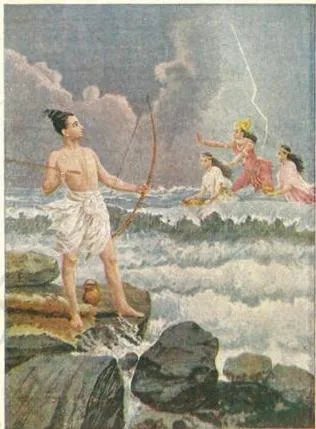
This oil painting shows the moment in the Valmiki Ramayana when Rama needs a bridge to Lanka for his army. He prays to Varuna, the god of the ocean, but Varuna does not respond; Rama stands to shoot his fiery arrow, and Varuna at once appears and appeases him (NCERT, p. 95).
It is a large, dramatic and emotional scene — the chapter describes each painting as a springboard to the next, so the series covers the whole epic.
The Two Modernisms: Western and Indian
This is the one idea in the chapter students usually find abstract, but it is also the chapter’s conclusion. In the 1920s, “modernism” meant different things to different camps.
The 1922 Bauhaus exhibition in Calcutta showed the European version: an abstract language of squares, circles, lines and colour patches, created by artists who had rejected academic realism (NCERT, p. 89). Pan-Asianism offered an eastern route, with Japanese artists teaching the wash technique at Shantiniketan as an alternative to oil.
The argument between the two was not based on race:
| Side | Who took it | What they believed |
|---|---|---|
| European modernism (anglicists) | Benoy Sarkar, a Bengali intellectual | European modernism was authentic; the Bengal School was regressive and anti-modern (p. 89) |
| Native tradition (orientalists) | E. B. Havell, an Englishman | A return to native art was the route to a true modern Indian art (pp. 89–90) |
| Meeting point | Amrita Sher-Gil | Used the style the Bauhaus exhibition showed, to depict Indian scenes (p. 90) |
Amrita Sher-Gil, whom the book takes up in the next chapter, is the meeting of both points of view (NCERT, p. 90).
The chapter closes by naming the deeper cause. Modern Indian art grew out of the conflict between colonialism, which brought new institutions — art schools, exhibition galleries, magazines — and nationalism, which asserted Indian taste (p. 90). That is why, the book concludes, Indian art keeps moving between internationalism (drawing ideas from the West) and the indigenous (being true to one’s own legacy).
That oscillation is the legacy the next chapters inherit.
Definitions: the Terms You Must Use Correctly
In this subject the examiner looks for the right word used precisely. These are the technical terms the chapter introduces, each pinned to the page where the book explains it.
- Company School of Painting — the style local artists produced for British patrons by mixing their traditional, memory-and-rule-book training with close European observation (NCERT, p. 85).
- Academic realism (academic style) — European-style oil painting taught in British art schools, turned to Indian subjects (p. 86).
- Oleograph — a mass-produced printed copy of a painting; Ravi Varma’s works spread as oleographs and calendar images (p. 86).
- Bengal School of Art — the nationalist art movement that began in Calcutta in the first decade of the 1900s, led by Abanindranath Tagore; the book notes the name is “not fully accurate” because it spread beyond Bengal (p. 86).
- Swadeshi — the nationalist movement with which the Bengal School was associated, reflected in a turn to Indian styles in art (pp. 86, 89).
- Wash technique — a watercolour method giving soft, misty, atmospheric effects; developed by Abanindranath Tagore (p. 97).
- Pan-Asianism — Kakuzo Okakura’s idea of uniting India with other eastern nations against western imperialism (p. 89).
- Cubism — a modern western style built from geometric patterns; Gaganendranath Tagore used it for building interiors and imaginary cities (p. 89).
- Tempera — a paint medium applied thickly; Nandalal Bose used it for the Haripura posters (p. 91).
- Gouache — an opaque watercolour; the medium of Jamini Roy’s Woman with Child (p. 96).
- Pat / patua — Bengal’s folk scroll-painting tradition and its practitioners; a source for Nandalal Bose and Jamini Roy (pp. 91, 96).
- Folk renaissance — the term attached to Jamini Roy, called the father of the folk renaissance for building an alternative modern Indian identity from folk art (p. 96).
- Anglicists and orientalists — the two camps in the art debate: supporters of the European academic style versus supporters of native Indian art; the division was not based on race (pp. 89–90).
Common Mistakes Students Make in This Chapter
Most mark loss in this chapter comes from swapping one artist for another. The table names six confusions the chapter actually produces, with the correction and a way to check yourself.
| Mistake | Correct rule | How to check your answer |
|---|---|---|
| “The Bengal School was confined to Bengal.” | The book says the term is “not fully accurate” — it was a movement that spread across India, including Shantiniketan (p. 86). | Does your answer treat it as a national movement, not a regional school? |
| “All the Tagores painted the same way.” | Abanindranath led the Bengal School; his brother Gaganendranath used Cubism; their uncle Rabindranath founded Visva-Bharati (pp. 87, 89). | Match the first name to the achievement before you write it. |
| “Journey’s End is an oil painting.” | It is a watercolour made in the wash technique (p. 97). | Check the medium of every painting you name. |
| “Company School painting grew out of the Indian courts.” | The artists migrated from courts like Murshidabad, Lucknow and Delhi, but the style was the British-commissioned mixture of tradition and observation (p. 85). | Ask who the patrons were. |
| “Every Indian artist rejected Western style.” | Gaganendranath adopted Cubism, and Benoy Sarkar defended European modernism (pp. 89–90). | Name the exception before you generalise. |
| “Jamini Roy was a self-taught folk artist.” | He trained at the colonial Art School first, then abandoned academic style for folk painting (p. 88). | Remember the order: academic training first, folk style second. |
How to Use This Chapter for Exams
The chapter rewards careful reading: its exercise (pp. 90–91) has five questions, and most answer directly from the pages the book spends on each artist. This mapping shows where each answer lives.
- Question 1 — an activity: build an album from two weeks of a local newspaper that shows the life of modern democratic India (p. 90).
- Question 2 — the importance of the Bengal School artists in making a national style of art; see pp. 86–89.
- Question 3 — your view on any one painting by Abanindranath Tagore; the chapter’s own example is Journey’s End (p. 97).
- Question 4 — the Indian art traditions that inspired the Bengal School; see pp. 87 and 89 for Mughal and Pahari miniatures, folk art and the pan-Asian wash technique.
- Question 5 — Jamini Roy’s themes after he abandoned the academic style; see pp. 88 and 96 — women and children, and rural life.
For any “write your view on a painting” question, use four steps:
- Name the painting and the artist, plus the date if the chapter gives one.
- State the medium and technique, and support it with one visual detail — “delicate flowing lines”, “broad folk brushwork”.
- Connect the work to the chapter’s larger argument: nationalism, the folk revival, or the Indian-versus-Western debate.
- Close with your own response — what mood or idea the painting carries for you.
One honest caution: textbook contents and the examinable syllabus are not always identical. Check the current official CBSE syllabus for what is examinable this session.
Revision Summary: the Chapter in Ten Lines
Ten lines that reconstruct the chapter’s whole argument in the order the book makes it. This condenses the story; it is not a substitute for reading the chapter.
- Before the British, Indian art served religion and daily life: temple sculpture, manuscript miniatures, village wall decoration (p. 85).
- British officers commissioned local artists, producing the Company School — a mix of traditional training and European observation (p. 85).
- Photography ended the Company School, and British art schools taught academic oil painting in its place (p. 86).
- Raja Ravi Varma, self-taught, mastered academic realism for epic subjects, and his oleographs became calendar images (p. 86).
- With the rise of nationalism, that Western style was rejected as foreign, and the Bengal School emerged in the first decade of the 1900s (p. 86).
- Abanindranath Tagore and E. B. Havell shaped the school: Indian subjects in an Indian style, drawn from Mughal and Pahari miniatures (p. 87).
- At Shantiniketan, Nandalal Bose’s Kala Bhavana made folk art central; the 1937 Haripura posters put common people at the centre of nation building (pp. 87–88).
- In 1922 the Bauhaus exhibition brought European modernism to Calcutta, and Gaganendranath Tagore applied its Cubism to Indian subjects (p. 89).
- Benoy Sarkar and E. B. Havell disagreed over which modernism was authentic — a divide based on conviction, not race (pp. 89–90).
- Modern Indian art, the book concludes, keeps moving between internationalism (ideas from the West) and the indigenous (one’s own tradition); that tension is its legacy (p. 90).
Related Resources
This listing is maintained for the 2026-27 academic session using the NCERT textbook information available to us. NCERT remains the authority for confirming the latest edition.
The book itself points forward: the chapter closes with Amrita Sher-Gil, whom the next chapter takes up (NCERT, p. 90). Continue with these pages:
- The Pahari Schools of Painting — the earlier chapter on the miniature tradition this chapter names as a key inspiration.
- The next chapter, on modern Indian art — it begins with Amrita Sher-Gil, the meeting point of the two modernisms.
- Class 12 Fine Arts notes hub — the chapters of An Introduction to Indian Art Part II.
- Class 12 hub — Class 12 notes across subjects.
- CBSE notes — the notes index.
Sources and Data Verification
All content on this page describes the NCERT Class 12 Fine Arts textbook An Introduction to Indian Art Part II, Chapter 6, “The Bengal School and Cultural Nationalism,” pages 84–97. The official PDF is available from NCERT at ncert.nic.in.
This page covers that chapter only. It does not cover the book’s other chapters or other Fine Arts textbooks.
This listing is maintained for the current academic session using the NCERT information available to us.
NCERT settles textbooks, editions and PDFs; CBSE settles curriculum, syllabus and examinations. Where a plan of study differs from the book — for example, in what is examinable — the official CBSE syllabus for the current session is the authority.
FAQs on The Bengal School and Cultural Nationalism
Which chapter is “The Bengal School and Cultural Nationalism” in the Class 12 Fine Arts book?
It is Chapter 6 of An Introduction to Indian Art Part II, the NCERT Class 12 Fine Arts textbook, running from page 84 to 97. The official PDF link is at the top of this page.
Who were the main artists of the Bengal School according to this chapter?
The chapter’s central artists are Abanindranath Tagore (leader of the movement), Gaganendranath Tagore (his brother, the Cubist), Nandalal Bose (Shantiniketan and the Haripura posters), Kshitindranath Majumdar (Rasa-Lila), Abdul Rehman Chughtai (Radhika) and Jamini Roy (Woman with Child), with E. B. Havell as Abanindranath’s supporter.
Raja Ravi Varma precedes them as the master of academic realism (pp. 86–88, 94–96).
What is the difference between the Company School of Painting and the Bengal School?
The Company School was made by local artists for British patrons — a mixture of traditional training and close European observation (p. 85). The Bengal School was a nationalist, Swadeshi movement led by Abanindranath Tagore that rejected academic and Company styles and looked to Mughal and Pahari miniatures instead (pp. 86–87).
Which Indian art traditions inspired the Bengal School artists?
Mughal and Pahari miniatures (p. 87); folk art and patua scroll painting, especially at Shantiniketan (p. 88); the Ajanta wall paintings, visible in Nandalal Bose’s Haripura panels (p. 91); and the Japanese wash technique taught at Shantiniketan as an alternative to oil (p. 89).
What does the chapter mean by “two concepts of modernism”?
It means Western modernism — the abstract style of squares, circles and colour patches shown by the 1922 Bauhaus exhibition in Calcutta — and the orientalist idea that a true modern Indian art must come from native tradition. Benoy Sarkar, a Bengali intellectual, defended the European version and called the Bengal School regressive; E. B. Havell, an Englishman, defended native art.
Amrita Sher-Gil combined both (pp. 89–90).
How many exercise questions does this chapter have and what do they ask?
Five. Question 1 is an activity — compiling an album from newspaper images and text about modern democratic India.
Question 2 asks about the Bengal School artists’ importance in a national style; question 3 asks for your view on a painting by Abanindranath Tagore; question 4 asks which Indian art traditions inspired the school; question 5 asks about Jamini Roy’s themes after he abandoned the academic style (pp. 90–91).
Reference: NCERT Class 12 Fine Arts textbook (An Introduction to Indian Art Part II), Chapter 6, official edition on ncert.nic.in.
Explore Class 12 Fine Art Books
- Previous: The Pahari Schools of Painting
- Next: The Modern Indian Art
Related chapters: