
The Rajasthani Schools of Painting Class 12 chapter is Chapter 2 of the NCERT Fine Art textbook An Introduction to Indian Art Part II. It runs from book page 10 to page 34 and covers eight painting schools, the literary texts behind the miniatures, and seven close readings of individual plates.
The official NCERT chapter PDF is right below; the rest of this page explains what is inside the chapter so you can study it directly.
Download the Rajasthani Schools of Painting Class 12 Chapter PDF
The chapter belongs to the official NCERT textbook, so the trustworthy copy is the one NCERT itself publishes. Open the chapter PDF when you want the book’s exact text and its colour plates in a single file: the Rajasthani Schools of Painting Class 12 chapter PDF is hosted on ncert.nic.in alongside the rest of the fine art textbook.
If an edition update changes the file, the full collection on the NCERT portal is the definitive place to look.
| What the chapter holds | Count | Where it is used |
|---|---|---|
| Printed pages | 25 | |
| Figures with NCERT captions | 12 | |
| Exercise questions | 5 | answered in our NCERT Solutions |
| Official NCERT PDF | Download the chapter PDF | the chapter exactly as NCERT publishes it |
Chapter at a glance
The chapter works in two halves. The first half is a field guide: it explains where the name Rajasthani came from, how a miniature was made, which texts the artists illustrated, and then gives one section to each of the eight schools.
The second half is a set of careful descriptions of individual paintings, each chosen to show one way of telling a story in a single frame. The exercise block of five questions sits between the two halves.
| Chapter item | Count |
|---|---|
| Printed pages | 25 |
| Section headings | 19 |
| Figures | 12 |
| Exercise questions | 5 |
What the chapter covers: the term, the region, the technique
The opening pages answer three questions before any school is discussed: where the name Rajasthani comes from, which territory the schools occupied, and how a painting was physically made.
The term. The chapter explains that the name covers the court styles of the princely kingdoms and thikanas of roughly present-day Rajasthan and parts of Madhya Pradesh, active mainly between the sixteenth and early nineteenth centuries (NCERT, p. 10). In 1916 the scholar Anand Coomaraswamy coined the term Rajput Paintings to separate these indigenous courts from the Mughal School.
That label is now obsolete — scholars use Rajasthani and Pahari instead — and the chapter says so explicitly, because older books still say Rajput.
The region. The schools named in the chapter’s opening list are Mewar, Bundi, Kota, Jaipur, Bikaner, Kishangarh, Jodhpur (Marwar), Malwa, Sirohi and other such principalities (NCERT, p. 10). Notice that Malwa lies in Central India, not in present-day Rajasthan: the chapter treats it as a Rajput school culturally, which matters for the map question in the exercise.
The technique. Paintings were made on waslis — thin sheets of handmade paper glued together in layers to reach the desired thickness. One miniature went through a set order:
- Sketch — the outline was drawn in black or brown, with brief colour notations or sample patches marking where each colour would go.
- Colour — pigments were mostly minerals and precious metals such as gold and silver, mixed with glue as the binding medium.
- Brush — camel and squirrel hair.
- Burnish — the finished surface was rubbed with an agate to give it a uniform sheen.
- Scribe — the verse was written in the space left for it, once the painting was complete.
The work was a form of teamwork. The master composed the painting and made the preliminary drawings; pupils and specialists handled colour, portraiture, architecture, landscape and animals; the master returned for the finishing touches; and the scribe wrote the verse (NCERT, pp. 10–11).
Keep this division of labour in mind — it is why the chapter refuses to assume that one artist painted every stroke of an inscribed work.
The stories painted: the texts behind the miniatures
Rajasthani miniatures are illustrations first, so the literary texts matter as much as the brushwork. The chapter’s overview of themes (NCERT, pp. 11–13) is the reading list behind nearly every plate, and it is the direct material for exercise question 5.
| Text | Author and date | What it gave the painters |
|---|---|---|
| Gita Govinda | Jayadeva, twelfth century | Krishna as God and ideal lover; Radha as the human soul offering herself to him; shringara rasa (NCERT, p. 12) |
| Rasamanjari | Bhanu Datta, fourteenth century, Bihar | Nayaka–nayika classification by age, appearance and emotional state (NCERT, p. 12) |
| Rasikapriya | Keshav Das, 1591, at the court of Raja Madhukar Shah of Orchha, in Brajbhasha | The emotional states of lovers — togetherness, jealousy, separation, quarrel (NCERT, p. 12) |
| Kavipriya | Keshav Das, written in honour of Rai Parbin | Its tenth chapter, Baramasa, describes the twelve months and the seasons (NCERT, pp. 12–13) |
| Bihari Satsai | Bihari Lal, about 1662, at the Jaipur court | Seven hundred aphoristic verses; painted chiefly at Mewar (NCERT, p. 13) |
| Ragamala | The imagination of musicians and poets | Ragas and raginis arranged as families in albums (NCERT, p. 13) |
| Bardic tales | Dhola-Maru, Sohni-Mahiwal, Mrigavat, Chaurpanchashika, Laurchanda | Romantic legends from the oral tradition (NCERT, p. 13) |
| Epics and Puranas | Ramayana, Bhagvata Purana, Mahabharata, Devi Mahatmya | Favourites of every school (NCERT, p. 13) |
| Court life | No single text | Darbars, hunts, festivals, portraits, city views — the record of the court’s own world (NCERT, p. 13) |
The chapter prints Chaurpanchashika, dated 1500, as an early example of the bardic vein — a romantic tale painted in Mewar more than a century before the schools took their classic forms (NCERT, p. 13).
It matters twice over: it is one of the earliest dated works in the Rajput style, and the Malwa section treats pieces like it as the bridge between Jain manuscript painting and the flat, two-dimensional court style of the 1600s (NCERT, p. 14).
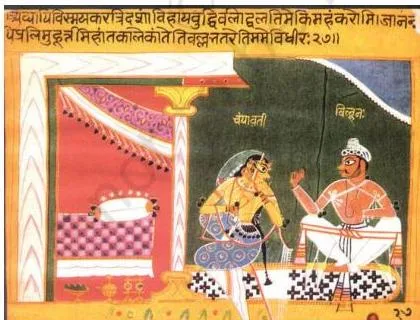
The eight schools of Rajasthani painting
The schools sat close to one another geographically, yet the chapter stresses how differently they painted. Its opening section lists the axes of difference — execution fine or bold; colour brilliant or gentle; composition; mode of narration; and naturalism versus mannerism (NCERT, p. 10). Hold that list in mind while you read: every school description below is organised around it.
Malwa School: the flat two-dimensional style
Malwa is the outlier of the group — the most representative Hindu Rajput style of its century, yet one with no precise court to pin it down. The chapter dates the school between 1600 and 1700 CE and traces its two-dimensional, simplified language to a line of descent from Jain manuscript painting, passing through early works like Chaurpanchashika (NCERT, p. 14).
Malwa had no single centre: Mandu, Nusratgarh and Narsyang Sahar are named, and the many paintings found in the Datia Palace collection in Bundelkhand point to the region of activity.
There are no patron portraits and no mention of patron kings, which supports the view that the Datia rulers bought these paintings from travelling artists, who carried popular themes such as the Ramayana, the Bhagvata Purana, the Amaru Shataka, the Rasikapriya, the Ragamala and the Baramasa (NCERT, pp. 14–15).
The early dated landmarks are the Amaru Shataka of 1652 and Madho Das’s Ragamala of 1680.
The folio below is Madho Das’s 1680 Raga Megha, the school’s best-known work.
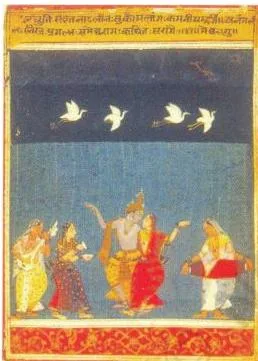
Read Raga Megha as the Malwa signature: flat colour planes, deliberate two-dimensional austerity, and no interest in the depth that Mughal painting pursued. That same compartmentalised flatness returns in the chapter’s plate study of the Bhagvata Purana, which is described as a typical Malwa composition (NCERT, p. 27).
Mewar School: from Nisardin’s Ragamala to Sahibdin’s epics
Mewar has the clearest documentary trail of the chapter, and its most famous painter is Sahibdin. Long wars with the Mughals destroyed most early work, so the school’s emergence is dated by a single set: the Ragamala painted at Chawand in 1605 by Nisardin, whose colophon page records the artist, the place and the date (NCERT, p. 15).
The reign of Jagat Singh I (1628–1652) reformulated the style under Sahibdin and Manohar. Sahibdin’s dated works are the Ragamala (1628), the Rasikapriya, the Bhagvata Purana (1648) and the Yuddha Kanda of the Ramayana (1652); Manohar’s major work is the Bal Kanda (1649); and Jagannath painted the Bihari Satsai in 1719 (NCERT, p. 16).
The Mewar palette favours bright reds and yellows, and the eighteenth century turned from texts to secular courtly subjects (NCERT, pp. 16–17). Nearby, Nathdwara became a painting school in the late seventeenth century, producing large cloth backdrops called pichhwais for the deity Shrinathji (NCERT, p. 17).
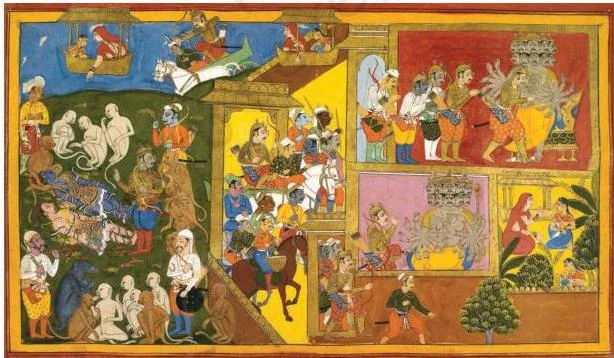
Sahibdin’s Yuddha Kanda is the chapter’s example of oblique aerial perspective — a tilted, elevated viewpoint that gives a war scene a credible scale. Instead of one moment, the artist layers several episodes into a single painting, here the story of Indrajit’s devious tactics and magic weapons (NCERT, p. 15).
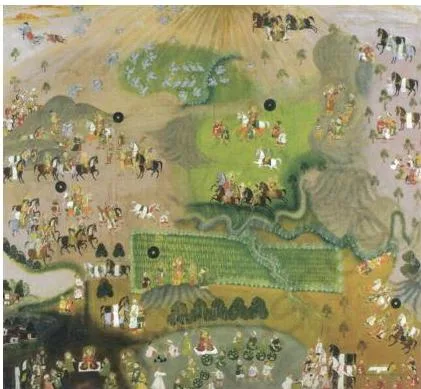
The 1744 folio of Maharana Jagat Singh II hawking shows the new courtly taste. The horizon is raised at a tangent to the foreground, which lets the artist open the scene into a panoramic view of limitless vision (NCERT, pp. 16–17).
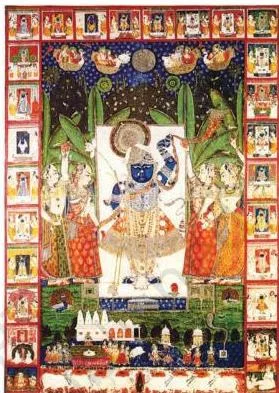
The 1800 Nathdwara painting of Krishna as Shrinathji celebrating Sarad Purnima stands for the devotional side of the Mewar region — festival paintings made for Vaishnava worship rather than for court records.
Bundi School: lush nature and refined design
Bundi, the chapter says, is remarkable for its unblemished colour sense and its excellent formal design — and it owns the earliest dated Rajasthani Ragamala. That set, the Chunar Ragamala of 1591, was painted at Chunar (near Benaras), where the Hada Rajput ruler Bhoj Singh (1585–1607) kept a palace.
Its Persian inscription names three artists — Shaykh Hasan, Shaykh Ali and Shaykh Hatim — who introduce themselves as pupils of the Mughal masters Mir Sayyid Ali and Khwaja Abdus Samad (NCERT, p. 18).
Bundi blossomed under two patrons: Rao Chattar Sal (1631–1659) and his son Rao Bhao Singh (1659–1682), an enthusiastic patron who commissioned many portraits of himself. Minute refinement marked the short accomplished phase of Umed Singh (1749–1771), and the long reign of Bishen Singh (1771–1821) brought hunting scenes, since he was a keen hunter (NCERT, pp. 17–18).
Two loves define the style. One is lush vegetation with water bodies, hills and wildlife — Bundi shares this with Kota, and its drawing of elephants is called unsurpassed. The other is a particular feminine ideal: petite women with round faces, receding foreheads, sharp noses, full cheeks, sharply penciled eyebrows and a pinched waist (NCERT, p. 18).
Eighteenth-century Bundi also absorbed Deccani aesthetics, loving bright and vivid colours (NCERT, p. 18).
One folio from the Chunar set supplies the chapter with a documentary clue. In Raga Dipak, the palace finial pokes into the empty label patch, proving the painting was finished before the scribe ever wrote the verse (NCERT, p. 19).
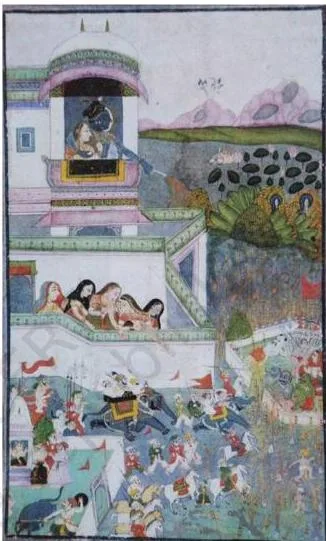
The Ashwin folio of a Bundi Baramasa is one of the twelve-month series the school loved. It shows Bundi’s atmospheric landscape instinct — the month rendered as weather and mood — and the Baramasa theme itself comes from Kavipriya, whose tenth chapter describes each month (NCERT, p. 19).
Kota School: the obsession with the chase
Kota grew out of Bundi and is defined by one subject — the hunt. The two were one kingdom until 1625, when Jahangir split the Bundi territory and awarded part of it to Madhu Singh, the younger son of Rao Ratan Singh, for his bravery (NCERT, pp. 19–20).
For several decades after, Kota work cannot be told apart from Bundi’s; some compositions were taken over verbatim. Then figural and architectural exaggeration, plus a growing Kota flair for drawing, made the style strikingly individual (NCERT, p. 20).
Under Ram Singh I (1686–1708), Kota artists enlarged their range and, the chapter says, became the first to treat landscape as the real subject of a composition (NCERT, p. 20).
Under the young Umed Singh (1770–1819), whose regent Zalim Singh kept him occupied with hunting while running the state, the chase became a social ritual in which even the women of the court joined. The style is characteristically spontaneous and calligraphic, with marked shading and the double-lid eye, and the artists excelled at animals and combat (NCERT, p. 20).

The 1695 hunting scene of Ram Singh I at Mukundgarh is the Kota achievement in one image: animal combat as spectacle, with landscape treated as a setting worth painting for its own sake.
Bikaner School: Mughal elegance in documented studios
Bikaner shows what long Mughal contact did to a Rajput court — and its inscriptions make it the best-documented school in the chapter. The kingdom was founded by Rao Bika in 1488; its great period came under Anup Singh (1669–1698), who built a library that became a repository of manuscripts and paintings (NCERT, pp. 20–21).
Mughal masters worked at Bikaner. Ustad Ali Raza, a master painter from Delhi, was employed by Karan Singh from about 1650. Later, Ruknuddin — whose ancestors came from the Mughal court — painted the Ramayana, the Rasikapriya and the Durga Satpsati in a style that mixed indigenous, Deccani and Mughal conventions; Ibrahim, Nathu, Sahibdin and Isa worked in his atelier (NCERT, p. 21).
Three habits make the school distinctive. First, studios called Mandi, where a group of artists worked under a master. Second, documentation: on completion, the court archivist entered the master’s name and the date behind the painting, and the master would occasionally add finishing touches called gudarayi, literally to lift. The studio also did marammat (repair) and nakals (copies).
Third, a unique custom of artist portraits, with the painters titled Usta or Ustad. The royal day-to-day diaries called the Bahis, plus inscriptions in Marwari and Persian, make Bikaner the best-documented school of all (NCERT, pp. 21–22).
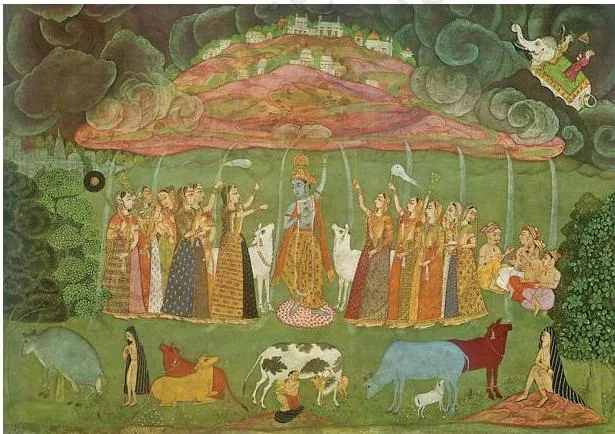
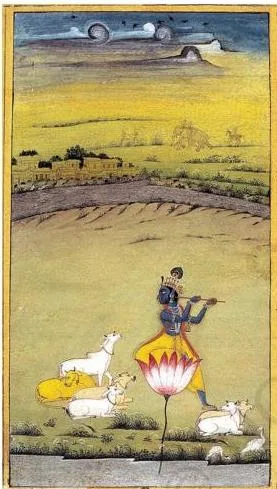
The two plates show the Bikaner manner at different moments. Shahadin’s Krishna supporting Mount Govardhan (1690) carries the Mughal-influenced elegance and soft colours of the school’s prime; the 1777 Krishna playing Flute surrounded by Cows shows the same gentle palette in a later, more decorative idiom.
Ruknuddin painted in soft colour tones, and Ibrahim’s works carry a misty, dreamlike quality — the two named artist voices inside this school (NCERT, pp. 21–22).
Kishangarh School: the face of Bani Thani
A Kishangarh miniature is recognisable in a second — by the face. The chapter calls the school among the most stylised of all Rajasthani miniatures, and its facial type is distinctive: arched eyebrows, lotus-petal eyes slightly tinged with pink and with drooping eyelids, a sharp slender nose, thin lips (NCERT, p. 22).
Kishan Singh founded the state in 1609; artists worked at the court under Man Singh (1658–1706). The distinctive style matured under Raj Singh (1706–1748), with a tendency to elongate the human figure, lavish use of green and a penchant for panoramic landscapes.
After Raj Singh’s initiation into the Pushtimarg cult of Vallabhacharya, Krishna Lila themes became the personal favourites of the Kishangarh rulers (NCERT, pp. 22–23).
Sawant Singh’s celebrated artist was Nihal Chand, active between 1735 and 1757, who painted Sawant Singh’s poetry as scenes of Radha and Krishna in courtly surroundings — the figures often tiny within vast, minutely worked landscapes (NCERT, p. 23).
The chapter’s Bani Thani plate study ties this face to a real person. Bani Thani was a young singer at Kishangarh, an attendant of Raj Singh’s wife, and a gifted poetess, singer and dancer. She became Sawant Singh’s muse, and Nihal Chand’s painting of her is based on Sawant Singh’s poem Bihari Jas Chandrika.
The exaggerated Kishangarh facial type is believed to derive from her sharp features — so the face you recognise in every figure began as one woman’s portrait (NCERT, pp. 32–33).
Jodhpur School: folk vigour and the documentary portrait
Jodhpur (Marwar) kept a folkish strength even as Mughal aesthetics entered its court. Mughal influence shows in portraiture and court scenes, but the chapter says the indigenous folkish style was so deeply embedded that it prevailed in most illustrated sets (NCERT, p. 23).
One of the earliest dated Jodhpur works is the Pali Ragamala of 1623 by Virji (NCERT, p. 23). The documentary trend belongs to Jaswant Singh (1638–1678): from about 1640 his court recorded portraiture and court life — a habit that lasted until photography replaced painting in the nineteenth century.
Ajit Singh (1679–1724) took the throne after 25 years of war with Aurangzeb, and the heroism of Veer Durgadas Rathore, who recaptured Marwar, was celebrated in poems and equestrian portraits (NCERT, pp. 23–24).
The last innovative phase came under Man Singh (1803–1843), a follower of the Nath Sampradaya. His period produced the Ramayana (1804) — in which the artist rebuilt Rama’s Ayodhya from Jodhpur’s own bazaars, lanes and gateways — along with the Dhola-Maru, the Panchatantra (1804), the Shiva Purana and the Nath Charita (1824) (NCERT, p. 24).
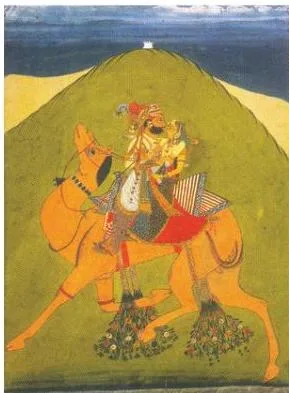
Dhola and Maru takes the local ballad as its theme and sets the lovers on a camel — the same camel that reappears in the chapter’s Maru Ragini plate study, where the ballad explains why Maru is the consort of Raga Shri (NCERT, pp. 24, 28–29).
Jaipur School: the Mughal-linked court style
Jaipur’s closeness to the Mughal capitals shaped its polish and its formats. The school began at Amer, the Rajput state nearest of all to Agra and Delhi, and its rulers kept firm Mughal ties: Bharmal married his daughter to Akbar, Bhagwant Das was Akbar’s close friend, and Man Singh became Akbar’s most trusted general (NCERT, p. 25).
Sawai Jai Singh (1699–1743) founded the city of Jaipur in 1727 and shifted from Amer. He brought Mughal painters from Delhi into his atelier, reorganised the Suratkhana — the place where paintings were made and stored — and commissioned Radha–Krishna sets in which the hero resembles the king himself. Sahibram, a portrait specialist, was part of this atelier (NCERT, pp. 25–26).
Ishwari Singh (1743–1750) had his leisure pursuits painted and Madho Singh (1750–1767) recorded incidents of court life. Under Sawai Pratap Singh (1779–1803), an atelier of about 50 artists saw Mughal influence recede into a reformulated Jaipur style, a blend of Mughal and indigenous features, with Gita Govinda, Ragamala and Bhagvata Purana painted afresh.
By the early nineteenth century the school loved large formats, lavish gold and life-size portraits (NCERT, p. 26). The chapter describes The Hour of Godhuli (1780) as an example of this courtly Jaipur manner.
The eight schools compared
Laid out side by side, the differences the chapter asks you to hold in memory sort themselves quickly.
| School | Period | Patrons | Main artists | Signature style |
|---|---|---|---|---|
| Malwa | Flourished 1600–1700 | No single court; buyers at Datia | Madho Das | Flat two-dimensional space; compartments; no patron portraits |
| Mewar | From 1605; peak under Jagat Singh I (1628–1652) | Jagat Singh I | Nisardin, Sahibdin, Manohar, Jagannath | Bright reds and yellows; layered battle scenes; documentary colophons |
| Bundi | Seventeenth century onward | Chattar Sal, Bhao Singh, Umed Singh, Bishen Singh | Shaykh Hasan, Shaykh Ali, Shaykh Hatim | Lush nature and water; fine equestrian portraits; petite women with round faces |
| Kota | Separate from 1625; its own school from about 1660 | Jagat Singh, Ram Singh I, Umed Singh (regent Zalim Singh) | No single named master; hunting specialists | The hunt; calligraphic line; double-lid eye; landscape as true subject |
| Bikaner | From about 1650; peak under Anup Singh (1669–1698) | Karan Singh, Anup Singh | Ustad Ali Raza, Ruknuddin, Ibrahim, Nathu, Sahibdin, Isa | Mughal elegance; subdued palette; studio inscriptions and artist portraits |
| Kishangarh | Matured by early eighteenth century | Man Singh, Raj Singh, Sawant Singh | Nihal Chand | Stylised face — arched brows, lotus-petal eyes; elongated figures; green panoramas |
| Jodhpur | From 1623; documentary phase from about 1640 | Jaswant Singh, Ajit Singh, Man Singh | Virji, Dana | Folkish vigour; documentary portraits; local life entering the epics |
| Jaipur | At Amer, then Jaipur from 1727 | Sawai Jai Singh, Sawai Pratap Singh | Sahibram, Muhammad Shah | Large formats; lavish gold; blended Mughal-indigenous style |
Reading the plates: narrative devices in Rajasthani painting
The chapter’s second half is a set of close readings of individual paintings. Each reading shows one visual device — the trick that lets a still image tell a story. When you are asked to describe a miniature, name the device, point to where it operates in the painting, then say what it does to the space or the narrative.
| Device | What it does | Example in the chapter | Book page |
|---|---|---|---|
| Compartmentalised space | Divides the picture into sections, each narrating one part of an episode | Bhagvata Purana: Krishna killing Shaktasura, in Malwa style | pp. 27–28 |
| Oblique aerial perspective | Tilted elevated viewpoint giving a war scene credible scale | Sahibdin’s Yuddha Kanda | p. 15 |
| Continuous narrative | One story runs left to right within a single frame | Guman’s Rama Meets Members of His Family at Chitrakut | pp. 33–34 |
| Top-to-bottom indoor-to-outdoor movement | A central mound splits the frame; a pavilion above means interior, trees below mean countryside | Nuruddin’s Krishna Swinging and Radha in Sad Mood | pp. 31–32 |
| Raised horizon | Horizon tilted up opens a panoramic view of limitless vision | Maharana Jagat Singh II hawking | pp. 16–17 |
| Negated foreground | Removing the ground makes a galloping horse airborne — speed | Tulchi Ram’s Raja Aniruddha Singh Hara | p. 29 |
| Style mixing in one canvas | Borrows from several schools at once | Dana’s Chaugan Players | p. 30 |
| Inscription as documentary evidence | The written label records artist, patron, place and date | Sahibdin’s Maru Ragini | p. 28 |
Two plates from the chapter show the method applied. The first is Tulchi Ram’s equestrian portrait of 1680, one of the most discussed paintings of Aniruddha Singh’s period.
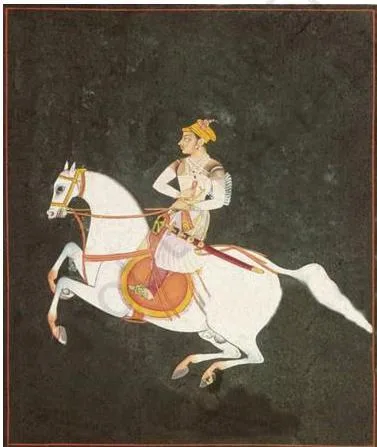
The painting is the chapter’s clearest example of a negated foreground. The horse gallops so high that the ground is invisible, and that single choice turns a formal portrait into a scene of motion — the chapter says such paintings turn still portraits into narratives (NCERT, p. 29).
The inscription adds documentary drama of its own: the back names the artist and prince (Kanwar) Aniruddha Singh, while the front carries the name Bharat Singh. Scholars disagree over whom it shows; most believe it is the young Aniruddha before he became ruler.
The second is Nuruddin’s 1683 illustration of the Rasikapriya, painted while he worked at the Bikaner court (1674–1698).
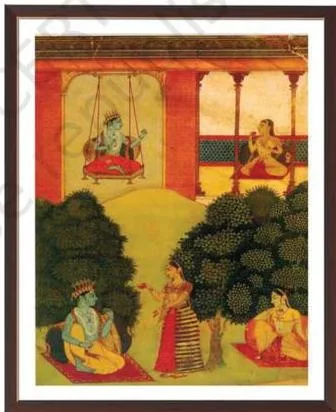
Nuruddin works by dividing the picture. A soft, undulating mound runs through the centre and acts as a pictorial prop: the pavilion above it reads as a palatial interior, the trees below as countryside, so the story moves from top to bottom, indoors to outdoors.
Above, Krishna swings with a gopi at her dwelling; below, the jilted Radha sits alone under a tree. Guilt-ridden Krishna follows her; Radha’s sakhi acts as messenger and pacifier between them (NCERT, pp. 31–32). The plate is also inscribed with the artist’s name and the date 1683.
The other plate studies supply the remaining devices.
Read the Bhagvata Purana folio as the Malwa compartment in practice: it shows the celebrations after Krishna’s birth — Nanda and Yashoda donating cows to Brahmins, food being prepared, women guarding baby Krishna from the evil eye — and the narrative ends with Krishna toppling the cart demon Shaktasura with a gentle kick (NCERT, pp. 27–28).
Dana’s Chaugan Players (1810) looks like one school but borrows from several: Mughal women, Deccani horses, Bundi–Kishangarh facial features, and a flat green ground that is pure indigenous preference for flat surfaces; its inscription reads beautiful maidens on horsebacks, playing (NCERT, p. 30).
Guman’s Rama Meets Members of His Family at Chitrakut (1740–1750) is a continuous narrative: the story begins on the left as the three mothers arrive, moves through Rama’s respectful greetings and Kaushalya’s embrace, passes the sages’ news of Dashratha’s death, and ends with the group exiting the frame on the right.
Every character is labelled and a verse is inscribed above — a full description should follow exactly that left-to-right order (NCERT, pp. 33–34).
The Chunar set’s Raga Dipak shows the same documentary habit in reverse. The palace finial protrudes into the patch reserved for the label, and only the words Dipak Raga appear — evidence that the painting was finished before the scribe’s verse was ever written (NCERT, p. 19).
Key terms used in this chapter
The chapter assumes a specialised vocabulary. This table collects the words it uses, so you do not have to pause and guess while reading.
| Term | Meaning | Page |
|---|---|---|
| wasli | Layered thin sheets of handmade paper glued together for thickness | p. 10 |
| thikana | Princely estate | p. 10 |
| shringara rasa | The romantic sentiment evoked by the Gita Govinda | p. 12 |
| nayaka / nayika | Hero and heroine, classified by age (baal, taruna, praudha), appearance (padmini, chitrini, shankhini, hastini) and mood (khandita, vasakshaja, abhisarika, utka) | p. 12 |
| satsai | Seven hundred verses, as in the Bihari Satsai | p. 13 |
| Baramasa | The twelve-months theme, from the tenth chapter of Kavipriya | pp. 13, 19 |
| Ragamala / ragini | Album of 36 or 42 folios; six main ragas — Bhairava, Malkos, Hindol, Dipak, Megha, Shri — each with six raginis | pp. 13, 18–19 |
| chitara | One who paints; Sahibdin’s title in the Maru Ragini inscription | p. 28 |
| likhitam | Written; the act of painting treated as the painterly equivalent of the inscribed verse | p. 28 |
| gudarayi | The master’s finishing touches on a pupil’s work, literally to lift | p. 21 |
| marammat | Repairing older works in the studio | p. 21 |
| nakal | Copy of an older work | p. 21 |
| Mandi | Studio in Bikaner, where a group worked under a master | p. 21 |
| Usta / Ustad | Title given to artists in Bikaner | p. 21 |
| pichhwai | Large painted cloth backdrop made for Shrinathji on festive occasions | p. 17 |
| Suratkhana | Jaipur’s storehouse where paintings were made and kept | p. 26 |
| zenana | Women’s quarters, shown in scenes of courtly life | p. 17 |
| colophon | Inscription recording the artist, patron, place and date, as on the Chawand Ragamala | pp. 15, 28 |
| samvat | The Indian calendar era used in inscriptions; samvat 1685 equals 1628 CE | p. 28 |
Common mistakes students make with this chapter
The chapter’s own evidence sets several traps. Name the mistake before you make it:
| Mistake | Correct rule | How to check your answer |
|---|---|---|
| Treating Bundi and Kota as always separate schools | They were one kingdom until 1625, when Jahangir divided it; for decades after, Kota’s paintings cannot be told from Bundi’s | Ask for the date — pre-1660s Kota is likely Bundi in origin; some Kota compositions were taken verbatim from Bundi pictures |
| Assuming the artist named on a painting painted every stroke | In Bikaner the court archivist entered the master’s name and date on completion, even on pupils’ work; the master added only gudarayi finishing touches | Read the inscription as a record of the studio, not of a single hand |
| Using Rajput painting as the current label | Coomaraswamy coined the term in 1916; it is now obsolete — use Rajasthani and Pahari | If a source says Rajput Schools, it is using dated terminology |
| Conflating the two artists named Sahibdin | Mewar’s Sahibdin painted the Yuddha Kanda (1652) under Jagat Singh I; a second Sahibdin worked in Ruknuddin’s atelier at Bikaner | Check the school and the dates of the work before naming the artist |
| Reading Bani Thani as Radha herself | Bani Thani was a singer and poetess, Sawant Singh’s muse; her sharp features shaped the Kishangarh Radha type | She is the model; Nihal Chand painted her in the role of Radha |
| Thinking a Ragamala is a single painting | A Ragamala is an album of 36 or 42 folios — six male ragas, each with six female raginis | Name all six ragas: Bhairava, Malkos, Hindol, Dipak, Megha, Shri |
| Swapping the dated landmarks of the early sets | Chunar 1591 is Bundi’s earliest; Chawand 1605 is Mewar’s; Pali 1623 is Jodhpur’s; Madho Das 1680 is Malwa’s | Attach the date to the correct school before writing it in an answer |
| Merging the two rulers named Umed Singh | Bundi’s Umed Singh (1749–1771) refined minute detail; Kota’s Umed Singh (1770–1819) was the young king pushed toward hunting | Match the reign dates to the school before citing a patron |
| Placing Malwa inside present-day Rajasthan | Malwa lies in Central India; the chapter includes it among the Rajput schools culturally, not geographically | On the map for exercise question 4, label Malwa in Madhya Pradesh |
Exam notes: the five exercise questions and where their answers sit
The chapter’s exercise block, with five questions, tests the same skills again and again: explain where a style came from, describe the schools, and give dated examples. No model answers are printed in the book, so your revision output is the school comparison and the timeline on this page.
| Question | What it tests | Where the answer sits | What a full answer includes |
|---|---|---|---|
| 1. Western Indian manuscript tradition and Rajasthani miniatures | Stylistic lineage | The Malwa section, which calls the Malwa two-dimensional language the consummation of the progression from Jain manuscripts to Chaurpanchashika | Name the lineage — Jain manuscripts, then Chaurpanchashika, then the Malwa flat style — and mention the travelling-artist economy (NCERT, pp. 13–14) |
| 2. Describe the schools with examples | School-by-school memory | The eight school sections and the comparison table above | For each school: period, a patron, a main artist, a dated work and the signature style — one dated example per school |
| 3. What is Ragamala, with examples | Concept plus examples | The Ragamala paragraph and the dated sets across the schools | Define the album (36 or 42 folios; six ragas each with six raginis), name the six ragas, then give dated sets — Chunar 1591, Chawand 1605, Pali 1623, Sahibdin 1628, Madho Das 1680 (NCERT, p. 13) |
| 4. Draw a map and label the schools | Geography | The chapter’s opening paragraph | Label all eight schools and remember Malwa lies in Central India, not Rajasthan proper (NCERT, p. 10) |
| 5. Which texts provided the themes | Literary knowledge | The themes overview and the stories table above | Name the text, its author and date, plus at least one painting or school associated with it (NCERT, pp. 12–13) |
One honest note on scope: textbook contents and the examinable syllabus are not always identical — check the current official CBSE syllabus for what is examinable this session.
Recap: the chapter’s dated masterpieces in one timeline
The fastest way to lock the chapter down is to order its dated works. Every row below is a date the chapter itself states.
| Year | Work | Artist | School | Collection |
|---|---|---|---|---|
| 1591 | Chunar Ragamala | Shaykh Hasan, Shaykh Ali, Shaykh Hatim | Bundi, painted at Chunar | Surviving folios, including Raga Dipak at Bharat Kala Bhavan, Varanasi |
| 1605 | Chawand Ragamala | Nisardin | Mewar | Colophon records the date |
| 1623 | Pali Ragamala | Virji | Jodhpur | Not named in the chapter |
| 1628 | Ragamala, including Maru Ragini | Sahibdin | Mewar | Maru Ragini folio in National Museum, New Delhi |
| 1648 | Bhagvata Purana | Sahibdin | Mewar | Not named in the chapter |
| 1649 | Bal Kanda | Manohar | Mewar | Not named in the chapter |
| 1652 | Yuddha Kanda | Sahibdin | Mewar | India Office Library, London |
| 1680 | Raga Megha | Madho Das | Malwa | National Museum, New Delhi |
| 1680 | Raja Aniruddha Singh Hara | Tulchi Ram | Bundi | National Museum, New Delhi |
| 1683 | Krishna Swinging and Radha in Sad Mood | Nuruddin | Bikaner | National Museum, New Delhi |
| 1690 | Krishna supporting Mount Govardhan | Shahadin | Bikaner | British Museum, London |
| 1719 | Bihari Satsai | Jagannath | Mewar | Not named in the chapter |
| 1744 | Maharana Jagat Singh II of Mewar hawking | Not named in the chapter | Mewar | Metropolitan Museum of Art, New York |
| 1777 | Krishna playing Flute surrounded by Cows | Not named in the chapter | Bikaner | National Museum, New Delhi |
| 1780 | The Hour of Godhuli | Not named in the chapter | Jaipur | National Museum, New Delhi |
| 1800 | Krishna as Shrinathji celebrating Sarad Purnima | Not named in the chapter | Nathdwara | National Museum, New Delhi |
| 1804 | Ramayana | Not named in the chapter | Jodhpur | Not named in the chapter |
| 1810 | Dhola and Maru | Not named in the chapter | Jodhpur | National Museum, New Delhi |
| 1810 | Chaugan Players | Dana | Jodhpur | National Museum, New Delhi |
Tell the schools apart in one line each:
- Malwa — flat, two-dimensional space; compartments; no court portraits.
- Mewar — bright reds and yellows; layered battle scenes; the finest documentation.
- Bundi — lush vegetation and water; fine equestrian portraits; petite women with round faces and pinched waists.
- Kota — the hunt; calligraphic line; double-lid eye; landscape as the real subject.
- Bikaner — Mughal elegance and subdued colours; studio inscriptions; artist portraits.
- Kishangarh — arched brows, lotus-petal eyes, sharp slender nose; elongated figures in green panoramas.
- Jodhpur — folkish vigour; documentary portraits; local life entering the epics.
- Jaipur — large formats; lavish gold; a blended Mughal-indigenous court style.
Related chapters and resources
This listing is maintained for the 2026-27 academic session using the NCERT textbook information available to us. NCERT remains the authority for confirming the latest edition.
The Rajasthani schools and the Pahari schools together form the indigenous pair of court traditions that the book sets against the Mughal School.
For the chapters around this one, the notes on the manuscript painting tradition that preceded the Rajput style and the notes on the Mughal School of Miniature Painting that followed it give the full arc of the book.
Use the Class 12 Fine Art notes hub to move between the chapters of this textbook, and the Class 12 hub or the CBSE notes home to find other subjects.
The authoritative source for every quotation, plate and date on this page is the official NCERT textbook, published on the NCERT portal at ncert.nic.in — check there whenever you need the current edition of An Introduction to Indian Art Part II.
Sources and data verification
- The figures and dates on this page describe the NCERT Class 12 Fine Art textbook An Introduction to Indian Art Part II, Chapter 2, The Rajasthani Schools of Painting, official edition published on ncert.nic.in.
- This page covers this single chapter of the book — it does not describe the other chapters of Part II or the Class 11 textbook Part I.
- The page is maintained for the current academic session using the NCERT material available to us.
- NCERT settles the textbook, its editions and its PDFs. CBSE settles the curriculum, the syllabus and the examinations. Textbook contents and the examinable syllabus are not always identical — check the current official syllabus.
Frequently asked questions
Where can I download the Rajasthani Schools of Painting Class 12 chapter PDF?
The download block near the top of this page links to the official NCERT chapter file on ncert.nic.in. Because NCERT periodically updates editions, the full textbook page on the NCERT portal is the definitive place to confirm the current file.
Which schools are included in the Rajasthani Schools of Painting?
Malwa, Mewar, Bundi, Kota, Bikaner, Kishangarh, Jodhpur (Marwar) and Jaipur, with Sirohi also named in the chapter’s opening list. The chapter treats them as Rajput court styles of roughly the sixteenth to early nineteenth centuries, and it includes Malwa even though that region lies in Central India (NCERT, p. 10).
What is the difference between Bundi and Kota painting?
The two schools were one kingdom until 1625, when Jahangir divided it; Kota’s early work is indistinguishable from Bundi’s, with some compositions copied directly. Kota then developed its own exaggeration of figures and architecture, a calligraphic line, marked shading and the double-lid eye, and made the hunt its obsessive subject (NCERT, pp. 19–20).
What is a Ragamala in Rajasthani painting?
A Ragamala is an album of 36 or 42 folios in which each main male raga has six female consorts called raginis. The six main ragas are Bhairava, Malkos, Hindol, Dipak, Megha and Shri (NCERT, p. 13). Dated sets from the chapter: Chunar 1591 (Bundi), Chawand 1605 (Mewar), Pali 1623 (Jodhpur), Sahibdin 1628 (Mewar) and Madho Das 1680 (Malwa).
Which texts did Rajasthani painters use as themes?
The Gita Govinda of Jayadeva, Bhanu Datta’s Rasamanjari, Keshav Das’s Rasikapriya and Kavipriya (whose tenth chapter is Baramasa), Bihari Lal’s Bihari Satsai, the Ragamala system, bardic tales such as Dhola-Maru, Sohni-Mahiwal, Mrigavat, Chaurpanchashika and Laurchanda, and the epics — Ramayana, Bhagvata Purana, Mahabharata and Devi Mahatmya (NCERT, pp. 12–13).
Who was Bani Thani?
Bani Thani was a young singer at Kishangarh, an attendant of Raj Singh’s wife and a gifted poetess, singer and dancer, who became the muse of Sawant Singh’s devotional poetry.
Nihal Chand’s painting of her as Radha, based on Sawant Singh’s poem Bihari Jas Chandrika, fixed the exaggerated Kishangarh facial type — arched brows, deeply curved lotus-petal eyes, pointed nose — that the school is known for (NCERT, pp. 32–33).
Reference: NCERT Class 12 Fine Art textbook, chapter 2, official edition on ncert.nic.in.
Explore Class 12 Fine Art Books
Related chapters:
- The Deccani Schools of Painting
- The Pahari Schools of Painting
- The Bengal School and Cultural Nationalism