
Here is The Mughal School of Miniature Painting 3 Class 12 PDF — Chapter 3 of the NCERT Class 12 Fine Art textbook An Introduction to Indian Art – Part II.
The chapter runs about 20 printed pages and follows the style emperor by emperor, from Babur’s memoirs to the last flickers under Bahadur Shah Zafar. The official NCERT file is linked below, and the rest of this page explains the chapter — its emperors, artists, techniques and the five masterpieces it reads closely — so you can revise without hunting through the book.
Download The Mughal School of Miniature Painting 3 Class 12 PDF
Download The Mughal School of Miniature Painting 3 Class 12 PDF from the official NCERT textbook portal — this is the full chapter as published in An Introduction to Indian Art – Part II, and it is the same edition schools use, so the page numbers quoted on this page match the file exactly.
| What the chapter holds | Count | Where it is used |
|---|---|---|
| Printed pages | 20 | |
| Figures with NCERT captions | 15 | |
| Exercise questions | 4 | answered in our NCERT Solutions |
| Official NCERT PDF | Download the chapter PDF | the chapter exactly as NCERT publishes it |
Chapter 3 at a glance
The table below lists what this chapter holds — its sections, figures and exercise questions, and where it sits in the book — straight from the textbook’s own contents.
The chapter’s named blocks, in the order they appear:
- Influences on Mughal Painting
- Early Mughal Painting
- Later Mughal Painting
- Process of Mughal Painting
- Colours and Technique of Mughal Painting
- Five masterpieces presented in detail: Noah’s Ark; Krishna Lifts Mount Govardhan; Falcon on a Bird Rest; Zebra; The Marriage Procession of Dara Shikoh
- Project for Students
- Exercise
What this chapter covers: from Babur to Bahadur Shah Zafar
The chapter works in three movements: where the Mughal style came from, how it changed ruler by ruler, and how the paintings were physically made. It then reads five masterpieces closely.
The three traditions that shaped the Mughal style
The chapter’s core claim is that Mughal painting was not a single inherited style but a deliberate blend of three visual cultures.
- Indigenous Indian: flat perspective, strong use of lines, a vivid colour palette, and bold modelling of figures and architecture (p. 36).
- Persian: subtlety and finesse, almost three-dimensional figures, and optical reality in the scenes (p. 36).
- European: naturalism and spatial depth, entering through European visitors to Akbar’s and Jahangir’s courts (p. 42, 43–44).
- The atelier: a workshop of calligraphers, painters, gilders and binders; paintings recorded imperial events and were made for royal eyes only, as parts of manuscripts and albums (p. 36).
Early Mughal painting: Babur and Humayun
Two rulers laid the foundation — one by writing, the other by importing masters.
- Babur (from 1526) arrived from present-day Uzbekistan, a descendant of Timur and the Chughtai Turks. His Baburnama showed a love of detailed writing and a keen eye for portraiture; it names the Persian master Bihzad, who lengthened the double chin (ghab-ghab), and Shah Muzaffar, praised for hairstyles (p. 37).
- Humayun (from 1530, interrupted by exile) was dethroned by Sher Shah and took refuge with the Safavid ruler Shah Tahmasp. There he saw Persian manuscript painting at its finest, and on regaining power he brought two Persian masters — Mir Sayyid Ali and Abd us Samad — to run his painting projects (p. 38–39).
- Humayun founded the Nigaar Khana, the painting workshop attached to his library, and started the illustrated Hamza Nama, a project his son would complete (p. 39).
- Princes of the House of Timur (probably by Abd us Samad, 1545–50, opaque watercolour on cotton) shows the dynasty’s ancestors; portraits of later emperors were painted over the originals, and its format and palette are remarkably Persian (p. 38–39).
Akbar’s atelier and its great manuscripts
Akbar (1556–1605) formalised the Mughal miniature style: a large atelier, huge manuscript projects, and a team of Indian and Persian artists.
- More than a hundred artists, Persian and Indian, worked for him — recorded by the court historian Abul Fazal — and Akbar personally supervised and evaluated works (p. 40, 42).
- Hamza Nama: completed 1567–82 — 14 volumes, 1400 illustrations, nearly 15 years — under Mir Sayyid Ali and Abd us Samad; the paintings are large, on cloth with paper backing, in gouache, a water-based opaque colour (p. 40).
- Razm Nama: the Persian translation and illustration of the Mahabharata, completed 1589 under master artist Daswant, with 169 paintings and ornate calligraphy (p. 41).
- The Ramayana was translated and illustrated around the same time; the Akbar Nama, an account of Akbar’s political and personal life, was one of his most expensive projects (p. 41–42).
- Govardhan and Miskin were celebrated for their court scenes, and Madonna and Child (Basavan, 1590, San Diego Museum of Art) marks the early entry of European themes into the atelier (p. 41–42).
Jahangir: naturalism and the single master artist
Jahangir (1605–1627) changed the atelier’s priorities from quantity to precision.
- His memoirs, the Tuzuk-i-Jahangiri, record his demand for scientific correctness in flora and fauna (p. 43).
- Where Akbar’s atelier mass-produced, Jahangir’s produced fewer, finer works by a single master artist, and made the muraqqa — individual paintings mounted in albums — popular, with margins illuminated in gold (p. 43).
- Artists: Aqa Riza and his son Abul Hasan (titled Nadir al Zaman), Ustad Mansur (titled Nadir ul Asr), Bichitra and Manohar (p. 43–45).
- Key works: Jahangir in Darbar (attributed to Abul Hasan and Manohar, 1620, Museum of Fine Arts, Boston); Jahangir’s Dream (Abul Hasan, 1618–22, Smithsonian Institution, Washington D.C.); Jahangir enthroned on an Hourglass (Bichitra, 1625, Smithsonian Institution) (p. 43–45).
- European paintings and objects arrived as gifts, including from the English Crown, deepening the European element in the Indo-Iranian style (p. 43–44).
Shah Jahan to Aurangzeb: idealisation and the turn of fortune
Shah Jahan (1628–1658) preferred beauty over accuracy; the succession dispute then changed the atelier’s fortunes.
- Idealisation and stylisation replaced naturalism: jewel-like colours, perfect rendering and intricate fine lines, used for royal, historical and mystic subjects in the Padshahnama, the Chronicles of the King (p. 45–46).
- Dara Shikoh, the scholar prince devoted to Sufi mysticism and Vedantic thought, appears in Dara Shikoh with Sages in a Garden (Bichitra, early seventeenth century, Chester Beatty Library, Dublin) (p. 46).
- Aurangzeb won the war of succession and focused on expansion of the empire. He did not devote the same effort to the atelier, but — contrary to popular belief — it was not shut down immediately and kept producing beautiful paintings (p. 46–47).
Later Mughal painting and the end of the style
Declining patronage dispersed the atelier’s talent, and the style slowly faded.
- Skilled artists left for provincial Mughal courts, which imitated the imperial manner (p. 47–48).
- Under Muhammad Shah Rangila, Shah Alam II and Bahadur Shah Zafar some masterworks appeared, but they were last flickers. The 1838 portrait of Bahadur Shah Zafar — poet, scholar and last Mughal — came about two decades before his exile to Burma (p. 48).
- The Mughal miniature style finally converged into the Provincial and Company School styles (p. 48).
Process, colours and technique of Mughal painting
This part of the chapter explains how a miniature was physically made — the most practical content in the book. First the page: handmade paper was cut to the manuscript’s size, space was left for the artist, and the scribe ruled the page and wrote the text. Only then did the artist compose a picture to match the text (p. 48).
The painting moved through three named stages, always in the same order:
- tarh — the composition is laid out;
- chiharanama — the portraits and faces are done;
- rangamizi — the colouring, the final stage.
Memory aid: tarh plans the picture, chiharanama paints the faces, rangamizi adds the colour — Plan, Face, Paint.
The work was painted with brushes of squirrel or kitten hair in opaque colours ground from natural pigments. The atelier divided the labour — drafting, grinding and filling colour, adding details — but the chapter notes paintings could also be produced single-handedly (p. 49). Records show artists were given incentives and salary increments according to the work done.
Once complete, the painting was burnished with agate, a gemstone, to set the colours and give them radiance (p. 49).
The natural pigments named in the chapter, all obtained by grinding and mixing (p. 49):
| Pigment or material | Natural source |
|---|---|
| Vermilion | cinnabar |
| Ultramarine | lapis lazuli |
| Bright yellow | orpiment |
| White | ground shells |
| Lampblack | charcoal |
| Gold and silver powders | mixed with colours or sprinkled on for extravagance |
The five masterpieces the chapter presents in detail
The chapter closes by reading five celebrated works, one after another (p. 50–54):
- Noah’s Ark — Miskin, from a dispersed Divan-i Hafiz of 1590, Freer Gallery of Art, Smithsonian Institution, Washington D.C.
- Krishna Lifts Mount Govardhan — Miskin, from a dispersed Harivamsa Purana, 1585–90, Metropolitan Museum of Art, New York.
- Falcon Perched on a Bird Rest — Ustad Mansur, 1615, Cleveland Museum of Art, Ohio.
- Zebra — Ustad Mansur, 1621; the painting later entered Shah Jahan’s royal album.
- The Marriage Procession of Dara Shikoh — Haji Madni, Shah Jahan period, National Museum, New Delhi.
The project for students and the exercise at the end
The chapter ends with one project and four exercise questions (p. 49–50).
- Project: choose about five quotations from a writer, poet or philosopher, translate them, and create a manuscript in calligraphic style with ornate borders, drawing inspiration from Mughal manuscripts.
- Exercise: four questions — the two master artists Humayun invited; a favourite Akbar project; a comprehensive list of Mughal court artists with one painting of each explained in 100 words; and three paintings that show indigenous Indian, Persian and European visual elements.
Answer plans for those four questions are in the exam preparation section below.
Key concepts: the ideas the chapter repeats and builds on
These are the ideas a student carries out of the chapter: blend rather than break, painting as team production, and a style that changed with every emperor.

This image opens the chapter beside its central claim: the Mughal style of miniature painting was an amalgamation of indigenous themes and styles with Persian and later European ones (p. 35). Everything that follows — the Persian masters under Humayun, the manuscripts under Akbar, the European motifs under Jahangir — is evidence for that single sentence.
The Mughal atelier as a workshop
Mughal painting was made by an institution, not only by individuals.
- The atelier grouped calligraphers, painters, gilders and binders, and its paintings were for royal eyes only (p. 36).
- Work was divided — draft drawing, grinding and filling colours, adding details — and artists received incentives and salary increments for work done (p. 49).
- The recorded names of master artists show the standing they enjoyed in the royal atelier (p. 49).
Styles are a blend, not a break
The Mughal style did not grow in a vacuum; it absorbed the schools around it.
- It was nurtured by direct interaction with pre-Mughal and contemporaneous Indian and Persian schools (p. 36).
- Indigenous Indian painting gave flat perspective, strong lines, vivid colour and bold modelling; the Mughal style added subtlety, finesse, near-three-dimensional figures and optical reality (p. 36).
- European naturalism and spatial depth entered through court contact and became part of the mix (p. 43–44).
Emperor by emperor
The chapter is organised as a dynasty’s story because each emperor shaped the style to his own taste (p. 34).
| Emperor | What they added to the Mughal style | Key works of this reign |
|---|---|---|
| Babur (from 1526) | The memoir tradition and a love of detailed description; a connoisseur’s eye for portraiture | Baburnama |
| Humayun (from 1530, interrupted by exile) | Persian masters imported from the Safavid court; the Nigaar Khana workshop | Princes of the House of Timur; the first Hamza Nama folios |
| Akbar (1556–1605) | Formalised the Mughal miniature style; mass production by an Indo-Persian team; translation of Sanskrit texts into Persian | Hamza Nama completed; Razm Nama; Ramayana; Akbar Nama; Madonna and Child |
| Jahangir (1605–1627) | Naturalism and scientific accuracy in flora and fauna; single master artist; muraqqa albums | Jahangirnama; Jahangir in Darbar; Jahangir’s Dream; the Hourglass portrait; Falcon; Zebra |
| Shah Jahan (1628–1658) | Idealisation and stylisation; jewel-like colours and intricate fine lines | Padshahnama; The Marriage Procession of Dara Shikoh |
| Aurangzeb (after the war of succession) | Focus on empire building; less effort on the atelier | The atelier continued producing beautiful paintings |
| Muhammad Shah Rangila, Shah Alam II, Bahadur Shah Zafar | Last flickers of the Mughal miniature style | The 1838 portrait of Bahadur Shah Zafar |
Reading the paintings: a closer look at the chapter’s figures
In an art history chapter the argument lives in the paintings themselves, so this section reads each reproduced work figure by figure: what it shows, who made it, under which emperor, and which visual traditions appear in it.
Early period: Babur to Akbar (pages 37–42)
These five images carry the style from Babur’s memoirs to the first European-influenced work of Akbar’s court.
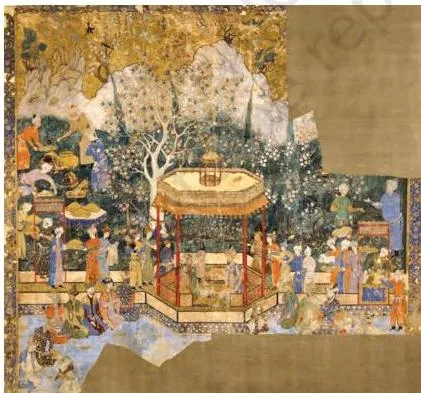
This image opens the chapter’s early period beside the lines introducing Babur. He brought the aesthetic sensibilities of Persia and Central Asia with him, and the chapter stresses his keen patronage of art, manuscripts, architecture and gardening (p. 37).
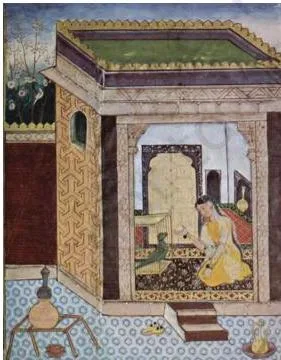
This early atelier folio, dated 1580–85, comes from the Tutinama and shows a girl with her parrot — the kind of lively story illustration the young Mughal workshops produced alongside official histories.
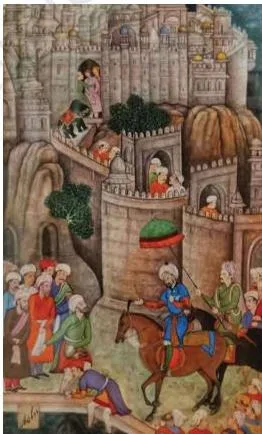
Illustrated copies of the Baburnama were produced long after Babur’s death — this one in 1598 by Bhure. It shows how seriously later ateliers took the founding emperor’s memoirs: the dynasty kept his habit of detailed, first-person observation (p. 39).
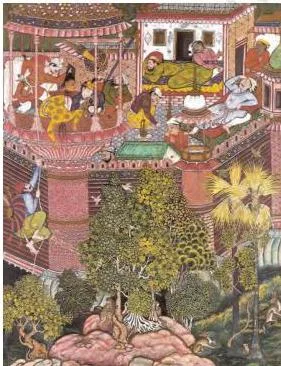
This folio is the chapter’s textbook example of the Indo-Persian blend. The space is sharply cut and divided so the eye can follow the action; vibrant colours energise the story; strong outer lines define the foliage; faces are mostly in profile, with some three-quarter views (p. 41).
Then look at where the elements come from: the intricate floor, column and canopy patterns, the four-limbed animals and the rocks are Persian, while the trees, creepers and the palette of pure yellows, reds and browns are Indian (p. 41).
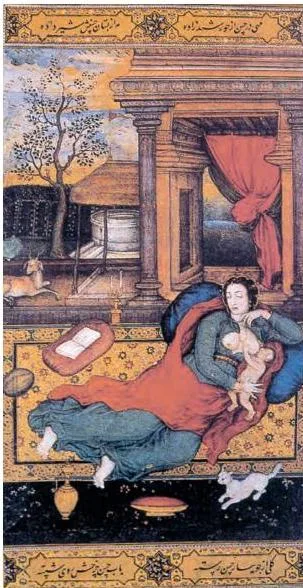
The chapter treats this as an important early sign of European influence at Akbar’s court (p. 42). A Byzantine, classical and Renaissance subject is translated into a Mughal visual experience: Mary is draped in the classical manner, the mother–child bond echoes Renaissance humanism, and the child’s physiology, the fan and the jewellery pull the image into an Indian world.
Jahangir and Shah Jahan: naturalism to idealisation (pages 43–46)
Under Jahangir the style turned to scientific observation; under Shah Jahan it turned to idealised glamour.
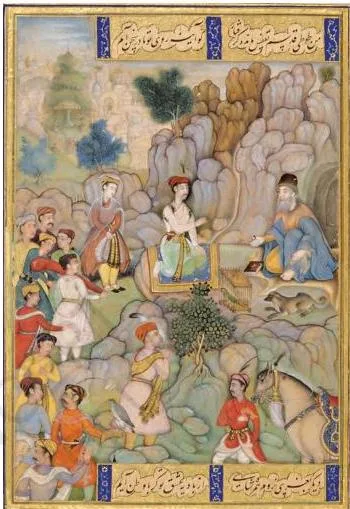
Jahangir sits at the highest level in the centre; the eye moves from his framed figure to the white pillars and the canopy above (p. 43–44). Khurram, the future Shah Jahan, attends with folded hands, flanked by his son Shuja — the son of Mumtaz Mahal, raised in the court by Nur Jahan.
Courtiers are placed by rank and are realistically identifiable; Father Corsi, a Jesuit priest, even has his name inscribed, proof of Jahangir’s demand for accurate individual portraiture.
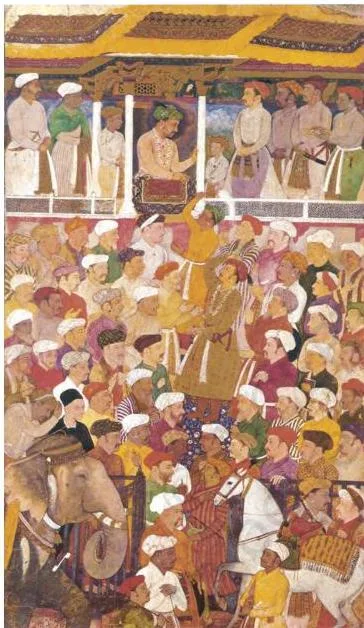
The chapter reproduces this folio in the Jahangir section even though the manuscript dates from 1595, before his accession. It shows the intimate, reflective album page — a prince in conversation with a hermit — the kind of subject the muraqqa culture of Jahangir’s court prized.
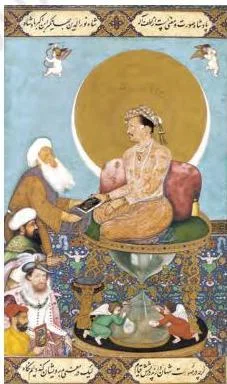
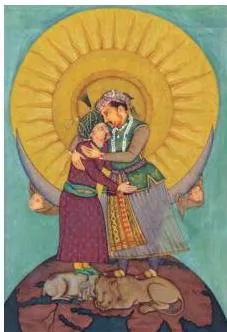
Jahangir dreamed that the Safavid emperor Shah Abbas, his rival for Qandahar, came to embrace him; taking it as a good omen, he had Abul Hasan paint the dream (p. 45). It is political fantasy: Jahangir dominates the composition, Shah Abbas looks frail, and the two stand on a globe that hovers over much of India and the Middle East.
The lion under Jahangir and the docile sheep under Shah Abbas carry the symbolism, while the sun-moon halo held by winged angels is the chapter’s example of European motifs arriving in the Mughal court.
The Padshahnama is the chapter’s evidence of how high miniature painting reached under Shah Jahan (p. 45). The style turned from Jahangir’s naturalism to idealisation: jewel-like colours, perfect rendering and intricate fine lines, arranged in sophisticated compositions on royal, historical and mystic subjects.
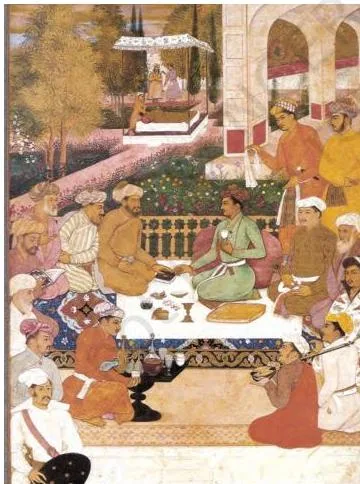
This is the chapter’s portrait of Shah Jahan’s eldest son: Dara Shikoh, a scholar who knew many languages including Sanskrit and was devoted to Sufi mysticism and the Vedantic school (p. 46). The chapter dates the painting around 1635, while its printed caption reads early seventeenth century.
Dara lost the succession — the chapter says he was denied his empire and life — which gives this quiet garden scene its poignancy.
The five masterpieces read closely (pages 50–54)
This is the chapter’s closing gallery: Noah’s Ark is discussed in the text, and the other four masterpieces are reproduced as figures.
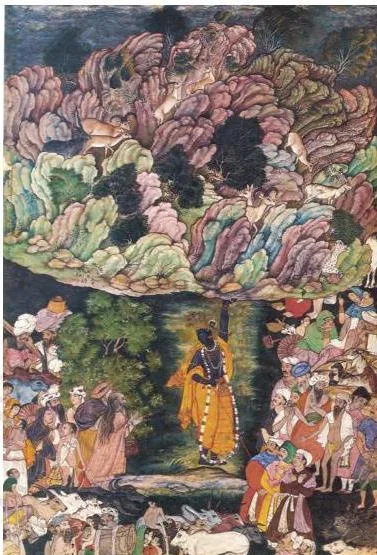
Miskin, a master of Akbar’s atelier, painted Krishna holding the mountain up like a huge umbrella while the village and its livestock shelter underneath (p. 51–52). The source is the Harivamsa Purana, one of the Sanskrit texts the Mughals translated into Persian; the orthodox scholar Badauni did that translation, a detail that contrasts with the liberal Abul Fazl.
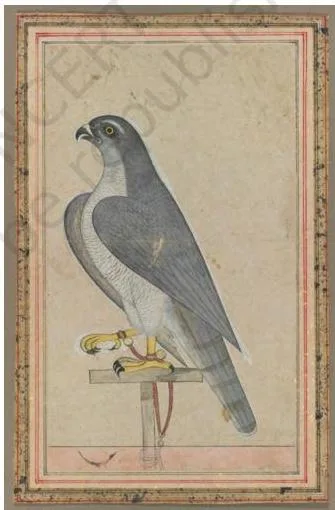
Jahangir kept fine falcons in his collection and had them painted for the Jahangirnama (p. 52). The chapter recounts how a falcon sent by Shah Abbas was mauled by a cat and died, and the emperor had it painted to preserve its memory.
Ustad Mansur, whom Jahangir titled Nadir ul Asr, “Wonder of the Age,” is the eye behind this portrait of a falcon perched on its rest.
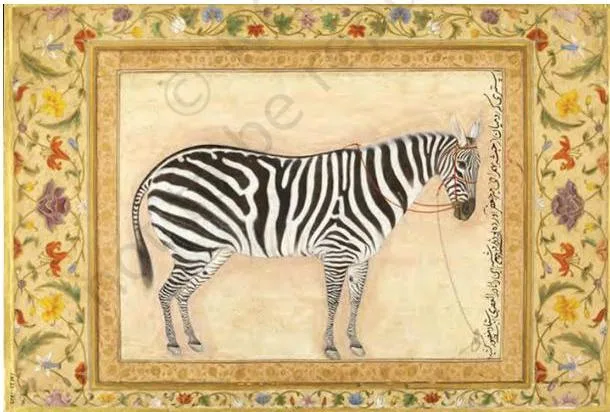
The zebra was brought from Ethiopia by the Turks and presented to Jahangir by his nobleman Mir Ja’far during the Nowruz, or New Year, festivities of March 1621 (p. 53).
Jahangir examined it carefully — some thought it was a horse painted with stripes — and his Persian note on the painting records it as “a mule which the Turks (rumiyan) in the company of Mir Ja’far had brought from Ethiopia.” He later sent the animal to Shah Abbas.
Under Shah Jahan the painting entered the royal album; its ornate borders date from that reign.
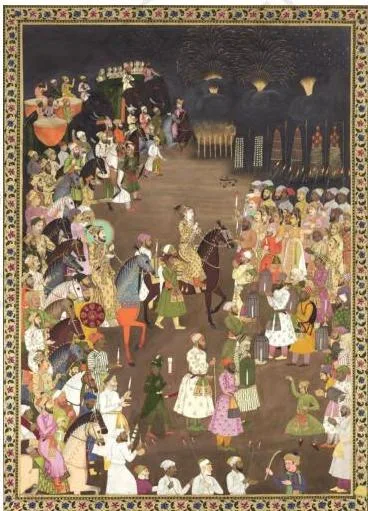
The chapter’s final close reading shows Dara Shikoh, eldest son of Shah Jahan, riding a brown stallion in the traditional sehra while his father — a nimbus around his head — rides a white horse (p. 54). Music, dance, gifts and fireworks surround the procession, and the chapter credits the artist Haji Madni with capturing its full pomp and show.
The chapter also discusses works that are not reproduced on this page — find them in the book itself:
- Princes of the House of Timur — attributed to Abd us Samad, 1545–50, opaque watercolour on cotton, British Museum, London (p. 38).
- Noah’s Ark — Miskin, 1590, from a dispersed Divan-i Hafiz, Freer Gallery of Art, Smithsonian Institution (p. 50–51).
- Jahangir enthroned on an Hourglass — Bichitra, 1625, Smithsonian Institution, Washington D.C. (p. 45).
- Bahadur Shah Zafar — 1838, Fogg Museum of Art (p. 48).
Master artists of the Mughal court and their works
This reference table fixes the attributions the chapter actually gives — exactly what the exercise’s artist list demands.
| Artist | Works attributed to them in the chapter | Date, context and collection |
|---|---|---|
| Mir Sayyid Ali | No single painting named; co-supervised the Hamza Nama to completion with Abd us Samad | Persian master invited by Humayun (p. 38–40) |
| Abd us Samad | Princes of the House of Timur (probably by him); co-supervised the Hamza Nama | 1545–50, opaque watercolour on cotton, British Museum, London (p. 38) |
| Bhure | Babur inspecting the fort of Gualior | Baburnama, 1598, National Museum, New Delhi (p. 39) |
| Daswant | Supervised the Razm Nama | Completed 1589, 169 paintings (p. 41) |
| Basavan | Madonna and Child | 1590, San Diego Museum of Art, California (p. 42) |
| Miskin | Noah’s Ark; Krishna Lifts Mount Govardhan; celebrated (with Govardhan) for court scenes | Ark: Divan-i Hafiz, 1590, Freer Gallery of Art, Washington D.C. (p. 50); Krishna: Harivamsa Purana, 1585–90, Metropolitan Museum of Art, New York (p. 51) |
| Govardhan | Court-scene visuals, celebrated alongside Miskin | Akbar’s reign (p. 41) |
| Aqa Riza | No single work named; Iranian painter employed by Jahangir | Jahangir’s reign (p. 43) |
| Abul Hasan (Nadir al Zaman) | Jahangir’s Dream; Jahangir in Darbar (jointly attributed with Manohar) | Dream: 1618–22, Smithsonian Institution, Washington D.C. (p. 45); Darbar: 1620, Museum of Fine Arts, Boston (p. 43) |
| Manohar | Jahangir in Darbar (jointly attributed with Abul Hasan) | 1620, Museum of Fine Arts, Boston (p. 43) |
| Bichitra | Jahangir enthroned on an Hourglass; Dara Shikoh with Sages in a Garden | Hourglass: 1625, Smithsonian Institution (p. 45); Dara: early seventeenth century (text says 1635), Chester Beatty Library, Dublin (p. 46) |
| Ustad Mansur (Nadir ul Asr) | Falcon Perched on a Bird Rest; Zebra | Falcon: 1615, Cleveland Museum of Art, Ohio (p. 52); Zebra: 1621, later in Shah Jahan’s album (p. 53) |
| Haji Madni | The Marriage Procession of Dara Shikoh | Shah Jahan period, National Museum, New Delhi (p. 54) |
Art terms and names a student needs to know
These terms keep appearing in the chapter and in questions on it. A plain definition fixes them; the page number shows where the book uses the term.
| Term | Plain meaning | Page |
|---|---|---|
| Miniature painting | A small-scale painting made for a manuscript or album; the Mughal style ran from the sixteenth to the mid-nineteenth century | p. 34 |
| Atelier | The royal workshop, staffed by calligraphers, painters, gilders and binders | p. 36 |
| Nigaar Khana | The painting workshop founded by Humayun, housed with his library | p. 39 |
| Tarh | The first stage of a painting: laying out the composition | p. 48 |
| Chiharanama | The portrait stage: painting the faces | p. 48–49 |
| Rangamizi | The final stage: colouring the work | p. 49 |
| Muraqqa | A single painting mounted in an album; made popular under Jahangir, with gold-illuminated margins | p. 43 |
| Gouache | Water-based opaque colour, the technique used for Hamza Nama paintings | p. 40 |
| Baburnama | Babur’s autobiography; it began the Mughal memoir tradition | p. 37 |
| Tuzuk-i-Jahangiri | Jahangir’s memoirs, recording his passion for art and for scientific accuracy in flora and fauna | p. 43 |
| Hamza Nama | Illustrated account of Hamza, uncle of the Prophet; begun under Humayun, completed under Akbar | p. 39–40 |
| Razm Nama | The Persian translation and illustrated version of the Mahabharata, completed 1589 | p. 41 |
| Akbar Nama | Illustrated account of Akbar’s political and personal life; one of his most expensive projects | p. 42 |
| Padshahnama | “The Chronicles of the King” — the exuberant manuscript project of Shah Jahan’s court | p. 45 |
| Divan-i Hafiz | The collection of Persian poems from which the Noah’s Ark folio comes | p. 50 |
| Harivamsa Purana | The Sanskrit text on Lord Krishna translated into Persian; source of the Govardhan painting | p. 51 |
| Nadir ul Asr / Nadir al Zaman | “Wonder of the Age” — Jahangir’s title; the chapter uses Nadir ul Asr for Ustad Mansur and Nadir al Zaman for Abul Hasan | p. 43, 52 |
| Sehra | The traditional headdress a groom wears; Dara wears one in the procession painting | p. 54 |
| Nimbus | A halo; Shah Jahan has a resplendent nimbus in the Marriage Procession painting | p. 54 |
| Ghab-ghab | The double chin that Bihzad used to lengthen in his portraits | p. 37 |
Mistakes students make with attributions and dates
This chapter is mostly tested by matching artists to paintings and emperors to projects, and a handful of mix-ups are so frequent they are worth fixing now.
| The mistake | The correct rule | How to check your answer |
|---|---|---|
| “Miskin painted only Noah’s Ark” | Miskin painted both Noah’s Ark (Divan-i Hafiz, 1590, Freer Gallery) and Krishna Lifts Mount Govardhan (Harivamsa Purana, 1585–90, Metropolitan Museum of Art) | Both close-readings name Miskin: p. 50 and p. 51 |
| “The Zebra has a different artist” | Ustad Mansur (Nadir ul Asr) painted both the Falcon (1615) and the Zebra (1621) | Both passages say “Ustad Mansur”: p. 52–53 |
| “Hamza Nama is an Akbar-only project” | It was begun under Humayun and completed under Akbar (1567–82; 14 volumes, 1400 illustrations), supervised by Mir Sayyid Ali and Abd us Samad | Humayun starts it on p. 39; completion is on p. 40 |
| “Jahangir’s Dream and Jahangir in Darbar are both by Abul Hasan alone” | The Dream is by Abul Hasan alone; the Darbar is attributed to Abul Hasan and Manohar jointly — some Mughal paintings were collaborative | Captions and text at p. 43 and p. 45 |
| “Aurangzeb shut the atelier down immediately” | The chapter states the atelier was not shut down immediately and kept producing beautiful paintings, though patronage declined | p. 47; declining patronage and provincial drift follow at p. 47–48 |
| “Bihzad worked in Akbar’s atelier” | Bihzad was a Persian master from Herat mentioned in Babur’s memoirs, known for lengthening the double chin (ghab-ghab) | p. 37 |
| Persian and Indian elements get swapped | Four-limbed animals, rocks and intricate floor/column/canopy patterns are Persian; trees, creepers and pure yellows, reds and browns are Indian; spatial depth and naturalism come from Europe | Analysis of the Spies of Hamza folio, p. 41; Madonna, p. 42; Jahangir’s Dream, p. 45 |
A quick date logic check: works from Akbar’s reign carry dates like Hamza Nama (1567–82), Razm Nama (1589) and Krishna Lifts Mount Govardhan (1585–90), while Jahangir’s commissions fall between 1605 and 1627. If a date does not fit the emperor’s reign, re-check the attribution.
How to use this chapter for exam preparation
The chapter itself tells you what it expects: the four exercise questions at the end (p. 49–50). Structure revision around answering those four completely.
| Exercise question | What a complete answer should include | Where the chapter supplies it |
|---|---|---|
| Name two master artists invited to India by Humayun, and discuss their masterpieces in detail | Name Mir Sayyid Ali and Abd us Samad; say both were known for portraiture; discuss at least one major work or project each — for example the Hamza Nama supervision, or Princes of the House of Timur for Abd us Samad | p. 38–40 |
| Out of the several art projects that Akbar undertook, discuss your favourite work, explaining what you like about it | Choose one named project — Hamza Nama, Razm Nama, the Ramayana translation, Akbar Nama or Madonna and Child — describe it, and justify your choice | p. 39–42 |
| Make a comprehensive list of artists in the Mughal court, briefly explaining one painting of each in 100 words | Draw on the master artists table on this page: thirteen named artists from Babur’s memoirs to Shah Jahan’s court, with one painting each, its date and collection | Artist names scattered through p. 37–54; the table gathers them |
| With examples of three paintings of your choice, discuss the indigenous Indian, Persian and European visual elements prevalent during the medieval period | Pick three paintings and name the elements: Persian patterns, rocks and four-limbed animals; Indian trees, creepers and pure yellows-reds-browns; European depth and naturalism | p. 41 (Spies), p. 42 (Madonna), p. 45 (Jahangir’s Dream) |
For every painting you quote, learn the five identification data points the chapter gives: the artist, the patron (which emperor’s court), the manuscript or album it comes from, the date, and the current collection. The figure captions in the book provide exactly these.
The exercise asks for 100-word descriptions, so the right drill is one short written paragraph per artist: who they were, which court they worked in, and one painting each with its date and collection.
One caution: textbook contents and the examinable syllabus are not always identical — check the current official syllabus.
The chapter in one page: a recap
This is the whole chapter compressed to a screen, for the night before the exam.
- What it is: a miniature painting style of the northern Indian subcontinent, developed from the sixteenth century and continuing to the mid-nineteenth century (p. 34).
- The blend: indigenous Indian, Persian and later European traditions, fused in the royal atelier (p. 35–36).
- The workshop: calligraphers, painters, gilders and binders working as a team, with division of labour and salary incentives (p. 36, 49).
- The rulers: Babur’s memoirs, Humayun’s Persian masters, Akbar’s great manuscripts, Jahangir’s scientific naturalism, Shah Jahan’s idealisation, decline under Aurangzeb (p. 37–47).
- The method: text first, then tarh, chiharanama and rangamizi; squirrel or kitten-hair brushes, natural pigments, agate burnishing (p. 48–49).
- The masterpieces: Noah’s Ark, Krishna Lifts Mount Govardhan, Falcon on a Bird Rest, Zebra, The Marriage Procession of Dara Shikoh (p. 50–54).
- The end: provincial courts, last flickers under Muhammad Shah Rangila, Shah Alam II and Bahadur Shah Zafar, then convergence into Provincial and Company School styles (p. 47–48).
- One false belief: Aurangzeb did not shut the atelier down immediately (p. 47).
Related chapters and resources
This listing is maintained for the 2026-27 academic session using the NCERT textbook information available to us. NCERT remains the authority for confirming the latest edition.
This chapter is Chapter 3 of An Introduction to Indian Art – Part II. Continue with the Class 12 Fine Art book page for the full chapter list, or jump to the previous chapter of this book and the next chapter of this book.
For the other Class 12 books, use the Class 12 hub. For revision-ready notes on the schools that surrounded the Mughal style, see the Rajasthani Schools of Painting and the Deccani Schools of Painting, or browse the Fine Art revision notes, the wider Class 12 notes and the CBSE notes index.
The chapter is published by the National Council of Educational Research and Training, and the official edition is available on the NCERT textbook portal linked at the top of this page.
Reference: NCERT Class 12 Fine Art textbook (An Introduction to Indian Art Part II), chapter 3, official edition on ncert.nic.in.
Sources and data verification
- All page references and figure reproductions on this page describe the NCERT textbook An Introduction to Indian Art – Part II, Class 12 Fine Art, Chapter 3, official edition on ncert.nic.in.
- This page covers the NCERT textbook only, not every fine art reference book.
- The listing is maintained for the current academic session using the NCERT information available to us.
- NCERT settles textbooks, editions and PDFs; CBSE settles curriculum, syllabus and examinations.
Frequently asked questions
Who were the two Persian master artists Humayun invited to India?
Mir Sayyid Ali and Abd us Samad. Humayun invited both when he regained power to establish a studio for royal painting, and both were respected for their portraiture; they later supervised the Hamza Nama to completion (p. 38–40). Abd us Samad is also linked to Princes of the House of Timur.
Which emperor commissioned the Hamza Nama and how long did it take?
Humayun started the project and Akbar completed it. The chapter dates the completed work to 1567–1582: 14 volumes, 1400 illustrations, nearly 15 years, under the supervision of Mir Sayyid Ali and Abd us Samad (p. 39–41).
What is the difference between Akbar’s and Jahangir’s ateliers?
Akbar’s atelier mass-produced large manuscripts with more than a hundred artists; Jahangir’s preferred fewer, finer works by a single master artist, with scientific accuracy in flora and fauna and gold-illuminated muraqqa albums (p. 40–43).
Which paintings are attributed to Ustad Mansur in this chapter?
Two: Falcon Perched on a Bird Rest (1615, Cleveland Museum of Art, Ohio) and the Zebra presented at Nowruz in March 1621, later added to Shah Jahan’s album (p. 52–53). Jahangir titled him Nadir ul Asr, “Wonder of the Age.”
What do tarh, chiharanama and rangamizi mean in Mughal painting?
The three stages of making a painting: tarh is the composition, chiharanama is the portraits, and rangamizi is the colouring (p. 48–49).
Did Aurangzeb shut down the Mughal atelier?
No — not immediately. The chapter says the royal atelier continued producing beautiful paintings, though Aurangzeb focused on the expansion of the empire and patronage gradually declined (p. 46–48).
Explore Class 12 Fine Art Books
Related chapters:
- The Manuscript Painting Tradition
- The Pahari Schools of Painting
- The Bengal School and Cultural Nationalism