
This page carries the Deccani Schools of Painting Class 12 chapter from NCERT’s Fine Art textbook An Introduction to Indian Art Part II. It runs from page 54 to 66 and covers three court schools of the Deccan — Ahmadnagar, Bijapur and Golconda. The official PDF is below; the rest of the section teaches the chapter and its exercise.
Download the Deccani Schools of Painting Class 12 Chapter PDF
The official chapter is published free on NCERT’s website. Open the Deccani Schools of Painting Class 12 chapter PDF from NCERT to read the chapter exactly as printed, with all its colour plates and the six-question exercise, in the current official edition; the same portal lists every other NCERT book if you need to check editions.
| What the chapter holds | Count | Where it is used |
|---|---|---|
| Printed pages | 12 | |
| Figures with NCERT captions | 9 | |
| Exercise questions | 6 | answered in our NCERT Solutions |
| Official NCERT PDF | Download the chapter PDF | the chapter exactly as NCERT publishes it |
Chapter 4 at a Glance
The table below summarises what the official file of Chapter 4 contains; the chapter itself is printed across the section from page 54 to page 66 of the book.
| What the chapter file contains | Count |
|---|---|
| Printed pages | 12 |
| Chapter sections | 12 |
| Exercise questions | 6 |
In shape, the chapter opens with the historical context of the Deccan, studies the three court schools in turn, comments on individual plates — some reproduced, some only described — and closes with the exercise.
What This Chapter Covers: From Ahmadnagar to Golconda
This section is a roadmap. Read it once to understand why the chapter moves from one kingdom to the next; the school-by-school detail in the following section will then fall into place.
The chapter opens with a correction. Deccani painting was long classified as Indo-Persian art — scholars called it Middle Eastern, Safavid, Persian, Turkish and even Mughal in origin, and acknowledged its uniqueness without granting it the status of a full-fledged school (NCERT, p. 55).
The book argues the opposite: the Deccan’s rulers had their own political and cultural vision, hired and nurtured their own artists, and commissioned works that served both artistic taste and the needs of governance.
On that foundation the chapter builds its account of three kingdoms — Ahmadnagar, Bijapur and Golconda — which developed sophisticated and distinct court schools in the sixteenth and seventeenth centuries (NCERT, p. 55). The order matters. Ahmadnagar comes first because it has the earliest surviving examples; Bijapur follows under the Adil Shahs; Golconda closes the trio as the wealthiest kingdom.
A final section studies individual paintings, and the chapter ends with the exercise.
Keep one thread in mind while reading: the comparison with the Mughal School of Miniature Painting. The chapter repeatedly contrasts Deccani density, colour and regional roots with the documentary character of Mughal portraiture, and that contrast is what Exercise 4 asks you to reproduce.
Key Concepts: The Three Schools of the Deccan
This section is the core of the chapter. Almost every exercise question routes back to one of the three court schools, so fix the patron, the key manuscript and the visual signature of each before doing anything else.
Ahmadnagar School of Painting
Ahmadnagar gives the chapter its starting point, because its paintings are the earliest Deccani works we have.
The earliest examples survive in a volume of poems celebrating the reign of Hussain Nizam Shah I (1553–1565); twelve battle-scene miniatures in it are of little artistic interest, but the pages showing the queen and her marriage are strikingly coloured and sensuously drawn (NCERT, p. 56).
Dress is the easiest way to identify an Ahmadnagar painting. The women wear a modified northern costume — a choli or bodice, long braided pigtails ending in a tassel, and a long scarf passing round the body below the hips. That scarf is a southern fashion, seen in the Lepakshi frescoes.
The style markers are equally specific: a palette richer and more brilliant than northern manuscripts, a high circular horizon with a gold sky that shows Persian influence, and, in the Ragamala series, women with their hair rolled into a bun at the nape of the neck like the Lepakshi murals.
The male costume is northern too — the jama with pointed tails and the small pagri stand close to early Akbari miniatures.
The chapter also notes a connection with Bukhara: the paintings of a 1567 Gulistan have been attributed to Bukhara artists, and a manuscript at the Bankipore Library, Patna, signed by the scribe Yusuf, is in the Bukhara idiom of that date (NCERT, p. 56).
Bijapur School of Painting
Bijapur’s school, under the Adil Shahs, produced the chapter’s richest single object: the Nujum al-Ulum, a lavishly illustrated encyclopaedia dated 1570 whose 876 miniatures include weapons, utensils and constellations (NCERT, p. 57).
The patrons were Ali Adil Shah I (1558–1580) and his successor Ibrahim Adil Shah II (1580–1627), both patrons of art and literature. Ibrahim Adil Shah II was himself an expert in Indian music and the author of the Nauras-nama; he owned the Nujum al-Ulum and may have commissioned the 1590s Ragamala series.
The chapter points out Bijapur’s close connection with Turkey, since the astronomical illustrations may derive from Ottoman Turkish manuscripts, while the Ragamala are Indian in their connections, with definite echoes of Lepakshi.
Two works define the school’s range. The Throne of Prosperity is a symbolic diagram of an auspicious throne of seven stages, each supported by different inhabitants — elephants and tigers, palm trees, storeys of peacocks — with a deep blue sky, Persian-style arabesques at the top and a strong Indian visual tradition behind it.
The Yogini takes the school beyond court life: a woman devoted to yoga, leading a disciplined life of physical and emotional training and famous for renouncing worldly attachments (NCERT, p. 58).
Golconda School of Painting
Golconda became independent in 1512 and was the wealthiest of the Deccan kingdoms by the end of the sixteenth century, thanks to trade from east-coast ports — iron and cotton goods to South East Asia, painted cottons to Europe — and, from the early seventeenth century, diamonds (NCERT, p. 59).
Its court paintings are recognisable at a glance: gold jewellery worn by both men and women, gold and deep azure skies, patterned carpets, and a free use of purple — at times animals even become blue, so you see blue foxes.
The earliest five miniatures, bound in a Diwan of Hafiz dated 1463, show a young ruler enthroned with a long straight Deccani sword, with no Mughal influence at all.
Later work grew more sophisticated. A portrait of Muhammad Qutb Shah (1611–1626) keeps the strict symmetry of the 1590 pages but shows adequate reference to the Mughal manner, especially in the plastic rendering of drapery. The chapter names one Golconda work directly: Poet in a Garden by Muhammad Ali (1605–1615), now in the Museum of Fine Arts, Boston (NCERT, p. 60).
Golconda also made wall hangings as large as eight feet high, and Dutch merchants carried portraits of its sultans to Europe in the late seventeenth century.
| School | Patrons and period | Key work or manuscript | Visual features |
|---|---|---|---|
| Ahmadnagar | Hussain Nizam Shah I (1553–1565) | Tarif-i-Hussain Shahi; Ragamala series | Choli with pigtails and tassels; long southern scarf; gold sky; high circular horizon |
| Bijapur | Ali Adil Shah I (1558–1580); Ibrahim Adil Shah II (1580–1627) | Nujum al-Ulum (1570); Nauras-nama; Throne of Prosperity; Yogini | Tall slender women in south Indian dress; daring colour; simplified compositions; deep blue sky |
| Golconda | Qutb Shahs; Muhammad Qutb Shah (1611–1626) | Diwan of Hafiz miniatures; Dancing before Muhammad Quli Qutb Shah (1590); Poet in a Garden | Gold jewellery; gold and azure skies; purple hues; blue animals; dense patterned architecture |
Figure Walkthrough: Reading the Paintings Like the Chapter Does
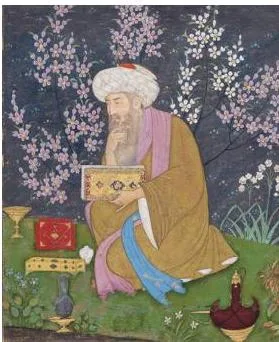
This section turns each reproduced plate into the paragraph you would write in an exam: name the painting, its school, its date, its present collection, and two or three features you can actually point to. Eight plates from the chapter are reproduced below.

This is the chapter’s opening plate, placed right at the start of the section on page 55, and it is one of the few works here with a named artist attached — Farrukh Beg.
The subject, Sultan Adil Shah II of Bijapur, sits playing the tambura, an instrument that matches the chapter’s emphasis on Ibrahim Adil Shah II’s musical expertise and the court’s cultural refinement. Any answer about it should lead with the artist, school, date and collection.
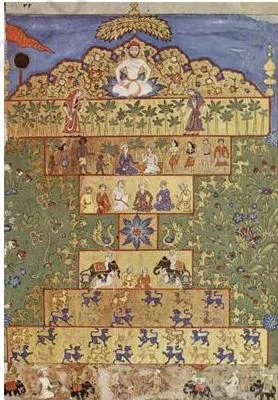
The Throne of Prosperity is a symbolic diagram, not a real scene: an auspicious throne of seven stages, each resting on different inhabitants — from elephants and tigers at the base, through palm trees and storeys of peacocks, to primitive tribes (NCERT, p. 57).
The page fuses traditions: the colouring of the arabesques follows the Islamic Persian tradition, the stylised plants recall Gujarati manuscript margins, and the whole structure echoes wood-carved Gujarati doorways or Deccan temples. That mixture is the chapter’s proof that the Deccan drew on both Persian and Indian roots.
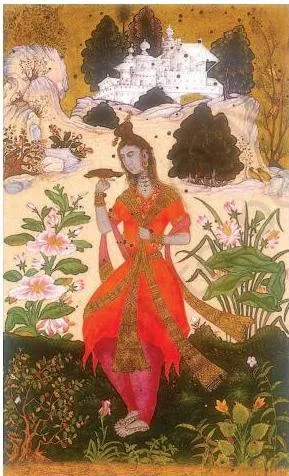
The Yogini is the chapter’s example of a theme beyond court ceremony — a woman who follows yoga, lives a disciplined life and renounces worldly attachments (NCERT, p. 58). The painting is deliberately vertical, with the long standing figure balanced by a group of white structures at the top as a tapering visual note.
The artist, of whom no record survives, shows her preoccupied with a myna bird as if in conversation, her hair bun lengthening her presence and long scarves swirling in a rhythmic circle around her. These are the exact details Exercise 1 expects you to name.
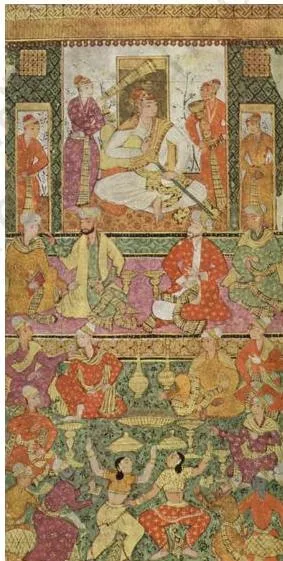
This 1590 Golconda page belongs to the earliest identified group of that school’s miniatures, which share a strict symmetry and an absence of Mughal influence (NCERT, p. 59). Dancing girls entertain the royal gathering; the ruler is enthroned with a long straight Deccani sword, and the whole page is lavishly enriched with gold touching a deep azure sky.
It is also where you can point to the Golconda love of purple and even blue animals, which the chapter mentions explicitly.
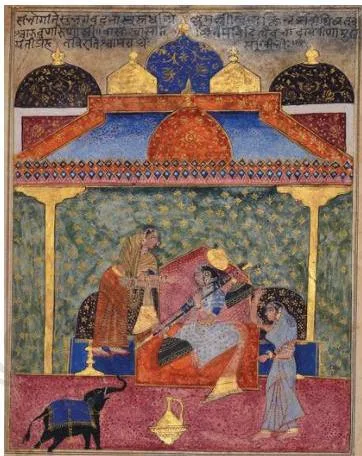
This plate is an important member of the Ragamala family — the series of paintings that visualise Indian musical modes — and some scholars place it in Bijapur (NCERT, p. 63). Three beautifully dressed women appear: a central musician playing what looks like a veena, with the other two swaying in accompaniment.
The details to quote are the vibrant red-and-green palette, the figures whose faces are almost formulaically stylised, the deep dark outlines that recall the Ajanta murals, and the small dark elephant with a raised trunk in the left corner — a sign of welcome that breaks the strict architecture of the scene.
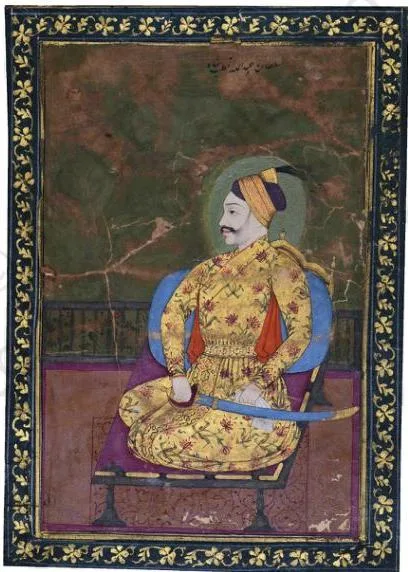
This portrait is the answer to Exercise 5, so read it carefully. The ruler — Sultan Abdullah Qutb Shah of Bijapur, not Golconda — sits enthroned with a sword in one hand that symbolises his political sovereignty, and a halo around his head that depicts his divinity (NCERT, p. 64). A Persian inscription runs across the top.
The chapter also notes that Bijapur under him attracted scholars and artists from various parts of the world, which is the context to add when you describe the portrait.
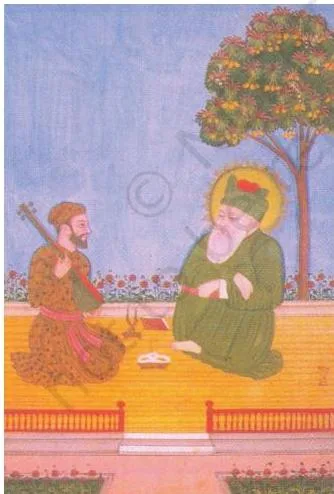
This provincial painting from Hyderabad shows the thirteenth-century Sufi saint Hazrat Nizamuddin Auliya listening to music played by his disciple Amir Khusrau, the renowned poet and scholar (NCERT, p. 65). The chapter calls it naive and basic, without the technical and artistic sophistication of a court painting, but charming and narrative.
The cultural thread is alive even now: at the saint’s dargah in New Delhi, qawwali by Khusrau in praise of his pir is still performed for devotees.
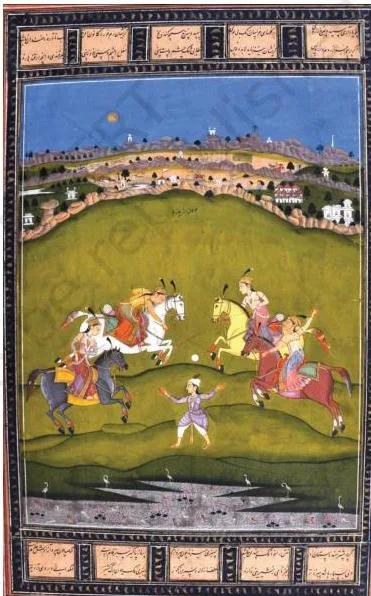
Chand Bibi, the Queen of Bijapur, is shown playing chaugan — the other name for equestrian polo, then a popular royal sport (NCERT, p. 66). The chapter values her as a revered and accomplished ruler who resisted Emperor Akbar’s attempts to bring the state under Mughal control.
Note the date caution: the painting appears to be provincial and of a much later period, so do not describe it as a sixteenth-century court work.
Two more plates are described in detail in the chapter though not reproduced above. Composite Horse (NCERT, p. 62) is a Golconda work of the early seventeenth century in which intertwined human figures form a galloping horse against a decorated background, with flying cranes, lions, Chinese clouds and large-leaved plants, all in a limited scheme of browns with some blue.
Sultan Ibrahim Adil Shah II Hawking (NCERT, p. 63) is a work of extraordinary energy: brilliant red on the horse’s limbs and tail, the sultan’s flowing garment, dense forest foliage in deep olive, emerald and cobalt, and the white hawk at centrestage, with Persian treatment of the horse and rocks set against native foreground plants.
Deccani vs Mughal: The Comparison the Chapter Keeps Returning To
This section answers the book’s comparison question (Exercise 4) directly. It is also the one place the chapter’s whole argument comes together, so every full answer should restate its structure.
The shared ground is real: both schools practised portraiture and represented historical and religious figures, and both drew on Persian influence.
The chapter is careful to say that Mughal portraiture was not wholly unique — Safavid and Ottoman painting did the same — but that the highly documentary nature of Mughal portraits was a singularly unique development in Asian Islamic and Mughal art (NCERT, p. 55).
What sets the Deccan apart is its own idiom. The chapter stresses dense composition, unique sensuality and intense colours with a strong affinity to regional aesthetics, the high circular horizon and gold sky taken from Persia, and southern Indian echoes such as the Lepakshi frescoes (NCERT, p. 56). Golconda even paints purple skies and blue foxes.
The Deccani style, the chapter argues, was long placed under Indo-Persian art, but it was a full-fledged school sustained by its own rulers and artists. The two styles met only near the end: later Golconda painting under Muhammad Qutb Shah shows clear reference to the Mughal manner (NCERT, p. 60).
A step-by-step answer plan for Exercise 4:
- State the shared ground. Both schools practised portraiture and absorbed Persian influence.
- Give the chapter’s correction. Deccani painting was long classified as Indo-Persian art but was an independent, full-fledged school with its own rulers, artists and cultural vision.
- List the Deccani features with one example each: dense composition, intense colours, gold skies, and regional echoes of Lepakshi; add the Golconda love of purple and blue animals as a distinctive detail.
- Contrast the Mughal feature: the documentary character of its portraiture.
- Close with the late overlap: by the reign of Muhammad Qutb Shah, Golconda painting shows reference to Mughal models.
Terms and Symbols From the Chapter, Explained
These are the words the exercise assumes you already know. Each definition below follows the way the chapter itself uses the term, so you can quote them safely.
- Choli: a bodice; in Ahmadnagar paintings, the women wear a modified northern costume with choli and long braided pigtails.
- Jama: a long coat with pointed tails; the northern male garment seen in early Akbari miniatures and in Ahmadnagar painting.
- Pagri: a small turban, close to the form found in the earliest Akbari miniatures.
- Ragamala: a series of paintings visualising Indian musical modes; it appears in both Ahmadnagar and Bijapur.
- Ragini Pathamsika: a ragini (sub-mode) of Raga Hindola; the chapter reproduces a famous version of c. 1590–95.
- Yogini: a woman who practises yoga — disciplined physical and emotional training, spiritual exploration and renunciation of worldly attachments.
- Nujum al-Ulum: the richly illustrated encyclopaedia made at Bijapur in 1570, containing 876 miniatures.
- Tarif-i-Hussain Shahi: the volume of poems celebrating the reign of Hussain Nizam Shah I, containing the earliest Deccani miniatures.
- Chaugan: the other name for equestrian polo, a popular royal sport; Chand Bibi is shown playing it.
- Dargah: the shrine of a Sufi saint; Hazrat Nizamuddin Auliya’s in New Delhi is still visited by devotees.
- Qawwali: devotional music performed at the dargah, with verses by Amir Khusrau in praise of his pir (spiritual teacher).
- Imperial symbols: the sword, which stands for political sovereignty; the halo, which depicts divinity; and the throne, shown as a symbolic structure in the Throne of Prosperity.
Common Mistakes Students Make With This Chapter
Each of these mix-ups has cost students marks. The table names the mistake, the rule that corrects it, and a quick way to check your answer.
| Mistake | Correct rule | How to check your answer |
|---|---|---|
| Treating all Deccani painting as a branch of the Mughal School | The chapter says it was long placed under Indo-Persian art but argues it was an independent full-fledged court school with Persian and southern Indian roots | Quote two regional features — the Lepakshi echoes and the gold skies — that are not Mughal |
| Forgetting that Ahmadnagar is the earliest school | Ahmadnagar has the earliest surviving examples, from the reign of Hussain Nizam Shah I (1553–1565) | Name the queen’s marriage miniatures as the earliest Deccani work |
| Assuming every Qutb Shah belongs to Golconda | The chapter’s portrait of Sultan Abdullah Qutb Shah is of Bijapur | Read the caption: it says Sultan Abdullah Qutb Shah of Bijapur |
| Describing a painting without its school, date or collection | A full description names all four before describing features | Use the formula: title — school — date — collection — two features |
| Missing the imperial symbols in the royal portrait | The sword symbolises political sovereignty; the halo depicts divinity | Mention both whenever you describe the portrait of Sultan Abdullah Qutb Shah |
Exam Notes: Answering the Exercise Questions in the Chapter
No weightage is claimed here; this is a map of where each of the six exercise questions finds its material inside the chapter, so you can locate the source text quickly. Textbook contents and the examinable syllabus are not always identical — check the current official syllabus for what is examinable.
| Exercise question | What it asks | Where the material sits |
|---|---|---|
| 1 — Yoga | Unique features of the Deccani Yogini, plus a research task on similar artists today | The Yogini description, NCERT p. 58 |
| 2 — Themes | Popular themes of the Deccani School | Ragamala, court scenes and portraits across NCERT pp. 56–60 |
| 3 — 100-word note | A note on two paintings you like | The described plates, NCERT pp. 62–66 |
| 4 — Comparison | Deccani style vs Mughal style | Framing argument on NCERT pp. 55–56; late Mughal reference on p. 60 |
| 5 — Imperial symbols | Symbols in a Deccani royal painting | The portrait of Sultan Abdullah Qutb Shah, NCERT p. 64 |
| 6 — Centres | Centres of Deccani painting, shown on a map | Ahmadnagar p. 56, Bijapur p. 57, Golconda p. 59; later provincial Hyderabad p. 65 |
Model structure for the 100-word note (Exercise 3):
- Open by naming the first painting: title, school, date, current collection.
- Give two visible features from the chapter — for example, the seven stages of the Throne of Prosperity, or the dark-outlined figures and small elephant in Ragini Pathamsika.
- Repeat for the second painting.
- Close with one sentence on what the two works together show about the school’s range.
For Exercise 1’s second half, note it is a research task rather than a chapter answer: the book asks you to find artists doing similar work nowadays, so name contemporary practitioners you have verified rather than inventing one.
Quick Recap: The Deccani Schools in Five Minutes
This is the chapter’s main thread in a compressed form — useful the night before a test, and built entirely from the chapter’s own material.
- Timeline: Deccani painting is traceable from the late sixteenth century to the 1680s, when the Mughals conquered the Deccan; it continued into the nineteenth century under the Asafiya dynasty and in the provincial courts of Rajas and Nawabs under the Nizam of Hyderabad.
- Ahmadnagar: the earliest school, from the reign of Hussain Nizam Shah I; signature work Tarif-i-Hussain Shahi; dress of choli, pigtails and the southern scarf.
- Bijapur: the Adil Shah court; Nujum al-Ulum (1570); the Throne of Prosperity; the Ragamala series with Lepakshi echoes; the Yogini as its spiritual theme.
- Golconda: the wealthiest kingdom, enriched by east-coast trade and diamonds; the Diwan of Hafiz miniatures; Dancing before Muhammad Quli Qutb Shah; Poet in a Garden.
- Shared Deccani features: dense composition, intense colours, gold skies, the Persian landscape idiom, and regional echoes of Lepakshi — with the late Golconda turn towards Mughal reference.
- Named plates to remember: Sultan Adil Shah II playing Tambura; Throne of Prosperity; Yogini; Dancing before Muhammad Quli Qutb Shah; Composite Horse; Sultan Ibrahim Adil Shah II Hawking; Ragini Pathamsika; Sultan Abdullah Qutb Shah; Hazrat Nizamuddin Auliya and Amir Khusrau; Chand Bibi Playing Polo.
Related Resources
This listing is maintained for the 2026-27 academic session using the NCERT textbook information available to us. NCERT remains the authority for confirming the latest edition.
Continue with the rest of the Class 12 Fine Art syllabus: the Class 12 Fine Art notes cover the full book, and the Class 12 notes hub links every subject. For the chapters that frame this one, see the notes on the Mughal School of Miniature Painting and the Pahari Schools of Painting, which carry the comparison with the Deccan further.
The main notes index is the starting point for every class. The official PDFs are all on the NCERT textbook portal at ncert.nic.in.
Sources and Data Verification
This page describes Chapter 4, The Deccani Schools of Painting, of the NCERT Class 12 textbook An Introduction to Indian Art Part II, as published on ncert.nic.in. Page references follow that NCERT edition’s printed pagination from page 54 to page 66.
NCERT settles textbooks, editions and PDFs; CBSE settles curriculum, syllabus and examinations. Textbook contents and the examinable syllabus are not always identical, so confirm the current official syllabus before relying on any chapter for exam preparation. This listing is maintained for the current academic session, and no subject-expert review beyond the NCERT publication itself is claimed.
FAQs on The Deccani Schools of Painting Class 12
Which three schools of Deccani painting are covered in this chapter?
The chapter covers three court schools of the Deccan sultanates — Ahmadnagar, Bijapur and Golconda — which flourished from the late sixteenth century until the Mughal conquest in the 1680s, and it closes with the later provincial painting of Hyderabad under the Asafiya dynasty and the Nizam (NCERT, pp. 55, 65).
What makes the Yogini painting important in this chapter?
The Yogini is the chapter’s example of a theme beyond court life at Bijapur: a woman devoted to yoga, leading a disciplined life and renouncing worldly attachments (NCERT, p. 58). Its vertical composition, the myna bird she seems to converse with, and the rhythmic swirl of her scarves are the features to quote, and it carries the answer to Exercise 1.
How is the Deccani style different from the Mughal style of painting?
In short: the Deccan was an independent school, not a Mughal branch. Deccani paintings favour dense composition, intense colours, gold skies and regional southern Indian echoes such as the Lepakshi frescoes, while Mughal portraiture is notable for its documentary character. The two converged only near the end, when later Golconda work showed Mughal reference (NCERT, pp. 55, 60).
What are the imperial symbols seen in a Deccani royal painting?
Two symbols matter: the sword, held by the ruler to signify political sovereignty, and the halo, which depicts his divinity. Both appear in the chapter’s portrait of Sultan Abdullah Qutb Shah of Bijapur (NCERT, p. 64).
Where can I find the official NCERT Class 12 Fine Art Chapter 4 PDF?
The official chapter is published free on NCERT’s textbook portal at ncert.nic.in. Use the Deccani Schools of Painting Class 12 chapter PDF from NCERT linked at the top of this page to open the exact current edition, with all its plates.
Which centres of painting in the Deccan does the chapter name?
The chapter names three court centres — Ahmadnagar, Bijapur and Golconda — and, for the later phase, Hyderabad, where provincial painting continued under the Nizam’s rule (NCERT, pp. 56, 57, 59, 65).
Reference: NCERT Class 12 An Introduction to Indian Art Part II textbook, chapter 4, official edition on ncert.nic.in.
Explore Class 12 Fine Art Books
Related chapters:
- The Manuscript Painting Tradition
- The Rajasthani Schools of Painting
- The Bengal School and Cultural Nationalism