
This page carries NCERT Class 12 Fine Art, An Introduction to Indian Art – Part II, Chapter 1 — the manuscript painting tradition class 12 — in its official form. The chapter PDF sits directly below, and the rest of the page walks you through the chapter’s two schools, its key terms and every painting it reproduces.
Download the Manuscript Painting Tradition Class 12 Chapter PDF
You can open the manuscript painting tradition class 12 chapter PDF straight from ncert.nic.in — the official NCERT source — to read the chapter in its original layout, with every full-colour plate and the closing exercise at the end of the file.
| What the chapter holds | Count | Where it is used |
|---|---|---|
| Printed pages | 9 | |
| Figures with NCERT captions | 5 | |
| Exercise questions | 2 | answered in our NCERT Solutions |
| Official NCERT PDF | Download the chapter PDF | the chapter exactly as NCERT publishes it |
Chapter at a Glance: What Is Inside the File
The chapter defines manuscript painting and then follows its two early schools — the Western Indian School of the west and the Pala School of the east — from their texts to their line and colour.
Section anchors inside the PDF, with the printed page spans:
- The Manuscript Painting Tradition — pp. 1–3
- Western Indian School of Painting — pp. 3–8
- Pala School of Painting — pp. 8–9
- Exercise — p. 9
These are the chapter’s contents in numbers:
| Contents | Count |
|---|---|
| Sections | 5 |
| Figures | 5 |
| Worked examples | 0 |
| Exercise questions | 2 |
What This Chapter Covers: From the Chitrasutra to the Pala Manuscripts
The chapter moves in three movements. Knowing the shape helps you place every painting as you read.
The tradition defined (pp. 1–3)
- The Chitrasutra, a chapter in the fifth-century Vishnudharmottara Purana, is the source book of Indian art; its pratima lakshana are the canons of image making (NCERT, p. 1).
- The six limbs of painting are explained at length, and artists followed them for centuries (NCERT, p. 1).
- Miniatures were hand-held and viewed close; murals decorated the patron’s walls (NCERT, p. 2).
- Manuscript illustrations translate verses into pictures, with the verse written in a demarcated box at the top or on the reverse of the folio (NCERT, pp. 1–2).
- The colophon page records patron, artist or scribe, date and place — and its loss forces scholars to attribute details from style (NCERT, p. 2).
- Paintings travelled as dowries, gifts and trade goods, and with pilgrims, monks and narrators (NCERT, p. 2).
The Western Indian School (pp. 3–8)
- Gujarat is the most prominent centre; trade wealth made merchants — largely the Jain community — major patrons (NCERT, p. 3).
- Shaastradaan, the donation of books to monastery libraries called bhandars, gave Jain painting its impetus (NCERT, p. 3).
- The most-painted texts are the Kalpasutra, Kalakacharyakatha, Uttaradhyana Sutra and Sangrahini Sutra (NCERT, pp. 3–4).
- Painters worked on palm leaf before paper arrived in the fourteenth century (NCERT, p. 5).
- The style is schematic: divided space, thin wiry lines, bright colours, and an extra eye to suggest depth in the face (NCERT, p. 6).
- A parallel indigenous style — called pre-Mughal or pre-Rajasthani — fed early Rajasthan painting (NCERT, pp. 6–7).
- Sultanate courts produced the hybrid Sultanate style, best seen in the Nimatnama (NCERT, pp. 7–8).
The Pala School (pp. 8–9)
- Monasteries such as Nalanda and Vikramsila illustrated Vajrayana Buddhist texts on palm leaf (NCERT, p. 8).
- A flowing, sinuous line in subdued tones marks Pala painting; the fine example is the Astasahasrika Prajnaparamita (NCERT, p. 9).
- The school ended in the first half of the thirteenth century when the monasteries were destroyed (NCERT, p. 9).
As you read, stop at the reproductions the chapter prints: the Kalpasutra folio on p. 3 for the Jain idiom, the Kalakacharyakatha page on p. 5 and the Sangrahini Sutra diagram on p. 6 for composition, and the Nimatnama page on p. 8 for the Sultanate hybrid.
Key Concepts in the Manuscript Painting Tradition Class 12
These are the recurring ideas the whole chapter leans on. Hold them, and the paintings stop being pictures and become arguments.
Shadanga: the six limbs of painting (NCERT, p. 1)
- Roopbheda — looks and appearance
- Pramana — measurements, proportion and structure
- Bhava — expressions
- Lavanya yojana — aesthetic composition
- Sadrishya — resemblance
- Varnikabhanga — use of brush and colours
The Chitrasutra explains each limb with examples, and artists followed them for centuries, which is why the same canons underpin every later school the book covers (NCERT, p. 1).
Memory aid for the six limbs
This mnemonic is ours, not the book’s: “Ravi Plays Bhajan Loudly, Sits Very Calmly.” The initials R-P-B-L-S-V stand for roopbheda, pramana, bhava, lavanya yojana, sadrishya and varnikabhanga, in order.
Miniature painting vs mural painting (NCERT, p. 2)
Miniatures are small, hand-held paintings meant to be seen from close range. The chapter is explicit that they were never intended for walls — murals did that job in a patron’s mansion.
Manuscript illustration as a format (NCERT, pp. 1–2)
A manuscript illustration is a pictorial translation of verses from an epic or a canonical, literary, bardic or music text. The verse sits in a demarcated box at the top of the folio, or on its reverse. Folios were conceived in thematic sets — Ramayana, Bhagavata Purana, Mahabharata, Gita Govinda, Ragamala — wrapped in cloth and stored as bundles.
The colophon page (NCERT, p. 2)
The colophon is the most important folio of a set because it names the patron, artist or scribe, date and place. When it is lost, scholars ascribe dates from style and circumstantial evidence — which is why the chapter treats every attribution as a reasoned guess.
Shaastradaan and bhandars (NCERT, p. 3)
Shaastradaan is the donation of books, glorified as an act of charity and righteousness. Illustrated manuscripts given to a monastery’s library, the bhandar, were a favoured form of this giving.
Palm leaf before paper (NCERT, p. 5)
Early Jain paintings were done on treated palm leaves, the writing etched with a sharp calligraphic device. The earliest surviving western Indian palm-leaf manuscript dates to the eleventh century; paper came only in the fourteenth. A hole in the centre took a string, and wooden covers called patlis protected the bundle.
Western Indian and Pala Schools compared
| Feature | Western Indian (Jain) School | Pala School |
|---|---|---|
| Main centre | Gujarat, with southern Rajasthan and western Central India (NCERT, p. 3) | Eastern India — monasteries of Nalanda and Vikramsila (NCERT, p. 8) |
| Patrons | Jain merchant community; shaastradaan donors (NCERT, p. 3) | Pala kings and Buddhist monasteries (NCERT, p. 8) |
| Texts illustrated | Kalpasutra, Kalakacharyakatha, Uttaradhyana Sutra, Sangrahini Sutra (NCERT, pp. 3–4) | Vajrayana Buddhist works such as the Astasahasrika Prajnaparamita (NCERT, p. 9) |
| Support | Palm leaf, then paper from the fourteenth century (NCERT, p. 5) | Palm leaf (NCERT, p. 8) |
| Line | Thin, wiry lines (NCERT, p. 6) | Flowing, sinuous lines (NCERT, p. 9) |
| Colour | Bright colours; profuse gold and lapis lazuli (NCERT, p. 6) | Subdued colour tones (NCERT, p. 9) |
| Distinctive device | Extra eye for three-dimensionality of the face (NCERT, p. 6) | Painterly language shared with the sculptural style, as at Ajanta (NCERT, p. 9) |
| Chronology | Creative peak roughly 1350–1450 (NCERT, p. 6) | 11th–12th centuries; ended in the first half of the 13th century (NCERT, pp. 8–9) |
Reading the Paintings: The Chapter’s Illustrations Explained
Every image in the chapter is chosen to prove one point about the tradition, and the point is in the composition. Work through the reproductions in order.
Manuscript illustrations as thematic sets (NCERT, p. 1)

This folio shows the format rule the chapter opens with: manuscript illustrations were methodically conceived in thematic sets, each set made of several loose folios (NCERT, p. 1).
The verse is written in its demarcated box on the upper part of the page, with the painted translation below — and when the text did not fit, it went on the reverse (NCERT, p. 2).
Birth of Mahavir, Kalpasutra (NCERT, p. 3)
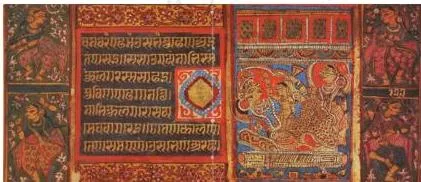
This is a Kalpasutra page, and the Kalpasutra is the most widely illustrated Jain text because its biographical section gives painters the lives of the 24 Tirthankaras, from birth to salvation (NCERT, p. 3). The five key incidents artists kept painting were conception, birth, renunciation, enlightenment and first sermon, and salvation.
The bright colour and gold on the page are the Jain taste the chapter returns to — paint that announces the patron’s wealth and status (NCERT, p. 6).
Trishala’s fourteen dreams (NCERT, p. 4)
Before Mahavir’s birth, his mother Trishala dreams fourteen objects (NCERT, p. 4). Grouped by kind:
- Animals: the elephant, the bull and the tiger
- Auspicious gifts: goddess Shri, the kalash and the palanquin
- Water and fire: the pond, the rivulet and fire
- Festivity: banners, garlands and a heap of jewels
- The heavens: the Sun and the moon
An astrologer reads the dreams and sets the whole biography in motion: the son will become a sovereign king or a great saint and teacher (NCERT, p. 4).
Kalakacharyakatha, 1497 (NCERT, p. 5)
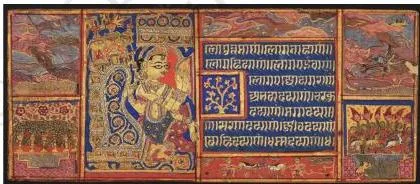
The Kalakacharyakatha is the adventure story of the tradition: Acharya Kalaka hunts for his abducted sister — a Jain nun — shows his magical powers, forges alliances and finally battles the evil king (NCERT, p. 4).
The 1497 folio packs several moments into one composition: Kalaka stands lower right, his captive sister is at the top left, the magical donkey spews arrows at Kalaka’s army of kings, and the evil king presides from inside the circular fort (NCERT, p. 5).
Planetary bodies, Sangrahini Sutra (NCERT, p. 5)
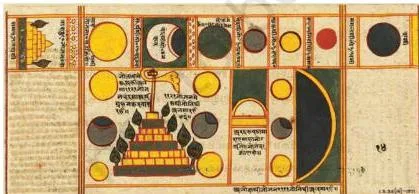
The Sangrahini Sutra is a twelfth-century cosmological text about the structure of the universe and the mapping of space (NCERT, p. 4). Painted in the seventeenth century, this page turns astronomy into a diagram — exactly what the chapter means by a schematic, simplified language that divides space into sections to accommodate different incidents (NCERT, p. 6).
Nimatnama, Mandu (NCERT, p. 8)
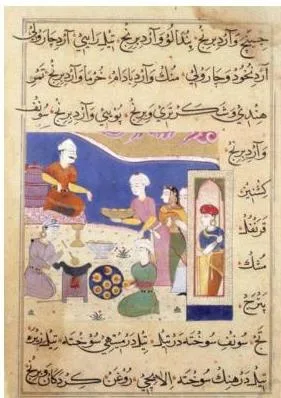
The Nimatnama — the Book of Delicacies — is the chapter’s showpiece for the Sultanate style. It was painted at Mandu during the reign of Nasir Shah Khalji (1500–1510 CE) and is a book of recipes with a section on hunting, plus methods for preparing medicines, cosmetics and perfumes (NCERT, p. 8).
The style is a hybrid: indigenous features meet Persian elements such as colour palette, physiognomy and a simplified, decorative landscape. The plate’s caption reads 1550 while the text dates it to Nasir Shah Khalji’s reign — either way, the chapter insists this is more a “style” than a “school” (NCERT, p. 8).
Terms and Definitions Used in This Chapter
This chapter introduces a specific art-historical vocabulary, and each term maps to one idea. Keep this glossary beside you while you re-read the PDF.
| Term | Meaning as the chapter uses it | NCERT page |
|---|---|---|
| Chitrasutra | Chapter in the third Khanda of the Vishnudharmottara Purana; the source book of Indian art and painting | p. 1 |
| Pratima lakshana | Canons of image making — the rules that guide painting | p. 1 |
| Shadanga (six limbs) | Roopbheda, pramana, bhava, lavanya yojana, sadrishya, varnikabhanga | p. 1 |
| Miniature painting | Small-scale painting, hand-held and viewed from close range; never meant for walls | p. 2 |
| Manuscript illustration | Pictorial translation of verses, with the text in a demarcated box or on the reverse | pp. 1–2 |
| Folio | A loose painted page within a thematic set | pp. 2, 5 |
| Colophon page | The folio recording patron, artist or scribe, date and place of the work | p. 2 |
| Shaastradaan | Donation of books, glorified as charity and righteousness | p. 3 |
| Bhandar | A monastery’s library or repository of donated manuscripts | p. 3 |
| Patli | Wooden cover protecting the top and bottom of a manuscript bundle | p. 5 |
| Tirthankara | One of the 24 Jain teachers whose lives the Kalpasutra recounts | p. 3 |
| Pre-Mughal / pre-Rajasthani indigenous style | Parallel style of the late 15th–16th centuries, before court styles of Rajasthan and Mughal influence | pp. 6–7 |
| Sultanate style | Hybrid of Persian and indigenous features; more a style than a school | p. 8 |
| Vajrayana | Buddhist tradition whose deities appear in the Pala palm-leaf manuscripts | p. 8 |
Common Mistakes Students Make in This Chapter
Art history chapters reward precision. The confusions below are the ones students actually make, each corrected from the chapter itself.
| Mistake | Correct rule | How to check your answer |
|---|---|---|
| Miniature paintings decorated walls | Miniatures were hand-held and never intended for walls; murals decorated the patron’s mansion (NCERT, p. 2) | Ask where the text places the art — walls belong to murals, miniatures to the hand and the closer eye |
| The extra eye in Jain faces is an artistic defect | It is the painter’s attempt at three-dimensionality of the face (NCERT, p. 6) | Look for the repeated eye as a depth device, not an error |
| Calling the Sultanate output a separate “school” | The chapter says it is more a “style” than a “school” — a hybrid of Persian and indigenous features (NCERT, p. 8) | The word “hybrid” in your answer signals you have read the distinction |
| Trusting every date and attribution in the chapter | Colophon pages are often lost; undated sets get a hypothetical timeframe from style and circumstantial evidence (NCERT, pp. 2–3) | Notice the chapter’s phrases of attribution, not assertion |
| Swapping the line styles of the two schools | Jain painting uses thin, wiry lines with bright colours; Pala uses flowing, sinuous lines in subdued tones (NCERT, pp. 6, 9) | Pair the line with the palette — bright with wiry, subdued with flowing |
| Mixing up the dated works | Astasahasrika Prajnaparamita (plate 1050), Kalakacharyakatha (1497), Nimatnama (reign of Nasir Shah Khalji, 1500–1510, though its plate caption reads 1550) (NCERT, pp. 5, 8, 9) | Match each dated work to its school — Jain works cluster 1475–1550, Pala works belong to the 11th–12th centuries |
Exam Notes: What to Remember When You Answer
This chapter feeds directly into the ones that follow — Rajasthani, Mughal and Deccan painting — because the indigenous style it describes is the soil those court styles grew from. The dates below are the spine of a good answer.
Timeline of dated works in the chapter
| Date | Work | School and place | Note |
|---|---|---|---|
| 750 CE – mid-12th century | Pala period | Eastern India | Last great phase of Buddhist art in India (NCERT, p. 8) |
| 11th century | Earliest surviving western Indian palm-leaf manuscript | Western India | Palm leaf predates paper here (NCERT, p. 5) |
| 1050 (plate caption); text places it in the last quarter of the 11th century, 15th year of King Ramapala | Lokeshwar, Astasahasrika Prajnaparamita | Pala, Nalanda; National Museum, New Delhi | Six pages of illustrations; wooden covers painted on both sides (NCERT, pp. 8–9) |
| 1260 | Sravakapratikramasutra-curni of Vijayasimha | Mewar, written by Kamalchandra; Boston collection | A dated colophon the chapter quotes (NCERT, p. 2) |
| 1350–1450 | Creative peak of Jain painting | Western Indian School | Shift from iconic images to margins with dancers and musicians (NCERT, p. 6) |
| 15th century | Birth of Mahavir, Kalpasutra | Jain Bhandar, Rajasthan | Biography of the Tirthankaras (NCERT, p. 3) |
| 15th century | Chaurpanchashika | Gujarat; N. C. Mehta Collection, Ahmedabad | Representative of the indigenous style (NCERT, p. 7) |
| About 1475 | Indra praising, Devasano Pado, Kalpasutra | Gujarat; Boston collection | Lavish use of gold and lapis lazuli (NCERT, p. 6) |
| 1497 | Kalakacharyakatha | N. C. Mehta Collection, Ahmedabad | Kalaka’s rescue adventure (NCERT, p. 5) |
| 1500–1510 (plate caption: 1550) | Nimatnama | Mandu, reign of Nasir Shah Khalji; British Library, London | Book of Delicacies; Sultanate style (NCERT, p. 8) |
| 1550 | Mitharam, Bhagvata Purana | — | Plate caption only (NCERT, p. 7) |
| 17th century | Planetary bodies and the distance between them, Sangrahini Sutra | N. C. Mehta Collection, Ahmedabad | Cosmological text composed in the 12th century; diagram painted in the 17th (NCERT, pp. 4–5) |
Answering Question 1 completely
A composed answer using only this chapter: Manuscript paintings are pictorial translations of poetic verses from manuscripts — epics and canonical, literary, bardic or music texts — with the verses handwritten in a clearly demarcated box-like space at the top of the painting or, at times, behind the work of art (NCERT, p. 2).
They were methodically conceived in thematic sets of loose folios, wrapped in cloth and stored in the library of the king or patron (NCERT, pp. 1–2). The tradition was prevalent in Gujarat, the main centre of the Western Indian School, and in eastern India under the Palas, where monasteries such as Nalanda and Vikramsila produced illustrated Buddhist manuscripts (NCERT, pp. 3, 8).
For a full answer, make sure you include:
- The definition with the boxed-text or reverse-side detail (NCERT, p. 2)
- The thematic-set and cloth-bundle detail (NCERT, pp. 1–2)
- Two named places, each tied to its school — Gujarat for the Western Indian School, eastern India for the Pala School (NCERT, pp. 3, 8)
One honest caveat: textbook contents and the examinable syllabus are not always identical, so check the current official syllabus for what is examinable.
The Chapter in a Nutshell
Read as one argument, the chapter establishes that India’s painting tradition was canon-driven from the start.
- The Chitrasutra gave painters six canons that were followed for centuries and became the basis of all later schools (NCERT, p. 1).
- The medieval miniature was hand-held; the largest group of miniatures were manuscript illustrations in thematic sets, with the text boxed above the painting or on its reverse (NCERT, pp. 1–2).
- The Western Indian School grew around Gujarat’s wealthy Jain merchants, whose shaastradaan funded illustrated Kalpasutras and other texts, first on palm leaf, then on paper (NCERT, pp. 3–6).
- A parallel indigenous style — called pre-Mughal or pre-Rajasthani — flourished among feudal lords and fed directly into early Rajasthan painting in the seventeenth century (NCERT, pp. 6–7).
- Sultanate courts blended Persian and indigenous features into a hybrid style, represented by the Nimatnama of Mandu (NCERT, pp. 7–8).
- In the east, Pala monasteries produced Buddhist palm-leaf manuscripts with a flowing line and subdued colour until the monasteries were destroyed in the first half of the thirteenth century (NCERT, pp. 8–9).
Making Your Own Illustrated Folio: The Activity Exercise in Practice
The second exercise asks you to build a folio, and the chapter itself supplies the design rules. Here is a suggested five-page plan you can copy for any short text — say, a four-stanza poem from your language textbook.
- Divide the poem into an opening, three middle episodes and a closing — one episode per page, the way Jain folios allocated space for separate incidents (NCERT, pp. 4–6).
- Page 1: make a colophon-style opening — the title, then imagined patron, artist or scribe, date and place, the way real colophon pages recorded these details (NCERT, p. 2).
- Pages 2–4: write each stanza in a clearly demarcated box at the top of the page and paint the stanza’s scene below it (NCERT, p. 2).
- Page 5: close the text with the final stanza and a final image.
- On the reverse of one page, write the full poem — the chapter notes that text sometimes appears behind the work of art (NCERT, p. 2).
- Optional physical details: a centre hole with a string to fasten the pages, wooden covers called patlis on top and bottom, and cloth wrapping for the bundle — the storage method the chapter describes (NCERT, pp. 2, 5).
This is a suggested approach, not an instruction from the book — the exercise is yours to design. The chapter only gives you the conventions to follow.
Related Resources: More from This Book
This listing is maintained for the 2026-27 academic session using the NCERT textbook information available to us. NCERT remains the authority for confirming the latest edition.
This chapter is the opening of An Introduction to Indian Art – Part II, the NCERT Fine Art textbook for Class 12. The pages below continue the journey.
- Browse the Class 12 Fine Art subject page for the full book list.
- See what else the textbook holds on its An Introduction to Indian Art – Part II book page.
- Reach every subject from the Class 12 book hub.
- Revise from the Class 12 Fine Art notes, including the Rajasthani Schools of Painting notes — the chapter’s pre-Rajasthani style hands you straight to them.
- Find more study material across the CBSE notes home and the Class 12 notes hub.
Reference: NCERT Class 12 An Introduction to Indian Art Part II textbook, chapter 1, official edition on ncert.nic.in.
Sources and Data Verification
- The descriptions on this page come from the NCERT Class 12 textbook An Introduction to Indian Art – Part II (English edition), Chapter 1, as published on ncert.nic.in.
- This page covers that single chapter; it does not cover other chapters of the book or other books.
- The listing is maintained for the current academic session using the NCERT information available to us.
- NCERT settles textbooks, editions and official PDFs; CBSE settles the curriculum, syllabus and examinations.
FAQs: Common Questions About the Manuscript Painting Tradition
Direct answers to the questions students search for when studying this chapter.
What are manuscript paintings according to the Class 12 Fine Art chapter?
Manuscript paintings are pictorial translations of poetic verses from manuscripts — epics and canonical, literary, bardic or music texts. The verses are handwritten in a clearly demarcated box at the top of the painting, or on its reverse, and the folios are conceived in thematic sets wrapped in cloth (NCERT, pp. 1–2).
What are the six limbs of painting in the Chitrasutra?
The six limbs are roopbheda (looks and appearance), pramana (measurements, proportion and structure), bhava (expressions), lavanya yojana (aesthetic composition), sadrishya (resemblance) and varnikabhanga (use of brush and colours), explained at length in the Chitrasutra (NCERT, p. 1).
Which two places had a strong manuscript painting tradition in this chapter?
Gujarat, the principal centre of the Western Indian School, and eastern India under the Palas, centred on monasteries such as Nalanda and Vikramsila (NCERT, pp. 3, 8).
What is the difference between the Western Indian and Pala schools of manuscript painting?
The Western Indian School was patronised by Jain merchants, illustrated Jain canonical texts, and used thin, wiry lines with bright colours and gold. The Pala School was Buddhist, illustrated Vajrayana texts on palm leaf, and used flowing, sinuous lines in subdued tones (NCERT, pp. 4–9).
What is the Nimatnama and which style does it represent?
The Nimatnama, or Book of Delicacies, was painted at Mandu during the reign of Nasir Shah Khalji (1500–1510 CE). It is a book of recipes with a section on hunting and methods for medicines, cosmetics and perfumes, and it is the most representative example of the hybrid Sultanate style (NCERT, p. 8).
How can I attempt the illustrated folio exercise in the chapter?
Divide your text into five folios: a colophon-style opening page, three pages with the verse boxed at the top and an illustration below (space divided for separate incidents), and a closing page. Write the full text on one reverse side and, optionally, tie the folios with a string through a centre hole between wooden covers called patlis (NCERT, pp. 2, 4–6).
Explore Class 12 Fine Art Books
Related chapters: