
The Pahari Schools of Painting Class 12 is Chapter 5 of NCERT’s Fine Art textbook An Introduction to Indian Art — Part II. It is a short chapter of 18 printed pages (NCERT pp. 66–83) that traces how miniature painting in the hill states of the western Himalayas moved from the bold Basohli idiom to the refined Kangra School.
The official NCERT chapter PDF is right here, with a section-by-section guide to what it teaches.
Download the Official NCERT Chapter PDF
Open the official NCERT Class 12 Fine Art Chapter 5: The Pahari Schools of Painting PDF on ncert.nic.in — this is the same chapter that appears on printed pages 66–83 of An Introduction to Indian Art — Part II, so it is the file to download, cite and revise from.
Reference: NCERT Class 12 An Introduction to Indian Art Part II textbook, chapter 5, official edition on ncert.nic.in.
| What the chapter holds | Count | Where it is used |
|---|---|---|
| Printed pages | 18 | |
| Figures with NCERT captions | 13 | |
| Exercise questions | 4 | answered in our NCERT Solutions |
| Official NCERT PDF | Download the chapter PDF | the chapter exactly as NCERT publishes it |

What Is Inside This Chapter
The file above is compact but packed: an opening on the meaning of the word “Pahari” and the difficulty of classifying hill miniatures, school-by-school sections, close studies of individual paintings, and a closing exercise. The table below summarises what the chapter holds, and the list that follows names the contents in the order you meet them.
| What the chapter holds | How many |
|---|---|
| Printed pages (NCERT pp. 66–83) | 18 |
| School sections (Basohli, Guler, Kangra) | 3 |
| Close painting studies | 3 |
| Figures and plates reproduced | 13 |
| Exercise questions at the end | 4 |
- The opening discussion (p. 67): what “Pahari” means, which hill towns became painting centres, and why territorial classification fails for these works.
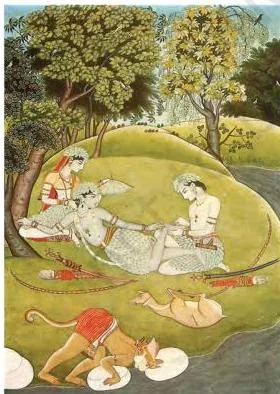
- Basohli School (pp. 69–71): the first dramatic hill style — its colours and materials, Devida’s Rasamanjari and the Shangri Ramayana.
- Guler School (pp. 72–73): the pre-Kangra phase under Raja Govardhan Chand, led by Pandit Seu and his sons Manak and Nainsukh.
- Kangra School (pp. 74–78): the patronage of Raja Sansar Chand, the mature style and its themes, and the decline after the 1805 Gurkha siege.
- Other hill centres (p. 79): Chamba, Kullu, Nurpur, Mankot, Jasrota, Mandi, Garhwal and Kashmir.
- Close painting studies (pp. 81–83): Awaiting Krishna and the Hesitant Radha, Balwant Singh Looking at a Painting with Nainsukh, and Nanda, Yashoda and Krishna.
- A closing exercise (pp. 79–80) with four questions.
What This Chapter Covers: From Basohli to Kangra
This chapter is a survey of miniature painting in the hill states of the western Himalayas from the seventeenth to the nineteenth century — and one continuous argument about how that style changed. Read the sections in order and you are watching a pictorial language being re-made twice.
- Meaning of “Pahari” and the hill centres (p. 67). Pahari means hilly or mountainous. The centres — Basohli, Guler, Kangra, Kullu, Chamba, Mankot, Nurpur, Mandi, Bilaspur, Jammu and others — emerged as painting towns from the seventeenth to the nineteenth century.
- Why territorial classification fails (pp. 67–68). Dated material, colophons and inscriptions are scarce, and political boundaries were fluid. Art historian B. N. Goswamy argued that the family of artists — above all the family of Pandit Seu — is the real bearer of style, not the region.
- The Basohli idiom (pp. 69–71). The earliest prevailing pictorial language in the hills, flamboyantly bold, patronised by Kirpal Pal, with distinctive colours, materials and themes.
- The Guler or pre-Kangra phase (pp. 72–73). A transformation that began in the first quarter of the eighteenth century, shaped by Pandit Seu’s sons Manak and Nainsukh under Raja Govardhan Chand.
- The mature Kangra style (pp. 74–78). Under Sansar Chand and the Katoch dynasty, the style reached its most poetic and lyrical form, then declined after the Gurkha siege of 1805.
- Other hill centres (p. 79). Local variations at Chamba, Kullu, Nurpur, Mankot, Jasrota, Mandi, Garhwal and Kashmir.
- Close painting studies and a closing exercise (pp. 79–83). The chapter ends by reading three paintings closely and posing four questions.
Held together, the chapter tells one story: a style that began coarsely flamboyant at Basohli matured, through the Guler or pre-Kangra experiment, into the exquisite sophistication of Kangra.
Key Concepts in the Pahari Schools of Painting
An “art school” here means a group of painters working in a recognisable style, called by the town or state where the style was centred. The names — Basohli, Guler, Kangra — are place names, which is exactly why the chapter warns against trusting them too far.
What “Pahari” means and why classification is hard
The chapter opens with a warning: these paintings do not classify neatly by region, the way the Mughal, Deccani and Rajasthani schools do.
- The word: Pahari comes from “hilly” or “mountainous” (p. 67).
- The regions: Basohli, Guler, Kangra, Kullu, Chamba, Mankot, Nurpur, Mandi, Bilaspur, Jammu and other towns of the western Himalayan hills, active as painting centres from the seventeenth to the nineteenth century (p. 67).
- The obstacles: dated material, colophons and inscriptions are scarce, and each centre developed its own preferences in nature, architecture, figures, facial types, costumes and colours — yet none grew into a fully independent school (p. 67).
- Goswamy’s answer: B. N. Goswamy made the artist’s family the unit of style. He argued that the family of Pandit Seu (Shiv) was chiefly responsible for the course of Pahari painting, and that attributing works to regions misleads because political boundaries were always fluid (pp. 67–68).
- The rejected theory: most scholars now dispute that artists migrating from the Mughal atelier caused the change; for Goswamy, the naturalism of the paintings that reached the hills is what appealed to Pahari artists (p. 68).
The Basohli idiom
Basohli is the chapter’s starting point — the first and most dramatic example of work from the hill states (p. 69). Under the rule of Kirpal Pal (1678–1695) it developed a distinctive and magnificent style.
- Look: strong primary colours; warm yellows filling the background and horizon; stylised vegetation; raised white paint imitating pearls; and the school’s signature — small shiny green particles of beetle wings used to imitate emeralds in jewellery (p. 69).
- Lineage: in its vibrant palette and elegance it shares the aesthetics of the Chaurpanchashika group of Western India (p. 69).
- Themes: Bhanu Datta’s Rasamanjari was the most popular; in 1694–95 Devida, a tarkhan (carpenter-painter), made a magnificent series for Kirpal Pal. Bhagvata Purana and Ragamala were also painted, along with portraits of local kings, consorts, courtiers, astrologers, mendicants and courtesans (p. 69).
- Spread: Basohli ateliers gradually moved to other hill states such as Chamba and Kullu, producing local variations of the Basohli kalam (p. 70).
- The Shangri Ramayana: a favourite text of hill artists at Basohli and Kullu, this set takes its name from Shangri, the residence of a branch of the Kullu royal family; Kullu artists made it under the influence of Basohli and Bilaspur styles (pp. 70–71).
The Guler or pre-Kangra phase
Around the first quarter of the eighteenth century the Basohli style transformed, and the change first appeared in Guler — a high-ranking branch of the Kangra royal family (p. 72).
- The phase: usually called the pre-Kangra or Guler-Kangra kalam, it is more refined, subdued and elegant than Basohli’s bold vitality (p. 72).
- The family: Pandit Seu of Guler and his sons Manak and Nainsukh changed the course of painting around 1730–40. Manak initiated the new style; Nainsukh, court painter to Raja Balwant Singh of Jasrota, shaped it emphatically (p. 72).
- Manak’s masterpiece: his set of Gita Govinda painted at Guler in 1730 still keeps some Basohli elements, most strikingly the lavish use of beetle-wing casings (p. 73).
- Nainsukh’s portraits: he left Guler for Jasrota, working first for Mian Zoravar Singh and then for Balwant Singh. His portraits show the prince performing puja, surveying a building site, or sitting in camp wrapped in a quilt against the cold — a unique visual record of a patron’s life, painted in delicate pastel shades with daring expanses of white or grey (p. 73).
- Next generation: sons and grandsons of Manak and Nainsukh — among them Khushala, Fattu and Gaudhu — worked at many centres and produced the finest examples of later Pahari painting (pp. 73–74).
The Kangra style
The Kangra region blossomed under Raja Sansar Chand (1775–1823), the ruler of the Katoch dynasty. The chapter calls the result “by far the most poetic and lyrical of Indian styles” (p. 74).
- The house: Sansar Chand’s grandfather Ghamand Chand had recovered territory after Mughal decline and founded Tira Sujanpur on the banks of the Beas (p. 74).
- The look: delicacy of line, brilliance of colour and minuteness of decorative detail; the most distinctive feature is the female face with a straight nose in line with the forehead, in vogue around the 1790s (p. 74).
- Themes: Bhagvata Purana, Gita Govinda, Nala Damayanti, Bihari Satsai, Ragamala and Baramasa, plus a pictorial record of Sansar Chand’s court — listening to music, watching dancers, presiding over festivals, practising tent pegging and archery, drilling troops (pp. 74–75).
- Artists: Fattu, Purkhu and Khushala are important names; the principal master of the great Bhagvata Purana series is believed to be a descendant of Nainsukh (pp. 75–76).
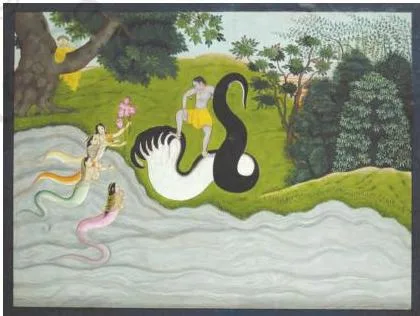
- Rasa Panchdhyayi: a group of five Bhagvata Purana chapters devoted to the philosophy of Rasa. In the folio the chapter describes, the gopis, devastated when Krishna vanishes, question deer, trees and creepers, then re-enact his lilas — killing Putana, freeing Yamala-Arjun, lifting Mount Govardhan, subduing Kaliya and answering the flute’s call (pp. 76–77).
- Decline: in 1805 the Gurkhas besieged the Kangra fort and Sansar Chand fled to Tira Sujanpur; in 1809 the Gurkhas were driven away with Ranjit Singh’s help, but later work never matched the masterpieces of 1785–1805 (p. 75).
- Spread: from Tira Sujanpur the style travelled east to Garhwal and west to Kashmir, where between 1846 and 1885 it initiated a local school of Hindu book illumination (pp. 75, 79).
The smaller centres (p. 79). The chapter stresses that the three-style division is broad — scholars may use variant terms, and the named centres are simply where each style travelled.
- Chamba: portraits of its rulers in the seventeenth and early eighteenth century in the Basohli style.
- Kullu: a distinctive style with prominent chin, wide open eyes, and lavish grey and terracotta red backgrounds.
- Nurpur: Basohli’s vibrant colours combined with Kangra’s dainty figure types.
- Mankot: a similar school to Basohli’s, linked through marital relations between the states.
- Jasrota: Balwant Singh’s patronage and Nainsukh’s portraits — the earlier simple Basohli style led to new sophistication, also called the Guler-Kangra style.
- Mandi: Krishna-lila themes and Shaivite subjects, since its rulers were ardent worshippers of Vishnu and Shiva.
- Garhwal: the artist Molaram, several signed paintings by him known, influenced by Sansar Chand’s Kangra style.
- Kashmir (1846–1885): the Kangra style initiated a local school of Hindu book illumination.
Reading the Paintings: A Figure by Figure Walkthrough
A Pahari miniature repays slow looking. This walkthrough tells you what to look at in six plates reproduced in the chapter — read with the book open beside you.
Krishna steals butter — the opening plate (p. 67)

The chapter opens with a plate of Krishna stealing butter from the Bhagvata Purana (1750, N. C. Mehta Collection). It sits beside the discussion of how the Pahari School emerged, and it is chosen deliberately: this bold, direct scene belongs to the flamboyantly bold language that the chapter understands as the earliest prevailing pictorial style of the hills (p. 67).
Rasamanjari, Basohli, 1720 (p. 69)
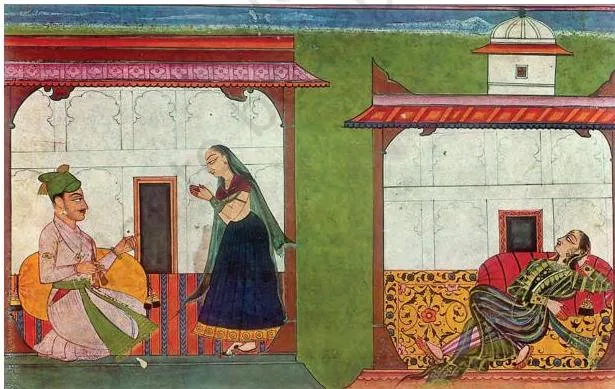
This folio, now in the British Museum, is a textbook Basohli picture. Look first at the colour: strong primaries and a warm yellow ground. Then notice the stylised vegetation and the jewellery — raised white paint for pearls and beetle-wing green for emeralds (p. 69).
It belongs to the same idiom Devida worked in for Kirpal Pal in 1694–95, though it is a later example. The Rasamanjari of Bhanu Datta was the theme Basohli artists painted most often (p. 69).
Rama gives away his possessions — Shangri Ramayana (pp. 70–71)
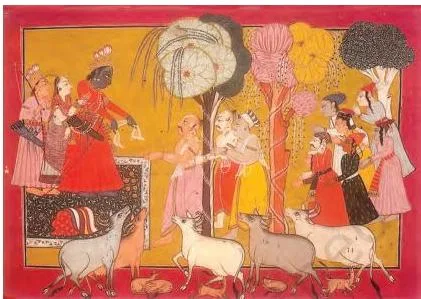
The chapter gives this plate its longest single description. Read it as a checklist:
- Arrangement: on the left, Rama and Lakshmana stand apart with Sita on a carpet; the crowd of recipients moves towards them.
- The crowd: recluses, Brahmins, courtiers, commoners and servants of the royal household — the painter carefully differentiates each type.
- The gifts: a pile of gold coins and garments on the carpet, and cows and calves with necks stretched and gazes fixed, unaware of the moment’s gravity.
- The expressions: Rama serene and gently smiling, Lakshmana curious, Sita apprehensive; the Brahmins willing but not pleased; others in disbelief and gratitude.
- The fine detail: the transparency of the garment Rama holds out, the stippled beards of the Brahmins, tilak marks, jewellery and weapons (pp. 70–71).
The same Shangri set includes the princes’ journey with sage Vishvamitra into the forest, where a wolf and a tiger, shown only in fragments, hide in the heavy outgrowth — read by the chapter as adding mystery to the courage of the two young princes (p. 72).
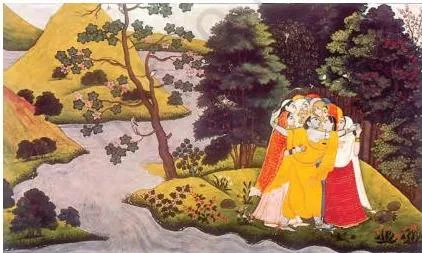
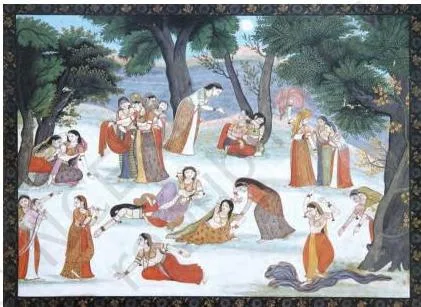
Krishna playing Holi with gopis — Kangra, 1800 (p. 75)
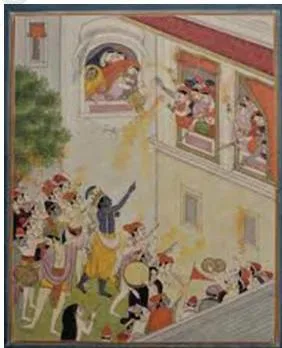
Compare this plate with the Basohli one: the same god, a completely different register. The Kangra painting reads through delicacy of line, brilliance of colour and minuteness of decorative detail (p. 74). The female faces follow the type with a straight nose in line with the forehead that came into vogue around the 1790s (p. 74).
Two more Kangra plates on page 78 — Abhisarika Nayika (1810–20) and A couple in the month of Jyeshtha (1800) — show the Ashta Nayika and Baramasa themes in this mature style.
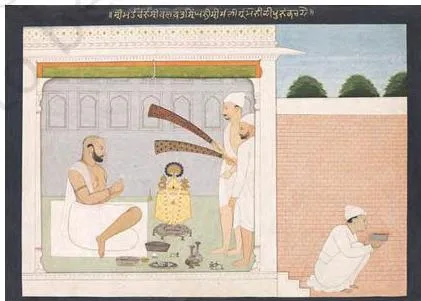
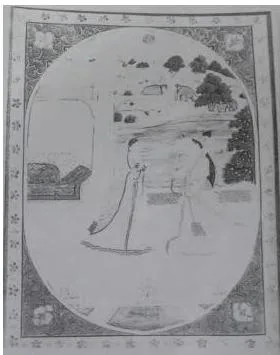
Balwant Singh Looking at a Painting with Nainsukh (p. 82)
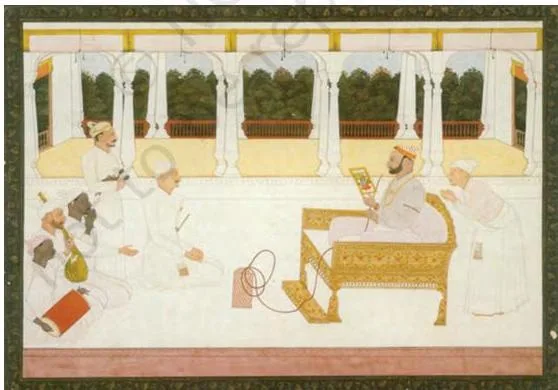
This is the rare portrait in which the artist shows himself beside his patron. Balwant Singh, seated in his palace, closely studies a painting he holds in his hands; the figure behind him, politely bowing, is probably Nainsukh himself (p. 82).
Everything in the scene is set up to read as calm. The composition is clutter-free; musicians are placed at the outer edge, not clamouring to be heard but “softly” producing music, so they deepen the quiet rather than disturb it.
Balwant Singh smokes a hukka, his habit during breaks in work, and stays engrossed in the painting, which depicts Krishna (p. 82).
That peace and tranquillity, the chapter says, are suggestive of Balwant Singh’s own temperament (p. 82).
Nanda, Yashoda and Krishna (p. 83)
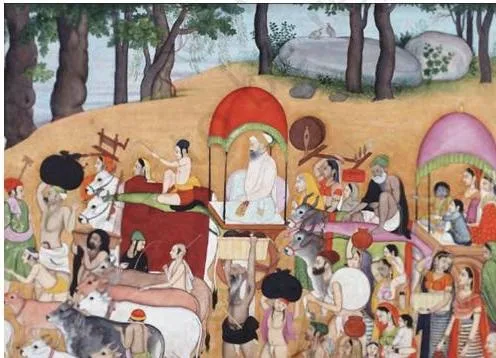
This plate illustrates a scene from the Bhagvata Purana: Nanda leads his family from Gokul, found to be infested with demons, to Vrindavan. Nanda’s bullock cart leads; a second follows carrying Krishna and Balaram with their mothers Yashoda and Rohini, while men and women walk alongside carrying household goods (p. 83).
What makes the painting is observation. The artist shows the tilt of heads as people talk, fatigue in downcast eyes under a heavy load, and arms stretched taut as a vessel is steadied on the head (p. 83).
The chapter connects this to the defining habit of Kangra painters — they observed the landscape acutely and represented it naturalistically — and notes the flush-cut composition that resembles a photograph and lends the scene naturalism (p. 83).
Terms and Names Defined
These are the words and names the chapter uses without re-explaining. Each row gives a plain meaning and the NCERT page where the term appears.
| Term | What it means | NCERT page |
|---|---|---|
| Pahari | “Hilly” or “mountainous”; the umbrella name for the hill-state miniature traditions. | p. 67 |
| kalam | Literally “pen”; used in the chapter for a painting style or school, as in “Basohli kalam” or “Guler-Kangra kalam”. | pp. 69, 72 |
| tarkhan | A carpenter-painter; Devida, who made the 1694–95 Rasamanjari series, was one. | p. 69 |
| Rasamanjari | Bhanu Datta’s Sanskrit work on the nayaka-nayika (hero-heroine) moods; the most popular Basohli theme. | pp. 69–70 |
| Gita Govinda | Jayadeva’s poem on the love of Radha and Krishna; Manak’s 1730 set is a landmark, and it remained a Kangra theme. | pp. 70, 73, 82 |
| Bhagvata Purana | The Puranic text of Krishna’s deeds; painted at both Basohli and Kangra. | pp. 69, 74, 76 |
| Bala Kanda and Ayodhya Kanda | Books of the Ramayana: the Bala Kanda covers the princes’ youth (Vishvamitra’s forest journey), the Ayodhya Kanda the exile and Rama’s last acts at Ayodhya. | pp. 70–71 |
| Ragamala | A series of paintings illustrating musical modes (ragas). | pp. 69, 74 |
| Baramasa | Twelve folios showing the moods of love or courtship suited to each month. | pp. 74, 79 |
| Rasa Panchdhyayi | Five chapters of the Bhagvata Purana devoted to the philosophical concept of Rasa (the gopis’ enactments of Krishna’s lilas). | p. 77 |
| pre-Kangra or Guler-Kangra phase | The experimental phase, begun around 1730–40 by Pandit Seu and his sons, that matured into the Kangra School in the 1780s. | p. 72 |
The chapter also names the Ashta Nayikas — the eight heroines of Indian poetics shown in different emotional states, one of the most painted Pahari themes. It identifies five of them by what they do:
| Nayika | What she does | NCERT page |
|---|---|---|
| Utka | Anticipates her beloved’s arrival and waits patiently for him. | p. 78 |
| Svandhinpatika | Her husband is subject to her will. | p. 78 |
| Vasaksajja | Awaits her beloved’s return from a voyage and decorates the bed with flowers. | p. 78 |
| Kalahantarita | Resists her beloved when he tries to soften her pride, then repents when he comes late. | p. 78 |
| Abhisarika | Hastens to meet her beloved braving all hazards; her passion and steadfastness triumph over the opposing elements of nature. | pp. 78–79 |
These are “to mention a few” of the eight, the chapter says, and none is treated with as much flair as the Abhisarika (pp. 78–79).
Common Mistakes Students Make in This Chapter
The chapter is short, but its names look alike — two brothers, several states, three schools — and they are easy to muddle. Each row below names the error first and the correction second.
| Mistake | Correction | How to check your answer |
|---|---|---|
| Putting the schools in the wrong order — e.g., Kangra before Guler. | The arc is Basohli → Guler (pre-Kangra) → Kangra. The Guler phase began around 1730–40, and Kangra matured only in the 1780s (pp. 67, 72, 74). | Name the phase between Basohli and Kangra. If you said “Guler” or “pre-Kangra”, you have it. |
| Attributing a painting by region alone. | Political boundaries were fluid, so the region is a weak label; the family of artists is the style bearer, the core of Goswamy’s argument (pp. 67–68). | Ask who the painter’s family was, not just which state the work came from. |
| Repeating the old Mughal migration theory. | Most scholars now dispute that migrating Mughal atelier artists caused the change; paintings reached the hills through various agencies, and their naturalism appealed to hill artists (p. 68). | Frame the change as a response to paintings, not a migration of painters. |
| Mixing up Manak and Nainsukh. | They were brothers, sons of Pandit Seu. Manak painted the 1730 Gita Govinda at Guler; Nainsukh became court painter to Balwant Singh of Jasrota (pp. 72–73). | Attach each brother to his own patron and work: Manak → Govardhan Chand and the Gita Govinda; Nainsukh → Balwant Singh and the portraits. |
| Confusing patrons and states. | Kirpal Pal ruled Basohli (1678–95); Govardhan Chand patronised Guler; Balwant Singh ruled Jasrota; Sansar Chand ruled Kangra (1775–1823) (pp. 69, 72–74). | Rehearse the four patron-state pairs aloud once. |
| Treating the “Guler-Kangra phase” and the “Kangra School” as the same thing. | The Guler-Kangra phase is the experimental pre-Kangra phase; the Kangra School is what it matured into (p. 72). | Say “pre-Kangra” for the experiment, “Kangra School” for the mature style. |
How to Use This Chapter for the Fine Art Exam
Revision of this chapter should follow the order the book itself builds. The guidance below tells you what to prioritise; it makes no promise about what will be asked.
- Start with the chapter’s own exercise (pp. 79–80). It shows what the book thinks matters: reasons for the pervasive representation of nature (Question 1, a reasoning question); the major schools, their places of expansion and their differences, with a map component (Question 2, factual); a creative illustration task (Question 3); and four short critiques — of Nainsukh, of Basohli paintings, of the Ashta Nayikas and of the Kangra kalam (Question 4, four-part critique).
- Study the three painting descriptions (pp. 81–83) as models. Each shows how to describe a Pahari miniature: subject, composition, figures, expressions, colours, landscape. Use that order in your own answers.
- Revise in this order: the school arc and its periods → the stylistic markers of each school → the artist-patron pairings → the paintings the chapter describes.
- Keep one visual cue for each school. Pahari → “hilly” (p. 67). Basohli → primary colours and beetle-wing green (p. 69). Guler → refined, subdued elegance with a pastel palette (p. 72). Kangra → delicate line and the straight-nose female face (p. 74).
A model approach to the nature question. The exercise asks why the representation of nature is found everywhere in Pahari miniature painting. A full answer does three things.
- State the evidence. Kangra painters “acutely observe the landscape and represent it naturalistically” (p. 83); the Nanda, Yashoda and Krishna study shows nature and figures woven together, even in a flush-cut, photograph-like composition (p. 83); in the Rasa Panchdhyayi folio the gopis address deer, trees and creepers (p. 77); and in the Shangri Ramayana forest scene, animals hide in the heavy outgrowth (p. 72).
- Give reasons the chapter supports. The texts the painters illustrated are set in nature — Krishna’s Vrindavan deeds happen in forests and by rivers — and the lyricism the book attributes to the Guler-Kangra and Kangra styles (p. 74) is a taste for mood, which landscape carries.
- Add your own judgement — the question asks what you think. For example, the painters lived in the hills, so the natural world was the world around them (the word Pahari itself means “hilly”, p. 67).
One caution applies to every chapter in this book: textbook contents and the examinable syllabus are not always identical. Confirm what is examinable this session on the official CBSE website before finalising your revision list.
Five Minute Revision Summary
This recap follows the chapter’s own argument. Read it once and you should be able to reconstruct the whole chapter around one table and three facts.
| School | Period | Patrons | Key artists | Stylistic markers | Main themes |
|---|---|---|---|---|---|
| Basohli | Style developed under Kirpal Pal’s rule, 1678–95; pieces continue into the early 1700s | Kirpal Pal of Basohli | Devida (a tarkhan) | Strong primary colours; warm yellow grounds; stylised vegetation; raised white paint for pearls; beetle-wing green for emeralds | Rasamanjari (Devida’s 1694–95 series); Bhagvata Purana; Ragamala; Ramayana (Shangri set); portraits of the court |
| Guler (pre-Kangra) | Transformation from the first quarter of the 18th century; experimental phase c. 1730–40 | Raja Govardhan Chand (1744–73); later Prakash Chand | Pandit Seu; sons Manak and Nainsukh; then Khushala, Fattu, Gaudhu | Refined, subdued, elegant; pastel palette with daring white or grey; individual portraiture | Gita Govinda (Manak’s 1730 set); portraits of the patron at work, at prayer and at rest |
| Kangra | Matures in the 1780s; Sansar Chand’s reign 1775–1823; finest years 1785–1805 | Raja Sansar Chand; Aniruddha Chand (1823–31) | Fattu, Purkhu, Khushala; the Bhagvata Purana principal master, believed a descendant of Nainsukh | Delicacy of line; brilliance of colour; minuteness of decorative detail; straight-nose female face from the 1790s | Bhagvata Purana; Gita Govinda; Nala Damayanti; Bihari Satsai; Ragamala; Baramasa; Ashta Nayikas; records of Sansar Chand’s court |
- The other centres (p. 79) add local accents to the three main styles — Kullu’s distinctive faces, Nurpur’s Basohli colours with Kangra figures, Jasrota’s Nainsukh portraits, Garhwal’s Molaram, and Kashmir’s book illumination.
- The three painting studies (pp. 81–83) each demonstrate one idea: Awaiting Krishna and the Hesitant Radha shows the lyricism of Manak’s Gita Govinda world; Balwant Singh Looking at a Painting with Nainsukh shows Nainsukh’s quiet portraiture; Nanda, Yashoda and Krishna shows Kangra’s naturalistic landscape.
- The chapter in one sentence: a style that began coarsely flamboyant at Basohli matured, through the Guler or pre-Kangra experiment, into the lyrical refinement of Kangra.
Related Chapters and Resources
This listing is maintained for the 2026-27 academic session using the NCERT textbook information available to us. NCERT remains the authority for confirming the latest edition.
The chapter opens by comparing the Pahari schools with the Mughal, Deccani and Rajasthani schools (p. 67), so those chapters — and the rest of the book — are natural follow-up reading. Use the links below to move around the fine-art material on this site.
- An Introduction to Indian Art — Part II: chapter pages and notes
- The previous chapter, on the Rajasthani schools of painting
- Chapter 6 of the same book
- The Deccani Schools of Painting: notes
- The Bengal School and Cultural Nationalism: notes
- Class 12 hub
- CBSE notes and study material
Sources and Data Verification
- The chapter contents and page references on this page describe the NCERT textbook An Introduction to Indian Art — Part II (Class 12 Fine Art), Chapter 5, printed pages 66–83, official edition published on ncert.nic.in.
- This page covers that single chapter of that single book — not other fine-art textbooks and not the full CBSE scheme.
- The page is maintained for the current academic session using the NCERT information available to us.
- NCERT settles textbook editions and PDFs; CBSE settles curriculum, syllabus and examinations. Because textbook contents and the examinable syllabus are not always identical, check the current official CBSE syllabus.
FAQs on the Pahari Schools of Painting
What does Pahari mean and which regions did the Pahari schools of painting cover?
Pahari means “hilly” or “mountainous” (NCERT p. 67). The Pahari schools covered the towns of the western Himalayan hills — Basohli, Guler, Kangra, Kullu, Chamba, Mankot, Nurpur, Mandi, Bilaspur, Jammu and others — which emerged as painting centres from the seventeenth to the nineteenth century. The style’s course ran from Basohli, through the Guler or pre-Kangra phase, to the mature Kangra School.
What is the difference between the Basohli, Guler and Kangra schools of painting?
Basohli is bold and flamboyant: strong primary colours, warm yellow grounds and beetle-wing green jewellery (p. 69). The Guler or pre-Kangra phase is more refined, subdued and elegant, with a pastel palette and an emphasis on individual portraiture (p. 72).
Kangra adds delicacy of line, brilliance of colour and minuteness of decorative detail, with the female face drawn with a straight nose in line with the forehead from the 1790s (p. 74).
Chronologically they are phases of one development: Basohli came first, Guler’s experiment began around 1730–40, and Kangra matured only in the 1780s (p. 72).
Who were the main patrons and artists of Pahari painting?
Kirpal Pal of Basohli (ruled 1678–95) patronised Devida, the tarkhan who painted the celebrated 1694–95 Rasamanjari series (p. 69). Raja Govardhan Chand of Guler (1744–73) supported Pandit Seu and his sons Manak and Nainsukh (p. 72). Balwant Singh of Jasrota was Nainsukh’s greatest patron (p. 73).
Raja Sansar Chand of Kangra (1775–1823), and later his son Aniruddha Chand (1823–31), supported a large studio that included Fattu, Purkhu and Khushala (pp. 74–75).
Why does the chapter say Pahari paintings cannot be classified by region alone?
Because the evidence does not support it: dated material, colophons and inscriptions are scarce, and political boundaries in the hills were always fluid (p. 67).
B. N. Goswamy argued that the family of artists is the true bearer of style — chiefly the family of Pandit Seu — because one family could produce several stylistic strands within a single region, which region-based labels cannot explain (pp. 67–68).
Who was Nainsukh and why were his portraits of Balwant Singh important?
Nainsukh was the younger son of Pandit Seu. He left Guler for Jasrota, worked first for Mian Zoravar Singh, then became court painter to Balwant Singh, his greatest patron (p. 73).
His genius was individual portraiture: he painted Balwant performing puja, surveying a building site, or sitting in a cold camp wrapped in a quilt — a visual record of a patron’s daily life that is unique in Pahari painting (p. 73).
His portrait of Balwant looking at a painting, with the artist himself bowing behind him, is probably a rare self-portrait of the artist with his patron (p. 82).
What are the Ashta Nayikas and Baramasa themes in Kangra painting?
The Ashta Nayikas are the eight heroines of Indian poetics shown in different emotional states — one of the most painted Pahari themes (p. 77). The chapter names Utka, Svandhinpatika, Vasaksajja, Kalahantarita and Abhisarika, the last treated with the most flair: she hastens to meet her beloved braving all hazards (pp. 78–79).
Baramasa is a twelve-folio series showing the modes of love or courtship appropriate to each month, popular in the hills in the nineteenth century. The chapter’s example is the hot month of Jyeshtha, following the account of Keshav Das in Kavipriya (p. 78).
Reference: NCERT Class 12 An Introduction to Indian Art Part II textbook, chapter 5, official edition on ncert.nic.in.
Explore Class 12 Fine Art Books
- Previous: The Deccani Schools of Painting
- Next: The Bengal School and Cultural Nationalism
Related chapters: