This is the official NCERT Class 12 English Vistas chapter 2, ‘The Tiger King’ — the tale of a ruler who builds his entire reign around escaping a prophecy. The chapter runs to about ten printed pages in the book, and the complete official PDF is published below.
Everything you need for The Tiger King Class 12 — the file, the full story and the analysis — sits on this one page.
Open the NCERT Class 12 English Vistas Chapter 2 The Tiger King PDF on the official NCERT portal (ncert.nic.in) to read the story in one clean file — the ‘Before you read’ prompt, all five narrative parts and the ‘Reading with Insight’ questions that close the chapter.
What is inside the chapter: sections and figures
The table below shows how this chapter is organised at a glance — its sections, its figures and the questions that close it — so you know exactly what is in the file before you open it.
| What the chapter holds | Count | Where it is used |
|---|---|---|
| Printed pages | 10 | |
| Figures with NCERT captions | 2 | |
| Official NCERT PDF | Download the chapter PDF | the chapter exactly as NCERT publishes it |
The chapter opens with a ‘Before you read’ prompt asking what the general attitude of human beings towards wild animals is. The story then moves through five narrative parts, from the prophecy at the prince’s birth to the wooden tiger on his son’s birthday, and closes with ‘Reading with Insight’, whose five questions double as a ready-made revision map.
The Tiger King Class 12: what happens in the story
This walkthrough gives the order of events in plain language, so the analysis that follows has a story to hang on. Keep the prophecy in mind at every step — the king’s entire life is one long attempt to dodge it.
Part 1 — The prophecy and the ten-day-old prince
The Maharaja of Pratibandapuram carries a string of grand state titles, but everyone shortens them to the Tiger King. The narrator promises to tell his story without retreating, then immediately discloses the vital fact: the king is dead, and the manner of his death is a matter of extraordinary interest.
The cause goes back to his birth, when astrologers predicted he would die. At that moment the ten-day-old prince astonished everyone by speaking. He did not question the fact of death — that comes to all — he demanded to know its manner.
Told that he was born in the hour of the Bull, that the Bull and the Tiger are enemies, and that death would come from a tiger, the infant’s reply was a growl: ‘Let tigers beware!’
Part 2 — The vow to kill a hundred tigers
The prince grew up exactly like the crown princes of other Indian states: English cow’s milk, an English nanny, an English tutor, nothing but English films. When the state came into his hands at twenty, the prophecy everyone still remembered reached his ears.
He reasoned his way into a lifelong hunt: killing in self-defence is lawful, tigers are his declared enemy, so he would kill them all. After his first kill the state astrologer warned him plainly — ninety-nine tigers were safe, but he must be careful with the hundredth.
The Maharaja banned tiger hunting by anyone else in the state, on pain of confiscation of all wealth and property.
Part 3 — The British officer and the three-lakh-rupee bill
A high-ranking British officer, fond of hunting tigers and fonder of being photographed over the carcass, asked permission to hunt in Pratibandapuram. The Maharaja refused, and refused again even when the officer offered to let the Maharaja do the killing while he posed for the photo. That refusal put the kingdom itself in danger.
The solution the king and his dewan devised was a bribe with a colonial flavour: fifty expensive diamond rings were ordered from a British jeweller in Calcutta and sent to the officer’s wife. She kept the entire lot and sent a thank-you note; the bill for three lakh rupees returned within two days.
The Maharaja decided the price was worth paying — he had kept his kingdom.
Part 4 — The tiger shortage and the midnight delivery
Within ten years the king had killed seventy tigers. Then the tigers of Pratibandapuram vanished entirely — the story jests about whether they practised birth control, committed harakiri, or ran off to be shot by British hands alone.
He solved the shortage by marrying into a tiger-rich state; each visit to his father-in-law brought five or six kills, until ninety-nine tiger skins lined the palace walls.
The hundredth tiger, however, could be found nowhere, and the king’s fury mounted. He doubled the land tax, and officers lost their jobs by the day. In despair the dewan fetched the old tiger from the People’s Park in Madras and hid it in his house.
At midnight he and his aged wife dragged the beast into his car and drove it to the forest where the Maharaja was hunting.
Part 5 — The missed shot and the wooden tiger
The old tiger wandered before the Maharaja, who took careful aim, shot it, and rejoiced: his vow was fulfilled. But once the king had driven off, the hunters saw the truth — the bullet had missed, and the tiger had only fainted from the shock. Fearing for their jobs, one hunter shot the beast dead from a distance of one foot.
The tiger was carried in procession, buried, and a tomb raised over it. The Maharaja never knew. Days later, shopping for his son’s third birthday, he found the perfect gift: a rough wooden tiger priced at three hundred rupees, because the terrified shopkeeper dared not quote its true price of two annas and a quarter.
While father and son played, a sliver of the toy pierced the king’s right hand.
The next day infection flared; within four days it covered his arm. Three surgeons operated, then came out and announced that the operation was successful — and that the Maharaja was dead.
Satire, dramatic irony and the prophecy: key ideas
These three ideas are what turn a hunting tale into a comment on power. Understand them, and most interpretation questions answer themselves.
Satire: mocking the conceit of those in power
Satire exposes foolishness or arrogance through humour and exaggeration. Every major turn in this story mocks the Maharaja’s self-importance: a ten-day-old baby lecturing court astrologers, a king celebrating a kill he did not actually make, a ruler so absorbed in tigers that he ignores his own son until the boy is three.
The final joke is that this all-powerful king is defeated by a two-anna toy.
Dramatic irony: the reader knows what the king does not
Dramatic irony is the gap between what the audience knows and what a character believes. The king celebrates his hundredth victory; the reader knows the bullet missed and a frightened hunter finished the tiger. He buys a toy for his son; the reader knows its sliver will kill him.
Reading with Insight question 1 asks you to show exactly this device working in a satire on the conceit of those in power.
The prophecy as the engine of the plot
The prophecy does not just predict the story — it drives it. Every move the king makes to escape death from a tiger, whether killing them, banning other hunters, or buying off the British, locks the ending in place.
He defeats the hundredth tiger only in his own mind; the real instrument of his death is the cheap wooden toy that stands in for it. The more furiously he fights fate, the more directly he walks into it.
The two NCERT illustrations, read closely
The chapter carries two illustrations, and each one marks a hinge of the plot — the promise at the opening and the infection at the close. Read them as a pair.

The first illustration sits at the top of the chapter, beside the narrator’s opening disclosure: the Tiger King is dead. Because the caption is the narrator’s own sentence, the picture does the work of a promise — before any adventure begins, the reader knows how this ends.
The story then becomes a question not of whether the king dies, but of how.
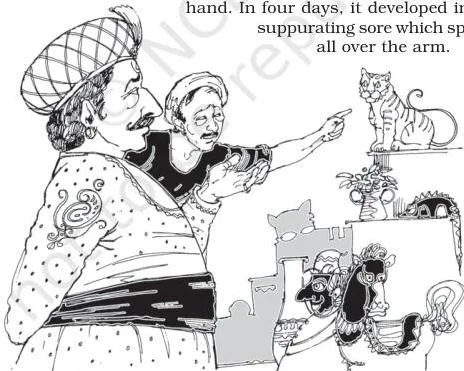
The second illustration marks the turn from triumph to death. Its caption — ‘The next day, infection flared in the Maharaja’s right hand’ — names the exact moment a sliver of the wooden toy tiger undoes everything the king’s bullets achieved.
Read together, the two images frame the whole irony: the story opens on a king who believes he controls his fate, and closes on the small wooden scratch through which fate reached him.
Chapter terms defined in plain language
These words appear in the story and in questions about it. Each definition below is tied to how the word works in this chapter.
- Maharaja — the title of the ruler of the princely state of Pratibandapuram. The story opens with his full string of grand titles, then notes that the name is often shortened to the Tiger King.
- Dewan — the king’s chief minister. The dewan carries out the impossible orders, from arranging tiger hunts to driving the People’s Park tiger to the forest at midnight.
- Durai and Duraisani — the local terms for the British officer and his wife. The ring-bribe episode turns on this colonial figure and his ‘good lady’.
- Prophecy — a prediction of the future. The astrologers’ prophecy that the king will die is the engine of the whole plot.
- Satire — the use of humour, exaggeration or ridicule to expose folly or vice. The story is a satire on the conceit of those in power.
- Dramatic irony — when the reader knows something a character does not. We watch the king celebrate a triumph while knowing the bullet missed.
- Conceit — excessive pride or self-importance. It is the stated target of the satire in Reading with Insight question 1.
Where students misread The Tiger King
The biggest error concerns the ending, so it comes first: the hundredth tiger that kills the Maharaja is the wooden toy tiger, not the hunted beast. The real hundredth tiger survived the king’s shot and was finished by a hunter. The table below names the common misreadings and the evidence that corrects them.
| Mistake | Correct rule | How to check your answer |
|---|---|---|
| The hundredth tiger mauled the king to death. | No tiger ever attacked him. The real hundredth tiger survived the king’s shot; a hunter killed it. Death came from infection caused by a wooden sliver. | In Part V the bullet ‘had missed’ the tiger, and infection ‘flared’ only after the toy sliver pierced his hand. |
| The Maharaja himself killed all one hundred tigers. | He killed ninety-nine. The hundredth was shot dead by a hunter from a distance of one foot. | Ninety-nine tiger skins hung in the reception hall; the hundredth beast in Part V is finished by a hunter. |
| The minions obeyed out of sincere loyalty. | They obeyed out of fear — of losing jobs, of doubled taxes, of the king’s gun. | The hunters shot the tiger to protect their jobs; the dewan shuddered at the sight of the gun. |
| The story is a straightforward hunting adventure. | It is a satire on the conceit of those in power, built on dramatic irony. | Reading with Insight question 1 names the satire; the toy-tiger death confirms it. |
What the Maharaja believes versus what actually happens
This second table is the fastest way to see the dramatic irony working. At every turning point, the king’s belief and the reader’s knowledge are different stories.
| Turning point | What the Maharaja believes | What actually happens |
|---|---|---|
| The hundredth shot | He has shot the hundredth tiger; his vow is fulfilled. | The bullet missed; the tiger had only fainted from the shock. |
| The funeral procession | The dangerous hundredth tiger is dead and buried. | The buried tiger was killed by a hunter’s bullet, not his. |
| The birthday gift | A wooden tiger is a harmless, suitable gift. | A sliver from its rough surface pierces his hand and brings the fatal infection. |
| The prophecy | Killing every tiger protects him from the predicted death. | The toy tiger — his gift, not his kill — delivers the predicted death. |
Every row in both tables is an example of dramatic irony, and that is what makes the chapter satire rather than a simple adventure tale.
Using Reading with Insight to prepare for board questions
The chapter’s own closing questions tell you what the book considers important. Map each one to its theme and you have a complete plan for interpretation answers.
| Question | What it asks about | What a good answer shows |
|---|---|---|
| 1 | Dramatic irony in a satire on the conceit of those in power. | The gap between the king’s belief and the reader’s knowledge, shown with evidence. |
| 2 | The author’s indirect comment on subjecting innocent animals to human willfulness. | Tigers treated as a tally, trophies and props, never as living beings. |
| 3 | The minions’ behaviour — sincerity or fear — and parallels in today’s political order. | Evidence of fear-driven obedience, then a careful modern comparison. |
| 4 | Present-day game-hunting by the rich and powerful. | A real instance of callousness toward wildlife, related to the story. |
| 5 | A new system for the age of ecology, embedded in care of all people and the Earth. | Ecology and sustainability understood as care for people and the planet together. |
Any full answer to these needs three parts: state the point, cite evidence from the story, explain the effect — what the device or detail does to the reader. Keep every quote short and every claim tied to a scene.
One honest caution: textbook contents and the examinable syllabus are not always identical. Use this chapter fully, but check the current official syllabus to confirm exactly what is examinable this session.
The Tiger King in one page: timeline and themes
The story has no printed summary block of its own, so this section pulls the whole arc onto one screen for last-minute revision.
The story in nine steps
- Astrologers predict the newborn prince will die; the ten-day-old baby speaks and asks for the manner of his death.
- At twenty he takes charge of the state and begins a lifelong tiger hunt.
- The astrologer warns him to beware the hundredth tiger; the state bans hunting by everyone else.
- A British officer is refused permission and bought off with fifty diamond rings — bill, three lakh rupees.
- Seventy tigers fall in ten years; the state then runs out of tigers.
- The king marries into a tiger-rich state; ninety-nine tiger skins hang in the palace.
- The hundredth tiger, delivered at midnight from the People’s Park, is shot by the king — but the bullet misses, and a hunter kills it.
- A toy wooden tiger bought for the prince’s birthday slivers the king’s hand.
- Infection flares, spreads up his arm, and after the surgeons’ successful operation the Maharaja is dead.
Themes in one line each
- Power and conceit — a ruler so self-important that he believes he can defeat destiny.
- Princely states under colonial rule — the British officer episode shows a kingdom bought for three lakh rupees.
- Cruelty to wildlife — tigers are a tally, a photograph and a throne’s insurance, never living creatures.
- Ecology — the chapter closes by asking for a system built on care of all people and the Earth.
- Fatal and dramatic irony — every attempt to escape the prophecy is exactly what completes it.
Related Class 12 English resources
This listing is maintained for the 2026-27 academic session using the NCERT textbook information available to us. NCERT remains the authority for confirming the latest edition.
If you are moving through Vistas in order, the chapter before The Tiger King is The Third Level and the one after it is Deep Water, both with pages on this site. For the whole book, go up to the Class 12 English notes hub; for other subjects, start at the Class 12 hub or the CBSE notes home page.
Sources and data verification
This page describes the NCERT Class 12 English Vistas textbook, chapter 2, The Tiger King, in its official edition published at ncert.nic.in. It covers that chapter of that book, and nothing else. It is maintained for the current academic session using the NCERT information available to us. NCERT settles textbook editions and PDFs; CBSE settles curriculum, syllabus and examinations.
Where anything on this page differs from the printed book, the printed book is authoritative.
The Tiger King Class 12: frequently asked questions
Why is the Maharaja of Pratibandapuram called the Tiger King?
His entire reign revolves around tigers — an astrologer’s prophecy that he would die at a tiger’s hands, and his vow to kill a hundred of them. The story opens with a long string of grand state titles that everyone shortens to the Tiger King.
How did the hundredth tiger actually kill the Tiger King?
Not with tooth or claw. The king’s shot missed the real hundredth tiger — a hunter killed that beast. Days later, a sliver of wood from the cheap toy tiger pierced the king’s hand; infection flared and spread, and the surgeons could not save him. The toy stands in for the hundredth tiger, so the prophecy is fulfilled ironically.
What is the dramatic irony in The Tiger King?
The reader knows what the king does not. He celebrates killing the hundredth tiger while the reader knows the bullet missed; he plays with a toy tiger while the reader knows its sliver will kill him. That gap between the king’s belief and our knowledge is the chapter’s central use of dramatic irony.
Why did the Maharaja send diamond rings to the British officer’s wife?
To buy back his kingdom. He had refused the British officer permission to hunt tigers, which put his throne at risk. Fifty diamond rings were ordered from a Calcutta jeweller and sent to the officer’s wife; she kept them all, the three-lakh-rupee bill followed, and the Maharaja considered his kingdom saved.
Is The Tiger King a satire on power?
Yes. Reading with Insight question 1 states outright that the story is a satire on the conceit of those in power. The absurd baby king, the ring bribe and the self-congratulation over a missed shot are all targets, and the wooden toy’s victory over the monarch is the final joke.
What are the main themes of The Tiger King for Class 12?
The main themes are power and conceit; princely states under colonial authority; human cruelty to wildlife; ecology and care of the Earth; and fatal and dramatic irony. Each can be traced to a specific moment — the ring bribe, the tiger hunts, or the final sliver.
Reference: NCERT Class 12 English Vistas textbook, chapter 2, official edition on ncert.nic.in.
Explore Class 12 English Books
- Previous: The Third Level
- Next: Deep Water
Class 12 English on LearnCBSE:
Related chapters:
- Prose
- Short stories
- Lost Spring