Journey to the End of the Earth Class 12 is Chapter 3 of the NCERT English Vistas book — a short six-page first-person travelogue by Tishani Doshi about a voyage to Antarctica aboard a Russian research vessel.
The official chapter PDF from NCERT is right below. Under it, you will find the key ideas, the chapter’s own questions with pointers, and the main terms explained.
Download the official NCERT PDF
If you want to read the chapter in its original layout — text, photographs and all — download the official NCERT Class 12 English Vistas Chapter 3 — Journey to the End of the Earth PDF from NCERT’s textbook portal at ncert.nic.in, where the full Vistas book and every chapter are published free of charge.
| What the chapter holds | Count | Where it is used |
|---|---|---|
| Printed pages | 6 | |
| Figures with NCERT captions | 2 | |
| Official NCERT PDF | Download the chapter PDF | the chapter exactly as NCERT publishes it |
Chapter at a glance
The table in this section gives the chapter’s totals at a glance — sections, figures and end questions — so you know the size of the task before you start.
The chapter itself is organised into five parts:
- Before you read — a one-line invitation: if you want to know more about the planet’s past, present and future, Antarctica is the place to go. It ends with the farewell “Bon Voyage!”.
- Part of history — the voyage, the first sight of the continent, and the story of Gondwana, the southern supercontinent that broke apart into today’s landmasses.
- Human impact — 12,000 years of civilisation, the blanket of carbon dioxide, climate change, the Students on Ice programme and the parable of the phytoplankton.
- Walk on the ocean — the walk on a metre-thick ice pack near the Antarctic Circle and the epiphany that everything connects.
- Reading with Insight — the four questions that close the chapter and test the ideas that came before.
What this chapter covers
This is a travelogue, not a factual essay. The author writes in the first person, and the whole piece follows one journey, so the ideas arrive in the order she experienced them.
The journey begins 13.09 degrees north of the Equator in Madras. From there to Antarctica the author crosses nine time zones, six checkpoints, three bodies of water and at least as many ecospheres, travelling over 100 hours in a combination of car, aeroplane and ship. The vessel is a Russian research ship, the Akademik Shokalskiy.
Her first emotion on reaching the continent is relief, followed at once by profound wonder — at Antarctica’s immensity and isolation, and at the thought that India and Antarctica were once part of the same landmass.
That thought opens the geological story: the supercontinent Gondwana, its 500 million years of thriving, and its break-up into the continents we know.
The middle of the chapter turns to the present and the future: how a paltry 12,000 years of human civilisation has left a blanket of carbon dioxide around the world, and why Antarctica’s ice cores matter to the climate debate.
It ends with a walk on the frozen ocean and a closing reflection on time — “a lot can happen in a million years, but what a difference a day makes.”
Key ideas in the chapter
The chapter is short, but it runs on five connected ideas. Notice the order: Doshi moves from geology to ecology to a personal epiphany, and that order is itself the argument.
Gondwana and the birth of the continents
Gondwana is the chapter’s first big idea, and the “Part of history” section opens with it. About 650 million years ago, this giant amalgamated southern supercontinent existed, centred roughly around present-day Antarctica. The climate was much warmer than today, and the land hosted a huge variety of flora and fauna.
Gondwana thrived for 500 million years. Around the time the dinosaurs were wiped out and the age of mammals got under way, the landmass was forced to separate into today’s countries.
India pushed northwards and jammed against Asia, buckling the crust to form the Himalayas. South America drifted off towards North America, opening the Drake Passage and creating a cold circumpolar current that keeps Antarctica frigid, desolate and at the bottom of the world.
Antarctica as a record of the earth’s history
To visit Antarctica, the “Part of history” section argues, is to become part of that history. The continent carries visible evidence of it — folded mountains called Cordilleran folds, ancient pre-Cambrian granite shields, ozone and carbon. Because it has never sustained a human population, it remains relatively pristine.
Most important for the climate debate, its ice cores hold half-million-year-old carbon records trapped in the layers of ice. Read those layers, the chapter argues, and you grasp where we have come from and where we could be heading.
Human impact and global warming
The “Human impact” section sets geological time against human time. Human civilisations have been around for a paltry 12,000 years — “a few seconds on the geological clock” — yet in that moment, rapid population growth and the unmitigated burning of fossil fuels have wrapped the world in a blanket of carbon dioxide that is slowly raising the average global temperature.
Doshi does not settle the debate. She raises the contested questions — will the West Antarctic ice sheet melt entirely? Will the Gulf Stream be disrupted? — and answers maybe, maybe not. What changes her mind is seeing it: when you can visibly watch glaciers retreating and ice shelves collapsing, the threat of global warming stops being abstract.
The chapter’s hope rests on Students on Ice, the programme the author is working with on the Shokalskiy. Led by Canadian Geoff Green, it has run for six years, taking high school students — the future generation of policy-makers — to the ends of the world at an age when they are ready to absorb, learn and, most importantly, act.
The parable of the phytoplankton
Phytoplankton are microscopic single-celled plants — “the grasses of the sea” — that nourish and sustain the entire Southern Ocean food chain. Using the sun’s energy, they assimilate carbon and synthesise organic compounds through photosynthesis.
The same section then runs a cause-and-effect chain: further depletion of the ozone layer would affect the phytoplankton, which would in turn affect every marine animal and bird of the region, and finally the global carbon cycle. The moral is the chapter’s most quoted line: take care of the small things and the big things will fall into place.
Everything connects
The epiphany lands in the closing “Walk on the ocean” section. Under the author’s feet is a metre-thick ice pack; below that lies 180 metres of living, breathing salt water.
In the periphery, Crabeater seals stretch and sun themselves on ice floes the way stray dogs do under a banyan tree at home. The observation, the chapter says, is nothing short of a revelation: everything does indeed connect.
Two images the chapter is built around
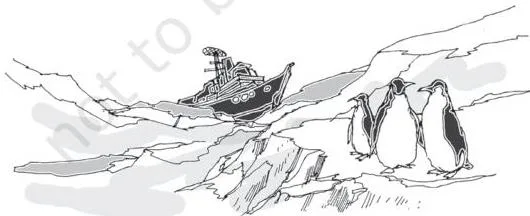
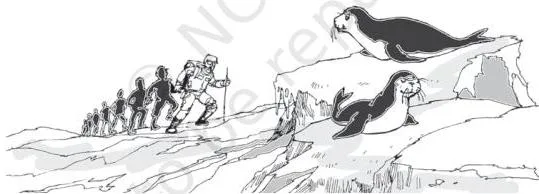
The chapter uses its two photographs to make you feel Antarctica’s scale before you believe its arguments. Both show a landscape almost empty of the marks a city-bred reader uses to measure the world.
The first photograph sits beside the description of the continent. It makes concrete the chapter’s two opening facts: Antarctica stores 90 per cent of the Earth’s total ice volumes, and it is bare of human markers — no trees, no billboards, no buildings.
Walking into that whiteness, the author says, is like walking into a giant ping-pong ball; you lose all earthly sense of perspective and time. For a “sun-worshipping South Indian”, two weeks there is chilling for the body and for the imagination alike.
The second photograph belongs with the Human impact section and shows why this extreme place is scientifically valuable. Antarctica’s simple ecosystem and lack of biodiversity mean there is little to mask cause and effect: if one small part of the web is damaged, the consequences show up fast across the whole system.
That is the thought that leads straight into the phytoplankton example and the chain that ends in the global carbon cycle. The picture makes the idea concrete: a landscape with so few species that a single change is quickly visible.
Terms the chapter expects you to know
The chapter names several scientific and geographical terms without stopping to define them. Here they are in plain words, in the order they matter.
| Term | What it means in this chapter |
|---|---|
| Gondwana | The giant amalgamated southern supercontinent that existed about 650 million years ago, centred roughly around present-day Antarctica. |
| Cordilleran folds | Folded mountain belts, named among the geological features a visitor to Antarctica must understand. |
| Pre-Cambrian granite shields | Very ancient granite rock masses, part of the continent’s geological record. |
| Drake Passage | The stretch of sea opened when South America drifted off towards North America. |
| Circumpolar current | The cold ocean current circling Antarctica that keeps it frigid, desolate and at the bottom of the world. |
| Ecospheres | The distinct biological zones the traveller crosses between Madras and Antarctica — at least as many as the checkpoints on the route. |
| Phytoplankton | Microscopic single-celled plants, “the grasses of the sea”, that photosynthesise and sustain the Southern Ocean’s food chain. |
| West Antarctic ice sheet | The ice mass whose possible total melting is one of the climate questions the chapter raises. |
| Akademik Shokalskiy | The Russian research vessel the author sails on for the expedition. |
The end-of-chapter questions, with pointers
The chapter closes with four questions under Reading with Insight. Each answer lives in a specific passage; the table tells you where and what a full answer needs.
| Question | Where the answer lies | One thing a full answer needs |
|---|---|---|
| “The world’s geological history is trapped in Antarctica.” How is the study of this region useful to us? | The Part of history section, especially the ice-core passage | The half-million-year-old carbon records, and what they let us reconstruct about where we have come from and where we could be heading |
| What are Geoff Green’s reasons for including high school students in the Students on Ice expedition? | The Human impact section, where the programme is introduced | Both halves: wealthy adult tourists could give back only in a limited way, while teenagers are the future generation of policy-makers — ready to absorb, learn and act |
| “Take care of the small things and the big things will take care of themselves.” What is the relevance of this statement in the context of the Antarctic environment? | The phytoplankton paragraph in the same section | The chain in order: ozone depletion affects photosynthesis in the plankton, which affects the marine animals and birds of the region, and finally the global carbon cycle |
| Why is Antarctica the place to go to, to understand the earth’s present, past and future? | The opening Before you read note and the human-impact argument | All three directions of time: the ice records the past, the pristine continent shows the present, the melting shapes the future |
Notice that three of the four questions ask you to connect one idea to its consequences. That connecting is the skill the whole chapter trains.
Common mistakes students make
One mistake explains most lost marks in this chapter: students treat a reflective travelogue as a report, so they list facts and miss the argument the facts support. The table names the specific traps.
| Mistake | Correct rule | How to check your answer |
|---|---|---|
| Calling Gondwana the single world-continent (as in Pangaea) | The chapter calls Gondwana a giant amalgamated southern supercontinent, centred roughly around present-day Antarctica | Does your sentence say “southern” and can you connect it to Antarctica — not to one global landmass? |
| Treating the ice cores as evidence of today’s pollution | They are half-million-year-old carbon records trapped in the layers of ice — an archive of past atmospheres, not recent emissions | Does your answer place the carbon records in the past, before human civilisation began? |
| Answering the phytoplankton question with only the moral (“take care of small things”) | The moral is the conclusion; the mechanism is the answer: ozone depletion → photosynthesis in the plankton → marine animals and birds → global carbon cycle | Does your answer name ozone, the plankton and the food chain in order? |
| Ignoring the narrator’s persona | Doshi is a “sun-worshipping South Indian”; the cold is chilling for her body and her imagination, which is why the white landscape feels like a giant ping-pong ball | Would your description of the cold make sense for a narrator who began the journey in Madras? |
What to watch in the exam
No one can promise which chapter will be tested, but the chapter itself tells you what answering it demands. The four Reading with Insight questions are its own practice set, and they all ask the same thing: take an idea from the text, connect it to another idea, and say why it matters.
Two habits separate a strong answer from a vague one:
- Name the point first. One sentence that answers the question directly, before any context.
- Anchor it in one vivid image from the text. The giant ping-pong ball, the seals like stray dogs under a banyan tree, the metre-thick ice over 180 metres of living salt water — explaining what a single image shows beats listing three facts.
Vistas questions are answered through short-answer and long-answer responses, and the shape this chapter rewards is a point, a text reference and a closing line of your own reasoning. Practise that shape on the four Reading with Insight questions and you have rehearsed exactly what this chapter can ask.
Revision summary
For the night before the exam, here is the chapter on one page:
- The journey — from Madras, 13.09 degrees north, across nine time zones, six checkpoints and three bodies of water; over 100 hours of travel by car, aeroplane and ship aboard the Akademik Shokalskiy. First emotion: relief; then wonder.
- The discovery — Gondwana, the southern supercontinent, existed 650 million years ago centred around Antarctica and thrived for 500 million years in a warm climate full of flora and fauna.
- The break-up — as the dinosaurs vanished, the landmass split; India jammed into Asia and raised the Himalayas, and the opening of the Drake Passage created the cold circumpolar current that froze Antarctica at the bottom of the world.
- The warning — human civilisation is only 12,000 years old, yet fossil-fuel burning has wrapped the planet in a blanket of carbon dioxide; retreating glaciers and collapsing ice shelves make the threat visible.
- The hope — Students on Ice, led by Canadian Geoff Green, brings high school students — the future generation of policy-makers — to Antarctica while they are still young enough to absorb, learn and act.
- The epiphany — walking on a metre-thick ice pack above 180 metres of living salt water near the Antarctic Circle, surrounded by Crabeater seals: everything connects.
- The closing line — “a lot can happen in a million years, but what a difference a day makes.” The title carries its own question: what difference can one day, one person, one small action make?
Where this chapter sits in the book
“Journey to the End of the Earth” is Chapter 3 of the Vistas anthology for Class 12, placed between two stories: “The Tiger King” before it and “The Rattrap” after it. If you are working through the book in order, the adjacent pages on this site cover those chapters and the wider Class 12 English set:
- The Tiger King (Chapter 2) — the chapter before this one
- The Rattrap (Chapter 4) — the chapter after this one
- All Class 12 English chapter notes
- All Class 12 notes across subjects
- The main CBSE notes index
Sources and data verification
This listing is maintained for the 2026-27 academic session using the NCERT textbook information available to us. NCERT remains the authority for confirming the latest edition.
This page describes Chapter 3 of the NCERT Class 12 English textbook Vistas, “Journey to the end of the Earth”, as published in the official NCERT edition available on ncert.nic.in.
- The section headings, questions and photographs described above are from that NCERT edition. This page covers this one chapter — not the other Vistas chapters, and not the CBSE syllabus beyond what the chapter itself contains.
- Textbook contents and the examinable syllabus are not always identical — check the current official CBSE syllabus for what is examinable.
- This page is maintained for the current academic session using the NCERT edition available to us.
- NCERT settles textbooks, editions and PDFs; CBSE settles the curriculum, syllabus and examinations.
Reference: NCERT Class 12 English (Vistas) textbook, chapter 3, official edition on ncert.nic.in.
FAQs
Why is Antarctica the place to go to, to understand the earth’s present, past and future?
Antarctica holds half-million-year-old carbon records in its ice cores, so its ice is an archive of the earth’s past atmosphere. It is also the only continent that has never sustained a human population, so it stays relatively pristine.
The visible retreat of its glaciers makes the present climate threat tangible. Past in the ice, present in the melting, future in the questions it raises — that is the chapter’s whole case.
What is the ‘parable of the phytoplankton’ in Journey to the End of the Earth?
Phytoplankton are microscopic single-celled plants — “the grasses of the sea” — that nourish and sustain the whole Southern Ocean food chain through photosynthesis. The parable is both a warning and a moral: further ozone depletion would damage the plankton, which would affect every marine animal and bird of the region and finally the global carbon cycle.
The big things depend on the small things, so take care of the small things and the big things will fall into place.
Who runs the Students on Ice programme and why does Geoff Green take high school students?
The programme is headed by Canadian Geoff Green and had been running for six years when the chapter was written. He grew tired of ferrying celebrities and retired, wealthy curiosity-seekers who could only “give” back in a limited way.
High school students are the future generation of policy-makers, at an age when they are ready to absorb, learn and, most importantly, act — and near the South Pole it is impossible not to be affected by what you see.
How does the author’s attitude change during the journey to Antarctica?
The author begins exhausted and out of place — a “sun-worshipping South Indian” after over 100 hours of travel, facing the coldest, driest, windiest continent in the world. Her first emotion on arrival is relief, then immediate wonder at the immensity.
Over two weeks the wonder becomes understanding: of Gondwana and India’s shared history, of the carbon blanket and climate change, and finally of interconnection — the walk on the ocean is nothing short of a revelation. The journey ends in hope, because of the teenagers who still have the idealism to save the world.
Explore Class 12 English Books
- Previous: The Tiger King
- Next: | The Rattrap
Class 12 English on LearnCBSE:
Related chapters:
- Prose
- Short stories
- The Third Level