
Indigo is Chapter 5 of the NCERT Class 12 English Flamingo textbook. It is an excerpt from Louis Fischer’s biography The Life of Mahatma Gandhi and tells how Gandhi, in 1917, took up the cause of indigo sharecroppers in Champaran, Bihar.
This page gives you the Indigo Class 12 chapter as an official PDF, then walks you through the episode — its people, its key ideas, its expressions and its questions. It is maintained for the current academic session.
Download the Class 12 English Indigo chapter PDF
You can download the Indigo Class 12 chapter PDF from the official NCERT Flamingo textbook page on ncert.nic.in — it is the same printed edition that this walkthrough cites page by page. The PDF holds the complete Flamingo book; Indigo and its exercises run from page 46 to page 55 of the print edition.
Keep the file open beside this page and follow the citations with your finger on the text.
| What the chapter holds | Count | Where it is used |
|---|---|---|
| Printed pages | 11 | |
| Figures with NCERT captions | 3 | |
| Exercise questions | not fully captured | our text of this chapter is incomplete; the printed book has more |
| In-text questions | 4 | |
| Official NCERT PDF | Download the chapter PDF | the chapter exactly as NCERT publishes it |
Indigo chapter at a glance
The table below lists what the printed chapter holds — its sections, its photographs and its exercises — so you can see the shape of the chapter before you open the PDF.
What the Indigo chapter is about
The chapter follows a single campaign from beginning to end. The numbered sequence below is the order the text tells it in, so you can retell the episode in your own words for the exercises.
- December 1916, Lucknow. Among 2,301 delegates at the annual Congress session, Rajkumar Shukla — an illiterate sharecropper from Champaran — asks Gandhi to come to his district. Gandhi has never heard of Champaran. (Flamingo p. 46)
- Shukla does not let go. He follows Gandhi to Cawnpore, to other engagements and to his ashram near Ahmedabad, until Gandhi fixes a date for Calcutta. (Flamingo p. 46)
- Calcutta and Patna. Shukla waits at the appointed spot in Calcutta; the two travel to Patna. The lawyer Rajendra Prasad is out of town, and the servants take Gandhi for a peasant — he is not allowed to draw water from the well. (Flamingo p. 46)
- Muzzafarpur, 15 April 1917. Professor J.B. Kripalani meets the midnight train with students; Gandhi stays two days with Professor Malkani, a government-school teacher — an act of courage in those days. Local lawyers brief him, and he chides them for taking big fees from sharecroppers. (Flamingo pp. 46-47)
- The indigo arrangement. Most arable land in Champaran belongs to English estates worked by Indian tenants. Under long-term contract, tenants must plant three twentieths (15 per cent) of their holdings with indigo and hand over the entire harvest as rent. (Flamingo p. 47)
- Synthetic indigo arrives. When the landlords learn that Germany has developed synthetic indigo, they make tenants sign agreements to pay compensation for release from the 15 per cent arrangement. Those who resist engage lawyers; the landlords hire thugs. The peasants who signed now want their money back. (Flamingo p. 48)
- Motihari and the notice to quit. The landlord association’s secretary and the Tirhut commissioner refuse Gandhi information and bully him. At Motihari a vast crowd greets him; when he sets out on an elephant to see a maltreated peasant, he is served a notice to quit Champaran. He signs the receipt and writes that he will disobey. A summons follows. (Flamingo p. 48)
- The court case. The town is “black with peasants.” Gandhi pleads guilty and reads his “conflict of duties” statement; he refuses bail. The magistrate releases him without bail and delays judgment. (Flamingo p. 49)
- The lawyers choose their side. Rajendra Prasad, Brij Kishor Babu and Maulana Mazharul Huq arrive from Bihar. When Gandhi asks what they will do if he goes to jail, they first admit they would go home; pressed on the sharecroppers’ injustice, they pledge to follow him into jail. “The battle of Champaran is won,” Gandhi exclaims. (Flamingo pp. 49-50)
- The case is dropped. The Lieutenant-Governor orders the case dropped. The chapter’s wording: “Civil disobedience had triumphed, the first time in modern India.” (Flamingo p. 50)
- Inquiry and settlement. A commission of inquiry is appointed, with Gandhi as the peasants’ sole representative. About ten thousand peasants give depositions. The planters agree to refunds; Gandhi asks 50 per cent and accepts 25 per cent, breaking the deadlock. (Flamingo pp. 50-51)
- A year in Champaran. The visit meant to last a few days occupies almost a year: schools in six villages, Kasturbai teaching cleanliness and sanitation, a volunteer doctor with three medicines. Gandhi refuses Charles Freer Andrews’s offer to stay — self-reliance comes before outside help. (Flamingo pp. 51-52)
Gandhi’s own verdict closes the episode: “What I did … was a very ordinary thing. I declared that the British could not order me about in my own country.” (Flamingo p. 52)
Key figures and events in the Champaran episode
These short entries fix who each person is and what they do in the chapter — enough to answer any “who” question without rereading.
| Person | Who they were | Part in the episode |
|---|---|---|
| Louis Fischer (1896-1970) | American journalist; served in the British Army 1918-1920; wrote for The New York Times and The Saturday Review; taught at Princeton | Author of The Life of Mahatma Gandhi; heard the account from Gandhi at Sevagram in 1942 |
| Rajkumar Shukla | Illiterate sharecropper from Champaran | Persuaded Gandhi at the 1916 Lucknow session; followed him for weeks until Gandhi fixed a date |
| Rajendra Prasad | Patna lawyer; later President of the Congress party and of India | Absent when Gandhi reached his house; later pledged to follow Gandhi into jail |
| Professor J.B. Kripalani | Teacher at the Arts College, Muzzafarpur | Received Gandhi’s telegram and met him at midnight, 15 April 1917, with students |
| Professor Malkani | Teacher in a government school | Gave Gandhi shelter for two days; extraordinary for a government servant to “harbour” him |
| Brij Kishor Babu and Maulana Mazharul Huq | Prominent Bihar lawyers | Arrived to advise Gandhi; joined the lawyers ready for prison |
| Charles Freer Andrews | English pacifist and follower of Gandhi | Wanted to stay and help; Gandhi refused and taught self-reliance |
| Sir Edward Gait | Lieutenant-Governor of the province | Ordered the case dropped; later appointed the commission of inquiry |
| Reverend J.Z. Hodge | British missionary in Champaran | Recorded the settlement: planters offered 25 per cent, Gandhi accepted |
| Devadas and Kasturbai Gandhi | Gandhi’s youngest son and his wife | Joined the village work; Kasturbai taught the ashram rules on personal cleanliness and community sanitation |
Key concepts in the Indigo Class 12 chapter: sharecropping, the crop and Gandhi’s method
The chapter’s questions assume you understand three interlocking ideas: the economic system the peasants lived under, the crop at the centre of it, and the method Gandhi used against it.
What sharecropping meant in Champaran
Sharecropping is an arrangement in which a tenant works land he does not own and hands over the crop to the owner. In Champaran the owners were English estates, the workers were Indian tenants, and the crop that mattered was indigo.
The arrangement was enforced by long-term contract: a tenant had to plant indigo on 15 per cent of his holding and surrender the entire harvest as rent. (Flamingo p. 47)
Separating the 15 per cent rule from the 25 per cent refund
The two numbers in this chapter are the easiest thing to mix up, and they refer to different things. The table separates them.
| Point | 15 per cent arrangement | 25 per cent refund |
|---|---|---|
| What it involved | Tenants planted indigo on 15 per cent (three twentieths) of their holdings and surrendered the entire harvest as rent | Planters refunded a quarter of the money extorted through compensation agreements |
| Who set it | British landlords, by long-term contract (Flamingo p. 47) | Offered by the planters’ representative; accepted by Gandhi (Flamingo p. 51) |
| Why the number matters | The injustice itself — forced planting and confiscation of the crop | Symbolic — landlords surrendered part of their money and prestige; peasants learned courage |
How synthetic indigo changed the arrangement
When Germany developed synthetic indigo, the landlords stopped needing the peasants’ natural crop. They made tenants sign agreements to pay compensation for release from the 15 per cent rule. Some signed willingly because the rule was irksome; others engaged lawyers and faced hired thugs. When the news reached the illiterate peasants, they wanted their money back. (Flamingo p. 48)
Gandhi’s method: facts, disobedience, negotiation
Gandhi’s approach runs through the episode in four moves:
- Facts before action: he visits the landlord association’s secretary, the Tirhut commissioner, then Motihari; the later inquiry records about ten thousand depositions.
- Open disobedience: he signs the receipt for the notice to quit, writes that he will disobey, pleads guilty in court and refuses bail.
- Non-violent pressure: the courthouse crowd is peaceful, and Gandhi helps the officials regulate it — their might is challenged without violence.
- Negotiation without surrender: he asks 50 per cent and accepts 25 per cent, but only because the refund made the planters surrender part of their money and prestige.
- Freedom from fear as the goal: to the lawyers he says law courts are useless for crushed, fear-stricken peasants; “the real relief for them is to be free from fear.” (Flamingo p. 47)
Self-reliance and the common cause
Gandhi refuses Andrews’s help because the cause is just and the Indians must rely on themselves; Rajendra Prasad calls it “a lesson in self-reliance.” The chapter’s closing line on the idea: “Self-reliance, Indian independence and help to sharecroppers were all bound together.”
(Flamingo p. 52) The chapter’s own theme note sums the episode up as leadership shown by Gandhi to secure justice for oppressed people through convincing argumentation and negotiation; its sub-theme is the contributions made by anonymous Indians — the peasants, the volunteers and the ordinary people who carried the movement. (Flamingo p. 54)
Figures in the chapter: what the pictures show
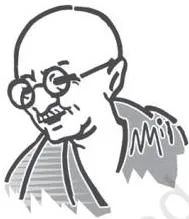
A picture walkthrough is worth doing because each of the three photographs in the chapter carries part of the argument — none of them is decoration.
Louis Fischer, the narrator

This is the man telling the story. Fischer was an American journalist who served in the British Army from 1918 to 1920, wrote for The New York Times and The Saturday Review, and later taught at Princeton University.
His book The Life of Mahatma Gandhi was reviewed by the Times Educational Supplement as one of the best books written on Gandhi. The portrait matters because it explains the chapter’s documentary feel: reported biography, with the central account coming from Gandhi himself at Sevagram in 1942. (Flamingo, About the author)
The economic root of the conflict

The caption of this photograph is the chapter’s thesis in one sentence: the land belonged to Englishmen and was worked by Indian tenants. Everything else — the 15 per cent planting rule, the compensation agreements, the court case — follows from that ownership structure. Read the picture as evidence, not scenery.
Champaran becomes a family mission
The picture records a shift in the chapter: the campaign was no longer only about the refund. Gandhi appealed for teachers; Mahadev Desai and Narhari Parikh and their wives came, then volunteers from Bombay, Poona and farther away.
Devadas’s arrival from the ashram, with Mrs. Gandhi, shows the work becoming a family mission. Kasturbai taught the ashram rules on personal cleanliness and community sanitation, and primary schools opened in six villages. (Flamingo p. 51)
Expressions and words you need to know
The chapter opens with a short list of expressions it asks you to infer from context, and later asks for legal vocabulary. Both are explained here.
Four expressions from the opening notice
- urge the departure — press for the British to leave India. Gandhi tells Fischer: “I decided to urge the departure of the British,” meaning he resolved to push for Britain’s withdrawal. (Flamingo p. 46)
- conflict of duties — two obligations pulling against each other. In court, Gandhi says he faces a conflict between not setting a bad example as a lawbreaker and rendering the humanitarian and national service he came for; conscience is the higher law. (Flamingo p. 49)
- harbour a man like me — give shelter to a person like Gandhi. He says it of Professor Malkani, a government-school teacher: it was extraordinary then for a government professor to shelter a home-rule advocate, since Indians in smaller localities feared showing sympathy. (Flamingo p. 46)
- seek a prop — look for outside support. Gandhi accuses the lawyers of wanting to lean on Andrews because he is English: “You should not seek a prop in Mr. Andrews because he happens to be an Englishman.” (Flamingo p. 52)
Legal-procedure words used in the chapter
The Working with words exercise asks you to list words related to legal procedures, starting with the examples the chapter itself uses. These appear in the text.
- deposition
- summons
- notice to quit
- prosecutor
- magistrate
- judge
- trial
- court
- bail
- sentence
- penalty
- plead guilty
- commission of inquiry
The exercise then asks for other words you know that fit the category. Appeal, verdict, cross-examination and acquittal would all fit, though they do not appear in this chapter.
Common mistakes students make in Indigo
These are the factual mix-ups the episode reliably produces. The chapter’s own wording corrects each one.
| Mistake | Correct rule | How to check your answer |
|---|---|---|
| “Gandhi was illiterate” | Shukla was illiterate; Gandhi was the educated lawyer and writer | Re-read: “He was illiterate but resolute” refers to Rajkumar Shukla (Flamingo p. 46) |
| Mixing up 15 per cent with 25 per cent | 15 per cent was the land share planted with indigo; 25 per cent was the refund of compensation money | Ask: land or money? If it is land, it is 15; if it is money paid back, it is 25 |
| “The judge acquitted Gandhi” | Gandhi pleaded guilty and asked for the penalty; the Lieutenant-Governor ordered the case dropped | The chapter says the magistrate informed Gandhi that the case had been dropped on orders from above (Flamingo p. 50) |
| “Gandhi demanded 25 per cent” | He asked for 50 per cent; the planters offered 25 and he accepted | Hodge’s account: the planters’ representative offered 25 and “to his amazement” Gandhi accepted (Flamingo p. 51) |
| “The first civil disobedience in Indian history” | The chapter says the first time “in modern India” | Quote exactly: “Civil disobedience had triumphed, the first time in modern India” (Flamingo p. 50) |
| “The legal victory freed the peasants” | Gandhi valued freedom from fear above legal justice | His words to the lawyers: the real relief is to be free from fear (Flamingo p. 47) |
Exam notes: which questions the chapter expects you to answer
The chapter’s own questions — the four “Think as you read” blocks and the end exercises on pages 46-53 — group into four skills. Decide which skill you are weak at, and answer only those questions.
Comprehension: getting the facts straight
- “Strike out what is not true”: Shukla was a sharecropper, poor and illiterate — not a politician, not a landlord, not physically strong.
- List the places Gandhi visited from his first meeting with Shukla to Champaran: Lucknow, Cawnpore, the Ahmedabad ashram, Calcutta, Patna, Muzzafarpur, Motihari.
- Explain the rent arrangement and the effect of synthetic indigo: landlords wanted compensation instead of the indigo crop, and natural indigo prices would fall against the synthetic product.
Inference: reading between the lines
- Why Shukla is “resolute”: he followed Gandhi for weeks until a date was fixed.
- Why the servants took Gandhi for another peasant: he arrived with Shukla, looked poor and unnamed, and the household’s caste fear kept him from the well.
- How Gandhi influenced the lawyers: a stranger’s willingness to go to jail shamed settled, prosperous lawyers into not deserting the peasants.
Judgement: giving a reasoned opinion
- Why Champaran was a turning point in Gandhi’s life: his own words — the British could not order him about in his own country.
- Why 25 per cent was enough: the symbolic surrender of money and prestige mattered more than the amount.
- Discussion prompts: “Freedom from fear is more important than legal justice for the poor” and the qualities of a good leader.
Language and words
- Direct speech: the chapter quotes Gandhi, Shukla, Andrews and others directly. The quotations give the narration immediacy and keep the participants’ own voices and words.
- Comma use: when the subordinate clause comes before the main clause, a comma separates them (sentences a and c); when it follows, no comma is used (sentence b).
- Legal vocabulary: build the list from Working with words, using the words listed in the previous section.
For any reasoning answer, state your point, add one specific instance from the chapter (a person, a place or a line), then explain the connection — that structure is what a full answer needs.
The chapter’s “Things to do” activity — researching a current issue such as the Bhopal Gas Tragedy or the Narmada Dam Project — is practice in the same method, rather than a comprehension exercise.
Indigo revision summary: the episode in ten lines
The whole arc for the night before:
- December 1916, Lucknow: Shukla, an illiterate sharecropper, asks Gandhi to visit Champaran and does not let go.
- Patna: Rajendra Prasad is absent; the servants mistake Gandhi for a peasant and bar him from the well.
- Muzzafarpur, 15 April 1917: Kripalani and students meet the train; Professor Malkani gives shelter; lawyers’ fees are condemned.
- The system: English estates, Indian tenants, 15 per cent of holdings forced into indigo, the whole crop surrendered as rent.
- Synthetic indigo from Germany: landlords demand compensation; thugs silence resisters.
- Motihari: the notice to quit is disobeyed; the “conflict of duties” statement is read in court; bail is refused.
- The lawyers pledge to follow Gandhi to jail; “The battle of Champaran is won.”
- The Lieutenant-Governor drops the case — civil disobedience triumphs, the first time in modern India.
- The commission of inquiry hears about ten thousand depositions; Gandhi asks 50 per cent and accepts 25, forcing the planters to surrender money and prestige.
- Village work follows: six schools, Kasturbai on sanitation, three medicines, Devadas and Mrs. Gandhi arriving from the ashram.
- Andrews is refused for self-reliance — “Self-reliance, Indian independence and help to sharecroppers were all bound together.”
Theme: leadership through convincing argumentation and negotiation. Sub-theme: the contributions of anonymous Indians.
Related resources
This listing is maintained for the 2026-27 academic session using the NCERT textbook information available to us. NCERT remains the authority for confirming the latest edition.
If you are working through the Flamingo prose section, the Class 12 English notes page collects the chapters in one place; the notes on Poets and Pancakes and, from Vistas, The Enemy are the natural next steps after this chapter. For other subjects and classes, use the Class 12 notes hub or the main CBSE notes index.
Sources and data verification
- The chapter described here is “Indigo”, Chapter 5 of the NCERT Class 12 English Flamingo textbook — an excerpt from Louis Fischer’s The Life of Mahatma Gandhi.
- This page describes the current NCERT edition of the chapter as published on ncert.nic.in, with page numbers following the printed Flamingo text (chapter pages 46-55).
- NCERT settles the textbook, its editions and its official PDFs; CBSE settles the curriculum and examinations. Textbook contents and the examinable syllabus are not always identical — check the current official syllabus for what is examinable.
- This page covers only the NCERT Flamingo chapter; it does not cover other English textbooks or the supplementary reader.
Frequently asked questions about Indigo Class 12
What is the main theme of the Indigo Class 12 chapter?
The chapter’s central theme is leadership: Gandhi secures justice for oppressed people through convincing argumentation and negotiation, not confrontation. Its sub-theme is the contribution of anonymous Indians — the peasants who gathered at the courthouse, the ten thousand who gave depositions, and the unnamed ordinary people who supported the movement. (Flamingo p. 54)
Why did Gandhi accept only a 25 per cent refund from the planters?
Because the amount mattered less than the principle. Gandhi asked for 50 per cent; when the planters’ representative offered 25, Gandhi took him at his word and broke the deadlock. The refund forced the landlords to surrender part of their money and, with it, part of their prestige — the peasant saw that he had rights and defenders, and learned courage. (Flamingo p. 51)
Who was Rajkumar Shukla and why did he follow Gandhi?
Rajkumar Shukla was an illiterate sharecropper from Champaran, a district Gandhi had never heard of. He came to the December 1916 Congress session in Lucknow, asked Gandhi to visit his district, and followed him to Cawnpore, other engagements and his Ahmedabad ashram for weeks until Gandhi fixed a date. That persistence is why the chapter calls him “resolute.” (Flamingo p. 46)
Why did Gandhi refuse Charles Freer Andrews’s help in Champaran?
Gandhi refused because he wanted the Indians to win the battle by relying on themselves. He told the lawyers that leaning on an Englishman showed the weakness of their hearts — the cause was just, and they should not seek a prop in Andrews. Rajendra Prasad recorded it as a lesson in self-reliance. (Flamingo p. 52)
What does conflict of duties mean in the Indigo chapter?
It is the dilemma Gandhi put to the Motihari court. As a lawbreaker he had a duty not to set a bad example; as a worker for the people he had a duty to render the humanitarian and national service he had come for.
He said he disobeyed the order to leave “in obedience to the higher law of our being, the voice of conscience.” (Flamingo p. 49)
Reference: NCERT Class 12 English Flamingo textbook, Chapter 5, official edition on ncert.nic.in.
Explore Class 12 English Books
Class 12 English on LearnCBSE:
Related chapters:
- Prose
- Short stories
- The Third Level