On the Face of It is Chapter 5 of the NCERT Class 12 English Vistas textbook — a play in three scenes that runs 15 printed pages. It follows Derry, a fourteen-year-old whose face was burned by acid, and Mr Lamb, an old man with a tin leg, who meet in a garden.
The official NCERT On the Face of It Class 12 PDF is right here, with a scene-by-scene guide to what happens and what the play means.
Download the On the Face of It Class 12 PDF
The official file contains the complete three-scene play with its stage directions, the “Before you read” prompt and the Reading with Insight questions, exactly as printed in the NCERT Vistas textbook — download the On the Face of It Class 12 PDF to read the full dialogue in your own copy.
| What the chapter holds | Count | Where it is used |
|---|---|---|
| Printed pages | 15 | |
| Figures with NCERT captions | 3 | |
| Official NCERT PDF | Download the chapter PDF | the chapter exactly as NCERT publishes it |
Chapter at a glance: a three-scene play
This section maps the file above: what kind of text it is, how it is divided, and what it ends with. Read it before the play so you know where the scenes are going.
The chapter is drama, not prose. Nearly all of it is dialogue between the two characters, and the action is carried by the stage directions — bracketed instructions such as [The door slams. Derry runs, panting.] that tell you where the scene is and what is happening.
The chapter file runs 15 pages and is divided like this:
| Part | What it contains |
|---|---|
| Before you read | A one-paragraph prompt: an old man and a small boy meet in the former’s garden; the boy is withdrawn and defiant; what is the bond that unites the two? |
| Scene One | Mr Lamb’s garden. The meeting — the long scene that is the heart of the play: the scar, the weeds, the bees, the open gate. |
| Scene Two | Derry’s house. The argument with his mother, who forbids him to go back. |
| Scene Three | Mr Lamb’s garden. The return, the fall, and the ending the stage directions carry. |
| Reading with Insight | The end-of-chapter questions on what draws Derry to Mr Lamb, Mr Lamb’s loneliness, alienation, and Derry’s future. |
| How about… | A closing speaking-and-writing activity: using your imagination to suggest another ending to the story. |
The story of the play, scene by scene
This section retells the plot in plain words so you can follow the play on a first read and keep the sequence straight when you revise. The scenes have to be learnt in order, because the whole point of the play is that Derry changes through them.
Scene One: the boy in Mr Lamb’s garden
Derry climbs over the garden wall even though the gate stands open; he wanted an empty place, and he treats this stranger with suspicion. Mr Lamb calls out “Mind the apples!” and warns him about the crab apples and windfalls in the long grass.
The conversation that follows is Derry testing whether this old man will flinch at his face the way everyone else does.
- The scar named: Mr Lamb guesses “burned in a fire”; Derry corrects him — “Not in a fire. I got acid all down that side of my face and it burned it all away.”
- The mirror confession: “When I look in the mirror… I’m afraid of me.”
- The weeds speech: “Some call them weeds… It’s all life… growing. Same as you and me.”
- The tin leg: “Real one got blown off, years back”; the children’s nickname “Lamey-Lamb” and Mr Lamb’s answer, “Doesn’t trouble me.”
- The bees: “Some hear bees and they say, bees buzz… I hear them singing.”
- Hate as acid: “That’d do you more harm than any bottle of acid. Acid only burns your face.”
- The locked-room story, at which Derry laughs “a lot”.
- The promise: “you could get on better than all the rest” — the way, Mr Lamb says, he does.
- The challenge: Derry insists nobody ever comes — “You’re here all by yourself and miserable.”
Mr Lamb’s house has no curtains — “Shutting things out, shutting things in” — and his gate is “always open”. When Mr Lamb says friends come by the hundreds, Derry will not believe it. As Derry runs off shouting “I’ll come back”, Mr Lamb’s aside shows the disappointment beneath the cheer: “They never do, though. Not them. Never do come back.”
Scene Two: Derry against his mother
At home the mother has been warned about the old man and forbids any return. Derry answers with the play’s key line: “Bees singing. Him talking.” She tells him he is “best off here”; he answers that he hates it. The scene turns when Derry separates his face from his life: “It’s got nothing to do with my face…
It’s what I think and feel and what I want to see and find out and hear.”
He leaves with the line that predicts Scene Three: “if I don’t go back there, I’ll never go anywhere in this world again.” The door slams, and he runs, panting, “And I want the world… I want it…”
Note the irony the play builds: the mother’s commands come from love and fear — she forgives him before he apologises — but Derry experiences them as a cage. The play does not make her a villain. It shows two kinds of care colliding.
Scene Three: the return
The stage directions carry the whole event. The sounds of a branch shifting and apples thumping down, Mr Lamb’s voice on the ladder — “Steady… that’s… got it” — then “A creak. A crash. The ladder falls back, Mr Lamb with it… Then silence.” The death is not stated in words; the silence says it.
Derry opens the gate, still panting, calling out “You see, you see! I came back.” He stops dead: “Mr Lamb, Mr… You’ve…” He kneels and repeats the promise he made: “I came back. Lamey-Lamb. I did… come back.” Then he weeps. Mr Lamb never speaks again.
The ending is precise in what it does: Derry did the one thing the old man said no one ever does — he came back — and he arrived too late. The playwright shows the change and the loss in the same moment.
The play’s arc in one table, with the change that matters:
| Scene | What happens | How Derry changes |
|---|---|---|
| Scene One | Derry climbs into a stranger’s garden, expecting to be stared at and feared. Mr Lamb talks to him without flinching. | Derry stops defending; admits “I like it here”; leaves promising to come back. |
| Scene Two | His mother forbids him to return. | He chooses the garden over obedience: “if I don’t go back there, I’ll never go anywhere in this world again.” |
| Scene Three | He returns and finds Mr Lamb dead after the fall. | He keeps his promise — “I did… come back” — change made real, then grief. |
Key concepts: what the play is really about
This section collects the ideas you will write about. For a play, every theme must be argued from the dialogue, so each theme below carries a short quote you can use as evidence.
| Theme | What the play shows | Evidence |
|---|---|---|
| Appearance versus reality | Judging by looks is the title in action; Mr Lamb keeps insisting the difference between people is not in the face. | “It’s all relative. Beauty and the beast.” |
| Alienation hurts more than the injury | Other people’s reactions — stares, whispers, pity — wound Derry more than the acid did. | “That’s a face only a mother could love” at the bus stop; “People are afraid of me.” |
| Hatred burns the hater | Hate, aimed inward or outward, damages the person who feels it. | “That’d do you more harm than any bottle of acid.” |
| Being seen as ordinary | Mr Lamb neither flinches nor pities; Derry is simply a boy who came into the garden. | “I’ve not moved.” |
| Listening and looking | The play is full of ways of paying attention: bees that sing, weeds that are life. | “Watching. Listening. Thinking.” |
| Risk and the open gate | Meeting people means risking rejection; keeping the gate open is Mr Lamb’s answer. | “You’d have to take the risk. So would they.” |
Four objects in the play work as symbols — things that carry meaning beyond themselves. Learn each one with its line:
| Object | What it stands for | The line that anchors it |
|---|---|---|
| The open gate | Welcome and risk: anyone may come in. Derry chose the wall instead. | “The gate’s always open. All welcome.” |
| The missing curtains | Openness — refusing to shut the world out or be shut in. | “I’m not fond of curtains. Shutting things out, shutting things in.” |
| The weeds | One person’s weed is another’s flower; all growing things are life. | “It’s all life… growing. Same as you and me.” |
| The crab apples | Not much to look at on the tree, but “magic fruit” once picked and made into jelly — value is made, not given. | “That’s magic fruit… It’s best picked and made into jelly.” |
Figure walkthrough: reading the play’s three illustrations
This section goes through the three NCERT illustrations in the chapter. A play’s pictures sit at its key beats, so each one marks a moment worth remembering in an answer.
The opening illustration: Mr Lamb’s garden
The first illustration accompanies the opening stage direction of Scene One. The caption is itself a sound cue: the play begins by asking us to hear the garden before anyone speaks. That act of listening sets up the listening theme — the bees that hum until they “sing”, the boy who says he likes to “listen and look”.
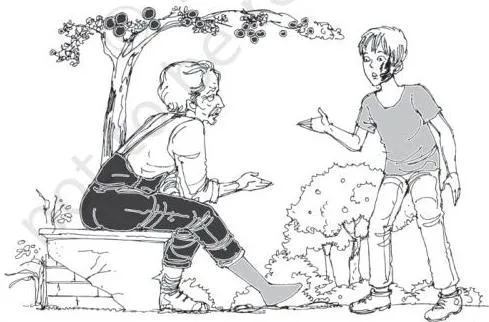
The illustration beside “I should say… to look at it…”
This figure marks the moment the cause of Derry’s scar is first named. Mr Lamb is the first adult to say the thing everyone else pretends is not there. He guesses wrong — “burned in a fire” — and Derry’s correction gives the play its factual centre: “Not in a fire.
I got acid all down that side of my face and it burned it all away.” The illustration fixes the moment when pretending stops and honesty begins.
The illustration beside “I’m not fond of curtains”
This figure anchors Mr Lamb’s most important metaphor. The line continues, “Shutting things out, shutting things in. I like the light and the darkness, and the windows open, to hear the wind.” Derry answers, “I like that” — the first thing the two agree on.
The open gate and the curtainless windows carry the same idea: Mr Lamb refuses to shut the world out, and he refuses to shut himself in. His house is the opposite of Derry’s locked room and of the mother’s “You’re best off here.”
Definitions: words to know before you read
This section gives the vocabulary that makes the dialogue clear on a first read. The meanings are the ones the play’s context supports.
| Word | Meaning in this play |
|---|---|
| withdrawn | Shut off from other people, not joining in — the “Before you read” prompt’s word for Derry. |
| defiant | Openly refusing to obey or accept — the prompt’s other word for Derry. |
| crab apples | Small, sour apples; Mr Lamb’s tree is full of them in September. |
| windfalls | Apples that have fallen to the ground on their own; Derry could trip on them. |
| scrump | A dialect word for stealing apples, from Mr Lamb’s line about the young lads who “scrump the apples”. |
| tin leg | An artificial leg, here literally of tin: “Real one got blown off, years back.” |
| daft | Foolish, crazy. Derry calls Mr Lamb “daft…crazy”, and Mr Lamb turns it into a “good excuse not to come back”. |
| seclusion | Being shut away from other people — the Reading with Insight question’s word for Derry’s old life. |
| alienation | The feeling of being cut off and separate from others — the play’s central wound for Derry. |
Common mistakes students make with this chapter
This section names the errors before you make them, with the correction from the text. In a play, the fix is usually one line away.
| The mistake | What the play actually shows | How to check |
|---|---|---|
| “Derry was burned in a fire.” | Derry’s own correction: “Not in a fire. I got acid all down that side of my face and it burned it all away.” | Quote the line that contains the word acid. |
| “Mr Lamb is a lonely man with no friends.” | He claims “Hundreds” of friends and keeps the gate open, with toffee and books ready. His loneliness shows only in the aside at the end of Scene One. | Give both the claims and the aside, or the answer is one-sided. |
| “The ending is ambiguous; maybe Derry saves him.” | The stage directions are explicit: the crash, the branch swishing back, silence, then Derry’s weeping. Mr Lamb has no further lines. | Read the stage directions as part of the text. |
| “Derry’s mother is cruel.” | She is afraid and overprotective — “you’re not to go back there” — and she forgives him. Derry experiences her care as control. | Look for her motive before judging her. |
| Crediting Mr Lamb’s lines to Derry. | “You could get on better than all the rest” and “That’d do you more harm than any bottle of acid” are spoken by Mr Lamb. | Write the speaker’s name before every quote. |
One general rule: because this is a play, stage directions are part of the text. Lines like “[The door slams]” and “Then silence” are evidence you can use in an answer.
Exam notes: answering questions on this play
This section shows how to turn the chapter’s Reading with Insight questions into full answers and how to build a character sketch. The approach works for any question the play sets — it is a method, not a list of predicted questions. Also remember that textbook contents and the examinable syllabus are not always identical; check the current official CBSE syllabus.
| Question | Where to find your evidence | What a full answer needs |
|---|---|---|
| 1. What draws Derry towards Mr Lamb in spite of himself? | Scene One: Mr Lamb does not flinch or turn away; he names the burn and moves on; the weeds speech; “People are never just nothing”; Derry’s “I like it here”. | The “in spite of himself” — Derry arrives suspicious and leaves promising to return. |
| 2. Where does Mr Lamb display loneliness and disappointment, and how does he fight it? | End of Scene One: the aside after Derry runs off. Against it: the open gate, toffee, books, bees, “I like to learn”. | Both halves of the question — the display of loneliness and the ways he overcomes it. |
| 3. Behaviour a person with a disability expects from others. | Scene One: Derry’s complaints about stares, whispers and pretence; the bus-stop line; Mr Lamb’s directness; the mother’s kiss “on the other side of my face”. | The worked answer below, argued from the dialogue. |
| 4. Will Derry get back to his old seclusion? | Scene Two: “if I don’t go back there, I’ll never go anywhere in this world again”; Scene Three: he actually returns. | Weigh the change against the grief, and quote the return. |
A worked answer: alienation (Reading with Insight question 3)
Here is one way a full answer to question 3 could be built. The question argues that the sense of alienation felt by a person with disabilities often hurts more than the physical impairment itself.
Derry does not ask others to pretend the scar is not there; he asks them to stop flinching and start speaking. What he cannot bear is the pretence — people who behave as though “it isn’t true and isn’t there”, who change the subject, or who glance and whisper.
The remark he overhears at a bus stop, “That’s a face only a mother could love”, wounds him more than the burn itself, because it comes from a stranger’s reaction to his appearance.
Against that, Mr Lamb offers the behaviour Derry actually wants: he asks the question directly, hears the answer, and then treats the boy as a visitor like any other — “I’ve not moved.” The full answer should conclude that alienation is caused by other people’s responses, and that Mr Lamb’s responses are the proof those responses can change.
Character sketches: Mr Lamb and Derry
A character sketch of either figure should open with the character’s role in the play, give two or three short quotes with scene references, and close with what the character does for the play’s theme.
- Mr Lamb — role: the old man who refuses to judge by appearance. Quotes: “I’m not fond of curtains” (Scene One), “It’s all life… growing. Same as you and me” (Scene One), “I’ve not moved” (Scene One, his answer when Derry warns that other friends would leave). Close on his function: he is the play’s proof that openness is possible, and his death is what makes Derry’s return tragic.
- Derry — role: the boy whose face hides his person. Quotes: “People are afraid of me” (Scene One), “When I look in the mirror… I’m afraid of me” (Scene One), “if I don’t go back there, I’ll never go anywhere in this world again” (Scene Two). Close on his arc: from self-hatred to choice, from climbing the wall to walking through the gate.
The two characters mirror each other — each has a damaged body, and each handles other people differently:
| Derry | Mr Lamb | |
|---|---|---|
| His injury | The acid-scarred face — visible to everyone. | The tin leg — “Real one got blown off, years back.” |
| How he sees it | “When I look in the mirror… I’m afraid of me.” | “Doesn’t trouble me” — the children’s game of “Lamey-Lamb” does not wound him. |
| Response to others | Expects stares, hears whispers, withdraws. | Keeps the gate open, makes toffee, welcomes anyone. |
| What changes | Chooses to return — “I did… come back.” | His death is the cost of Derry’s change. |
The “How about…” activity: writing another ending
This section explains the chapter’s closing task, which is a speaking-and-writing prompt rather than an exam question.
The prompt is one line: “using your imagination to suggest another ending to the above story.” Three directions that stay true to the play:
- Derry arrives while Mr Lamb is still on the ladder, and helps him down — the crab apples get picked together.
- Derry finds Mr Lamb alive but injured, and runs the three miles home for help.
- Years later, Derry keeps the garden himself — gate open, no curtains.
Whatever ending you choose, it should respect Derry’s change: the point of the play is that he came back. An ending that ignores the return misses the story.
The play in one page: a quick recap
This section is the night-before condensation. The chapter itself has no printed summary, so this is a plain recap of the arc, not a quote from the book.
- Derry climbs into a garden because an empty place is the only place he feels safe. He is fourteen, and acid “ate my face up”; strangers stare, whisper, and are “afraid of me”.
- Mr Lamb, old with a tin leg, does none of that. Weeds and flowers are both “all life”, bees are “singing”, the gate is “always open”, and curtains only “shut things out, shut things in”.
- The mother means love but speaks control: “You’re best off here.” Derry answers with the play’s hinge line — “if I don’t go back there, I’ll never go anywhere in this world again.”
- Scene Three: the crash, the silence. Derry runs through the open gate calling “I came back”, kneels beside the fallen old man, and weeps.
Remember the two lines that carry the whole play: Derry’s “When I look in the mirror… I’m afraid of me”, and Mr Lamb’s “That’d do you more harm than any bottle of acid. Acid only burns your face.”
Related resources
This listing is maintained for the 2026-27 academic session using the NCERT textbook information available to us. NCERT remains the authority for confirming the latest edition.
This section links the places this chapter sits in. For the rest of the book, start on the Class 12 English Vistas book page. For everything in Class 12, use the Class 12 hub, or the CBSE notes home page for the full set of subjects.
The Vistas chapter just before this one is The Enemy, and the Class 12 English notes also cover the Flamingo chapter Poets and Pancakes.
Sources and data verification
- This page describes NCERT Class 12 English Vistas, Chapter 5, “On the Face of It”, official edition on ncert.nic.in. All quotations are from that text.
- It covers this chapter only, not the other Vistas chapters in detail.
- The page is maintained for the current academic session using the NCERT information available to us; for what is examinable, check the current official CBSE syllabus.
- NCERT settles textbooks, editions and PDFs; CBSE settles curriculum, syllabus and examinations. Every official textbook chapter can be browsed at the NCERT textbook portal.
Reference: NCERT Class 12 English Vistas textbook, chapter 5, official edition on ncert.nic.in.
FAQ
Direct answers to the questions students search about this chapter. Answers come first, evidence after.
What is the summary of On the Face of It Class 12?
Derry, fourteen and scarred by acid, meets Mr Lamb, an old man with a tin leg, in Mr Lamb’s garden. Mr Lamb talks to him without flinching, and Derry — wounded by other people’s stares — is drawn in.
His mother forbids him to go back, so he defies her and returns, only to find Mr Lamb has fallen from the ladder and died. The play is about how other people’s reactions wound more than the injury itself, and how Derry changes from hiding to choosing the world.
What happened to Derry’s face in On the Face of It?
Acid burned it. Derry’s correction to Mr Lamb’s guess is exact: “Not in a fire. I got acid all down that side of my face and it burned it all away. It ate my face up.”
The scar will not change — “I’ll still only have half a face” — and strangers react to it with stares, whispers and pity, which hurts Derry more than the burn does.
Does Mr Lamb die at the end of On the Face of It?
Yes. The play never states it in words, but the stage directions carry the event: the ladder “falls back, Mr Lamb with it… Then silence.” Derry runs in, kneels beside him, says “I came back. Lamey-Lamb. I did… come back,” and weeps. Mr Lamb has no further lines. In a play, the directions are part of the text.
Why does Mr Lamb keep his gate open and his windows without curtains?
Because he refuses to shut the world out or shut himself in. His own explanation is “I’m not fond of curtains. Shutting things out, shutting things in. I like the light and the darkness, and the windows open, to hear the wind.”
The open gate makes the same point — “All welcome” — and both stand against Derry’s mother, who wants to shut Derry in.
What draws Derry towards Mr Lamb in the play?
Mr Lamb treats him as an ordinary person. He does not flinch, stare or pretend the scar is invisible; he names the burn, hears the answer, and moves on to weeds, bees and crab apples. He tells Derry “I’ve not moved” when Derry warns that other friends would leave, and “People are never just nothing.”
Derry, who expects fear, finds an adult who is not afraid — and admits “I like it here.”
Why is the play called On the Face of It?
“On the face of it” means judging something by how it looks. The title points at both characters: everyone judges Derry by his face, and Derry judges himself by it. The play’s argument is that appearance is not the truth — Mr Lamb, who “should say… to look at it”, looks and stays.
The title is the whole theme in four words.
Explore Class 12 English Books
- Previous: The Enemy
- Next: Poets and Pancakes
Class 12 English on LearnCBSE:
Related chapters:
- Prose
- Short stories
- The Third Level