
Here is the NCERT Class 12 English A Thing of Beauty chapter PDF — Chapter 11 of the Flamingo textbook, where John Keats’s poem “A Thing of Beauty” appears.
The chapter is only two printed pages, and the official file below holds the whole of it: the note on the poet, the prompt questions, the poem itself and the closing “Think it out” block. Everything below the download explains what those pages contain, so you can open the poem already knowing what to look for.
Download the official NCERT Class 12 English ‘A Thing of Beauty’ chapter PDF
Get the NCERT Class 12 English A Thing of Beauty chapter PDF from the official NCERT Flamingo textbook page on ncert.nic.in — the authoritative source, where the current edition of the book is always published first.
Then use the sections below to read the poem with a guide, learn the words that trip readers, and see how each of the chapter’s own questions can be answered from the printed lines.
| What the chapter holds | Count | Where it is used |
|---|---|---|
| Printed pages | 2 | |
| Figures with NCERT captions | 1 | |
| Official NCERT PDF | Download the chapter PDF | the chapter exactly as NCERT publishes it |
Chapter at a glance: how this chapter is organised
The chapter is short, so the table below shows its size at a glance — how many sections, figures and questions the file holds. The names of its parts follow the table.
- About the poet — a note on John Keats: his dates (1795–1821), his early training as a surgeon, his decision to devote himself wholly to poetry, and the source of the poem that follows.
- Before you read — the two prompt questions that open the reading: “What pleasure does a beautiful thing give us? Are beautiful things worth treasuring?”
- The poem text — the excerpt from Endymion: A Poetic Romance, with two glossed words printed at the end: rills, meaning small streams, and brake, meaning a thick mass of ferns.
- Think it out — the closing question block, followed by a note asking you to observe the poem’s rhyme scheme, line length and the balance within its sentences.
What the chapter covers: Keats, the legend of Endymion, and the poem
This chapter is not prose but a short Romantic lyric, and it comes with everything needed to read it. The chapter’s opening page introduces John Keats (1795–1821), a British Romantic poet who trained as a surgeon before deciding to devote himself wholly to poetry.
The poem that follows is an excerpt from Endymion: A Poetic Romance, and the note explains the legend behind it.
Endymion, a beautiful young shepherd and poet who lived on Mount Latmos, saw a vision of Cynthia, the Moon Goddess. Enchanted, he resolved to seek her out and wandered away through the forest and down under the sea.
That legend matters because Keats’s speaker is in love with beauty itself — which is the point of the poem’s famous opening line. The excerpt argues that beauty, once seen, never stops giving.
Key ideas: what the poem counts as beautiful, and what it counts as suffering
The whole poem is an argument that beauty outlasts suffering. It opens with its most-quoted claim: a thing of beauty is a joy forever — “its loveliness increases, it will never pass into nothingness”.
What does that beauty give us? The poem says a bower quiet — a sheltered, peaceful place — a sleep full of sweet dreams, health, and quiet breathing.
This is why every morning we are “wreathing a flowery band to bind us to the earth”: noticing beauty re-ties us to life, “spite of despondence” and everything else that weighs us down. The table below sets the poem’s two lists side by side.
| Things of beauty | Things that cause suffering and pain |
|---|---|
| The sun and the moon — “Such the sun, the moon” | Despondence — “Spite of despondence” |
| Trees old and young, sprouting a shady boon — “Trees old, and young, sprouting a shady boon” | The inhuman dearth of noble natures — “the inhuman dearth / Of noble natures” |
| Daffodils with the green world they live in — “such are daffodils / With the green world they live in” | The gloomy days — “of the gloomy days” |
| Clear rills that make a cooling covert — “clear rills / That for themselves a cooling covert make” | All the unhealthy and o’er-darkened ways made for our searching — “Of all the unhealthy and o’er-darkened ways / Made for our searching” |
| Musk-rose blooms in the mid forest brake — “the mid forest brake, / Rich with a sprinkling of fair musk-rose blooms” | |
| The grandeur of the dooms imagined for the mighty dead — “the grandeur of the dooms / We have imagined for the mighty dead” | |
| Lovely tales heard or read — “All lovely tales that we have heard or read” |
Notice that the list of beauties is not only natural: it ends with imagined grandeur and with stories — the beauties we carry inside us.
Words in the poem: rills, brake, dearth and the lines that confuse
The poem prints only two glosses, but several other words regularly trip readers. The table gives each word, what it means, and the line where it appears.
| Word | Meaning | Line where it appears |
|---|---|---|
| rills | small streams (the chapter’s own gloss) | “and clear rills / That for themselves a cooling covert make” |
| brake | a thick mass of ferns (the chapter’s own gloss) | “the mid forest brake, / Rich with a sprinkling of fair musk-rose blooms” |
| dearth | scarcity, lack — not “death” | “of the inhuman dearth / Of noble natures” |
| despondence | low spirits, dejection | “Spite of despondence” |
| o’er-darkened | darkened over, shadowed | “Of all the unhealthy and o’er-darkened ways” |
| covert | a shelter, a hidden place | “That for themselves a cooling covert make” |
| pall | a gloom that covers the spirits | “Some shape of beauty moves away the pall / From our dark spirits” |
| dooms | fates — here, the deaths of the mighty as we imagine them | “the grandeur of the dooms / We have imagined for the mighty dead” |
Test each meaning against its line before writing about it: a misread of dearth or dooms changes the meaning of the whole passage.
The chapter’s illustration: an endless fountain of immortal drink
The poem ends by turning its whole catalogue of beauties into one image: the bounty of the earth is “an endless fountain of immortal drink, pouring unto us from the heaven’s brink”. The chapter’s illustration shows exactly that image — a fountain pouring down from heaven.
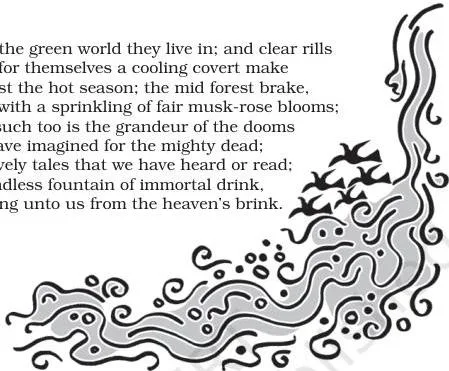
The illustration is not decoration: it is the answer to the last question in “Think it out”. Asked what image the poet uses to describe the beautiful bounty of the earth, the answer is the poem’s own closing words — an endless fountain of immortal drink, pouring unto us from the heaven’s brink.
Rhyme, line length and the balance the chapter asks you to notice
The final page of the chapter tells you to watch the poem’s craft, not just its meaning: it asks you to notice the consistency in rhyme scheme and line length, and the balance in each sentence. Three things are being pointed at.
- Rhyme scheme: the lines rhyme in consecutive pairs — forever/never, earth/dearth, days/ways, all/pall, moon/boon, dead/read, drink/brink. Most pairs are exact; a couple, such as daffodils/rills, are approximate rather than perfect.
- Line length: the lines are of roughly even length, which is what the chapter calls “consistency in line length”. Stick to describing the pairs you can see rather than naming a formal scheme the book does not give.
- Balance in the sentence: the poem builds sentences from matched phrases. The chapter’s own example is the run of parallel “of…” phrases: “Of noble natures, of the gloomy days, / Of all the unhealthy and o’er-darkened ways / Made for our searching: yes, in spite of all” — the turn comes at “yes, in spite of all”.
Answering the chapter’s own questions: ‘Think it out’
The chapter closes with a block of questions the book expects you to answer from the poem itself. Each question below is answered the way you should write it, with the supporting lines quoted in short phrases.
- List the things of beauty mentioned in the poem. The sun and the moon; trees old and young, sprouting a shady boon for simple sheep; daffodils with the green world they live in; clear rills that make a cooling covert against the hot season; musk-rose blooms in the mid forest brake; the grandeur of the dooms imagined for the mighty dead; and all lovely tales that we have heard or read.
- List the things that cause suffering and pain. Despondence; the inhuman dearth of noble natures; the gloomy days; and all the unhealthy and o’er-darkened ways “made for our searching”.
- What does the line “Therefore are we wreathing a flowery band to bind us to earth” suggest? That every morning we gather the beauty around us and bind it to ourselves. The act keeps us attached to life — “to bind us to the earth” — even when suffering makes living hard.
- What makes human beings love life in spite of troubles and sufferings? Beauty never dies. A shape of beauty “moves away the pall from our dark spirits”, so however gloomy the days become, something lovely always remains to hold onto.
- Why is ‘grandeur’ associated with the ‘mighty dead’? Because we imagine great and noble fates for those who have died — “the grandeur of the dooms we have imagined for the mighty dead”. The greatness we remember in them becomes itself a thing of beauty.
- Do we experience things of beauty only for short moments or do they make a lasting impression on us? A lasting impression. Beauty “will never pass into nothingness” — its loveliness increases — so its effect grows rather than fading.
- What image does the poet use to describe the beautiful bounty of the earth? The image of an endless fountain of immortal drink, pouring unto us from the heaven’s brink — beauty as a stream that pours from the sky and never runs dry.
Common mistakes when reading ‘A Thing of Beauty’
This short poem produces a small set of predictable misreadings, and nearly all of them come from vocabulary. Read the table before you write any answer.
| Mistake | Correct rule | How to check your answer |
|---|---|---|
| Reading “brake” as a stopping device | In the poem “brake” means a thick mass of ferns — the chapter’s own gloss | Read the gloss printed under the poem before you explain the line |
| Reading “dearth” as “death” | Dearth means scarcity; the line describes a cruel lack of noble natures | Substitute “scarcity” and see that the line still makes sense |
| Reading “dooms” as destruction | Here “dooms” are the fates we imagine for the mighty dead, not disaster | Ask whose dooms they are — the dead we honour, not the living |
| Saying the poem lists only natural beauties | It also counts the grandeur imagined for the dead and lovely tales heard or read | Re-read from “and such too is the grandeur…” to the end of the poem |
| Treating “a sleep full of sweet dreams” as literal sleep only | In context beauty gives rest, peace and health to the spirit | Read the line together with “and health, and quiet breathing” |
| Skipping the closing instruction to notice rhyme and balance | The final page explicitly asks you to observe rhyme scheme, line length and sentence balance | Be ready to quote one balanced line, such as the parallel “of…” phrases |
The two glosses the chapter prints — rills and brake — are the minimum vocabulary a reader must know before explaining any line of the poem.
Using this chapter for exam preparation
A short poem chapter is examined through the abilities its own questions practise. The chapter itself shows what those abilities are.
- The “Think it out” block practises the question shapes this poem produces: list the beauties, list the causes of suffering, explain a quoted line, and identify the closing image.
- “About the poet” supplies the life facts a factual item can draw on — Keats’s dates (1795–1821), his surgeon’s training, his choice of poetry, and the Greek legend of Endymion and Cynthia that frames the poem.
- The closing note explicitly invites a comment on rhyme, line length and sentence balance, so be ready to quote one balanced set of lines and say what the repeated structure does.
- In any answer, quote a single line and explain it in your own words rather than reproducing several lines. Anchor every answer in the printed excerpt, not in the full Endymion poem.
For revision materials built around the same syllabus, see the Class 12 English revision notes or the Class 12 revision hub.
Textbook contents and the examinable syllabus are not always identical — check the current official CBSE syllabus to confirm what is examinable this session.
The poem in a nutshell: what ‘A Thing of Beauty’ is saying
If you can restate the poem in your own words, you have understood it. The chapter prints no summary of its own, so this one distils the excerpt in the order the poem gives it.
- The claim: a thing of beauty is a joy forever — its loveliness increases and never passes into nothingness.
- The gift: beauty gives a quiet bower, a sleep full of sweet dreams, health and quiet breathing.
- The daily act: every morning we wreath a flowery band, gathering beauty to bind us to the earth.
- The suffering it answers: despondence, the inhuman dearth of noble natures, the gloomy days, and the unhealthy o’er-darkened ways made for our searching.
- The catalogue: the sun, the moon, trees old and young, daffodils with the green world, clear rills, musk-rose blooms in the mid forest brake, the imagined grandeur of the mighty dead, and lovely tales.
- The closing image: the bounty of the earth is an endless fountain of immortal drink, pouring unto us from the heaven’s brink.
Related resources
This listing is maintained for the 2026-27 academic session using the NCERT textbook information available to us. NCERT remains the authority for confirming the latest edition.
Move from this chapter to another part of the site without another search.
- NCERT Class 12 English book — the Flamingo chapters directory.
- NCERT Class 12 books hub — every Class 12 subject in one place.
- CBSE notes library — revision notes for every class.
- Poem notes for “Trees” and “Time and Time Again” study notes — poem pages for the same class.
Sources and data verification
- The contents above describe the NCERT Class 12 English Flamingo textbook, chapter 11, “A Thing of Beauty”, as published on ncert.nic.in, the official NCERT portal.
- This page covers only this chapter of Flamingo. It does not cover the rest of the book or the Vistas reader.
- The listing is maintained for the current academic session using the NCERT information available to us.
- NCERT settles textbook editions and official PDFs; CBSE settles the curriculum, syllabus and examinations.
Reference: NCERT Class 12 English Flamingo textbook, chapter 11, official edition on ncert.nic.in.
Frequently asked questions about ‘A Thing of Beauty’
Who wrote ‘A Thing of Beauty’ and where is the poem taken from?
John Keats (1795–1821) wrote the poem. It is an excerpt from his longer work Endymion: A Poetic Romance, which retells the Greek legend of Endymion and Cynthia, the Moon Goddess.
Which book is ‘A Thing of Beauty’ in for Class 12?
It is Chapter 11 of the NCERT Class 12 English Flamingo textbook. The chapter runs two printed pages and holds the note on the poet, the poem and the closing “Think it out” questions.
What are the things of beauty the poet lists in the poem?
The sun, the moon, trees old and young, daffodils with the green world they live in, clear rills, musk-rose blooms in the mid forest brake, the grandeur of the dooms imagined for the mighty dead, and lovely tales heard or read.
What does ‘a flowery band to bind us to the earth’ mean?
Every morning we gather beauty around us — that is the “flowery band”. The image suggests that noticing beauty keeps us bound to life, even when suffering makes the world feel dark.
Why is ‘grandeur’ associated with the ‘mighty dead’?
Because we imagine great and noble fates for those who have died. That remembered greatness — “the grandeur of the dooms we have imagined for the mighty dead” — is itself a source of beauty.
What does the ‘endless fountain of immortal drink’ image suggest?
That beauty is inexhaustible. Like a fountain that pours from the sky and never runs dry, beauty keeps reaching us from heaven, so there is always enough of it to lift the spirits.
Explore Class 12 English Books
- Previous: Trees
- Next: Time and Time Again
Class 12 English on LearnCBSE:
Related chapters:
- Prose
- Short stories
- The Third Level