This page collects the sequences and progressions class 9 formulas from the NCERT chapter “Predicting What Comes Next: Exploring Sequences and Progressions”. It covers the term notation \( t_n \), explicit and recursive rules, the nth term of an arithmetic progression (AP) and a geometric progression (GP), and the sum of the first n natural numbers.
Each formula is grouped by the textbook sub-topic it belongs to, with a symbol table, guidance on when to use it, and worked examples using original numbers. For the full explanations and derivations, browse the Class 9 maths formulas hub.
Formulas at a Glance
| Purpose (what you are finding) | Formula |
|---|---|
| Term of a sequence from its position (explicit rule) | \( t_n = \text{expression in } n \) |
| Check if a value is a term, and find its position (from the explicit rule) | \( t_n = k,\ n \in \mathbb{N} \) |
| General form of an AP | \( a,\ a+d,\ a+2d,\ \dots,\ a+(n-1)d \) |
| nth term of an AP | \( t_n = a + (n-1)d \) |
| Recursive rule of an AP | \( t_1 = a,\ t_n = t_{n-1} + d \ (n \geq 2) \) |
| Sum of the first n natural numbers | \( S_n = \frac{n(n+1)}{2} \) |
| nth triangular number (same formula) | \( t_n = \frac{n(n+1)}{2} \) |
| Sum of consecutive numbers m to N (derived from the natural-number sum) | \( S_N – S_{m-1} \) |
| General form of a GP | \( a,\ ar,\ ar^2,\ \dots,\ ar^{n-1} \) |
| nth term of a GP | \( t_n = ar^{n-1} \) |
| Recursive rule of a GP | \( t_1 = a,\ t_n = r\, t_{n-1} \ (n \geq 2) \) |
| Virahānka–Fibonacci sequence rule | \( V_1 = 1,\ V_2 = 2,\ V_n = V_{n-1} + V_{n-2} \ (n \geq 3) \) |
| Sierpiński triangle: black triangles at stage n | \( t_n = 3^n \) |
| Sierpiński triangle: shaded area at stage n | \( s_n = \left( \frac{3}{4} \right)^n \) |
All Formulas, Grouped by Topic
The groups below follow the textbook’s sub-topics. Page numbers refer to the printed NCERT pages of Ganita Manjari, Chapter 8.
Explicit Rule for a Sequence
Terms of a sequence are written \( t_1, t_2, t_3, \dots \), where the subscript is the position; the letters \( u_n, s_n, V_n \) are used for other sequences (NCERT, p. 175). An explicit rule uses the position \( n \) directly to give the term (NCERT, p. 177):
\[ t_n = \text{expression in } n \]
For example, \( u_n = 2n – 1 \) is the explicit rule for the odd numbers: substituting \( n = 53 \) gives \( u_{53} = 105 \) without computing earlier terms.
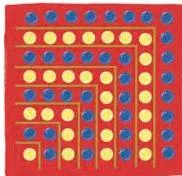
The pattern in Fig. 8.2 is a picture of such a rule: each square number is the sum of the odd numbers up to it, \( 1 = 1, 4 = 1 + 3, 9 = 1 + 3 + 5 \), and so on (NCERT, p. 176).
Checking a value. To test whether \( k \) is a term and find its position, solve \( t_n = k \). If \( n \) comes out a natural number, \( k \) is the nth term; if not, \( k \) is not in the sequence (NCERT, p. 177).
Recursive Rule for a Sequence
A recursive rule gives the first term and defines each later term using earlier ones (NCERT, p. 179). You must know the earlier terms first, then generate the next ones step by step. For the sequence 1, 4, 7, 10, … :
\[ t_1 = 1, \qquad t_n = t_{n-1} + 3 \quad (n \geq 2) \]
The Virahānka–Fibonacci rule uses the previous two terms (NCERT, p. 180):
\[ V_1 = 1,\ V_2 = 2, \qquad V_n = V_{n-1} + V_{n-2} \quad (n \geq 3) \]
\[ 1, 2, 3, 5, 8, 13, 21, \dots \]
Arithmetic Progressions
An arithmetic progression (AP) is a list in which each term after the first is obtained by adding a fixed number \( d \), the common difference (NCERT, p. 181). A list is an AP only when every consecutive difference is the same (NCERT, p. 181):
\[ t_2 – t_1 = t_3 – t_2 = t_4 – t_3 = \dots = d \]
Two or three equal differences suggest the pattern, but all available consecutive differences must agree before the list is confirmed as an AP.
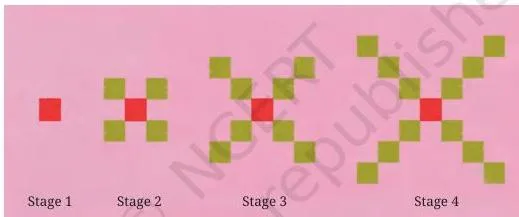
Fig. 8.3 is where the AP definition comes from: each stage adds an outer ring of 4 squares, so the counts \( 1, 5, 9, 13 \) form an AP with \( a = 1 \), \( d = 4 \) and \( t_n = 4n – 3 \) (NCERT, p. 181).
The general form and the nth term of an AP (NCERT, p. 182):
\[ a,\ a + d,\ a + 2d,\ a + 3d,\ \dots,\ a + (n-1)d \]
\[ t_n = a + (n-1)d \]
Why (n − 1)? The first term is \( a \) with no \( d \) added. Moving from term to term adds one \( d \) at a time, so the nth term carries (n − 1) copies of \( d \).
Recursive rule of the same AP (NCERT, p. 182):
\[ t_1 = a, \qquad t_n = t_{n-1} + d \quad (n \geq 2) \]
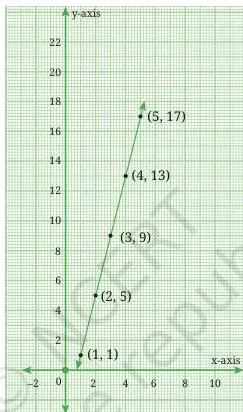
The AP has a visual signature: plotting the ordered pairs (1, 1), (2, 5), (3, 9), (4, 13), (5, 17) places them on a straight line, as Fig. 8.4 shows (NCERT, p. 183). This is a quick check, not a proof — the difference test above is the proof.
Sum of the First n Natural Numbers
The sum of the first \( n \) natural numbers (NCERT, p. 185):
\[ S_n = \frac{n(n+1)}{2} \]
Why it works. Write the sum once forward and once in reverse, then add the two rows. Every column pair adds to \( n + 1 \), and there are \( n \) such pairs, so doubling the sum gives:
\[ 2S = n(n+1) \]
Halving gives the formula. This argument holds for odd and even \( n \) alike because it never requires splitting the list into pairs.
The nth triangular number is exactly this sum (NCERT, p. 186):
\[ t_n = \frac{n(n+1)}{2} \]
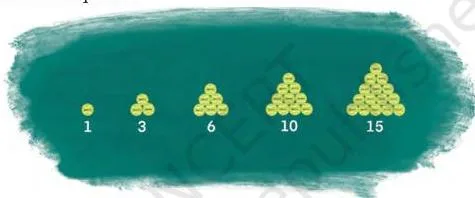
Fig. 8.1 shows the first five triangular numbers as dot arrays: 1, 3, 6, 10, 15, each a sum \( 1 + 2 + \dots + n \) (NCERT, p. 175).
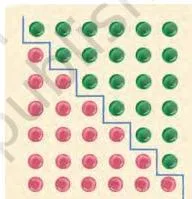
Fig. 8.5 shows the doubling trick for \( n = 6 \): two copies of \( 1 + 2 + 3 + 4 + 5 + 6 \) fill a 7 by 6 rectangle, which is exactly \( 2(1 + 2 + 3 + 4 + 5 + 6) = 7 \times 6 \) (NCERT, p. 185).
A block of consecutive numbers from \( m \) to \( N \) (derived from \( S_n \); NCERT, p. 186 applies it to 25 to 58):
\[ m + (m+1) + \dots + N = S_N – S_{m-1} \]
Geometric Progressions
A geometric progression (GP) is a list in which each term after the first is obtained by multiplying the previous term by a fixed number \( r \), the common ratio (NCERT, p. 187). A list is a GP only when every consecutive ratio is the same (NCERT, p. 187):
\[ \frac{t_2}{t_1} = \frac{t_3}{t_2} = \frac{t_4}{t_3} = \dots = r \]
The ratio test is defined only when no term is zero. A negative \( r \) is allowed — 1, −1, 1, −1, … is a GP with \( r = -1 \), and its signs alternate (NCERT, p. 188).
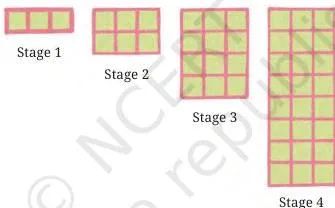
Fig. 8.6 is the GP pattern of the chapter: each stage doubles the number of green squares, so 3, 6, 12, 24 is a GP with \( a = 3 \), \( r = 2 \) (NCERT, p. 187).
The general form and the nth term of a GP (NCERT, p. 187):
\[ a,\ ar,\ ar^2,\ ar^3,\ \dots,\ ar^{n-1} \]
\[ t_n = ar^{n-1} \]
Why (n − 1)? The multiplier \( r \) first appears when moving from the first term to the second, so the nth term contains (n − 1) factors of \( r \).
Recursive rule of the same GP:
\[ t_1 = a, \qquad t_n = r\, t_{n-1} \quad (n \geq 2) \]
Fun with Fractals
The Sierpiński triangle is a fractal: at every stage each black triangle splits into three smaller ones. Counting black triangles and measuring shaded area give two GPs (NCERT, p. 190). With \( n \) the stage number starting at 0:
\[ t_n = 3^n \quad \text{(number of black triangles)} \]
\[ s_n = \left( \frac{3}{4} \right)^n \quad \text{(shaded area, starting at 1 square unit)} \]
Recursive forms (NCERT, p. 190):
\[ t_1 = 1,\ t_n = 3\, t_{n-1} \qquad s_1 = 1,\ s_n = \frac{3}{4}\, s_{n-1} \quad (n \geq 2) \]
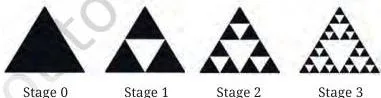
Fig. 8.7 shows the Sierpiński triangle at stages 0 to 3; the black-triangle counts are 1, 3, 9, 27 — a GP with \( r = 3 \) (NCERT, p. 189).
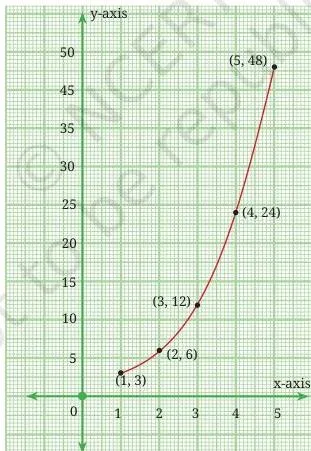
The two graphs in Fig. 8.10 plot stage number against black-triangle count and against shaded area: the count climbs steeply while the area falls toward 0 (NCERT, p. 192).
What Each Symbol Means
| Symbol | What it means | Unit / nature |
|---|---|---|
| \( t_n \) | The nth term of a sequence; the subscript gives the position. Different letters (\( u_n, s_n, V_n \)) name different sequences. | A real number — can be negative, zero or a fraction |
| \( n \) | Position of the term in the sequence | A natural number: 1, 2, 3, … |
| \( a \) | First term of an AP or GP | A real number |
| \( d \) | Common difference of an AP: the fixed number added to reach each next term | A real number (negative \( d \) gives a decreasing AP, e.g. \( d = -4 \)) |
| \( r \) | Common ratio of a GP: the fixed multiplier from one term to the next | A real number (negative \( r \) alternates signs; the ratio test needs non-zero terms) |
| \( S_n \) | Sum of the first n natural numbers | A whole number |
| \( t_n = 3^n \) | Number of black triangles at stage n of the Sierpiński triangle | A whole number — a count |
| \( s_n = (3/4)^n \) | Shaded area at stage n of the Sierpiński triangle (stage 0 area = 1 square unit) | Square units |
When to Use Each Formula
- Explicit rule — use when you have a formula in \( n \) and need any term directly (the 20th, 300th, …), without computing earlier terms.
- Position / membership check — use when asked “is k a term?” or “which term is k?”: solve \( t_n = k \); a natural-number \( n \) means yes.
- Recursive rule — use when terms are defined from previous terms; you need the earlier values first, then generate step by step.
- AP nth term — use when the same number \( d \) is added at every step, so the terms grow or shrink steadily. Condition: every consecutive difference equals \( d \).
- AP recursive rule — use to generate AP terms one at a time from \( t_1 = a \) and \( d \).
- Natural-number sum — use for \( 1 + 2 + \dots + n \), for triangular numbers, and — by subtracting two sums — for any block of consecutive numbers.
- GP nth term — use when every term is the previous one multiplied by the same \( r \) (doubling, halving, etc.). Condition: every consecutive ratio equals \( r \).
- GP recursive rule — use to generate GP terms step by step from \( t_1 = a \) and \( r \).
- Sierpiński rules — use when a stage number is given and you need the triangle count \( 3^n \) or shaded area \( (3/4)^n \).
Worked Examples
Worked Example 1: Finding an AP term directly
- Step 1: For the AP 4, 9, 14, 19, …, read the first term \( a = 4 \) and find the common difference \( d = 9 – 4 = 5 \).
- Step 2: Choose the nth-term formula \( t_n = a + (n-1)d \) with \( n = 15 \).
\[ t_{15} = 4 + (15 – 1) \times 5 = 4 + 14 \times 5 = 74 \]
Final answer: the 15th term is 74.
Worked Example 2: Working backwards to find a position
- Step 1: For the AP 7, 10, 13, 16, …, \( a = 7 \) and \( d = 3 \).
- Step 2: Set the nth term equal to 100 and solve for \( n \): \( 7 + (n-1) \times 3 = 100 \).
\[ (n-1) \times 3 = 93 \implies n – 1 = 31 \implies n = 32 \]
Final answer: 100 is the 32nd term (check: \( 7 + 31 \times 3 = 100 \)).
Worked Example 3: Testing a GP and finding a term
- Step 1: For 3, 12, 48, …, check the ratios: \( \frac{12}{3} = 4 \) and \( \frac{48}{12} = 4 \), so it is a GP with \( a = 3 \) and \( r = 4 \).
- Step 2: Use the GP nth-term formula \( t_n = ar^{n-1} \) with \( n = 6 \).
\[ t_6 = 3 \times 4^5 = 3 \times 1024 = 3072 \]
Final answer: the 6th term is 3072.
Quick check of the natural-number sum: \( 1 + 2 + \dots + 20 = \frac{20 \times 21}{2} = 210 \). For formula sheets of other chapters, visit the main maths formulas index.
Common Mistakes to Avoid
Each row shows a chapter-specific slip, the correct rule, and a quick self-check.
| Mistake | Correct rule | How to check your answer |
|---|---|---|
| Writing the nth term as \( t_n = a + nd \) | \( t_n = a + (n-1)d \) — the first term carries no \( d \) | Put \( n = 1 \): you must get \( a \), and \( t_n – t_{n-1} \) must equal \( d \) |
| Accepting any solution of \( t_n = k \) as a term | Only a natural number \( n \) counts; e.g. \( 5n – 2 = 471 \) gives \( n = 94.6 \), so 471 is not a term | Substitute your \( n \) back into \( t_n \) — you must get exactly \( k \) |
| Calling a list an AP after a few equal differences | Every consecutive difference must equal \( d \); 1, 4, 9 fails since \( 9 – 4 = 5 \neq 4 – 1 = 3 \) | Work through all the consecutive differences, not just the first two or three |
| Taking a decreasing AP as having positive \( d \) | \( d = t_2 – t_1 \); for 21, 18, 15, …, \( d = -3 \) | Check that \( t_3 – t_2 = t_2 – t_1 = -3 \) |
| Multiplying when you should add (or the reverse) | AP adds the same \( d \) each step; GP multiplies by the same \( r \) | Differences all equal → AP; ratios all equal → GP |
| Writing the Sierpiński count as \( 3^{n-1} \) | Count at stage \( n \) is \( 3^n \), since stage 0 has \( 3^0 = 1 \) triangle | Put \( n = 0 \) in your rule: the answer must be 1 |
Frequently Asked Questions
What is the difference between an explicit rule and a recursive rule?
An explicit rule gives the nth term from the position alone, e.g. \( u_n = 2n – 1 \) finds any odd number directly. A recursive rule defines each term from earlier terms, e.g. \( t_1 = 1 \), \( t_n = t_{n-1} + 3 \), so you compute the terms one after another.
Is every sequence an AP or a GP?
No. The prime numbers 2, 3, 5, 7, 11, … follow no such rule (NCERT, p. 181), and \( 1, \frac{1}{2}, \frac{1}{3}, \frac{1}{4}, \dots \) has neither a constant difference nor a constant ratio. Even the square numbers 1, 4, 9, 16 have differences 3, 5, 7, … — so they are not an AP.
Only a list whose consecutive differences are all equal is an AP, and only a list whose consecutive ratios are all equal is a GP.
How do I check whether a number is a term of a sequence?
Set the nth-term formula equal to the number and solve for \( n \). If \( n \) is a natural number, the number is the nth term; if \( n \) is a fraction or negative, it is not. Example: \( 5n – 2 = 471 \) gives \( n = 94.6 \), so 471 is not in that sequence (NCERT, p. 177).
Can d or r be negative?
Yes. The AP 11, 7, 3, −1, … has \( d = -4 \) — the terms decrease. A GP can have a negative ratio too: 1, −1, 1, −1, … has \( r = -1 \), and the signs of its terms alternate (NCERT, p. 188).
Reference: NCERT Class 9 Mathematics textbook (Ganita Manjari, Rationalised NCERT), chapter “Predicting What Comes Next: Exploring Sequences and Progressions”. The official text is available free on NCERT’s textbook portal.
Explore Class 9 Maths Formulas
More for this chapter:
Class 9 Maths on LearnCBSE:
Related chapters: