
These are quick revision notes for NCERT Class 9 Maths Chapter 8, “Predicting What Comes Next: Exploring Sequences and Progressions”. The page covers sequence notation, explicit and recursive rules, arithmetic progressions (AP), geometric progressions (GP), the sum of the first n natural numbers, worked examples, and the mistakes students most often make.
Use it as a last-night revision sheet for the current academic session.
Every formula and definition below is drawn from the NCERT Ganita Manjari textbook (Chapter 8, pp. 175–196). Where a page number is cited, you can check the exact spot in the book.
Chapter map: from number patterns to AP and GP
The chapter builds one idea on another. First you learn what a sequence is and how to name its terms. Then you meet two ways to describe a sequence: a rule that uses position n, and a rule that uses previous terms.
From there, the chapter studies two special kinds of sequences — APs (adding a fixed number) and GPs (multiplying by a fixed number) — and finishes with a famous sum formula and fractal patterns.
| Chapter block | Textbook pages | Core idea |
|---|---|---|
| Sequences and notation | pp. 175–176 | Ordered list of numbers; each member is a term, written t₁, t₂, …, tₙ. |
| Explicit and recursive rules | pp. 177–180 | Explicit rule uses n; recursive rule uses earlier terms. |
| Arithmetic progressions | pp. 181–183 | Each term adds a fixed common difference d. |
| Sum of first n natural numbers | pp. 184–186 | Sₙ = n(n+1)/2, found by reverse-and-add. |
| Geometric progressions and fractals | pp. 187–193 | Each term multiplies by a fixed common ratio r; Sierpiński triangle. |
| Chapter summary | p. 196 | All key definitions and formulas collected. |
Sequences, notation and the two kinds of rules
A sequence is an ordered list of numbers (NCERT, p. 175). Each number in the list is a term. For example, the square numbers 1, 4, 9, 16, 25, … form a sequence: 1 is the first term, 4 the second, 25 the fifth, and so on. Sequences can be finite (like 6, 12, 24, 48, 96) or infinite (like the natural numbers).
To talk about terms, we use the notation t₁, t₂, t₃, …, tₙ, where the subscript is the position of the term. So t₄ = 7 in the sequence of odd numbers means “the term in the fourth position is 7” (NCERT, p. 176). If you work with more than one sequence, you can use different letters: s₁, s₂, … for one, u₁, u₂, … for another.
A sequence can have two kinds of rules (NCERT, pp. 177–179):
- Explicit formula: uses the position n to calculate the term directly. Example: tₙ = 4n + 3 gives 7, 11, 15, 19, … because t₁ = 4(1) + 3 = 7, t₂ = 4(2) + 3 = 11, and so on. You can jump straight to the 100th term without knowing earlier terms.
- Recursive formula: uses one or more previous terms. Example: s₁ = 2, sₙ = sₙ₋₁ + 5 for n ≥ 2 gives 2, 7, 12, 17, … You must know earlier terms to build the next one.
A famous recursive sequence is the Virahānka–Fibonacci sequence: V₁ = 1, V₂ = 2, and Vₙ = Vₙ₋₁ + Vₙ₋₂ for n ≥ 3. It produces 1, 2, 3, 5, 8, 13, 21, 34, … (NCERT, p. 179). Virahānka studied it in the 7th century CE in the context of Prakrit meter and poetry.
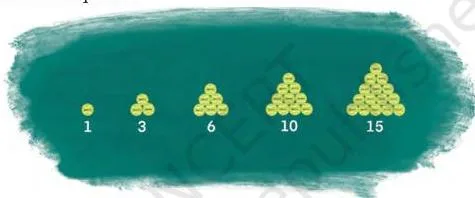
The triangular numbers 1, 3, 6, 10, 15, … are each a sum of natural numbers: 1 = 1, 3 = 1 + 2, 6 = 1 + 2 + 3, 10 = 1 + 2 + 3 + 4, and so on. So the fifth triangular number, 15, equals 1 + 2 + 3 + 4 + 5, as Fig. 8.1 shows with triangular arrays of dots (NCERT, p. 176).
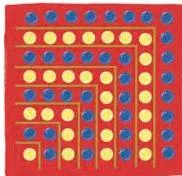
Square numbers follow a similar pattern: 1 = 1, 4 = 1 + 3, 9 = 1 + 3 + 5, 16 = 1 + 3 + 5 + 7. Each square number is the sum of consecutive odd numbers, as Fig. 8.2 shows (NCERT, p. 176).
Checking whether a number is a term: when you solve tₙ = (some number) and get a value of n, that value must be a natural number (1, 2, 3, …). For example, for tₙ = 5n − 2, the number 308 is a term because 5n − 2 = 308 gives n = 62, a natural number. But 471 is not a term because 5n − 2 = 471 gives n = 94.6, which is not a natural number (NCERT, p. 178).
Arithmetic progressions: adding a fixed difference
An arithmetic progression (AP) is a sequence in which each term after the first is obtained by adding a fixed number to the previous term. That fixed number is the common difference, written d (NCERT, p. 181). The general form is:
\[ a, a + d, a + 2d, a + 3d, \dots, a + (n-1)d \]
where a is the first term and d is the common difference. The nth term is:
\[ t_n = a + (n-1)d \]
The recursive rule for the same AP is t₁ = a, tₙ = tₙ₋₁ + d for n ≥ 2 (NCERT, p. 183).
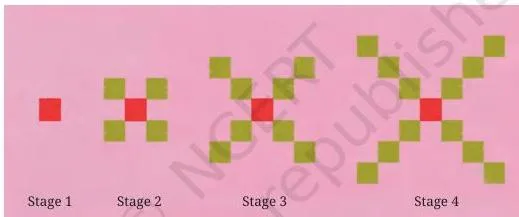
In the square pattern of Fig. 8.3, the number of tiny squares at each stage is 1, 5, 9, 13, …. Each stage adds 4 squares, so the common difference is 4. The explicit nth term is tₙ = 1 + (n−1) × 4 = 4n − 3 (NCERT, p. 181).
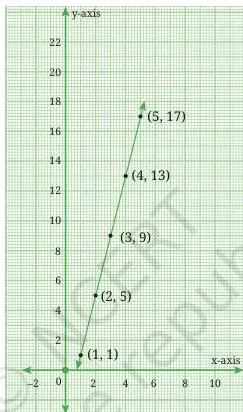
When you plot the stage number against the number of squares — (1, 1), (2, 5), (3, 9), (4, 13), (5, 17) — the points lie on a straight line, as Fig. 8.4 shows (NCERT, p. 183). This linear graph is a visual signature of an AP.
A decreasing AP has a negative common difference. For example, 11, 7, 3, −1, −5, … is an AP with a = 11 and d = −4 (NCERT, p. 182).
A real-life AP with fresh numbers: Suppose you save ₹600 in the first month and increase your saving by ₹150 every month. The savings are 600, 750, 900, 1050, … — an AP with a = 600 and d = 150. Your saving in month n is tₙ = 600 + (n−1) × 150. It is an AP because the difference between consecutive months is always ₹150.
Sum of the first n natural numbers
The sum of the first n natural numbers has the neat formula:
\[ S_n = 1 + 2 + 3 + \dots + n = \frac{n(n+1)}{2} \]
The reverse-and-add method (why it works): Write S = 1 + 2 + … + n and also S = n + (n−1) + … + 1. Adding the two lines, each vertical pair (1 + n, 2 + (n−1), …) sums to n + 1, and there are n such pairs. So 2S = n(n+1), giving S = n(n+1)/2 (NCERT, p. 185).
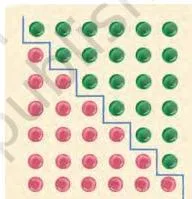
Fig. 8.5 shows the same idea pictorially: two copies of 1 + 2 + 3 + 4 + 5 + 6 form a 7 × 6 rectangle, so 2(1 + 2 + 3 + 4 + 5 + 6) = 7 × 6 (NCERT, p. 185). In general, 2(1 + 2 + … + n) = n(n+1).
Finding a range of consecutive numbers: you can subtract two S values. With original numbers:
\[ 31 + 32 + \dots + 50 = S_{50} – S_{30} = \frac{50 \times 51}{2} – \frac{30 \times 31}{2} = 1275 – 465 = 810 \]
So the sum of the natural numbers from 31 to 50 is 810.
The triangular numbers are exactly these sums: the nth triangular number is tₙ = n(n+1)/2 (NCERT, p. 186). So the 10th triangular number is 10 × 11 / 2 = 55, and the 17th is 17 × 18 / 2 = 153.
As a historical note, the first known written mention of this sum rule appears in Āryabhaṭa’s Āryabhaṭīya, Chapter 2, Verse 19 (NCERT, p. 185).
Geometric progressions, Sierpiński triangle and fractals
A geometric progression (GP) is a sequence in which each term after the first is obtained by multiplying the previous term by a fixed number. That constant multiplier is the common ratio, written r (NCERT, p. 188). The general form is:
\[ a, ar, ar^2, ar^3, \dots, ar^{n-1} \]
where a is the first term, r is the common ratio, and the nth term is:
\[ t_n = ar^{n-1} \]
The recursive rule is t₁ = a, tₙ = r × tₙ₋₁ for n ≥ 2 (NCERT, p. 188).
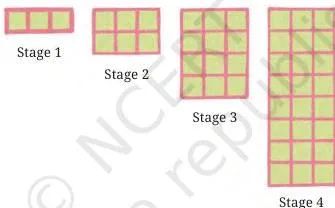
In the green-square pattern of Fig. 8.6, the counts are 3, 6, 12, 24, …: each stage doubles the previous one, so r = 2. The nth term is tₙ = 3 × 2ⁿ⁻¹ (NCERT, p. 188).
To check a GP, divide consecutive terms in the correct order: t₂/t₁, t₃/t₂, t₄/t₃, …. All ratios must be equal. For example, the sequence 5, 15/4, 45/16, 135/64, … is a GP because each ratio is 3/4, so its nth term is 5 × (3/4)ⁿ⁻¹ (NCERT, p. 188).
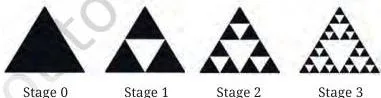
The Sierpiński triangle (Fig. 8.7) is built by repeatedly joining the midpoints of an equilateral triangle and removing the central triangle. The number of black triangles at stages 0, 1, 2, 3 is 1, 3, 9, 27 — a GP with ratio 3, since each black triangle is replaced by three smaller ones.
Meanwhile the shaded area follows a GP with ratio 3/4: starting from area 1, the black area at stage n is (3/4)ⁿ. So while the number of black triangles grows rapidly, the total black area shrinks toward 0 (NCERT, pp. 190–191).
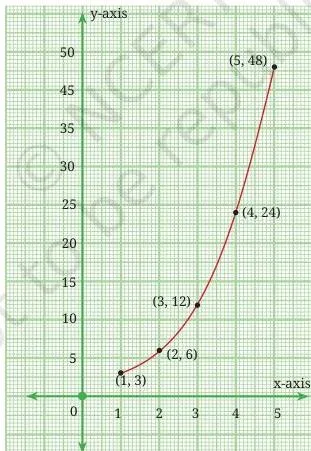
When you plot a GP, the points do not lie on a straight line. Fig. 8.10 shows the contrast: the number of triangles shoots up quickly, while the area drops and approaches 0 (NCERT, p. 192).
Fractals are shapes or patterns that repeat themselves at different scales — zoom into a small part and it looks similar to the whole. Examples from nature include the branching of trees, cauliflower or broccoli, snowflakes, and coastlines (NCERT, p. 191).
Note that the common ratio r can be negative or a fraction. The sequence 1, −1, 1, −1, … is a GP with r = −1, and 5, 15/4, 45/16, … has r = 3/4 (NCERT, p. 188). For an original GP example, consider the sequence 7, 21, 63, 189: each term multiplies by 3, so a = 7, r = 3, and tₙ = 7 × 3ⁿ⁻¹.
Key terms in sequences and progressions
| Term | Meaning | Example |
|---|---|---|
| Sequence | An ordered list of numbers | 1, 4, 7, 10, 13, … |
| Term | Each number in a sequence, written t₁, t₂, t₃, … | t₃ = 9 in 1, 4, 9, 16, … |
| Explicit formula | Uses position n to find a term directly | tₙ = 3n − 2 gives 1, 4, 7, 10, … |
| Recursive formula | Uses one or more previous terms | t₁ = 1, tₙ = tₙ₋₁ + 3 for n ≥ 2 |
| AP | Each term adds a fixed common difference d | 2, 5, 8, 11, … with d = 3 |
| Common difference | The fixed number added in an AP | d = −4 in 11, 7, 3, −1, … |
| GP | Each term multiplies by a fixed common ratio r | 3, 6, 12, 24, … with r = 2 |
| Common ratio | The constant multiplier in a GP | r = 1/2 in 8, 4, 2, 1, … |
| Triangular number | Sum of the first n natural numbers | t₅ = 1 + 2 + 3 + 4 + 5 = 15 |
| Fractal | A shape that repeats itself at different scales | Sierpiński triangle |
Formula box: nth terms and sum formulas
| Formula | Meaning | Where it comes from |
|---|---|---|
| tₙ = a + (n−1)d | nth term of an AP; a is the first term, d is the common difference | NCERT, p. 182 |
| AP general form: a, a+d, a+2d, … | Every AP can be written this way | NCERT, p. 182 |
| AP recursive rule: t₁ = a, tₙ = tₙ₋₁ + d | Builds the AP term by term | NCERT, p. 183 |
| tₙ = arⁿ⁻¹ | nth term of a GP; a is the first term, r is the common ratio | NCERT, p. 188 |
| GP general form: a, ar, ar², … | Every GP can be written this way | NCERT, p. 188 |
| GP recursive rule: t₁ = a, tₙ = r × tₙ₋₁ | Builds the GP term by term | NCERT, p. 188 |
| Sₙ = n(n+1)/2 | Sum of the first n natural numbers | NCERT, p. 185 |
| tₙ = n(n+1)/2 | nth triangular number | NCERT, p. 186 |
Every formula above is worth memorising exactly. Notice that the triangular number formula and the sum formula are the same — that is the connection between the two sections.
Worked examples: applying the nth term rules
Example 1: Writing terms from an explicit formula and checking whether a number is a term
Step 1: Use the explicit rule tₙ = 6n − 1.
Substitute n = 1, 2, 3, 4 to get the first four terms.
t₁ = 6(1) − 1 = 5, t₂ = 6(2) − 1 = 11, t₃ = 6(3) − 1 = 17, t₄ = 6(4) − 1 = 23
- Step 1: First four terms: 5, 11, 17, 23.
- Step 2: Check whether 149 is a term.
Solve tₙ = 149.
6n − 1 = 149 → 6n = 150 → n = 25
- Step 1: Since n = 25 is a natural number, 149 is the 25th term of the sequence.
- Step 2: Check whether 200 is a term.
Solve tₙ = 200.
6n − 1 = 200 → 6n = 201 → n = 33.5 Step 6: Since 33.5 is not a natural number, 200 is not a term of the sequence.
Final answer: First four terms are 5, 11, 17, 23. 149 is the 25th term; 200 is not a term because n would be 33.5, not a natural number.
Example 2: Generating terms from a recursive rule
Step 1: The recursive rule is t₁ = 4, tₙ = 3tₙ₋₁ − 2 for n ≥ 2.
Notice that the rule needs the previous term, so we build terms one at a time.
Step 2: Substitute n = 2.
t₂ = 3t₁ − 2 = 3(4) − 2 = 10 Step 3: Substitute n = 3.
t₃ = 3t₂ − 2 = 3(10) − 2 = 28 Step 4: Substitute n = 4.
t₄ = 3t₃ − 2 = 3(28) − 2 = 82 Final answer: The first four terms are 4, 10, 28, 82.
Example 3: An AP application — monthly savings
Step 1: Identify the AP.
Savings are ₹500 in month 1, and increase by ₹250 each month.
So a = 500 (₹) and d = 250 (₹ per month).
Step 2: Write the nth term formula for an AP.
tₙ = a + (n−1)d Step 3: Substitute a = 500, d = 250, n = 12.
t₁₂ = 500 + (12−1) × 250 = 500 + 11 × 250 = 500 + 2750 = 3250 Final answer: The amount saved in month 12 is ₹3,250.
Example 4: Sums using Sₙ = n(n+1)/2
Step 1: Find S₁₅, the sum of the first 15 natural numbers.
S₁₅ = 15 × 16 / 2 = 240 / 2 = 120 Step 2: Find 31 + 32 + … + 50 by subtracting S₃₀ from S₅₀.
31 + 32 + … + 50 = S₅₀ − S₃₀ = (50 × 51)/2 − (30 × 31)/2 = 1275 − 465 = 810 Final answer: S₁₅ = 120; the sum 31 + 32 + … + 50 is 810.
Common AP and GP mistakes students make
| What students write | Correct version | Why |
|---|---|---|
| tₙ = a + nd for an AP | tₙ = a + (n−1)d | The first term is a itself, so no d has been added at n = 1. Substituting n = 1 must give t₁ = a, and only (n−1)d does that. |
| 11, 7, 3, −1, … has common difference +4 | Common difference is −4 | Each term is 4 less than the previous: 7 − 11 = −4. A decreasing AP always has a negative d. |
| Recursive rule written as “tₙ = tₙ₋₁ + d for n ≥ 1” | “for n ≥ 2” | The formula refers to the previous term tₙ₋₁, which exists only when n − 1 ≥ 1, i.e. n ≥ 2. The first term must be given separately as t₁ = a. |
| Checking a GP by computing t₁/t₂ instead of t₂/t₁ | Compute t₂/t₁, t₃/t₂, t₄/t₃, … | The common ratio multiplies a term to give the next term, so the later term goes on top. Using the wrong order gives a different (usually reciprocal) value. |
| Accepting n = 33.5 as the position of a term | Reject it; n must be a natural number | Positions in a sequence are 1, 2, 3, 4, … . A non-natural n means the number is not in the sequence. |
| “Every increasing sequence is an AP” | Check whether the differences are constant | Square numbers 1, 4, 9, 16 have differences 3, 5, 7 — not constant, so not an AP even though they increase. |
Exam notes: how AP and GP questions usually appear
The exercise sets in this chapter (NCERT, pp. 180, 186, 194–196) consistently repeat a few question patterns. Practise these until they feel mechanical:
- Finding a specified term of an AP or GP: you are given a and d (or r), and asked for the 10th, 26th, or nth term.
- Checking whether a number is a term and finding its position: set tₙ equal to the number, solve for n, and check that n is a natural number.
- Writing both explicit and recursive rules for the same sequence.
- Given two terms of an AP, form two equations in a and d. For example, a 3rd term of 12 and a 50th term of 106 give a + 2d = 12 and a + 49d = 106. Solve the pair of linear equations, then use a and d to find any other term (NCERT, p. 186).
- Counting multiples: “How many 2-digit numbers are divisible by 3?” The multiples form an AP; find the smallest and largest ones in the range, then use the nth term formula to count them.
- GP questions asking for the nth term or checking whether a sequence is a GP by comparing consecutive ratios.
Which steps earn the marks: write the formula (tₙ = a + (n−1)d or tₙ = arⁿ⁻¹), substitute the given values with their units, solve the equation, and then state the term position clearly. In a “which term” question, the final sentence “so 4374 is the 8th term” is the mark-carrying conclusion.
One-page recap: sequences, AP, GP and sums
| Concept | Rule | Quick example |
|---|---|---|
| Sequence and term notation | A sequence is an ordered list; tₙ is the nth term | Odd numbers: t₁ = 1, t₂ = 3, t₃ = 5 |
| Explicit vs recursive formula | Explicit uses n; recursive uses previous terms | tₙ = 2n−1 vs t₁ = 1, tₙ = tₙ₋₁ + 2 |
| AP and nth term | Add d each time; tₙ = a + (n−1)d | 3, 8, 13, 18: a = 3, d = 5, tₙ = 3 + (n−1)5 |
| GP and nth term | Multiply by r each time; tₙ = arⁿ⁻¹ | 3, 6, 12, 24: a = 3, r = 2, tₙ = 3 × 2ⁿ⁻¹ |
| Sum of first n natural numbers | Sₙ = n(n+1)/2 | S₁₀ = 10 × 11 / 2 = 55 |
| Triangular numbers | tₙ = n(n+1)/2 | 10th triangular number = 55 |
Quick doubts on sequences and progressions
What is the difference between an arithmetic progression and a geometric progression in Class 9?
An AP is built by adding a fixed number (the common difference d) to each term to get the next. A GP is built by multiplying each term by a fixed number (the common ratio r) to get the next. For example, 2, 5, 8, 11 is an AP with d = 3, while 2, 6, 18, 54 is a GP with r = 3.
The nth terms are tₙ = a + (n−1)d for an AP and tₙ = arⁿ⁻¹ for a GP.
How do I check whether a number is a term of a sequence when only the nth term formula is given?
Set the formula equal to the number and solve for n. If the value of n you get is a natural number (1, 2, 3, …), the number is a term and n is its position. If n is not a natural number — like 33.5 — the number is not in the sequence.
For example, with tₙ = 6n − 1, the number 149 gives n = 25, so it is the 25th term; 200 gives n = 33.5, so it is not a term.
Why is the nth term of an AP written as a + (n−1)d and not a + nd?
Because the first term already is a, with no d added. The first term is t₁ = a = a + (1−1)d, the second is t₂ = a + (2−1)d = a + d, and so on. If you used a + nd, then t₁ would wrongly be a + d. The (n−1) appears precisely so that n = 1 gives the first term.
How are triangular numbers connected to the sum of the first n natural numbers?
The nth triangular number is exactly the sum of the first n natural numbers. So 1, 3, 6, 10, 15 are the sums 1, 1+2, 1+2+3, 1+2+3+4, 1+2+3+4+5. Both use the same formula: tₙ = n(n+1)/2 (NCERT, p. 186).
What is the recursive rule of a sequence and how is it different from the explicit rule?
A recursive rule gives each term using earlier terms, so you must know the previous term (or terms) before you can build the next one. For example, t₁ = 4, tₙ = 3tₙ₋₁ − 2 for n ≥ 2. An explicit rule uses only the position n, so you can find any term directly — like tₙ = 6n − 1 gives the 100th term as 599 without computing 99 earlier terms.
What do the stage numbers in the Sierpiński triangle have to do with geometric progressions?
The number of black triangles at stage n is 3ⁿ, which forms a GP with ratio 3 (1, 3, 9, 27, …), because every triangle is replaced by three smaller ones at the next stage. The shaded area at stage n is (3/4)ⁿ, a GP with ratio 3/4, because each stage keeps only 3 of the 4 parts.
So the same fractal produces two GPs moving in opposite directions — the triangle count grows while the area shrinks.
Reference: NCERT Class 9 Mathematics textbook, chapter “Predicting What Comes Next: Exploring Sequences and Progressions”.
Explore Class 9 Mathematics Notes
- Class 9 Maths Notes
- Class 9 CBSE Notes
- CBSE Notes for Classes 1 to 12
- Previous: The Mathematics of Maybe: Introduction to Probability
More for this chapter:
Related chapters:
- Orienting Yourself: The Use of Coordinates notes
- Introduction to Linear Polynomials notes
- The World of Numbers notes
Official source: download the NCERT textbook free from ncert.nic.in.