This chapter introduces the Cartesian coordinate system—a grid-based method to locate points in a plane using two numbers called coordinates. The formulas you need cover the coordinates of a point, the sign pattern in each quadrant, and the distance between any two points on the plane.
Each formula below is grouped by topic, with the meaning of every symbol, when to use it, and worked examples using original numbers. For detailed explanations and derivations, see the chapter notes.
Formulas at a Glance
| Purpose (what you are finding) | Formula |
|---|---|
| Coordinates of a point on the x-axis | \( (x,0) \) |
| Coordinates of a point on the y-axis | \( (0,y) \) |
| Coordinates of the origin | \( (0,0) \) |
| Distance between two points with the same y-coordinate | \( |x_2 – x_1| \) |
| Distance between two points with the same x-coordinate | \( |y_2 – y_1| \) |
| Distance between any two points \((x_1, y_1)\) and \((x_2, y_2)\) | \( \sqrt{(x_2 – x_1)^2 + (y_2 – y_1)^2} \) |
All Formulas, Grouped by Topic
1. The Cartesian Coordinate System
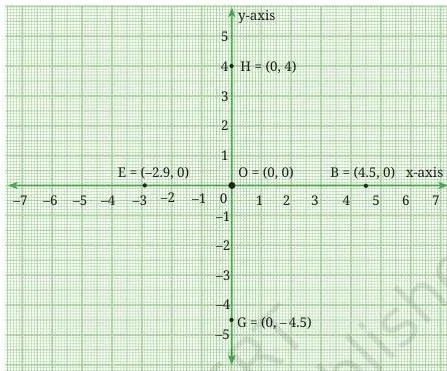
The coordinate plane is formed by two perpendicular lines: the horizontal x-axis and the vertical y-axis. Their intersection is the origin \( O(0,0) \).
- A point on the x-axis: \( (x,0) \)
- A point on the y-axis: \( (0,y) \)
- Origin: \( (0,0) \)
Quadrant signs:
- Quadrant I: \( (+,+) \)
- Quadrant II: \( (-,+) \)
- Quadrant III: \( (-,-) \)
- Quadrant IV: \( (+,-) \)
2. Distance Between Two Points
For points on the same horizontal line (\(y\)-coordinate same):
\[ \text{Distance} = |x_2 – x_1| \]
For points on the same vertical line (\(x\)-coordinate same):
\[ \text{Distance} = |y_2 – y_1| \]
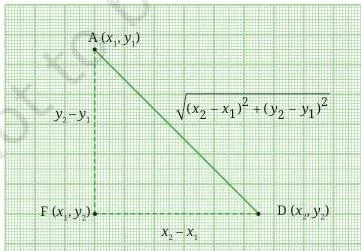
For any two points \( (x_1, y_1) \) and \( (x_2, y_2) \) in the plane:
\[ \text{Distance} = \sqrt{(x_2 – x_1)^2 + (y_2 – y_1)^2} \]
What Each Symbol Means
| Symbol | What it means | Unit / Nature |
|---|---|---|
| \( x \) | Horizontal coordinate (distance from the y-axis) | units (length) |
| \( y \) | Vertical coordinate (distance from the x-axis) | units (length) |
| \( (x_1, y_1) \) | Coordinates of the first point | units (length) |
| \( (x_2, y_2) \) | Coordinates of the second point | units (length) |
| \( | \cdot | \) | Absolute value (non‑negative distance) | dimensionless |
| \( \sqrt{ \ } \) | Square root | — |
When to Use Each Formula
- Coordinates of a point on an axis: Use when you know a point lies exactly on the x-axis (then \(y=0\)) or on the y-axis (then \(x=0\)).
- Distance between points with same y-coordinate (horizontal line): Use when the two points are level, e.g., \(A(2,5)\) and \(B(7,5)\). The distance is simply the difference in x-coordinates.
- Distance between points with same x-coordinate (vertical line): Use when the points are aligned vertically, e.g., \(C(3,1)\) and \(D(3,8)\). The distance is the difference in y-coordinates.
- Distance formula \( \sqrt{(x_2-x_1)^2+(y_2-y_1)^2} \): Use for any two points not on the same horizontal or vertical line. It works for all pairs, including those on axes.
Worked Examples
Example 1: Find the distance between two points with the same y-coordinate
Find the distance between \( P(4, -2) \) and \( Q(9, -2) \).
Step 1: Both points have the same y-coordinate \(-2\), so they lie on a horizontal line.
Step 2: Use the formula \( |x_2 – x_1| \).
\[ \text{Distance} = |9 – 4| = 5 \text{ units} \]
Answer: \( PQ = 5 \) units.
Example 2: Find the distance between two points that are not aligned with the axes
Find the distance between \( A(1, 2) \) and \( B(4, 6) \).
Step 1: Identify \( x_1 = 1, y_1 = 2, x_2 = 4, y_2 = 6 \).
Step 2: Apply the distance formula:
\[ \text{Distance} = \sqrt{(4 – 1)^2 + (6 – 2)^2} = \sqrt{3^2 + 4^2} = \sqrt{9 + 16} = \sqrt{25} = 5 \text{ units} \]
Answer: \( AB = 5 \) units.
Example 3: Find the coordinates of a point on the y-axis given its distance from the origin
Point \(C\) lies on the y-axis, 7 units below the origin. What are its coordinates?
Step 1: On the y-axis, \(x = 0\). Below the origin means the y-coordinate is negative.
Step 2: The distance below is 7 units, so \(y = -7\).
Answer: \( C = (0, -7) \).
Common Mistakes to Avoid
| Mistake | Correct rule | How to check your answer |
|---|---|---|
| Writing the coordinates of a point on the x-axis as \((0,y)\) | On the x-axis, \(y=0\), so the coordinates are \((x,0)\). | Verify that the point lies on the horizontal axis – its y-coordinate must be zero. |
| Forgetting the absolute value when finding distance on a horizontal/vertical line | Distance is always positive: use \(|x_2-x_1|\) or \(|y_2-y_1|\). | Substitute the numbers and check that the result is ≥ 0. |
| Using the distance formula in the wrong order (e.g., \((x_1-x_2)^2\) instead of \((x_2-x_1)^2\)) | The order inside the squares does not matter because squaring removes the sign. But keep the same order for both differences: \((x_2-x_1)\) and \((y_2-y_1)\). | Compute \((x_1-x_2)^2+(y_1-y_2)^2\) – you should get the same number. If you don’t, you may have mixed the coordinates. |
| Confusing the sign of a quadrant: e.g., thinking Quadrant II is \((+, -)\) | Quadrant II: \((-, +)\). | Draw a quick sketch: x-negative left, y-positive up. |
Frequently Asked Questions
What is the difference between the x-coordinate and y-coordinate?
The x-coordinate gives the horizontal distance from the y-axis (positive to the right, negative to the left). The y-coordinate gives the vertical distance from the x-axis (positive upward, negative downward).
Can the distance formula be used if one point is the origin?
Yes. If one point is \((0,0)\), the distance reduces to \(\sqrt{x^2+y^2}\), which is the distance of the point from the origin.
How do I remember the quadrant signs?
Think of the quadrants in counter‑clockwise order starting from the top right: (+,+), (−,+), (−,−), (+,−). A mnemonic: “All Students Take Coffee” (A for All positive in I, S for Sine positive in II, T for Tangent positive in III, C for Cosine positive in IV).
What if the two points have the same coordinates?
Then the distance is zero. For example, \(A(2,3)\) and \(B(2,3)\) give \(\sqrt{(2-2)^2+(3-3)^2}=0\).
Reference: NCERT Class 9 Mathematics textbook, chapter Orienting Yourself: The Use of Coordinates.
Explore Class 9 Maths Formulas
More for this chapter:
Class 9 Maths on LearnCBSE:
Related chapters:
Official source: download the NCERT textbook free from ncert.nic.in.