This sheet collects the perimeter and area formulas from Chapter 6, Measuring Space: Perimeter and Area, of the NCERT Class 9 Mathematics textbook (Ganita Manjari): perimeters of squares, rectangles, triangles and circles, arc length, and the areas of rectangles, parallelograms, triangles (including Heron’s formula), trapeziums, kites, cyclic 4-gons, circles and sectors.
Each formula is grouped by topic, with the meaning of every symbol, its unit, and guidance on when to use it, followed by three worked examples with original numbers. For the other chapters’ sheets, see the Class 9 maths formulas collection or the main maths formulas index. Verify any formula against the textbook PDF on the official NCERT website.
Formulas at a Glance
The whole formula inventory of this chapter in one table. Every row below is explained in the sections that follow.
| Purpose (what you are finding) | Formula |
|---|---|
| Perimeter of a square | \( P = 4a \) |
| Perimeter of an equilateral triangle | \( P = 3a \) |
| Perimeter of a rectangle | \( P = 2(a + b) \) |
| Circumference of a circle | \( C = 2\pi r = \pi D \) |
| Length of an arc subtending angle \(\theta\) at the centre | \( l = 2\pi r \times \frac{\theta^\circ}{360^\circ} \) |
| Length of a semicircle arc (arc formula with \(\theta = 180^\circ\)) | \( l = \pi r \) |
| Length of a quarter-circle arc (arc formula with \(\theta = 90^\circ\)) | \( l = \frac{\pi r}{2} \) |
| Area of a rectangle (square when \(a = b\)) | \( A = ab \) |
| Area of a parallelogram | \( A = bh \) |
| Area of a triangle | \( A = \frac{1}{2}bh \) |
| Area of a triangle from its three sides — Heron’s formula | \( A = \sqrt{s(s-a)(s-b)(s-c)} \) |
| Area of an equilateral triangle | \( A = \frac{\sqrt{3}}{4}a^2 \) |
| Area of an isosceles triangle, equal sides \(a\), base \(2b\) (from Heron’s formula) | \( A = b\sqrt{a^2 – b^2} \) |
| Area of a triangle using its circumradius | \( A = \frac{abc}{4R} \) |
| Area of a triangle using its inradius | \( A = \frac{r(a + b + c)}{2} \) |
| Area of a regular polygon (used to reach the circle-area formula) | \( A = \frac{1}{2}Pr \) |
| Area of a trapezium | \( A = \frac{1}{2}(a + b)h \) |
| Area of a kite or rhombus from its diagonals | \( A = \frac{1}{2}d_1 d_2 \) |
| Area of a cyclic 4-gon — Brahmagupta’s formula | \( A = \sqrt{(s-a)(s-b)(s-c)(s-d)} \) |
| Area of a circle | \( A = \pi r^2 \) |
| Area of a sector of a circle | \( A = \pi r^2 \times \frac{\theta^\circ}{360^\circ} \) |
| Exact infinite-series formula for \(\pi\) (Mādhava) | \( \frac{\pi}{4} = 1 – \frac{1}{3} + \frac{1}{5} – \frac{1}{7} + \dots \) |
All Formulas, Grouped by Topic
Perimeter of a Shape
The perimeter of a shape is the total length of its border (NCERT, p. 120). A square with side \(a\) has perimeter:
\[ P = 4a \]
An equilateral triangle with side \(a\) has perimeter:
\[ P = 3a \]
A rectangle with length \(a\) and width \(b\) has perimeter:
\[ P = 2(a + b) \]
The square formula is a special case of the rectangle formula with \(a = b\).
Perimeter of a Circle — the C/D Ratio
The perimeter of a circle is its circumference \(C\). The ratio of circumference to diameter is the same for every circle, whatever its size; that constant is called \(\pi\) (NCERT, p. 121). Since the diameter \(D = 2r\):
\[ C = \pi D = 2\pi r \]
Unless a question says otherwise, the chapter uses \(\pi \approx \frac{22}{7} \approx 3.14\). The figure below shows Archimedes’ way of trapping \(\pi\) between the perimeters of an inscribed and a circumscribed hexagon.
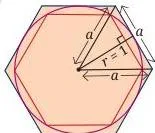
\(\pi\) is irrational: it cannot be written as a ratio of two integers, so \(\frac{22}{7}\) and 3.14 are approximations, never equalities (NCERT, p. 124). Mādhava of Sangamagrāma discovered the first exact formula for \(\pi\):
\[ \frac{\pi}{4} = 1 – \frac{1}{3} + \frac{1}{5} – \frac{1}{7} + \dots \]
Length of an Arc of a Circle
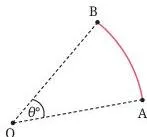
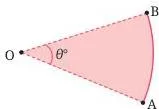
If an arc \(AB\) subtends an angle \(\theta^\circ\) at the centre, the arc is the same fraction of the full circumference as \(\theta\) is of \(360^\circ\) (NCERT, p. 127):
\[ l = 2\pi r \times \frac{\theta^\circ}{360^\circ} \]
The figure below names the parts this formula uses: the radius \(r\), the arc \(AB\), and the central angle \(\theta\).
Two special cases of the arc formula (NCERT, p. 126):
- Semicircle, \(\theta = 180^\circ\): \( l = \pi r \)
- Quarter circle, \(\theta = 90^\circ\): \( l = \frac{\pi r}{2} \)
Area of a Rectangle and a Square
Area is measured in square units; a \(1 \times 1\) square has area \(1\) sq. unit. A rectangle with sides \(a\) and \(b\) has area (NCERT, p. 131):
\[ A = ab \]
A square is the special case \(b = a\), giving \(A = a^2\) (NCERT, p. 140).
Area of a Parallelogram
As Fig. 6.17 shows, cutting a parallelogram and sliding the piece turns it into a rectangle with the same base and height — so the two shapes have the same area (NCERT, p. 131):
\[ A = bh \]
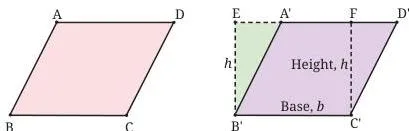
Here \(h\) is the perpendicular distance between the parallel sides. Knowing only the lengths of the sides does not fix a parallelogram’s area (NCERT, p. 132).
Area of a Triangle
Fig. 6.21 shows the cleanest reason the formula works: two congruent copies of a triangle fit together to make a parallelogram, so the triangle is half of it (NCERT, p. 133):
\[ A = \frac{1}{2}bh \]
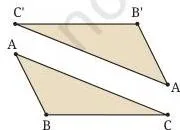
Median property: a median of a triangle divides it into two triangles of equal area, because the two halves have equal bases and the same height (NCERT, p. 134).
Heron’s formula gives the area from the three side lengths alone. First compute the semi-perimeter, then the area (NCERT, p. 135):
\[ s = \frac{1}{2}(a + b + c), \qquad A = \sqrt{s(s-a)(s-b)(s-c)} \]
Two special cases obtained from Heron’s formula:
- Equilateral triangle, side \(a\): \( A = \frac{\sqrt{3}}{4}a^2 \)
- Isosceles triangle with equal sides \(a\) and base \(2b\): \( A = b\sqrt{a^2 – b^2} \)
Every triangle has exactly one circumcircle (through its three vertices) and one incircle (touching its three sides), shown in Fig. 6.26. With their radii the chapter gives two more area formulas (NCERT, p. 137):
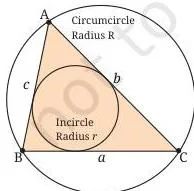
\[ \text{Area of } \triangle ABC = \frac{abc}{4R} \]
\[ \text{Area of } \triangle ABC = \frac{r(a + b + c)}{2} \]
Area of a Trapezium
A trapezium’s area is half the sum of the parallel sides times the perpendicular distance between them (NCERT, p. 151):
\[ A = \frac{1}{2}(a + b)h \]
The chapter derives this by dividing the trapezium into two triangles, and again by joining two identical copies into a parallelogram.
Area of a Kite or a Rhombus
The area of a kite is half the product of its diagonals (NCERT, p. 151). Since a rhombus is a kite with all four sides equal, the same formula covers it:
\[ A = \frac{1}{2}d_1 d_2 \]
Area of a Cyclic 4-gon — Brahmagupta’s Formula
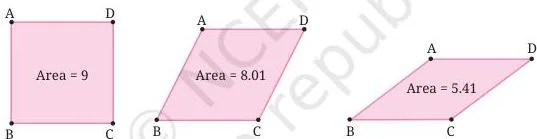
A 4-gon’s area is not fixed by its four side lengths. Fig. 6.27 shows three rhombi each with side 3 that have different areas — so you need extra information, such as the condition that the quadrilateral is cyclic (all four vertices on one circle). For a cyclic 4-gon with sides \(a, b, c, d\), Brahmagupta’s formula (NCERT, p. 138) states:
\[ s = \frac{1}{2}(a + b + c + d), \qquad A = \sqrt{(s-a)(s-b)(s-c)(s-d)} \]
Brahmagupta’s formula generalises Heron’s formula: put the fourth side \(d = 0\), and the 4-gon collapses into a triangle, giving Heron’s formula back (NCERT, p. 141).
Area of a Circle
Archimedes expressed the area as half the circumference times the radius, and since \(C = 2\pi r\) this becomes (NCERT, p. 146):
\[ A = \frac{1}{2} \times C \times r = \pi r^2 \]
The argument starts from a property of regular polygons: the area of a regular polygon equals half its perimeter times the radius of the circle that fits tightly inside it (NCERT, p. 146):
\[ A = \frac{1}{2}Pr \]
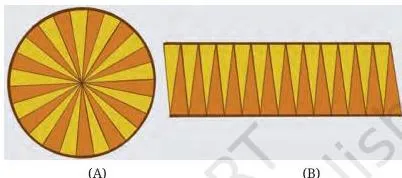
As the number of sides grows without limit, the polygon approaches the circle, giving \(A = \pi r^2\). Fig. 6.37 shows the same result visually: cut the circle into thin slices and rearrange them into a shape that becomes a parallelogram with base \(\pi r\) and height \(r\).
Area of a Sector of a Circle
A sector is the region bounded by an arc and the two radii containing its endpoints. Its area is the same fraction of the circle’s area as its central angle is of \(360^\circ\) (NCERT, p. 147):
\[ A = \pi r^2 \times \frac{\theta^\circ}{360^\circ} \]
The figures below show the sector and its two special cases; the semicircular disc is \(\frac{1}{2}\pi r^2\), and the quarter disc is \(\frac{1}{4}\pi r^2\). A segment is the region bounded by an arc and the chord joining its endpoints — its area is found by subtracting a triangle from the sector.
What Each Symbol Means
The table below gives the meaning of each symbol and its unit. Lengths share the unit of the given sides (cm, m, and so on), and areas are in square units.
| Symbol | What it means | Unit |
|---|---|---|
| \(a, b\) | sides of a rectangle; \(a\) also stands for a square’s side, an equilateral triangle’s side, and a triangle side in Heron’s formula | length |
| \(P\) | perimeter of a shape | length |
| \(C\) | circumference of a circle | length |
| \(r\) | radius of a circle | length |
| \(d, D\) | diameter of a circle; \(D = 2r\) | length |
| \(\pi\) | the constant \(C/D\) ratio for all circles; \(\pi \approx 3.14 \approx \frac{22}{7}\), and \(\pi\) is irrational | dimensionless (pure number) |
| \(\theta\) | the angle an arc or sector subtends at the centre | degrees — the formula takes \(\theta^\circ\) |
| \(l\) | length of an arc | length |
| \(A\) | area | square units (\(\text{cm}^2\), \(\text{m}^2\), sq. units) |
| \(b\) | base of a parallelogram or triangle; it also appears as a rectangle’s width | length |
| \(h\) | perpendicular height — never the slanted side | length |
| \(s\) | semi-perimeter: half the perimeter | length |
| \(R\) | circumradius: radius of the circle through the triangle’s three vertices | length |
| \(r\) (inradius) | radius of the incircle touching the triangle’s three sides — a different \(r\) from the circle radius above | length |
| \(d_1, d_2\) | the two diagonals of a kite or rhombus | length |
When to Use Each Formula
Use this table to decide which formula a question needs, and the condition that must hold before you apply it.
| Formula | Use it when… | Condition |
|---|---|---|
| \(P = 4a\), \(P = 3a\), \(P = 2(a+b)\) | you need the total length of the border of a square, equilateral triangle or rectangle | all sides in the same unit |
| \(C = 2\pi r = \pi D\) | you need the distance around a circle, or how far a wheel travels in one full turn | radius known (use \(2\pi r\)) or diameter known (use \(\pi D\)) |
| \(l = 2\pi r \times \frac{\theta^\circ}{360^\circ}\) | only part of the circle’s rim is involved, making angle \(\theta\) at the centre | \(\theta\) in degrees |
| \(A = ab\) | a rectangle or square region (floor, wall, field, paper) | sides known; a square has \(a = b\) |
| \(A = bh\) | a parallelogram whose base and perpendicular height are known | you have the perpendicular height, not just the sides |
| \(A = \frac{1}{2}bh\) | a triangle with a known base and its perpendicular height | base and height meet at right angles |
| Heron’s formula | all three sides are given but the height is not easy to find | compute \(s\) first; every factor \((s-a)\) etc. is positive |
| \(A = \frac{\sqrt{3}}{4}a^2\) | an equilateral triangle of side \(a\) | all three sides equal |
| \(A = b\sqrt{a^2 – b^2}\) | an isosceles triangle with equal sides \(a\) and base \(2b\) | the base is \(2b\), so the half-base is \(b\) |
| \(A = \frac{abc}{4R}\) | a triangle whose circumcircle radius \(R\) is known | \(a, b, c\) are the three side lengths |
| \(A = \frac{r(a+b+c)}{2}\) | a triangle whose incircle radius \(r\) is known | \(r\) is the inradius, not the circle radius |
| \(A = \frac{1}{2}(a+b)h\) | a trapezium with parallel sides \(a\) and \(b\) | \(h\) is the perpendicular distance between the parallel sides |
| \(A = \frac{1}{2}d_1 d_2\) | a kite or rhombus whose two diagonals are known | both diagonals known; rhombus is a kite with equal sides |
| Brahmagupta’s formula | a cyclic 4-gon with all four sides known | the 4-gon must be cyclic |
| \(A = \pi r^2\) | the area enclosed by a circle | radius known |
| \(A = \pi r^2 \times \frac{\theta^\circ}{360^\circ}\) | the area of a sector (a slice) of a disc | \(\theta\) in degrees, with \(0 \lt \theta \lt 360\) |
Worked Examples
Three worked examples with original numbers show the formulas being selected and substituted.
Example 1: Circumference and area of a circle
Step 1: A circular garden has radius \(14\ \text{m}\).
Pick the formulas \(C = 2\pi r\) and \(A = \pi r^2\), and use \(\pi = \frac{22}{7}\).
\[ C = 2 \times \frac{22}{7} \times 14 = 88\ \text{m} \]
\[ A = \frac{22}{7} \times 14^2 = \frac{22}{7} \times 196 = 616\ \text{m}^2 \]
Final answer: circumference \(88\ \text{m}\), area \(616\ \text{m}^2\).
Example 2: Working backwards to find a height
Step 1: A parallelogram has area \(96\ \text{cm}^2\) and base \(12\ \text{cm}\).
Start from \(A = bh\) and rearrange: \(h = \frac{A}{b}\).
\[ h = \frac{96}{12} = 8\ \text{cm} \]
Final answer: the perpendicular height is \(8\ \text{cm}\). Check: \(12 \times 8 = 96\ \text{cm}^2\).
Example 3: Heron’s formula when no height is given
Step 1: A triangular plot has sides \(13\ \text{m}, 14\ \text{m}, 15\ \text{m}\).
No height is available, so use Heron’s formula.
Semi-perimeter:
\[ s = \frac{1}{2}(13 + 14 + 15) = 21\ \text{m} \]
Step 2: Substitute into \(A = \sqrt{s(s-a)(s-b)(s-c)}\):
\[ A = \sqrt{21(21-13)(21-14)(21-15)} = \sqrt{21 \times 8 \times 7 \times 6} = \sqrt{7056} = 84\ \text{m}^2 \]
Final answer: the area is \(84\ \text{m}^2\).
Common Mistakes to Avoid
These are the chapter-specific errors students make when applying these formulas, with the correction and a quick self-check.
| Mistake | Correct rule | How to check your answer |
|---|---|---|
| Putting the diameter into \(2\pi r\) | \(C = 2\pi r = \pi D\): with the diameter use \(\pi D\), with the radius use \(2\pi r\) | Your circumference should be about \(3.14 \times\) the diameter |
| Using a slanted side of a parallelogram as its height | Area = base × perpendicular height; the height is the distance straight across to the opposite side | A rhombus with side 5 squeezes to different areas; only base × height is fixed |
| Dropping the \(\frac{\theta^\circ}{360^\circ}\) factor in arc length or sector area | The arc or sector is the same fraction of the circle as the angle is of \(360^\circ\) | For \(\theta = 90^\circ\), the result must be one quarter of the full circle |
| Using the full perimeter as \(s\) in Heron’s formula | \(s\) is the semi-perimeter: \(s = \frac{1}{2}(a+b+c)\) | For sides 3, 4, 5: \(s = 6\), not 12, and the area is 6 sq. units |
| Writing \(\pi = \frac{22}{7}\) | \(\pi\) is irrational; \(\frac{22}{7}\) and 3.14 are only approximations | The digits \(3.14159\dots\) never repeat, so no fraction equals \(\pi\) |
| Mixing up the two \(r\)’s: circle radius and inradius | \(A = \pi r^2\) uses the circle’s own radius; \(A = \frac{r(a+b+c)}{2}\) uses the incircle radius of a triangle | Read the figure: is the circle touching the sides (incircle) or passing through the vertices (circumcircle)? |
Frequently Asked Questions
Why do athletics tracks use staggered starts?
On the 400 m track described in the chapter, every lane has the same straight sections, but the two semicircular ends have different radii in different lanes. Since circumference is \(2\pi r\), a larger radius means a longer curved distance.
The stagger shifts the outer-lane runners forward to compensate for the extra curved length, so all runners cover the same total distance (NCERT, p. 128).
Is π exactly equal to 22/7?
No. \(\pi\) is an irrational number — its decimal expansion goes on forever with no repeating pattern — so it cannot be written as a ratio of two integers (NCERT, p. 124). The fraction \(\frac{22}{7}\) is a convenient approximation: \(\pi \approx \frac{22}{7}\), never \(\pi = \frac{22}{7}\).
Heron’s formula or half base times height — which do I use?
Use \(A = \frac{1}{2}bh\) when you know a base and its perpendicular height. Use Heron’s formula when you know only the three side lengths: compute \(s = \frac{1}{2}(a+b+c)\), then \(A = \sqrt{s(s-a)(s-b)(s-c)}\). Both give the same answer; Heron’s just needs no height measurement.
Can a quadrilateral’s area be found from its four side lengths?
No. Four rods of fixed lengths can be hinged into different shapes with different areas — Fig. 6.27 shows three rhombi of side 3 with different areas. You need extra information, such as an angle, a diagonal, or (for Brahmagupta’s formula) the condition that the quadrilateral is cyclic.
Reference: NCERT Class 9 Mathematics textbook, chapter Measuring Space: Perimeter and Area.
Explore Class 9 Maths Formulas
- Previous: I'm Up and Down, and Round and Round
- Next: The Mathematics of Maybe: Introduction to Probability
More for this chapter:
Class 9 Maths on LearnCBSE:
Related chapters: