The Dawn of Mathematics Class 9 formulas — the arithmetic rules behind the number system — are gathered here for quick revision. The chapter traces how counting grew from tally marks on bone into the real number line.
The formulas you need cover the rules for zero, integer signs, rational-number operations, absolute value, density, \( \sqrt{2} \), \( \pi \), and decimal conversions. Each formula is grouped by topic, with a symbol table, when-to-use guidance, and worked examples using fresh numbers. For the full explanations and derivations, visit the Class 9 Maths Formulas hub.
The Dawn of Mathematics Class 9 Formulas at a Glance
Every formula on this sheet in one table; the meanings of the symbols follow in the next section.
| Purpose | Formula |
|---|---|
| Zero as the result of self-subtraction | \( a – a = 0 \) |
| Adding zero leaves a number unchanged | \( a + 0 = a \) |
| Subtracting zero leaves a number unchanged | \( a – 0 = a \) |
| Multiplying any number by zero | \( a \times 0 = 0 \) |
| Adding two negative numbers | \( (-a) + (-b) = -(a + b) \) |
| Multiplying numbers of opposite signs | \( (-a) \times b = -(ab) \) |
| Multiplying two negative numbers | \( (-a) \times (-b) = ab \) |
| Form of a rational number | \( \frac{p}{q} \), \( p, q \in \mathbb{Z} \), \( q \neq 0 \) |
| Equality of two rational numbers | \( \frac{a}{b} = \frac{c}{d} \iff ad = bc \) |
| Adding rationals with the same denominator | \( \frac{a}{b} + \frac{c}{b} = \frac{a + c}{b} \) |
| Subtracting rationals with the same denominator | \( \frac{a}{b} – \frac{c}{b} = \frac{a – c}{b} \) |
| Multiplying rationals | \( \frac{a}{b} \times \frac{c}{d} = \frac{ac}{bd} \), \( b \neq 0, d \neq 0 \) |
| Dividing rationals | \( \frac{a}{b} \div \frac{c}{d} = \frac{ad}{bc} \), \( b \neq 0, d \neq 0, c \neq 0 \) |
| Distributive law | \( p(q + r) = pq + pr \) |
| Distance between two numbers on the number line | \( |a – b| \) |
| A rational number between two given rationals | \( \frac{a + b}{2} \) |
| Diagonal of a unit square | \( d = \sqrt{2} \) |
| Exact value of \( \pi \) (infinite series) | \( \pi = 4\left(1 – \frac{1}{3} + \frac{1}{5} – \frac{1}{7} + \dots\right) \) |
| Terminating-decimal test | \( \frac{p}{q} \text{ terminates } \iff \text{every prime factor of } q \text{ is 2 or 5} \) |
| Pure repeating decimal to fraction | \( x = 0.\overline{d_1 d_2 \dots d_n} \Rightarrow 10^n x – x = N \) |
All Formulas, Grouped by Topic
Natural Numbers and the Need to Count
The counting numbers began with one-to-one correspondence — matching one pebble to each cow — long before written symbols existed (NCERT, p. 1):
\[ \mathbb{N} = \{1, 2, 3, 4, \dots\} \]
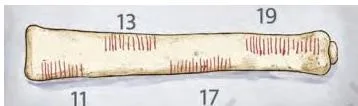
The Ishango bone carries tallies grouped as 11, 13, 17 and 19 — the prime numbers between 10 and 20 — showing that numbers were grouped deliberately tens of thousands of years ago (NCERT, p. 2).
Brahmagupta’s Rules for Zero
Brahmagupta defined zero as the result of subtracting a number from itself, then gave the operational rules in the Brāhmasphuṭasiddhānta (NCERT, p. 4):
\[ a – a = 0 \]
\[ a + 0 = a \]
\[ a – 0 = a \]
\[ a \times 0 = 0 \]
Arithmetic of Integers: Fortunes and Debts
Brahmagupta called positive numbers fortunes (dhana) and negative numbers debts (ṛiṇa), and gave the sign rules we still use (NCERT, p. 5):
\[ (-a) + (-b) = -(a + b) \]
\[ (-a) \times b = -(ab) \]
\[ (-a) \times (-b) = ab \]

The figure shows the number line extending left of zero, where the negative numbers (debts) sit opposite the fortunes on the right (NCERT, p. 5).
Rational Numbers: Definition and Operations
A rational number is any number expressible as \( \frac{p}{q} \), where \( p \) and \( q \) are integers and \( q \neq 0 \) (NCERT, pp. 6–7). The standard form uses co-prime \( p \) and \( q \); for example, \( -\frac{1}{3} = -\frac{2}{6} = -\frac{3}{9} = \dots \) are equivalent fractions.
Equality of two rationals:
\[ \frac{a}{b} = \frac{c}{d} \iff ad = bc \]
Addition and subtraction with the same denominator:
\[ \frac{a}{b} + \frac{c}{b} = \frac{a + c}{b} \]
\[ \frac{a}{b} – \frac{c}{b} = \frac{a – c}{b} \]
Multiplication and division:
\[ \frac{a}{b} \times \frac{c}{d} = \frac{ac}{bd} \quad (b \neq 0, d \neq 0) \]
\[ \frac{a}{b} \div \frac{c}{d} = \frac{a}{b} \times \frac{d}{c} = \frac{ad}{bc} \quad (b \neq 0, d \neq 0, c \neq 0) \]
Commutativity and distributivity:
\[ \frac{a}{b} + \frac{c}{d} = \frac{c}{d} + \frac{a}{b} \]
\[ \frac{a}{b} \times \frac{c}{d} = \frac{c}{d} \times \frac{a}{b} \]
\[ p(q + r) = pq + pr \]
Rational numbers are closed under addition, subtraction and multiplication, and under division except by zero (NCERT, p. 7).
Representing Rational Numbers on the Number Line
To locate \( \frac{p}{q} \) on the number line, divide the unit interval into \( q \) equal parts and move \( p \) parts — right for positive, left for negative (NCERT, pp. 10–11).



Integers sit at equal distances (first figure); rationals fill the spaces between them (second figure). The third applies the rule: four equal parts between 0 and 1, then three parts right, gives \( \frac{3}{4} \).
Absolute Value and Distance
The absolute value \( |x| \) is the distance of \( x \) from 0 on the number line, so it is never negative (NCERT, p. 11):
\[ |x| = x \text{ if } x \geq 0 \]
\[ |x| = -x \text{ if } x \lt 0 \]
\[ |a – b| = \text{distance between } a \text{ and } b \]

For example, \( \left| \frac{5}{3} \right| = \frac{5}{3} \) and \( \left| -\frac{5}{3} \right| = \frac{5}{3} \). The figure shows the distance between -4 and 3 as \( |3 – (-4)| = 7 \).
Density of Rational Numbers
Between any two rationals there is always another rational — their average (NCERT, p. 12):
\[ \frac{a + b}{2} \text{ is a rational number between } a \text{ and } b \]

The figure shows the average of 1 and \( \frac{3}{2} \) giving \( \frac{5}{4} \), which lies between them. Because this works for any two rationals, there are infinitely many rational numbers between any two points.
Irrational Numbers: The Diagonal of a Unit Square
By the Baudhāyana–Pythagoras theorem, the diagonal \( d \) of a unit square satisfies (NCERT, p. 13):
\[ d^2 = 1^2 + 1^2 = 2 \Rightarrow d = \sqrt{2} \]
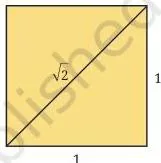
The length \( \sqrt{2} \) cannot be written as \( \frac{p}{q} \). The proof by contradiction, first given by Hippasus (c. 400 BCE), assumes \( \sqrt{2} = \frac{p}{q} \) in lowest terms:
\[ 2q^2 = p^2 \Rightarrow p \text{ even} \Rightarrow p = 2k \Rightarrow q^2 = 2k^2 \Rightarrow q \text{ even} \]
But \( p \) and \( q \) cannot both be even if the fraction is in lowest terms — a contradiction. Hence \( \sqrt{2} \) is irrational (NCERT, pp. 13–15).
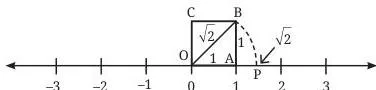
The construction shows how \( \sqrt{2} \) is located on the number line: draw a perpendicular of length 1 at the point 1, join it to the origin (length \( \sqrt{2} \)), and swing that length down with a compass to mark the point (NCERT, p. 16).
Pi and Madhava’s Infinite Series
An irrational number cannot be written as a single fraction; it needs an infinite sum. Mādhava of Sangamagrama discovered the exact series (NCERT, p. 16):
\[ \pi = 4\left(1 – \frac{1}{3} + \frac{1}{5} – \frac{1}{7} + \dots\right) \]
Āryabhaṭa (499 CE) gave the approximation \( \frac{3927}{1250} = 3.1416 \), calling it asanna (approximation); Lambert proved \( \pi \) irrational in 1761.
Decimal Expansions: Terminating and Repeating
Every rational number has a terminating or repeating decimal. To predict which without dividing, reduce \( \frac{p}{q} \) to lowest terms and factorise \( q \) (NCERT, p. 18):
\[ \frac{p}{q} \text{ terminates } \iff \text{every prime factor of } q \text{ is 2 or 5} \]
For example, \( \frac{3}{20} = \frac{3}{2^2 \times 5} = \frac{15}{100} = 0.15 \) terminates, while \( \frac{5}{11} = 0.\overline{45} \) repeats. Irrational decimals such as \( \sqrt{2} = 1.41421\dots \) never end and never repeat.
Converting Repeating Decimals to p/q
Pure repeating decimal — the block repeats immediately after the point. Let \( x = 0.\overline{d_1 d_2 \dots d_n} \), multiply by \( 10^n \), and subtract the original equation (NCERT, pp. 19–20):
\[ 10^n x – x = \text{an integer} \]
General repeating decimal — non-repeating digits first. Multiply by \( 10^m \) (m = number of non-repeating digits), then by \( 10^n \) (n = number of repeating digits), and subtract the two shifted equations.
A terminating decimal converts directly: \( 0.35 = \frac{35}{100} = \frac{7}{20} \). Special case: \( 0.\overline{9} = 1 \) exactly, because \( 10x – x = 9 \) gives \( x = 1 \).
Cyclic Numbers
The repeating block of \( \frac{1}{7} \) is 142857. Multiplying it by 1 through 6 rotates the same digits in a cycle (NCERT, p. 21):
\[ 142857 \times 2 = 285714 \]
\[ 142857 \times 3 = 428571 \]
Real Numbers: Rationals and Irrationals Together
Together, the rational and irrational numbers make up the entire real number line (NCERT, p. 23):
\[ \mathbb{R} = \mathbb{Q} \cup \mathbb{I} \]
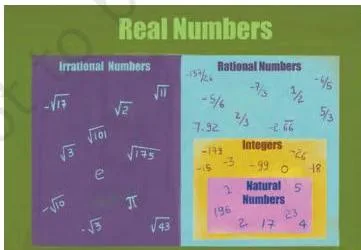
The figure shows the growth of the number system: natural numbers inside integers, integers inside rationals, and rationals joined by irrationals to form the continuous real line.
What Each Symbol Means
This chapter is pure mathematics, so the “unit” column below gives the nature of each quantity rather than a physical unit.
| Symbol | What it means | Nature / unit |
|---|---|---|
| \( a, b, c, d \) | numbers (integers or rationals) appearing in the arithmetic rules | number |
| \( p, q \) | numerator and denominator of a rational number | integers, \( q \neq 0 \) |
| \( n \) | number of digits in the repeating block of a decimal | whole-number count |
| \( m \) | number of non-repeating digits after the decimal point | whole-number count |
| \( k \) | integer such that \( p = 2k \) in the \( \sqrt{2} \) proof | integer |
| \( \mathbb{N} \) | natural numbers \( \{1, 2, 3, \dots\} \) | set of counting numbers |
| \( \mathbb{Z} \) | integers \( \{\dots, -2, -1, 0, 1, 2, \dots\} \) | set |
| \( \mathbb{Q} \) | rational numbers \( \frac{p}{q} \) | set |
| \( \mathbb{I} \) | irrational numbers such as \( \sqrt{2} \) and \( \pi \) | set |
| \( \mathbb{R} \) | real numbers \( = \mathbb{Q} \cup \mathbb{I} \) | set |
| \( |x| \) | absolute value of \( x \) — its distance from 0 | non-negative number |
| \( d \) | diagonal length of a unit square | length (unit length) |
| \( \pi \) | ratio of a circle’s circumference to its diameter | dimensionless ratio |
When to Use Each Formula
Reach for each formula in the situation named below; the condition column is the check before you apply it.
| Formula | Use it when… | Condition |
|---|---|---|
| \( a – a = 0 \) | a number is subtracted from itself | \( a \) is any number |
| \( a + 0 = a \), \( a – 0 = a \), \( a \times 0 = 0 \) | simplifying expressions that contain zero | \( a \) is any number |
| \( (-a) + (-b) = -(a + b) \) | adding two negative numbers (two debts) | both numbers negative |
| \( (-a) \times b = -(ab) \) | multiplying numbers of opposite signs | signs differ |
| \( (-a) \times (-b) = ab \) | multiplying two negative numbers | signs same |
| \( \frac{p}{q} \), \( q \neq 0 \) | deciding whether a number is rational | \( p, q \) integers |
| \( ad = bc \) | testing whether two fractions are equal | \( b \neq 0, d \neq 0 \) |
| \( \frac{a}{b} \pm \frac{c}{b} = \frac{a \pm c}{b} \) | adding or subtracting fractions with the same denominator | \( b \neq 0 \) |
| \( \frac{a}{b} \times \frac{c}{d} = \frac{ac}{bd} \) | multiplying any two fractions | \( b \neq 0, d \neq 0 \) |
| \( \frac{a}{b} \div \frac{c}{d} = \frac{ad}{bc} \) | dividing fractions — keep the first, flip the second | \( b \neq 0, d \neq 0, c \neq 0 \) |
| \( p(q + r) = pq + pr \) | expanding brackets or simplifying a product of a number and a sum | \( p, q, r \) rational |
| \( |a – b| \) | finding the distance between two points on the number line | result is always \( \geq 0 \) |
| \( \frac{a + b}{2} \) | generating a rational number between two given rationals | \( a, b \) rational |
| \( d = \sqrt{2} \) | finding the diagonal of a unit square — the classic irrational length | side = 1 unit |
| \( \pi = 4\left(1 – \frac{1}{3} + \frac{1}{5} – \dots\right) \) | expressing \( \pi \) exactly as an infinite sum | infinite series |
| terminating test | predicting whether a decimal terminates, without long division | \( \frac{p}{q} \) in lowest terms |
| \( 10^n x – x = N \) | converting a pure repeating decimal to \( \frac{p}{q} \) | \( n \) = number of repeating digits |
Worked Examples
Three original examples showing how to select the right formula, substitute, and check the answer.
Example 1: Applying the division rule for rational numbers
Compute \( \left(-\frac{2}{3}\right) \div \frac{4}{9} \).
- Step 1: Select the division rule \( \frac{a}{b} \div \frac{c}{d} = \frac{a}{b} \times \frac{d}{c} \), valid for \( b \neq 0, d \neq 0, c \neq 0 \).
- Step 2: Keep the first fraction and flip the second: \( \left(-\frac{2}{3}\right) \times \frac{9}{4} \).
\[ \left(-\frac{2}{3}\right) \times \frac{9}{4} = \frac{-2 \times 9}{3 \times 4} = \frac{-18}{12} \]
Step 3: Reduce by the common factor 6: \( \frac{-18}{12} = -\frac{3}{2} \).
Final answer: \( \left(-\frac{2}{3}\right) \div \frac{4}{9} = -\frac{3}{2} \). Check: \( -\frac{3}{2} \times \frac{4}{9} = -\frac{12}{18} = -\frac{2}{3} \), the original number.
Example 2: Converting a general repeating decimal to p/q
Convert \( 0.2\overline{7} \) to the form \( \frac{p}{q} \).
Step 1: Let \( x = 0.2\overline{7} \).
One digit (2) is non-repeating and one digit (7) repeats.
- Step 1: Multiply by \( 10^1 = 10 \) to move the non-repeating digit: \( 10x = 2.\overline{7} \).
- Step 2: Multiply by 10 again to move one full repeating cycle: \( 100x = 27.\overline{7} \).
- Step 3: Subtract the two shifted equations:
\[ 100x – 10x = 27.\overline{7} – 2.\overline{7} \Rightarrow 90x = 25 \]
Step 5: Solve and reduce: \( x = \frac{25}{90} = \frac{5}{18} \).
Final answer: \( 0.2\overline{7} = \frac{5}{18} \). Check: \( 5 \div 18 = 0.2777\dots \).
Example 3: Density — a rational between two rationals
Find a rational number between \( \frac{1}{3} \) and \( \frac{1}{2} \).
Step 1: Use the density rule: the average \( \frac{a + b}{2} \) of two rationals is rational and lies between them.
\[ \frac{\frac{1}{3} + \frac{1}{2}}{2} = \frac{\frac{2}{6} + \frac{3}{6}}{2} = \frac{\frac{5}{6}}{2} = \frac{5}{12} \]
Step 2: Verify the order: \( \frac{1}{3} = \frac{4}{12} \lt \frac{5}{12} \lt \frac{6}{12} = \frac{1}{2} \).
Final answer: \( \frac{5}{12} \) lies between \( \frac{1}{3} \) and \( \frac{1}{2} \).
These examples follow the same pattern as the NCERT exercise sets. For formula sheets from other chapters and classes, browse the Maths Formulas index.
Common Mistakes to Avoid
| Mistake | Correct rule | How to check your answer |
|---|---|---|
| Writing \( \frac{5}{0} \) as a rational number | \( \frac{p}{q} \) is rational only when \( q \neq 0 \); division by zero is undefined | If the denominator is 0, the expression is not a number |
| Flipping the first fraction when dividing: \( \frac{2}{3} \div \frac{4}{9} = \frac{3}{2} \times \frac{4}{9} \) | Keep the first fraction, flip the second: \( \frac{a}{b} \div \frac{c}{d} = \frac{a}{b} \times \frac{d}{c} \) | Multiply your answer by \( \frac{c}{d} \); you must recover \( \frac{a}{b} \) |
| Testing the terminating rule without reducing: \( \frac{3}{30} \) has \( q = 30 = 2 \times 3 \times 5 \), so it is called non-terminating | Reduce \( \frac{p}{q} \) to lowest terms first, then check the prime factors of \( q \) | \( \frac{3}{30} = \frac{1}{10} = 0.1 \), which terminates |
| Multiplying by 10 when two digits repeat: for \( 0.\overline{45} \), writing \( 10x = 4.\overline{45} \) | Multiply by \( 10^n \), where \( n \) is the number of repeating digits; for \( 0.\overline{45} \) use \( 10^2 = 100 \) | After subtracting, the repeating tails must cancel exactly |
| Writing \( |a – b| = a – b \) without checking the order | \( |a – b| \) is always non-negative; if \( a \lt b \), then \( |a – b| = b – a \) | The distance between 3 and -4 is 7, never -7 |
Frequently Asked Questions
Why must q be non-zero in the definition of a rational number p/q?
Division by zero is undefined: no number multiplied by 0 gives a non-zero numerator, and \( a \times 0 = 0 \) for every number \( a \). So \( \frac{p}{0} \) cannot represent any quantity, and the definition excludes it (NCERT, p. 7).
Why does a negative times a negative equal a positive?
Think of removing a debt. If a debt of ₹3 is written as -3, then removing four such debts — multiplying by -4 — makes you ₹12 richer: \( (-3) \times (-4) = 12 \) (NCERT, p. 6).
How can I tell whether a decimal terminates without doing long division?
Reduce \( \frac{p}{q} \) to lowest terms and factorise \( q \). If its prime factors are only 2, only 5, or both 2 and 5, the decimal terminates; any other prime factor makes it repeat (NCERT, p. 18).
Why is the square root of 2 irrational?
Assume \( \sqrt{2} = \frac{p}{q} \) in lowest terms. Squaring gives \( 2q^2 = p^2 \), so \( p \) is even; write \( p = 2k \). Then \( q^2 = 2k^2 \), so \( q \) is even too. But \( p \) and \( q \) cannot both be even if the fraction is in lowest terms — a contradiction. So \( \sqrt{2} \) cannot be written as \( \frac{p}{q} \) (NCERT, pp. 13–15).
All formulas on this sheet follow the Rationalised NCERT Class 9 Mathematics textbook (Ganita Manjari), Chapter 3. You can verify any rule against the official PDF on the NCERT website.
Reference: NCERT Class 9 Mathematics textbook, chapter The Dawn of Mathematics: the Human Need to Count.
Explore Class 9 Maths Formulas
Class 9 Maths on LearnCBSE:
Related chapters: