
Looking for orienting yourself the use of coordinates class 9 notes? This page condenses Chapter 1 of the Ganita Manjari Mathematics textbook (Rationalised NCERT edition) into a quick-revision pack: the axes and origin, quadrant sign rules, the distance formula with full working, common errors, and exam pointers. Everything here follows the current academic session’s syllabus.
Use the index below to jump straight to any section, or read top to bottom for the whole chapter in one pass. For the full original text, download the official NCERT textbook PDF (iemh101).
Orienting Yourself the Use of Coordinates Class 9 Notes — Chapter Overview
A coordinate system is a structured grid that lets you describe the exact position of any point with numbers (NCERT, p. 1). This chapter builds that system in two steps: first you learn the grid itself — axes, origin, quadrants — then you learn to measure distances inside it.
The idea is ancient. The Sindhu-Sarasvati civilisation laid out city streets along North–South and East–West lines at uniform intervals, and the scholar Baudhāyana (c. 800 CE) used such lines for his geometric constructions, developing the Baudhāyana–Pythagoras theorem on which this chapter’s distance formula rests (NCERT, p. 1).
The system reached its modern form when René Descartes (1637) showed that any point in a plane can be fixed by just two numbers measured from two perpendicular axes (NCERT, p. 1).
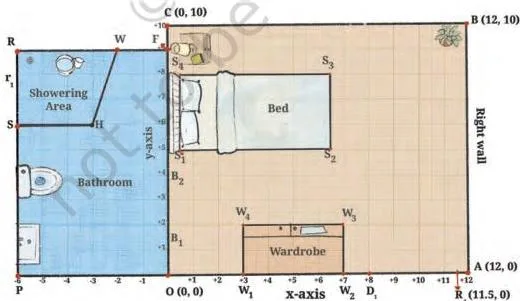
The chapter opens with a story: Shalini uses a pin-and-thread grid on a 1 cm : 1 foot scale to help her brother Reiaan find his way around a new room (NCERT, p. 2). The floor sketch below shows how the corners of furniture sit on simple grid points.
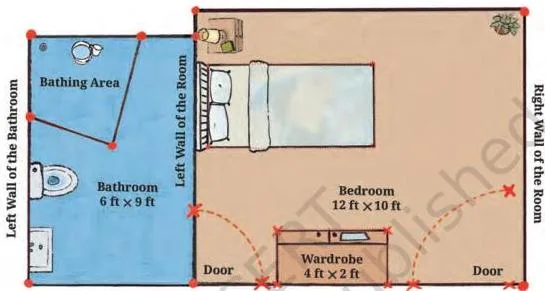
Here is how the chapter’s topics map to the textbook, so you know what each section covers.
| Topic | Textbook page | Covered in this page |
|---|---|---|
| Grid thinking and history (Sindhu-Sarasvati, Baudhāyana, Ujjayinī) | p. 1 | Chapter Overview |
| Reiaan’s room and the floor sketch | p. 2 | Chapter Overview |
| The 2-D Cartesian coordinate system: axes, origin | p. 3 | Coordinate Axes |
| Reading points and axis conventions | p. 4 | Coordinate Axes |
| Quadrants and sign conventions | p. 5–6 | Quadrants |
| Placing objects with coordinates (furniture) | p. 7 | Exam Notes |
| Distance between two points | p. 8–11 | Distance and Worked Examples |
| End-of-chapter exercises | p. 12–14 | Exam Notes |
| Chapter summary | p. 14–15 | Chapter Summary |
If you want the same treatment for the rest of the course, browse the Class 9 Mathematics notes or the full CBSE notes library. For other subjects, head to the Class 9 notes section.
The Coordinate Axes and the Origin
The two-dimensional coordinate system (2-D space) uses two number lines at right angles to each other (NCERT, p. 3). One line is horizontal and is called the x-axis; the other is vertical and is called the y-axis. Their point of intersection is the origin, written O, with coordinates (0, 0).
Distances are marked in equal units on both axes. Distances to the right of O or upwards from O are positive; distances to the left or downwards are negative (NCERT, p. 3).
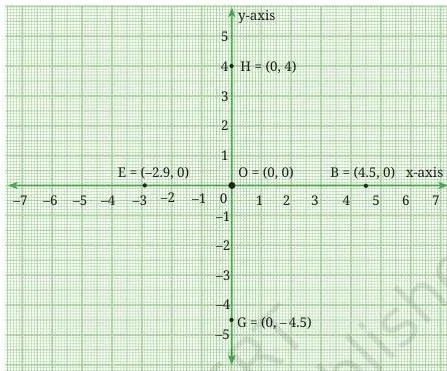
Working the rules from the figure (NCERT, p. 4):
- B = (4.5, 0) lies on the x-axis, 4.5 units to the right of O.
- G = (0, –4.5) lies on the y-axis, 4.5 units below O.
- H = (0, 4) lies on the y-axis, 4 units above O.
- In general, P = (x, 0) is on the x-axis, and P = (0, y) is on the y-axis.
The axes are perpendicular so every position reads as a right triangle from the reference lines — that perpendicularity is exactly what makes the distance formula work later in the chapter.
Key Concepts and Definitions
Here are the chapter’s core terms in one table (NCERT, pp. 3–6).
| Term | Meaning | Example |
|---|---|---|
| Origin | The point where the x-axis and y-axis cross; coordinates (0, 0) | O = (0, 0) |
| x-axis | The horizontal number line | Every point on it is (x, 0) |
| y-axis | The vertical number line | Every point on it is (0, y) |
| Coordinates | The ordered pair (x, y) that fixes a point’s location | (3, –5) |
| x-coordinate (abscissa) | The perpendicular distance of the point from the y-axis, measured along the x-axis | In (3, –5), it is 3 |
| y-coordinate (ordinate) | The perpendicular distance of the point from the x-axis, measured along the y-axis | In (3, –5), it is –5 |
| Quadrant | One of the four parts into which the axes divide the plane | Quadrants I, II, III, IV |
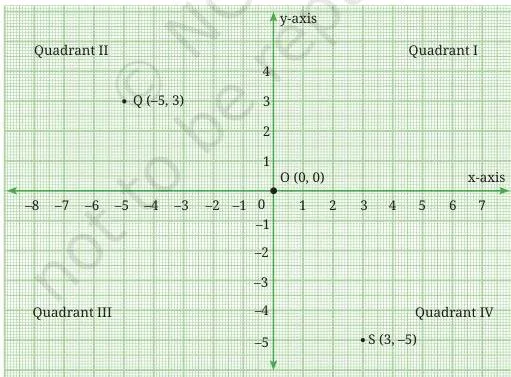
In the pair (x, y), x counts your distance from the y-axis and y counts your distance from the x-axis (NCERT, p. 6). For example, S = (3, –5) sits in Quadrant IV — 3 units right, 5 units down — while Q = (–5, 3) sits in Quadrant II, 5 units left, 3 units up (NCERT, p. 6).
Quadrants and Their Sign Conventions
Reading a point’s signs tells you instantly which quadrant it lives in. This comparison table is the one to memorise (NCERT, pp. 5–6).
| Quadrant | Sign of x | Sign of y | Where the point lies |
|---|---|---|---|
| I | + | + | Right and above the origin |
| II | – | + | Left and above the origin |
| III | – | – | Left and below the origin |
| IV | + | – | Right and below the origin |
Memory device QuPAR: Quadrant I Positive–Positive, Quadrant II Negative–Positive, Quadrant III Negative–Negative, Quadrant IV Positive–Negative. Read it aloud as: “First both plus, second minus-plus, third both minus, fourth plus-minus.”
Two cautions. First, a point lying on an axis belongs to no quadrant (NCERT, p. 5) — (x, 0) is on the x-axis and (0, y) is on the y-axis. Second, the order inside the pair matters: (x, y) equals (y, x) only when x = y (NCERT, p. 14).
Distance Between Two Points — Baudhāyana–Pythagoras Method
You already know how to measure distance along an axis: it is the plain difference |x₂ − x₁| or |y₂ − y₁|. The problem comes when the segment joining two points is not parallel to either axis (NCERT, p. 8).
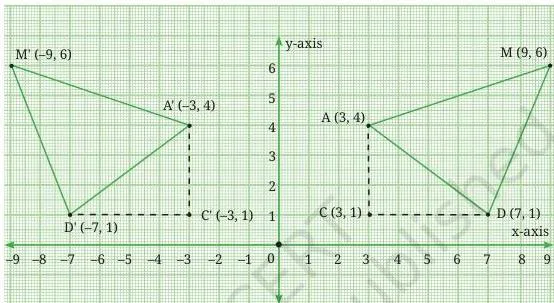
The trick is to break the slant into a right triangle. In Fig. 1.6, take A = (3, 4) and D = (7, 1):
- Horizontal shift: 7 − 3 = 4 (the distance CD).
- Vertical shift: 4 − 1 = 3 (the distance AC).
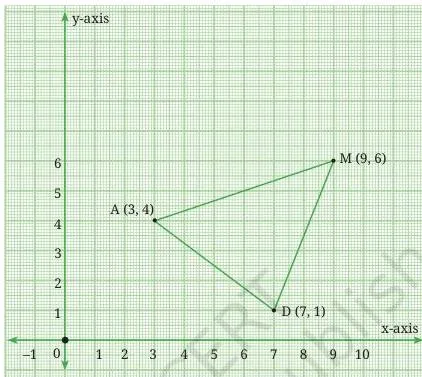
By the Baudhāyana–Pythagoras theorem (NCERT, p. 9):
\[ AD = \sqrt{4^2 + 3^2} = \sqrt{16 + 9} = 5 \text{ units} \]
The same idea gives the other two sides of the triangle: DM = √(2² + 5²) = √29 units and MA = √(6² + 2²) = √40 units (NCERT, p. 9).
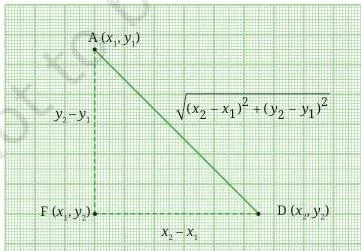
Generalised for any two points (x₁, y₁) and (x₂, y₂), the distance is (NCERT, p. 10):
\[ \text{Distance} = \sqrt{(x_2 – x_1)^2 + (y_2 – y_1)^2} \]
Why squaring makes order irrelevant: whether the shift (x₂ − x₁) is positive or negative, its square is never negative, so it does not matter which point you call “first” (NCERT, p. 10).
Misconception autopsy: “the formula only goes up and to the right”
Students often draw the two legs only in the positive directions and panic when a point has negative coordinates. Squaring absorbs direction: a segment that drops left and down gives the identical length to its mirror image.
The chapter proves this by reflecting triangle AMD in the y-axis (Fig. 1.9) — after reflection the horizontal shift is –3 –(–7) = 4 and the vertical shift is 4 – 1 = 3, so AD stays √(4² + 3²) = 5 units, unchanged (NCERT, p. 11). Reflection preserves lengths, and likewise the formula never “loses the sign” — it removes the sign by squaring.
Traffic-light memory device
To keep the formula straight, treat it like traffic lights (NCERT, p. 10):
- Red — run: find the x-difference, x₂ − x₁.
- Yellow — rise: find the y-difference, y₂ − y₁.
- Pause at amber: square both differences, then add them.
- Green — go: take the square root of that sum.
Worked Examples — Step by Step
Both examples below use entirely new numbers, so you practise the method instead of reading a memorised answer.
Example 1: Distance between A(5, –2) and B(–3, 6)
Step 1: Name the coordinates.
Let (x₁, y₁) = (5, –2) and (x₂, y₂) = (–3, 6).
Step 2: Find the horizontal shift and square it.
\[ x_2 – x_1 = -3 – 5 = -8, \quad (-8)^2 = 64 \]
Step 3: Find the vertical shift and square it.
\[ y_2 – y_1 = 6 – (-2) = 6 + 2 = 8, \quad 8^2 = 64 \]
Step 4: Add the squares and take the square root.
\[ AB = \sqrt{64 + 64} = \sqrt{128} = 8\sqrt{2} \text{ units} \]
Final answer: the distance is 8√2 units. Notice the horizontal shift was –8; squaring removed the minus, so the order of the points truly does not matter.
Example 2: Perimeter of the triangle with vertices A(–4, 1), B(2, –3), C(–1, 5)
Method: apply the distance formula to each pair of vertices, then add the three lengths. Negative coordinates are handled exactly the same — the squares absorb every sign.
Step 1: Side AB.
\[ x_2 – x_1 = 2 – (-4) = 6, \quad y_2 – y_1 = -3 – 1 = -4 \]
\[ AB = \sqrt{6^2 + (-4)^2} = \sqrt{36 + 16} = \sqrt{52} = 2\sqrt{13} \text{ units} \]
Step 2: Side BC.
\[ x_2 – x_1 = -1 – 2 = -3, \quad y_2 – y_1 = 5 – (-3) = 8 \]
\[ BC = \sqrt{(-3)^2 + 8^2} = \sqrt{9 + 64} = \sqrt{73} \text{ units} \]
Step 3: Side CA.
\[ x_2 – x_1 = -4 – (-1) = -3, \quad y_2 – y_1 = 1 – 5 = -4 \]
\[ CA = \sqrt{(-3)^2 + (-4)^2} = \sqrt{9 + 16} = \sqrt{25} = 5 \text{ units} \]
Step 4: Add the three sides.
\[ \text{Perimeter} = 2\sqrt{13} + \sqrt{73} + 5 \text{ units} \]
Final answer: the triangle’s perimeter is (2√13 + √73 + 5) units.
Common Mistakes and Their Fixes
| Mistake | Correct rule | How to check your answer |
|---|---|---|
| Swapping the coordinates: writing (5, –2) instead of (–2, 5) | The first number is always the x-coordinate (distance from the y-axis); the second is the y-coordinate | Plot the point — a quick sketch shows you placed it on the wrong side of the axes |
| Forgetting to square the differences | Square both (x₂ − x₁) and (y₂ − y₁) before adding | If your answer came from |x₂ − x₁| + |y₂ − y₁| without squares, redo it — squaring changes the value |
| Adding instead of subtracting coordinates (using x₁ + x₂) | Always subtract: x₂ − x₁ and y₂ − y₁, then square | Test on a simple vertical pair like (0, 0) and (0, 4) — the correct distance is 4 |
| Misidentifying the quadrant from the signs | Check the sign of x first (right positive, left negative), then y (up positive, down negative) | Sketch the point; right-and-below the origin can only be Quadrant IV |
Exam-Worthy Notes
Patterns the end-of-chapter problems repeatedly test (NCERT, pp. 12–14):
- Name the quadrant for a given point — a one-line sign question. Remember that a point on an axis, like R(3, 0), sits in no quadrant.
- Collinearity by distances: to check whether M(–3, –4), A(0, 0) and G(6, 8) lie on one straight line, compute the three distances and show that the sum of the two smaller equals the largest. That explicit check is the step that earns the mark.
- Midpoint and trisection ideas (starred problems 9–13): M is the midpoint of segment ST when its coordinates are the averages of S’s and T’s coordinates; points P and Q trisect AB at one-third and two-thirds of the way along it.
- Points on an axis: the x-coordinate of any point on the y-axis is 0, and the y-coordinate of any point on the x-axis is 0.
Real-life application — the city street model. Two main roads cross at the city centre, one running North–South and the other East–West, with all other streets parallel to them and 200 m apart (NCERT, p. 12). An intersection is named by (N, E): the 2nd North–South street meeting the 5th East–West street is called (2, 5).
That pair of numbers locates an address with pinpoint accuracy — the same counting idea that places furniture in Reiaan’s room (NCERT, p. 2) and in Exercise Set 1.2, where a study table sits with three feet at (8, 9), (11, 9) and (11, 7) and the fourth foot must close the rectangle at (8, 7) (NCERT, p. 7).
Chapter Summary
- To locate a point in a plane you need two perpendicular lines — one horizontal (the x-axis), one vertical (the y-axis) (NCERT, p. 14).
- The two axes together make the Cartesian plane, the coordinate plane, or the xy-plane.
- The axes meet at the origin, O = (0, 0).
- The axes divide the plane into four quadrants, numbered anticlockwise I to IV.
- For a point (x, y): x is its distance from the y-axis measured along the x-axis; y is its distance from the x-axis measured along the y-axis.
- Points on the x-axis have the form (x, 0); points on the y-axis have the form (0, y).
- Quadrant signs: I (+, +), II (–, +), III (–, –), IV (+, –). Mnemonic: QuPAR.
- (x, y) = (y, x) only when x = y; otherwise the order matters.
- Distance along an axis is |x₂ − x₁| or |y₂ − y₁|; distance across the plane is √((x₂ − x₁)² + (y₂ − y₁)²) by the Baudhāyana–Pythagoras theorem (NCERT, p. 15).
\[ \text{Distance} = \sqrt{(x_2 – x_1)^2 + (y_2 – y_1)^2} \]
Re-read Figures 1.2 and 1.4 to fix the picture of axes and quadrants in your mind, then practise one collinearity question and one perimeter question to lock in the method. Coordinate geometry is the bridge to graphing — for the algebra that follows, see our Introduction to Linear Polynomials notes for Class 9.
Frequently Asked Questions
Why are the x- and y-axes perpendicular?
Perpendicular axes give a uniform grid, so every position is measured as the two legs of a right triangle from the reference lines. That right-angle structure is exactly what lets the Baudhāyana–Pythagoras theorem turn the two shifts into a distance (NCERT, p. 8). With slanted axes the same formula would not hold.
How do I remember the quadrant signs?
Use QuPAR: Quadrant I Positive–Positive, II Negative–Positive, III Negative–Negative, IV Positive–Negative. In words: “First both plus, second minus-plus, third both minus, fourth plus-minus.”
What does a negative coordinate mean?
Distances to the left of the origin are negative x-coordinates, and distances below it are negative y-coordinates (NCERT, p. 3). So (–2, 5) is 2 units left and 5 units up — in Quadrant II.
What is the difference between distance on an axis and distance in the plane?
On an axis the distance is a straight difference — |x₂ − x₁| or |y₂ − y₁|. In the plane, when the segment is not parallel to an axis, you combine both shifts using the square-root formula √((x₂ − x₁)² + (y₂ − y₁)²) (NCERT, p. 10).
What happens if I mix up the coordinates of a point (x, y)?
You describe a different point. (x, y) equals (y, x) only when x = y (NCERT, p. 14). Mixing them places the point in a completely different location — (5, –2) is right-and-below the origin, while (–2, 5) is left-and-above it.
Reference: NCERT Class 9 Mathematics textbook (Ganita Manjari), chapter Orienting Yourself: The Use of Coordinates.
Explore Class 9 Mathematics Notes
More for this chapter:
Class 9 Mathematics on LearnCBSE:
Related chapters: