
Welcome to these measuring space perimeter and area class 9 notes — your revision companion for Chapter 6 of the NCERT Ganita Manjari textbook. This page compresses the full chapter into definitions, formulas, worked examples, and exam pointers so you can revise the night before a test. Every formula below is grounded in the NCERT textbook and page-referenced.
Chapter 6 in one look: from the relay stagger to Brahmagupta’s formula
Chapter 6 opens with a puzzle: why do athletes in outer lanes start ahead of inner lanes in a 4 × 100 m relay? Answering that requires the perimeter of a circle. The chapter then builds a full toolkit of perimeter and area formulas.
The route through the chapter:
- Perimeter of polygons (square, equilateral triangle, rectangle)
- The constant \( C/D \) ratio — pi — and its history
- Arc length as a fraction of the circumference
- The 400 m track stagger — the opening puzzle solved
- Area of rectangle, parallelogram, triangle
- Heron’s formula — area from three sides alone
- Brahmagupta’s formula — area of a cyclic 4-gon
- Area of a circle and sectors, with segments
Perimeter of polygons: one definition and three formulas
The perimeter of a shape is the total length around its border. NCERT uses a vivid image: imagine a tiny insect walking around the border, never turning back, until it returns to its start — the distance it travels is the perimeter (NCERT, p. 119).
- Square with side \( a \): perimeter \( = 4a \)
- Equilateral triangle with side \( a \): perimeter \( = 3a \)
- Rectangle with length \( a \) and width \( b \): perimeter \( = 2(a + b) \)
The square is a special case of the rectangle: put \( a = b \) in \( 2(a + b) \) and you get \( 2(2a) = 4a \).
Why the ratio idea matters: for squares, the ratio perimeter : side is always \( 4:1 \), no matter the size. For equilateral triangles it is always \( 3:1 \). This fixed-ratio idea sets up the key question: is the ratio of a circle’s circumference to its diameter also fixed? That question leads straight to pi (NCERT, p. 120).
Circumference: the constant C/D ratio that the world calls pi
The circumference is simply the perimeter of a circle (NCERT, p. 120). The critical fact: for every circle, the ratio of circumference \( C \) to diameter \( D \) is the same constant. We call this constant \( \pi \) (NCERT, p. 120).
Why is the ratio constant? Because all circles are similar — scaling a circle up multiplies both circumference and diameter by the same factor, so their ratio stays fixed. This mirrors the square’s fixed \( 4:1 \) ratio (NCERT, p. 120).
NCERT suggests a home experiment: wrap thin thread around a cotton reel, measure the diameter, unwrap, and compute length \( \div \) diameter — you should get a value between 3 and 4 (NCERT, p. 121).
A table of pi approximations through history
| Civilisation / Mathematician | Approximation | Notes |
|---|---|---|
| Mesopotamia (c. 1900 BCE) | \( 3 + \frac{1}{8} = 3.125 \) | Compared circle with inscribed hexagon |
| Archimedes (c. 250 BCE) | \( 3\frac{10}{71} \lt \pi \lt 3\frac{1}{7} \) | Used inscribed and circumscribed polygons up to 96 sides |
| Zu Chongzhi (480 CE) | \( \frac{355}{113} \approx 3.1415929 \) | Best fraction for over 800 years |
| Āryabhaṭa (499 CE) | \( \frac{62832}{20000} = 3.1416 \) | Called it asanna — ‘approaching’ |
| Mādhava (c. 1400 CE) | \( \frac{\pi}{4} = 1 – \frac{1}{3} + \frac{1}{5} – \frac{1}{7} + \cdots \) | First exact infinite series formula |
This table is drawn from the chapter’s history section (NCERT, pp. 121–124). The key takeaways: pi is irrational — it cannot be written as a ratio of two integers (proved by Lambert in 1761) — so there is no ‘best fraction’ for pi.
The common \( \frac{22}{7} \) is a good approximation but not equal to pi, so we write \( \pi \approx \frac{22}{7} \) and also \( \pi \neq \frac{22}{7} \) (NCERT, p. 124).
Memory device for pi digits: “How I wish I could recollect pi” — count letters: 3, 1, 4, 1, 5, 9, 2 (NCERT, p. 125).
Arc length: taking a fraction of the circumference
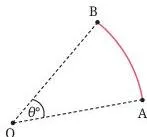
The circumference is \( 2\pi r \). An arc is a portion of the circumference. If the arc subtends an angle \( \theta^\circ \) at the centre, it is the fraction \( \frac{\theta}{360} \) of the whole circle.
\[ \text{Arc length} = 2\pi r \times \frac{\theta^\circ}{360^\circ} \]
Why this works: the full circle is 360°; the arc takes the fraction \( \frac{\theta}{360} \) of the circumference, just as the semicircle (180°) takes half: \( 2\pi r \times \frac{180}{360} = \pi r \) (NCERT, p. 126). Check the quarter circle: \( 2\pi r \times \frac{90}{360} = \frac{\pi r}{2} \) (NCERT, p. 126).
Units: if \( r \) is in cm, arc length is in cm — it is a length, not an area.
The 400 m track: how the stagger comes out of the circle formula
The chapter’s opening question — why athletes start at different positions — is answered by applying the circumference formula to a real track (NCERT, p. 127).
Given data (NCERT, p. 127):
- Straight sections: 84.39 m each (total 168.78 m)
- Inner semicircle radius: 36.5 m
- Lane width: 1.22 m
- Runner runs 0.3 m from the inner border
One lap for the inner-lane runner:
- Straights: \( 2 \times 84.39 = 168.78 \) m
- Running radius: \( 36.5 + 0.3 = 36.8 \) m
- Two semicircles = one full circle: \( 2 \times 3.1416 \times 36.8 = 231.22 \) m
- Total: \( 168.78 + 231.22 = 400 \) m ✓
A runner in the second lane runs on a larger circle (radius greater by the lane width), so on the curved portions she runs farther. The stagger compensates for this extra distance. The stagger between lanes is \( 2\pi \times \text{lane width} = 2\pi \times 1.22 \approx 7.67 \) m (NCERT, p. 127–128).
Combined shapes: two perimeter puzzles that sharpen arc addition
Example 1: Two circles through each other’s centres
Two circles of radius \( r \), each passing through the other’s centre, intersect at points C and D. The triangle ABC is equilateral (all sides \( r \)), so each angle is 60°. Hence \( \angle CAD = 120^\circ \).
Each red arc is \( \frac{120}{360} = \frac{1}{3} \) of its circle — but the perimeter has two red arcs, each \( \frac{2}{3} \) of a circle, so the total is \( 2 \times \frac{2}{3} \times 2\pi r = \frac{8}{3}\pi r \) (NCERT, p. 128–129).
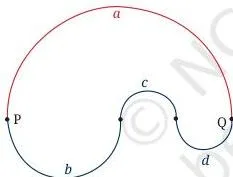
Example 2: Semicircle path versus three semicircles
Path a is a single semicircle; path b + c + d is three smaller semicircles along the same diameter. Let the radii be \( a’, b’, c’, d’ \). Path a has length \( \pi a’ \); the other path has length \( \pi(b’ + c’ + d’) \). Since the diameter \( 2a’ = 2b’ + 2c’ + 2d’ \), we get \( a’ = b’ + c’ + d’ \).
So both paths are equal in length (NCERT, p. 129).
Key insight: the fraction-of-circumference idea lets you break any arc into pieces — the total length is the sum of the pieces.
Area of rectangles, parallelograms and triangles: one cut-and-paste idea
Area measures the space a 2-D region occupies. The unit is a \( 1 \times 1 \) square, whose area is \( 1 \) sq unit. A rectangle with sides \( a \) and \( b \) has area \( ab \) sq units (NCERT, p. 131).
Parallelogram: cut and shift
A parallelogram can be transformed into a rectangle by cutting off a right triangle from one end and shifting it to the other. The resulting rectangle has the same base \( b \) and height \( h \) — so area \( = \text{base} \times \text{height} = bh \) (NCERT, p. 131–132).
Warning: you cannot find a parallelogram’s area from its side lengths alone — you need the perpendicular height (NCERT, p. 132).
Triangle: two congruent copies make a parallelogram
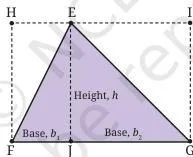
Two congruent triangles fit together to form a parallelogram, so the triangle’s area is half: \( \text{Area} = \frac{1}{2} \times \text{base} \times \text{height} = \frac{1}{2}bh \) (NCERT, p. 133).
Median theorem: a median of a triangle divides it into two equal-area triangles. Since the two halves have equal bases (the midpoint splits the side) and the same height, \( \frac{1}{2} \times \frac{b}{2} \times h = \frac{1}{2} \times \frac{b}{2} \times h \) — equal areas (NCERT, p. 134).
Heron’s formula: a triangle’s area without knowing its height
Heron’s formula finds a triangle’s area knowing only its three side lengths (NCERT, p. 135).
- Step 1: Compute the semi-perimeter \( s = \frac{1}{2}(a + b + c) \).
- Step 2: Apply the formula:
\[ \text{Area} = \sqrt{s(s-a)(s-b)(s-c)} \]
Memory device for Heron’s formula: “Half the sum first, then every side subtracted, all multiplied, then square root.” Think of \( s \) minus each side, multiplied together, inside the root.
Why it works: Heron’s formula is verified in the textbook against known cases — the equilateral triangle (giving \( \frac{\sqrt{3}}{4}a^2 \)), the isosceles triangle (giving \( b\sqrt{a^2 – b^2} \)), and a 3-4-5 right triangle (giving 6 sq units) — each matching the half-base-times-height result (NCERT, pp. 135–137).
Two related formulas connect triangle area to circles (NCERT, p. 137):
- With circumcircle radius \( R \): \( \text{Area} = \frac{abc}{4R} \)
- With incircle radius \( r \): \( \text{Area} = \frac{r(a + b + c)}{2} \)
Here \( a, b, c \) are the triangle’s sides; the circumcircle passes through all three vertices, and the incircle touches all three sides (NCERT, p. 137).
Brahmagupta’s formula: area of a cyclic 4-gon from its four sides
Three side lengths fix a triangle’s area, but four side lengths do not fix a 4-gon’s area. A rhombus with sides 3, 3, 3, 3 can be squeezed into many different shapes with different areas — try it with four rods joined at the ends (NCERT, p. 138). A cyclic 4-gon (one whose vertices lie on a circle) adds the missing condition.
Brahmagupta’s formula (NCERT, p. 138):
\[ \text{Area} = \sqrt{(s-a)(s-b)(s-c)(s-d)}, \quad s = \frac{1}{2}(a+b+c+d) \]
Why it generalises Heron: Think of a triangle as a special 4-gon whose fourth side \( d = 0 \). Then Brahmagupta’s formula becomes \( \sqrt{(s-a)(s-b)(s-c)(s-0)} = \sqrt{s(s-a)(s-b)(s-c)} \), which is exactly Heron’s formula (NCERT, p. 141). This is the chapter’s key generalisation idea.
Special cases verified in the textbook: a rectangle (gives \( ab \)) and an isosceles trapezium (gives \( (a+b)h/2 \)) — both work because all rectangles and isosceles trapezia are cyclic (NCERT, pp. 138–140).
Area of a circle: why it is pi r squared, and how sectors are sliced
Early civilisations knew area grows with the square of size. The Babylonians used \( A \approx \frac{C^2}{12} \) (since \( C^2 : A \approx 12 : 1 \)); the Egyptians used \( A \approx \left(\frac{8d}{9}\right)^2 \), which is \( \frac{256}{81}r^2 \) (NCERT, p. 145). Archimedes showed the exact constant is \( \pi \), giving \( A = \pi r^2 \) (NCERT, p. 146).
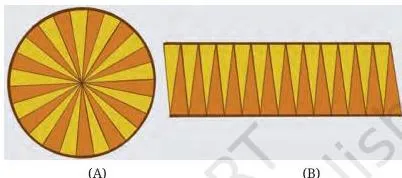
The visual proof (due to Nilakanṭha Somayāji, c. 1500): cut a circle into thin slices and rearrange them into a parallelogram-like shape. As slices get thinner, the shape approaches a parallelogram with base \( \pi r \) (half the circumference) and height \( r \). So area \( = \pi r \times r = \pi r^2 \) (NCERT, p. 147).
Sector area
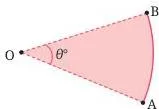
A sector is the region bounded by an arc and the two radii containing its endpoints (NCERT, p. 147). Just like arc length, sector area takes the same fraction of the circle:
\[ \text{Sector area} = \pi r^2 \times \frac{\theta^\circ}{360^\circ} \]
A segment is the region bounded by an arc and the chord joining the arc’s endpoints (NCERT, p. 148). To find a segment’s area: \[ \text{Segment area} = \text{Sector area} – \text{Triangle area} \]
Definitions that must be exact: perimeter, circumference, arc, sector, segment, semi-perimeter
| Term | Meaning | Example |
|---|---|---|
| Perimeter | Total length around a shape’s border | Square of side 5 cm has perimeter 20 cm |
| Circumference | Perimeter of a circle | Circle of radius 7 cm has circumference \( 2 \times \frac{22}{7} \times 7 = 44 \) cm |
| Arc | A portion of a circle’s circumference | Semicircle arc of radius 7 cm has length \( \frac{22}{7} \times 7 = 22 \) cm |
| Central angle | Angle an arc subtends at the circle’s centre | Quarter circle has central angle 90° |
| Semi-perimeter | Half the perimeter of a polygon | Triangle with sides 3, 4, 5 cm: \( s = 6 \) cm |
| Sector | Region bounded by an arc and its two radii | Pizza slice with 45° angle |
| Segment | Region bounded by an arc and its chord | Lens-shaped region between chord and arc |
| Cyclic 4-gon | Quadrilateral whose vertices all lie on one circle | Every rectangle and isosceles trapezium |
These definitions come from NCERT pp. 119–148.
Formula sheet: perimeter and area formulas, with what every symbol means
| Formula | What it gives | Symbols |
|---|---|---|
| \( P = 4a \) | Perimeter of square | \( a \) = side |
| \( P = 3a \) | Perimeter of equilateral triangle | \( a \) = side |
| \( P = 2(a+b) \) | Perimeter of rectangle | \( a \) = length, \( b \) = width |
| \( C = 2\pi r \) | Circumference of circle | \( r \) = radius |
| \( l = 2\pi r \times \frac{\theta}{360} \) | Arc length | \( \theta \) = central angle in degrees |
| \( A = ab \) | Area of rectangle | \( a, b \) = sides |
| \( A = bh \) | Area of parallelogram | \( b \) = base, \( h \) = perpendicular height |
| \( A = \frac{1}{2}bh \) | Area of triangle | \( b \) = base, \( h \) = height |
| \( A = \sqrt{s(s-a)(s-b)(s-c)} \) | Area of triangle (Heron) | \( s = \frac{1}{2}(a+b+c) \) |
| \( A = \sqrt{(s-a)(s-b)(s-c)(s-d)} \) | Area of cyclic 4-gon (Brahmagupta) | \( s = \frac{1}{2}(a+b+c+d) \) |
| \( A = \pi r^2 \) | Area of circle | \( r \) = radius |
| \( A = \pi r^2 \times \frac{\theta}{360} \) | Area of sector | \( \theta \) = central angle in degrees |
Use \( \pi \approx \frac{22}{7} \) unless a question says otherwise. Note: \( \frac{22}{7} \approx 3.1428 \), while \( \pi \approx 3.14159 \) — they are close but not equal.
Worked examples with original numbers
Example A: Pizza slices — arc length and sector area together
Step 1: A pizza of radius 14 cm is cut into 8 equal slices.
Each slice is a sector with \( \theta = \frac{360}{8} = 45^\circ \).
Step 2: Area of one slice: sector area \( = \pi r^2 \times \frac{\theta}{360} = \frac{22}{7} \times 14 \times 14 \times \frac{45}{360} \).
\[ = \frac{22}{7} \times 196 \times \frac{1}{8} = 616 \times \frac{1}{8} = 77 \text{ cm}^2 \]
Step 3: Crust (arc) of one slice: \( 2\pi r \times \frac{\theta}{360} = 2 \times \frac{22}{7} \times 14 \times \frac{1}{8} \).
\[ = 88 \times \frac{1}{8} = 11 \text{ cm} \]
Final answer: Each slice has area 77 cm² and crust length 11 cm.
Example B: Heron’s formula on a 13-14-15 triangle
Step 1: Sides \( a = 13 \), \( b = 14 \), \( c = 15 \) cm.
Compute semi-perimeter: \( s = \frac{13+14+15}{2} = \frac{42}{2} = 21 \) cm.
Step 2: Apply Heron: \( \text{Area} = \sqrt{21(21-13)(21-14)(21-15)} \).
\[ = \sqrt{21 \times 8 \times 7 \times 6} = \sqrt{7056} = 84 \text{ cm}^2 \]
Final answer: Area is 84 cm².
Example C: Perimeter of a sector
Step 1: Radius \( r = 10.5 \) cm, central angle \( \theta = 120^\circ \).
Arc length \( = 2\pi r \times \frac{120}{360} = 2 \times \frac{22}{7} \times 10.5 \times \frac{1}{3} \).
\[ = 2 \times 33 \times \frac{1}{3} = 22 \text{ cm} \]
Step 2: Add the two radii: \( \text{Perimeter} = 2r + \text{arc} = 21 + 22 \).
Final answer: Sector perimeter is 43 cm. Never forget the two straight radii!
Common mistakes in perimeter and area problems, with corrections
| Mistake | Correct rule | How to check your answer |
|---|---|---|
| Writing \( \pi = \frac{22}{7} \) exactly | \( \pi \approx \frac{22}{7} \) — pi is irrational, never equal to a fraction | Remember \( \frac{22}{7} \approx 3.1428 \), but \( \pi \approx 3.14159 \) |
| Sector perimeter = only the curved arc | Add the two radii: \( P = 2r + \text{arc} \) | Trace the shape — the boundary includes two straight sides |
| Parallelogram area = side × side | Area = base × perpendicular height | Height must be measured at a right angle to the base |
| Heron’s \( s \) = sum of sides | \( s \) is half the perimeter: \( s = \frac{1}{2}(a+b+c) \) | Check: \( s \) must be less than the total perimeter |
| Segment area = sector formula | Subtract triangle from sector: \( A_{\text{seg}} = A_{\text{sector}} – A_{\text{triangle}} \) | Segment is always smaller than its sector |
These are the chapter-specific traps drawn from NCERT pp. 124, 131–135, 148.
How the chapter’s exercises are likely to show up in your exam
Based on the patterns in Exercise Sets 6.1–6.3 and the end-of-chapter exercises (NCERT pp. 130, 142, 148–155), here is what to expect — stated observationally, not as a prediction:
- Direct substitution with \( \pi = \frac{22}{7} \): circumference, arc length, sector area questions give radius and angle.
- Combined shapes made of semicircles or quarter circles — calculate each piece’s perimeter or area and add.
- Sector perimeter questions that test whether you remember the two radii.
- Heron’s formula on triangles with sides given in ratio form (e.g., 3:5:7 with perimeter 300 m, NCERT p. 143).
- Show-that tasks on equal areas — often using the median theorem or comparing triangles with equal bases and heights.
Exam-wise tips:
- Write the formula line first — this earns method marks even if the arithmetic slips.
- Keep units attached at every step.
- Draw the figure before substituting; label the radius, angle, base, and height.
Revision recap: the chapter in one page
| Formula | Textbook page |
|---|---|
| Perimeter: square \( 4a \), triangle \( 3a \), rectangle \( 2(a+b) \) | p. 119 |
| Circumference \( C = 2\pi r \), \( \pi \approx \frac{22}{7} \) | pp. 120–124 |
| Arc length \( l = 2\pi r \times \frac{\theta}{360} \) | p. 126 |
| Rectangle area \( A = ab \); parallelogram \( A = bh \); triangle \( A = \frac{1}{2}bh \) | pp. 131–133 |
| Heron: \( A = \sqrt{s(s-a)(s-b)(s-c)} \) | p. 135 |
| Triangle area via circles: \( \frac{abc}{4R} \), \( \frac{r(a+b+c)}{2} \) | p. 137 |
| Brahmagupta: \( A = \sqrt{(s-a)(s-b)(s-c)(s-d)} \) | p. 138 |
| Circle area \( A = \pi r^2 \); sector \( A = \pi r^2 \times \frac{\theta}{360} \) | pp. 146–148 |
If you forget everything else, remember: perimeter is a length (cm, m), area counts unit squares (cm², m²), and pi is the circle’s circumference divided by its diameter — a constant for all circles.
Continue practising with our Class 9 Mathematics notes, explore all Class 9 subjects, or browse the full notes library. The official textbook is available from the NCERT portal if you need to check any figure or exercise directly.
Quick answers to the questions students ask before the perimeter-area exam
Why do we write pi is approximately 22/7 and also pi is not equal to 22/7?
Because \( \frac{22}{7} \approx 3.1428 \) but \( \pi \approx 3.14159 \). Since pi is irrational, no fraction equals it exactly. \( \frac{22}{7} \) is a good approximation for calculations, but the two numbers are never equal (NCERT, p. 124).
What is the difference between a sector and a segment of a circle?
A sector is bounded by an arc and two radii (like a pizza slice); a segment is bounded by an arc and the chord joining its endpoints (NCERT, pp. 147–148).
When should I use Heron’s formula instead of half base times height?
Use Heron’s formula when you know all three sides but not the height. If you can find the height (e.g., in a right-angled triangle), half base × height is quicker (NCERT, p. 135).
Why can’t I find the area of a parallelogram from just its four sides?
Because you need the perpendicular height, not the slant side. A rhombus with sides 3, 3, 3, 3 can be squeezed into many shapes with different areas — the side lengths alone don’t fix the height (NCERT, p. 132, 138).
How does Brahmagupta’s formula turn into Heron’s formula?
Set the fourth side \( d = 0 \). Then \( s = \frac{1}{2}(a+b+c) \) and the formula becomes \( \sqrt{s(s-a)(s-b)(s-c)} \), which is Heron’s formula (NCERT, p. 141).
What exactly is the stagger on a 400 m track and how is it calculated?
The stagger is the distance between starting points of adjacent lanes, compensating for the larger circle outer lanes run on. It equals \( 2\pi \times \text{lane width} \), about \( 2\pi \times 1.22 \approx 7.67 \) m for a standard track (NCERT, p. 127–128).
Reference: NCERT Class 9 Mathematics (Ganita Manjari) textbook, chapter ‘Measuring Space: Perimeter and Area’.
Explore Class 9 Mathematics Notes
- Previous: I'm Up and Down, and Round and Round
- Next: The Mathematics of Maybe: Introduction to Probability
More for this chapter:
Class 9 Mathematics on LearnCBSE:
Related chapters: