
The Vector Algebra Class 12 formulas you need for the NCERT chapter, in one lookup sheet: position vectors and magnitudes, direction cosines and direction ratios, vector addition and scalar multiplication, the section formula, dot and cross products, projections, and the areas that come from the cross product.
A vector is a quantity carrying both magnitude and direction. Each formula below comes with its symbols, units, and a when-to-use line, followed by original worked examples. For the other Class 12 chapters, see the Class 12 Maths formulas hub.
Vector Algebra Class 12 Formulas at a Glance
| Purpose (what you are finding) | Formula |
|---|---|
| Position vector of a point P(x, y, z) | \( \overrightarrow{OP} = \vec{r} = x\hat{i} + y\hat{j} + z\hat{k} \) |
| Magnitude (length) of a vector | \( |\vec{r}| = \sqrt{x^2 + y^2 + z^2} \) |
| Magnitude of the vector joining two points | \( |\overrightarrow{P_1P_2}| = \sqrt{(x_2 – x_1)^2 + (y_2 – y_1)^2 + (z_2 – z_1)^2} \) |
| Unit vector in the direction of a (valid when a is not the zero vector) | \( \hat{a} = \frac{\vec{a}}{|\vec{a}|} \) |
| Direction cosines from the coordinates of the point | \( l = \frac{x}{|\vec{r}|},\; m = \frac{y}{|\vec{r}|},\; n = \frac{z}{|\vec{r}|} \) |
| Identity linking the three direction cosines | \( l^2 + m^2 + n^2 = 1 \) |
| Direction cosines from direction ratios | \( l = \frac{a}{r},\; m = \frac{b}{r},\; n = \frac{c}{r} \) |
| Resultant of two vectors — triangle law | \( \overrightarrow{AC} = \overrightarrow{AB} + \overrightarrow{BC} \) |
| Sum of the three sides of a triangle, taken in order | \( \overrightarrow{AB} + \overrightarrow{BC} + \overrightarrow{CA} = \vec{0} \) |
| Resultant of two coinitial vectors — parallelogram law | \( \overrightarrow{OA} + \overrightarrow{OB} = \overrightarrow{OC} \) |
| Commutative law of addition | \( \vec{a} + \vec{b} = \vec{b} + \vec{a} \) |
| Associative law of addition | \( (\vec{a} + \vec{b}) + \vec{c} = \vec{a} + (\vec{b} + \vec{c}) \) |
| Magnitude after multiplication by a scalar | \( |\lambda\vec{a}| = |\lambda|\,|\vec{a}| \) |
| Distributive laws over scalars and vectors | \( k\vec{a} + m\vec{a} = (k + m)\vec{a},\; k(\vec{a} + \vec{b}) = k\vec{a} + k\vec{b} \) |
| Sum of two vectors in component form | \( \vec{a} + \vec{b} = (a_1 + b_1)\hat{i} + (a_2 + b_2)\hat{j} + (a_3 + b_3)\hat{k} \) |
| Difference of two vectors in component form | \( \vec{a} – \vec{b} = (a_1 – b_1)\hat{i} + (a_2 – b_2)\hat{j} + (a_3 – b_3)\hat{k} \) |
| Scalar multiple in component form | \( \lambda\vec{a} = (\lambda a_1)\hat{i} + (\lambda a_2)\hat{j} + (\lambda a_3)\hat{k} \) |
| Collinearity condition in component form | \( \vec{b} = \lambda\vec{a} \Leftrightarrow \frac{b_1}{a_1} = \frac{b_2}{a_2} = \frac{b_3}{a_3} = \lambda \) |
| Position vector of R dividing PQ internally in the ratio m : n | \( \vec{r} = \frac{m\vec{b} + n\vec{a}}{m + n} \) |
| Position vector of R dividing PQ externally in the ratio m : n (needs m and n to be different) | \( \vec{r} = \frac{m\vec{b} – n\vec{a}}{m – n} \) |
| Midpoint of a segment | \( \vec{r} = \frac{\vec{a} + \vec{b}}{2} \) |
| Dot product in terms of magnitudes and the angle | \( \vec{a}\cdot\vec{b} = |\vec{a}|\,|\vec{b}|\cos\theta \) |
| Dot product in component form | \( \vec{a}\cdot\vec{b} = a_1b_1 + a_2b_2 + a_3b_3 \) |
| Dot product of a vector with itself | \( \vec{a}\cdot\vec{a} = |\vec{a}|^2 \) |
| Perpendicularity test (for nonzero vectors) | \( \vec{a}\cdot\vec{b} = 0 \Leftrightarrow \vec{a} \perp \vec{b} \) |
| Angle between two vectors | \( \cos\theta = \frac{\vec{a}\cdot\vec{b}}{|\vec{a}|\,|\vec{b}|} \) |
| Square of the sum or difference of two vectors | \( |\vec{a} \pm \vec{b}|^2 = |\vec{a}|^2 \pm 2\,\vec{a}\cdot\vec{b} + |\vec{b}|^2 \) |
| Cauchy–Schwarz inequality | \( |\vec{a}\cdot\vec{b}| \leq |\vec{a}|\,|\vec{b}| \) |
| Triangle inequality | \( |\vec{a} + \vec{b}| \leq |\vec{a}| + |\vec{b}| \) |
| Projection of vector a on vector b | \( \vec{a}\cdot\hat{b} = \frac{\vec{a}\cdot\vec{b}}{|\vec{b}|} \) |
| Cross product in terms of magnitudes and the angle | \( \vec{a} \times \vec{b} = |\vec{a}|\,|\vec{b}|\sin\theta\,\hat{n} \) |
| Cross product in component (determinant) form | \( \vec{a} \times \vec{b} = \begin{vmatrix} \hat{i} & \hat{j} & \hat{k} \\ a_1 & a_2 & a_3 \\ b_1 & b_2 & b_3 \end{vmatrix} \) |
| Parallelism test (for nonzero vectors) | \( \vec{a} \times \vec{b} = \vec{0} \Leftrightarrow \vec{a} \parallel \vec{b} \) |
| Magnitude of the cross product | \( |\vec{a} \times \vec{b}| = |\vec{a}|\,|\vec{b}|\sin\theta \) |
| Anti-commutativity of the cross product | \( \vec{a} \times \vec{b} = -\vec{b} \times \vec{a} \) |
| Cross products of the axis unit vectors | \( \hat{i} \times \hat{j} = \hat{k},\; \hat{j} \times \hat{k} = \hat{i},\; \hat{k} \times \hat{i} = \hat{j} \) |
| Area of a parallelogram with adjacent sides a and b | \( |\vec{a} \times \vec{b}| \) |
| Area of a triangle with adjacent sides a and b | \( \frac{1}{2}|\vec{a} \times \vec{b}| \) |
All Formulas, Grouped by Topic
Position Vector and Magnitude
For a point P(x, y, z), the position vector is drawn from the origin O(0, 0, 0) to P (NCERT, p. 340). Its length follows from applying Pythagoras twice.
\[ \overrightarrow{OP} = \vec{r} = x\hat{i} + y\hat{j} + z\hat{k} \]
\[ |\vec{r}| = \sqrt{x^2 + y^2 + z^2} \]
Direction Cosines and Direction Ratios
The direction angles \( \alpha, \beta, \gamma \) are the angles a vector makes with the positive x, y and z axes; their cosines are the direction cosines (NCERT, p. 341). The diagram below marks them on the position vector.
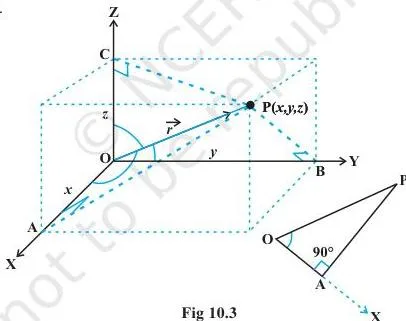
\[ l = \cos\alpha = \frac{x}{|\vec{r}|}, \quad m = \cos\beta = \frac{y}{|\vec{r}|}, \quad n = \cos\gamma = \frac{z}{|\vec{r}|} \]
\[ l^2 + m^2 + n^2 = 1 \]
Direction ratios \( a, b, c \) are any numbers proportional to the direction cosines:
\[ l = \frac{a}{r}, \quad m = \frac{b}{r}, \quad n = \frac{c}{r} \]
The scalar components of a vector are its direction ratios, and they also give its projections along the axes (NCERT, p. 374). A unit vector written with direction cosines takes the form \( \vec{a} = \cos\alpha\,\hat{i} + \cos\beta\,\hat{j} + \cos\gamma\,\hat{k} \) (NCERT, p. 359).
Addition of Vectors
In the triangle law, the second vector starts where the first one ends; in the parallelogram law, both start at the same point. The two laws are equivalent (NCERT, p. 344). The diagrams show the same sum in both forms.
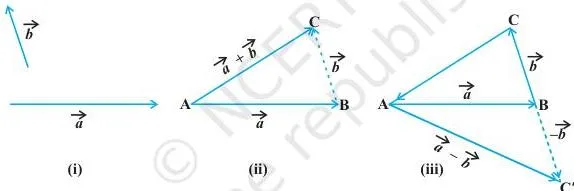
\[ \overrightarrow{AC} = \overrightarrow{AB} + \overrightarrow{BC} \]
\[ \overrightarrow{AB} + \overrightarrow{BC} + \overrightarrow{CA} = \vec{0} \]
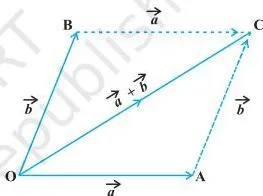
\[ \overrightarrow{OA} + \overrightarrow{OB} = \overrightarrow{OC} \]
\[ \vec{a} – \vec{b} = \vec{a} + (-\vec{b}) \]
\[ \vec{a} + \vec{b} = \vec{b} + \vec{a} \]
\[ (\vec{a} + \vec{b}) + \vec{c} = \vec{a} + (\vec{b} + \vec{c}) \]
\[ \vec{a} + \vec{0} = \vec{a} \]
The zero vector \( \vec{0} \) is the additive identity; \( -\vec{a} \) is the additive inverse.
Multiplication of a Vector by a Scalar
Multiplying \( \vec{a} \) by a scalar \( \lambda \) keeps the product collinear with \( \vec{a} \), reverses its direction when \( \lambda \lt 0 \), and multiplies its length by \( |\lambda| \) (NCERT, p. 347). The figure below visualises this.

\[ |\lambda\vec{a}| = |\lambda|\,|\vec{a}| \]
\[ \vec{a} + (-\vec{a}) = \vec{0} \]
\[ \hat{a} = \frac{1}{|\vec{a}|}\,\vec{a} \quad (\vec{a} \neq \vec{0}) \]
Distributive laws for any scalars k and m:
\[ k\vec{a} + m\vec{a} = (k + m)\vec{a}, \quad k(m\vec{a}) = (km)\vec{a}, \quad k(\vec{a} + \vec{b}) = k\vec{a} + k\vec{b} \]
Components of a Vector
In component form every operation acts on matching components only (NCERT, p. 348). The figure shows how \( \overrightarrow{OP} \) splits into perpendicular vector components.
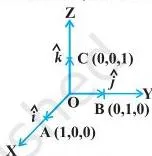
\[ \vec{a} + \vec{b} = (a_1 + b_1)\hat{i} + (a_2 + b_2)\hat{j} + (a_3 + b_3)\hat{k} \]
\[ \vec{a} – \vec{b} = (a_1 – b_1)\hat{i} + (a_2 – b_2)\hat{j} + (a_3 – b_3)\hat{k} \]
\[ \lambda\vec{a} = (\lambda a_1)\hat{i} + (\lambda a_2)\hat{j} + (\lambda a_3)\hat{k} \]
Equality holds only when every pair of matching components is equal:
\[ \vec{a} = \vec{b} \Leftrightarrow a_1 = b_1,\; a_2 = b_2,\; a_3 = b_3 \]
Two vectors are collinear exactly when one is a scalar multiple of the other (NCERT, p. 349):
\[ \vec{b} = \lambda\vec{a} \Leftrightarrow \frac{b_1}{a_1} = \frac{b_2}{a_2} = \frac{b_3}{a_3} = \lambda \]
Vector Joining Two Points
For points \( P_1(x_1, y_1, z_1) \) and \( P_2(x_2, y_2, z_2) \), subtract the initial point’s position vector from the terminal point’s (NCERT, p. 352):
\[ \overrightarrow{P_1P_2} = (x_2 – x_1)\hat{i} + (y_2 – y_1)\hat{j} + (z_2 – z_1)\hat{k} \]
\[ |\overrightarrow{P_1P_2}| = \sqrt{(x_2 – x_1)^2 + (y_2 – y_1)^2 + (z_2 – z_1)^2} \]
Section Formula
If R divides the segment joining P (position vector \( \vec{a} \)) and Q (position vector \( \vec{b} \)) in the ratio \( m : n \), the position vector of R is (NCERT, p. 353):
\[ \text{Internal:} \quad \vec{r} = \frac{m\vec{b} + n\vec{a}}{m + n} \]
\[ \text{External:} \quad \vec{r} = \frac{m\vec{b} – n\vec{a}}{m – n} \quad (m \neq n) \]
When R is the midpoint, \( m = n \), and the formula collapses to \[ \vec{r} = \frac{\vec{a} + \vec{b}}{2} \]
Scalar (Dot) Product
The dot product returns a real number, not a vector (NCERT, p. 356). The geometric form uses the angle between the vectors; the component form does not need the angle at all.
\[ \vec{a}\cdot\vec{b} = |\vec{a}|\,|\vec{b}|\cos\theta, \quad 0 \leq \theta \leq \pi \]
\[ \vec{a}\cdot\vec{b} = a_1b_1 + a_2b_2 + a_3b_3 \]
\[ \vec{a}\cdot\vec{a} = |\vec{a}|^2 \]
\[ \vec{a}\cdot\vec{b} = 0 \Leftrightarrow \vec{a} \perp \vec{b} \]
\[ \hat{i}\cdot\hat{i} = \hat{j}\cdot\hat{j} = \hat{k}\cdot\hat{k} = 1, \quad \hat{i}\cdot\hat{j} = \hat{j}\cdot\hat{k} = \hat{k}\cdot\hat{i} = 0 \]
\[ \cos\theta = \frac{\vec{a}\cdot\vec{b}}{|\vec{a}|\,|\vec{b}|} \]
\[ |\vec{a} \pm \vec{b}|^2 = |\vec{a}|^2 \pm 2\,\vec{a}\cdot\vec{b} + |\vec{b}|^2 \]
The scalar product distributes over addition, and behaves like a product under scaling (NCERT, p. 357):
\[ \vec{a}\cdot(\vec{b} + \vec{c}) = \vec{a}\cdot\vec{b} + \vec{a}\cdot\vec{c} \]
\[ (\lambda\vec{a})\cdot\vec{b} = \lambda(\vec{a}\cdot\vec{b}) = \vec{a}\cdot(\lambda\vec{b}) \]
Two standard bounds finished off the dot product (NCERT, p. 360):
\[ \text{Cauchy–Schwarz:} \quad |\vec{a}\cdot\vec{b}| \leq |\vec{a}|\,|\vec{b}| \]
\[ \text{Triangle inequality:} \quad |\vec{a} + \vec{b}| \leq |\vec{a}| + |\vec{b}| \]
Projection of a Vector on a Line
The projection of \( \overrightarrow{AB} \) on a directed line \( l \) has magnitude \( |\overrightarrow{AB}|\,|\cos\theta| \) (NCERT, p. 358). As a dot product, the projection is a signed scalar.
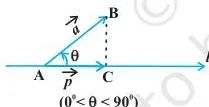
\[ \vec{a}\cdot\hat{b} = \frac{1}{|\vec{b}|}\,(\vec{a}\cdot\vec{b}) \]
If \( \hat{p} \) is a unit vector along a line, the projection of \( \vec{a} \) on that line is \( \vec{a}\cdot\hat{p} \). The projection vector itself has magnitude \( |\vec{a}|\,|\cos\theta| \) along the line, and points opposite to it when \( \cos\theta \lt 0 \).
Vector (Cross) Product
The cross product returns a vector perpendicular to both inputs; its direction is fixed by the right-handed system of \( \vec{a}, \vec{b}, \hat{n} \) (NCERT, p. 363). The figure shows this unit normal.
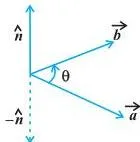
\[ \vec{a} \times \vec{b} = |\vec{a}|\,|\vec{b}|\sin\theta\,\hat{n}, \quad 0 \leq \theta \leq \pi \]
\[ \vec{a} \times \vec{b} = \begin{vmatrix} \hat{i} & \hat{j} & \hat{k} \\ a_1 & a_2 & a_3 \\ b_1 & b_2 & b_3 \end{vmatrix} \]
\[ \vec{a} \times \vec{b} = \vec{0} \Leftrightarrow \vec{a} \parallel \vec{b} \]
\[ \vec{a} \times \vec{a} = \vec{0} \]
\[ |\vec{a} \times \vec{b}| = |\vec{a}|\,|\vec{b}|\sin\theta, \quad \sin\theta = \frac{|\vec{a} \times \vec{b}|}{|\vec{a}|\,|\vec{b}|} \]
\[ \vec{a} \times \vec{b} = -\vec{b} \times \vec{a} \]
Unit-vector products you will use while expanding determinants (NCERT, p. 364):
\[ \hat{i} \times \hat{j} = \hat{k}, \quad \hat{j} \times \hat{k} = \hat{i}, \quad \hat{k} \times \hat{i} = \hat{j} \]
\[ \hat{j} \times \hat{i} = -\hat{k}, \quad \hat{k} \times \hat{j} = -\hat{i}, \quad \hat{i} \times \hat{k} = -\hat{j} \]
Distributive law of the vector product over addition (NCERT, p. 366):
\[ \vec{a} \times (\vec{b} + \vec{c}) = \vec{a} \times \vec{b} + \vec{a} \times \vec{c} \]
\[ \lambda(\vec{a} \times \vec{b}) = (\lambda\vec{a}) \times \vec{b} = \vec{a} \times (\lambda\vec{b}) \]
Area Using Cross Product
If \( \vec{a} \) and \( \vec{b} \) are adjacent sides, the magnitude of the cross product gives the parallelogram’s area, and half of it gives the triangle’s area (NCERT, p. 367). The figure below shows why the height is \( |\vec{a}|\sin\theta \).
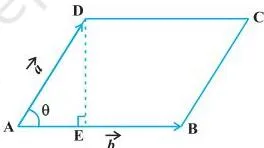
\[ \text{Area of parallelogram} = |\vec{a} \times \vec{b}| \]
\[ \text{Area of triangle} = \frac{1}{2}|\vec{a} \times \vec{b}| \]
What Each Symbol Means
| Symbol | What it means | Unit / nature |
|---|---|---|
| \( \vec{a}, \vec{b}, \vec{c}, \vec{p}, \vec{q}, \vec{r} \) | vectors (directed line segments) | magnitude with direction; in applied problems the unit is the unit of the quantity (e.g. m for displacement) |
| \( |\vec{a}| \) or \( a \) | magnitude (length) of the vector | non-negative number; length |
| \( \hat{a} \) | unit vector in the direction of \( \vec{a} \) | dimensionless, magnitude 1 |
| \( \hat{i}, \hat{j}, \hat{k} \) | unit vectors along the positive x, y and z axes | dimensionless, magnitude 1 |
| \( \hat{n} \) | unit vector perpendicular to the plane of \( \vec{a} \) and \( \vec{b} \), forming a right-handed system | dimensionless |
| \( x, y, z \) | coordinates of P; scalar components of \( \vec{r} \) | length (plain numbers in pure maths) |
| \( a_1, a_2, a_3 \) | scalar components of \( \vec{a} \) | same unit as the vector |
| \( b_1, b_2, b_3 \) | scalar components of \( \vec{b} \) | same unit as the vector |
| \( l, m, n \) | direction cosines \( \cos\alpha, \cos\beta, \cos\gamma \) | dimensionless; \( l^2 + m^2 + n^2 = 1 \) |
| \( a, b, c \) | direction ratios of a vector | dimensionless; proportional to \( l, m, n \) |
| \( \alpha, \beta, \gamma \) | direction angles with the x, y and z axes | angles, \( 0 \leq \alpha, \beta, \gamma \leq \pi \) |
| \( \theta \) | angle between two vectors | angle (radians), \( 0 \leq \theta \leq \pi \) |
| \( \lambda, k, m \) | scalar multipliers | dimensionless; positive, negative or zero |
| \( m : n \) | ratio in which R divides PQ | dimensionless (positive for internal division) |
| \( \vec{0} \) | zero (null) vector | magnitude 0, no definite direction |
When to Use Each Formula
| Topic | Use it when you need… | Condition to remember |
|---|---|---|
| Position vector / magnitude | a point P(x, y, z) is given and you want its vector from the origin or its distance from O | coordinates are measured from the origin O(0, 0, 0) |
| Direction cosines | the cosines of the angles a vector makes with the axes, or a check on a direction | cosines satisfy \( l^2 + m^2 + n^2 = 1 \); direction ratios do not |
| Unit vector | a vector of length 1 in a given direction, written \( \hat{a} \) | \( \vec{a} \neq \vec{0} \) |
| Triangle / parallelogram law | two displacements or forces act together and you want the resultant | head-to-tail for the triangle law; tail-to-tail for the parallelogram law |
| Component-form operations | vectors are given as \( a_1\hat{i} + a_2\hat{j} + a_3\hat{k} \) | combine only matching components |
| Section formula | a point R divides PQ in the ratio \( m : n \) | internal uses plus; external uses minus and needs \( m \neq n \); midpoint has \( m = n \) |
| Dot product | the angle between vectors, a perpendicularity test, a projection, or \( |\vec{a} \pm \vec{b}|^2 \) | geometric form needs the angle; component form does not |
| Projection | the length of a vector’s shadow along another direction | the projection \( \vec{a}\cdot\hat{b} \) is a signed scalar and can be negative |
| Cross product | a vector perpendicular to two given vectors, a parallelism test, or an area | the result is a vector and order matters: \( \vec{a} \times \vec{b} = -\vec{b} \times \vec{a} \) |
| Area formulas | the area of a parallelogram or triangle with adjacent sides \( \vec{a}, \vec{b} \) | a triangle uses half of the parallelogram area |
| Cauchy–Schwarz / triangle inequality | bounding \( |\vec{a}\cdot\vec{b}| \) or \( |\vec{a} + \vec{b}| \) in proofs | equality in the triangle inequality means the vectors are collinear in the same direction |
Worked Examples
Example 1: Magnitude, unit vector and direction cosines of a vector
Step 1: Use the magnitude formula on \( \vec{a} = 2\hat{i} – 3\hat{j} – 6\hat{k} \).
\[ |\vec{a}| = \sqrt{a_1^2 + a_2^2 + a_3^2} = \sqrt{2^2 + (-3)^2 + (-6)^2} = \sqrt{49} = 7 \]
Step 2: The unit vector is \( \hat{a} = \frac{\vec{a}}{|\vec{a}|} \), so divide every component by 7.
\[ \hat{a} = \frac{2}{7}\hat{i} – \frac{3}{7}\hat{j} – \frac{6}{7}\hat{k} \]
Step 3: Direction cosines are the components of the unit vector: \( l = \frac{2}{7}, m = -\frac{3}{7}, n = -\frac{6}{7} \).
Check with \( l^2 + m^2 + n^2 = \frac{4 + 9 + 36}{49} = 1 \).
Final answer: \( |\vec{a}| = 7 \) units; \( \hat{a} = \frac{2}{7}\hat{i} – \frac{3}{7}\hat{j} – \frac{6}{7}\hat{k} \); direction cosines \( \left(\frac{2}{7}, -\frac{3}{7}, -\frac{6}{7}\right) \).
Example 2: Finding a scalar that makes two vectors perpendicular
Step 1: Two nonzero vectors are perpendicular exactly when their dot product is zero.
Set \( \vec{p}\cdot\vec{q} = 0 \) for \( \vec{p} = 2\hat{i} + \lambda\hat{j} + 4\hat{k} \) and \( \vec{q} = 3\hat{i} – 2\hat{j} + \hat{k} \).
\[ \vec{p}\cdot\vec{q} = 2(3) + \lambda(-2) + 4(1) = 10 – 2\lambda \]
Step 2: Equate to zero and solve.
\[ 10 – 2\lambda = 0 \Rightarrow \lambda = 5 \]
Step 3: Check by substituting back: \( 6 – 10 + 4 = 0 \).
The dot product is zero, so the vectors are perpendicular.
Final answer: \( \lambda = 5 \).
Example 3: Area of a parallelogram using the cross product
Step 1: For adjacent sides the area is \( |\vec{a} \times \vec{b}| \).
Take \( \vec{a} = \hat{i} + 2\hat{j} – \hat{k} \) and \( \vec{b} = 2\hat{i} – \hat{j} + 3\hat{k} \), and expand the determinant form.
\[ \vec{a} \times \vec{b} = \begin{vmatrix} \hat{i} & \hat{j} & \hat{k} \\ 1 & 2 & -1 \\ 2 & -1 & 3 \end{vmatrix} = \hat{i}(6-1) – \hat{j}(3+2) + \hat{k}(-1-4) = 5\hat{i} – 5\hat{j} – 5\hat{k} \]
Step 2: Take the magnitude of the cross product.
\[ |\vec{a} \times \vec{b}| = \sqrt{5^2 + (-5)^2 + (-5)^2} = \sqrt{75} = 5\sqrt{3} \]
Step 3: The parallelogram’s area is this magnitude.
A triangle with the same adjacent sides would use half of it: \( \frac{5\sqrt{3}}{2} \).
Final answer: Area of the parallelogram \( = 5\sqrt{3} \) square units.
Common Mistakes to Avoid
These are the errors that actually appear when this chapter’s formulas are applied.
| Mistake | Correct rule | How to check your answer |
|---|---|---|
| Giving direction ratios (a, b, c) as the direction cosines | Direction cosines are \( l = \frac{a}{r}, m = \frac{b}{r}, n = \frac{c}{r} \), so \( l^2 + m^2 + n^2 = 1 \) | Square your three numbers and add: sum 1 means cosines; anything else means ratios |
| Assuming the cross product commutes: \( \vec{a} \times \vec{b} = \vec{b} \times \vec{a} \) | \( \vec{a} \times \vec{b} = -\vec{b} \times \vec{a} \); order matters | Swap the vectors: every component of the product must change sign |
| Missing the minus sign on the middle term of the determinant expansion | \( \vec{a} \times \vec{b} = (a_2b_3 – a_3b_2)\hat{i} – (a_1b_3 – a_3b_1)\hat{j} + (a_1b_2 – a_2b_1)\hat{k} \) | Dot your answer with \( \vec{a} \): you must get 0 |
| Using \( |\vec{a} \times \vec{b}| \) for a triangle’s area | Triangle: \( \frac{1}{2}|\vec{a} \times \vec{b}| \); parallelogram: \( |\vec{a} \times \vec{b}| \) | Halve the cross-product magnitude only when the figure is a triangle |
| Computing magnitude as \( \sqrt{a_1 + a_2 + a_3} \) | \( |\vec{a}| = \sqrt{a_1^2 + a_2^2 + a_3^2} \) | A magnitude is never negative; recompute with squares |
| Reading the projection \( \vec{a}\cdot\hat{b} \) as a vector | It is the signed scalar projection; it is negative when \( \frac{\pi}{2} \lt \theta \leq \pi \) | If the question asks for a vector, multiply the scalar projection by \( \hat{b} \) |
Frequently Asked Questions
When is the triangle inequality actually an equality?
Only when \( \vec{a} \) and \( \vec{b} \) act along the same line and the same direction, so the points are collinear. The general statement is \( |\vec{a} + \vec{b}| \leq |\vec{a}| + |\vec{b}| \) (NCERT, p. 361); in every other case the left side is strictly smaller.
What is the difference between direction ratios and direction cosines?
Direction cosines \( l, m, n \) are the cosines of the angles with the axes and satisfy \( l^2 + m^2 + n^2 = 1 \). Direction ratios \( a, b, c \) are any numbers proportional to them: \( l = \frac{a}{r}, m = \frac{b}{r}, n = \frac{c}{r} \), so in general \( a^2 + b^2 + c^2 \neq 1 \) (NCERT, p. 341).
To turn ratios into cosines, divide each ratio by the vector’s magnitude.
When is the cross product of two vectors zero?
Exactly when the vectors are parallel (collinear): \( \theta = 0 \) or \( \theta = \pi \), or one of them is the zero vector (NCERT, p. 364). This is the parallelism test; the dot product test \( \vec{a}\cdot\vec{b} = 0 \) checks perpendicularity instead — the two tests are different.
Can a dot product or a projection be negative?
Yes. \( \vec{a}\cdot\vec{b} = |\vec{a}|\,|\vec{b}|\cos\theta \) is negative when \( \frac{\pi}{2} \lt \theta \leq \pi \), and the projection \( \vec{a}\cdot\hat{b} \) carries the same sign. The projection vector then points opposite to \( \hat{b} \).
Practise these formulas on the chapter’s exercises, then use the Maths formulas index to jump to any class or chapter.
This sheet follows the Rationalised NCERT Class 12 Mathematics Part II textbook, Chapter 10. You can open the official chapter PDF (lemh204.pdf) at ncert.nic.in to verify any formula line for line.
Reference: NCERT Class 12 Mathematics textbook, chapter Vector Algebra.
Explore Class 12 Maths Formulas
More for this chapter:
Class 12 Maths on LearnCBSE:
Related chapters:
Official source: download the NCERT textbook free from ncert.nic.in.