
This page collects the formulas you need from Application of Derivatives (NCERT Class 12 Mathematics, Part I, Chapter 6): rate of change of quantities, the chain rule for related rates, increasing and decreasing functions, critical points, the first and second derivative tests for local maxima and minima, and the working rule for absolute maxima and minima on a closed interval.
Each formula is grouped by topic, with the meaning of every symbol, a line on when to use it, and worked examples with original numbers. For the explanations and derivations of these tests (including the Mean Value Theorem proof of Theorem 1), see the detailed Class 12 Maths Formulas hub and the chapter notes.
Formulas at a Glance
| Purpose (what you are finding) | Formula |
|---|---|
| Rate of change of \( y \) with respect to \( x \) | \( \dfrac{dy}{dx} = f'(x) \) |
| Rate of change of \( y \) with respect to \( x \) when both depend on \( t \) (chain rule for related rates) | \( \dfrac{dy}{dx} = \dfrac{dy}{dt} \big/ \dfrac{dx}{dt} \), if \( \dfrac{dx}{dt} \neq 0 \) |
| Rate of change of \( y \) with respect to \( x \) at \( x = x_0 \) | \( \left. \dfrac{dy}{dx} \right|_{x=x_0} = f'(x_0) \) |
| Test: \( f \) is increasing on \( [a, b] \) | \( f'(x) \ge 0 \) for each \( x \in (a, b) \) |
| Test: \( f \) is decreasing on \( [a, b] \) | \( f'(x) \leq 0 \) for each \( x \in (a, b) \) |
| Test: \( f \) is constant on \( [a, b] \) | \( f'(x) = 0 \) for each \( x \in (a, b) \) |
| First derivative test — local maxima at \( c \) | \( f'(x) \) changes from \( + \) to \( – \) through \( c \) |
| First derivative test — local minima at \( c \) | \( f'(x) \) changes from \( – \) to \( + \) through \( c \) |
| Second derivative test — local maxima at \( c \) | \( f'(c) = 0 \) and \( f”(c) \lt 0 \) |
| Second derivative test — local minima at \( c \) | \( f'(c) = 0 \) and \( f”(c) \gt 0 \) |
| Absolute maximum/minimum on \( [a, b] \) (working rule, 4 steps) | Compare \( f \) at all critical points and at \( a, b \) |
All Formulas, Grouped by Topic
Rate of Change of Quantities
If one quantity \( y \) varies with another quantity \( x \) by the rule \( y = f(x) \), then the derivative \( \frac{dy}{dx} \) (or \( f'(x) \)) is the rate of change of \( y \) with respect to \( x \) (NCERT, p. 148):
\[ \frac{dy}{dx} = f'(x) \]
At a particular value \( x = x_0 \), this rate is written as follows:
\[ \left. \frac{dy}{dx} \right|_{x=x_0} = f'(x_0) \]
If \( x \) and \( y \) both vary with time \( t \), the rate of change of \( y \) with respect to \( x \) is obtained by the chain rule:
\[ \frac{dy}{dx} = \frac{dy}{dt} \big/ \frac{dx}{dt}, \quad \text{provided } \frac{dx}{dt} \neq 0 \]
This is the formula behind nearly every “how fast is it changing” problem: write \( A = \pi r^2 \), differentiate with respect to \( t \), and get \( \frac{dA}{dt} = 2\pi r \, \frac{dr}{dt} \).
Increasing and Decreasing Functions
A real-valued function \( f \) is strictly increasing on an interval if bigger \( x \) always gives a bigger \( f(x) \), and strictly decreasing if bigger \( x \) always gives a smaller \( f(x) \) (NCERT, p. 153). The derivative gives a working test (NCERT, p. 154): let \( f \) be continuous on \( [a, b] \) and differentiable on \( (a, b) \). Then
- \( f \) is increasing in \( [a, b] \) if \( f'(x) \ge 0 \) for each \( x \in (a, b) \);
- \( f \) is decreasing in \( [a, b] \) if \( f'(x) \leq 0 \) for each \( x \in (a, b) \);
- \( f \) is a constant function in \( [a, b] \) if \( f'(x) = 0 \) for each \( x \in (a, b) \).
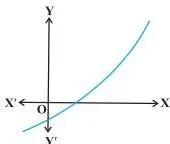
To find the intervals, solve \( f'(x) = 0 \): the roots split the real line (or the given domain) into disjoint intervals, and the sign of \( f'(x) \) in each interval tells you whether \( f \) is increasing there (NCERT, p. 155).
Critical Points, Local Maxima and Minima
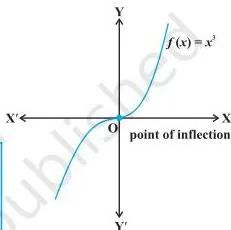
A point \( c \) in the domain of \( f \) is a critical point if either \( f'(c) = 0 \) or \( f \) is not differentiable at \( c \) (NCERT, p. 164). If \( f \) has a local maximum or local minimum at \( c \), then \( c \) must be a critical point — but the converse is false: \( f'(c) = 0 \) does not guarantee an extremum.
For \( f(x) = x^3 \), \( f'(0) = 0 \) yet 0 is neither a local maximum nor a local minimum (NCERT, p. 164).
First Derivative Test
Let \( f \) be continuous at a critical point \( c \). Examine the sign of \( f'(x) \) as \( x \) increases through \( c \) (NCERT, p. 164):
- If \( f'(x) \) changes sign from positive to negative through \( c \), then \( c \) is a point of local maxima.
- If \( f'(x) \) changes sign from negative to positive through \( c \), then \( c \) is a point of local minima.
- If \( f'(x) \) does not change sign through \( c \), then \( c \) is neither — it is a point of inflexion.
Second Derivative Test
Let \( f \) be twice differentiable at \( c \) and let \( f'(c) = 0 \) (NCERT, p. 166):
- \( x = c \) is a point of local maxima if \( f”(c) \lt 0 \); \( f(c) \) is the local maximum value.
- \( x = c \) is a point of local minima if \( f”(c) \gt 0 \); \( f(c) \) is the local minimum value.
- The test fails if \( f”(c) = 0 \) — go back to the first derivative test.
Why the sign of \( f” \) decides: at a local maximum the slope falls from positive to negative, so the slope itself is decreasing, which means \( f” \lt 0 \); at a local minimum the slope increases from negative to positive, so \( f” \gt 0 \).
Absolute Maxima and Minima on a Closed Interval
Every continuous function on a closed interval \( [a, b] \) attains an absolute maximum and an absolute minimum (NCERT, p. 171). The working rule (NCERT, p. 172):
- Find all critical points of \( f \) in \( [a, b] \) — points where \( f'(x) = 0 \) or \( f \) is not differentiable.
- Take the end points \( a \) and \( b \).
- Calculate \( f \) at every point from Step 1 and Step 2.
- The largest of these values is the absolute maximum; the smallest is the absolute minimum.
If an absolute maximum or minimum occurs at an interior point \( c \), then \( f'(c) = 0 \) (NCERT, p. 172).
What Each Symbol Means
| Symbol | What it means | Unit / nature |
|---|---|---|
| \( y \) | Dependent variable (the quantity being differentiated) | Whatever quantity \( y \) measures |
| \( x \) | Independent variable with respect to which \( y \) changes | Whatever quantity \( x \) measures |
| \( f'(x) \) or \( \dfrac{dy}{dx} \) | Rate of change of \( y \) with respect to \( x \) | Units of \( y \) per unit of \( x \) |
| \( x_0 \) | A particular value of \( x \) at which the rate is evaluated | Same unit as \( x \) |
| \( t \) | Time, used when both \( x \) and \( y \) change with time | second (s), minute, hour as given |
| \( a, b \) | End points of a closed interval \( [a, b] \) | Same unit as \( x \) |
| \( c \) | A critical point; a candidate for local/absolute extremum | Same unit as \( x \) |
| \( h \) | Radius of a small neighbourhood \( (c-h, c+h) \) used in the definition of local maxima/minima | Positive number (length in \( x \)-units) |
| \( f”(c) \) | Second derivative of \( f \) at \( c \) — the rate of change of the slope | Units of \( y \) per (unit of \( x \))\(^2\) |
| \( r, A, V, S \) (in related-rate problems) | Radius, area, volume, surface area of a geometric figure | m / cm; m² / cm²; m³ / cm³; m² / cm² |
When to Use Each Formula
| Formula / test | Use it when … | Condition that must hold |
|---|---|---|
| \( \dfrac{dy}{dx} = f'(x) \) | The question asks for the rate of change of one quantity with respect to another | \( y = f(x) \) is given or can be written |
| \( \dfrac{dy}{dx} = \dfrac{dy}{dt} \big/ \dfrac{dx}{dt} \) | Both quantities vary with time, e.g. “how fast is the area increasing” | \( \dfrac{dx}{dt} \neq 0 \) |
| \( f'(x) \ge 0 \) ⇒ increasing | You need the intervals where a function rises | \( f \) continuous on \( [a,b] \), differentiable on \( (a,b) \) |
| \( f'(x) \leq 0 \) ⇒ decreasing | You need the intervals where a function falls | Same continuity/differentiability condition |
| First derivative test (sign change) | Classify each critical point, or when the second derivative test fails (\( f”(c) = 0 \)) | \( f \) continuous at the critical point \( c \) |
| Second derivative test (\( f”(c) \lt 0 \) / \( \gt 0 \)) | Fast classification of a critical point found from \( f'(x) = 0 \) | \( f \) twice differentiable at \( c \), and \( f”(c) \neq 0 \) |
| Working rule for \( [a, b] \) | The question asks for absolute (global) maximum/minimum on a closed interval | \( f \) continuous on \( [a, b] \) |
A quick way to remember the sign rules: positive derivative → function climbs; negative derivative → function falls. For the second derivative, think “above zero is a valley”: \( f”(c) \gt 0 \) ⇒ local minimum; \( f”(c) \lt 0 \) ⇒ local maximum.
Worked Examples
Example 1: Rate of change — area of a circle
Step 1: Identify the relation.
Area \( A = \pi r^2 \), and we need \( \dfrac{dA}{dr} \) when \( r = 7 \) cm.
Step 2: Differentiate with respect to \( r \):
\[ \frac{dA}{dr} = \frac{d}{dr}(\pi r^2) = 2\pi r \]
Step 3: Put \( r = 7 \) cm:
\[ \frac{dA}{dr} = 2\pi (7) = 14\pi \]
Final answer: The area is changing at \( 14\pi \ \) cm per cm change in radius (i.e. \( 14\pi \) cm² per cm).
Example 2: Using the chain rule — a balloon’s volume
Step 1: A spherical balloon is inflated at \( \dfrac{dV}{dt} = 72\pi \) cm³/s.
Find \( \dfrac{dr}{dt} \) when \( r = 3 \) cm.
Since the balloon is spherical, \( V = \frac{4}{3}\pi r^3 \).
Step 2: Differentiate \( V \) with respect to \( t \) by the chain rule:
\[ \frac{dV}{dt} = \frac{dV}{dr} \cdot \frac{dr}{dt} = 4\pi r^2 \, \frac{dr}{dt} \]
Step 3: Substitute \( \dfrac{dV}{dt} = 72\pi \) and \( r = 3 \):
\[ 72\pi = 4\pi (9)\, \frac{dr}{dt} \quad \Rightarrow \quad \frac{dr}{dt} = 2 \]
Final answer: The radius increases at \( 2 \) cm/s.
Example 3: Second derivative test — local extrema
Step 1: For \( f(x) = 2x^3 – 9x^2 + 12x + 1 \), find \( f'(x) \):
\[ f'(x) = 6x^2 – 18x + 12 = 6(x – 1)(x – 2) \]
- Step 1: Critical points come from \( f'(x) = 0 \), giving \( x = 1 \) and \( x = 2 \).
- Step 2: Compute \( f”(x) = 12x – 18 \).
Now \( f”(1) = -6 \lt 0 \), so \( x = 1 \) is a local maximum; \( f”(2) = 6 \gt 0 \), so \( x = 2 \) is a local minimum.
\[ f(1) = 2 – 9 + 12 + 1 = 6, \qquad f(2) = 16 – 36 + 24 + 1 = 5 \]
Final answer: Local maximum value \( 6 \) at \( x = 1 \), local minimum value \( 5 \) at \( x = 2 \).
Practise applying these formulas on the textbook’s own questions: Exercise 6.1 (rates), Exercise 6.2 (increasing/decreasing), Exercise 6.3 (maxima and minima) and the Miscellaneous Exercise.
Common Mistakes to Avoid
| Mistake | Correct rule | How to check your answer |
|---|---|---|
| Assuming \( f'(c) = 0 \) automatically means a maximum or minimum | \( f'(c) = 0 \) only makes \( c \) a candidate; classify it with the first or second derivative test | Test a point just left and right of \( c \): if \( f'(x) \) keeps the same sign, \( c \) is an inflection point (as with \( x^3 \) at 0) |
| Using the second derivative test when \( f”(c) = 0 \) | If \( f'(c) = 0 \) and \( f”(c) = 0 \), the test fails — return to the first derivative test | Re-examine the sign change of \( f'(x) \) through \( c \) |
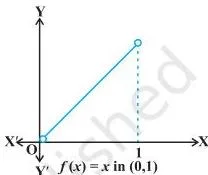
| Applying the derivative tests where \( f \) is not differentiable | A critical point also means “not differentiable”; e.g. \( f(x) = 3 + |x| \) has a local minimum at \( x = 0 \) where \( f'(0) \) does not exist | Check differentiability at every corner point of the graph |
| Writing \( \dfrac{dy}{dx} = \dfrac{dt}{dy} \cdot \dfrac{dt}{dx} \) | The chain rule is \( \dfrac{dy}{dx} = \dfrac{dy}{dt} \big/ \dfrac{dx}{dt} \) | Check units: if \( \frac{dy}{dt} \) has units of \( y/t \) and \( \frac{dx}{dt} \) units of \( x/t \), the quotient has units of \( y/x \) — correct |
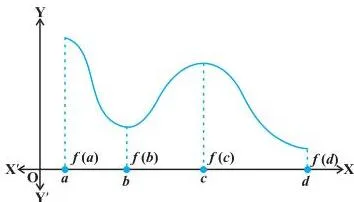
| Forgetting the end points when finding absolute extrema on \( [a, b] \) | Always evaluate \( f \) at \( a \) and \( b \) as well as at all critical points | The absolute maximum/minimum on a closed interval can sit at an end point (compare with Fig 6.19) |
| Mixing the signs: \( f” \gt 0 \) at a local maximum | \( f”(c) \gt 0 \) ⇒ local minimum; \( f”(c) \lt 0 \) ⇒ local maximum | Sketch the curve: at a hilltop the slope is turning downwards, so \( f” \lt 0 \) |
Frequently Asked Questions
What is the difference between a local maximum and an absolute maximum?
A local maximum is the largest value of \( f \) in a small neighbourhood around the point \( c \); the absolute (global) maximum is the largest value of \( f \) on the whole given interval.
On a closed interval, the absolute maximum can occur at an end point, but a local maximum requires an interior point \( c \) where \( f(c) \geq f(x) \) for all \( x \) in \((c-h, c+h) \) (NCERT, p. 163). The graph in Fig 6.19 shows both cases.
When does the second derivative test fail?
It fails when \( f'(c) = 0 \) and \( f”(c) = 0 \) at the same point. In that situation the test gives no information, so you must go back to the first derivative test and check whether \( f'(x) \) changes sign through \( c \) (NCERT, p. 166). The derivative may change sign (extremum) or keep its sign (inflexion).
How do I find the intervals in which a function is increasing or decreasing?
Find \( f'(x) \), solve \( f'(x) = 0 \), and let the roots divide the domain into intervals. On each interval, test the sign of \( f'(x) \) using one convenient value of \( x \). Where \( f'(x) \gt 0 \), the function is increasing; where \( f'(x) \lt 0 \), it is decreasing (NCERT, p. 155).
Why is \( f'(c) = 0 \) not enough to guarantee an extremum?
Because the slope can be zero without the graph turning. For \( f(x) = x^3 \), \( f'(0) = 3(0)^2 = 0 \), but the graph keeps rising through \( x = 0 \) — it is a point of inflexion, not a turning point (NCERT, p. 164). You must apply a test that examines the sign of \( f'(x) \) or the sign of \( f”(x) \).
Reference: NCERT Class 12 Mathematics textbook, chapter Application of Derivatives. For the full chapter, see the official NCERT Class 12 Maths textbook (Part I) and the Maths formulas index for the whole syllabus.
Explore Class 12 Maths Formulas
More for this chapter:
Class 12 Maths on LearnCBSE:
Related chapters: