
This sheet covers the Relations and Functions Class 12 formulas you need for quick revision: the tests for empty, universal, reflexive, symmetric, transitive and equivalence relations, equivalence classes, the one-one, onto and bijective function tests, composition of functions, and the condition for invertibility.
Every formula below comes from the NCERT Class 12 Mathematics Part I textbook, Chapter 1 (Relations and Functions). Each is grouped by topic, with the meaning of every symbol, the nature of each quantity, and a note on when to use it; three worked examples with original numbers show the formulas in action. For other chapters, browse the Class 12 Maths formulas hub.
Formulas at a Glance
Every Relations and Functions Class 12 formula on this page appears in the index below. The meanings of the symbols and the conditions of use follow in the next sections.
| Purpose (what you are finding) | Formula |
|---|---|
| Empty relation | \( R = \phi \subset X \times X \) |
| Universal relation | \( R = X \times X \) |
| Reflexive test | \( (a, a) \in R \) for every \( a \in X \) |
| Symmetric test | \( (a_1, a_2) \in R \Rightarrow (a_2, a_1) \in R \) |
| Transitive test | \( (a_1, a_2), (a_2, a_3) \in R \Rightarrow (a_1, a_3) \in R \) |
| Equivalence relation | reflexive + symmetric + transitive |
| Equivalence class of \( a \) | \( [a] = \{ b \in X : (a, b) \in R \} \) |
| Partition of \( X \) into classes | \( X = \bigcup A_i,\ A_i \cap A_j = \phi \ (i \neq j) \) |
| Intersection of two equivalence relations | \( R_1 \cap R_2 \) is an equivalence relation |
| Relation induced by a function | \( \{(a, b) : f(a) = f(b)\} \) is an equivalence relation |
| One-one (injective) test | \( f(x_1) = f(x_2) \Rightarrow x_1 = x_2 \) |
| Onto (surjective) test | \( \forall y \in Y,\ \exists x \in X : f(x) = y \) |
| Onto, in range form | \( \text{Range}(f) = Y \) |
| Bijective function | one-one and onto |
| Finite set: one-one \( \Leftrightarrow \) onto | \( f: X \to X \) one-one \( \Leftrightarrow \) onto \( (X \) finite) |
| Number of one-one maps (from Example 22) | \( 3! = 6 \) for \( \{1, 2, 3\} \); in general \( n! \) |
| Composition of functions | \( gof(x) = g(f(x)) \) |
| Invertible function | \( gof = I_X,\ fog = I_Y,\ g = f^{-1} \) |
| Invertible \( \Leftrightarrow \) bijective | one-one and onto |
| Inverse by solving | \( y = f(x) \Rightarrow x = f^{-1}(y) \) |
All Formulas, Grouped by Topic
Formulas are grouped under the NCERT sub-topics they come from. Each formula carries its condition of validity, and page references point to the textbook.
Types of Relations
Empty relation — no element of \( X \) is related to any element of \( X \) (NCERT, p. 2):
\[ R = \phi \subset X \times X \]
Universal relation — each element of \( X \) is related to every element of \( X \) (NCERT, p. 2):
\[ R = X \times X \]
The empty and universal relations are together called trivial relations. Now the three properties that decide whether a relation is an equivalence relation (NCERT, p. 3):
Reflexive: every element is related to itself.
\[ (a, a) \in R \quad \forall a \in X \]
Symmetric: if \( a \) is related to \( b \), then \( b \) is related to \( a \).
\[ (a_1, a_2) \in R \Rightarrow (a_2, a_1) \in R \quad \forall a_1, a_2 \in X \]
Transitive: a chain of two relations forces the third.
\[ (a_1, a_2) \in R \text{ and } (a_2, a_3) \in R \Rightarrow (a_1, a_3) \in R \quad \forall a_1, a_2, a_3 \in X \]
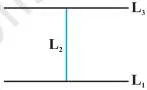
The three tests are independent. The relation “is perpendicular to” on the lines of a plane is symmetric, but not reflexive (no line is perpendicular to itself) and not transitive: if \( L_1 \perp L_2 \) and \( L_2 \perp L_3 \), then \( L_1 \) is parallel to \( L_3 \), not perpendicular to it. Fig 1.1 shows the symmetric pair (NCERT, p. 3).
Equivalence Relations and Equivalence Classes
Equivalence relation (Definition 4, NCERT, p. 3): a relation that is reflexive, symmetric and transitive.
\[ R \text{ is an equivalence relation } \iff R \text{ is reflexive, symmetric and transitive} \]
Equivalence class of \( a \) (NCERT, p. 4): the set of all elements related to \( a \), defined only when \( R \) is an equivalence relation.
\[ [a] = \{ b \in X : (a, b) \in R \} \]
The classes \( A_i \) split \( X \) into a partition: all elements of one class are related to each other, no element of one class is related to any element of another class, and the classes cover \( X \) without overlap (NCERT, p. 4):
\[ X = \bigcup A_i, \quad A_i \cap A_j = \phi \ (i \neq j) \]
Two reusable results (NCERT, Miscellaneous Examples 18 and 21):
- If \( R_1 \) and \( R_2 \) are equivalence relations in a set \( A \), then \( R_1 \cap R_2 \) is also an equivalence relation.
- For any function \( f: X \to Y \), the relation \( R = \{(a, b) : f(a) = f(b)\} \) is an equivalence relation in \( X \).
Types of Functions
One-one (injective) — distinct inputs give distinct images (NCERT, p. 7):
\[ f(x_1) = f(x_2) \Rightarrow x_1 = x_2 \quad \forall x_1, x_2 \in X \]
Onto (surjective) — every element of the co-domain is the image of some element of the domain (NCERT, p. 7):
\[ \forall y \in Y,\ \exists x \in X \ \text{such that} \ f(x) = y \]
Equivalently (NCERT, p. 8):
\[ f \text{ is onto } \iff \text{Range}(f) = Y \]
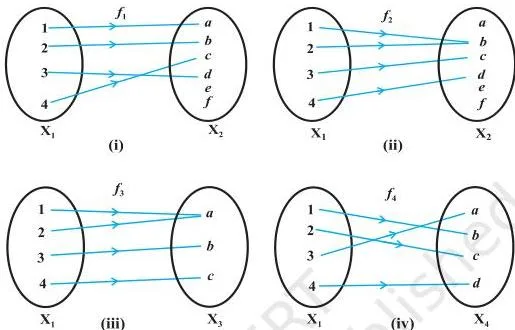
Bijective: one-one and onto together (Definition 7, NCERT, p. 8). The four arrow diagrams in Fig 1.2 show the possibilities on small sets: \( f_1 \) is one-one but not onto (elements \( e, f \) are missed), \( f_2 \) is many-one, \( f_3 \) is many-one but onto, and \( f_4 \) is both one-one and onto, hence bijective (NCERT, p. 8).
Characteristic property of a finite set (NCERT, p. 10 and Summary, p. 16): for a finite set \( X \), the two conditions collapse into one.
\[ f: X \to X \text{ is one-one } \iff f: X \to X \text{ is onto} \]
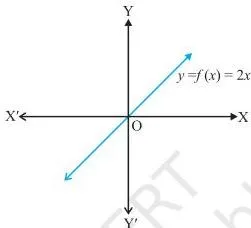
This is false for infinite sets: \( f: \mathbf{N} \to \mathbf{N} \) with \( f(x) = 2x \) is one-one but not onto, and the graph of \( f(x) = 2x \) on \( \mathbf{R} \) is the straight line in Fig 1.3 — a bijection of the real numbers (NCERT, p. 9).
Counting one-one maps (NCERT, Example 22, p. 14): a one-one function from a set to itself is a permutation of its elements, so for \( \{1, 2, 3\} \) the count is \( 3! = 6 \). The same reasoning for an \( n \)-element set gives \( n! \) one-one maps, each automatically onto by the finite-set property.
Composition of Functions and Invertible Functions
Composition (Definition 8, NCERT, p. 12): applying \( f \) first and then \( g \).
\[ gof(x) = g(f(x)) \quad \forall x \in A \]
\[ gof : A \to C \]
Order matters: in general \( gof \neq fog \). For \( f(x) = \cos x \) and \( g(x) = 3x^2 \), \( gof(x) = 3\cos^2 x \) but \( fog(x) = \cos(3x^2) \) (NCERT, Example 16, p. 12).
Invertible function (Definition 9, NCERT, pp. 12–13): \( f: X \to Y \) is invertible if there exists \( g: Y \to X \) that undoes \( f \) and that \( f \) undoes.
\[ gof = I_X \quad \text{and} \quad fog = I_Y \]
\[ g = f^{-1} \]
Invertible \( \Leftrightarrow \) bijective (NCERT, p. 13): \( f \) is invertible if and only if \( f \) is one-one and onto. This is the fastest route — prove bijectivity, and invertibility follows even before writing \( f^{-1} \).
Inverse by solving (NCERT, Example 17, p. 13): set \( y = f(x) \) and solve for \( x \); the expression in \( y \) is \( f^{-1}(y) \).
\[ y = f(x) \Rightarrow x = f^{-1}(y) \]
For the textbook’s example \( f(x) = 4x + 3 \), this gives \( y = 4x + 3 \Rightarrow x = \frac{y – 3}{4} \), so \( f^{-1}(y) = \frac{y – 3}{4} \).
What Each Symbol Means
This is a pure-mathematics chapter, so the “unit” column states the nature of each quantity — a set, an element, a count — rather than a physical unit.
| Symbol | What it means | Nature / unit |
|---|---|---|
| \( R \) | A relation, i.e. a subset of \( X \times X \) | Set of ordered pairs |
| \( X, Y, A, B, C \) | Sets; for \( f: X \to Y \), \( X \) is the domain and \( Y \) the co-domain | Set |
| \( a, a_1, a_2 \) | Elements of the set \( X \) | Element |
| \( (a, b) \) | Ordered pair; if \( (a, b) \in R \), “\( a \) is related to \( b \)” | Ordered pair |
| \( \phi \) | Empty set — the relation with no pairs | Set with no elements |
| \( X \times Y \) | Cartesian product: all ordered pairs \( (x, y) \) | Set of pairs |
| \( \subset \) | “Is a subset of” | Set comparison |
| \( \in \) | “Belongs to” | Membership |
| \( \forall \) | “For every” | Quantifier |
| \( \exists \) | “There exists” | Quantifier |
| \( \Rightarrow \) | “Implies” | Logical connective |
| \( f, g \) | Functions | Mapping |
| \( x_1, x_2 \) | Any two elements of the domain | Element |
| \( f(x) \) | Image of \( x \) under \( f \) | Co-domain element |
| \( gof \) | Composite: apply \( f \) first, then \( g \) | Function \( A \to C \) |
| \( I_X, I_Y \) | Identity functions: \( I_X(x) = x \) | Function |
| \( f^{-1} \) | Inverse of \( f \) — not \( \frac{1}{f(x)} \) | Function \( Y \to X \) |
| \( [a] \) | Equivalence class containing \( a \) | Subset of \( X \) |
| \( A_i \) | The equivalence classes (blocks of the partition) | Subsets of \( X \) |
| \( \text{Range}(f) \) | Set of all images of \( f \) | Subset of \( Y \) |
| \( n! \) | \( n \) factorial — number of one-one maps from an \( n \)-element set to itself | Count |
When to Use Each Formula
The table below tells you which Relations and Functions Class 12 formula to reach for in each situation, and the condition that must hold.
| You are asked to… | Use this | Watch out |
|---|---|---|
| Check whether \( R \) is reflexive | \( (a, a) \in R \) for every \( a \) | One missing pair fails the test; check the whole set |
| Check whether \( R \) is symmetric | \( (a, b) \in R \Rightarrow (b, a) \in R \) | Every pair needs its reverse present |
| Check whether \( R \) is transitive | \( (a, b), (b, c) \in R \Rightarrow (a, c) \in R \) | One broken chain “\( (a, b), (b, c) \) without \( (a, c) \)” disproves it |
| Show \( R \) is an equivalence relation | Reflexive + symmetric + transitive | All three must hold; if one fails, stop |
| Find all elements related to \( a \) | \( [a] = \{ b \in X : (a, b) \in R \} \) | Valid only when \( R \) is an equivalence relation |
| Prove \( f \) is one-one | Assume \( f(x_1) = f(x_2) \) and derive \( x_1 = x_2 \) | Work with general \( x_1, x_2 \), not specific numbers |
| Prove \( f \) is onto | Solve \( f(x) = y \) for \( x \) in terms of \( y \); or show \( \text{Range}(f) = Y \) | The \( x \) you find must lie in the domain |
| Prove \( f \) is bijective or invertible | One-one and onto tests together | On a finite set \( f: X \to X \), one test implies the other |
| Combine two functions | \( gof(x) = g(f(x)) \) | Apply \( f \) first; \( gof \) and \( fog \) usually differ |
| Find the inverse of a function | Set \( y = f(x) \), solve for \( x \) | First confirm \( f \) is one-one and onto; then verify by composing |
| Count bijections of a finite set to itself | \( n! \) | Only when domain and co-domain are the same finite set |
Worked Examples
Three examples with original numbers — one direct application of the relation tests, one inverse-function construction, and one counting application. Practise the same formulas on the NCERT exercise questions, then use the formula index to jump to other chapters.
Example 1: Applying the equivalence-relation tests
Step 1: Check reflexivity.
For any \( a \in \mathbf{Z} \), \( a – a = 0 \), and 5 divides 0.
Hence \( (a, a) \in R \) for every \( a \), so \( R \) is reflexive.
Step 2: Check symmetry.
\( (a, b) \in R \Rightarrow 5 \) divides \( a – b \Rightarrow 5 \) divides \( b – a \Rightarrow (b, a) \in R \).
So \( R \) is symmetric.
Step 3: Check transitivity.
If \( (a, b) \in R \) and \( (b, c) \in R \), then 5 divides both \( a – b \) and \( b – c \).
Their sum \( (a – b) + (b – c) = a – c \) is therefore divisible by 5, so \( (a, c) \in R \).
Final answer: All three properties hold, so \( R = \{(a, b) : a – b \text{ is divisible by } 5\} \) is an equivalence relation on \( \mathbf{Z} \). The class of 0 is \( [0] = \{\dots, -10, -5, 0, 5, 10, \dots\} \), the set of all multiples of 5.
Example 2: Proving invertibility and finding the inverse
Step 1: One-one test.
\( f(x_1) = f(x_2) \Rightarrow 3x_1 – 7 = 3x_2 – 7 \Rightarrow 3x_1 = 3x_2 \Rightarrow x_1 = x_2 \).
So \( f \) is one-one.
Step 2: Onto test.
For any \( y \in \mathbf{R} \), choose \( x = \frac{y + 7}{3} \).
Then \( f(x) = 3\left(\frac{y + 7}{3}\right) – 7 = y \).
Every real \( y \) is hit, so \( f \) is onto.
Step 3: Since \( f \) is bijective, it is invertible.
Solve \( y = 3x – 7 \) for \( x \):
\[ y = 3x – 7 \Rightarrow 3x = y + 7 \Rightarrow x = \frac{y + 7}{3} \]
Step 4: Verify by composing: \( f^{-1}(f(x)) = \frac{(3x – 7) + 7}{3} = x \).
Final answer: \( f \) is invertible and \( f^{-1}(y) = \frac{y + 7}{3} \).
Example 3: Counting one-one functions on a finite set
Step 1: A one-one function from \( \{1, 2, 3, 4\} \) to itself is a permutation of the four symbols.
Choices: 4 for \( f(1) \), then 3 for \( f(2) \), 2 for \( f(3) \), 1 for \( f(4) \).
\[ 4 \times 3 \times 2 \times 1 = 4! = 24 \]
Step 2: The set is finite, so every one-one map is automatically onto.
Final answer: There are \( 24 \) one-one functions from \( \{1, 2, 3, 4\} \) to itself — equivalently, 24 bijections.
Common Mistakes to Avoid
| Mistake | Correct rule | How to check your answer |
|---|---|---|
| Testing reflexivity on just one element, e.g. checking only \( (1, 1) \in R \) | \( (a, a) \in R \) must hold for every \( a \in X \) | Run through the whole set \( A \); if any \( a \) lacks \( (a, a) \), the relation is not reflexive |
| Computing the composition in the wrong order: taking \( gof(x) = f(g(x)) \) | \( gof(x) = g(f(x)) \) — apply \( f \) first, then \( g \) | Test one value: \( gof(0) = g(f(0)) \), never \( f(g(0)) \) |
| Writing \( f^{-1} \) as \( \frac{1}{f(x)} \) | \( f^{-1} \) is the inverse function; \( (f^{-1} \circ f)(x) = x \) | Compose: if you do not recover \( x \), what you wrote is not the inverse |
| Declaring a function invertible after proving only one test | Invertible requires one-one and onto; e.g. \( f(x) = 2x \) on \( \mathbf{N} \) is one-one but not onto | Ask: is some element of the co-domain unreachable? If yes, no inverse exists |
| Assuming different elements always name different equivalence classes | Elements related to each other share a class, e.g. \( [0] = [2r] \) for even integers | Verify the classes are disjoint and their union is the whole set |
Frequently Asked Questions
When is a function invertible?
Exactly when it is one-one and onto. If two inputs share one output, no single inverse can undo the function; if some output is never reached, the inverse has nowhere to send it. Prove bijectivity first, then solve \( y = f(x) \) for \( x \) to construct \( f^{-1} \).
What is the difference between \( gof \) and \( fog \)?
\( gof(x) = g(f(x)) \) applies \( f \) first and then \( g \); \( fog \) applies \( g \) first. The order usually changes the result, so in general \( gof \neq fog \). Example: \( f(x) = \cos x \), \( g(x) = 3x^2 \) give \( gof(x) = 3\cos^2 x \) but \( fog(x) = \cos(3x^2) \).
Why must all three properties be checked for an equivalence relation?
Because the three properties are independent — one can hold while another fails. For instance, \( R = \{(1, 1)\} \) on \( \{1, 2\} \) is symmetric and transitive but not reflexive, since \( (2, 2) \notin R \). Only when reflexive, symmetric and transitive all hold does the set split into disjoint equivalence classes.
How do I find the inverse of a simple function quickly?
Set \( y = f(x) \) and solve for \( x \); the expression in \( y \) is \( f^{-1}(y) \). For \( f(x) = 4x + 3 \), \( y = 4x + 3 \) gives \( x = \frac{y – 3}{4} \), so \( f^{-1}(y) = \frac{y – 3}{4} \). Always verify by composing: \( f^{-1}(f(x)) \) must equal \( x \).
For the official text, open the NCERT Class 12 Mathematics Part I textbook on the NCERT portal and check any formula against the printed chapter.
Reference: NCERT Class 12 Mathematics textbook, chapter Relations and Functions.
Explore Class 12 Maths Formulas
More for this chapter:
Class 12 Maths on LearnCBSE:
Related chapters: