
This sheet covers the key formulas for Continuity and Differentiability (NCERT Class 12 Mathematics, Chapter 5). You will find the continuity condition, derivative definition, chain rule, derivatives of inverse trigonometric functions, exponential and logarithmic functions, logarithmic differentiation, parametric differentiation, and second order derivatives. Each formula is grouped by topic with symbol meanings, when-to-use guidance, and original worked examples.
For detailed explanations and derivations, refer to the Class 12 Mathematics Notes.
Formulas at a Glance
| Purpose (what you are finding) | Formula (MathJax) |
|---|---|
| Continuity at a point | \( \lim_{x \to c} f(x) = f(c) \) |
| Derivative at a point | \( f'(c) = \lim_{h \to 0} \frac{f(c+h) – f(c)}{h} \) |
| Chain rule (composite function) | \( \frac{df}{dx} = \frac{dv}{dt} \cdot \frac{dt}{dx} \) |
| Derivative of \(\sin^{-1} x\) | \( \frac{d}{dx}(\sin^{-1} x) = \frac{1}{\sqrt{1-x^2}} \) |
| Derivative of \(\cos^{-1} x\) | \( \frac{d}{dx}(\cos^{-1} x) = -\frac{1}{\sqrt{1-x^2}} \) |
| Derivative of \(\tan^{-1} x\) | \( \frac{d}{dx}(\tan^{-1} x) = \frac{1}{1+x^2} \) |
| Derivative of \(e^x\) | \( \frac{d}{dx}(e^x) = e^x \) |
| Derivative of \(\log x\) | \( \frac{d}{dx}(\log x) = \frac{1}{x} \) |
| Derivative of \(a^x\) | \( \frac{d}{dx}(a^x) = a^x \log a \) |
| Logarithmic differentiation (for \(y = [u(x)]^{v(x)}\)) | \( \frac{dy}{dx} = y\left[ \frac{v(x)}{u(x)} u'(x) + v'(x) \log u(x) \right] \) |
| Parametric differentiation | \( \frac{dy}{dx} = \frac{\frac{dy}{dt}}{\frac{dx}{dt}} \) |
| Second order derivative | \( \frac{d^2 y}{dx^2} = \frac{d}{dx}\left( \frac{dy}{dx} \right) \) |
All Formulas, Grouped by Topic
Continuity
A function f is continuous at x = c if:
\[ \lim_{x \to c} f(x) = f(c) \]
Equivalently, left-hand limit = right-hand limit = value of the function.
Algebra of continuous functions (Theorem 1): If f and g are continuous at c, then
- \( f + g \) is continuous at c.
- \( f – g \) is continuous at c.
- \( f \cdot g \) is continuous at c.
- \( \frac{f}{g} \) is continuous at c, provided \( g(c) \neq 0 \).
Differentiability
The derivative of a function f at a point c is defined as (provided the limit exists):
\[ f'(c) = \lim_{h \to 0} \frac{f(c+h) – f(c)}{h} \]
For a function to be differentiable at c, both the left-hand and right-hand derivatives must exist and be equal.
Relation between continuity and differentiability: Every differentiable function is continuous, but the converse is not true.
Derivatives of Composite Functions (Chain Rule)
If f = v \circ u and t = u(x), then:
\[ \frac{df}{dx} = \frac{dv}{dt} \cdot \frac{dt}{dx} \]
For a composition of three functions, the chain rule extends as:
\[ \frac{df}{dx} = \frac{dw}{ds} \cdot \frac{ds}{dt} \cdot \frac{dt}{dx} \]
Derivatives of Inverse Trigonometric Functions
\[ \frac{d}{dx}(\sin^{-1} x) = \frac{1}{\sqrt{1-x^2}}, \quad x \in (-1,1) \]\[ \frac{d}{dx}(\cos^{-1} x) = -\frac{1}{\sqrt{1-x^2}}, \quad x \in (-1,1) \]\[ \frac{d}{dx}(\tan^{-1} x) = \frac{1}{1+x^2}, \quad x \in \mathbf{R} \]
Exponential and Logarithmic Functions
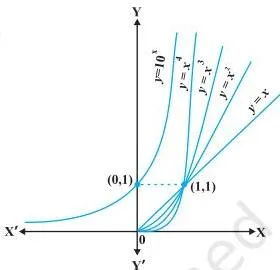
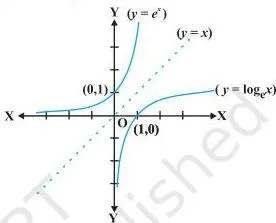
\[ \frac{d}{dx}(e^x) = e^x \]\[ \frac{d}{dx}(\log x) = \frac{1}{x}, \quad x \gt 0 \]\[ \frac{d}{dx}(a^x) = a^x \log a, \quad a \gt 0, a \neq 1 \]
The natural exponential function \( y = e^x \) and the natural logarithm \( y = \log x \) are inverses of each other.
Logarithmic Differentiation
For functions of the form \( y = [u(x)]^{v(x)} \) where u(x) > 0, take natural logarithms on both sides:
\[ \log y = v(x) \log u(x) \]
Differentiate both sides w.r.t. x:
\[ \frac{1}{y} \cdot \frac{dy}{dx} = v(x) \cdot \frac{1}{u(x)} \cdot u'(x) + v'(x) \cdot \log u(x) \]\[ \frac{dy}{dx} = y \left[ \frac{v(x)}{u(x)} u'(x) + v'(x) \log u(x) \right] \]
Derivatives of Functions in Parametric Forms
If x = f(t) and y = g(t), then:
\[ \frac{dy}{dx} = \frac{\frac{dy}{dt}}{\frac{dx}{dt}} \quad \text{provided} \quad \frac{dx}{dt} \neq 0 \]
Second Order Derivative
The second order derivative of y = f(x) is the derivative of the first derivative:
\[ \frac{d^2 y}{dx^2} = \frac{d}{dx} \left( \frac{dy}{dx} \right) \]
It is denoted by \( f”(x) \) or \( y” \).
What Each Symbol Means
| Symbol | What it means | Unit / Nature |
|---|---|---|
| \( x \) | Independent variable | Real number |
| \( c \) | Point at which continuity/derivative is evaluated | Real number |
| \( f(x) \) | Function value at x | Real number |
| \( \lim_{x \to c} f(x) \) | Limit of f(x) as x approaches c | Real number |
| \( f'(c) \) | Derivative of f at c | Rate of change |
| \( h \) | Small increment in x | Real number |
| \( u(x), v(x) \) | Functions being composed | Real number |
| \( t \) | Intermediate variable (in chain rule / parametric form) | Real number |
| \( \sin^{-1} x, \cos^{-1} x, \tan^{-1} x \) | Inverse trigonometric functions | Angle (radian) |
| \( e \) | Euler’s number (≈ 2.71828) | Dimensionless |
| \( \log x \) | Natural logarithm of x (base e) | Dimensionless |
| \( a \) | Positive constant base of exponential/logarithm | Dimensionless |
| \( y \) | Dependent variable (often f(x)) | Real number |
| \( \frac{d^2 y}{dx^2} \) | Second order derivative | Rate of change of rate |
When to Use Each Formula
| Formula | When to use it | Condition |
|---|---|---|
| \( \lim_{x \to c} f(x) = f(c) \) | To check if f is continuous at c. | f must be defined at c, and both LHL and RHL must exist and equal f(c). |
| Algebra of continuous functions | To build continuity of combinations of known continuous functions. | Each function must be continuous at the point; for quotient, denominator ≠ 0. |
| \( f'(c) = \lim_{h \to 0} \frac{f(c+h)-f(c)}{h} \) | To find the derivative from first principles, or to verify differentiability at a point. | Limit must exist (finite). |
| Chain rule \( \frac{df}{dx} = \frac{dv}{dt} \cdot \frac{dt}{dx} \) | When differentiating a composition of two or more functions. | Both inner and outer derivatives must exist. |
| Derivatives of \( \sin^{-1} x, \cos^{-1} x, \tan^{-1} x \) | When differentiating inverse trigonometric functions. | Domain restrictions: \( x \in (-1,1) \) for sin⁻¹ and cos⁻¹; all real for tan⁻¹. |
| \( \frac{d}{dx}(e^x) = e^x \) | When differentiating the natural exponential function. | Any real x. |
| \( \frac{d}{dx}(\log x) = \frac{1}{x} \) | When differentiating the natural logarithm. | \( x \gt 0 \). |
| Logarithmic differentiation | When the function is of the form \( [u(x)]^{v(x)} \) or a product/quotient of many factors. | u(x) > 0 for the logarithm to be defined. |
| Parametric differentiation | When x and y are given in terms of a parameter t. | \( \frac{dx}{dt} \neq 0 \). |
| Second order derivative | To find the rate of change of the slope, concavity, or higher-order differentiation. | First derivative must be differentiable. |
Worked Examples
Example 1: Applying the Chain Rule
Differentiate \( f(x) = \sin(3x^2 + 5) \) with respect to x.
Step 1: Identify the outer and inner functions.
Outer: \( v(t) = \sin t \), inner: \( u(x) = 3x^2 + 5 \).
Step 2: Compute derivatives.
\( v'(t) = \cos t \), \( u'(x) = 6x \).
Step 3: Apply chain rule: \( f'(x) = v'(u(x)) \cdot u'(x) \).
\[ f'(x) = \cos(3x^2+5) \cdot 6x = 6x \cos(3x^2+5) \]
Final answer: \( f'(x) = 6x \cos(3x^2+5) \).
Example 2: Logarithmic Differentiation
Differentiate \( y = (\cos x)^{x} \) for \( 0 \lt x \lt \frac{\pi}{2} \).
- Step 1: Take natural logarithms: \( \ln y = x \ln(\cos x) \).
- Step 2: Differentiate both sides with respect to x:
\[ \frac{1}{y} \frac{dy}{dx} = \ln(\cos x) + x \cdot \frac{1}{\cos x} \cdot (-\sin x) = \ln(\cos x) – x \tan x \]
Step 3: Multiply both sides by y:
\[ \frac{dy}{dx} = (\cos x)^x \left[ \ln(\cos x) – x \tan x \right] \]
Final answer: \( \frac{dy}{dx} = (\cos x)^x (\ln(\cos x) – x \tan x) \).
Example 3: Parametric Differentiation
Find \( \frac{dy}{dx} \) if \( x = 4t^2 \), \( y = 8t \).
Step 1: Compute derivatives with respect to parameter t:
\[ \frac{dx}{dt} = 8t, \quad \frac{dy}{dt} = 8 \]
Step 2: Apply the parametric formula:
\[ \frac{dy}{dx} = \frac{\frac{dy}{dt}}{\frac{dx}{dt}} = \frac{8}{8t} = \frac{1}{t} \]
Final answer: \( \frac{dy}{dx} = \frac{1}{t} \).
Common Mistakes to Avoid
| Mistake | Correct Rule | How to Check Your Answer |
|---|---|---|
| Forgetting the domain restriction for \( \frac{d}{dx}(\sin^{-1} x) \) – using it at \( x = \pm 1 \) where the derivative is undefined. | The derivative exists only for \( x \in (-1,1) \). | If the original function is not differentiable at the endpoints (vertical tangent), the derivative formula should not be applied there. |
| Applying the chain rule incorrectly by not multiplying all derivatives in the composition. | For \( f = v \circ u \), \( f'(x) = v'(u(x)) \cdot u'(x) \). | Differentiate the outer function first, leaving the inner unchanged, then multiply by the derivative of the inner. |
| Confusing the derivative of \( a^x \) with \( x^a \). | \( \frac{d}{dx}(a^x) = a^x \ln a \), not \( x a^{x-1} \). | Remember that \( a^x \) is an exponential function, not a power function. Use the formula from the chapter. |
| In logarithmic differentiation, forgetting to multiply by y after differentiating both sides. | After finding \( \frac{1}{y} \frac{dy}{dx} \), multiply both sides by y to get \( \frac{dy}{dx} \). | Always substitute back \( y = [u(x)]^{v(x)} \) to express the final answer in terms of x. |
Frequently Asked Questions
Is every continuous function differentiable?
No. Continuity is a necessary condition for differentiability, but not sufficient. For example, \( f(x) = |x| \) is continuous at x = 0 but not differentiable there because the left and right derivatives differ.
When should I use logarithmic differentiation?
Use it when the function is of the form \( [u(x)]^{v(x)} \) (variable base and variable exponent), or when the function is a product/quotient of many factors that would be messy to differentiate by standard rules. Logarithmic differentiation simplifies the process by converting products into sums.
What is the difference between \( \frac{d}{dx}(a^x) \) and \( \frac{d}{dx}(x^a) \)?
\( \frac{d}{dx}(a^x) = a^x \ln a \) (exponential function, base constant), while \( \frac{d}{dx}(x^a) = a x^{a-1} \) (power function, exponent constant). They are different rules; do not confuse them.
How do I find the second derivative of a parametric function?
First find \( \frac{dy}{dx} \) in terms of the parameter t. Then differentiate that result with respect to t and divide by \( \frac{dx}{dt} \): \( \frac{d^2 y}{dx^2} = \frac{ \frac{d}{dt} \left( \frac{dy}{dx} \right) }{ \frac{dx}{dt} } \).
Reference: NCERT Class 12 Mathematics textbook, chapter Continuity and Differentiability.
Explore Class 12 Maths Formulas
More for this chapter:
Class 12 Maths on LearnCBSE:
Related chapters:
Official source: download the NCERT textbook free from ncert.nic.in.