
This page collects the matrices class 12 formulas you need from the NCERT chapter on Matrices — order and types of a matrix, equality, addition and scalar multiplication, matrix multiplication, transpose, symmetric and skew-symmetric matrices, and invertible matrices. Each formula is stated the way the Rationalised NCERT Class 12 Mathematics Part I textbook gives it, with its conditions.
Formulas are grouped by topic below, with a symbol table, a when-to-use guide and three original worked examples. For the other formula sheets in this course, see the Class 12 maths formulas section; the official textbook PDF is available on the NCERT website.
Formulas at a Glance
Every formula on this sheet appears in the table below; symbol meanings follow in the next section.
| Purpose (what you are finding) | Formula |
|---|---|
| Matrix notation and number of elements | \( A = [a_{ij}]_{m \times n} \), where \( 1 \leq i \leq m \) and \( 1 \leq j \leq n \); number of elements \( = mn \) |
| Equality of two matrices | \( A = B \) if and only if the orders are the same and \( a_{ij} = b_{ij} \) for all \( i, j \) |
| Sum of two matrices (same order) | \( A + B = [a_{ij} + b_{ij}]_{m \times n} \) |
| Scalar multiplication | \( kA = [k\,a_{ij}]_{m \times n} \) |
| Negative and difference of matrices | \( -A = (-1)A \), \( A – B = A + (-1)B \) |
| Properties of matrix addition | \( A+B=B+A \); \( (A+B)+C=A+(B+C) \); \( A+O=A \); \( A+(-A)=O \) |
| Distributive laws for scalars | \( k(A+B)=kA+kB \); \( (k+l)A=kA+lA \) |
| Product of two matrices | \( AB = [c_{ik}]_{m \times p} \), \( c_{ik} = \sum_{j=1}^{n} a_{ij}b_{jk} \) |
| Properties of multiplication | \( (AB)C=A(BC) \); \( A(B+C)=AB+AC \); \( (A+B)C=AC+BC \); \( IA=AI=A \) |
| Entry conditions of special square matrices | diagonal: \( a_{ij}=0 \) when \( i \neq j \); scalar: \( a_{ij}=k \) when \( i=j \); identity: \( a_{ij}=1 \) when \( i=j \), \( 0 \) when \( i \neq j \) |
| Transpose of a matrix | \( A’ = A^{T} = [a_{ji}]_{n \times m} \) |
| Properties of transpose | \( (A’)’=A \); \( (kA)’=kA’ \); \( (A+B)’=A’+B’ \); \( (AB)’=B’A’ \) |
| Symmetric / skew-symmetric test | \( A’=A \) for symmetric; \( A’=-A \) for skew-symmetric |
| Split into symmetric and skew-symmetric parts | \( A+A’ \) is symmetric, \( A-A’ \) is skew-symmetric; \( A=\frac{1}{2}(A+A’)+\frac{1}{2}(A-A’) \) |
| Unknown matrix in a matrix equation (derived from the addition and scalar properties) | if \( pA + qX = B \), then \( X = \frac{1}{q}(B – pA) \), \( q \neq 0 \) |
| Inverse of a matrix | \( AB = BA = I \Rightarrow B = A^{-1} \) |
| Inverse of a product (Theorem 4) | \( (AB)^{-1} = B^{-1}A^{-1} \) |
| Power of a rotation matrix (Example 23) | \( A = \begin{bmatrix} \cos\theta & \sin\theta \\ -\sin\theta & \cos\theta \end{bmatrix} \Rightarrow A^{n} = \begin{bmatrix} \cos n\theta & \sin n\theta \\ -\sin n\theta & \cos n\theta \end{bmatrix}, \ n \in \mathbb{N} \) |
All Matrices Class 12 Formulas, Grouped by Topic
The groups below follow the sub-topics of the NCERT chapter, so you can jump straight to the section your revision needs.
Matrix and Its Order
A matrix is an ordered rectangular array of numbers or functions; the numbers or functions are its elements or entries (NCERT, p. 36). A matrix with \( m \) rows and \( n \) columns is of order \( m \times n \):
\[ A = [a_{ij}]_{m \times n}, \qquad 1 \leq i \leq m, \quad 1 \leq j \leq n \]
Here \( a_{ij} \) is the element in the \( i \)-th row and \( j \)-th column, and the number of elements of the matrix is \( mn \). This row-column notation is used in every later formula of the chapter.
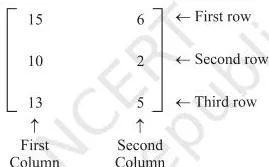
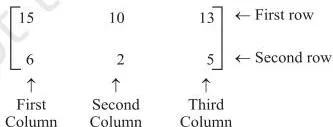
The two figures show the same possession data written two ways. In the first, each row is a student and each column an item, so the order is \( 3 \times 2 \). In the second the rows and columns are interchanged, so the order is \( 2 \times 3 \). This very operation — interchanging rows and columns — is later formalised as the transpose of a matrix.
Types of Matrices
Each type is fixed by its order and its entry conditions (NCERT, p. 39–41):
| Type | Defining condition |
|---|---|
| Column matrix | only one column: \( A = [a_{ij}]_{m \times 1} \) |
| Row matrix | only one row: \( B = [b_{ij}]_{1 \times n} \) |
| Square matrix | \( m = n \); the diagonal elements are \( a_{11}, a_{22}, \ldots, a_{nn} \) |
| Diagonal matrix | \( a_{ij} = 0 \) whenever \( i \neq j \) |
| Scalar matrix | \( a_{ij} = 0 \) when \( i \neq j \); \( a_{ij} = k \) when \( i = j \) (all diagonal entries equal) |
| Identity matrix | \( a_{ij} = 1 \) when \( i = j \); \( a_{ij} = 0 \) when \( i \neq j \); written \( I_n \) |
| Zero matrix | every element is zero; written \( O \) |
Notice the relation between the three square types: a scalar matrix is an identity matrix exactly when \( k = 1 \), and every identity matrix is a scalar matrix.
Equality of Matrices
Two matrices are equal when both conditions hold (NCERT, p. 41):
\[ A = B \iff A \text{ and } B \text{ have the same order and } a_{ij} = b_{ij} \text{ for all } i, j \]
This is the rule that lets you compare entries in the same position and solve for unknown letters inside a matrix.
Addition and Scalar Multiplication
For two matrices of the same order \( m \times n \), addition is entry-wise (NCERT, p. 44):
\[ A + B = [a_{ij} + b_{ij}]_{m \times n} \]
Multiplying by a scalar multiplies every element (NCERT, p. 45):
\[ kA = [k\,a_{ij}]_{m \times n}, \qquad -A = (-1)A, \qquad A – B = A + (-1)B \]
Matrix addition obeys:
- Commutative law: \( A + B = B + A \)
- Associative law: \( (A+B) + C = A + (B+C) \)
- Additive identity: \( A + O = O + A = A \)
- Additive inverse: \( A + (-A) = (-A) + A = O \)
- Scalar distributive laws: \( k(A+B) = kA + kB \) and \( (k+l)A = kA + lA \)
Multiplication of Matrices
The product \( AB \) is defined only when the number of columns of \( A \) equals the number of rows of \( B \).
For \( A = [a_{ij}]_{m \times n} \) and \( B = [b_{jk}]_{n \times p} \), the product \( AB \) has order \( m \times p \); its \( (i,k) \)-th entry is found by multiplying the \( i \)-th row of \( A \) with the \( k \)-th column of \( B \) element-wise and adding (NCERT, p. 51):
\[ c_{ik} = a_{i1}b_{1k} + a_{i2}b_{2k} + \cdots + a_{in}b_{nk} = \sum_{j=1}^{n} a_{ij}b_{jk} \]
Multiplication rules:
- Associative: \( (AB)C = A(BC) \), whenever both sides are defined
- Distributive: \( A(B+C) = AB + AC \) and \( (A+B)C = AC + BC \)
- Identity: \( IA = AI = A \) for every square matrix \( A \)
- Not commutative: \( AB \neq BA \) in general, even when both products exist. Diagonal matrices of the same order do commute.
- Zero product: \( AB = O \) does not force \( A = O \) or \( B = O \).
Transpose of a Matrix
The transpose of \( A = [a_{ij}]_{m \times n} \) is the \( n \times m \) matrix obtained by interchanging rows and columns (NCERT, p. 61):
\[ A’ = A^{T} = [a_{ji}]_{n \times m} \]
Transpose properties:
- \( (A’)’ = A \)
- \( (kA)’ = kA’ \) for any constant \( k \)
- \( (A+B)’ = A’ + B’ \)
- \( (AB)’ = B’A’ \) — the factors reverse their order
Symmetric and Skew Symmetric Matrices
A square matrix \( A \) is symmetric when \( A’ = A \), that is \( a_{ij} = a_{ji} \) for all \( i, j \). It is skew symmetric when \( A’ = -A \), that is \( a_{ji} = -a_{ij} \); putting \( i = j \) then forces every diagonal element to be zero (NCERT, p. 63).
For any square matrix \( A \) with real entries (NCERT, p. 64):
\[ A + A’ \text{ is symmetric}, \qquad A – A’ \text{ is skew symmetric} \]
and therefore any square matrix can be written as the sum of a symmetric and a skew-symmetric matrix:
\[ A = \frac{1}{2}(A + A’) + \frac{1}{2}(A – A’) \]
Invertible Matrices
A square matrix \( A \) is invertible if there exists a square matrix \( B \) of the same order such that (NCERT, p. 68):
\[ AB = BA = I \Rightarrow B = A^{-1} \]
- A rectangular matrix has no inverse.
- If the inverse exists, it is unique (Theorem 3).
- If \( B \) is the inverse of \( A \), then \( A \) is the inverse of \( B \).
- For invertible matrices \( A \) and \( B \) of the same order (Theorem 4, NCERT, p. 69):
\[ (AB)^{-1} = B^{-1}A^{-1} \]
Power of a Rotation Matrix
For the rotation matrix \( A = \begin{bmatrix} \cos\theta & \sin\theta \\ -\sin\theta & \cos\theta \end{bmatrix} \), the chapter proves by induction (Miscellaneous Example 23) that \[ A^{n} = \begin{bmatrix} \cos n\theta & \sin n\theta \\ -\sin n\theta & \cos n\theta \end{bmatrix}, \qquad n \in \mathbb{N} \]
What Each Symbol Means
This is a pure-maths chapter, so there are no SI units; the third column records the nature of each quantity.
| Symbol | What it means | Unit / nature |
|---|---|---|
| \( A, B, C \) | matrices, denoted by capital letters | rectangular array of numbers |
| \( a_{ij} \) | the element in the \( i \)-th row and \( j \)-th column of \( A \) | real number |
| \( i \) | row number (index) | count, \( 1 \leq i \leq m \) |
| \( j \) | column number (index) | count, \( 1 \leq j \leq n \) |
| \( m \) | number of rows of the matrix | count |
| \( n \) | number of columns of the matrix | count |
| \( p \) | number of columns of \( B \) in the product \( AB \) | count |
| \( m \times n \) | order of the matrix, read as m by n | dimensions of the array |
| \( k, l \) | scalars (constants) | real numbers |
| \( c_{ik} \) | the \( (i,k) \)-th element of the product matrix | real number |
| \( O \) | zero (null) matrix of the same order | matrix |
| \( I \) or \( I_n \) | identity matrix of order \( n \) | matrix |
| \( A’ \) or \( A^{T} \) | transpose of \( A \) | matrix |
| \( A^{-1} \) | inverse of \( A \) | matrix |
| \( \theta \) | angle in the rotation matrix | angle (degrees or radians, as the problem gives) |
| \( n \) in \( A^{n} \) | natural-number exponent | natural number |
When to Use Each Formula
Pick the formula by the situation, then check the condition before substituting.
| Situation | Use | Condition to check |
|---|---|---|
| Add two matrices entry by entry (combine two sets of data) | \( A + B = [a_{ij} + b_{ij}] \) | both matrices have the same order \( m \times n \) |
| Scale every entry by the same factor (2% profit, doubling production) | \( kA = [k a_{ij}] \) | \( k \) any real number; order unchanged |
| Subtract one matrix from another | \( A – B = A + (-1)B \) | same order |
| Multiply two matrices (rows of \( A \) times columns of \( B \)) | \( AB \), with \( c_{ik} = \sum_{j=1}^{n} a_{ij}b_{jk} \) | columns of \( A \) = rows of \( B \); result has order \( m \times p \) |
| Regroup a product of three matrices | \( (AB)C = A(BC) \) | both sides defined (compatible orders) |
| Distribute multiplication over addition | \( A(B+C) = AB + AC \); \( (A+B)C = AC + BC \) | all products and sums are defined |
| Flip rows and columns of a matrix | \( A’ = [a_{ji}] \) | any \( m \times n \) matrix; transpose is \( n \times m \) |
| Transpose a sum or a product | \( (A+B)’ = A’ + B’ \); \( (AB)’ = B’A’ \) | for a product, reverse the order of the factors |
| Test whether a square matrix is symmetric or skew-symmetric | \( A’ = A \) or \( A’ = -A \) | square matrix; for skew-symmetric, diagonal entries must be zero |
| Split a square matrix into symmetric and skew-symmetric parts | \( A = \frac{1}{2}(A+A’) + \frac{1}{2}(A-A’) \) | square matrix |
| Isolate an unknown matrix in an equation such as \( pA + qX = B \) | \( X = \frac{1}{q}(B – pA) \) | all matrices have the same order and \( q \neq 0 \) |
| Find or use the inverse of a matrix | \( AB = BA = I \Rightarrow B = A^{-1} \); \( (AB)^{-1} = B^{-1}A^{-1} \) | \( A, B \) square, same order, invertible |
For the rotation matrix \( A = \begin{bmatrix} \cos\theta & \sin\theta \\ -\sin\theta & \cos\theta \end{bmatrix} \), use the power formula \( A^{n} = \begin{bmatrix} \cos n\theta & \sin n\theta \\ -\sin n\theta & \cos n\theta \end{bmatrix} \) when you need a natural power of such a matrix directly.
Worked Examples
Three lookups with original numbers. Each example shows the formula selected, the substitution, and the final answer.
Worked Example 1: Multiplying two matrices
Formula to use: for \( A = [a_{ij}]_{2 \times 2} \) and \( B = [b_{jk}]_{2 \times 3} \), the product is \( AB = [c_{ik}]_{2 \times 3} \), where \( c_{ik} = \sum_{j=1}^{2} a_{ij}b_{jk} \).
Step 1 — check the order condition: \( A = \begin{bmatrix} 1 & 3 \\ 2 & -1 \end{bmatrix} \) has 2 columns and \( B = \begin{bmatrix} 2 & 0 & 5 \\ -1 & 4 & 2 \end{bmatrix} \) has 2 rows, so \( AB \) is defined and its order is \( 2 \times 3 \).
Step 2 — multiply each row of \( A \) by each column of \( B \):
\[ AB = \begin{bmatrix} 1(2) + 3(-1) & 1(0) + 3(4) & 1(5) + 3(2) \\ 2(2) + (-1)(-1) & 2(0) + (-1)(4) & 2(5) + (-1)(2) \end{bmatrix} \]
\[ = \begin{bmatrix} -1 & 12 & 11 \\ 5 & -4 & 8 \end{bmatrix} \]
Step 3 — check the reverse product: \( B \) has 3 columns while \( A \) has 2 rows, so \( BA \) is not defined.
The order of the factors is not optional.
Final answer: \( AB = \begin{bmatrix} -1 & 12 & 11 \\ 5 & -4 & 8 \end{bmatrix} \).
Worked Example 2: Finding unknowns from equal matrices
Formula to use: equality of matrices — \( A = B \) only if the orders match and every pair of corresponding entries is equal.
Step 1: both sides are \( 2 \times 2 \), so compare entries position by position:
\[ \begin{bmatrix} x+4 & 2y-6 \\ 3 & 5-x \end{bmatrix} = \begin{bmatrix} 7 & 2 \\ 3 & 2 \end{bmatrix} \]
Step 2 — equate corresponding entries: \( x + 4 = 7 \) gives \( x = 3 \), and \( 2y – 6 = 2 \) gives \( y = 4 \).
Step 3 — verify the remaining entries: \( 5 – x = 5 – 3 = 2 \) and the \( (2,1) \) entries are both 3, so both conditions of equality hold.
Final answer: \( x = 3 \), \( y = 4 \).
Worked Example 3: Splitting a matrix into symmetric and skew-symmetric parts
Formula to use: \( A = \frac{1}{2}(A + A’) + \frac{1}{2}(A – A’) \), where the first part is symmetric and the second is skew-symmetric.
Step 1 — write the transpose: for \( A = \begin{bmatrix} 3 & 1 & 0 \\ -2 & 4 & 5 \\ 1 & -3 & 2 \end{bmatrix} \), \[ A’ = \begin{bmatrix} 3 & -2 & 1 \\ 1 & 4 & -3 \\ 0 & 5 & 2 \end{bmatrix} \]
Step 2 — symmetric part:
\[ \frac{1}{2}(A + A’) = \frac{1}{2} \begin{bmatrix} 6 & -1 & 1 \\ -1 & 8 & 2 \\ 1 & 2 & 4 \end{bmatrix} = \begin{bmatrix} 3 & -\frac{1}{2} & \frac{1}{2} \\ -\frac{1}{2} & 4 & 1 \\ \frac{1}{2} & 1 & 2 \end{bmatrix} \]
Step 3 — skew-symmetric part:
\[ \frac{1}{2}(A – A’) = \frac{1}{2} \begin{bmatrix} 0 & 3 & -1 \\ -3 & 0 & 8 \\ 1 & -8 & 0 \end{bmatrix} = \begin{bmatrix} 0 & \frac{3}{2} & -\frac{1}{2} \\ -\frac{3}{2} & 0 & 4 \\ \frac{1}{2} & -4 & 0 \end{bmatrix} \]
Step 4 — check: the first result equals its own transpose; the second has zero diagonal and its transpose equals its negative; adding them returns \( A \).
Final answer: \( A = \begin{bmatrix} 3 & -\frac{1}{2} & \frac{1}{2} \\ -\frac{1}{2} & 4 & 1 \\ \frac{1}{2} & 1 & 2 \end{bmatrix} + \begin{bmatrix} 0 & \frac{3}{2} & -\frac{1}{2} \\ -\frac{3}{2} & 0 & 4 \\ \frac{1}{2} & -4 & 0 \end{bmatrix} \).
Now practise these formulas on the exercises of the chapter. The maths formulas index lists formula sheets for every chapter.
Common Mistakes to Avoid
The errors below are the ones students make when applying matrix formulas, with a check for each.
| Mistake | Correct rule | How to check your answer |
|---|---|---|
| Adding two matrices of different orders | \( A + B \) is defined only when both matrices have the same order \( m \times n \) | Write down both orders first; if they differ, the sum does not exist |
| Assuming \( AB = BA \) whenever both products are defined | Matrix multiplication is not commutative; even same-order products can differ | Compute \( BA \) and compare entry by entry; if the two orders differ, equality is impossible |
| Writing the transpose of a product as \( A’B’ \) | \( (AB)’ = B’A’ \) — the factors reverse | Check the order: if \( AB \) is \( m \times p \), its transpose must be \( p \times m \), which is \( B’A’ \), not \( A’B’ \) |
| Concluding \( A = O \) or \( B = O \) from \( AB = O \) | The zero-product rule for real numbers does not carry over to matrices | Counterexample: \( \begin{bmatrix} 1 & 0 \\ 0 & 0 \end{bmatrix} \begin{bmatrix} 0 & 0 \\ 0 & 1 \end{bmatrix} = O \) with neither factor zero |
| Dropping the half in the decomposition \( A = \frac{1}{2}(A+A’) + \frac{1}{2}(A-A’) \) | Both parts carry the factor \( \frac{1}{2} \) | Add your two resulting matrices; you must recover \( A \), not \( 2A \) |
| Confusing diagonal, scalar and identity matrices | Diagonal: \( a_{ij} = 0 \) for \( i \neq j \). Scalar: diagonal entries all equal to the same \( k \). Identity: diagonal entries all exactly 1 | Check the diagonal entries: identity needs every one equal to 1; scalar needs them all equal; diagonal only needs the off-diagonal entries to be zero |
Frequently Asked Questions
When is the product AB defined, and what is its order?
The product \( AB \) is defined exactly when the number of columns of \( A \) equals the number of rows of \( B \). If \( A \) is \( m \times n \) and \( B \) is \( n \times p \), then \( AB \) is \( m \times p \) and its \( (i,k) \)-th entry is \( c_{ik} = \sum_{j=1}^{n} a_{ij}b_{jk} \) (NCERT, p. 51).
Check the orders first: if the inner numbers do not match, the product does not exist.
Does AB always equal BA?
No. Matrix multiplication is not commutative. For both products to be defined at all, \( A \) must be \( m \times n \) and \( B \) must be \( n \times m \); and even when both are square of the same order, \( AB \) and \( BA \) can differ — the NCERT chapter gives an explicit \( 2 \times 2 \) example.
One case where equality does hold is when both matrices are diagonal of the same order.
How do I know whether a matrix has an inverse?
A matrix must be square to be invertible — rectangular matrices have no inverse (NCERT, p. 68). If there is a square matrix \( B \) of the same order with \( AB = BA = I \), then \( B = A^{-1} \). The inverse is unique when it exists, and for invertible \( A, B \) of the same order, \( (AB)^{-1} = B^{-1}A^{-1} \) (NCERT, p. 69).
Is every scalar matrix an identity matrix?
The other way round: every identity matrix is a scalar matrix, because its diagonal entries are all equal to 1. A scalar matrix is an identity matrix only when its common diagonal value is \( k = 1 \).
Which exercises practise which formulas?
Exercise 3.1 tests order, elements and equality; Exercise 3.2 practises addition, scalar multiplication, matrix multiplication and the properties of these operations; Exercise 3.3 covers transpose, symmetric and skew-symmetric matrices; Exercise 3.4 tests the definition of inverse. The Miscellaneous Exercise combines formulas from all of these.
Reference: NCERT Class 12 Mathematics textbook, chapter Matrices.
Explore Class 12 Maths Formulas
More for this chapter:
Class 12 Maths on LearnCBSE:
Related chapters: