
This chapter lists the domain, range, and principal value branch of each inverse trigonometric function, together with the key properties that let you simplify expressions involving \( \sin^{-1} x \), \( \cos^{-1} x \), \( \tan^{-1} x \), \( \cot^{-1} x \), \( \sec^{-1} x \), and \( \cosec^{-1} x \).
The sheet covers the definitions, the composition identities, the double‑angle forms, and the sum‑to‑single‑term formulas that appear in the board exam.
Each formula is grouped by topic with its symbol meanings, when‑to‑use guidance, and original worked examples. For the full explanations and derivations, see the chapter notes page.
Formulas at a Glance
| Purpose (what you are finding) | Formula |
|---|---|
Domain of \( \sin^{-1} x \) |
\( [-1, 1] \) |
Principal value range of \( \sin^{-1} x \) |
\( \left[ -\frac{\pi}{2}, \frac{\pi}{2} \right] \) |
Domain of \( \cos^{-1} x \) |
\( [-1, 1] \) |
Principal value range of \( \cos^{-1} x \) |
\( [0, \pi] \) |
Domain of \( \cosec^{-1} x \) |
\( \mathbf{R} - (-1, 1) \) |
Principal value range of \( \cosec^{-1} x \) |
\( \left[ -\frac{\pi}{2}, \frac{\pi}{2} \right] - \{0\} \) |
Domain of \( \sec^{-1} x \) |
\( \mathbf{R} - (-1, 1) \) |
Principal value range of \( \sec^{-1} x \) |
\( [0, \pi] - \left\{ \frac{\pi}{2} \right\} \) |
Domain of \( \tan^{-1} x \) |
\( \mathbf{R} \) |
Principal value range of \( \tan^{-1} x \) |
\( \left( -\frac{\pi}{2}, \frac{\pi}{2} \right) \) |
Domain of \( \cot^{-1} x \) |
\( \mathbf{R} \) |
Principal value range of \( \cot^{-1} x \) |
\( (0, \pi) \) |
Composition: \( \sin(\sin^{-1} x) = x \) |
\( \sin(\sin^{-1} x) = x, \quad x \in [-1, 1] \) |
Composition: \( \sin^{-1}(\sin x) = x \) |
\( \sin^{-1}(\sin x) = x, \quad x \in \left[ -\frac{\pi}{2}, \frac{\pi}{2} \right] \) |
Double‑angle: \( \sin^{-1}(2x\sqrt{1-x^2}) = 2\sin^{-1} x \) |
\( \sin^{-1}\left(2x\sqrt{1-x^2}\right) = 2\sin^{-1} x, \quad -\frac{1}{\sqrt{2}} \leq x \leq \frac{1}{\sqrt{2}} \) |
Triple‑angle: \( \sin^{-1}(3x-4x^3) = 3\sin^{-1} x \) |
\( \sin^{-1}(3x-4x^3) = 3\sin^{-1} x, \quad x \in \left[ -\frac{1}{2}, \frac{1}{2} \right] \) |
Triple‑angle: \( \cos^{-1}(4x^3-3x) = 3\cos^{-1} x \) |
\( \cos^{-1}(4x^3-3x) = 3\cos^{-1} x, \quad x \in \left[ \frac{1}{2}, 1 \right] \) |
Sum of \( \sin^{-1} \) and \( \sin^{-1} \) (example formula) |
\( \sin^{-1} \frac{8}{17} + \sin^{-1} \frac{3}{5} = \tan^{-1} \frac{77}{36} \) |
Sum of \( \cos^{-1} \) and \( \cos^{-1} \) (example formula) |
\( \cos^{-1} \frac{4}{5} + \cos^{-1} \frac{12}{13} = \cos^{-1} \frac{33}{65} \) |
All Formulas, Grouped by Topic
Basic Concepts: Domains and Principal Value Ranges
Each inverse trigonometric function is defined only after restricting the domain of the original trigonometric function so that it becomes one‑one and onto. The table below shows the principal value branch (the range we use by default) together with the domain.
| Function | Domain | Range (Principal Value) |
|---|---|---|
\( y = \sin^{-1} x \) |
\( [-1, 1] \) |
\( \left[ -\frac{\pi}{2}, \frac{\pi}{2} \right] \) |
\( y = \cos^{-1} x \) |
\( [-1, 1] \) |
\( [0, \pi] \) |
\( y = \cosec^{-1} x \) |
\( \mathbf{R} - (-1, 1) \) |
\( \left[ -\frac{\pi}{2}, \frac{\pi}{2} \right] - \{0\} \) |
\( y = \sec^{-1} x \) |
\( \mathbf{R} - (-1, 1) \) |
\( [0, \pi] - \left\{ \frac{\pi}{2} \right\} \) |
\( y = \tan^{-1} x \) |
\( \mathbf{R} \) |
\( \left( -\frac{\pi}{2}, \frac{\pi}{2} \right) \) |
\( y = \cot^{-1} x \) |
\( \mathbf{R} \) |
\( (0, \pi) \) |
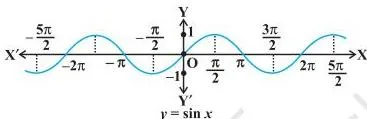
\( y = \sin^{-1} x \) (principal value branch) along with the original sine curve reflected across \( y = x \). Source: NCERT![Graph of y = cos x and y = cos^{-1} x, with the principal value branch of arccosine in [0, π].](https://www.learncbse.net/images/inverse-trigonometric-functions-the-graph-of-the-function-given-by-y-cos-1-x-can-be-drawn-in.webp "Inverse Trigonometric Functions Class 12 Formulas")
Properties of Inverse Trigonometric Functions
These identities hold for every admissible \( x \) within the respective domains.
- Composition with the original trigonometric function:
\( \sin(\sin^{-1} x) = x, \quad x \in [-1, 1] \)
\( \cos(\cos^{-1} x) = x, \quad x \in [-1, 1] \)
\( \tan(\tan^{-1} x) = x, \quad x \in \mathbf{R} \)
\( \cot(\cot^{-1} x) = x, \quad x \in \mathbf{R} \)
\( \sec(\sec^{-1} x) = x, \quad x \in \mathbf{R} - (-1, 1) \)
\( \cosec(\cosec^{-1} x) = x, \quad x \in \mathbf{R} - (-1, 1) \) - Composition in the reverse order: (only when the argument lies in the principal value branch)
\( \sin^{-1}(\sin x) = x, \quad x \in \left[ -\frac{\pi}{2}, \frac{\pi}{2} \right] \)
\( \cos^{-1}(\cos x) = x, \quad x \in [0, \pi] \)
\( \tan^{-1}(\tan x) = x, \quad x \in \left( -\frac{\pi}{2}, \frac{\pi}{2} \right) \)
\( \cot^{-1}(\cot x) = x, \quad x \in (0, \pi) \)
\( \sec^{-1}(\sec x) = x, \quad x \in [0, \pi] - \left\{ \frac{\pi}{2} \right\} \)
\( \cosec^{-1}(\cosec x) = x, \quad x \in \left[ -\frac{\pi}{2}, \frac{\pi}{2} \right] - \{0\} \) - Negation formulas: (for
\( x \)in the domain)
\( \sin^{-1}(-x) = -\sin^{-1} x \)
\( \cos^{-1}(-x) = \pi - \cos^{-1} x \)
\( \tan^{-1}(-x) = -\tan^{-1} x \)
\( \cot^{-1}(-x) = \pi - \cot^{-1} x \)
\( \sec^{-1}(-x) = \pi - \sec^{-1} x \)
\( \cosec^{-1}(-x) = -\cosec^{-1} x \) - Reciprocal relations:
\( \cosec^{-1} x = \sin^{-1} \frac{1}{x} \quad (x \neq 0) \)
\( \sec^{-1} x = \cos^{-1} \frac{1}{x} \quad (x \neq 0) \)
\( \cot^{-1} x = \tan^{-1} \frac{1}{x} \quad (x \gt 0) \)
Multiple‑Angle and Substitution Identities
These are derived by setting \( x = \sin \theta \) or \( x = \cos \theta \) and are valid only for the indicated \( x \)‑intervals.
-
\( \sin^{-1}\left(2x\sqrt{1-x^2}\right) = 2\sin^{-1} x \),for\( -\frac{1}{\sqrt{2}} \leq x \leq \frac{1}{\sqrt{2}} \) -
\( \sin^{-1}\left(2x\sqrt{1-x^2}\right) = 2\cos^{-1} x \),for\( \frac{1}{\sqrt{2}} \leq x \leq 1 \) -
\( \sin^{-1}(3x-4x^3) = 3\sin^{-1} x \),for\( x \in \left[ -\frac{1}{2}, \frac{1}{2} \right] \) -
\( \cos^{-1}(4x^3-3x) = 3\cos^{-1} x \),for\( x \in \left[ \frac{1}{2}, 1 \right] \)
Sum and Difference Formulas (as given in the chapter)
These identities are verified by converting to \( \tan^{-1} \) or by using the addition formulas for sine and cosine. They are valid for the values that keep all terms defined.
\( 2\sin^{-1} \frac{3}{5} = \tan^{-1} \frac{24}{7} \)\( \sin^{-1} \frac{8}{17} + \sin^{-1} \frac{3}{5} = \tan^{-1} \frac{77}{36} \)\( \cos^{-1} \frac{4}{5} + \cos^{-1} \frac{12}{13} = \cos^{-1} \frac{33}{65} \)\( \cos^{-1} \frac{12}{13} + \sin^{-1} \frac{3}{5} = \sin^{-1} \frac{56}{65} \)\( \tan^{-1} \frac{63}{16} = \sin^{-1} \frac{5}{13} + \cos^{-1} \frac{3}{5} \)
What Each Symbol Means
| Symbol | Meaning | Nature (unit) |
|---|---|---|
\( \sin^{-1} x \) |
Angle whose sine is \( x \) (arcsine of \( x \)) |
Angle (radians) |
\( \cos^{-1} x \) |
Angle whose cosine is \( x \) (arccosine of \( x \)) |
Angle (radians) |
\( \tan^{-1} x \) |
Angle whose tangent is \( x \) (arctangent of \( x \)) |
Angle (radians) |
\( \cot^{-1} x \) |
Angle whose cotangent is \( x \) (arccotangent of \( x \)) |
Angle (radians) |
\( \sec^{-1} x \) |
Angle whose secant is \( x \) (arcsecant of \( x \)) |
Angle (radians) |
\( \cosec^{-1} x \) |
Angle whose cosecant is \( x \) (arccosecant of \( x \)) |
Angle (radians) |
\( x \) |
Input value (argument of the inverse function) | Real number (dimensionless) |
\( \pi \) |
Ratio of a circle’s circumference to its diameter | Constant (≈ 3.14159) |
\( \mathbf{R} \) |
Set of all real numbers | — |
When to Use Each Formula
| Formula | When to use it |
|---|---|
| Domain and range tables | To check whether a given value belongs to the domain of an inverse function, and to pick the correct principal value angle. |
\( \sin(\sin^{-1} x) = x \) |
When you have an inverse function inside its own trigonometric function and the argument is a numeric value between –1 and 1. |
\( \sin^{-1}(\sin x) = x \) |
When you need to simplify an expression like \( \sin^{-1}(\sin \theta) \) and \( \theta \) lies in the principal value interval; otherwise reduce \( \theta \) to that interval. |
| Negation formulas | When the argument of an inverse function is negative; rewrite it as a positive argument plus a constant. |
| Reciprocal relations | To convert between \( \cosec^{-1} \) and \( \sin^{-1} \), or \( \sec^{-1} \) and \( \cos^{-1} \), or \( \cot^{-1} \) and \( \tan^{-1} \). |
\( \sin^{-1}(2x\sqrt{1-x^2}) \) identities |
When you need to simplify expressions of the form \( \sin^{-1}(2x\sqrt{1-x^2}) \); choose the right form based on the \( x \)‑interval. |
| Triple‑angle identities | When you encounter \( \sin^{-1}(3x-4x^3) \) or \( \cos^{-1}(4x^3-3x) \); check that \( x \) lies in the specified interval. |
Sum‑to‑single‑term formulas (e.g., \( \sin^{-1} a + \sin^{-1} b \)) |
When you need to combine two inverse trigonometric functions into one, usually to simplify an equation. |
Worked Examples
Example 1: Finding a principal value
Find the principal value of \( \cos^{-1}\left( -\frac{1}{2} \right) \).
Step 1: Let \( y = \cos^{-1}\left( -\frac{1}{2} \right) \).
Then \( \cos y = -\frac{1}{2} \).
Step 2: The principal value range of \( \cos^{-1} \) is \( [0, \pi] \).
We need an angle \( y \) in \( [0, \pi] \) such that \( \cos y = -\frac{1}{2} \).
Step 3: \( \cos \frac{2\pi}{3} = -\frac{1}{2} \) and \( \frac{2\pi}{3} \in [0, \pi] \).
Final answer: \( \frac{2\pi}{3} \).
Example 2: Simplifying a composition that is not in the principal branch
Simplify \( \sin^{-1}\left( \sin \frac{5\pi}{4} \right) \).
- Step 1:
\( \frac{5\pi}{4} \)is not in the principal value interval\( \left[ -\frac{\pi}{2}, \frac{\pi}{2} \right] \). - Step 2: Use
\( \sin \frac{5\pi}{4} = \sin\left(\pi + \frac{\pi}{4}\right) = -\sin\frac{\pi}{4} = -\frac{\sqrt{2}}{2} \). - Step 3:
\( \sin^{-1}\left( -\frac{\sqrt{2}}{2} \right) = -\frac{\pi}{4} \)because\( -\frac{\pi}{4} \)lies in the principal range and\( \sin\left( -\frac{\pi}{4} \right) = -\frac{\sqrt{2}}{2} \).
Final answer: \( -\frac{\pi}{4} \).
Example 3: Applying the double‑angle identity
Evaluate \( \sin^{-1}\left( 2 \times \frac{1}{2} \sqrt{1 - \left(\frac{1}{2}\right)^2} \right) \).
- Step 1: Notice that the expression is
\( \sin^{-1}\left( 2x\sqrt{1-x^2} \right) \)with\( x = \frac{1}{2} \). - Step 2: Check the interval:
\( -\frac{1}{\sqrt{2}} \leq \frac{1}{2} \leq \frac{1}{\sqrt{2}} \)holds because\( \frac{1}{\sqrt{2}} \approx 0.707 \)and\( 0.5 \leq 0.707 \). - Step 3: Use the identity
\( \sin^{-1}\left( 2x\sqrt{1-x^2} \right) = 2\sin^{-1} x \). - Step 4:
\( 2\sin^{-1} \frac{1}{2} = 2 \times \frac{\pi}{6} = \frac{\pi}{3} \).
Final answer: \( \frac{\pi}{3} \).
Common Mistakes to Avoid
| Mistake | Correct rule | How to check your answer |
|---|---|---|
Using \( \sin^{-1}(\sin x) = x \) when \( x \) is outside the principal branch. |
First reduce \( x \) to an equivalent angle in the principal range using the periodicity of sine. |
Check that the angle you output lies in \( \left[ -\frac{\pi}{2}, \frac{\pi}{2} \right] \). |
Confusing \( \sin^{-1} x \) with \( (\sin x)^{-1} \). |
\( \sin^{-1} x \) is the inverse function, not the reciprocal. The reciprocal is \( \csc x = \frac{1}{\sin x} \). |
If your answer is a large number (e.g., 2, 3), you probably computed the reciprocal instead of the angle. |
| Forgetting the interval condition for the double‑angle identity. | The identity \( \sin^{-1}(2x\sqrt{1-x^2}) = 2\sin^{-1} x \) is valid only for \( -\frac{1}{\sqrt{2}} \leq x \leq \frac{1}{\sqrt{2}} \). For \( x \gt \frac{1}{\sqrt{2}} \) use the cosine form. |
Substitute your \( x \) into the right‑hand side and see if the left‑hand side matches. |
Using the wrong principal value range for \( \cos^{-1} \) (e.g., giving \( -\frac{\pi}{3} \) for \( \cos^{-1}\frac{1}{2} \)). |
The principal value range of \( \cos^{-1} \) is \( [0, \pi] \), so all angles must be non‑negative and at most \( \pi \). |
If your answer is negative, it is wrong. Convert to the positive equivalent using \( \cos^{-1}(-x) = \pi - \cos^{-1} x \). |
Frequently Asked Questions
What is the difference between \( \sin^{-1} x \) and \( (\sin x)^{-1} \)?
\( \sin^{-1} x \) (arcsine) is the inverse function of the sine function: it gives the angle whose sine is \( x \). \( (\sin x)^{-1} \) is the reciprocal of the sine value, i.e., \( \frac{1}{\sin x} \), which is the cosecant of \( x \). They are completely different; the notation is a historical convention.
How do I find the principal value of an inverse trigonometric function with a negative argument?
Use the negation formulas. For \( \sin^{-1}(-x) = -\sin^{-1} x \), so you can first find the principal value for the positive argument and then change the sign. For \( \cos^{-1}(-x) \), use \( \cos^{-1}(-x) = \pi - \cos^{-1} x \). Always ensure the final angle lies in the principal value range of that function.
When should I use the identity \( \sin^{-1}(2x\sqrt{1-x^2}) = 2\cos^{-1} x \) instead of the \( 2\sin^{-1} x \) form?
Use the \( 2\cos^{-1} x \) form when \( x \) is in the interval \( \left[ \frac{1}{\sqrt{2}}, 1 \right] \). For \( x \) in \( \left[ -\frac{1}{\sqrt{2}}, \frac{1}{\sqrt{2}} \right] \) use the \( 2\sin^{-1} x \) form. This choice ensures the resulting angle is in the principal value range of the inverse function used.
Why do we need to restrict the domain of trigonometric functions to define their inverses?
Trigonometric functions are periodic and not one‑one over their entire domain. An inverse function exists only if the original function is bijective (one‑one and onto).
By restricting the domain to an interval where the function is strictly monotonic (e.g., \( \left[ -\frac{\pi}{2}, \frac{\pi}{2} \right] \) for sine), we make it one‑one and onto its range, and then its inverse can be defined. The chosen interval gives the principal value branch.
Reference: NCERT Class 12 Mathematics textbook, Chapter 2 – Inverse Trigonometric Functions.
Explore Class 12 Maths Formulas
More for this chapter:
Class 12 Maths on LearnCBSE:
Related chapters:
Official source: download the NCERT textbook free from ncert.nic.in.