
These relations and functions class 12 notes compress Chapter 1 of the NCERT textbook into one revision pass: types of relations, equivalence relations and their classes, one-one and onto functions, composition of functions and invertible functions. Every section cites the page it comes from, so you can cross-check against the book while you revise.
The page follows the rationalised NCERT Class 12 Mathematics Part I textbook for the 2026-27 session. Work through it in order the night before a test, or jump straight to the worked examples, common mistakes and exam notes if the ideas already feel familiar.
Chapter map: what these relations and functions class 12 notes cover
Chapter 1 builds four ideas, one on top of the other. The chapter announcement on p. 1 also names binary operations, but the exercise sets practise relations, functions, composition and invertible functions — and these notes cover exactly what the exercises test.
- Types of relations — empty, universal, reflexive, symmetric, transitive (p. 2-4)
- Equivalence relations and equivalence classes — how a relation slices a set into groups (p. 3-5)
- Types of functions — one-one, onto, bijective (p. 7-10)
- Composition and invertible functions — gof, fog, and the inverse \( f^{-1} \) (p. 12-13)
Before the new work, recall the Class 11 foundation: a relation from A to B is any subset of \( A \times B \), a function is a special kind of relation, and every function has a domain, a co-domain and a range (NCERT, p. 1). The chapter picks up from exactly there.
If any definition here feels thin, the wider Class 12 Mathematics notes library carries every chapter in the same revision format. You can also verify any page reference against the official NCERT Class 12 Mathematics Part I PDF (Chapter 1, pages 1-17).
Types of relations: empty, universal, and the three properties
An empty relation in a set A pairs nothing with anything: \( R = \phi \subset A \times A \). A universal relation is the opposite extreme, \( R = A \times A \) (Definitions 1-2, NCERT, p. 2). Together they are called the trivial relations.
The textbook’s Example 1 makes both concrete in a boys’ school: the relation “a is sister of b” is empty, while “the difference in heights of a and b is less than 3 metres” is universal on the set of students (NCERT, p. 2).
A relation may also be written in raster form (listed pairs) or set-builder form (a rule in braces); both are accepted (NCERT, p. 2).
The three working properties (Definition 3, NCERT, p. 2-3):
- Reflexive — \((a,a) \in R\) for every \(a \in A\). Every element relates to itself.
- Symmetric — \((a_1,a_2) \in R\) implies \((a_2,a_1) \in R\). If a relates to b, b relates back to a.
- Transitive — \((a_1,a_2) \in R\) and \((a_2,a_3) \in R\) imply \((a_1,a_3) \in R\). The relation carries through a chain.
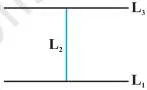
Example 3 (NCERT, p. 3) applies these to the set of all lines in a plane with \( R = \{(L_1, L_2) : L_1 \text{ is perpendicular to } L_2\} \). A line cannot be perpendicular to itself, so R is not reflexive. It is symmetric, since \( L_2 \perp L_1 \) whenever \( L_1 \perp L_2 \).
It is not transitive: when \( L_1 \perp L_2 \) and \( L_2 \perp L_3 \), the lines \( L_1 \) and \( L_3 \) are parallel, never perpendicular. The figure below carries the whole argument.
Example 4 (NCERT, p. 3-4) shows a relation that passes only one test: on {1, 2, 3}, \( R = \{(1,1),(2,2),(3,3),(1,2),(2,3)\} \) is reflexive because all three diagonal pairs are present, but not symmetric — (1, 2) ∈ R while (2, 1) ∉ R — and not transitive — (1, 2) and (2, 3) are in R while (1, 3) is not. Checking order: test reflexive first; one missing \((a,a)\) kills the relation instantly and saves two wasted lines.
Equivalence relations and equivalence classes: how a relation cuts a set into groups
An equivalence relation is a relation that is reflexive, symmetric and transitive all at once (Definition 4, NCERT, p. 3). Congruence of triangles is the model: every triangle is congruent to itself, congruence works both ways, and triangles congruent to the same triangle are congruent to each other (NCERT, p. 3).
Example 5 (NCERT, p. 4) uses \( R = \{(a,b) : 2 \text{ divides } a-b\} \) on the integers. Reflexive: 2 divides \( a-a=0 \). Symmetric: if 2 divides \( a-b \), it divides \( b-a \). Transitive: if 2 divides \( a-b \) and \( b-c \), then \( a-c = (a-b)+(b-c) \) is even, so 2 divides it.
Every even integer is related to 0, and no odd integer is, so the evens form the class [0] and the odds form the class [1] (NCERT, p. 4).
Memory device — R-S-T: check Reflexive first, then Symmetric, then Transitive, always in that order. Reflexive needs every diagonal pair; symmetric is matched pairs; transitive is the one that must close every chain.
Such a relation cuts the set into mutually disjoint subsets called equivalence classes \( A_i \), satisfying three conditions (NCERT, p. 4):
- All elements of one class are related to each other.
- No element of a class is related to any element of a different class.
- The classes are pairwise disjoint and their union is the whole set X.
The move works in reverse: any partition of a set defines an equivalence relation. The textbook subdivides Z into multiples of 3, numbers with remainder 1, and numbers with remainder 2; the relation “3 divides a − b” then has exactly the classes [0], [1], [2] (NCERT, p. 4-5).
Real-life application: clock arithmetic. On a 12-hour clock, “a shows the same hour as b” is an equivalence relation, and the twelve hours partition the day exactly as [0], [1], [2], [3] partition the integers in the worked example below.
Example 6 (NCERT, p. 5) does the same on \( A = \{1,2,3,4,5,6,7\} \) with \( R = \{(a,b) : a \text{ and } b \text{ are both odd or both even}\} \). The odds {1, 3, 5, 7} form one class, the evens {2, 4, 6} the other, and no element of one class is related to any element of the other.
Types of functions: one-one, onto, and the finite-set surprise
Definitions 5-7 (NCERT, p. 7-8) classify \( f : X \rightarrow Y \) by its images:
- One-one (injective) — distinct elements of X have distinct images: \( f(x_1) = f(x_2) \Rightarrow x_1 = x_2 \). Otherwise f is many-one.
- Onto (surjective) — every element of Y is the image of some element of X.
- Bijective — one-one and onto together.
The remark on p. 8 is the mark-earning line: f is onto if and only if the range of f equals the co-domain Y. Write that sentence, then justify it.
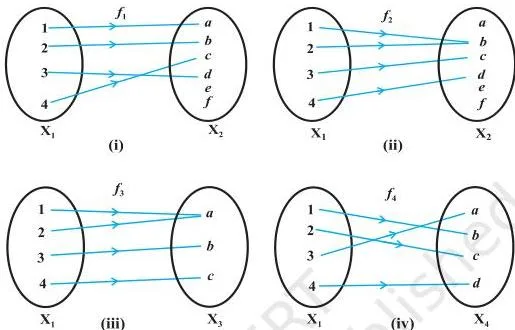
The four arrow diagrams of Fig 1.2 (NCERT, p. 8) carry the whole lesson in one picture: \(f_1\) is one-one but not onto because elements e and f are never reached; \(f_2\) is many-one because 1 and 2 both map to b; \(f_3\) is onto because every co-domain element is hit; \(f_4\) is bijective.
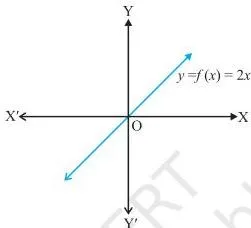
Compare two famous examples. \( f(x) = 2x \) from N to N is one-one but not onto, because 1 is never an image (Example 8, NCERT, p. 8). The same rule \( f(x) = 2x \) from R to R is bijective, because every real y is the image of \( y/2 \) (Example 9, NCERT, p. 9, Fig 1.3).
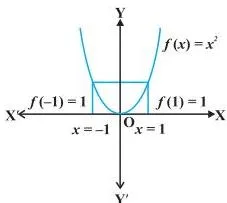
Example 12 (NCERT, p. 9-10) is the piecewise map on N with \( f(x) = x+1 \) for odd x and \( f(x) = x-1 \) for even x; Fig 1.4 shows how it pairs odd with even, hitting every natural number exactly once — both one-one and onto. By contrast \( f(x) = x^2 \) on R is neither (Example 11, NCERT, p. 9).
Examples 13-14 prove that on {1, 2, 3}, onto implies one-one and one-one implies onto (NCERT, p. 10).
Finite sets vs infinite sets. For \( f : X \rightarrow X \) with X finite, one-one and onto are equivalent; for infinite X they are not (NCERT, p. 10).
| Behaviour of \( f : X \rightarrow X \) | Finite set X | Infinite set X (take N) |
|---|---|---|
| One-one | automatically onto — n distinct images fill an n-element set | can miss values: \( f(x) = 2x \) never hits 1 |
| Onto | automatically one-one — n pre-images occupy all n slots | can repeat values: the map with \( f(1)=f(2)=1 \) and \( f(x) = x-1 \) for \( x \gt 2 \) is onto but not one-one |
Quick test table for one-one and onto:
| Question | Algebraic test | Graphical test |
|---|---|---|
| Is f one-one? | Assume \( f(x_1) = f(x_2) \) and show \( x_1 = x_2 \) | Every horizontal line cuts the graph at most once |
| Is f onto? | For any y in the co-domain, exhibit an x with \( f(x) = y \) — that is, show range = co-domain | The graph reaches every y-value in the co-domain |
Composition of functions and invertible functions
Composition (Definition 8, NCERT, p. 12): for \( f : A \rightarrow B \) and \( g : B \rightarrow C \), the composition \( \mathrm{gof} : A \rightarrow C \) is given by \[ \mathrm{gof}(x) = g(f(x)) \text{ for all } x \in A. \]
The notation is the trap: gof reads “g after f”, so apply f first, then g. Example 15 (NCERT, p. 12) computes gof element by element from a small table.
Example 16 shows the order matters: with \( f(x) = \cos x \) and \( g(x) = 3x^2 \), \[ \mathrm{gof}(x) = g(\cos x) = 3\cos^2 x \quad \text{but} \quad \mathrm{fog}(x) = f(3x^2) = \cos(3x^2). \]
The two expressions already differ at \( x = 0 \), so \( \mathrm{gof} \neq \mathrm{fog} \) in general (NCERT, p. 12). Fig 1.5 (NCERT, p. 12) draws composition as an arrow diagram of f followed by g.
Invertible functions (Definition 9, NCERT, p. 12): f is invertible if a function g exists with \( \mathrm{gof} = I_X \) and \( \mathrm{fog} = I_Y \), where \( I_X \) and \( I_Y \) are the identity functions; that g is the inverse \( f^{-1} \). The key equivalence: f is invertible if and only if f is one-one and onto (NCERT, p. 12).
That is why every inverse question first makes you prove both.
Example 17 (NCERT, p. 12-13) is the model method. For \( f : \mathbb{N} \rightarrow Y \), \( f(x) = 4x + 3 \) with \( Y = \{y \in \mathbb{N} : y = 4x + 3 \text{ for some } x \in \mathbb{N}\} \), solve \( y = 4x + 3 \) for x to get \( g(y) = \frac{y-3}{4} \), then check \( \mathrm{gof}(x) = x \) and \( \mathrm{fog}(y) = y \).
This three-part working — one-one, onto, then inverse — is what full-credit answers repeat. Invertible functions set up the next chapter on inverse trigonometric functions.
Definitions at a glance: the terms you must write correctly
Self-test with this table: cover the middle column, read the term, and say the definition aloud.
| Term | Student-friendly meaning | Example |
|---|---|---|
| Empty relation | \( R = \phi \subset A \times A \): no element of A is related to any element of A | “a is sister of b” in a boys’ school (NCERT, p. 2) |
| Universal relation | \( R = A \times A \): every element is related to every element | “heights differ by less than 3 m” among students (NCERT, p. 2) |
| Reflexive | \( (a,a) \in R \) for every \( a \in A \) | \( \{(1,1),(2,2),(3,3)\} \) on {1, 2, 3} |
| Symmetric | \( (a,b) \in R \) implies \( (b,a) \in R \) | “L1 is perpendicular to L2” (NCERT, p. 3) |
| Transitive | \( (a,b), (b,c) \in R \) imply \( (a,c) \in R \) | \( a \le b \) on the real numbers |
| Equivalence relation | reflexive + symmetric + transitive together | congruence of triangles (NCERT, p. 3) |
| Equivalence class [a] | all elements of the set that are related to a | [0] = all even integers in the mod-2 relation (NCERT, p. 4) |
| One-one (injective) | \( f(x_1) = f(x_2) \Rightarrow x_1 = x_2 \) | roll numbers of students (NCERT, p. 8) |
| Onto (surjective) | every y in the co-domain is an image; range = co-domain | \( f(x) = 2x \) on R (NCERT, p. 9) |
| Bijective | one-one and onto together | the odd/even piecewise map on N (NCERT, p. 9-10) |
| Composition gof | \( \mathrm{gof}(x) = g(f(x)) \): apply f, then g | with \( f(x) = \cos x \), \( g(x) = 3x^2 \), \( \mathrm{gof}(x) = 3\cos^2 x \) (NCERT, p. 12) |
| Invertible function; inverse \( f^{-1} \) | g exists with \( \mathrm{gof} = I_X \) and \( \mathrm{fog} = I_Y \) | \( f(x) = 4x + 3 \), \( f^{-1}(y) = \frac{y-3}{4} \) (NCERT, p. 12-13) |
Formula box: the results you will write in the exam
This chapter has no computational formulas; the “formulas” are the tests and conditions examiners expect in your working. Symbols: \( I_X(x) = x \) is the identity function on X, \( f^{-1} \) is the inverse of f, and gof reads “g after f”.
| Result | Statement | Source |
|---|---|---|
| Composition rule | \( \mathrm{gof}(x) = g(f(x)) \) for all x in the domain of f | Definition 8, NCERT p. 12 |
| One-one test | \( f(x_1) = f(x_2) \Rightarrow x_1 = x_2 \) | Definition 5, NCERT p. 7 |
| Onto test | range of f = co-domain Y | Remark, NCERT p. 8 |
| Invertibility | f is invertible \( \Leftrightarrow \) f is one-one and onto | NCERT p. 12 |
| Inverse condition | \( \mathrm{gof} = I_X \) and \( \mathrm{fog} = I_Y \), where \( g = f^{-1} \) | Definition 9, NCERT p. 12 |
| Finite-set result | for finite X, \( f : X \rightarrow X \) is one-one \( \Leftrightarrow \) onto; false for infinite sets | Summary, NCERT p. 16 |
Worked examples with fresh numbers
Three problems in the exact style the exams expect. The method comes from the textbook’s examples; the numbers are new, so the working is worth rehearsing.
Example A: Prove that “4 divides a − b” is an equivalence relation and write its classes (method of Example 5, NCERT, p. 4)
Step 1 (Reflexive): For any \( a \in \mathbb{Z} \), \( a – a = 0 \), and 4 divides 0.
So \( (a, a) \in R \) for every \( a \).
Step 2 (Symmetric): If \( (a, b) \in R \), then \( a – b = 4k \) for some integer k, so \( b – a = -4k \), which 4 also divides.
Hence \( (b, a) \in R \).
Step 3 (Transitive): If \( (a, b) \in R \) and \( (b, c) \in R \), then \( a – b = 4k \) and \( b – c = 4m \).
Adding gives \( a – c = 4(k + m) \), so \( (a, c) \in R \).
Step 4 (Conclusion): R is reflexive, symmetric and transitive, hence an equivalence relation.
The four equivalence classes are the integers with the same remainder on division by 4:
\[ [0] = \{\ldots, -8, -4, 0, 4, 8, \ldots\}, \quad [1] = \{\ldots, -7, -3, 1, 5, 9, \ldots\} \]
\[ [2] = \{\ldots, -6, -2, 2, 6, 10, \ldots\}, \quad [3] = \{\ldots, -5, -1, 3, 7, 11, \ldots\} \]
Final answer: R is an equivalence relation on Z with four equivalence classes [0], [1], [2], [3]. All four are arithmetic progressions with common difference 4.
Example B: Compute gof and fog and show they differ (method of Example 16, NCERT, p. 12)
Step 1 (gof): With \( f : \mathbb{R} \rightarrow \mathbb{R} \), \( f(x) = x^2 + 1 \) and \( g : \mathbb{R} \rightarrow \mathbb{R} \), \( g(x) = 2x – 3 \), apply f first, then g:
\[ \mathrm{gof}(x) = g(f(x)) = g(x^2 + 1) = 2(x^2 + 1) – 3 = 2x^2 – 1. \]
Step 2 (fog): Apply g first, then f:
\[ \mathrm{fog}(x) = f(g(x)) = f(2x – 3) = (2x – 3)^2 + 1 = 4x^2 – 12x + 10. \]
Step 3 (Compare): At \( x = 0 \), \( \mathrm{gof}(0) = -1 \) while \( \mathrm{fog}(0) = 10 \).
The two rules are not the same function.
Final answer: \( \mathrm{gof}(x) = 2x^2 – 1 \) and \( \mathrm{fog}(x) = 4x^2 – 12x + 10 \), so \( \mathrm{gof} \neq \mathrm{fog} \).
Example C: Prove that f(x) = 5x − 7 is invertible and find its inverse (method of Example 17, NCERT, p. 12-13)
Step 1 (One-one): Assume \( f(x_1) = f(x_2) \).
Then \( 5x_1 – 7 = 5x_2 – 7 \), so \( 5x_1 = 5x_2 \), hence \( x_1 = x_2 \).
Therefore f is one-one.
Step 2 (Onto): For any \( y \in \mathbb{R} \), choose \( x = \frac{y+7}{5} \).
Then \( f(x) = 5 \cdot \frac{y+7}{5} – 7 = y \).
Every real y is hit, so range = co-domain and f is onto.
Step 3 (Inverse rule): Solve \( y = 5x – 7 \) for x: \( f^{-1}(y) = \frac{y+7}{5} \).
Step 4 (Verify both compositions): Check that the inverse works in both directions:
\[ f^{-1}(f(x)) = f^{-1}(5x – 7) = \frac{(5x – 7) + 7}{5} = x \]
\[ f(f^{-1}(y)) = f\left(\frac{y + 7}{5}\right) = 5\left(\frac{y + 7}{5}\right) – 7 = y \]
Final answer: f is bijective, hence invertible, with \( f^{-1}(y) = \frac{y+7}{5} \).
Common mistakes in relations and functions
Six slips that cost marks, with the correction you should memorise.
| Mistake | Correct rule | How to check your answer |
|---|---|---|
| Writing \( \mathrm{gof}(x) = f(g(x)) \) | \( \mathrm{gof}(x) = g(f(x)) \): gof means apply f first, then g (Definition 8, p. 12) | Read “gof” as “g after f” and substitute f(x) into g |
| Calling a relation transitive without checking every chain | Every chained pair must close: (a, b) and (b, c) in R force (a, c) in R (Definition 3, p. 3) | On \( R = \{(1,1),(2,2),(3,3),(1,2),(2,1),(2,3),(3,2)\} \), (1, 2) and (2, 3) are in R but (1, 3) is not — reflexive and symmetric, yet not transitive |
| Assuming symmetric + transitive implies reflexive | The three properties are independent; diagonal pairs for 1 and 2 do not supply (3, 3) | \( R = \{(1,1),(2,2),(1,2),(2,1)\} \) on {1, 2, 3} is symmetric and transitive but (3, 3) is missing — the pattern behind Ex 1.1 Q10(v) |
| Claiming \( f(x) = 2x \) on N is onto | 1 in the co-domain is never hit, so range ≠ co-domain (Example 8, p. 8) | Ask: is every natural number an even number? |
| Calling \( f(x) = x^2 \) one-one on R | Squares of a and −a are equal, so two distinct inputs share an image (Example 11, p. 9) | Test with a and −a: \( f(-a) = f(a) \) always |
| Writing \( f^{-1} \) without proving the function is invertible | Invertible requires one-one and onto, and the inverse must satisfy both \( \mathrm{gof} = I_X \) and \( \mathrm{fog} = I_Y \) (Definition 9, p. 12) | Verify your inverse in both directions, not just one |
Exam notes: how this chapter is actually tested
These patterns come from the exercise sets in the textbook — rehearse the shape they test, not random problems.
- Exercise 1.1 Q1-Q14 all follow one shape: a relation is given by a rule and you test it. Rehearse the three-line skeleton — reflexive line, symmetric line, transitive line, conclusion.
- The remark “range of f = Y” (p. 8) is the exact sentence that earns the onto mark. Write it explicitly, then show it holds.
- One-mark questions mirror Exercise 1.1 Q15-16 and Exercise 1.2 Q11-12: classify a given relation or function by its properties rather than proving everything from scratch.
- “Find the set of all elements related to 1” style questions appear in Exercise 1.1 Q9, Q11, Q13 and Q14; the answer is a set, so write braces and list the elements.
- The finite-set result appears in the Summary (p. 16) and is often tested as a short true/false style statement.
- Full-credit inverse answers have three parts: prove one-one, prove onto, then compute \( f^{-1} \) and verify both compositions (the Example 17 model).
| NCERT exercise | Concept it practises |
|---|---|
| Ex 1.1 Q1-Q6 | Classify a relation given by a rule into reflexive / symmetric / transitive |
| Ex 1.1 Q7-Q9 | Prove equivalence and write the elements related to a given element (classes) |
| Ex 1.1 Q10 | Construct a relation with a missing property |
| Ex 1.1 Q11-Q14 | Equivalence relations in geometry: points, triangles, polygons, parallel lines |
| Ex 1.1 Q15-Q16 | Objective questions: choose the correct property set |
| Ex 1.2 Q1-Q2 | One-one and onto checks across N, Z, R |
| Ex 1.2 Q3-Q5 | Greatest integer, modulus and signum functions — neither one-one nor onto |
| Ex 1.2 Q6-Q10 | Bijectivity proofs |
| Ex 1.2 Q11-Q12 | Objective classification of \( f(x) = x^4 \) and \( f(x) = 3x \) |
Reading the textbook figures: what the diagrams tell you
Three figures repay a second look before the exam; each one encodes a whole definition in pictures.
- Fig 1.1 (NCERT, p. 3): three lines with \( L_1 \perp L_2 \) and \( L_2 \perp L_3 \). The picture forces the conclusion \( L_1 \parallel L_3 \), so perpendicularity is symmetric but can never be transitive. One diagram kills the most common false assumption.
- Fig 1.2 (i)-(iv) (NCERT, p. 8): the four arrow diagrams of Section 1.3, discussed above. When an exam shows you an arrow diagram, ask: does any arrow land twice (many-one)? Is any co-domain element left empty (not onto)?
- Fig 1.3 (NCERT, p. 9): the picture for \( f(x) = 2x \) on R; the textbook’s point is that every real y is the image of \( y/2 \), which is the onto argument in visual form.
- Fig 1.4 (NCERT, p. 9): the piecewise map shifting odd x to x + 1 and even x to x − 1; the arrows pair the naturals up, showing one-one and onto together.
Quick revision: the chapter on one screen
From the chapter Summary (NCERT, p. 16) — these are the statements to recall cold:
- Empty and universal relations are the trivial relations.
- Reflexive: \((a,a) \in R\) for all a. Symmetric: \((a,b) \in R \Rightarrow (b,a) \in R\). Transitive: \((a,b), (b,c) \in R \Rightarrow (a,c) \in R\).
- Equivalence relation: all three at once; its classes [a] partition the set.
- One-one: \( f(x_1) = f(x_2) \Rightarrow x_1 = x_2 \). Onto: range = co-domain. Bijective: both.
- Finite set X: \( f : X \rightarrow X \) is one-one \( \Leftrightarrow \) onto; not true for infinite sets.
Self-check list — run this the night before:
- Can I test any given relation for reflexivity, symmetry, transitivity, in that order?
- Can I list the equivalence classes of a modular relation like “4 divides a − b”?
- Can I prove one-one using \( f(x_1) = f(x_2) \Rightarrow x_1 = x_2 \)?
- Can I prove onto by writing range = co-domain and showing every y has a pre-image?
- Can I compute gof without flipping the order?
- Can I find \( f^{-1} \) and verify both \( \mathrm{gof} = I_X \) and \( \mathrm{fog} = I_Y \)?
These relations and functions class 12 notes are part of the Class 12 notes library; keep them beside the textbook’s own Summary on p. 16-17 for the final pass.
Frequently asked questions
How do I check whether a relation is an equivalence relation?
Test reflexive first — one line: \((a,a) \in R\) for every a. Then symmetric: swap the pair. Then transitive: chain two pairs and close the triangle. If all three pass, the relation is an equivalence relation. In “2 divides a − b”, for instance, evens relate to evens and odds to odds, giving classes [0] and [1].
Why is gof not equal to fog in general?
Because the order of application differs. \( \mathrm{gof}(x) = g(f(x)) \) applies f first, then g, while \( \mathrm{fog}(x) = f(g(x)) \) applies g first. The textbook’s pair \( f(x) = \cos x \), \( g(x) = 3x^2 \) gives \( \mathrm{gof}(x) = 3\cos^2 x \) but \( \mathrm{fog}(x) = \cos(3x^2) \) — different expressions, so the two compositions rarely agree.
How do I find the inverse of a function?
Prove one-one, prove onto, then solve \( y = f(x) \) for x and write \( f^{-1}(y) \) equal to that expression. Finally verify both \( f^{-1}(f(x)) = x \) and \( f(f^{-1}(y)) = y \). The model is \( f(x) = 4x + 3 \) with \( f^{-1}(y) = \frac{y-3}{4} \).
Why is a one-one function from a finite set to itself always onto?
A one-one map sends n distinct elements to n distinct images, all inside an n-element set — so every element of the set is hit. The argument breaks for infinite sets: \( f(x) = 2x \) on N is one-one yet never takes the value 1.
What is an equivalence class and how do I find the class of an element?
The class [a] is the set of all b such that \((a,b) \in R\). In the relation “2 divides a − b”, the class [0] is the set of all even integers and [1] is the set of all odd integers, because every even integer is related to 0 and every odd integer to 1.
Is the empty relation an equivalence relation?
Only when the underlying set is also empty. On any non-empty set it fails reflexivity, because no \((a,a)\) pair exists. It is symmetric and transitive vacuously, but an equivalence relation needs all three properties.
Reference: NCERT Class 12 Mathematics textbook, chapter Relations and Functions.
Explore Class 12 Mathematics Notes
More for this chapter:
Class 12 Mathematics on LearnCBSE:
Related chapters: