Need the Probability Class 10 formulas in one place? This sheet covers the theoretical (classical) probability formula, the empirical formula from trials, the complement rule, the bounds of probability, and elementary events. It also covers the length-based and area-based forms used when outcomes cannot be counted, all from chapter 14 of the Rationalised NCERT Class 10 Mathematics textbook.
Each formula is grouped by the sub-topic it belongs to, with the meaning and unit of every symbol, guidance on when each formula is used, and worked examples using original numbers. The detailed explanations and derivations live in the Probability Class 10 notes; for other chapters, browse the Class 10 Maths formulas hub.
Formulas at a Glance
Every formula on this page in one table — then read the topic groups below for the symbols and conditions.
| Purpose | Formula |
|---|---|
| Probability of an event (equally likely outcomes) | \( P(E) = \dfrac{\text{Number of outcomes favourable to } E}{\text{Number of all possible outcomes of the experiment}} \) |
| Empirical probability from repeated trials (Class IX definition) | \( P(E) = \dfrac{\text{Number of trials in which the event happened}}{\text{Total number of trials}} \) |
| Probability of the complement, ‘not \(E\)’ | \( P(\bar{E}) = 1 – P(E) \) |
| Sum of an event and its complement | \( P(E) + P(\bar{E}) = 1 \) |
| Sum of probabilities of all elementary events (stated in words in the textbook) | \( P(E_1) + P(E_2) + \dots + P(E_n) = 1 \) |
| Range of any probability | \( 0 \leq P(E) \leq 1 \) |
| Probability of a sure (certain) event | \( P(\text{sure event}) = 1 \) |
| Probability of an impossible event | \( P(\text{impossible event}) = 0 \) |
| Geometric probability on a line (Example 10) | \( P(E) = \dfrac{\text{Favourable length}}{\text{Total length}} \) |
| Geometric probability over a region (Example 11) | \( P(E) = \dfrac{\text{Favourable area}}{\text{Total area}} \) |
All Formulas, Grouped by Topic
The complete formula inventory of this chapter, grounded in the NCERT text, appears below. Each group gives the formula, its condition, and the reason it works.
Theoretical and Empirical Probability
The chapter assumes that every experiment — a fair coin, a fair die, a card drawn from a well-shuffled deck — has equally likely outcomes (NCERT, pp. 203–204). The theoretical probability, also called classical probability, of an event \(E\) is:
\[ P(E) = \frac{\text{Number of outcomes favourable to } E}{\text{Number of all possible outcomes of the experiment}} \]
The formula is exact, not a measurement: because the outcomes are equally likely, the event’s share of the probability equals its share of the outcomes, so the experiment needs no repetition.
The empirical probability (defined in Class IX) instead records what actually happened:
\[ P(E) = \frac{\text{Number of trials in which the event happened}}{\text{Total number of trials}} \]
It suits experiments that can be repeated cheaply, like tossing a coin. When repetition is impossible — launching a satellite, say — the theoretical form is used (NCERT, p. 203). As trials increase, the empirical value tends to approach the theoretical probability.
Complementary Events
For any event \(E\), the event ‘not \(E\)’ is written \(\bar{E}\) and is called the complement of \(E\). Because \(E\) and \(\bar{E}\) together cover every possible outcome, their probabilities add to 1 (NCERT, p. 206):
\[ P(E) + P(\bar{E}) = 1 \]
\[ P(\bar{E}) = 1 – P(E) \]
This is the formula that answers ‘not ace’ without recounting: \(P(\text{not ace}) = 1 – \frac{1}{13} = \frac{12}{13}\) (NCERT, p. 208).
Elementary Events and the Range of Probability
An elementary event is an event with exactly one outcome of the experiment. The sum of the probabilities of all the elementary events of an experiment is 1 (NCERT, p. 206):
\[ P(E_1) + P(E_2) + \dots + P(E_n) = 1 \]
In the definition of \(P(E)\), the numerator is always less than or equal to the denominator, so every probability is a number between 0 and 1 (NCERT, p. 208):
\[ 0 \leq P(E) \leq 1 \]
Two special values follow directly. A sure event (or certain event) — every outcome is favourable — has probability 1. An impossible event — no outcome is favourable — has probability 0 (NCERT, p. 208):
\[ P(\text{sure event}) = 1, \qquad P(\text{impossible event}) = 0 \]
Geometric Probability (Length and Area)
When the outcomes are infinitely many — every number between 0 and 2, every point of a region — they cannot be counted, and the chapter uses lengths instead. Example 10 applies this to a musical-chair game (NCERT, p. 211):
\[ P(E) = \frac{\text{Favourable length}}{\text{Total length}} \]
The figure below shows the possible outcomes as all numbers between 0 and 2. The event ‘the music stops within the first half-minute’ is favourable over \(\frac{1}{2}\) unit of the 2-unit line, giving \(P(E) = \frac{1/2}{2} = \frac{1}{4}\).

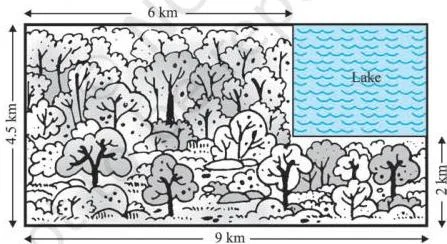
Example 11 compares areas in the same way for a missing helicopter over a rectangular region (NCERT, p. 212):
\[ P(E) = \frac{\text{Favourable area}}{\text{Total area}} \]
The lake covers \(7.5\ \text{km}^2\) of the \(40.5\ \text{km}^2\) region, so \(P(\text{crashed in lake}) = \frac{7.5}{40.5} = \frac{5}{27}\).
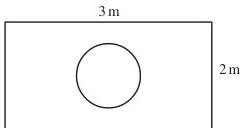
Exercise 14.1 Question 20 (starred in the textbook as not from the examination point of view) applies the same area form to the region below — a rectangle with a circle of diameter 1 m.
What Each Symbol Means
Probability is a pure ratio, so it has no unit — but it always lies between 0 and 1. The table gives every symbol used in the formulas above.
| Symbol | What it means | Unit / nature |
|---|---|---|
| \(P(E)\) | Probability of the event \(E\) | Dimensionless ratio; always \(0 \leq P(E) \leq 1\) |
| \(E\) | An event — the outcome or set of outcomes we are interested in | A subset of the possible outcomes, not a number |
| \(\bar{E}\) | Complement of \(E\), the event ‘not \(E\)’ | The event that \(E\) does not occur |
| Number of outcomes favourable to \(E\) | How many of the possible outcomes match the event | A whole-number count |
| Number of all possible outcomes | The total outcomes of the experiment | A whole-number count |
When to Use Each Formula
| Formula | Reach for it when | Condition |
|---|---|---|
| \(P(E) = \dfrac{\text{favourable}}{\text{total}}\) | Drawing one object at random — coin, die, card, ball, marble, name card — and you can count every outcome | Outcomes are equally likely, which this chapter always assumes |
| \(P(E) = \dfrac{\text{trials with the event}}{\text{total trials}}\) | You have recorded results from actually repeating an experiment | The experiment can be repeated many times; the value is an estimate |
| \(P(\bar{E}) = 1 – P(E)\) | The question says ‘not’, ‘no’, ‘does not’ or ‘at least one’ — counting the opposite is usually shorter | \(\bar{E}\) must be exactly the opposite of \(E\) |
| \(P(E_1) + \dots + P(E_n) = 1\) | After listing all outcomes, to verify the probabilities you assigned | Every elementary event of the experiment is included once |
| \(0 \leq P(E) \leq 1\) | As a validity check on any answer | Always true — a value outside this range means a counting error |
| Length and area forms | Outcomes are points of a line segment or a region, so counting is impossible | Examples 10, 11 and Q20 — marked in the textbook as not from the examination point of view |
How Exercise 14.1 maps to these formulas:
- Q1–Q7 test definitions, the range of probability and the complement rule \(P(\bar{E}) = 1 – P(E)\).
- Q8–Q21 are direct applications of \(P(E) = \frac{\text{favourable}}{\text{total}}\) to one random draw from a collection.
- Q22–Q25 test counting outcomes for two coins or two dice, and judging whether an argument treats outcomes as equally likely.
A full-answer routine for any of these: state the total outcomes, state the favourable outcomes, then write the probability as a fraction in lowest terms. The final value must lie between 0 and 1.
Worked Examples
Three examples covering the main formula, the complement rule and the area form. All use original numbers — none are taken from the textbook’s own examples. To practise these formulas on the textbook’s questions, see the NCERT solutions for Class 10 Maths Chapter 14.
Example 1.
A box contains 6 red, 4 blue and 5 green marbles.
One marble is drawn at random.
What is the probability that it is blue?
Step 1 — choose the formula.
‘At random’ makes every marble equally likely, so use \(P(E) = \frac{\text{number of outcomes favourable to } E}{\text{number of all possible outcomes}}\).
Step 2 — count.
Total marbles = 6 + 4 + 5 = 15.
Favourable outcomes (blue) = 4.
\[ P(\text{blue}) = \frac{4}{15} \]
Final answer: \(\frac{4}{15}\), about 0.27. Check: \(\frac{4}{15} + \frac{6}{15} + \frac{5}{15} = 1\).
Example 2.
Two dice are thrown together.
What is the probability that 4 comes up on at least one die?
Step 1 — choose the formula.
‘At least one’ signals the complement rule \(P(\bar{E}) = 1 – P(E)\), because counting ‘no 4’ is shorter than counting ‘one 4 or two 4s’.
Step 2 — count the complement.
Total outcomes = 6 × 6 = 36.
‘No 4 on either die’ has 5 × 5 = 25 outcomes.
\[ P(\text{no 4}) = \frac{25}{36}, \qquad P(\text{at least one 4}) = 1 – \frac{25}{36} = \frac{11}{36} \]
Final answer: \(\frac{11}{36}\). Check by direct count: the pairs with a 4 are \((4,1)\) to \((4,6)\) and \((1,4)\) to \((6,4)\), minus the double-counted \((4,4)\): \(6 + 6 – 1 = 11\).
Example 3.
A rectangular field, 90 m by 60 m, contains a square pond of side 10 m.
A stone dropped at random lands somewhere in the field.
What is the probability that it lands in the pond?
Step 1 — choose the formula.
The stone can land at any point of the field, so outcomes cannot be counted — use the area form \(P(E) = \frac{\text{favourable area}}{\text{total area}}\).
Step 2 — compute the areas.
Field: \(90 \times 60 = 5400\ \text{m}^2\).
Pond: \(10 \times 10 = 100\ \text{m}^2\).
\[ P(\text{lands in the pond}) = \frac{100}{5400} = \frac{1}{54} \]
Final answer: \(\frac{1}{54}\).
Common Mistakes to Avoid
The four errors below are the ones that appear most often when applying this chapter’s formulas.
| Mistake | Correct rule | How to check your answer |
|---|---|---|
| Treating two coins as having three equally likely outcomes (HH, one of each, TT), so \(P(\text{one head}) = \frac{1}{3}\) | The four ordered outcomes HH, HT, TH, TT are equally likely; \(P(\text{exactly one head}) = \frac{2}{4} = \frac{1}{2}\) | HT and TH are different physical results; list all four outcomes — their probabilities sum to 1 |
| Counting \((1,4)\) and \((4,1)\) as the same outcome when two dice are thrown | The dice are distinct, so \((1,4) \neq (4,1)\); there are \(6 \times 6 = 36\) outcomes, not 21 | The sum 7 has 6 favourable outcomes — check this against the \(6 \times 6\) grid |
| Giving a probability below 0 or above 1, such as \(-1.5\) or \(1.6\) | Always \(0 \leq P(E) \leq 1\); a percentage is fine because \(15\% = 0.15\) | Put your final answer into \(0 \leq P(E) \leq 1\) before moving on |
| For ‘at least one’, subtracting something that is not the complement — e.g. \(1 – P(\text{one particular outcome})\) | \(P(\text{at least one}) = 1 – P(\text{none})\); ‘at least one’ and ‘none’ are exact opposites | For two dice, \(P(\text{at least one 4}) = \frac{11}{36}\); count the 11 favourable pairs directly to confirm |
Frequently Asked Questions
Why is every probability between 0 and 1?
In \(P(E) = \frac{\text{favourable outcomes}}{\text{total outcomes}}\), the favourable count can never be negative and can never exceed the total count. So the ratio can never go below 0 or above 1; it reaches 1 only for a sure event (NCERT, p. 208).
What is the difference between theoretical and empirical probability?
Empirical probability is calculated from trials that actually happened — trials with the event divided by total trials. Theoretical probability predicts the value from the assumption of equally likely outcomes, without repeating the experiment. The textbook’s note to the reader says that as the number of trials increases, the experimental and theoretical probabilities tend to become nearly the same.
When should I use \(P(\bar{E}) = 1 – P(E)\)?
Whenever counting the event directly is longer than counting its opposite — the wording usually signals this with ‘not’, ‘no’, ‘does not’ or ‘at least one’. For example, ‘not ace’ is quicker as \(1 – \frac{1}{13}\) than as a separate count of 48 cards.
Why are there 36 outcomes when two dice are thrown?
The dice are distinct (one blue, one grey in the textbook’s Example 13). Each of the 6 faces of one die pairs with each of the 6 faces of the other, giving \(6 \times 6 = 36\) ordered pairs, and \((1,4)\) is a different outcome from \((4,1)\) (NCERT, p. 213).
Looking for other chapters? The Maths formulas section collects the formula sheets for the whole subject.
Reference: NCERT Class 10 Mathematics textbook, chapter Probability. Verify any formula against the official NCERT textbook at ncert.nic.in.
Explore Class 10 Maths Formulas
More for this chapter:
Class 10 Maths on LearnCBSE:
Related chapters: