
These Reproduction How Life Continues Class 9 notes give you the whole chapter on one page — every definition, each mode of reproduction in order, the key tables and the exam pointers. The chapter is long, but the exam keeps returning to a fixed set of ideas, so a tight revision map is enough.
The chapter covers two big routes of reproduction — asexual (one parent, identical copies) and sexual (two parents, mixed traits) — then follows sexual reproduction through flowering plants and animals into the human reproductive system, the menstrual cycle, pregnancy and reproductive health.
Read the processes in the order they appear, then attempt the three worked examples; they show the reasoning the exam rewards.
Keep the one-page recap at the end for the night before the test. You can check the full official chapter text on the NCERT portal, and find every other chapter in the Class 9 notes index.
Why reproduction matters: the two ways life continues
Every living organism has a definite life span — it is born, grows, matures, reproduces and eventually dies. Reproduction replaces dying individuals with new ones of the same kind, which is how life on Earth continues (NCERT, p. 1).
A mango tree may grow old and die, but its seeds grow into new mango plants; cows give birth to calves and humans to children.
Living beings reproduce in two main ways: asexually, where a single parent produces offspring that are almost exact copies, and sexually, where two parents contribute characteristics, so offspring inherit a mix.
That mixing creates small differences between parents and young; accumulated over generations, these differences help species adapt to changing environments and can even give rise to new kinds of species (NCERT, p. 1).
This page covers, in order:
- asexual methods — vegetative propagation, budding, spore formation
- meiosis and why sexual reproduction creates variation
- sexual reproduction in flowering plants — flower, pollination, fertilisation
- reproduction in animals — external and internal fertilisation
- the human reproductive system, menstrual cycle, pregnancy and reproductive health
- revision tools — definitions table, sequences, worked examples, mistakes and exam pointers
Asexual reproduction: one parent, identical clones
Asexual reproduction is seen in many unicellular organisms (bacteria, amoeba, yeast), simple multicellular organisms (hydra, sponge) and many plants. The central claim of the whole section is short: one parent, no gametes, offspring that are genetic copies. The chapter groups the methods as vegetative propagation, budding and spore formation (NCERT, p. 2).
Vegetative propagation
In vegetative propagation, new plants arise from the growing (vegetative) parts, not from seeds. Potatoes and ginger sprout from fleshy underground stems; money plant and sugarcane grow from stem cuttings; Bryophyllum leaves sprout tiny plantlets that grow into new plants. Because only one parent is involved, every new plant is genetically identical to it (NCERT, p. 2).
Four propagation methods farmers use
Scientists and horticulturists have adapted this natural process into four techniques that help farmers grow desirable crops on a large scale (NCERT, p. 2–3):
- Cutting — collect shoot cuttings in the morning, remove leaves from the lower half, insert the cutting about half its length into soil mixed with compost at a 45–60° angle from the soil surface, and water regularly.
- Grafting — make a slit in a twig of rooted Plant A (say a wild rose), fit a stem piece of Plant B (say a yellow or pink rose) into the slit, protect the wound with cloth or film until it heals, and cut away the other branches of Plant A.
- Layering — bury the middle of a flexible, thin twig (say of a lemon tree) under the soil. Roots develop from the buried part in about 10–15 days; then cut the twig from the parent so it grows as a new plant.
- Tissue culture — mass-produce healthy plantlets from shoot tips (apical meristems), as in banana farming. This eliminates virus-infected plants and ensures high yields.
Krishi Vigyan Kendras (KVKs) under ICAR train farmers in modern grafting, helping them grow high-yield fruits and raise their income (NCERT, p. 3). Simple organisms like bacteria, amoeba and hydra also reproduce asexually — you met their classification in the Patterns in Life: Diversity and Classification notes.
Budding: yeast and hydra
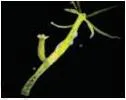
In budding, repeated cell division at a specific site on the parent body produces a small outgrowth called a bud. The bud enlarges and separates from the parent to live independently. Yeast buds in this way (Fig. 11.6); hydra often carries many buds on its body at the same time (NCERT, p. 4).
Spore formation: Rhizopus and Aspergillus
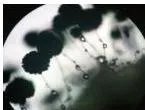
Fungi such as Rhizopus and Aspergillus form spores inside a sac-like structure or on a swollen vesicle on a long hypha. Spores are produced in millions, are lightweight and usually single-celled, and float easily through air.
When they settle on food that has moisture, nutrients and warmth (25–35°C), they germinate quickly into new individuals — which is exactly why we refrigerate perishable food (NCERT, p. 5).
Why asexual offspring are clones
Behind every asexual method is mitosis: cell division that produces two daughter cells with the same number of chromosomes as the parent. Offspring are therefore genetically identical to the parent and to each other — they are called clones. This method is fast and helps organisms increase population quickly when environmental conditions are favourable (NCERT, p. 5).
Sexual reproduction and the chromosome story: why meiosis creates variation
The chromosome-doubling problem
Sexual reproduction involves two parents, and both contribute genetic material. If each generation received the full chromosome set from both parents, the number would double every generation. This biological problem is solved by meiosis, a special cell division that halves the chromosome number (NCERT, p. 5–6).
Humans have 23 pairs of chromosomes — 46 in a body cell, with one chromosome of each pair coming from each parent. During meiosis, each gamete receives just one chromosome from each pair, so every human gamete has 23 chromosomes.
In animals, male gametes are sperm and female gametes are eggs; in plants, the pollen grain carries the male gametes to an ovule that holds the egg (NCERT, p. 6).
Meiosis is like halving a deck of cards
Think of the 23 pairs of chromosomes as 23 pairs of cards. Meiosis deals each gamete one card from every pair — so each gamete holds half the set. At fertilisation, a sperm’s half joins an egg’s half, and the new zygote again holds a full set of pairs: 23 + 23 = 46.
But the deal is fresh every time — the same 23 pairs can be dealt into millions of different hands.
The chapter’s bead activity shows this concretely: with just three pairs of contrasting traits (hair colour, hair type, eye colour), randomly picking one bead from each pair gives eight different combinations. With 23 pairs, each carrying information for many characters, the number of combinations is enormous (NCERT, p. 6).
Why variation matters
This random mixing makes every human gamete a fresh shuffle, so children are genetically different from their parents and from their siblings.
Variation is important for the survival of a species: some individuals cope better with change — for example, tolerating low oxygen at high altitudes, or digesting milk in adulthood — and over many generations this process contributes to evolution (NCERT, p. 6).
From flower to fruit: sexual reproduction in flowering plants
Parts of a flower
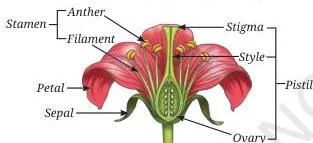
Flowers are the reproductive organs of angiosperms (flowering plants). Working from outside in, a complete flower has four parts (NCERT, p. 7–8):
- Sepal — the green outer whorl that protects the flower in the bud stage.
- Petal — the coloured whorl that attracts pollinators.
- Stamen — the male part, made of a filament and an anther; the anther produces pollen grains containing male gametes.
- Pistil — the female part, with a stigma at the tip (often flat and sticky), a style connecting it to the ovary, and an ovary that holds ovules; each ovule contains an egg cell (female gamete).
Pollination
Pollination is the transfer of pollen grains from the anther to the stigma of a flower (NCERT, p. 8). It is essential for fruit formation: in the chapter’s pea-plant experiment, fruits formed in every treatment except the flower bud from which stamens were removed before it could be pollinated. If pollen never reaches the stigma, no fruit and no seed form.
- Self-pollination — pollen transfers to the stigma of the same flower, or to another flower of the same plant.
- Cross-pollination — pollen transfers from the anther of a flower of one plant to the stigma of a flower of another plant of the same type.
Pollinators and their strategies
Pollination depends on external agents called pollinators — wind, water, insects or birds. Each agent demands different flower adaptations (NCERT, p. 9):
| Pollinator | Example plants | Flower adaptations |
|---|---|---|
| Wind | Wheat, maize, rice | Light, small pollen in huge numbers; long feathery stigma that traps it |
| Water | Vallisneria, Hydrilla | Water currents carry pollen from flower to flower |
| Insects (bees, butterflies) | Sunflower, hibiscus, marigold | Bright colour, nectar, fragrance; large sticky or spiny pollen; sticky stigma |
| Birds | Coral tree, hibiscus | Visited by Indian white-eye and sunbirds |
The chapter also compares how efficient these strategies are at making seeds (Table 11.3, NCERT, p. 10):
| Pollination strategy | Approximate pollen grains released per flower | Estimated average number of seeds formed |
|---|---|---|
| Wind-pollinated grasses (e.g. maize, wheat) | 5,00,000 – 10,00,000 | 50 – 200 |
| Insect-pollinated plants (e.g. sunflower) | 20,000 – 40,000 | 800 – 1,000 |
Wind pollination floods the air with pollen but forms few seeds per flower; insect pollination releases far fewer grains yet forms many more seeds. We work out the exact “pollen cost per seed” in the worked examples below.
Fertilisation and seed formation
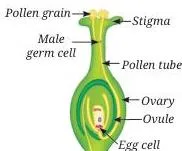
After pollen lands on a compatible stigma, the pollen grain produces a pollen tube that grows down through the style into the ovary. The male gamete travels through this tube and fuses with the egg cell — this fusion of gametes is fertilisation, and it marks the beginning of a new life (NCERT, p. 9).
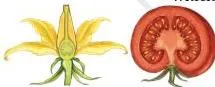
The fertilised egg is the zygote, which later develops into an embryo. Meanwhile the ovary enlarges into a fruit and the ovules become the seeds inside it. Seeds then disperse by wind, water or animals, and germinate into new plants when moisture, air and temperature are favourable.
Fertilisation outside or inside: reproduction in animals
All animals face the same challenge: the male and female gametes must meet, and the young must survive long enough to grow and reproduce (NCERT, p. 11).
- External fertilisation — in many aquatic animals such as frogs and most fish, the female releases eggs into water and the male releases sperm over them. Many eggs are destroyed by water currents or eaten, so huge numbers are laid.
- Internal fertilisation — in reptiles, birds and mammals, fertilisation happens inside the female’s body. The fertilised egg or embryo is protected, so the chances of survival of the young are generally higher.
The chapter’s data for four animal groups (Table 11.4, NCERT, p. 11) shows the trade-off between egg number and survival:
| Animal | Habitat | Mode of fertilisation | Number of eggs produced | Estimated survival of young |
|---|---|---|---|---|
| Fish | Water | External | 100s – 1000s at a time | Low |
| Frog | Water/land | External | 5,000 – 50,000 at a time | Low |
| Lizard | Land | Internal | 2 – 20 at a time | Moderate |
| Bird | Water/land | Internal | 1 – 15 at a time | Moderate to high |
The yolk idea explains the pattern. Fish, amphibians and insects make many eggs with just enough yolk to raise a larva — a feeding stage that eats organic waste and grows before transforming into the adult, as in butterflies and frogs. Reptiles and birds put enough yolk in each egg to nourish the embryo until it hatches.
In mammals, the zygote develops inside the mother’s body, and the young feed on breast milk after birth (NCERT, p. 11).
The human reproductive system: organs and gametes
Male reproductive system
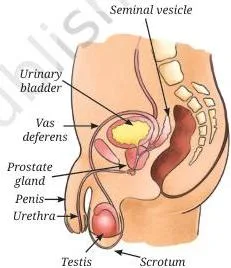
Sperm are produced in two oval organs called testes, held in a pouch of skin called the scrotum. The scrotum keeps the testes slightly cooler than body temperature, which is necessary for sperm formation. The testes also produce a hormone that controls sperm production and drives the physical changes of puberty (NCERT, p. 12).
From the testes, sperm travel through the vas deferens, which opens into the urethra — a common passage for urine and sperm. The seminal vesicles and prostate add nourishing fluids that keep sperm active and mobile. Each sperm has a head containing genetic material and a long tail for swimming (NCERT, p. 12).
Female reproductive system
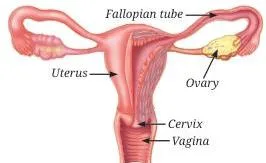
The female system has a pair of ovaries, oviducts (fallopian tubes), a bag-like uterus, and the vagina. Each oviduct connects an ovary to the uterus; the uterus opens into the vagina through a narrow passage called the cervix. The ovaries produce eggs and release hormones (NCERT, p. 12–13).
Gametogenesis and the sperm–egg contrast
Gametogenesis is the formation of gametes in the testes and ovaries. It happens by meiosis, which halves the chromosome number: human body cells have 46 chromosomes, but sperm and eggs have only 23. This matters because the zygote formed at fusion gets 23 + 23 = 46 — the same number as the parents (NCERT, p. 13).
| Feature | Sperm | Egg |
|---|---|---|
| Size | Very small | Large |
| Number produced | Millions | Few |
| Stored nutrients | Absent | Present |
| Motility | Actively motile | Non-motile |
From zygote to baby: ovulation, menstruation and pregnancy
Ovulation to implantation: the journey of the zygote
- Ovulation — at birth, a girl’s ovaries already hold millions of immature eggs. From puberty onwards, usually one mature egg is released each month from one of the ovaries; before this, the inner lining of the uterus becomes thick (NCERT, p. 13).
- Fertilisation — the egg travels from the ovary to the oviduct. During sexual intercourse, millions of sperm enter through the vagina and swim up; if one fuses with the egg, a zygote forms.
- Implantation — the zygote undergoes mitotic divisions while travelling to the uterus and implants into the thickened, blood-rich inner lining. This implantation marks the beginning of pregnancy (NCERT, p. 13).
When the egg is not fertilised
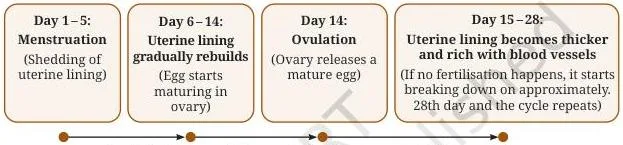
If the egg is not fertilised, it remains viable for about a day and then degenerates. The thickened uterine lining is no longer needed, so it sheds along with some blood through the vagina — this process is called menstruation or a period, and usually lasts 3 to 7 days (NCERT, p. 14).
The cycle of ovulation, preparation of the uterus and menstruation repeats typically every 21–35 days (often around 28 days). It begins at puberty, between the ages of about 10 and 14, and continues until menopause, around age 50 (NCERT, p. 14).
What determines a baby’s biological sex
Every person has two sex chromosomes: females have XX and males have XY. The mother always contributes an X chromosome; the father contributes either an X (making a girl, XX) or a Y (making a boy, XY). So the father’s sperm decides the baby’s sex (NCERT, p. 14).
Pregnancy and childbirth
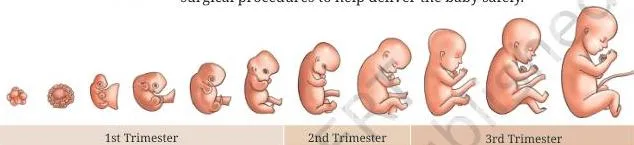
Pregnancy in humans lasts about nine months and is divided into three stages called trimesters (NCERT, p. 15):
- First trimester — the fertilised egg develops into an embryo during the first two months and major organs start forming. From about the ninth week, the developing embryo is called a foetus.
- Second trimester — the foetus grows bigger and stronger; the mother can usually feel its movements.
- Third trimester — the baby grows rapidly and gets ready for life outside the womb.
During childbirth, strong contractions of the muscles of the uterus push the foetus out through the birth canal (NCERT, p. 15).
Mother’s health during pregnancy
A pregnant woman needs a balanced diet rich in proteins, vitamins and minerals, regular medical check-ups, light exercise as advised, and rest. She should avoid smoking, alcohol and any medicine without medical advice (NCERT, p. 15). After birth, breastfeeding is essential: a mother’s milk provides complete nutrition and protects the infant from many diseases.
Reproductive health: protecting yourself and others
Sexual maturity is not the same as emotional maturity
Sexual maturation — sperm production in boys, menstrual cycles in girls — happens gradually during adolescence. But emotional maturity — handling feelings, communicating clearly, making thoughtful decisions — takes longer. Being ready for sexual activity is about responsible decisions, not just physical change (NCERT, p. 16).
Sexually Transmitted Infections (STIs)
Some infections spread through close physical contact during sexual activity. These Sexually Transmitted Infections include gonorrhoea, herpes, syphilis, genital warts, and HIV (which can eventually lead to AIDS). Some are not curable yet. Using condoms reduces transmission and also helps prevent pregnancy (NCERT, p. 16).
Contraceptive methods at a glance
| Method | How it works | Notes |
|---|---|---|
| Barrier (condoms, vaginal covers) | Stop sperm from reaching the egg | Also reduce STI transmission |
| Oral pills | Change the release of eggs by altering hormones | May have some side effects |
| Intra-Uterine Devices (IUDs, e.g. Copper-T) | Placed in the uterus to avoid pregnancy | May sometimes irritate the uterus |
| Surgical methods | Block the vas deferens (male) or fallopian tubes (female) | Permanent; sperm and egg cannot meet |
Abortion — removal of an unwanted pregnancy — is generally done only within the first trimester, when the embryo is very small. Because self-selective abortion can unbalance the sex ratio, prenatal sex determination is strictly prohibited by law in India (NCERT, p. 16–17).
Menstrual hygiene and the “period is your pride” message
- Change pads or products every 4–6 hours, or more often if the flow is heavy.
- Wash hands with soap and water before and after changing products; clean the genital area with water, avoiding soap.
- Wrap used pads in newspaper or their wrapper before disposal in a bin; never flush them.
- Follow the manufacturer’s cleaning instructions for reusable pads and dry them fully before the next use.
Menstruation is a sign of a healthy reproductive system, not something to be ashamed of (NCERT, p. 15).
Key terms quick reference: definitions table
One glance at this table should be enough to check any term from the chapter.
| Term | Meaning | Chapter example |
|---|---|---|
| Reproduction | Biological process by which living beings produce new individuals of their own kind | A mango tree’s seeds grow into new mango plants |
| Asexual reproduction | One parent produces offspring that are almost exact copies | Budding in yeast |
| Sexual reproduction | Two parents contribute genetic material; offspring inherit a mix | Flowering plants and humans |
| Vegetative propagation | New plants arise from growing (vegetative) parts, not seeds | Potato, ginger, Bryophyllum leaves |
| Clone | Genetically identical offspring produced by mitosis | Plantlets from tissue culture |
| Budding | Repeated cell division at one site forms an outgrowth that enlarges and separates | Yeast and hydra |
| Spore | Lightweight, single-celled reproductive unit that floats in air and germinates | Rhizopus, Aspergillus |
| Gamete | Haploid reproductive cell formed by meiosis | Sperm and egg |
| Zygote | Fertilised egg formed by fusion of male and female gametes | Zygote has 46 chromosomes in humans |
| Meiosis | Cell division that halves the chromosome number to form gametes | 23 chromosomes in human gametes |
| Gametogenesis | Formation of gametes in the testes and ovaries | Sperm in testes, eggs in ovaries |
| Pollination | Transfer of pollen from anther to stigma | Transfer in self- or cross-pollination |
| Self-pollination | Pollen to the stigma of the same flower or another flower of the same plant | Pea plants |
| Cross-pollination | Pollen from one plant to a flower of another plant of the same type | Maize, sunflower |
| Fertilisation | Fusion of male gamete with egg cell inside the ovule | Fusion after pollen tube reaches the ovule |
| Ovulation | Release of a mature egg from an ovary | Usually one egg per month |
| Menstruation | Shedding of the thickened uterine lining with some blood | Period lasting 3–7 days |
| Sexually Transmitted Infection (STI) | Infection transmitted through close physical contact during sexual activity | Gonorrhoea, herpes, HIV |
| Contraceptive | Any method that prevents pregnancy | Condoms, oral pills, Copper-T |
Sequences you must reproduce in the exam
This chapter has no mathematical formulas, so the exam’s “formula box” is the ordered process chains. Write them in this order to score the sequencing marks.
1. Sexual reproduction in a flowering plant
- Pollination — pollen transfers from anther to stigma
- Pollen germination on the stigma
- Pollen tube grows down through the style into the ovary
- Fertilisation — male gamete fuses with the egg cell
- Zygote forms, then develops into an embryo
- Ovary becomes fruit; ovules become seeds
2. Human fertilisation path
- Ovulation — a mature egg is released and travels to the oviduct
- Sperm enter through the vagina and swim up the reproductive tract
- A sperm fuses with the egg → zygote with 46 chromosomes
- The zygote divides by mitosis while travelling to the uterus
- Implantation in the thickened uterine lining → pregnancy begins
3. Asexual reproduction logic
- One parent
- Mitosis — daughter cells get the same chromosome number as the parent
- Offspring are genetically identical → clones
- Fast population growth under favourable conditions
4. The menstrual cycle timeline (typical ~28 days)
| Phase | What happens |
|---|---|
| Menstruation (about 3–7 days) | Uterine lining sheds with blood if no fertilisation occurred |
| After menstruation | The uterine lining begins to thicken again |
| Around mid-cycle (about day 14 in a 28-day cycle) | Ovulation — one egg is released |
| Later half of the cycle | The lining stays thick and rich in blood vessels, ready for a zygote |
| If no fertilisation | The egg degenerates, the lining sheds, and a new cycle begins |
Worked examples: reasoning problems solved step by step
Worked example 1 — Meiosis halves, fertilisation restores: counting chromosomes
Method: Every gamete carries one chromosome from each pair; the zygote joins one gamete from each parent.
- Step 1: A human body cell has 46 chromosomes in 23 pairs (NCERT, p. 6).
- Step 2: Meiosis gives each gamete one chromosome from every pair, so each sperm and each egg has 23 chromosomes.
- Step 3: At fertilisation, one sperm fuses with one egg:
\[ 23 + 23 = 46 \]
Step 4: The zygote has 46 chromosomes — the same number as the parents’ body cells.
Conclusion: Without meiosis, the chromosome number would double every generation (46 → 92 → 184). Halving the number in gametes is what keeps it fixed.
Worked example 2 — Predicting the next period
Method: Count forward from the last period using the girl’s own cycle length; remember the normal cycle range is 21–35 days, often about 28.
Given: A girl’s last period began on 3 June, and her cycles average 28 days.
- Step 1: The 28-day estimate: 3 June + 28 days = 1 July.
- Step 2: The full possible window:
\[ \text{3 June} + 21\text{ days} = \text{24 June},\quad \text{3 June} + 35\text{ days} = \text{8 July} \]
- Step 1: So the next period is most likely to fall between about 24 June and 8 July, centred near 1 July.
- Step 2: This estimate is only a guide.
Cycle length varies from person to person and cycle to cycle, so the day of ovulation shifts with it — “always day 14” is not correct.
Final answer: Most likely around 1 July, within the window 24 June – 8 July.
Worked example 3 — Pollen grains wasted per seed: wind vs insect pollination
Method: Pollen-cost per seed = pollen grains released per flower ÷ seeds formed.
(Values chosen within the ranges of Table 11.3, NCERT, p. 10.)
Given: A wind-pollinated grass releases about 6,00,000 grains and forms about 150 seeds.
An insect-pollinated sunflower releases about 30,000 grains and forms about 900 seeds.
Step 1: Wind-pollinated grass:
\[ 6{,}00{,}000 \div 150 = 4{,}000 \text{ pollen grains per seed} \]
Step 2: Insect-pollinated sunflower:
\[ 30{,}000 \div 900 = 33.3 \approx 33 \text{ pollen grains per seed} \]
Step 3: Interpret the numbers.
Wind pollination wastes roughly 4,000 grains for every seed made, because most grains never land on a stigma — the plant compensates by releasing enormous numbers.
Insect pollination is targeted: the pollinator carries pollen deliberately from flower to flower, so far fewer grains are wasted.
Final answer: Wind ≈ 4,000 grains per seed; insect ≈ 33 grains per seed. Insect pollination is far more efficient per pollen grain.
Common mistakes students make in Reproduction
Each mistake below is an error → correction pair with the reason, plus a quick way to check your answer.
| Mistake | Correct rule | How to check your answer |
|---|---|---|
| “Pollination is the same as fertilisation” | Pollination is only the transfer of pollen from anther to stigma — no gametes fuse. Fertilisation is the later fusion of the male gamete (brought down the pollen tube) with the egg in the ovule (NCERT, p. 8–9). | Ask: did any gametes fuse? If yes, you are describing fertilisation. |
| “A human zygote has 23 chromosomes” | Each gamete has 23; the zygote gets 23 from the sperm plus 23 from the egg, so it has 46 — the same as the parents’ body cells. | Add the two gamete numbers before you write the answer. |
| “Ovulation always happens on day 14; every cycle is 28 days” | The cycle repeats every 21–35 days, often around 28. Ovulation day shifts with cycle length, so day 14 is only an approximation for a typical 28-day cycle. | Count forward from the last period using the actual cycle length. |
| “Budding means the parent splits in two” | Budding is repeated cell division at one site forming an outgrowth (bud) that enlarges and then separates, as in yeast and hydra. | Look for an outgrowth stage; splitting is a different process. |
| “Clones are just organisms that look alike” | Clones are genetically identical because asexual reproduction runs on mitosis, which copies the chromosome set exactly. | Ask which cell division is involved: mitosis → clones; meiosis → gametes. |
The day-14 belief deserves a full misconception autopsy. The textbook says cycles repeat every 21–35 days (often ~28) and that ovulation takes place around the 14th day of the cycle (NCERT, p. 14, 17). “Around” is the key word: in a 35-day cycle, mid-cycle ovulation is closer to day 17–18, not day 14.
The chapter’s own revision exercise asks you to critically examine the claim that ovulation always happens on day 14 — the correct judgement is that the claim is false because cycle length varies and ovulation day shifts with it (NCERT, p. 18).
Exam pointers: how to write Reproduction answers
These pointers come from the chapter’s own design — the diagrams it draws, the sequences it builds, and the question styles in its revision exercise.
- Diagram questions target the chapter’s own figures: longitudinal section of a flower, structure of a pistil, male and female reproductive systems. A correctly placed label earns the mark even when the drawing is rough — memorise the labels, not the shading.
- Process-order questions recur. The standard plant order is pollination → pollen germination on the stigma → pollen tube through the style → fertilisation → zygote → embryo → seed and fruit. Writing it in this exact order earns the sequencing mark.
- Assertion–reason items appear (as in the chapter’s revision exercise). Test each half separately before judging whether the reason explains the assertion — for example, the zygote implants only because the uterine wall has prepared a thick, blood-rich lining.
- Data-interpretation questions (pollen counts, egg numbers vs survival, the apple-orchard experiment) reward answers that quote both values and then state the relationship — not just a conclusion.
- Definition questions score full marks when the key phrase is included: pollination is “transfer of pollen from anther to stigma”, fertilisation is “fusion of gametes”, menstruation is “shedding of the uterine lining with blood”.
- Sex determination is a frequent short answer: the mother always contributes an X; the father’s sperm contributes X (girl, XX) or Y (boy, XY) — so the father’s sperm decides the baby’s sex.
One-page revision recap
Scan this section the night before the test; everything here is expanded above.
Asexual vs sexual reproduction side by side
| Feature | Asexual reproduction | Sexual reproduction |
|---|---|---|
| Number of parents | One | Two |
| Gametes | None — mitosis only | Sperm and egg formed by meiosis |
| Genetic make-up of offspring | Identical to parent (clones) | Varied — a mix of both parents |
| Speed and numbers | Fast; large numbers quickly | Slower; fewer offspring, more care |
| Variation | Absent | Present — the basis of adaptation and evolution |
| Chapter examples | Vegetative propagation, budding, spore formation | Flowering plants, animals, humans |
Plant pathway: pollination → fertilisation → zygote → embryo; ovary → fruit, ovule → seed.
Human pathway: ovulation → fertilisation in the oviduct → zygote → implantation → embryo → foetus → birth after about nine months.
Key numbers:
- 46 body chromosomes; 23 in each gamete; 46 in the zygote
- Menstrual cycle: 21–35 days (often ~28); menstruation 3–7 days
- Pregnancy: about nine months, three trimesters; embryo → foetus from about the ninth week
- Wind-pollinated grasses release ~5–10 lakh grains and form ~50–200 seeds; insect-pollinated plants release ~20,000–40,000 grains and form ~800–1,000 seeds
Contraception at a glance: barrier (condoms, vaginal covers), oral pills, IUD (Copper-T), surgical (blocking vas deferens or fallopian tubes).
This page belongs to the CBSE notes library. For the rest of your syllabus, work through the Class 9 Science notes hub, and meet the same revision format in the Sound — Characteristics and Applications notes.
How to read the key diagrams
You never need to draw these perfectly — you need to label them correctly. Here is what to look for in each figure.
- Longitudinal section of a flower (Fig. 11.10): label the outermost green sepals (protect the bud), the coloured petals (attract pollinators), the stamen (filament + anther) and the pistil. The separate pistil-structure figure (Fig. 11.11) adds the stigma at the tip, the style as the connecting tube, and the ovary at the base holding the ovules.
- Self and cross-pollination (Fig. 11.13): follow the arrows — pollen moving to the stigma of the same flower or another flower of the same plant is self-pollination; pollen moving from one plant to a flower of another plant of the same type is cross-pollination.
- Germination of pollen on the stigma (Fig. 11.14): label the pollen grain on the stigma and the pollen tube growing down the style toward the ovule — this is the route the male gamete travels before fertilisation.
- Male reproductive system (Fig. 11.18): label the testes in the scrotum (kept cooler than body temperature), the vas deferens, and the urethra; recall that the seminal vesicles and prostate add nourishing fluid.
- Female reproductive system (Fig. 11.19): label the pair of ovaries, the oviducts (fallopian tubes), the uterus, the cervix and the vagina.
- Menstrual cycle (Fig. 11.21): trace the typical 28-day cycle — the thickening uterine lining, ovulation near mid-cycle, and menstruation if no fertilisation occurs.
- Stages of pregnancy (Fig. 11.22): note the growing foetus in the uterus across three trimesters, ending with birth through the birth canal.
Exam habit: label in pencil first, check against the figure, then ink the labels in.
Frequently asked questions
What is the main difference between asexual and sexual reproduction?
Asexual reproduction involves one parent, produces no gametes, runs on mitosis, and gives genetically identical offspring (clones). Sexual reproduction involves two parents, forms gametes by meiosis, and gives varied offspring that inherit a mix of traits from both parents — the basis of variation, adaptation and evolution.
How many chromosomes does a human zygote have and why?
A human zygote has 46 chromosomes. Each gamete has 23 (one chromosome from each pair, thanks to meiosis); at fertilisation, 23 + 23 = 46, which restores the full chromosome number of the parents’ body cells and prevents it from doubling every generation.
Is pollination the same as fertilisation?
No. Pollination is only the transfer of pollen from anther to stigma, with no fusion of gametes. Fertilisation happens later: the pollen tube grows down the style, and the male gamete fuses with the egg cell in the ovule. Pollination comes first; fertilisation follows.
Why do frogs and fish lay thousands of eggs while birds lay only a few?
Frogs and fish use external fertilisation in water, where eggs are exposed to currents and predators, so they lay huge numbers to compensate (a frog lays 5,000–50,000). Birds use internal fertilisation, and each egg is protected and well stocked with yolk, so survival of each young one is higher and only 1–15 eggs are needed (NCERT, p. 11).
When does ovulation happen — is it always on day 14 of the menstrual cycle?
No. The cycle repeats every 21–35 days, often around 28, so ovulation sits near mid-cycle — about day 14 only in a typical 28-day cycle. Because cycle length varies, ovulation day shifts with it, so “always day 14” is incorrect; the chapter’s revision exercise asks you to criticise exactly that claim.
How do cutting, grafting, layering and tissue culture help farmers?
All four are asexual methods that produce many genetically identical plants quickly.
Cutting (money plant, sugarcane) grows a new plant from a stem piece; grafting joins a desirable variety (e.g. a yellow rose) onto a strong rooted plant; layering (lemon) grows roots on a buried twig in 10–15 days; tissue culture mass-produces healthy plantlets from shoot tips and removes virus-infected plants, as in banana farming.
Reference: NCERT Class 9 Science textbook, chapter Reproduction: How Life Continues.
Explore Class 9 Science Notes
- Previous: Sound Waves: Characteristics and Applications
- Next: Patterns in Life: Diversity and Classification
Class 9 Science on LearnCBSE:
Related chapters: