
These sound waves class 9 science notes re-teach Chapter 10 in the order a teacher would build it: vibration produces sound; sound travels as a compression–rarefaction wave through a medium; wavelength, frequency, amplitude and speed describe the wave; and reflected sound gives echo, sonar and echolocation.
Definitions link to NCERT pages, and worked examples use fresh numbers so you see the method, not just the answer.
If you are revising the night before, jump straight from the contents below to the definitions table, the v = λν formula box or the echo halving step. Reading it fully works too — each section assumes only what came before it.
Sound Waves Class 9 Science Notes: The Chapter Map in One Read
This chapter builds one idea on the next, and every definition below assumes the one before it:
- Vibration is the only source of sound. A rubber band, vocal cord or tuning fork produces sound only while it vibrates.
- Sound needs a medium. It propagates through solids, liquids and gases, but not through vacuum.
- Sound travels as density disturbances. Compressions and rarefactions move through the medium; the particles themselves only oscillate in place.
- The wave is measurable. Wavelength, frequency, time period, amplitude and speed describe it; the ear perceives these as pitch, loudness and timbre.
- Reflected sound has uses. Echo, reverberation, echolocation and sonar all follow from the reflection of sound.
One question drives the whole chapter: which form of energy converts to sound? The vibrating source has mechanical (kinetic) energy; as it vibrates, it transfers that energy to the surrounding medium, and the wave carries it to your ear. What travels is energy — never the matter of the medium (NCERT, pp. 185–186, 193).
This chapter sits inside the Class 9 Science notes collection; you can also browse all Class 9 notes or start from the full CBSE notes library.
Producing Sound: Vibration Is the Only Source
Pluck a stretched rubber band across a box: you hear sound while it vibrates, and the sound stops the moment the vibration stops (Activity 10.1, p. 186). This is the chapter’s foundational rule — sound is produced by vibrations.
Vibration is the periodic to and fro motion (oscillation) of an object. The object that vibrates and produces sound is called the source of the sound (p. 186).
- Strings: a plucked or struck string vibrates (sitar, guitar, tanpura).
- Membranes: a stretched skin or sheet vibrates (tabla, mridangam, drum).
- Air columns: blowing through a bansuri (flute) makes the air inside the hollow pipe vibrate.
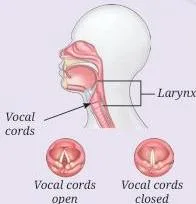
- Vocal cords: in humans, tightly stretched muscular flaps inside the voice box (larynx) vibrate; the tongue, lips, mouth and nasal cavity shape the sound into speech (p. 186).
- Body parts rubbed together: grasshoppers and crickets rub their wings or legs to produce sound (p. 186).
A tuning fork is a U-shaped metal bar (steel or aluminium) with a stem; its two sides are called prongs or tines. Strike a prong gently on a rubber pad and bring it near your ear — you hear a clear tone (p. 187).

Touch a vibrating prong to a water surface: waves form on the water, proving the prong is really oscillating even when you cannot see it clearly. The tuning fork’s sound is heard in different orientations too, which shows sound spreads in multiple directions from the source (p. 187).
How Sound Reaches You: Propagation and the Medium Rule
Sound propagates (travels) from source to ear through a medium — the material through which sound travels. The medium can be a solid, a liquid or a gas (p. 187).
A vacuum is a space with no matter in it. Sound cannot propagate in vacuum (p. 187).
Three pieces of evidence build this rule:
- Solids: knock gently on a desk; place your ear against the desk and knock again — you hear the sound clearly through the solid (Activity 10.3, p. 186).
- Liquids: tap two spoons together in air and listen; submerge them in water without touching the tub walls and tap again — you still hear the sound, so it has travelled through water and air (Activity 10.4, p. 187).
- Not vacuum: in the vacuum bell jar experiment, an electric bell rings inside a jar. As air is pumped out the sound becomes fainter; at near vacuum almost no sound is heard even though the bell is visibly ringing. When air is let back in, the sound returns (p. 188).
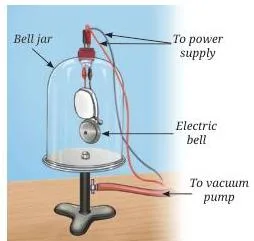
The bell jar logic in cause–effect order: air is pumped out, fewer particles remain to collide and carry the disturbance, so the sound grows fainter; at near vacuum almost nothing is heard though the bell is visibly ringing; when air is let back in, the sound returns. Conclusion: sound needs a medium to propagate.

This answers the chapter’s opening question: astronauts on a spacewalk cannot hear each other talk or hear metal clanking because outer space is a near vacuum. They communicate through special radio devices fitted in their spacesuits (p. 188).
The textbook’s Pause and Ponder 3 (p. 189) turns this into an assertion–reason item: the bell is seen ringing but is almost inaudible, and the reason is that sound requires a medium to travel.
The Slinky Model: Compressions and Rarefactions
How does sound move through a medium? The textbook uses a slinky and a piston model to show it. In Activity 10.5, a mark is made on one turn of a slinky; when one end is pushed and pulled sharply, a disturbance travels along the slinky (pp. 188–189).
- Regions where the turns are closer together appear and travel along the slinky.
- Regions where the turns are more spread out also travel along the slinky.
- The marked turn does not travel — it only oscillates about its position of rest, parallel to the disturbance.
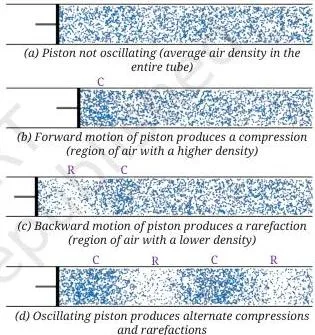
The textbook then replaces the slinky with a tube of air and a piston (p. 189):
- Piston at rest: air has a uniform average density.
- Piston moves forward: it pushes nearby air particles, so a small region becomes denser than average — this is a compression (C).
- Compressed particles collide with neighbours further ahead, so the compression passes forward — but the particles themselves do not travel with it.
- Piston moves backward: nearby air becomes less dense than average — this is a rarefaction (R), which also travels forward by collisions.
- Repeated oscillation sends an alternating series of compressions and rarefactions away from the source.
A sound wave is the disturbance consisting of a series of alternating compressions and rarefactions propagating through a medium, without the actual flow of the medium’s particles (p. 190). The direction the wave travels is the direction of propagation.
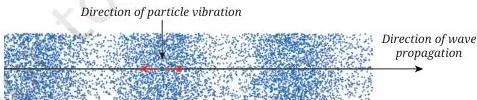
Fresh analogy: think of a stadium Mexican wave. Every spectator stands and sits in their own seat — nobody leaves it — yet the disturbance visibly circles the whole stadium. That is exactly how compressions and rarefactions travel: the disturbance moves, the particles only oscillate in place.
Carry this picture into every exam answer: in a sound wave, what travels is the disturbance and energy, never the particles of the medium (pp. 190, 193).
Longitudinal and Transverse Waves: Where Sound Sits
In the slinky, each turn oscillates parallel to the direction the disturbance travels. Waves with this behaviour are called longitudinal waves (p. 191). In a transverse wave, particles vibrate perpendicular to the direction of propagation (p. 191).
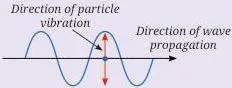
- Sound is a longitudinal wave — particles vibrate parallel to propagation.
- Light is a transverse wave — and it needs no medium at all, which is why sunlight reaches Earth through space.
- Mechanical waves (like sound) require a material medium; light is not a mechanical wave.
- Seismic waves from earthquakes travel through the Earth and can be longitudinal or transverse; the longitudinal ones are detected first by seismographs (p. 192).
Reading a Sound Wave Graph: Crests, Troughs and Density
Because sound is a density disturbance, the standard graph plots density against distance at a given instant (Fig. 10.16, pp. 192–193).
- x-axis: distance from the source; y-axis: density of the medium.
- A horizontal dashed line marks the average density.
- The highest point — maximum density — is the crest; it marks a compression.
- The lowest point — minimum density — is the trough; it marks a rarefaction.

Exam pointer: when asked to draw or label a sound wave graph, many students draw a displacement-style sine curve. The sound wave graph must show density varying above and below the average-density line — label C at the crests and R at the troughs (Pause and Ponder 6, p. 194).
You may also be asked to plot density against time at one fixed location.
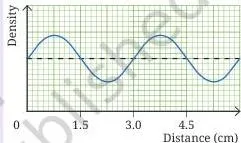
Wavelength is measured crest to crest or trough to trough on exactly such a graph (p. 194).
Wavelength, Frequency and Time Period: The Three Core Definitions
Three quantities describe how often and how far the density pattern repeats. Learn them as a set (pp. 194–195):
| Quantity | Symbol | SI unit | Definition |
|---|---|---|---|
| Wavelength | \( \lambda \) | metre (m) | Distance between two consecutive crests or two consecutive troughs |
| Frequency | \( \nu \) | hertz (Hz) | Number of density oscillations at a fixed point per unit time |
| Time period | \( T \) | second (s) | Time taken for one complete density oscillation at a fixed point |
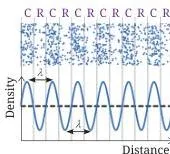
Why “one complete oscillation”? At a fixed point in the medium, density rises from average to a maximum, falls through average to a minimum, and returns to maximum — that full cycle is one density oscillation (p. 195).
Frequency and time period are inversely related: a shorter time period means a higher frequency.
\( \nu = \frac{1}{T} \) (Eq. 10.1, p. 195) — \(\nu\) in hertz, \(T\) in seconds.
Musical hook: sing Sa, Re, Ga, Ma, Pa, Dha, Ni, Sa and watch the frequency on a sound app — the frequency is lowest for Sa and rises through the other notes. Each note has a distinct frequency, which is what makes it sound different (Activity 10.7, pp. 194–195).
Amplitude, Intensity and Speed: What Determines Loudness
Amplitude is the maximum change in density of the air in a compression (or rarefaction) compared to the average density (p. 196). A larger amplitude means the wave carries more energy — strike a plate harder and the grains on the stretched sheet jump higher (Activity 10.6, p. 193).
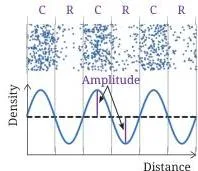
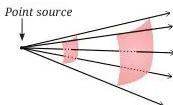
Intensity is the amount of sound energy passing through a unit area perpendicular to the direction of propagation, in unit time (p. 196). As the wave travels away from its source it spreads over a larger area; since energy is conserved, the same energy covers a bigger area, so intensity decreases with distance.
A sound starting with larger amplitude carries more energy and travels farther before its intensity drops (p. 196).
Speed of sound is the distance a point on the wave, such as a crest or trough, travels in unit time (p. 197). In one time period \(T\), a crest covers exactly one wavelength \(\lambda\), so:
\( v = \frac{\lambda}{T} \), and since \(\nu = 1/T\), we get the key equation:
\( v = \lambda \nu \) (Eq. 10.2, p. 197) — \(v\) speed in m/s, \(\lambda\) wavelength in m, \(\nu\) frequency in Hz.
Why does the medium set the speed? A compression is passed forward by particle collisions, so the closer the particles sit, the sooner the disturbance reaches the next particle. Hence speed is fastest in solids, slower in liquids and slowest in gases (pp. 189, 197).
| State | Medium | Approximate speed |
|---|---|---|
| Solid | Steel | 5000 m/s |
| Liquid | Water | 1500 m/s |
| Gas | Air | 340 m/s |
Table 10.1, NCERT p. 198 (at 15 °C). For perspective, sound travels about 4–5 times faster in water and 15–20 times faster in solids than in air.
In most media the speed of sound depends on the medium, not on the source or the frequency. If frequency rises, wavelength shortens and speed stays put. Temperature and humidity also matter: dry air gives about 331 m/s at 0 °C and nearly 344 m/s at 22 °C — warmer, more humid air carries sound faster (p. 197).
How the Ear Perceives Sound: Pitch, Loudness and the 20 Hz–20 kHz Range
The physical quantities above are measurable; how we experience them is subjective. Pitch is how frequency is perceived — a siren sounds shrill (high pitch), thunder sounds deep (low pitch) (p. 199). Loudness is how amplitude is perceived (p. 200).
Timbre is the quality that lets you tell a flute from a tabla even when both play the same note at the same loudness; it comes from the pattern and intensity of the overtones in each sound (p. 201).
| Measurable quantity | What it measures | Perception | Example |
|---|---|---|---|
| Frequency \(\nu\) (Hz) | Number of density oscillations per second | Pitch — how shrill or deep | Siren (high pitch), thunder (low pitch) |
| Amplitude | Maximum density change above average | Loudness — how loud it feels | Striking a plate harder makes the sound louder |
| Overtone pattern | Mixture of frequencies in the note | Timbre — why instruments differ | Same note on flute and tabla sounds different |
| Intensity | Sound energy per unit area per unit time | Heard as loudness, but listener-dependent | Intensity is instrument-measurable; loudness varies per person |
Humans hear a limited band called the audible range: 20 Hz to 20,000 Hz (20 kHz). The range varies from person to person and shrinks with age (p. 199).
Memory device: “twenty to twenty thousand” hertz. Below twenty is infrasonic (infra = below); above twenty thousand is ultrasonic (ultra = beyond). We hear neither, but some animals do: dogs, cats, bats and dolphins detect ultrasound, while elephants detect infrasound (p. 199).
Loudness is commonly reported in decibels (dB): rustling leaves are a few dB, normal conversation is about 60 dB, and firecrackers can exceed 100 dB. A small rise in dB means a large rise in intensity. Prolonged exposure to loud sound can damage hearing (p. 200).
Reflection of Sound: Echo, the 0.1 s Rule and Reverberation
Sound bounces off obstacles such as solids or liquids — this is reflection of sound. It follows the same laws as reflection of light: the incident and reflected directions make equal angles with the normal to the surface, and all three lie in the same plane (p. 200).
An echo is the reflected sound you hear again after shouting near a cliff, a mountain or a long corridor. But echoes are not heard everywhere. The brain separates two sounds only if they arrive at least 0.1 s apart (p. 201).
This 0.1 s gap sets the minimum distance of a reflecting surface:
\( \text{distance} = v \times t = 340\ \text{m/s} \times 0.1\ \text{s} = 34\ \text{m} \) That 34 m is the round trip — source to reflecting surface and back. So the reflector must be at least \(34/2 = 17\) m away for a clear echo (p. 201).
- Reflections are strong from hard, smooth surfaces that reflect sound.
- Soft surfaces like curtains absorb sound.
- Rough surfaces scatter sound in many directions, so no clear echo forms.

Fig. 10.23 tests how the medium changes arrival time: two friends stand 340 m apart along a steel fence, one knocks, and the other listens with an ear to the steel. Comparing the arrival time through steel with the arrival time through air is a direct application of Table 10.1’s speeds.
Reverberation happens when multiple reflections arrive with a time difference of less than 0.05 s, so the sound seems to persist after the source stops (p. 202). Modern auditoriums control it with sound-absorbing panels, upholstered chairs and curtains, so speech and music stay clear instead of turning garbled.
The Whispering Gallery of the Gol Gumbaz in Bijapur, Karnataka, is a famous opposite case — its dome carries even a faint whisper several times (p. 202).
Echolocation, Sonar and Ultrasonic Applications
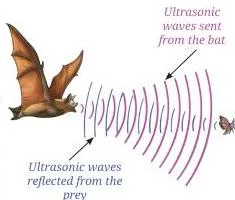
Echolocation is the ability to locate objects using reflected sound waves. Bats fly in the dark without colliding: they emit short bursts of ultrasonic waves, sense the reflected echoes, and so determine the position of obstacles and prey. Dolphins, whales and some birds use the same method (p. 203).
Humans have adapted the same principle underwater through sonar (sound navigation and ranging). Ultrasonic waves are sent into water, and the reflected waves are analysed to find the distance, direction and speed of underwater objects such as submarines or shipwrecks (p. 203).
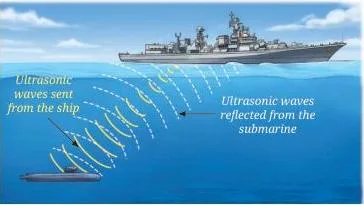
The sonar distance step that examiners always mark: the measured time is the round trip, so halve it before multiplying by speed.
distance = \( v \times \frac{t}{2} \) — halve the total time, then multiply by the speed of sound in that medium.
Beyond the ocean, ultrasound finds everyday uses: parking sensors on vehicles emit about 40 kHz ultrasonic pulses and time the reflection off an obstacle, and audio surveillance uses sensitive sensors to detect the low-frequency hum of drones and aircraft even when they are hard to see (p. 204).
Worked Examples: Frequency, Wavelength and Echo with Fresh Numbers
Each example below is a different question type the chapter repeats. Read the method line first, then follow every substitution with its unit.
Example 1: Finding frequency and time period from oscillation count (definition-based)
Method: frequency = number of oscillations ÷ time taken; time period = time taken ÷ number of oscillations.
Step 1: A tuning fork completes 40 density oscillations in 5.0 s.
Substitute:
\[ \nu = \frac{40}{5.0\ \text{s}} = 8.0\ \text{Hz} \]
Step 2: Time period is the time for one oscillation:
\[ T = \frac{5.0\ \text{s}}{40} = 0.125\ \text{s} \]
Check: \(T = 1/\nu = 1/8.0 = 0.125\ \text{s}\).
Both methods agree.
Final answer: \(\nu = 8.0\ \text{Hz}\), \(T = 0.125\ \text{s}\).
Example 2: Finding wavelength from speed and frequency (rearrange v = λν)
Method: rewrite \(v = \lambda \nu\) as \(\lambda = v/\nu\).
Step 1: A 256 Hz tone travels through air at 340 m/s.
Substitute:
\[ \lambda = \frac{340\ \text{m/s}}{256\ \text{Hz}} = 1.33\ \text{m} \]
Step 2: Sanity check: this wavelength is comparable to the length of a door, which fits the low-mid audible range.
Final answer: wavelength \(\lambda \approx 1.33\ \text{m}\).
Example 3: Confirming speed from an echo (round-trip halving)
Method: sound goes to the cliff and comes back, so the path length is twice the cliff distance; speed = total distance ÷ total time.
Step 1: You shout towards a cliff 102 m away and hear the echo after 0.6 s.
Round trip distance:
\[ 2 \times 102\ \text{m} = 204\ \text{m} \]
Step 2: Divide by the total time:
\[ v = \frac{204\ \text{m}}{0.6\ \text{s}} = 340\ \text{m/s} \]
Step 3: The value matches the known speed of sound in air at 15 °C.
Final answer: the speed of sound in air is 340 m/s.
Common Mistakes Students Make in Sound (and the Fix)
Each row below is an error examiners actually see; the right column shows the rule that replaces it.
| Mistake | Correct rule | How to check your answer |
|---|---|---|
| “Higher frequency means sound travels faster” | Speed is fixed by the medium; a higher frequency only shortens the wavelength in \(v = \lambda \nu\) | Compute \(\lambda = v/\nu\): in air, 20 Hz gives 17.2 m and 20 kHz gives 1.72 cm — same speed throughout |
| “The particles of the medium travel with the wave” | Only the disturbance (and its energy) travels; particles oscillate about their mean positions | Recall the slinky mark: it stays in place while compressions move past it (pp. 189–190) |
| “Echo distance = speed × time” (no halving) | The time is a round trip, so distance = \(v \times t/2\) | Draw the path: source to reflector to ear; count two legs before using the time |
| “Loudness equals intensity” | Intensity is a measurable quantity; loudness is the listener’s subjective perception | Two listeners can hear the same sound at different loudness; instruments measure one intensity |
| “Draw a displacement sine graph for sound” | Sound wave graphs plot density against distance (or time) with a dashed average line | Label the crest at maximum density and the trough at minimum density; mark C and R correctly |
The first misconception deserves an autopsy. Two waves in the same air, one at 20 Hz and one at 20 kHz, travel at the same speed because the medium is the same. What changes is the wavelength: the low note’s compressions are 17.2 m apart, the high note’s are 1.72 cm apart.
Frequency changes the spacing of compressions per second, never the speed at which they cross the room (p. 197).
Exam Notes: Where the Marks Are
These are observed patterns in how the chapter is examined — treat them as revision priorities, not predictions.
- Definition questions are the most reliable marks: wavelength, frequency, time period, amplitude and intensity are exact-definition targets. Write the definition and add the symbol with its SI unit (pp. 194–196).
- Almost every numerical needs one rearrangement of \(v = \lambda \nu\): state each symbol’s unit at every substitution; that step alone earns the method mark even if arithmetic slips (p. 197).
- Echo and sonar problems award the halving line: write explicitly “time to reach the object = total time ÷ 2” before multiplying by speed (NCERT Examples 10.5 and 10.6, pp. 201, 203).
- Assertion–reason items test cause–effect links: “sound becomes inaudible when air is pumped out because sound needs a medium” (p. 189), and “compressions move forward but particles do not” (p. 191).
- Graph questions expect labelled axes: density on the y-axis, distance on the x-axis, dashed average-density line, C at crests, R at troughs (Pause and Ponder 6, p. 194).
Warm numbers to keep ready:
- 340 m/s — speed of sound in air at 15 °C; 331 m/s at 0 °C; about 344 m/s at 22 °C.
- 1500 m/s — speed in water; 5000 m/s — speed in steel.
- 0.1 s — minimum gap to hear two sounds separately → minimum echo distance 17 m.
- 0.05 s — reflection gap that produces reverberation.
- 20 Hz to 20 kHz — audible range; infrasonic below 20 Hz; ultrasonic above 20 kHz.
Revision Summary: All Formulas and Facts in One Table
These two tables compress the chapter’s At a Glance list (pp. 204–205) for a quick scan.
| Quantity | Symbol | SI unit | Definition |
|---|---|---|---|
| Wavelength | \(\lambda\) | m | Distance between two consecutive crests or troughs |
| Frequency | \(\nu\) | Hz | Number of density oscillations per unit time at a fixed point |
| Time period | \(T\) | s | Time for one complete density oscillation |
| Amplitude | — | density change | Maximum change in density compared to average density |
| Intensity | — | energy per unit area per unit time | Sound energy through unit area perpendicular to propagation in unit time |
| Speed | \(v\) | m/s | Distance a point on the wave (crest or trough) travels in unit time |
Formula box (all in one place):
- \(\nu = 1/T\) (Eq. 10.1)
- \(v = \lambda / T\), so \(v = \lambda \nu\) (Eq. 10.2)
- Echo and sonar distance from source to reflector: \( v \times \frac{t}{2} \)
| Number | What it means |
|---|---|
| 340 / 1500 / 5000 m/s | Speed of sound in air / water / steel at 15 °C |
| 20 Hz – 20 kHz | Human audible range |
| below 20 Hz, above 20 kHz | Infrasonic, ultrasonic |
| 0.1 s | Minimum gap to hear two sounds separately |
| 17 m | Minimum echo distance for 340 m/s |
| 0.05 s | Reflection gap that causes reverberation |
For board-level verification of figures, speeds and exercise values, the official NCERT portal (ncert.nic.in) hosts the Class 9 Exploration Science textbook PDF, which is the definitive copy of this chapter. Related revision pages on this site cover Atomic Foundations of Matter and Reproduction: How Life Continues.
FAQs: Quick Answers for Revision
Why can astronauts on a spacewalk not hear each other without a radio?
Outer space is a near vacuum — there is no matter to carry the disturbance. Sound needs a medium (solid, liquid or gas) to propagate, exactly as the bell jar experiment shows with air pumped out. Astronauts therefore use radio devices, which need no medium (p. 188).
Why is 17 m the minimum distance to hear an echo?
Two sounds must arrive at least 0.1 s apart for the brain to separate them. In 0.1 s, sound in air at 340 m/s travels 34 m — that is the round trip to the reflector and back. Half of 34 m is 17 m, the minimum reflector distance (p. 201).
What is the difference between loudness and intensity of sound?
Intensity is a measurable quantity: sound energy passing through a unit area perpendicular to the direction of propagation per unit time. Loudness is subjective — how loud the sound feels to a particular listener, based mainly on amplitude (p. 200).
What is the difference between an echo and reverberation?
An echo is a distinct reflected sound heard separately from the original because it arrives at least 0.1 s later. Reverberation is the persistence of sound caused by multiple reflections arriving less than 0.05 s apart, common in large halls (pp. 201–202).
Can humans hear ultrasonic waves, and which animals can?
No — the human audible range is 20 Hz to 20 kHz, so we hear neither infrasound (below 20 Hz) nor ultrasound (above 20 kHz). Dogs, cats, bats and dolphins can detect ultrasound; elephants can detect infrasound (p. 199).
If the speed of sound stays the same, what happens to wavelength when frequency increases?
Wavelength decreases. Since \(v = \lambda \nu\) and \(v\) is fixed by the medium, doubling the frequency halves the wavelength. In air, 20 Hz gives a wavelength of 17.2 m while 20 kHz gives 1.72 cm (p. 197).
Reference: NCERT Class 9 Exploration Science textbook, chapter Sound Waves: Characteristics and Applications.
Explore Class 9 Science Notes
More for this chapter:
Class 9 Science on LearnCBSE:
Related chapters: