
These linear programming class 12 notes condense NCERT Chapter 12 (Mathematics Part II) into what you need the night before the test, for the 2026-27 session. The whole chapter is one question: how do you maximise profit or minimise cost when your choices are limited by resources?
Here you get the definitions table, the corner point method in three steps, two worked examples solved in full with fresh numbers, a walkthrough of the feasible region figure, and the mistake fixes that quietly cost marks.
Use this as your last pass: skim the definitions table, run both worked examples by hand, then learn the common mistakes table before you close the book. The figures and numbering can be verified in the official NCERT Class 12 Mathematics Part II textbook on ncert.nic.in. These notes fit inside the wider Class 12 Mathematics notes hub.
The Furniture Dealer Problem: What Makes It a Linear Programming Problem
A furniture dealer has Rs 50,000 to invest and storage for at most 60 pieces. A table costs Rs 2,500 and earns Rs 250 profit; a chair costs Rs 500 and earns Rs 75 profit (NCERT, p. 395). He can sell everything he buys, so the question is: how many tables and how many chairs?
Many mixes are possible, and each gives a different profit:
- 20 tables, 0 chairs — cost Rs 50,000, storage 20, profit Rs 5,000.
- 0 tables, 60 chairs — cost Rs 30,000, storage 60, profit Rs 4,500.
- 16 tables, 20 chairs — cost Rs 50,000, storage 36, profit Rs 5,500.
Because every relation involved — cost, storage, profit — is linear, this is a linear programming problem (LPP), a special class of optimisation problem (NCERT, p. 395).
History in one line: the first LPPs were formulated in 1941 by Kantorovich and Hitchcock around the transportation problem; Dantzig’s simplex method followed in 1947 (NCERT, p. 405). This chapter solves LPPs by the graphical method only.
Formulating an LPP: Decision Variables, Constraints and the Objective Function
Every LPP is written in the same four-part pattern. Use the furniture problem as your template (NCERT, p. 396).
- Decision variables: let \( x \) = number of tables and \( y \) = number of chairs.
- Non-negative restrictions: \( x \geq 0 \), \( y \geq 0 \). You cannot buy negative furniture.
- Constraints: investment gives \( 2500x + 500y \leq 50000 \); storage gives \( x + y \leq 60 \).
- Objective function: \( Z = 250x + 75y \), the total profit in rupees to maximise.
Simplify before graphing: divide the investment constraint by 500 on both sides to get \( 5x + y \leq 100 \). Dividing an inequality by a positive number does not change its solution set, so the two forms are equivalent (NCERT, p. 396).
Standard form of any LPP: maximise or minimise \( Z = ax + by \) subject to linear constraints and \( x \geq 0 \), \( y \geq 0 \).
Definitions Table: Every LPP Term You Need for Revision
All official terms of the chapter in one table (NCERT, p. 397).
| Term | Meaning | Example |
|---|---|---|
| Objective function | The linear function \( Z = ax + by \) you want to maximise or minimise | \( Z = 250x + 75y \) |
| Decision variables | The unknowns you choose; the answer reports their values | \( x \) tables, \( y \) chairs |
| Constraints | Linear inequalities that limit the variables | \( 5x + y \leq 100 \), \( x + y \leq 60 \) |
| Non-negative restrictions | Conditions \( x \geq 0 \), \( y \geq 0 \) — variables cannot be negative | \( x \geq 0 \), \( y \geq 0 \) |
| Optimisation problem | Problem seeking max profit or min cost under limits | The furniture dealer’s question |
| Linear programming problem | Optimisation problem in which every relation is linear | The furniture problem |
| Feasible region | Common region of all constraints, including non-negative ones | Region OABC in Fig 12.1 (NCERT, p. 398) |
| Feasible solution | A point inside or on the boundary of the feasible region | \( (10, 50) \) |
| Infeasible solution | A point outside the feasible region | \( (25, 40) \) |
| Optimal solution | Feasible point that gives the maximum or minimum of \( Z \) | B(10, 50), gives \( Z = 6250 \) |
| Bounded region | Can be enclosed within a circle (footnote, NCERT, p. 399) | OABC in Fig 12.1 |
| Unbounded region | Extends indefinitely in some direction | Region of NCERT Example 4, p. 403 |
| Corner point | Intersection of two boundary lines of the feasible region | O(0,0), A(20,0), B(10,50), C(0,60) |
The Corner Point Method: Theorems and the Three Steps
Two theorems carry the method (NCERT, p. 398). Theorem 1: if the objective function has an optimal value anywhere, that value occurs at a corner point of the feasible region. Theorem 2: if the feasible region is bounded, both a maximum and a minimum exist, each at a corner point.
Why it works: \( Z = ax + by \) is a plane, and the highest and lowest points of a plane over a flat convex polygon always land on a vertex. So you never test the infinitely many interior points — only the corners.
The method itself has three steps (NCERT, p. 399):
- Find the feasible region and its corner points, either by inspection or by solving the two line equations that meet at each corner.
- Evaluate \( Z = ax + by \) at every corner. Call the largest value \( M \) and the smallest \( m \).
- (i) Bounded region: \( M \) and \( m \) are the maximum and minimum of \( Z \). (ii) Unbounded region: \( M \) is the maximum only if the open half plane \( ax + by \gt M \) has no point in common with the region, and \( m \) is the minimum only if \( ax + by \lt m \) has no point in common — otherwise no such optimum exists.
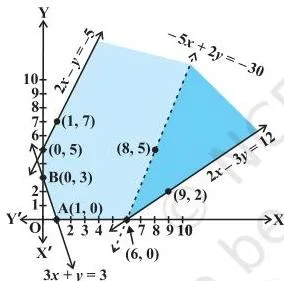
The unbounded trap: in NCERT Example 4 (p. 403), \( Z = -50x + 20y \) gave \(-300\) at (6, 0), the smallest table value. But the region was unbounded, and the open half plane \( -5x + 2y \lt -30 \) still met the region — so \( Z \) had no minimum despite that small value.
The no-solution case: in NCERT Example 5 (p. 404), the constraints \( x + y \geq 8 \) and \( 3x + 5y \leq 15 \) leave no common point, so there is no feasible region and the problem has no solution.
Graphing a system of linear inequalities from Class XI is the prerequisite for all of this; the Class 12 Mathematics notes assume you can shade half planes already.
Formulas at a Glance: Objective Function and Constraint Forms
Every formula of the chapter at symbol level.
| Quantity | Formula | Symbols | Context |
|---|---|---|---|
| Objective function | \( Z = ax + by \) | \( a, b \) constants; \( x, y \) decision variables | \( Z \) in rupees for the furniture problem |
| Constraint forms | linear inequality using \( \leq \), \( \geq \) or \( = \) | — | \( 2500x + 500y \leq 50000 \) |
| Non-negative restrictions | \( x \geq 0 \), \( y \geq 0 \) | — | always included |
| Largest and smallest corner values | \( M \), \( m \) | \( M \) = max of \( Z \), \( m \) = min of \( Z \) at corners | NCERT, p. 399 |
| Unbounded max test | \( ax + by \gt M \) has no common point with region | — | else \( Z \) has no maximum |
| Unbounded min test | \( ax + by \lt m \) has no common point with region | — | else \( Z \) has no minimum |
| Simplification step | \( 2500x + 500y \leq 50000 \rightarrow 5x + y \leq 100 \) | divide both sides by 500 | NCERT, p. 396 |
Worked Examples: Corner Point Method in Action
Method: Corner Point Method (NCERT, p. 399).
Example A — Maximising on a bounded region
A workshop makes gadgets X and Y. Each X needs 2 hours of assembly and 2 hours of testing; each Y needs 3 hours of assembly and 1 hour of testing. The shop has at most 12 assembly hours and 8 testing hours a day. X earns Rs 60 profit, Y earns Rs 50 profit. How many of each maximise daily profit?
Formulation: Maximise \( Z = 60x + 50y \) subject to \( 2x + 3y \leq 12 \), \( 2x + y \leq 8 \), \( x \geq 0 \), \( y \geq 0 \).
Step 1: Turn each inequality into a line and plot its intercepts.
\( 2x + 3y = 12 \) passes through (6, 0) and (0, 4); \( 2x + y = 8 \) passes through (4, 0) and (0, 8).
- Step 1: Test the origin: \( 0 \leq 12 \) true and \( 0 \leq 8 \) true, so shade the side containing the origin for both lines.
- Step 2: Find the corners.
The axes give (0, 0), (4, 0) and (0, 4).
The two lines meet where \( 2x + y = 8 \), so \( y = 8 – 2x \); substituting into \( 2x + 3y = 12 \) gives \( 2x + 24 – 6x = 12 \), hence \( x = 3 \) and \( y = 2 \).
Corner point: (3, 2).
- Step 1: Build the Z table: (0, 0) → 0; (4, 0) → 60(4) + 50(0) = 240; (3, 2) → 60(3) + 50(2) = 280; (0, 4) → 60(0) + 50(4) = 200.
- Step 2: The region is bounded (enclose it in a circle), so \( M = 280 \) is the true maximum.
Final answer: Maximum profit \( Z = \) Rs 280 per day at (3, 2) — make 3 of X and 2 of Y.
Example B — Minimising on an unbounded region where the minimum exists
Problem: Minimise \( Z = 2x + 3y \) subject to \( x + y \geq 4 \), \( 2x + y \geq 5 \), \( x \geq 0 \), \( y \geq 0 \).
- Step 1: Lines: \( x + y = 4 \) through (4, 0) and (0, 4); \( 2x + y = 5 \) through (2.5, 0) and (0, 5).
- Step 2: Test the origin: \( 0 \geq 4 \) is false, so shade away from the origin for both inequalities.
- Step 3: Corners: (0, 5) from \( 2x + y = 5 \) with \( x = 0 \); solving \( 2x + y = 5 \) and \( x + y = 4 \) together gives \( x = 1 \), \( y = 3 \); and (4, 0) from \( x + y = 4 \) with \( y = 0 \).
Points like (0, 4) fail \( 2x + y \geq 5 \), so they are not corners.
Step 4: Z values: (0, 5) → 15; (1, 3) → 2(1) + 3(3) = 11; (4, 0) → 2(4) + 3(0) = 8.
Smallest table value \( m = 8 \).
Step 5: The region is unbounded, so check before concluding: does the open half plane \( 2x + 3y \lt 8 \) touch the region?
The line \( 2x + 3y = 8 \) meets the feasible region only at (4, 0), and every feasible point satisfies \( 2x + 3y \geq 8 \).
No region point lies in \( 2x + 3y \lt 8 \).
Final answer: Minimum \( Z = 8 \) at (4, 0) — the check confirms it in an unbounded region.
Figure Walkthrough: Reading the Feasible Region of Fig 12.1
Fig 12.1 graphs the furniture problem’s four constraints. The boundary lines come from \( 5x + y \leq 100 \), \( x + y \leq 60 \), \( x \geq 0 \), \( y \geq 0 \); where they intersect, the shaded quadrilateral OABC is the feasible region (NCERT, p. 398).
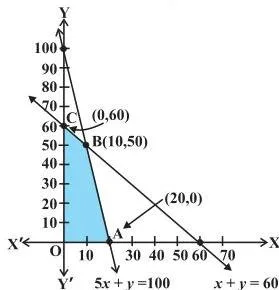
The corner coordinates are O(0, 0), A(20, 0), B(10, 50) and C(0, 60). Every point inside or on the boundary, such as (10, 50), is a feasible solution; a point outside the shading, such as (25, 40), is infeasible because it breaks the storage or investment limit (NCERT, p. 398).
Common Mistakes in Linear Programming and Their Fixes
These six errors cost the most marks. Learn them as pairs.
| Mistake | Correct rule | How to check your answer |
|---|---|---|
| Shading the wrong half plane | Test the origin: if it satisfies the inequality, shade the side containing the origin | Plug (0, 0) into the inequality and confirm the shaded side keeps true points |
| Shading outside the first quadrant | The feasible region always lies in the first quadrant because \( x \geq 0 \), \( y \geq 0 \) | Confirm both axes bound the shaded area |
| Keeping \( 2500x + 500y \leq 50000 \) un-simplified | Divide both sides by 500 to get \( 5x + y \leq 100 \) | Same operation on both sides keeps the inequality equivalent |
| Treating the smallest corner value as the minimum in an unbounded region | Check that \( ax + by \lt m \) has no point in common with the region (NCERT Example 4, p. 403) | Graph the test line and look for overlap before writing your answer |
| Giving a final answer when constraints contradict | If no point satisfies all constraints, there is no feasible region and no solution (NCERT Example 5, p. 404) | Test one point against every constraint; if none passes, state no solution |
| Listing only one corner when two tie | If two corners give the same optimum, every point on the segment joining them is also optimal (remark, NCERT, p. 402) | Compare equal Z values at adjacent corners and mention the whole segment |
Exam Notes: The Presentation Pattern That Earns Marks
Examiners expect a visible, ordered method. Follow this checklist every time:
- Write the LPP in standard form first: Maximise / Minimise \( Z = … \) subject to …
- Draw each constraint line by converting the inequality to an equation and plotting its intercepts.
- Test and shade the correct half plane.
- Find and label every corner point, solving the two intersecting line equations where they meet.
- Build a Z-value table, with units such as rupees where they apply.
- Bounded region: finish with a sentence stating the optimum value and the point.
- Unbounded region: show the half plane check before concluding.
The classic trap is NCERT Example 4 (p. 403): the table’s smallest value was \(-300\), yet the problem had no minimum because the test half plane still met the region. On an exam, write that check even when it feels obvious — it is the step that earns the mark.
The same graph-first, then conclude discipline appears in other Class 12 chapters — see the Three Dimensional Geometry notes and the Probability notes for comparable revision.
Linear Programming Class 12 Notes: One-Page Revision Summary
The solving pipeline:
- Problem statement → decision variables.
- Write the constraints and non-negative restrictions.
- Write the objective function \( Z \).
- Graph the feasible region.
- Find the corner points.
- Evaluate \( Z \) at each corner (\( M \) and \( m \)).
- Decide using the bounded / unbounded rule.
| Region type | What the method guarantees |
|---|---|
| Bounded | Both maximum and minimum exist, each at a corner point (Theorem 2) |
| Unbounded | A corner value is optimal only if the test half plane has no common point with the region; otherwise no optimum exists |
| No feasible region | No point satisfies all constraints; the problem has no solution |
Memory device: Fresh Green Corners Earn Dessert = Formulate, Graph, Corner points, Evaluate, Decide.
Multiple optimal solutions: if two corner points produce the same optimum, every point on the segment joining them gives the same value (NCERT, p. 402).
Real-life echo: planning your own revision is the same problem. Let \( x \) = hours on Mathematics and \( y \) = hours on Physics. With 20 study hours and at least 4 hours of Mathematics, the constraints are \( x + y \leq 20 \) and \( x \geq 4 \), with \( x \geq 0 \), \( y \geq 0 \).
Maximise an estimated score \( Z = 3x + 2y \); the corner points decide the answer, exactly like the furniture dealer.
This page is part of the Class 12 notes collection, under the main CBSE notes hub.
Frequently Asked Questions on Linear Programming
Why does the optimum of a linear programming problem always lie at a corner point?
Because \( Z = ax + by \) is a linear function, and its maximum or minimum over a convex polygon must land on a vertex (Theorem 1, NCERT, p. 398). That is why you evaluate the objective function only at the corners.
What is the difference between a bounded and an unbounded feasible region?
A bounded region can be enclosed within a circle; an unbounded one extends indefinitely in some direction (footnote, NCERT, p. 399). A bounded region guarantees both a maximum and a minimum, while an unbounded region needs the half plane check before you can claim either.
When does a linear programming problem have no feasible solution?
When the constraints contradict each other. In NCERT Example 5 (p. 404), \( x + y \geq 8 \) and \( 3x + 5y \leq 15 \) leave no common point, so there is no feasible region and no solution.
What must I check when the smallest value of Z appears at a corner of an unbounded region?
Check whether the open half plane \( ax + by \lt m \) has any point in common with the region. If it does, \( m \) is not the minimum (NCERT Example 4, p. 403). The same test with \( \gt \) applies to a maximum.
Can a linear programming problem have more than one optimal solution?
Yes. If two corner points give the same optimum, every point on the segment joining them also gives that value (remark to NCERT Example 3, p. 402).
Do I need to learn the simplex method for Class 12 linear programming?
No. Class 12 covers the graphical method only; the simplex method appears only in the historical note about Dantzig (NCERT, p. 405).
Reference: NCERT Class 12 Mathematics Part II textbook, chapter Linear Programming.
Explore Class 12 Mathematics Notes
More for this chapter:
Class 12 Mathematics on LearnCBSE:
Related chapters: