
These three dimensional geometry class 12 notes compress Chapter 11 (Three Dimensional Geometry) of the NCERT Mathematics Part II textbook into revision form: direction cosines and direction ratios, equations of lines, angles between lines, and shortest distances (NCERT, p. 378).
Everything here rests on the vector algebra from Chapter 10 — dot and cross products drive the angle and distance results — so if those feel shaky, run through our vector algebra notes first.
Use the page as a night-before sheet: skim the chapter map, learn the definitions and the formula table, copy the worked examples step by step, then scan the common mistakes. Every section is tied to its textbook pages, and the worked examples use fresh numbers so you can watch the method before attempting the NCERT exercises.
The same compact style covers the whole course in our Class 12 Mathematics notes hub, and the wider CBSE Class 12 notes collection holds every subject.
Three dimensional geometry class 12 notes: how the chapter builds
The chapter stacks six ideas in a strict order: numbers that fix a direction, the cosines of a segment, the equation of a line, the angle between lines, then the two distance formulas. See which formula belongs to which part before memorising anything.
| Building block | Textbook section | Main result |
|---|---|---|
| Direction cosines and direction ratios | §11.2 (p. 378–380) | Cosines of the angles with the axes; any proportional triple; \( l^2+m^2+n^2=1 \) |
| Direction cosines of a joining line | §11.2.1 (p. 380–381) | \( \frac{x_2-x_1}{PQ}, \frac{y_2-y_1}{PQ}, \frac{z_2-z_1}{PQ} \) |
| Equation of a line in space | §11.3 (p. 381–383) | \( \vec{r}=\vec{a}+\lambda\vec{b} \) and the cartesian symmetric form |
| Angle between two lines | §11.4 (p. 383–385) | \( \cos\theta = \frac{|a_1a_2+b_1b_2+c_1c_2|}{|b_1||b_2|} \) |
| Shortest distances | §11.5 (p. 385–389) | Skew: \( \frac{|(\vec{b}_1\times\vec{b}_2)\cdot(\vec{a}_2-\vec{a}_1)|}{|\vec{b}_1\times\vec{b}_2|} \); parallel: \( \frac{|\vec{b}\times(\vec{a}_2-\vec{a}_1)|}{|\vec{b}|} \) |
This build matters because each formula reuses the previous one: the angle formula is the dot product of direction numbers, and the skew distance is a scalar triple product of the same numbers. The official NCERT page for Class 12 Mathematics Part II prints this chapter in full — open it to verify any formula you are unsure about.
Direction cosines and direction ratios: the foundation
A line in space is fixed by its direction. Take a directed line L through the origin making angles \( \alpha \), \( \beta \) and \( \gamma \) with the x, y and z-axes; these are its direction angles. The direction cosines are \( \cos\alpha \), \( \cos\beta \), \( \cos\gamma \), written \( l \), \( m \), \( n \) (NCERT, p. 378).
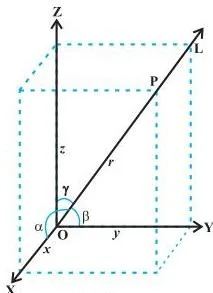
Why do the squares add to 1? The numbers \( l \), \( m \), \( n \) are the components of a unit vector pointing along L, and a unit vector always has squared components summing to 1. So \( l^2 + m^2 + n^2 = 1 \).
Reverse the sense of L and the angles become \( \pi-\alpha \), \( \pi-\beta \), \( \pi-\gamma \) — every cosine changes sign. A line therefore has two sets of direction cosines, \( (l,m,n) \) and \( (-l,-m,-n) \); taking the line as directed gives one unique set (NCERT, p. 378).
Remark: if a line does not pass through the origin, draw a parallel line through it — parallel lines share the same direction cosines (NCERT, p. 379).
Direction ratios are any three numbers proportional to the direction cosines: \( a=\lambda l \), \( b=\lambda m \), \( c=\lambda n \), with \( \lambda\neq 0 \). Because \( \lambda \) is arbitrary, a line has infinitely many sets of direction ratios, all proportional to each other (NCERT, p. 379).
To convert direction ratios into direction cosines, normalise using \[ l = \pm\frac{a}{\sqrt{a^2+b^2+c^2}}, \quad m = \pm\frac{b}{\sqrt{a^2+b^2+c^2}}, \quad n = \pm\frac{c}{\sqrt{a^2+b^2+c^2}} \]
The \( \pm \) appears because \( k = \pm 1/\sqrt{a^2+b^2+c^2} \); choose the sign that matches the directed sense you want (NCERT, p. 379).
Memory device: direction cosines are the three components of a unit vector along the line, so their squares sum to one. To normalise direction ratios run SSSD — Square each ratio, Sum them, Square-root the sum, then Divide each ratio by that root.
Direction cosines of a line joining two points
Exactly one line passes through two given points, so its direction cosines are fixed. Drop perpendiculars from \( P(x_1,y_1,z_1) \) and \( Q(x_2,y_2,z_2) \) to the XY-plane, and connect them; the right triangle PNQ gives \( \cos\gamma = \frac{z_2-z_1}{PQ} \) (NCERT, p. 380).
The full set is \[ \left( \frac{x_2-x_1}{PQ}, \frac{y_2-y_1}{PQ}, \frac{z_2-z_1}{PQ} \right), \quad PQ = \sqrt{(x_2-x_1)^2 + (y_2-y_1)^2 + (z_2-z_1)^2} \]
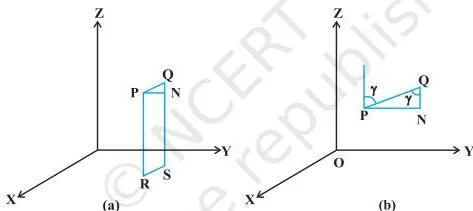
As a shortcut, the direction ratios of PQ may be taken as \( (x_2-x_1,\,y_2-y_1,\,z_2-z_1) \) or the reverse — the negative of all three simply gives the other directed sense (NCERT, p. 380).
Collinearity check: three points A, B, C are collinear when the direction ratios of AB and BC are proportional AND a point is common to both segments (NCERT, p. 381). Direction ratios alone are not enough — you must name the shared point.
Equation of a line in space: vector, parametric and cartesian forms
A line is fixed either by a point plus a direction, or by two points. Both lead to the same equation. With A the given point (position vector \( \vec{a} \)) and AP parallel to a direction vector \( \vec{b} \), we have \( \overrightarrow{AP} = \lambda\vec{b} \) (NCERT, p. 382).
\[ \vec{r} = \vec{a} + \lambda\vec{b} \]
Each value of \( \lambda \) gives a point P on the line.
Writing \( \vec{r}=x\hat{i}+y\hat{j}+z\hat{k} \), \( \vec{a}=x_1\hat{i}+y_1\hat{j}+z_1\hat{k} \) and \( \vec{b}=a\hat{i}+b\hat{j}+c\hat{k} \), then equating coefficients of \( \hat{i}, \hat{j}, \hat{k} \) gives the parametric equations (NCERT, p. 382):
\[ x = x_1 + \lambda a, \quad y = y_1 + \lambda b, \quad z = z_1 + \lambda c \]
Eliminating \( \lambda \) gives the cartesian symmetric form (NCERT, p. 382):
\[ \frac{x-x_1}{a} = \frac{y-y_1}{b} = \frac{z-z_1}{c} \]
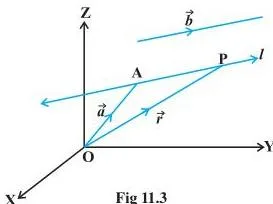
Two-point form: if only two points are given, use \( \vec{r} = \vec{a} + \lambda(\vec{b}-\vec{a}) \), where \( \vec{a} \) and \( \vec{b} \) are their position vectors (NCERT, p. 392). Here \( \vec{b}-\vec{a} \) is the direction vector.
Careful: the letters \( a,b,c \) in the denominators are the direction ratios of the line, not the modulus \( |\vec{b}| \) of the direction vector (NCERT, p. 382).
Angle between two lines: formula, perpendicular and parallel conditions
For two lines with direction ratios \( (a_1,b_1,c_1) \) and \( (a_2,b_2,c_2) \), bring them through the origin and take the acute angle \( \theta \) between them (NCERT, p. 384):
\[ \cos\theta = \left| \frac{a_1a_2 + b_1b_2 + c_1c_2}{\sqrt{a_1^2+b_1^2+c_1^2}\,\sqrt{a_2^2+b_2^2+c_2^2}} \right| \]
With direction cosines this collapses to \( \cos\theta = |l_1l_2 + m_1m_2 + n_1n_2| \), because each set of cosines already has unit magnitude (NCERT, p. 384). In vector form, with \( \vec{b}_1 \) and \( \vec{b}_2 \) the direction vectors of \( \vec{r}=\vec{a}_1+\lambda\vec{b}_1 \) and \( \vec{r}=\vec{a}_2+\mu\vec{b}_2 \):
\[ \cos\theta = \left| \frac{\vec{b}_1 \cdot \vec{b}_2}{|\vec{b}_1|\,|\vec{b}_2|} \right| \]
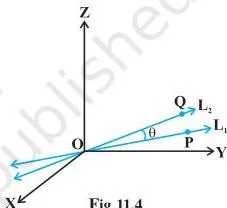
Why the absolute value? It forces \( \theta \) to be acute. The dot product alone can come out negative depending on which directed sense you took of each line; the angle between lines is conventionally the acute one (NCERT, p. 383).
Perpendicular: \( a_1a_2 + b_1b_2 + c_1c_2 = 0 \). Parallel: \( \frac{a_1}{a_2} = \frac{b_1}{b_2} = \frac{c_1}{c_2} \) (NCERT, p. 384). These two quick tests are the first thing to do in any line-pair question.
Shortest distance between skew lines
Two intersecting lines have shortest distance zero; two parallel lines are separated by the perpendicular dropped from one onto the other. But a third case exists: lines that are neither parallel nor intersecting. They are non-coplanar and are called skew lines (NCERT, p. 386).
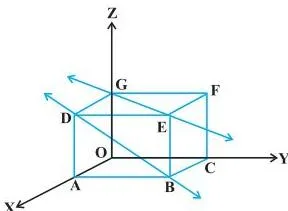
Picture a room: the line GE drawn diagonally across the ceiling and the line DB running down a corner wall are not parallel and never meet — that pair is skew (NCERT, p. 386).
For skew lines the shortest segment is perpendicular to both lines; its length is the projection of the join of two points onto that common perpendicular (NCERT, p. 386–387).
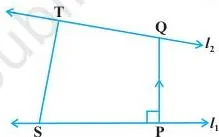
For the lines \( \vec{r}=\vec{a}_1+\lambda\vec{b}_1 \) and \( \vec{r}=\vec{a}_2+\mu\vec{b}_2 \):
\[ d = \left| \frac{(\vec{b}_1 \times \vec{b}_2) \cdot (\vec{a}_2 – \vec{a}_1)}{|\vec{b}_1 \times \vec{b}_2|} \right| \]
The direction \( \vec{b}_1\times\vec{b}_2 \) is perpendicular to both lines, so the unit vector along the shortest segment is \( \hat{n} = \frac{\vec{b}_1\times\vec{b}_2}{|\vec{b}_1\times\vec{b}_2|} \) (NCERT, p. 387).
For lines in cartesian symmetric form, the numerator becomes a determinant (NCERT, p. 393):
\[ d = \frac{ \begin{vmatrix} x_2-x_1 & y_2-y_1 & z_2-z_1 \ a_1 & b_1 & c_1 \ a_2 & b_2 & c_2 \end{vmatrix} }{ \sqrt{(b_1c_2-b_2c_1)^2 + (c_1a_2-c_2a_1)^2 + (a_1b_2-a_2b_1)^2} } \]
Take the absolute value of the whole ratio — distance is always positive.
Choosing a distance formula: the table separates the three cases so you pick the right formula first.
| Class of lines | How to identify it | Shortest distance |
|---|---|---|
| Intersecting | Lines meet at a common point | 0 |
| Parallel | Direction vectors proportional (\( \vec{b}_1 = k\vec{b}_2 \)) | \( \frac{|\vec{b}\times(\vec{a}_2-\vec{a}_1)|}{|\vec{b}|} \) |
| Skew | Neither parallel nor intersecting; non-coplanar | \( \frac{|(\vec{b}_1\times\vec{b}_2)\cdot(\vec{a}_2-\vec{a}_1)|}{|\vec{b}_1\times\vec{b}_2|} \) |
Distance between parallel lines
When two lines share the same direction vector \( \vec{b} \), drop a perpendicular from a point \( T \) on one line to the other; its length is the distance. The result (NCERT, p. 388):
\[ d = \frac{|\vec{b} \times (\vec{a}_2 – \vec{a}_1)|}{|\vec{b}|} \]
Misconception autopsy — why the skew formula fails for parallel lines. If \( \vec{b}_1 \) and \( \vec{b}_2 \) are parallel, then \( \vec{b}_1 \times \vec{b}_2 = \vec{0} \), so the denominator of the skew-line formula is zero and the expression is undefined. Geometrically there is no single common perpendicular: parallel lines have infinitely many equal-length perpendicular connectors.
That is exactly why this chapter gives parallel lines their own formula — follow Example 10’s pattern: spot the identical direction vectors, compute \( \vec{a}_2 – \vec{a}_1 \), form \( \vec{b}\times(\vec{a}_2-\vec{a}_1) \), and divide by \( |\vec{b}| \) (NCERT, p. 389).
Key definitions at a glance
| Term | Meaning | Example |
|---|---|---|
| Direction angles | Angles \( \alpha, \beta, \gamma \) a line makes with the positive x, y, z-axes | x-axis: \( 0^\circ, 90^\circ, 90^\circ \) |
| Direction cosines (\( l, m, n \)) | \( \cos\alpha, \cos\beta, \cos\gamma \); always \( l^2+m^2+n^2=1 \) | x-axis: \( 1, 0, 0 \) |
| Direction ratios (\( a, b, c \)) | Any three numbers proportional to the direction cosines; infinitely many sets | Ratios \( 2,-1,-2 \) give cosines \( \frac{2}{3}, -\frac{1}{3}, -\frac{2}{3} \) |
| Directed line | A line with a fixed positive sense; gives a unique set of direction cosines | Reversing the sense gives \( (-l,-m,-n) \) |
| Skew lines | Lines neither parallel nor intersecting; non-coplanar, lying in different planes | Ceiling line GE and wall line DB in a room |
| Shortest distance | Length of the segment perpendicular to both lines joining them | Skew-line distance formula (NCERT, p. 392) |
Formula sheet: every line formula on one page
All notation matches the NCERT summary on p. 392–393. Verify any unfamiliar symbol against the textbook.
| What it gives | Formula | Symbols | When to use |
|---|---|---|---|
| Direction cosine identity | \( l^2 + m^2 + n^2 = 1 \) | \( l,m,n \) direction cosines | Always true; also a check on your answer |
| Cosines from direction ratios | \( l = \frac{\pm a}{\sqrt{a^2+b^2+c^2}} \), \( m = \frac{\pm b}{\sqrt{a^2+b^2+c^2}} \), \( n = \frac{\pm c}{\sqrt{a^2+b^2+c^2}} \) | \( a,b,c \) direction ratios | Convert any ratio set to cosines |
| Direction cosines of segment PQ | \( \frac{x_2-x_1}{PQ}, \frac{y_2-y_1}{PQ}, \frac{z_2-z_1}{PQ} \) | \( PQ = \sqrt{(x_2-x_1)^2+(y_2-y_1)^2+(z_2-z_1)^2} \) | Joining two given points |
| Vector equation of a line | \( \vec{r} = \vec{a} + \lambda\vec{b} \) | \( \vec{a} \) point, \( \vec{b} \) direction | Point plus direction given |
| Cartesian symmetric form | \( \frac{x-x_1}{a} = \frac{y-y_1}{b} = \frac{z-z_1}{c} \) | \( a,b,c \) direction ratios | Same line written in coordinates |
| Two-point form | \( \vec{r} = \vec{a} + \lambda(\vec{b}-\vec{a}) \) | \( \vec{a}, \vec{b} \) position vectors of two points | Only two points known |
| Angle between lines (ratios) | \( \cos\theta = \frac{|a_1a_2+b_1b_2+c_1c_2|}{\sqrt{a_1^2+b_1^2+c_1^2}\,\sqrt{a_2^2+b_2^2+c_2^2}} \) | ratios of both lines | Any two lines, cartesian or vector form |
| Angle between lines (cosines) | \( \cos\theta = |l_1l_2 + m_1m_2 + n_1n_2| \) | direction cosines of both lines | When cosines are already known |
| Perpendicular / parallel checks | \( a_1a_2+b_1b_2+c_1c_2 = 0 \); \( \frac{a_1}{a_2}=\frac{b_1}{b_2}=\frac{c_1}{c_2} \) | direction ratios | Test line pairs before other work |
| Skew-line shortest distance | \( d = \frac{|(\vec{b}_1\times\vec{b}_2)\cdot(\vec{a}_2-\vec{a}_1)|}{|\vec{b}_1\times\vec{b}_2|} \) | two point vectors, two direction vectors | Lines are skew (neither parallel nor intersecting) |
| Parallel-line distance | \( d = \frac{|\vec{b}\times(\vec{a}_2-\vec{a}_1)|}{|\vec{b}|} \) | common direction \( \vec{b} \), two points | Lines are parallel |
Worked examples: direction cosines, line equations, angles and distances
Worked example 1: Convert the direction ratios \(4, -3, 12\) into direction cosines
Method: normalise the ratios by the square root of the sum of squares (the SSSD device).
- Step 1: Compute the denominator \( \sqrt{4^2 + (-3)^2 + 12^2} = \sqrt{16+9+144} = \sqrt{169} = 13 \).
- Step 2: Divide each ratio by 13: \( l = \frac{4}{13} \), \( m = \frac{-3}{13} \), \( n = \frac{12}{13} \).
- Step 3: Check with the identity: \( \frac{16+9+144}{169} = \frac{169}{169} = 1 \).
Final answer: \( \left(\frac{4}{13}, -\frac{3}{13}, \frac{12}{13}\right) \).
Worked example 2: Line through \((1,-2,3)\) parallel to \(2\hat{i}+3\hat{j}-\hat{k}\)
Method: write the vector equation \( \vec{r}=\vec{a}+\lambda\vec{b} \), then eliminate \( \lambda \).
- Step 1: Identify \( \vec{a} = \hat{i} – 2\hat{j} + 3\hat{k} \) and \( \vec{b} = 2\hat{i} + 3\hat{j} – \hat{k} \).
- Step 2: Vector equation: \( \vec{r} = (\hat{i} – 2\hat{j} + 3\hat{k}) + \lambda(2\hat{i} + 3\hat{j} – \hat{k}) \).
- Step 3: Equate coefficients: \( x = 1+2\lambda \), \( y = -2+3\lambda \), \( z = 3-\lambda \).
- Step 4: Eliminate \( \lambda \): \( \frac{x-1}{2} = \frac{y+2}{3} = \frac{z-3}{-1} \).
Final answer: \( \vec{r} = (\hat{i} – 2\hat{j} + 3\hat{k}) + \lambda(2\hat{i} + 3\hat{j} – \hat{k}) \) and \( \frac{x-1}{2} = \frac{y+2}{3} = \frac{z-3}{-1} \).
Worked example 3: Angle between lines with direction ratios \((1,2,2)\) and \((2,-1,2)\)
Method: use the acute-angle formula with the absolute value of the dot product.
- Step 1: Dot product: \( 1\cdot 2 + 2\cdot(-1) + 2\cdot 2 = 2 – 2 + 4 = 4 \).
- Step 2: Magnitudes: \( \sqrt{1+4+4} = 3 \) and \( \sqrt{4+1+4} = 3 \).
\[ \cos\theta = \frac{|4|}{3 \times 3} = \frac{4}{9} \]
Final answer: \( \theta = \cos^{-1}\left(\frac{4}{9}\right) \).
Worked example 4: Shortest distance between \( \vec{r} = \hat{i} + \lambda(\hat{i}+\hat{j}) \) and \( \vec{r} = \hat{j} + \hat{k} + \mu(\hat{i}+2\hat{k}) \)
Method: decide the lines are skew, then use \( d = \frac{|(\vec{b}_1\times\vec{b}_2)\cdot(\vec{a}_2-\vec{a}_1)|}{|\vec{b}_1\times\vec{b}_2|} \).
- Step 1: Read off \( \vec{a}_1 = \hat{i} \), \( \vec{b}_1 = \hat{i}+\hat{j} \); \( \vec{a}_2 = \hat{j}+\hat{k} \), \( \vec{b}_2 = \hat{i}+2\hat{k} \).
- Step 2: Compute the cross product:
\[ \vec{b}_1 \times \vec{b}_2 = \begin{vmatrix} \hat{i} & \hat{j} & \hat{k} \ 1 & 1 & 0 \ 1 & 0 & 2 \end{vmatrix} = 2\hat{i} – 2\hat{j} – \hat{k} \]
- Step 1: \( |\vec{b}_1\times\vec{b}_2| = \sqrt{4+4+1} = 3 \).
- Step 2: \( \vec{a}_2 – \vec{a}_1 = -\hat{i} + \hat{j} + \hat{k} \).
Dot with the cross product: \( 2(-1) + (-2)(1) + (-1)(1) = -5 \).
Step 5: Divide and take the absolute value: \( d = \frac{|-5|}{3} \).
Final answer: \( d = \frac{5}{3} \) units.
Common mistakes in 3D geometry (and the correction for each)
| Mistake | Correct rule | How to check your answer |
|---|---|---|
| Treating direction ratios as direction cosines | Normalise: divide each of \( a,b,c \) by \( \sqrt{a^2+b^2+c^2} \) | The squares of your cosines must sum to 1 |
| Forgetting the absolute value in the angle formula | Take \( \cos\theta \) as the absolute value of the fraction | A positive cosine means an acute angle |
| Using the skew-line formula on parallel lines | Check proportionality first; if parallel use \( \frac{|\vec{b}\times(\vec{a}_2-\vec{a}_1)|}{|\vec{b}|} \) | If \( \vec{b}_1\times\vec{b}_2 = \vec{0} \) the skew formula is undefined |
| Declaring collinearity from proportional direction ratios only | Also show a common point, e.g. B lies on both AB and BC | Proportional ratios + a common point = collinear |
| Ignoring that reversing the line flips the signs of the cosines | A reversed directed line gives \( (-l,-m,-n) \) | The two answer sets are negatives of each other |
Exam notes: how the NCERT exercises test these formulas
Exercise 11.1 and Exercise 11.2 repeat five families of question. For each, the first step is what earns the mark.
| Question type | Question range | First step that earns the mark |
|---|---|---|
| Direction cosine / direction ratio conversions | Ex 11.1 Q1–Q3 | Write the normalising denominator \( \sqrt{a^2+b^2+c^2} \) (or the cosines) before dividing |
| Collinearity and triangle sides | Ex 11.1 Q4–Q5 | Write the direction ratios of two segments AB and BC, compare proportionality AND name the common point |
| Perpendicular and parallel checks | Ex 11.2 Q1–Q3 | Test \( a_1a_2+b_1b_2+c_1c_2 = 0 \) for perpendicular, or equal ratios for parallel |
| Line equations | Ex 11.2 Q4–Q7 | Read off the point and the direction vector, write \( \vec{r} = \vec{a} + \lambda\vec{b} \), then eliminate \( \lambda \) |
| Angles and shortest distances | Ex 11.2 Q8–Q15 | For angles use the absolute dot product; for distances first decide skew versus parallel, then substitute into the correct formula |
Two traps appear often in the angle questions: an equation like \( \frac{1-x}{3} \) hides a direction ratio of \( -3 \) for the x-term, not 3, and a cartesian equation must be read as \( \frac{x-x_1}{a} = \frac{y-y_1}{b} = \frac{z-z_1}{c} \) before you extract \( a,b,c \). The same revision style runs across the CBSE notes library.
Two-minute revision recap
- Normalise direction ratios: divide each of \( a,b,c \) by \( \sqrt{a^2+b^2+c^2} \) to reach the cosines; keep the sign that matches the directed line.
- Write the line equation from a point and a direction vector: \( \vec{r}=\vec{a}+\lambda\vec{b} \), then \( \frac{x-x_1}{a} = \frac{y-y_1}{b} = \frac{z-z_1}{c} \).
- Find angles from the dot product: \( \cos\theta = \frac{|a_1a_2+b_1b_2+c_1c_2|}{|b_1||b_2|} \) — always take the absolute value.
- Choose the distance formula by checking the lines first: intersecting (0), skew (scalar triple product over cross-product magnitude), or parallel (cross product over \( |\vec{b}| \)).
When you move on, the linear programming notes show a very different kind of applied problem in Class 12 Maths.
Reference: NCERT Class 12 Mathematics Part II textbook, chapter Three Dimensional Geometry.
Frequently asked questions
What is the difference between direction cosines and direction ratios?
Direction cosines are the actual cosines of the angles a line makes with the axes, scaled so that \( l^2+m^2+n^2=1 \). Direction ratios are any three proportional numbers \( a,b,c \), and there are infinitely many sets; convert ratios to cosines by dividing each by \( \sqrt{a^2+b^2+c^2} \) (NCERT, p. 379).
How do I find the shortest distance between two skew lines?
For \( \vec{r}=\vec{a}_1+\lambda\vec{b}_1 \) and \( \vec{r}=\vec{a}_2+\mu\vec{b}_2 \), use \( d = \frac{|(\vec{b}_1\times\vec{b}_2)\cdot(\vec{a}_2-\vec{a}_1)|}{|\vec{b}_1\times\vec{b}_2|} \). Compute the cross product first, dot it with \( \vec{a}_2-\vec{a}_1 \), and divide by the magnitude (NCERT, p. 387).
When should I use the parallel line distance formula instead of the skew line formula?
Whenever the direction vectors are proportional. Then \( \vec{b}_1\times\vec{b}_2 = \vec{0} \), so the skew formula’s denominator is zero. Use \( d = \frac{|\vec{b}\times(\vec{a}_2-\vec{a}_1)|}{|\vec{b}|} \) instead (NCERT, p. 388).
Why is the absolute value used in the formula for the angle between two lines?
To guarantee the acute angle. The dot product alone can be negative depending on which directed sense of each line you took; the absolute value forces \( \theta \le 90^\circ \), the angle between lines by convention (NCERT, p. 383).
How do I write the equation of a line in 3D when only two points are given?
Use the two-point form \( \vec{r} = \vec{a} + \lambda(\vec{b}-\vec{a}) \), where \( \vec{a} \) and \( \vec{b} \) are the position vectors of the two points; \( \vec{b}-\vec{a} \) is the direction vector. Then expand to cartesian form by eliminating \( \lambda \) (NCERT, p. 392).
Explore Class 12 Mathematics Notes
More for this chapter:
Class 12 Mathematics on LearnCBSE:
Related chapters: