
These amines class 12 notes compress the whole of NCERT Unit 9 (Amines, Chemistry Part II) into one revision page: the pyramidal structure of the amino group, classification and IUPAC naming, all six preparation methods, the basicity order students misquote, the key chemical reactions, the three distinguishing tests, and the complete diazonium salt chemistry.
Every section carries its NCERT page number so you can cross-check any reaction against the textbook. Worked conversions, chapter-specific mistakes and the exam pattern from Exercises 9.1-9.14 are built in; the one-page recap at the end is enough for a final five-minute skim before the paper.
This page belongs to the Class 12 Chemistry notes collection — the class 12 notes and CBSE notes indexes let you jump to any other unit.
Amines Class 12 Notes: Structure and the Unshared Pair That Drives Everything
An amine is a derivative of ammonia in which one or more hydrogen atoms of ammonia are replaced by alkyl or aryl groups (NCERT, p. 259). That single sentence defines the whole unit: replace one, two or three H atoms and you get the three classes of amines.
Amines appear throughout medicines and materials (NCERT, p. 259):
- Adrenaline and ephedrine — both secondary amines — raise blood pressure.
- Novocain, a synthetic amino compound, is used as an anaesthetic in dentistry.
- Benadryl, an antihistaminic drug, contains a tertiary amino group.
- Quaternary ammonium salts act as surfactants; diazonium salts are intermediates for aromatic compounds, including dyes.
Why the lone pair drives everything
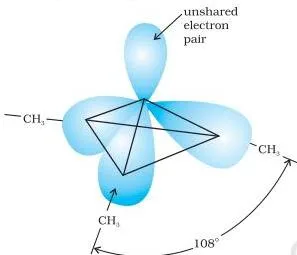
Like ammonia, the nitrogen of every amine is trivalent and carries one unshared pair of electrons. Its orbitals are \( sp^3 \) hybridised, so amines have a pyramidal geometry (NCERT, p. 259).
The fourth \( sp^3 \) orbital holds the lone pair; the pair repels the three bonding pairs, so the C–N–E angle (E = C or H) is squeezed below the tetrahedral \( 109.5^\circ \) — for example \( 108^\circ \) in trimethylamine (NCERT, p. 259).
That lone pair is the engine of the whole unit: it makes every amine a Lewis base and a nucleophile. Salt formation, alkylation, acylation, the carbylamine test and diazotisation all start from this pair.
| Term | Meaning | Example |
|---|---|---|
| Amine | Ammonia in which one or more H atoms are replaced by alkyl or aryl groups | \( \text{CH}_3\text{NH}_2 \), \( \text{C}_6\text{H}_5\text{NH}_2 \) |
| Primary (1°) amine | One H replaced; N carries one C–N bond and two N–H bonds | \( \text{C}_2\text{H}_5\text{NH}_2 \) |
| Secondary (2°) amine | Two H replaced; N carries two C–N bonds and one N–H bond | \( (\text{C}_2\text{H}_5)_2\text{NH} \) |
| Tertiary (3°) amine | Three H replaced; N carries three C–N bonds and no N–H bond | \( (\text{CH}_3)_3\text{N} \) |
| Alkanamine | IUPAC name for a primary aliphatic amine (alkane minus final ‘e’, plus ‘amine’) | methanamine for \( \text{CH}_3\text{NH}_2 \) |
| Ammonolysis | Cleavage of the C–X bond of an alkyl halide by ammonia; \( -\text{NH}_2 \) replaces the halogen | \( \text{C}_2\text{H}_5\text{Cl} \xrightarrow{\text{NH}_3} \text{C}_2\text{H}_5\text{NH}_2 \) |
| Diazonium salt | Compound with the diazonium group \( \text{ArN}_2^+ \) and an anion such as \( \text{Cl}^- \) or \( \text{HSO}_4^- \) | \( \text{C}_6\text{H}_5\text{N}_2^+\text{Cl}^- \) (benzenediazonium chloride) |
| Azo dye | Coloured coupling product with both aromatic rings joined through \( -\text{N}=\text{N}- \) | p-hydroxyazobenzene |
Classification of Amines: Primary, Secondary or Tertiary in One Glance
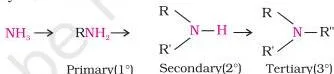
Count how many hydrogen atoms of ammonia have been replaced by alkyl or aryl groups (NCERT, p. 260):
- one H replaced → primary \( (1^\circ) \) amine, \( \text{RNH}_2 \);
- two H replaced → secondary \( (2^\circ) \) amine, \( \text{R}_2\text{NH} \) — the two groups may be identical or different;
- three H replaced → tertiary \( (3^\circ) \) amine, \( \text{R}_3\text{N} \).
An amine is simple when all alkyl or aryl groups on nitrogen are the same, and mixed when they differ (NCERT, p. 260).
Worked example — classify: \( (\text{C}_2\text{H}_5)_2\text{CHNH}_2 \) is primary: nitrogen is bonded to exactly one carbon (the CH carbon) and to two hydrogens.
\( (\text{C}_2\text{H}_5)_2\text{NH} \) is secondary: nitrogen is bonded to two carbons and one hydrogen.
The trap: count C–N bonds, not total carbons. A primary amine can be quite large; only the bonds on nitrogen decide the class.
Naming Amines: Common and IUPAC Rules With the Working Table
Common system: prefix the alkyl group to the word ‘amine’ — methylamine, ethylamine. When two or three groups are identical, use di- or tri- (dimethylamine, trimethylamine) (NCERT, p. 260).
IUPAC for primary amines — alkanamines: replace the final ‘e’ of the alkane by ‘amine’. \( \text{CH}_3\text{NH}_2 \) is methanamine. With more than one \( -\text{NH}_2 \) group, number the chain, attach di/tri, and keep the ‘e’ of the parent: \( \text{H}_2\text{NCH}_2\text{CH}_2\text{NH}_2 \) is ethane-1,2-diamine (NCERT, p. 260).
Substituents on nitrogen: use the locant N. \( \text{CH}_3\text{NHCH}_2\text{CH}_3 \) is N-methylethanamine; \( (\text{CH}_3\text{CH}_2)_3\text{N} \) is N,N-diethylethanamine (NCERT, p. 260). Aniline is an accepted IUPAC name; the systematic alternative is benzenamine (NCERT, p. 261).
| Compound | Common name | IUPAC name |
|---|---|---|
| \( \text{CH}_3\text{CH}_2\text{NH}_2 \) | Ethylamine | Ethanamine |
| \( (\text{CH}_3)_2\text{CHNH}_2 \) | Isopropylamine | Propan-2-amine |
| \( \text{CH}_3\text{NHCH}_2\text{CH}_3 \) | Ethylmethylamine | N-Methylethanamine |
| \( (\text{CH}_3)_3\text{N} \) | Trimethylamine | N,N-Dimethylmethanamine |
| \( \text{C}_6\text{H}_5\text{NH}_2 \) | Aniline | Aniline or Benzenamine |
| \( o\text{-CH}_3\text{C}_6\text{H}_4\text{NH}_2 \) | o-Toluidine | 2-Methylaniline |
| \( \text{C}_6\text{H}_5\text{N}(\text{CH}_3)_2 \) | N,N-Dimethylaniline | N,N-Dimethylbenzenamine |
| \( \text{H}_2\text{NCH}_2\text{CH}_2\text{NH}_2 \) | Ethylenediamine | Ethane-1,2-diamine |
| \( \text{H}_2\text{N}(\text{CH}_2)_6\text{NH}_2 \) | Hexamethylenediamine | Hexane-1,6-diamine |
| \( \text{CH}_2=\text{CHCH}_2\text{NH}_2 \) | Allylamine | Prop-2-en-1-amine |
Six Methods of Preparing Amines: A Carbon-Count Cheat Table
Six standard routes, and only two change the number of carbon atoms. Learn the reagent-and-condition arrow for each, then let the cheat table choose the route in a conversion.
- Reduction of nitro compounds — \( \text{RNO}_2 \xrightarrow{\text{H}_2/\text{Ni}} \text{RNH}_2 \), or reduction with metals in acid. Iron scrap + HCl is preferred because the FeCl₂ formed hydrolyses to regenerate HCl, so only a small amount of acid is needed to start the reaction (NCERT, p. 262).
- Ammonolysis of alkyl or benzyl halides — \( \text{RX} \) with excess ethanolic ammonia in a sealed tube at 373 K replaces the halogen by \( -\text{NH}_2 \). The 1° amine formed keeps reacting to give 2°, 3° and finally a quaternary ammonium salt; a large excess of ammonia makes the 1° amine the major product. Halide reactivity is \( \text{RI} \gt \text{RBr} \gt \text{RCl} \) (NCERT, p. 262). This is the C–X cleavage you studied in the Haloalkanes and Haloarenes notes.
- Reduction of nitriles — \( \text{RCN} \xrightarrow{\text{LiAlH}_4 \text{ or } \text{H}_2/\text{Ni}} \text{RCH}_2\text{NH}_2 \). This is the ascent of the amine series: the product has one carbon more than the starting amine (NCERT, p. 263).
- Reduction of amides — \( \text{RCONH}_2 \xrightarrow{\text{LiAlH}_4} \text{RCH}_2\text{NH}_2 \). The amides themselves come from the Aldehydes, Ketones and Carboxylic Acids notes (NCERT, p. 263).
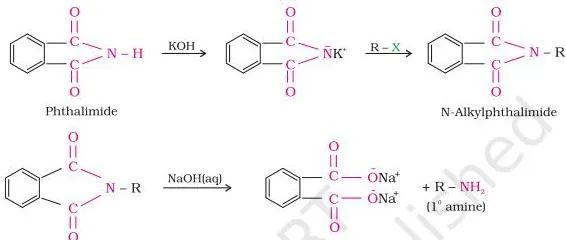
- Gabriel phthalimide synthesis — phthalimide + ethanolic KOH gives potassium phthalimide; heating with an alkyl halide, then alkaline hydrolysis, releases a pure primary amine. Aromatic primary amines cannot be made this way because aryl halides do not undergo nucleophilic substitution with the phthalimide anion (NCERT, p. 264).
- Hoffmann bromamide degradation — \( \text{RCONH}_2 + \text{Br}_2 + 4\text{NaOH} \rightarrow \text{RNH}_2 + \text{Na}_2\text{CO}_3 + 2\text{NaBr} + 2\text{H}_2\text{O} \). An alkyl or aryl group migrates from the carbonyl carbon to nitrogen; the amine has one carbon less than the amide (NCERT, p. 264).
| Method | Carbon change | Why |
|---|---|---|
| Nitro reduction | Same | \( -\text{NO}_2 \) becomes \( -\text{NH}_2 \) on the same carbon skeleton |
| Ammonolysis | Same | Halogen is simply replaced; no carbon is added |
| Nitrile reduction | \( +1 \) | The \( \text{C}\equiv\text{N} \) carbon is retained as \( -\text{CH}_2\text{NH}_2 \) |
| Amide reduction | Same | The carbonyl carbon is retained as \( \text{CH}_2 \) |
| Gabriel synthesis | Same | The alkyl group of the halide is carried over unchanged |
| Hoffmann degradation | \( -1 \) | The carbonyl carbon is lost as \( \text{Na}_2\text{CO}_3 \) |
Physical Properties: Why Boiling Points Fall Primary > Secondary > Tertiary
Lower aliphatic amines are gases with a fishy odour; primary amines with three or more carbons are liquids, and still higher ones are solids. Aniline is colourless when pure but darkens on storage because of atmospheric oxidation (NCERT, p. 265).
Solubility follows the hydrophobic part
Lower aliphatic amines dissolve in water by forming hydrogen bonds with water; solubility falls as the hydrophobic alkyl part grows, and higher amines are essentially insoluble (NCERT, p. 265).
Electronegativity settles the alcohol-versus-amine question: N is 3.0 and O is 3.5, so alcohols are more polar than amines. Amines therefore dissolve better in non-polar solvents such as alcohol, ether and benzene, while the more polar alcohol forms stronger hydrogen bonds and is the better partner for water (NCERT, p. 265).
Boiling points: \( 1^\circ \gt 2^\circ \gt 3^\circ \)
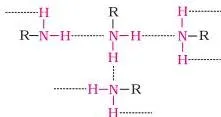
Primary and secondary amines associate through intermolecular \( \text{N}-\text{H}\cdots\text{N} \) hydrogen bonds; a primary amine has two N–H hydrogens to offer, a secondary has one, and a tertiary has none. More association means more energy to separate the molecules, hence the higher boiling point (NCERT, p. 265).
| Compound | Molar mass | b.p. / K |
|---|---|---|
| n-Butylamine (1°) | 73 | 350.8 |
| Diethylamine (2°) | 73 | 329.3 |
| Ethyldimethylamine (3°) | 73 | 310.5 |
| Alkane of similar mass, \( \text{C}_2\text{H}_5\text{CH}(\text{CH}_3)_2 \) | 72 | 300.8 |
| Butan-1-ol | 74 | 390.3 |
Read the table as a ladder: for the same molar mass an alkane boils lowest, the amine sits in the middle, and the alcohol boils highest — hydrogen bonding explains every rung (NCERT, p. 265).
Basicity of Amines: pKb Values and the Order That Confuses Most Students
Amines accept a proton to form ammonium salts, and the unshared pair makes them Lewis bases (NCERT, p. 266). Strength is measured by \( K_b \) and \( pK_b \):
\[ \text{RNH}_2 + \text{H}_2\text{O} \rightleftharpoons \text{RNH}_3^+ + \text{OH}^- \]
\[ K_b = \frac{[\text{RNH}_3^+][\text{OH}^-]}{[\text{RNH}_2]}, \qquad pK_b = -\log K_b \]
Rule: the larger the \( K_b \) — equivalently, the smaller the \( pK_b \) — the stronger the base (NCERT, p. 266). Ammonia has \( pK_b = 4.75 \); aliphatic amines lie between 3 and 4.22; aromatic amines are weaker than ammonia (NCERT, p. 267).
The three factors that decide basicity in water
- Inductive effect (+I): alkyl groups push electron density towards nitrogen, making the lone pair more available to a proton.
- Solvation: water molecules hydrogen-bond to the substituted ammonium ion and stabilise it; the more stable the cation, the more basic the amine.
- Steric hindrance to solvation: bulky alkyl groups block water from reaching the cation and so lower its stability.
The +I effect alone gives the gas-phase order \( 3^\circ \gt 2^\circ \gt 1^\circ \gt \text{NH}_3 \) (NCERT, p. 268). In water the other two factors cut in, and for small alkyl groups the order flips:
\[ (\text{CH}_3)_2\text{NH} \gt \text{CH}_3\text{NH}_2 \gt (\text{CH}_3)_3\text{N} \gt \text{NH}_3 \]
\[ (\text{C}_2\text{H}_5)_2\text{NH} \gt (\text{C}_2\text{H}_5)_3\text{N} \gt \text{C}_2\text{H}_5\text{NH}_2 \gt \text{NH}_3 \]
Why the flip happens: the tertiary cation gets the most +I stabilisation but is the least solvated — the larger the ion, the weaker its hydrogen bonding with water (NCERT, p. 268). Think of a bulky umbrella: rain cannot wet a huge cation fully, so it is stabilised less.
When the alkyl group grows from \( -\text{CH}_3 \) to \( -\text{C}_2\text{H}_5 \), steric hindrance to solvation appears and the exact order changes — hence the two different aqueous sequences above (NCERT, p. 268).
Memory device for aqueous methylamines: remember \( 2 \gt 1 \gt 3 \gt 0 \). Dimethylamine (2 methyls) beats methylamine (1), which beats trimethylamine (3); ammonia (0 methyls) is last. Three methyls push electrons hardest, but the bulky \( (\text{CH}_3)_3\text{NH}^+ \) cation is poorly solvated; two methyls give a strong +I effect while the cation stays small enough to solvate — and solvation stabilisation tips the balance.
| Amine | \( pK_b \) |
|---|---|
| Methanamine | 3.38 |
| N-Methylmethanamine | 3.27 |
| N,N-Dimethylmethanamine | 4.22 |
| Ethanamine | 3.29 |
| N-Ethylethanamine | 3.00 |
| N,N-Diethylethanamine | 3.25 |
| Benzenamine (aniline) | 9.38 |
| Phenylmethanamine (benzylamine) | 4.70 |
| N-Methylaniline | 9.30 |
| N,N-Dimethylaniline | 8.92 |
Arylamines: aniline loses to ammonia
The \( pK_b \) of aniline is high because the lone pair on nitrogen is in conjugation with the benzene ring. Aniline is a resonance hybrid of five structures, while the anilinium ion formed on protonation has only two (Kekulé) structures (NCERT, p. 269).
More resonance structures mean more stability: the free amine is stabilised more than its protonated form, so aniline accepts a proton less readily than ammonia — \( pK_b \) 9.38 versus 4.75. Electron-releasing substituents (\( -\text{OCH}_3 \), \( -\text{CH}_3 \)) raise basicity; electron-withdrawing groups (\( -\text{NO}_2 \), \( -\text{SO}_3\text{H} \), \( -\text{COOH} \), \( -\text{X} \)) lower it (NCERT, p. 269).
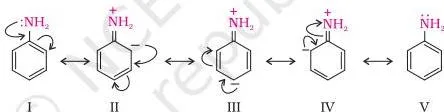
Worked example: arrange in decreasing basic strength \( \text{C}_6\text{H}_5\text{NH}_2 \), \( \text{C}_2\text{H}_5\text{NH}_2 \), \( (\text{C}_2\text{H}_5)_2\text{NH} \), \( \text{NH}_3 \).
\[ (\text{C}_2\text{H}_5)_2\text{NH} \gt \text{C}_2\text{H}_5\text{NH}_2 \gt \text{NH}_3 \gt \text{C}_6\text{H}_5\text{NH}_2 \]
Reasoning: diethylamine benefits from two +I ethyl groups and easy solvation; ethylamine has one +I group; ammonia has none; aniline is last because resonance removes the lone pair from protonation (NCERT, p. 270).
Other Chemical Reactions of Amines: Acylation, Carbylamine and Nitrous Acid
Alkylation
Treatment with alkyl halides replaces N–H hydrogens in steps: \( \text{RNH}_2 \rightarrow \text{R}_2\text{NH} \rightarrow \text{R}_3\text{N} \rightarrow \text{R}_4\text{N}^+\text{X}^- \), the quaternary ammonium salt (NCERT, p. 270). This cascade is why ammonolysis alone never gives a pure primary amine.
Acylation and benzoylation
Primary and secondary amines react with acid chlorides, anhydrides or esters to form amides. Pyridine, a base stronger than the amine, removes the HCl formed and shifts the equilibrium to the right (NCERT, p. 270).
\[ \text{CH}_3\text{NH}_2 + \text{C}_6\text{H}_5\text{COCl} \rightarrow \text{CH}_3\text{NHCOC}_6\text{H}_5 + \text{HCl} \]
With benzoyl chloride the reaction is called benzoylation; the product here is N-methylbenzamide (NCERT, p. 270).
Carbylamine (isocyanide) test
Only primary amines give this reaction: heating with chloroform and ethanolic KOH produces a foul-smelling isocyanide. Secondary and tertiary amines do not react (NCERT, p. 271).
\[ \text{RNH}_2 + \text{CHCl}_3 + 3\text{KOH} \xrightarrow{\text{heat}} \text{RNC} + 3\text{KCl} + 3\text{H}_2\text{O} \]
Reaction with nitrous acid (NaNO₂ + mineral acid, in situ)
- 1° aliphatic: forms an unstable aliphatic diazonium salt that liberates \( \text{N}_2 \) quantitatively and gives an alcohol; the gas volume is used to estimate amino acids and proteins (NCERT, p. 271) — a direct link to the Biomolecules notes.
- 1° aromatic: at 273-278 K it forms a diazonium salt stable for a short time — the gateway to diazonium chemistry.
- 2° and 3°: react differently and release no nitrogen — so \( \text{N}_2 \) evolution is a clean pointer to a 1° aliphatic amine.
Three Safe Tests to Distinguish Primary, Secondary and Tertiary Amines
The board-favourite answer is the Hinsberg test, with carbylamine and nitrous acid as cross-checks. The reagent is benzenesulphonyl chloride (\( \text{C}_6\text{H}_5\text{SO}_2\text{Cl} \)); modern laboratories use p-toluenesulphonyl chloride instead (NCERT, p. 271).
| Amine class | Product | Observation |
|---|---|---|
| Primary | N-alkylsulphonamide — one N–H remains, and that hydrogen is strongly acidic because of the sulphonyl group | Soluble in alkali (salt formation) |
| Secondary | N,N-dialkylsulphonamide — no N–H on nitrogen | Insoluble in alkali |
| Tertiary | No reaction | No sulphonamide forms |
Cross-checks: carbylamine is positive only for 1° amines, and nitrous acid releases \( \text{N}_2 \) only from 1° aliphatic amines. Together the three tests settle Exercise 9.2 (distinguish methylamine/dimethylamine, ethylamine/aniline, aniline/N-methylaniline and more) and Exercise 9.6 (write a full identification method for all three classes).
Electrophilic Substitution in Aniline: Why Acetylation Is the Rescue Trick
In the five resonance structures of aniline, the ortho and para positions carry the highest electron density. So \( -\text{NH}_2 \) is an ortho/para-directing, powerfully activating group (NCERT, p. 272).
Bromination
Aniline and bromine water at room temperature give a white precipitate of 2,4,6-tribromoaniline (NCERT, p. 272) — dramatic proof of how strongly the amino group activates the ring.
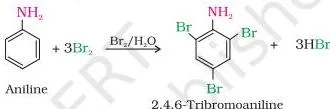
Direct nitration: the classic problem (Exercise 9.3 iv)
Direct nitration of aniline gives tarry oxidation products and — crucially — a significant amount of the meta derivative. In the strongly acidic medium, aniline is protonated to the anilinium ion, and \( -\text{NH}_3^+ \) is meta-directing (NCERT, p. 273).
The acetylation rescue
Protect \( -\text{NH}_2 \) by acetylation with acetic anhydride to get acetanilide. The nitrogen lone pair is now delocalised towards the carbonyl oxygen, so the activating power of the group falls; nitration then gives mainly the para product, and hydrolysis of the amide regenerates the amine (NCERT, pp. 272-273).
Sulphonation and Friedel-Crafts
- Sulphonation: conc. \( \text{H}_2\text{SO}_4 \) at 453-473 K gives sulphanilic acid (p-aminobenzenesulphonic acid) as the major product (NCERT, p. 273).
- Friedel-Crafts fails: aniline forms a salt with AlCl₃, the nitrogen gains a positive charge, and the ring becomes strongly deactivated (NCERT, p. 273). Name the salt formation with AlCl₃ — that is the operative reason.
Diazonium Salts: Preparation and the Replacement Menu
Diazonium salts have the general formula \( \text{ArN}_2^+\text{X}^- \), where \( \text{X} \) may be \( \text{Cl}^- \), \( \text{Br}^- \), \( \text{HSO}_4^- \) or \( \text{BF}_4^- \), and \( \text{N}_2^+ \) is the diazonium group (NCERT, p. 274). The parent hydrocarbon gives the name: \( \text{C}_6\text{H}_5\text{N}_2^+\text{Cl}^- \) is benzenediazonium chloride.
Diazotisation
\[ \text{C}_6\text{H}_5\text{NH}_2 + \text{NaNO}_2 + 2\text{HCl} \xrightarrow{273-278\ \text{K}} \text{C}_6\text{H}_5\text{N}_2^+\text{Cl}^- + \text{NaCl} + 2\text{H}_2\text{O} \]
Nitrous acid is generated in situ from NaNO₂ and HCl; the conversion is diazotisation (NCERT, p. 274). Arenediazonium salts owe their short-term stability to resonance but are never stored: they are colourless crystalline solids, soluble in water, stable in the cold, decomposed in the dry state or when warmed. The fluoroborate salt is water-insoluble and stable at room temperature (NCERT, p. 275).
Displacement of nitrogen: the replacement menu
The diazonium group is a very good leaving group; \( \text{N}_2 \) escapes as gas while a nucleophile takes its place (NCERT, p. 275).
| Group introduced | Reagent and conditions | Product |
|---|---|---|
| \( -\text{Cl} \) | Cu₂Cl₂/HCl (Sandmeyer) or Cu/HCl (Gattermann) | ArCl |
| \( -\text{Br} \) | Cu₂Br₂/HBr (Sandmeyer) or Cu/HBr (Gattermann) | ArBr |
| \( -\text{CN} \) | CuCN/KCN | ArCN |
| \( -\text{I} \) | KI | ArI |
| \( -\text{F} \) | HBF₄, then heat | ArF |
| \( -\text{H} \) | Hypophosphorous acid (\( \text{H}_3\text{PO}_2 \)) or ethanol | ArH |
| \( -\text{OH} \) | Warm water, 283 K | ArOH |
| \( -\text{NO}_2 \) | NaNO₂ + Cu, from the diazonium fluoroborate | ArNO₂ |
Sandmeyer versus Gattermann
Both introduce Cl or Br from the diazonium salt; the difference is the catalyst (NCERT, p. 275).
| Point | Sandmeyer reaction | Gattermann reaction |
|---|---|---|
| Catalyst | Cuprous halide — Cu₂Cl₂ or Cu₂Br₂ | Copper powder |
| Acid medium | Hydrohalic acid (HCl or HBr) | Hydrohalic acid (HCl or HBr) |
| Reagent pair | Cu₂X₂ + HX | Cu + HX |
| Yield | Better | Lower than Sandmeyer |
Why diazonium salts matter
Aryl fluorides and aryl iodides cannot be made by direct halogenation of benzene, and the cyano group cannot be introduced by nucleophilic substitution of chlorobenzene. The diazonium route is the practical path to \( -\text{F} \), \( -\text{I} \) and \( -\text{CN} \) on the ring (NCERT, p. 276).
Coupling Reactions: How Azo Dyes Are Born
Coupling keeps the diazo group and joins it to a phenol or aniline at the para position — an electrophilic substitution (NCERT, p. 276):
- benzenediazonium chloride + phenol → p-hydroxyazobenzene;
- benzenediazonium chloride + aniline → p-aminoazobenzene.
The product has an extended conjugated system: both aromatic rings joined through \( -\text{N}=\text{N}- \). That conjugation lets the molecule absorb visible light, which is why azo compounds are coloured and are used as azo dyes (NCERT, p. 276). This is the content of a short note for Exercise 9.7(iv).
Worked Conversions: Stepwise Sequences With Original Numbers
In conversion questions the arrow is the answer — every arrow must carry its reagent and conditions.
Worked example A: 1-bromopropane → butan-1-amine (nitrile route, +1 C)
Step 1 — replace Br by CN: \( \text{CH}_3\text{CH}_2\text{CH}_2\text{Br} + \text{NaCN} \) (ethanolic) \( \rightarrow \text{CH}_3\text{CH}_2\text{CH}_2\text{C}\equiv\text{N} \) (butanenitrile) + NaBr.
Step 2 — reduce the nitrile: \( \text{CH}_3\text{CH}_2\text{CH}_2\text{C}\equiv\text{N} \xrightarrow{\text{LiAlH}_4} \text{CH}_3\text{CH}_2\text{CH}_2\text{CH}_2\text{NH}_2 \) (butan-1-amine).
\( \text{H}_2/\text{Ni} \) works as well.
Final answer: butan-1-amine. This is the ascent of the series: a 3-carbon halide becomes a 4-carbon amine (NCERT, p. 263).
Worked example B: propanamide → ethanamine (Hoffmann, −1 C)
Step 1 — identify the amide: propanamide is \( \text{CH}_3\text{CH}_2\text{CONH}_2 \), three carbons.
Step 2 — Hoffmann degradation: \( \text{CH}_3\text{CH}_2\text{CONH}_2 + \text{Br}_2 + 4\text{NaOH} \rightarrow \text{CH}_3\text{CH}_2\text{NH}_2 + \text{Na}_2\text{CO}_3 + 2\text{NaBr} + 2\text{H}_2\text{O} \).
Final answer: ethanamine. The carbonyl carbon leaves as \( \text{Na}_2\text{CO}_3 \), so the amine has one carbon less than the amide (NCERT, p. 264).
Worked example C: benzene → bromobenzene through the diazonium salt
Step 1 — nitration: benzene + conc.
\( \text{HNO}_3 \) / conc.
\( \text{H}_2\text{SO}_4 \) → nitrobenzene.
Step 2 — reduction: nitrobenzene + Fe/HCl → aniline.
Step 3 — diazotisation: aniline + NaNO₂ + 2HCl at 273-278 K → benzenediazonium chloride.
Step 4 — Sandmeyer bromination: \( \text{C}_6\text{H}_5\text{N}_2^+\text{Cl}^- + \text{Cu}_2\text{Br}_2/\text{HBr} \rightarrow \text{C}_6\text{H}_5\text{Br} + \text{N}_2 \); Gattermann (Cu/HBr) is the alternative.
Final answer: bromobenzene. The 273-278 K temperature at step 3 is the condition that earns the mark.
Common Mistakes Students Make in Amines (And the Correct Thinking)
These five slips cost more marks in this unit than any others.
| Mistake | Correct rule | How to check |
|---|---|---|
| Quoting the pKb order as if it were the basicity order | Smaller \( pK_b \) = stronger base — compare inversely | In Table 9.3, N-ethylethanamine (\( pK_b \) 3.00) is the strongest base listed |
| “Tertiary amines are always the most basic” | True only in the gas phase; in water solvation flips the methylamine order | Apply \( 2 \gt 1 \gt 3 \gt 0 \): \( (\text{CH}_3)_2\text{NH} \gt \text{CH}_3\text{NH}_2 \gt (\text{CH}_3)_3\text{N} \gt \text{NH}_3 \) |
| “Direct nitration of aniline gives only o- and p-products” | In strong acid aniline becomes the anilinium ion (meta-directing), so a significant meta fraction forms | Write the protonation step first: \( \text{C}_6\text{H}_5\text{NH}_2 \xrightarrow{\text{H}^+} \text{C}_6\text{H}_5\text{NH}_3^+ \) |
| Confusing Sandmeyer with Gattermann | Sandmeyer: cuprous halide + hydrohalic acid (Cu₂Cl₂/HCl); Gattermann: copper powder + halogen acid | State the catalyst — that names the reaction; Sandmeyer gives the better yield |
| “Gabriel synthesis can make aniline” | Aryl halides do not undergo nucleophilic substitution with the phthalimide anion | Use nitro reduction or Hoffmann instead for aromatic primary amines |
Exam Notes: Question Patterns in Amines and What Earns the Mark
NCERT Exercises 9.1-9.14 map cleanly onto the question families that recur in board papers:
| Exercise | Skill it tests |
|---|---|
| 9.1 | IUPAC naming + classification into primary/secondary/tertiary |
| 9.2 | Give one chemical test to distinguish a pair of amines |
| 9.3 | “Account for” reasoning — pKb, solubility, nitration, Friedel-Crafts failure, diazonium stability, Gabriel |
| 9.4 | Arrange in order of pKb, basic strength, boiling point, solubility |
| 9.5, 9.8 | Multi-step conversions |
| 9.6 | Describe a complete identification method for all three classes |
| 9.7 | Short notes — carbylamine, diazotisation, Hoffmann, coupling, ammonolysis, acetylation, Gabriel |
| 9.9, 9.10 | Identify structures A, B, C in reaction chains |
| 9.11 | Complete the reactions |
| 9.12-9.14 | “Why” reasoning questions |
What earns the mark:
- Reasoning: name the operative factor — +I effect, solvation, steric hindrance, resonance, hydrogen bonding — and tie it to the stability of the cation or intermediate. A quoted order with no reason earns nothing.
- Conversions: the mark is in the arrow: reagent plus conditions (273-278 K for diazotisation, 283 K for hydrolysis to phenol, sealed tube at 373 K for ammonolysis). One missing condition loses the mark.
- Tests: quote the reagent, the product, and the observation — soluble or insoluble in alkali, foul smell, \( \text{N}_2 \) gas. The observation is the answer.
You can verify every reaction against the official text: Unit 9 (Amines) sits in NCERT Chemistry Part II — open the NCERT textbook page for Class 12 and check the reactions and exercises directly.
Amines Revision Summary: The One-Page Recap
| Preparation method | Reagents / conditions | What you get | Carbon change |
|---|---|---|---|
| Nitro reduction | H₂/Ni or Fe/HCl | 1° amine | Same |
| Ammonolysis | RX + excess NH₃ (ethanol, 373 K) | 1° amine (plus 2°/3°/quaternary salts) | Same |
| Nitrile reduction | LiAlH₄ or H₂/Ni | 1° amine | \( +1 \) |
| Amide reduction | LiAlH₄ | 1° amine | Same |
| Gabriel synthesis | Phthalimide salt + RX, then hydrolysis | Pure 1° amine | Same |
| Hoffmann degradation | Amide + Br₂ + 4NaOH | 1° amine | \( -1 \) |
Basicity one-liners:
- Gas phase: \( 3^\circ \gt 2^\circ \gt 1^\circ \gt \text{NH}_3 \).
- Aqueous methylamines: \( (\text{CH}_3)_2\text{NH} \gt \text{CH}_3\text{NH}_2 \gt (\text{CH}_3)_3\text{N} \gt \text{NH}_3 \).
- Aromatic amines \( \lt \text{NH}_3 \lt \) aliphatic amines.
| Test | Positive outcome |
|---|---|
| Carbylamine | 1° only — foul-smelling isocyanide |
| Hinsberg | 1° soluble in alkali; 2° insoluble; 3° no reaction |
| Nitrous acid | \( \text{N}_2 \) gas only from 1° aliphatic amines |
Diazonium displacement menu: from \( \text{ArN}_2^+ \) — Cl (Cu₂Cl₂/HCl), Br (Cu₂Br₂/HBr), CN (CuCN/KCN), I (KI), F (HBF₄ then heat), H (H₃PO₂ or ethanol), OH (warm water, 283 K), NO₂ (NaNO₂ + Cu).
Frequently Asked Questions on Amines
Why is aniline a weaker base than ammonia even though it has a free NH₂ group?
The lone pair on nitrogen is delocalised into the benzene ring by resonance. Aniline is a resonance hybrid of five structures, so it is more stable than the anilinium ion, which has only two (Kekulé) structures.
A base must be less stable than its protonated form to donate electrons readily; since protonation does not stabilise aniline much, basicity falls — \( pK_b \) 9.38 versus 4.75 for ammonia (NCERT, p. 269).
Why does a tertiary amine have a lower boiling point than a primary amine of similar molar mass?
Because a tertiary amine has no N–H hydrogen and cannot form intermolecular hydrogen bonds. Primary amines offer two N–H hydrogens per molecule and associate most strongly, so the boiling point order is \( 1^\circ \gt 2^\circ \gt 3^\circ \) — n-butylamine 350.8 K versus ethyldimethylamine 310.5 K at the same molar mass (NCERT, p. 265).
Why cannot aromatic primary amines be prepared by Gabriel phthalimide synthesis?
Because the method requires nucleophilic substitution of an alkyl halide by the phthalimide anion. Aryl halides do not undergo nucleophilic substitution with this anion, so the alkylation step fails for aromatic halides (NCERT, p. 264). Use nitro reduction or Hoffmann degradation for aromatic primary amines instead.
Why does direct nitration of aniline give a significant amount of meta-nitroaniline along with ortho and para products?
Because the nitrating mixture is strongly acidic, so aniline exists as the anilinium ion, \( -\text{NH}_3^+ \), which is meta-directing. That is why a significant meta fraction forms along with o/p derivatives and tarry oxidation products. Protecting \( -\text{NH}_2 \) by acetylation before nitration makes the para product the major one (NCERT, p. 273).
What is the difference between the Sandmeyer and Gattermann reactions?
Both introduce Cl or Br from a diazonium salt, but Sandmeyer uses a cuprous halide with the hydrohalic acid (Cu₂Cl₂/HCl, Cu₂Br₂/HBr), while Gattermann uses copper powder with the halogen acid (Cu/HCl, Cu/HBr). The Sandmeyer reaction gives the better yield (NCERT, p. 275).
Why is (CH₃)₂NH a stronger base than (CH₃)₃N in aqueous solution?
In water, basicity depends on the stability of the substituted ammonium ion, which comes from both the +I effect and solvation. \( (\text{CH}_3)_3\text{N} \) gives the most +I stabilisation, but its bulky cation is poorly solvated; \( (\text{CH}_3)_2\text{NH}^+ \) has two +I groups and is small enough to be well solvated.
Solvation wins, so dimethylamine is the stronger base (NCERT, p. 268).
Reference: NCERT Class 12 Chemistry textbook, chapter Amines.
Explore Class 12 Chemistry Notes
Class 12 Chemistry on LearnCBSE:
Related chapters:
Official source: download the NCERT textbook free from ncert.nic.in.