
These water resources class 10 notes cover the chapter’s exam-critical concepts for the 2026-27 session: why freshwater is scarce despite being renewable, the causes of water scarcity, multi-purpose river projects and their criticism, traditional and modern rainwater harvesting methods, and the bamboo drip irrigation of Meghalaya.
Coming from our Class 10 Geography notes series, the page is built so you can revise the entire chapter in one sitting and walk into the exam knowing exactly which terms and structures earn marks.
Water Resources Class 10 Notes: Why Water Is Scarce Despite Being Renewable
Three-fourths of Earth’s surface is covered with water, yet only a small proportion is usable freshwater (NCERT, p. 1). The freshwater we rely on comes mainly from surface runoff and groundwater, both of which are continually renewed through the hydrological cycle. Because the cycle keeps replenishing these sources, water qualifies as a renewable resource.
The paradox is that despite this abundance and renewability, countries and regions across the globe suffer from water scarcity. By 2025, it is predicted that nearly two billion people will face absolute water scarcity (NCERT, p. 1). This projection is what makes conservation and management of water resources a pressing issue.
The availability of fresh water varies over space and time, mainly due to the variations in seasonal and annual precipitation. However, low rainfall is only one part of the story. Most water scarcity is caused by over-exploitation, excessive use, and unequal access to water among different social groups (NCERT, p. 1).
What Is Water Scarcity? Causes Beyond Low Rainfall
Students instinctively associate water scarcity with low-rainfall or drought-prone regions like the Thar Desert. True, the availability of water resources varies over space and time, due mainly to the variations in seasonal and annual precipitation — but water scarcity in most cases is caused by over-exploitation, excessive use, and unequal access among different social groups (NCERT, p. 1).
Water scarcity has two dimensions you must separate in exam answers.
Quantitative Scarcity — Not Enough Water
A large and growing population demands more water, both for domestic use and for higher food-grain production. To facilitate this, water resources are being over-exploited to expand irrigated areas, especially for dry-season agriculture. Irrigated agriculture is the largest consumer of water (NCERT, p. 1).
Farmers running their own wells and tube-wells for irrigation has led to falling groundwater levels, threatening water availability and food security.
Post-independence India saw intensive industrialisation and urbanisation. The ever-increasing number of industries exerts pressure on freshwater resources — they are heavy users of water and also require hydroelectric power to run (NCERT, p. 3). In cities, housing societies and colonies install their own groundwater pumping devices, and multiplying urban centres with dense populations aggravate the problem further.
The government’s NCERT Class 10 Geography textbook chapter 3 includes a box on Atal Bhujal Yojana (Atal Jal), being implemented in 8,220 water-stressed Gram Panchayats across 80 districts of seven states — Gujarat, Haryana, Karnataka, Madhya Pradesh, Maharashtra, Rajasthan, and Uttar Pradesh.
Its key aspect is to bring behavioural changes in the community, shifting from an attitude of consumption to one of conservation and smart water management (NCERT, p. 3).
Qualitative Scarcity — Water Exists but Is Unsafe
Water may be sufficiently available to meet the needs of the people, yet the area still suffers from scarcity because the water is polluted by domestic and industrial wastes, chemicals, pesticides, and fertilisers used in agriculture (NCERT, p. 3). This makes it hazardous for human use even when the quantity is adequate.
The government has launched the Jal Jeevan Mission (JJM) to address this. Its goal is to enable every rural household to get an assured supply of potable piped water at a service level of 55 litres per capita per day regularly on a long-term basis by ensuring functionality of tap water connections (NCERT, p. 3).
Key Concepts and Definitions in Water Resources
Below is a definitions table covering every exam-critical term in this chapter. Learn these in your own words rather than memorising textbook phrasing.
| Term | Meaning | Example |
|---|---|---|
| Hydrological cycle | The continuous movement of water through evaporation, condensation, precipitation, and runoff that renews and recharges surface and groundwater. | Rain recharging a dugwell after percolating through soil. |
| Water scarcity | Shortage of water caused by over-exploitation, excessive use, unequal access, or pollution — not only by low rainfall. | A city with high rainfall but polluted rivers facing drinking water shortage. |
| Dam | A barrier across flowing water that obstructs, directs, or retards the flow, creating a reservoir. “Dam” refers to the reservoir rather than the structure itself. | Bhakra-Nangal dam on the Sutlej-Beas basin. |
| Spillway | A section of a dam over or through which water flows, either intermittently or continuously, to safely release excess water. | The overflow channel on Hirakud Dam. |
| Multi-purpose river project | A dam project where many uses of the impounded water — irrigation, electricity, flood control, domestic supply, navigation, fish breeding — are integrated with one another. | Sardar Sarovar on the Narmada covering four states. |
| Rainwater harvesting | The broad practice of collecting and storing rainwater for domestic or agricultural use, adapted to local rainfall regimes and soil types. | Guls/kuls in Western Himalayas; tankas in Rajasthan. |
| Rooftop rainwater harvesting | Collecting rain falling on a sloping roof, channelling it through a pipe, and storing it in an underground tank for household use. | Rajasthan houses with tankas connected to roof pipes. |
| Tanka | An underground tank built inside the main house or courtyard to store drinking water from rooftop rainwater harvesting. | A tank 6.1 m deep, 4.27 m long, 2.44 m wide in Phalodi (NCERT, p. 7). |
| Gul / Kul | Diversion channels built in hill and mountainous regions of the Western Himalayas to carry water for agriculture. | A kul leading to a circular village tank in Kaza village. |
| Khadin | An agricultural rain-fed storage structure in Jaisalmer where fields are converted to allow water to stand and moisten the soil. | Jaisalmer fields acting as rainwater storage during the monsoon. |
| Johad | A traditional rainwater storage structure used in other parts of Rajasthan (beyond Jaisalmer) for agricultural and drinking purposes. | Earth-fill johads recharging groundwater in Alwar district. |
| Inundation channel | Channels developed in the flood plains of Bengal to irrigate fields using floodwater from rivers. | Bengal floodplain channels diverting river overflow to paddy fields. |
| Salinisation | The accumulation of salts in the soil due to irrigation changing the cropping pattern to water-intensive commercial crops, causing ecological consequences. | Soil turning saline after years of irrigating cash crops near a dam. |
| Per drop more crop | A goal of the Pradhan Mantri Krishi Sinchayee Yojana to improve on-farm water use efficiency and reduce wastage using irrigation and water-saving technologies. | Drip irrigation delivering water directly to plant roots. |
| Har khet ko pani | A goal of the Pradhan Mantri Krishi Sinchayee Yojana to expand cultivable area under assured irrigation so every farm has access to protective irrigation. | New canal branches reaching previously unirrigated farms. |
| Palar pani | The term used in parts of Rajasthan for rainwater, considered the purest form of natural water. | Tanka water referred to as palar pani by villagers in Bikaner. |
Rooftop Rainwater Harvesting Diagram
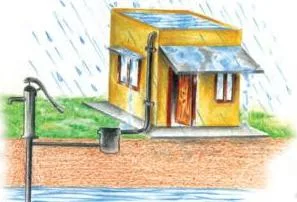
Fig 3.3 shows two methods of rooftop rainwater harvesting. In the first method, water from the rooftop is collected using a PVC pipe, filtered through sand and bricks, and taken underground through a pipe. An underground pipe takes water to a sump for immediate usage. Excess water from the sump is taken to recharge through a hand pump.
In the second method, water follows the same initial steps but excess water from the sump is taken to an abandoned dugwell instead, which recharges the underground aquifer. Water can be drawn from the well later.

You can see the parallel structure: both methods filter rooftop water through sand and bricks before storing or recharging. The difference is only the recharge target — a hand pump sump or an abandoned dugwell. Examiners often ask students to describe these steps in 30 words, so learn the sequence: collect → filter → store in sump → recharge underground.
Multi-Purpose River Projects: Benefits, Criticism and Inter-State Disputes
From ancient times, India has a tradition of building hydraulic structures — dams, reservoirs, embankments, and canals. After independence, modern India continued this tradition by building dams in most river basins.
Jawaharlal Nehru proclaimed dams as the ‘temples of modern India’ because he saw them as integrating the development of agriculture and the village economy with rapid industrialisation and growth of the urban economy (NCERT, p. 3).
Today, dams are built not just for irrigation but for electricity generation, water supply for domestic and industrial uses, flood control, recreation, inland navigation, and fish breeding. Because the many uses of the impounded water are integrated with one another, dams are now referred to as multi-purpose projects (NCERT, p. 3).
Examples of Multi-Purpose Projects
- Bhakra-Nangal project — on the Sutlej-Beas river basin, used for both hydel power production and irrigation.
- Hirakud project — on the Mahanadi basin, integrating conservation of water with flood control.
- Sardar Sarovar Dam — built over the Narmada river in Gujarat, covering four states — Maharashtra, Madhya Pradesh, Gujarat, and Rajasthan. It provides irrigation to 18.45 lakh hectare of land covering 3,112 villages in 15 districts of Gujarat. It also irrigates 2,46,000 hectare in Barmer and Jalore districts of Rajasthan and 37,500 hectare in the tribal hilly tract of Maharashtra (NCERT, p. 5).
The map below shows India’s major rivers and the locations of key dams, illustrating how multi-purpose projects are spread across the country’s river basins.

Criticisms and Environmental Consequences
In recent years, multi-purpose projects and large dams have come under scrutiny and opposition for a variety of reasons. The key criticisms are:
- Disrupted natural flow — regulating and damming rivers affects the natural flow, causing poor sediment flow and excessive sedimentation at the bottom of the reservoir.
- Rockier stream beds — sedimentation results in rockier stream beds, making poorer habitats for the rivers’ aquatic life.
- Fragmented rivers — dams make it difficult for aquatic fauna to migrate, especially for spawning.
- Submerged vegetation and soil — reservoirs created on floodplains submerge existing vegetation and soil, leading to decomposition over time.
- Triggered floods — ironically, dams constructed to control floods have triggered floods due to sedimentation in the reservoir, and have mostly been unsuccessful in controlling floods at the time of excessive rainfall (NCERT, p. 5).
- Soil erosion and land degradation — floods devastate life and property and cause extensive soil erosion. Sedimentation deprives flood plains of silt, a natural fertiliser, worsening land degradation.
- Induced earthquakes — multi-purpose projects have been observed to induce earthquakes.
- Water-borne diseases and pests — standing reservoir water has caused water-borne diseases and pests, and pollution resulting from excessive use of water.
- Changed cropping patterns — irrigation has shifted cropping patterns towards water-intensive and commercial crops, causing ecological consequences like salinisation of the soil (NCERT, p. 5).
Advantages vs Disadvantages of Multi-Purpose Projects
The side-by-side comparison below is one of the most exam-useful frameworks in this chapter. Examiners reward answers that give at least two advantages and two disadvantages with specific project names.
| Advantages | Disadvantages |
|---|---|
| Integrates irrigation with electricity generation (Bhakra-Nangal). | Disrupts natural river flow, causing poor sediment flow and rockier stream beds. |
| Provides flood control along with water conservation (Hirakud). | Reservoirs submerge existing vegetation and soil, causing decomposition. |
| Supplies water to drought-prone and desert areas (Sardar Sarovar covers 4 states). | Fragments rivers, blocking aquatic fauna migration for spawning. |
| Supports inland navigation and fish breeding in addition to irrigation. | Triggered floods due to sedimentation; failed during excessive rainfall. |
| Enables assured irrigation for previously dry regions, improving farm incomes. | Induced earthquakes and water-borne diseases from standing reservoir water. |
| Meets domestic and industrial water supply needs of growing cities. | Shifts cropping pattern to water-intensive commercial crops, causing salinisation. |
Inter-State Water Disputes: The Krishna-Godavari Example
The Krishna-Godavari dispute arises from objections raised by the Karnataka and Andhra Pradesh governments regarding the diversion of more water at Koyna by the Maharashtra government for a multi-purpose project. This diversion would reduce downstream flow in their states with adverse consequences for agriculture and industry (NCERT, p. 5).
This is a textbook example of how damming a river in one state affects the water availability of downstream states, sparking conflict.
Initiatives to Address Irrigation and Water Conservation
The Pradhan Mantri Krishi Sinchayee Yojana has been started to ensure access to protective irrigation for all agricultural farms. Its broad objectives include expanding cultivable area under assured irrigation (har khet ko pani), improving on-farm water use efficiency to reduce wastage and increase availability (per drop more crop), and introducing sustainable water conservation practices (NCERT, p. 5).
For the broader context of how water resources fit with other resources and their development, see our notes on Resources and Development. For connections to how irrigation patterns affect what farmers grow, our Agriculture chapter notes link the cropping pattern shift discussed here to the broader agricultural landscape.
Rainwater Harvesting in India: Traditional Systems by Region
Many considered water harvesting systems a viable alternative to multi-purpose projects, both socio-economically and environmentally. In ancient India, people had in-depth knowledge of rainfall regimes and soil types and developed wide-ranging techniques to harvest rainwater, groundwater, river water, and flood water to suit local ecological conditions (NCERT, p. 7).
Memory Device: Region → Structure → Name
To remember which harvesting system belongs where, use this triplet — Region → Structure → Name.
- Western Himalayas → Diversion channels for agriculture → Guls/Kuls
- Rajasthan houses → Underground drinking water tank → Tanka
- Jaisalmer fields → Rain-fed agricultural storage → Khadin
- Other parts of Rajasthan → Earthen rainwater storage → Johad
- Bengal flood plains → Inundation channels for irrigation → Inundation channels
Traditional Systems by Region
| Region | System | How It Works |
|---|---|---|
| Western Himalayas | Guls / Kuls | Diversion channels built in hill and mountainous regions to carry water for agriculture. A kul leads to a circular village tank, and water is released as and when required. |
| Rajasthan (Bikaner, Phalodi, Barmer) | Tanka | Underground tanks built inside the main house or courtyard, connected to sloping roofs through a pipe. Rain travels down the pipe and is stored. The first spell of rain is not collected as it cleans the roofs and pipes; subsequent showers are stored. |
| Jaisalmer | Khadin | Agricultural fields converted into rain-fed storage structures that allow water to stand and moisten the soil. |
| Other parts of Rajasthan | Johad | Traditional rainwater storage structures used in parts of Rajasthan beyond Jaisalmer. |
| Bengal flood plains | Inundation channels | Channels developed to irrigate fields using floodwater from rivers during the monsoon. |
The Tanka — Detailed Construction
In the semi-arid and arid regions of Rajasthan, particularly in Bikaner, Phalodi, and Barmer, almost all houses traditionally had underground tankas for storing drinking water. The tanks could be as large as a big room. One household in Phalodi had a tank that was 6.1 metres deep, 4.27 metres long, and 2.44 metres wide (NCERT, p. 7).
Below is an image of a traditional tanka built inside a house courtyard, showing how it connects to the roof for rainwater collection.
Tankas were part of a well-developed rooftop rainwater harvesting system. The rainwater could be stored till the next rainfall, making it an extremely reliable source of drinking water when all other sources dried up, particularly in summers (NCERT, p. 8). Rainwater — or palar pani, as commonly referred to in these parts — is considered the purest form of natural water.
Many houses constructed underground rooms adjoining the tanka to beat the summer heat, as it would keep the room cool.
Modern Adaptations of Rainwater Harvesting
Today, in western Rajasthan, the practice of rooftop rainwater harvesting is on the decline because plenty of water is available due to the perennial Indira Gandhi Canal, though some houses still maintain tankas since they do not like the taste of tap water (NCERT, p. 9).
In many parts of rural and urban India, rooftop rainwater harvesting is being adapted to store and conserve water. The three notable examples examiners ask about are:
- Gendathur (Mysuru, Karnataka) — A remote backward village where villagers installed rooftop rainwater harvesting systems. Nearly 200 households have installed the system, giving the village the distinction of being rich in rainwater. Gendathur receives an annual precipitation of 1,000 mm, and with 80 per cent collection efficiency and about 10 fillings, every house can collect and use about 50,000 litres of water annually (NCERT, p. 9).
- Shillong (Meghalaya) — Rooftop rainwater harvesting is the most common practice here. It is notable because Cherapunjee and Mawsynram, 55 km away, receive the highest rainfall in the world, yet Shillong faces acute water shortage. Nearly every household has a rooftop structure, and 15–25 per cent of the total water requirement comes from rooftop harvesting (NCERT, p. 9).
- Tamil Nadu — The first state in India to make rooftop rainwater harvesting structures compulsory for all houses across the state. There are legal provisions to punish defaulters (NCERT, p. 9).
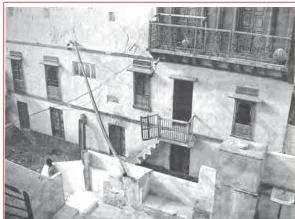
The image below shows the rooftop rainwater harvesting system adapted in Gendathur, where water from sloping roofs is taken through a pipe into an underground tanka built in the main house or courtyard.
For our complete set of Class 10 notes across subjects, or to explore more CBSE study material on this site, those pages organise chapters by subject.
Bamboo Drip Irrigation System of Meghalaya
In Meghalaya, a 200-year-old system of tapping stream and spring water using bamboo pipes is prevalent. About 18–20 litres of water enters the bamboo pipe system, gets transported over hundreds of metres, and finally reduces to 20–80 drops per minute at the site of the plant (NCERT, p. 10). This drop rate is a frequently examined fact — learn the exact range.
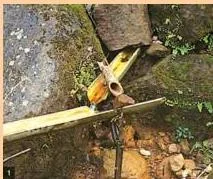
The image below shows the first stage of the system, where bamboo pipes divert perennial springs from hilltops to lower reaches using gravity.
The system works in six stages:
- Bamboo pipes divert perennial springs on the hilltops to the lower reaches by gravity.
- Channel sections made of bamboo divert water to the plant site.
- Water is distributed into branches, again made and laid out with different forms of bamboo pipes. The flow of water into the pipes is controlled by manipulating the pipe positions.
- If the pipes pass a road, they are taken high above the land.
- Reduced channel sections and diversion units are used at the last stage of water application.
- The last channel section enables water to be dropped near the roots of the plant at 20–80 drops per minute.
This system is an example of how traditional knowledge achieves per drop more crop without modern technology. Gravity does the transport, and the calibrated bamboo sections control the flow so water reaches the plant roots drop by drop — no pump, no electricity, minimal waste.
Worked Example: Calculating Rainwater Harvested from a Rooftop
This worked example uses original numbers to show how to calculate the volume of rainwater collectable from a rooftop — a calculation that reinforces the Gendathur concept and applies the relationship 1 mm rainfall on 1 sq m = 1 litre. This is an info-gain element not found in the NCERT textbook or competitor pages.
Example: Rooftop Rainwater Harvesting Calculation
- Step 1: A house in semi-arid Karnataka has a rooftop area of 60 square metres. Annual rainfall is 850 mm. Collection efficiency is 75 per cent.
- Step 2: Convert annual rainfall from millimetres to metres so the area times rainfall gives cubic metres.
\[ 850\ \text{mm} = \frac{850}{1000}\ \text{m} = 0.85\ \text{m} \]
Step 3: Calculate the total volume of rainwater falling on the rooftop in cubic metres.
\[ \text{Volume} = \text{Area} \times \text{Rainfall} = 60\ \text{sq m} \times 0.85\ \text{m} = 51\ \text{cubic metres} \]
Step 4: Convert cubic metres to litres, since 1 cubic metre = 1,000 litres.
\[ 51\ \text{cubic metres} = 51 \times 1000\ \text{litres} = 51{,}000\ \text{litres} \]
Step 5: Apply the collection efficiency of 75 per cent to find the usable harvested water.
\[ \text{Harvested water} = 51{,}000\ \text{litres} \times 0.75 = 38{,}250\ \text{litres} \]
Final answer: Approximately 38,250 litres of rainwater can be harvested annually from a 60-square-metre rooftop at 850 mm rainfall and 75 per cent collection efficiency.
Extension: Scaling Up to 120 Houses
Step 1: If 120 such houses install the system, multiply the per-house yield by 120.
\[ \text{Total harvested} = 120 \times 38{,}250\ \text{litres} = 45{,}90{,}000\ \text{litres} \]
Final answer: 120 houses together harvest 45,90,000 litres (approximately 4.59 million litres) annually — demonstrating how rooftop harvesting at scale can meaningfully reduce a village’s dependence on groundwater.
You can cross-check the logic against the NCERT figures: Gendathur’s 200 households each collect about 50,000 litres per year with 80 per cent efficiency. This example uses a smaller roof, lower efficiency, and different rainfall to give you practice with the method rather than the specific numbers.
Common Mistakes Students Make in Water Resources Questions
Below are five strict error-to-correction pairs covering the chapter-specific mistakes examiners see most often. Each pair explains why the correction holds.
| Mistake | Correct rule | How to check your answer |
|---|---|---|
| Students write water scarcity is only caused by low rainfall. | Correct is scarcity is also caused by over-exploitation, unequal access, and polluted water quality — even high-rainfall areas face scarcity. | Check whether your answer has both quantitative (population, irrigation, industry) and qualitative (pollution) causes. If only rainfall is mentioned, add the other causes. |
| Students write dams only provide irrigation. | Correct is modern dams are multi-purpose — providing electricity, flood control, domestic water supply, navigation, and fish breeding — because the uses are integrated. | Check whether your answer lists at least three uses beyond irrigation. If only irrigation is listed, add the others from NCERT p. 3. |
| Students confuse tanka with khadin. | Correct is a tanka is an underground drinking water storage tank in Rajasthan houses, while a khadin is an agricultural rain-fed storage system in Jaisalmer fields. | Check whether you have matched the structure (underground tank vs field storage) with its purpose (drinking water vs agriculture). |
| Students write multi-purpose projects always control floods. | Correct is dams have sometimes triggered floods due to sedimentation and failed during excessive rainfall, because sedimentation reduces reservoir capacity. | Check whether your answer notes the irony that flood-control dams triggered floods. If you only write benefits, add the criticism. |
| Students write the first rainwater is collected in tankas. | Correct is the first spell of rain is not collected because it cleans the roofs and pipes; subsequent showers are stored. | Check whether your description of tankas includes the first-rain rejection step. If omitted, add it. |
Forest and Wildlife Resources — another chapter where students mix up causes and effects — has similar issues with conflating natural and human-made factors.
Exam Notes: What Examiners Expect in Water Resources Answers
Below are observed exam-pattern pointers written from an examiner’s mindset. These state which specific terms and structures earn marks in 30-word and 120-word answers — without predictions or guarantees.
- For “how water becomes renewable” (30 words) — mention the hydrological cycle explicitly. The cycle keyword earns the mark. State that the cycle renews and recharges surface runoff and groundwater continuously.
- For “what is water scarcity and its causes” (30 words) — structure the answer as quantitative (population, over-exploitation, irrigation, industry, urbanisation) and qualitative (pollution, bad quality). Examiners reward this two-part structure. A one-line answer listing only “low rainfall” loses marks.
- For “compare advantages and disadvantages of multi-purpose projects” (30 words) — give at least two of each. Naming specific projects — Bhakra-Nangal (irrigation + hydel power), Hirakud (flood control + conservation), Sardar Sarovar (4 states, 18.45 lakh ha) — with their specific use earns full marks.
- For “rainwater harvesting in semi-arid Rajasthan” (120 words) — mention tankas, the first-rain rejection step, palar pani, and the underground construction inside the house or courtyard. These specific terms earn marks. Also mention the tanka dimensions from Phalodi (6.1 m × 4.27 m × 2.44 m) to show depth.
- For “modern adaptations of rainwater harvesting” (120 words) — Gendathur (Karnataka, 200 households, 1,000 mm rainfall, 80 per cent efficiency, 50,000 litres per house) and Shillong (Meghalaya, 15–25 per cent of household water needs) with numbers earn marks. The Tamil Nadu compulsory law is a bonus point that examiners reward.
- For “bamboo drip irrigation” — the 20–80 drops per minute figure and gravity-based transport from hilltop springs are tested facts. State the 200-year-old age of the system too.
- For “inter-state water disputes” — the Krishna-Godavari dispute (Karnataka and Andhra Pradesh objecting to Maharashtra’s Koyna diversion) is the textbook example. State which states are involved and why.
Revision Summary: Water Resources at a Glance
This is the speed-revision section. The table below condenses the entire chapter into its key points — read this the night before the exam.
| Topic | Key Points |
|---|---|
| Water as a renewable resource | Three-fourths of Earth is water; only a small proportion is freshwater from surface runoff and groundwater. The hydrological cycle continually renews and recharges these sources, making water renewable. |
| Causes of water scarcity | Quantitative: large population, over-exploitation for irrigated agriculture (largest consumer), industrialisation, urbanisation, groundwater pumping in city housing societies. Qualitative: water polluted by domestic waste, chemicals, pesticides, fertilisers despite being ample in quantity. |
| Government initiatives | Jal Jeevan Mission — 55 litres per capita per day piped water to rural households. Atal Bhujal Yojana — 8,220 water-stressed Gram Panchayats in 7 states, shifting consumption to conservation. PM Krishi Sinchayee Yojana — har khet ko pani, per drop more crop. |
| Multi-purpose projects | Benefits: irrigation + electricity + flood control + domestic supply + navigation + fish breeding integrated. Examples: Bhakra-Nangal (Sutlej-Beas), Hirakud (Mahanadi), Sardar Sarovar (Narmada, 4 states, 18.45 lakh ha). Criticisms: disrupted natural flow, sedimentation, rockier stream beds, blocked aquatic migration, submerged vegetation, triggered floods, induced earthquakes, water-borne diseases, salinisation from changed cropping patterns. |
| Inter-state water disputes | Krishna-Godavari dispute — Karnataka and Andhra Pradesh object to Maharashtra’s Koyna diversion reducing downstream flow for agriculture and industry. |
| Rainwater harvesting — traditional systems | Western Himalayas → guls/kuls (diversion channels for agriculture). Rajasthan houses → tankas (underground drinking water tanks, first rain rejected, palar pani). Jaisalmer → khadins (agricultural rain-fed storage). Other Rajasthan → Johads. Bengal floodplains → inundation channels. |
| Modern adaptations | Gendathur (Mysuru, Karnataka) — 200 households, 1,000 mm rainfall, 80% efficiency, 50,000 litres per house/year. Shillong (Meghalaya) — 15-25% of household water needs met by rooftop harvesting despite nearby Cherapunjee/Mawsynram receiving highest rainfall. Tamil Nadu — first state to make rooftop harvesting compulsory with legal provisions. |
| Bamboo drip irrigation | Meghalaya — 200-year-old system. 18-20 litres enters bamboo pipes, transported by gravity over hundreds of metres, reduces to 20-80 drops per minute at plant roots. |
Key facts to memorise verbatim: the hydrological cycle, 55 litres per capita per day (JJM), 8,220 Gram Panchayats (Atal Bhujal Yojana), 18.45 lakh hectares (Sardar Sarovar irrigation), tanka dimensions (6.1 m × 4.27 m × 2.44 m), Gendathur numbers (200 households, 1,000 mm, 80%, 50,000 litres), Shillong figure (15-25 per cent), and the bamboo drip rate (20-80 drops per minute).
Reference: NCERT Class 10 Geography textbook, chapter Water Resources.
Frequently Asked Questions About Water Resources
How does water qualify as a renewable resource?
Water qualifies as renewable because the hydrological cycle continually renews and recharges surface runoff and groundwater through evaporation, condensation, and precipitation. Water moves within this cycle, ensuring it is replenished rather than used up. However, being renewable does not mean water is unlimited — over-exploitation can outpace the cycle’s ability to recharge, which is why conservation is essential.
Can a region with high rainfall still face water scarcity?
Yes. A region with high rainfall can still face water scarcity if it has a large and growing population, over-exploitation of groundwater, unequal access to water among social groups, or highly polluted water. The textbook example is Shillong, Meghalaya, which faces acute water shortage despite being near Cherapunjee and Mawsynram — the places receiving the highest rainfall in the world.
Nearly every household in Shillong uses rooftop rainwater harvesting, meeting 15–25 per cent of its water needs.
Why were multi-purpose projects called temples of modern India and why are they now criticised?
Jawaharlal Nehru called dams the ‘temples of modern India’ because he saw them as vehicles integrating development of agriculture and the village economy with rapid industrialisation and growth of the urban economy.
They are now criticised because regulating and damming rivers disrupts the natural flow, causes poor sediment flow and sedimentation, fragments rivers and blocks aquatic fauna migration, submerges vegetation and soil, triggers floods due to sedimentation, induces earthquakes, causes water-borne diseases, and shifts cropping patterns towards water-intensive commercial crops causing salinisation.
What is the difference between a tanka and a khadin?
A tanka is an underground drinking water storage tank built inside the main house or courtyard in Rajasthan, connected to the sloping roof through a pipe to collect rainwater. A khadin is an agricultural rain-fed storage system in Jaisalmer where fields are converted to allow rainwater to stand and moisten the soil for crops.
The key difference: tankas store drinking water in a household setting; khadins are field-based systems that irrigate agricultural land.
Which state made rooftop rainwater harvesting compulsory by law?
Tamil Nadu is the first state in India to make rooftop rainwater harvesting structures compulsory for all houses across the state. There are legal provisions to punish defaulters. This makes Tamil Nadu the example examiners look for when asking about legal measures to promote rainwater harvesting.
Explore Class 10 Geography Notes
Class 10 Geography on LearnCBSE:
Related chapters: