
Exercise 6.2 Class 10 Maths NCERT Solutions — this page carries all ten questions of Exercise 6.2 from the Triangles chapter (NCERT book code jemh106), each solved step by step using the basic proportionality theorem and its converse.
Question 1 and 2 are direct computations, Questions 3 to 6 are proofs of parallelism, Questions 7 and 8 rebuild the Class IX mid-point theorem, and Questions 9 and 10 deal with the diagonals of a trapezium.
To use this page: find your question number, read the one-line concept that tells you which theorem to reach for, then follow the worked answer (units included), and finally check the error warning — it names the slip students actually make on that question.
Every question solved here is taken word for word from the official NCERT Class 10 Mathematics textbook, so you can open the official NCERT textbook page, download the Triangles chapter (jemh106) and verify each question, theorem, figure and diagram straight from the source PDF as you work through the solutions below.
Exercise 6.2 Solutions
Exercise 6.2 is the first place where the basic proportionality theorem and its converse are actually applied. The questions fall into four groups:
- Q1–Q2 — direct computation: find a missing segment, or test whether a line is parallel by comparing two ratios.
- Q3–Q6 — proofs of parallelism: use the two given parallel lines to build equal ratios, then chain them.
- Q7–Q8 — the mid-point theorem from Class IX, now re-proved cleanly with Theorem 6.1 and its converse.
- Q9–Q10 — the diagonals-of-a-trapezium property, asked once as a statement (Q9) and once as its converse (Q10).
In the board exam, Q7–Q10 are the ones to spend time on: they are short proof questions that test whether you can choose the correct theorem and write each ratio with the right pair of segments.
This page is part of the full Class 10 Maths NCERT solutions; for the same treatment of other chapters, browse the Class 10 study material in the complete NCERT solutions library. The proportional thinking you build here returns in later chapters, especially Arithmetic Progressions and Coordinate Geometry.
Key ideas you need: the basic proportionality theorem and its converse
Theorem 6.1 (Basic Proportionality Theorem / Thales theorem, NCERT, p. 81): when a line is drawn parallel to one side of a triangle and cuts the other two sides, it divides those two sides in the same ratio. In triangle ABC, if D lies on AB, E lies on AC and DE ∥ BC, then \[ \frac{AD}{DB} = \frac{AE}{EC} \]
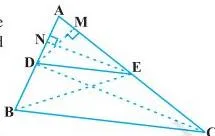
The figure shows the theorem’s proof set-up: D on AB, E on AC, and DE parallel to BC. The textbook proves AD/DB = AE/EC by comparing areas of triangles ADE, BDE and DEC — triangles BDE and DEC sit on the same base DE between the same parallels, so their areas are equal, which forces the two ratios to match.
Why the ratio works: the parallel line slices off a small triangle at the vertex (ADE) that has the same angles as the whole triangle ABC, so it is a scaled-down copy. That means the whole-side ratios match — AD/AB = AE/EC — and subtracting 1 from both sides of that equality turns it into AD/DB = AE/EC.
A parallel cut divides the sides proportionally because the two triangles are the same shape.
Theorem 6.2 (converse, NCERT, p. 82): if a line divides any two sides of a triangle in the same ratio, then the line is parallel to the third side. In the same triangle, if AD/DB = AE/EC, then DE ∥ BC.
The rearranged whole-side form (Example 1, NCERT, p. 83): from AD/DB = AE/EC you can also write AD/AB = AE/AC. Question 1(ii) is solved with this form because the given data are whole-side parts. The two statements are equivalent — one is obtained from the other by adding 1 to both ratios.
Mid-point special case: when the ratio equals 1, the point is a mid-point. If AD = DB and DE ∥ BC, then AE/EC = 1, so E is also a mid-point — this is the Class IX mid-point theorem, recovered as a special case of Theorem 6.1.
Quick fact used in Q4 and Q5: two lines parallel to the same line are parallel to each other (this is how EF becomes parallel to the base in Q5).
| Theorem 6.1 (forward) | Theorem 6.2 (converse) | |
|---|---|---|
| What you are given | A line parallel to one side, cutting the other two sides | A line dividing two sides of a triangle |
| What it lets you conclude | The two sides are divided in the same ratio — a ratio statement, or a missing segment | The line is parallel to the third side |
| Check before using | The line really cuts two sides (not through a vertex) and is parallel to the third | The two division ratios genuinely are equal — compute and compare both |
| Used in this exercise | Q1, Q3, Q4, Q7, Q9 | Q2, Q5, Q6, Q8, Q10 |
Worked example with new numbers — testing parallelism with the converse
Do not wait for the exam to meet a new figure. Try this: in triangle XYZ, E lies on XY and F on XZ, with XE = 4.5 cm, EY = 6 cm, XF = 6 cm and FZ = 8 cm. Is EF ∥ YZ?
- Step 1: write the part-ratio on side XY: \( \frac{XE}{EY} = \frac{4.5}{6} = \frac{45}{60} = \frac{3}{4} \).
- Step 2: write the part-ratio on side XZ: \( \frac{XF}{FZ} = \frac{6}{8} = \frac{3}{4} \).
- Step 3: the ratios are equal, so by Theorem 6.2 the line EF divides the two sides in the same ratio and is parallel to YZ.
Answer: EF ∥ YZ, because \( \frac{3}{4} = \frac{3}{4} \).
Checking method with cross-multiplication: for any proportion \( \frac{a}{b} = \frac{c}{d} \), check that \( a \times d = b \times c \). Here, 4.5 × 8 = 36 and 6 × 6 = 36 — the equality holds, so the ratios really match. Use this check in every ratio question instead of redoing the whole working.
Common mistakes in Exercise 6.2
| Mistake | Correct rule | How to check your answer |
|---|---|---|
| Writing AD/AB when the theorem gives AD/DB | Use the part-ratio AD/DB; use the whole-side form AD/AB = AE/AC only when whole sides are given | Cross-multiply: AD × EC should equal DB × AE |
| In Q2(iii), comparing PE/EQ when EQ is not given | Use the whole-side form PE/PQ = PF/PR | Both sides reduce to the same fraction (here 9/64) |
| Comparing a part-ratio with a whole-ratio (e.g. PE/EQ with PF/PR) | Compare like with like — both part-ratios, or both whole-ratios | Reduce each ratio separately; they must match exactly |
| Citing Theorem 6.1 when proving parallelism | If the question asks you to SHOW a line is parallel, use the converse (Theorem 6.2) | Ask: do I already know the line is parallel? If not, you need the converse |
| In Q10, trying to prove both pairs of sides parallel | A trapezium needs only ONE pair of opposite sides parallel | Stop as soon as AB ∥ DC is shown |
Question 1: In Fig. 6.17, (i) and (ii), DE ∥ BC. Find EC in (i) and AD in (ii).
- (i) Find EC.
- (ii) Find AD.
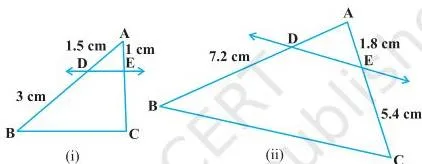
The figure shows two triangles, each cut by a line DE parallel to BC. Because DE ∥ BC, Theorem 6.1 guarantees that the two cut sides are divided in the same ratio, so a missing segment is found by cross-multiplying the proportion. Read the printed lengths from the figure — the values below are the ones marked on the sides.
Part (i): here AD = 1.5 cm, DB = 3 cm and AE = 1 cm.
\[ \frac{AD}{DB} = \frac{AE}{EC} \;\Rightarrow\; \frac{1.5}{3} = \frac{1}{EC} \;\Rightarrow\; EC = \frac{3 \times 1}{1.5} = 2 \]
Answer (i): EC = 2 cm.
Part (ii): here DB = 7.2 cm, AE = 1.8 cm and EC = 5.4 cm, and AD is the unknown. Using the same theorem, \[ \frac{AD}{DB} = \frac{AE}{EC} \;\Rightarrow\; \frac{AD}{7.2} = \frac{1.8}{5.4} = \frac{1}{3} \;\Rightarrow\; AD = \frac{7.2}{3} = 2.4 \]
Answer (ii): AD = 2.4 cm.
The slips students actually make here are writing AD/AB instead of AD/DB, and treating EC as the whole of AC — EC is only the second part of AC, after point E. Check with cross-multiplication: in (ii), 2.4 × 5.4 = 12.96 and 7.2 × 1.8 = 12.96, so the proportion is right.
Question 2: E and F are points on the sides PQ and PR respectively of a △PQR. For each of the following cases, state whether EF ∥ QR:
- (i) PE = 3.9 cm, EQ = 3 cm, PF = 3.6 cm and FR = 2.4 cm
- (ii) PE = 4 cm, QE = 4.5 cm, PF = 8 cm and RF = 9 cm
- (iii) PQ = 1.28 cm, PR = 2.56 cm, PE = 0.18 cm and PF = 0.36 cm

The figure shows triangle PQR with E on PQ, F on PR and EF drawn. The line EF is parallel to QR exactly when the converse theorem holds: the two sides must be divided in the same ratio. So compute each ratio, reduce it, and compare.
In parts (i) and (ii) compare the part-ratios; in part (iii), since only whole sides PE, PF, PQ, PR are given, use the whole-side form.
Part (i): \( \frac{PE}{EQ} = \frac{3.9}{3} = 1.3 \) and \( \frac{PF}{FR} = \frac{3.6}{2.4} = \frac{3}{2} = 1.5 \). The ratios are not equal, so EF is not parallel to QR.
Answer (i): EF ∦ QR.
Part (ii): \( \frac{PE}{QE} = \frac{4}{4.5} = \frac{8}{9} \) and \( \frac{PF}{RF} = \frac{8}{9} \). The ratios are equal.
Answer (ii): EF ∥ QR.
Part (iii): EQ is not given here, so use the whole-side form. \( \frac{PE}{PQ} = \frac{0.18}{1.28} = \frac{9}{64} \) and \( \frac{PF}{PR} = \frac{0.36}{2.56} = \frac{9}{64} \). The ratios are equal.
Answer (iii): EF ∥ QR.
In part (iii), most students look for EQ, which is not given — switch to the whole-side comparison PE/PQ and PF/PR instead. Never mix the two forms: comparing PE/EQ with PF/PR pairs a part-ratio with a whole-ratio and gives a wrong verdict. Reduce each fraction fully (9/64) before deciding.
Question 3: In Fig. 6.18, if LM ∥ CB and LN ∥ CD, prove that AM/AB = AN/AD
Both of the given parallel lines cross the side AC at the same point L, so the ratio that L creates on AC is the single bridge between the two triangles. Apply Theorem 6.1 once in each triangle, write out the two ratios, and chain them.
Step 1 — in triangle ABC: since LM ∥ CB with M on AB and L on AC, the whole-side form of Theorem 6.1 gives \[ \frac{AM}{AB} = \frac{AL}{AC} \]
Step 2 — in triangle ACD: since LN ∥ CD with L on AC and N on AD, Theorem 6.1 gives \[ \frac{AL}{AC} = \frac{AN}{AD} \]
Step 3 — chain: both ratios equal AL/AC, so they equal each other.
Hence proved: \( \frac{AM}{AB} = \frac{AN}{AD} \).
Students pick the wrong triangles here, or jump straight to AM/AB = AN/AD without showing the middle step. Write the bridging ratio AL/AC explicitly — it is the whole reason the proof works.
The same figure 6.18 is used for Question 2; the points L, M, N sit so that M and N each connect back to the same point L on AC.
Question 4: In Fig. 6.19, DE ∥ AC and DF ∥ AE. Prove that BF/FE = BE/EC
The two given parallels sit in two different triangles that share the side AB, and the shared ratio comes from point D on AB. Apply Theorem 6.1 once in each triangle, then chain through that common ratio.
(The figure 6.19 could not be reproduced on this page; the configuration is exactly as the question states — D on BA, E on BC, F on BE, with DE ∥ AC and DF ∥ AE.)
Step 1 — in triangle BAE: since DF ∥ AE with D on BA and F on BE, Theorem 6.1 gives \[ \frac{BF}{FE} = \frac{BD}{DA} \]
Step 2 — in triangle BAC: since DE ∥ AC with D on BA and E on BC, Theorem 6.1 gives \[ \frac{BE}{EC} = \frac{BD}{DA} \]
Step 3 — chain: both ratios equal BD/DA, so they are equal.
Hence proved: \( \frac{BF}{FE} = \frac{BE}{EC} \).
The common error is writing BD/DA in one triangle and then guessing the other ratio. Name the triangle you are working in at each step, and always write the ratio of the two parts of the sides — near the shared point over the far part — before you equate anything.
Question 5: In Fig. 6.20, DE ∥ OQ and DF ∥ OR. Show that EF ∥ QR.
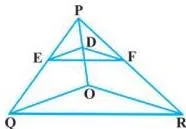
The figure shows the vertex P common to the two small triangles POQ and POR, with D on PO. Each of the two given parallel lines produces one ratio of division of the sides from P, and because both ratios involve the same point D on PO, they are equal. That equality is exactly what the converse theorem needs.
Step 1 — in triangle POQ: since DE ∥ OQ with D on PO and E on PQ, Theorem 6.1 gives \[ \frac{PE}{EQ} = \frac{PD}{DO} \]
Step 2 — in triangle POR: since DF ∥ OR with D on PO and F on PR, Theorem 6.1 gives \[ \frac{PF}{FR} = \frac{PD}{DO} \]
Step 3: hence \( \frac{PE}{EQ} = \frac{PF}{FR} \).
In triangle PQR, the line EF divides the two sides PQ and PR in the same ratio, so by Theorem 6.2, EF ∥ QR.
Hence proved: EF ∥ QR.
The whole point of this question is the converse: you PROVE parallelism by showing the two division ratios are equal, then citing Theorem 6.2. Citing Theorem 6.1 here would be backwards — Theorem 6.1 needs a parallel line you already have; Theorem 6.2 produces the parallel line you are asked to prove.
Question 6: In Fig. 6.21, A, B and C are points on OP, OQ and OR respectively such that AB ∥ PQ and AC ∥ PR. Show that BC ∥ QR.
This is the same pattern as Question 5, one step further out. Each given parallel produces a ratio on the sides through O, and both ratios share the point A on OP. Equal ratios let you apply the converse in the outer triangle OQR.
(Figure 6.21 could not be reproduced on this page; the configuration is exactly as the question states — A on OP, B on OQ, C on OR.)
Step 1 — in triangle OPQ: since AB ∥ PQ with A on OP and B on OQ, Theorem 6.1 gives \[ \frac{OA}{AP} = \frac{OB}{BQ} \]
Step 2 — in triangle OPR: since AC ∥ PR with A on OP and C on OR, Theorem 6.1 gives \[ \frac{OA}{AP} = \frac{OC}{CR} \]
Step 3: hence \( \frac{OB}{BQ} = \frac{OC}{CR} \).
In triangle OQR, the line BC divides the two sides OQ and OR in the same ratio, so by Theorem 6.2, BC ∥ QR.
Hence proved: BC ∥ QR.
Keep the parallel-lines logic explicit at every step: the shared ratio OA/AP appears in both small triangles, and that is the bridge. If you find yourself unsure which triangle to work in, look for the side the parallel line is parallel to — that side names the triangle’s third side, and the two cut sides are the other two.
Question 7: Using Theorem 6.1, prove that a line drawn through the mid-point of one side of a triangle parallel to another side bisects the third side. (Recall that you have proved it in Class IX).
This is the mid-point theorem, now established as a one-line consequence of the basic proportionality theorem. Because D is a mid-point, the ratio on the first side is exactly 1; Theorem 6.1 then forces the ratio on the third side to also be 1. Sketch triangle ABC with D on AB, E on AC and DE ∥ BC.
- Step 1: D is the mid-point of AB, so \( AD = DB \), hence \( \frac{AD}{DB} = 1 \).
- Step 2: since DE ∥ BC, Theorem 6.1 gives \( \frac{AD}{DB} = \frac{AE}{EC} \).
- Step 3: therefore \( \frac{AE}{EC} = 1 \), so \( AE = EC \), which means E is the mid-point of AC — the line bisects the third side.
Hence proved: the line bisects the third side.
Do not write AE = EC immediately — show the ratio equals 1 first. The value of writing AE/EC = 1 is that it connects the conclusion to the theorem you are allowed to use. This is exactly the mid-point theorem you proved in Class IX, now rebuilt with Theorem 6.1.
Question 8: Using Theorem 6.2, prove that the line joining the mid-points of any two sides of a triangle is parallel to the third side. (Recall that you have done it in Class IX).
This is the mirror of Question 7: there you used the forward theorem to prove a bisection, here you use the converse to prove a parallel. Two mid-points force both division ratios to equal 1, so the two sides are divided in the same ratio — which is precisely the condition Theorem 6.2 checks.
Let D and E be the mid-points of AB and AC.
- Step 1: D is the mid-point of AB, so \( \frac{AD}{DB} = 1 \).
- Step 2: E is the mid-point of AC, so \( \frac{AE}{EC} = 1 \).
- Step 3: hence \( \frac{AD}{DB} = \frac{AE}{EC} = 1 \).
By Theorem 6.2, the line DE is parallel to the third side BC.
Hence proved: DE ∥ BC.
The classic slip is mixing this up with Question 7 — citing Theorem 6.1 when the question asks you to prove a parallel. Remember the two-step test: Question 7 knows the parallel and proves a bisection (Theorem 6.1); Question 8 knows the mid-points and proves a parallel (Theorem 6.2).
Question 9: ABCD is a trapezium in which AB ∥ DC and its diagonals intersect each other at the point O. Show that AO/BO = CO/DO
This is the diagonals-of-a-trapezium result — the trickiest ratio in the exercise, and the pattern for Question 10. The two diagonals together with the parallel bases create one large triangle split by a parallel line.
Draw the line through O parallel to AB, meeting AD at E; since AB ∥ DC, this line is also parallel to DC, so it can be used in both of the triangles that share the side AD.
Step 1 — in triangle ADC: with E on AD, O on AC and EO ∥ DC, Theorem 6.1 gives \[ \frac{AE}{ED} = \frac{AO}{OC} \]
Step 2 — in triangle DAB: with E on AD, O on DB and EO ∥ AB, Theorem 6.1 gives \[ \frac{DE}{EA} = \frac{DO}{OB} \;\Rightarrow\; \frac{AE}{ED} = \frac{OB}{DO} \]
Step 3: both expressions equal AE/ED, so \( \frac{AO}{OC} = \frac{OB}{DO} \).
Cross-multiply: \( AO \times DO = OB \times OC \).
Step 4: divide both sides by \( BO \times DO \) to get \( \frac{AO}{BO} = \frac{OC}{DO} = \frac{CO}{DO} \).
Hence proved: \( \frac{AO}{BO} = \frac{CO}{DO} \).
The ratio AO/BO pairs a segment of one diagonal with a segment of the other — not AO/OC, which compares the two parts of the same diagonal. Label each segment in your working and say which triangle you are in at every step; the two-triangle chaining is what the examiner expects to see.
Question 10: The diagonals of a quadrilateral ABCD intersect each other at the point O such that AO/BO = CO/DO. Show that ABCD is a trapezium.
This is the converse of Question 9, and it is solved by turning the given ratio into a similarity, then reading off alternate angles. Cross-multiplying the ratio first puts the side pairs in the order needed for similarity.
- Step 1: given \( \frac{AO}{BO} = \frac{CO}{DO} \), cross-multiply to \( AO \times DO = BO \times CO \), which rearranges to \( \frac{AO}{CO} = \frac{BO}{DO} \).
- Step 2: in triangles AOB and COD, \( \angle AOB = \angle COD \) (vertically opposite angles), and the sides around those angles are in the same ratio \( \frac{AO}{CO} = \frac{BO}{DO} \).
- Step 3: by the SAS similarity criterion, \( \triangle AOB \sim \triangle COD \), so \( \angle OAB = \angle OCD \).
- Step 4: these equal angles are alternate interior angles formed by the transversal AC with the lines AB and DC.
Equal alternate angles mean AB ∥ DC.
Hence proved: ABCD is a trapezium.
A trapezium needs only ONE pair of opposite sides parallel — do not try to prove both pairs. Also, be careful which pair is parallel: the equal alternate angles give AB ∥ DC, not AB ∥ BC. Pair this answer with Q9 as statement and converse: Q9 proves the ratio from the parallel bases, Q10 proves the parallel bases from the ratio.
Questions students ask about Triangles Exercise 6.2
In Question 2, why do I compare PE/EQ with PF/FR instead of PE/PQ with PF/PR?
Theorem 6.2 talks about how the line cuts each side into two parts, so the natural comparison is the part-ratio: the part near P over the remaining part on each side.
The whole-side form PE/PQ = PF/PR is equivalent — it follows from the part-ratio by adding 1 to both ratios — and it is used in part (iii) only because EQ is not given there. What you may never do is mix the forms, because PE/PQ and PF/FR compare different pairs of lengths.
When should I apply Theorem 6.1 and when should I apply Theorem 6.2?
Ask what you already know. If you are given a parallel line inside a triangle, you use Theorem 6.1 to get a ratio — that is Questions 1, 3, 4, 7 and 9. If you are given (or can compute) two equal ratios, you use Theorem 6.2 to conclude a line is parallel — that is Questions 2, 5, 6, 8 and 10.
The forward theorem turns a parallel into a ratio; the converse turns equal ratios into a parallel.
Why can I write AD/AB = AE/AC in Question 1 when the theorem gives AD/DB = AE/EC?
They are two forms of the same statement (Example 1, NCERT, p. 83). From AD/DB = AE/EC, take reciprocals, add 1 to both sides, and reciprocate again — you arrive at AD/AB = AE/AC. Use whichever form matches the data you are given: part-ratios when you have the two parts of each side, whole-side form when you have whole sides.
How are Questions 7 and 8 related to the mid-point theorem I proved in Class IX?
Question 7 is the mid-point theorem itself: a line through a mid-point, parallel to another side, bisects the third side — proved via Theorem 6.1 because the ratio is 1. Question 8 is its converse: the line joining the mid-points of two sides is parallel to the third side — proved via Theorem 6.2.
Together they show that the Class IX results follow cleanly from the basic proportionality theorem, which is why the exercise asks you to rebuild them.
In Questions 9 and 10, why is the trapezium diagonal ratio written as AO/BO = CO/DO and not as AO/OC = BO/OD?
AO/OC = BO/OD would compare the two parts of each diagonal to each other — the ratio you would write for a line drawn parallel to the bases.
The ratio AO/BO = CO/DO instead pairs a segment of one diagonal with a segment of the other, in the same order (part near A with part near B, part near C with part near D). That pairing is forced by which similar triangles you compare — △DCO ~ △BAO in Question 9, and △AOB ~ △COD in Question 10.
Label the segments before you write any ratio, and the right pairing follows.
Reference: NCERT Class 10 Mathematics textbook, chapter Triangles.
Explore Class 10 Maths NCERT Solutions
More for this chapter:
Class 10 Maths on LearnCBSE:
Related chapters: