
These exercise 1.2 class 10 maths ncert solutions walk you through every irrationality proof in the exercise — three questions, each built on proof by contradiction and Theorem 1.2 (NCERT, p. 6). The page is written for a student who is stuck on the logic and wants the reasoning, not just the final line.
Every question below is reproduced exactly as printed. The model answer then explains the principle, gives full worked steps, and flags the slip that usually costs a mark. You can check each proof against the official NCERT Class 10 Maths Chapter 1 PDF, which carries the exact wording of Exercise 1.2 and the starred note on Theorem 1.2.
For revision, pair this page with the Class 10 Maths revision notes and the broader Class 10CBSE notes hub, or move ahead to Polynomials once you are done.
Exercise 1.2 Class 10 Maths NCERT Solutions: Proving Irrational Numbers
All three questions of Exercise 1.2 are solved below. Question 3 has three lettered sub-parts, and each is worked on its own with its own reasoning.
Question 1: Prove that \( \sqrt{5} \) is irrational
Concept: The number 5 is prime, so the proof mirrors Theorem 1.3 (NCERT, p. 7) for \( \sqrt{2} \). The strategy is proof by contradiction: assume the opposite, use Theorem 1.2 to force a divisibility chain, and show the chain breaks the coprime condition.
Step 1 — Assume the opposite.
Suppose, to the contrary, that \( \sqrt{5} \) is rational.
Then we can write \( \sqrt{5} = \frac{a}{b} \), where \( a \) and \( b \) are positive integers with no common factor other than 1 (coprime), and \( b \neq 0 \).
\[ b\sqrt{5} = a \]
Step 2 — Square and apply Theorem 1.2.
Squaring both sides:
\[ 5b^2 = a^2 \]
So 5 divides \( a^2 \).
By Theorem 1.2 (NCERT, p. 6), since 5 is prime and divides \( a^2 \), 5 must divide \( a \).
Write \( a = 5c \) for some positive integer \( c \).
Step 3 — Substitute and obtain the second divisibility.
Place \( a = 5c \) back into the equation:
\[ 5b^2 = (5c)^2 = 25c^2 \implies b^2 = 5c^2 \]
So 5 divides \( b^2 \), and again by Theorem 1.2, 5 divides \( b \).
Now 5 is a common factor of both \( a \) and \( b \), contradicting the fact that they are coprime.
Step 4 — Conclude.
The contradiction arises only because of our incorrect assumption that \( \sqrt{5} \) is rational.
Therefore \( \sqrt{5} \) is irrational.
Common error: students skip the coprime declaration in Step 1. Without it, the final contradiction has nothing to contradict — you can finish the algebra but the proof has no logical anchor.
Question 2: Prove that \( 3 + 2\sqrt{5} \) is irrational
Concept: This is a rational number (3) plus a non-zero rational multiple (2) of a known irrational (\( \sqrt{5} \)). Instead of squaring the whole mixed expression — which would produce two radical terms and obscure the logic — rearrange to isolate \( \sqrt{5} \). Once isolated, the contradiction from Question 1 carries over directly.
Step 1 — Assume the opposite.
Suppose, to the contrary, that \( 3 + 2\sqrt{5} \) is rational.
Then it equals \( \frac{a}{b} \) for some positive integers \( a \) and \( b \), with \( b \neq 0 \).
\[ 3 + 2\sqrt{5} = \frac{a}{b} \]
Step 2 — Isolate the radical.
Subtract 3, then divide by 2 (both legal because \( b \neq 0 \) and \( 2 \neq 0 \)):
\[ 2\sqrt{5} = \frac{a}{b} – 3 \implies \sqrt{5} = \frac{a – 3b}{2b} \]
Step 3 — Identify the contradiction.
Here \( a \), \( 3b \) and \( 2b \) are all integers, and \( 2b \neq 0 \).
So the right-hand side is a quotient of integers with a non-zero denominator — a rational number.
This forces \( \sqrt{5} \) to be rational, which contradicts Question 1.
Step 4 — Conclude.
The assumption must be false, so \( 3 + 2\sqrt{5} \) is irrational.
Common error: squaring both sides of \( 3 + 2\sqrt{5} = \frac{a}{b} \) produces a cross term \( 12\sqrt{5} \), which complicates the rearrangement and invites algebraic slips. Always isolate the radical first.
Question 3: Prove that the following are irrationals
Reproduced exactly as printed (NCERT, p. 9):
- (i) \( \frac{1}{\sqrt{2}} \)
- (ii) \( 7\sqrt{5} \)
- (iii) \( 6 + \sqrt{2} \)
The three sub-parts use three different rearrangement moves, so each gets its own reasoning.
Part (i): The key here is the reciprocal link.
Theorem 1.3 (NCERT, p. 7) has already proved \( \sqrt{2} \) is irrational, and a reciprocal of a known irrational behaves in a predictable way for this proof.
Step 1.
Assume, to the contrary, that \( \frac{1}{\sqrt{2}} \) is rational, so \( \frac{1}{\sqrt{2}} = \frac{a}{b} \) for integers \( a, b \) with \( b \neq 0 \) and coprime.
Step 2.
Take the reciprocal (valid since both sides are non-zero):
\[ \sqrt{2} = \frac{b}{a} \]
Step 3.
Since \( a, b \) are integers and \( a \neq 0 \), the right-hand side is a rational number, forcing \( \sqrt{2} \) to be rational — contradicting Theorem 1.3.
So \( \frac{1}{\sqrt{2}} \) is irrational.
Part (i) common error: rationalising the denominator to \( \frac{\sqrt{2}}{2} \) first. It is a valid manipulation but adds an extra step; the proof is cleaner when you take the reciprocal directly.
Part (ii): Here a non-zero rational (7) multiplies an irrational (\( \sqrt{5} \)).
Divide both sides by 7 to isolate \( \sqrt{5} \), which Question 1 has already settled.
Step 1.
Assume, to the contrary, that \( 7\sqrt{5} \) is rational, so \( 7\sqrt{5} = \frac{a}{b} \) for integers \( a, b \), with \( b \neq 0 \) and coprime.
Step 2.
Rearrange to isolate \( \sqrt{5} \):
\[ \sqrt{5} = \frac{a}{7b} \]
Step 3.
Here \( 7b \) is a non-zero integer, so the right-hand side is rational, forcing \( \sqrt{5} \) to be rational — contradicting Question 1.
So \( 7\sqrt{5} \) is irrational.
Part (ii) common error: forgetting to state \( 7b \neq 0 \) before dividing. The denominator condition matters and an examiner can dock a half-mark for omitting it.
Part (iii): This is the same template as Question 2: a rational (6) added to a known irrational (\( \sqrt{2} \)).
Isolate the radical and reuse Theorem 1.3.
Step 1.
Assume, to the contrary, that \( 6 + \sqrt{2} \) is rational, so \( 6 + \sqrt{2} = \frac{a}{b} \) for integers \( a, b \), with \( b \neq 0 \) and coprime.
Step 2.
Isolate the radical:
\[ \sqrt{2} = \frac{a}{b} – 6 = \frac{a – 6b}{b} \]
Step 3.
Since \( a – 6b \) and \( b \) are integers and \( b \neq 0 \), the right-hand side is rational, forcing \( \sqrt{2} \) to be rational — contradicting Theorem 1.3.
So \( 6 + \sqrt{2} \) is irrational.
Part (iii) common error: students write \( \frac{a}{b} – 6 = \frac{a}{b} – \frac{6}{1} \) but forget to form the single fraction \( \frac{a – 6b}{b} \), which is what proves the right side is rational.
Method recap: the proof pattern behind every irrationality question
Every problem in this exercise follows the same four-step logic. Remember it with the mnemonic Assume — Coprime — Square — Contradict (for pure radicals) and Assume — Isolate — Reuse — Contradict (for combinations built on a known irrational).
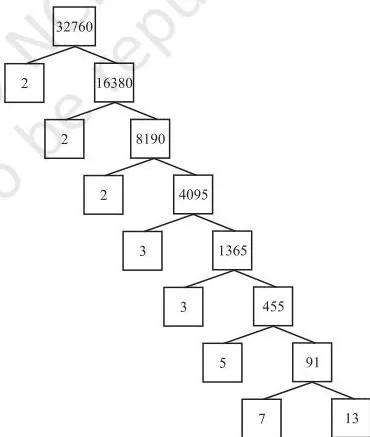
The factor tree is shown here because every proof in this exercise ultimately leans on the Fundamental Theorem of Arithmetic and the derived result Theorem 1.2 (NCERT, p. 6). Each \( a \) and \( b \) in the proofs has a unique prime factorisation; that is what lets a prime \( p \) dividing \( a^2 \) force \( p \) to divide \( a \).
Note the textbook’s starred remark (NCERT, p. 6): the full proof of Theorem 1.2 is marked “not from the examination point of view”. You are expected to use the theorem, not reproduce its proof. A full breakdown of the chapter’s theorems lives in the main CBSE notes archive.
Proof strategies at a glance
| Form | Assumption | Key rearrangement | Contradiction step |
|---|---|---|---|
| Pure radical (\( \sqrt{5} \)) | \( \sqrt{5} = \frac{a}{b} \), coprime | Square: \( 5b^2 = a^2 \) | Apply Theorem 1.2 twice (for \( a \), then \( b \)), contradict coprime |
| Sum (\( 3 + 2\sqrt{5} \)) | \( 3 + 2\sqrt{5} = \frac{a}{b} \) | Isolate: \( \sqrt{5} = \frac{a – 3b}{2b} \) | RHS is rational \( \Rightarrow \sqrt{5} \) rational, contradict Q1 |
| Product (\( 7\sqrt{5} \)) | \( 7\sqrt{5} = \frac{a}{b} \) | Isolate: \( \sqrt{5} = \frac{a}{7b} \) | RHS rational \( \Rightarrow \sqrt{5} \) rational, contradict Q1 |
| Reciprocal (\( \frac{1}{\sqrt{2}} \)) | \( \frac{1}{\sqrt{2}} = \frac{a}{b} \) | Reciprocate: \( \sqrt{2} = \frac{b}{a} \) | RHS rational \( \Rightarrow \sqrt{2} \) rational, contradict Theorem 1.3 |
Common mistakes in Exercise 1.2 proofs and how to fix them
Four specific slips cost marks repeatedly on this exercise. Each is listed below with its correction and a check you can run on your own proof.
| Mistake | Correct rule | How to check your answer |
|---|---|---|
| Omitting the coprime declaration before squaring | Always write “where \( a \) and \( b \) are coprime” (NCERT, p. 7) after introducing \( \frac{a}{b} \) | Underline this phrase in the draft; the final contradiction points back at it |
| Applying Theorem 1.2 when the divisor is not prime | Theorem 1.2 requires \( p \) prime (NCERT, p. 6); \( 4 \mid b^2 \) does NOT imply \( 4 \mid b \) | Check that each divisor in your proof (2, 3, 5, 7…) is prime before invoking the theorem |
| Isolating the radical wrongly in \( 3 + 2\sqrt{5} \) | Subtract 3, then divide by 2; do not square the whole expression first | Your rearranged line should have \( \sqrt{5} \) alone on one side and a single rational fraction on the other |
| Treating \( 1/\sqrt{2} \) as rational because its decimal “looks funny” | Decimal appearance is never proof; use the reciprocal argument with Theorem 1.3 (NCERT, p. 7) | The proof must end with a contradiction referencing an established irrational, not a decimal guess |
Typical marking scheme for a two-mark irrationality proof
The CBSE board typically allocates marks across four logical checkpoints. The split below mirrors the steps each model proof above uses, and it is the pattern an examiner looks for.
| Checkpoint | What earns the mark |
|---|---|
| Assumption and coprime statement | Assume the number is rational, write \( = \frac{a}{b} \), state \( a, b \) coprime (NCERT, p. 7) |
| Squaring or isolating | Reach \( 5b^2 = a^2 \) (Q1) or isolate the radical (Q2, Q3) cleanly |
| Applying Theorem 1.2 | Invoke the correctly-numbered theorem with prime \( p \) to force divisibility of \( a \) (and \( b \)) |
| Stating the contradiction and conclusion | Show \( a \) and \( b \) share a common factor, contradict coprime, conclude irrational |
Extra practice: prove \( \sqrt{7} \) and \( 2 + 3\sqrt{7} \) are irrational
Try these two original problems using the same proof template. The numbers are deliberately different from the textbook; your thinking must not be.
Worked example: prove \( \sqrt{7} \) is irrational
Step 1.
Suppose, to the contrary, that \( \sqrt{7} \) is rational.
Write \( \sqrt{7} = \frac{a}{b} \), where \( a, b \) are coprime positive integers and \( b \neq 0 \).
Step 2.
Squaring: \( 7b^2 = a^2 \).
So 7 divides \( a^2 \).
Since 7 is prime, Theorem 1.2 (NCERT, p. 6) gives \( 7 \mid a \), so write \( a = 7c \).
\[ 7b^2 = (7c)^2 = 49c^2 \implies b^2 = 7c^2 \]
Step 3.
So 7 divides \( b^2 \), and again by Theorem 1.2, 7 divides \( b \).
Now \( a \) and \( b \) share the common factor 7, contradicting that they are coprime.
Hence \( \sqrt{7} \) is irrational.
Common error: forgetting to declare \( a \) and \( b \) in lowest terms before squaring. Without that anchor, the final contradiction has nothing to contradict.
Outline to complete: prove \( 2 + 3\sqrt{7} \) is irrational
- Assume: \( 2 + 3\sqrt{7} = \frac{a}{b} \), with \( a, b \) coprime and \( b \neq 0 \).
- Isolate: subtract 2, then divide by 3 to get \( \sqrt{7} = \frac{a – 2b}{3b} \).
- Reuse: the right-hand side is rational, which would force \( \sqrt{7} \) to be rational — contradicting the proof above.
- Conclude: \( 2 + 3\sqrt{7} \) is irrational.
FAQs on Exercise 1.2 Class 10 Maths NCERT Solutions
Why do we need to say \( a \) and \( b \) are coprime before squaring \( \sqrt{5} = \frac{a}{b} \)?
The final contradiction is that \( a \) and \( b \) turn out to share a common prime factor. That conclusion only breaches the proof if you began by declaring them coprime. The declaration is the anchor the contradiction pulls on.
In the proof of \( 3 + 2\sqrt{5} \), why rearrange to isolate \( \sqrt{5} \) instead of squaring both sides?
Squaring first leaves a cross term like \( 12\sqrt{5} \), which mixes rational and irrational parts and demands extra algebra. Isolating the radical first reduces the proof to a single clean contradiction with the result from Question 1.
Can \( 1/\sqrt{2} \) be proved irrational without rationalising the denominator?
Yes. Assume \( \frac{1}{\sqrt{2}} = \frac{a}{b} \) and take the reciprocal — \( \sqrt{2} = \frac{b}{a} \) — which is rational, contradicting Theorem 1.3 (NCERT, p. 7). Rationalising produces the same outcome in more steps.
Do we have to prove Theorem 1.2 in the exam, or just use it?
Just use it. The textbook marks the full proof with an asterisk as “Not from the examination point of view” (NCERT, p. 6). You are expected to apply it correctly, quoting it by name when you invoke the prime-divisibility step.
Why does 4 dividing \( b^2 \) not prove 4 divides \( b \), while 2 dividing \( b^2 \) does prove 2 divides \( b \)?
Theorem 1.2 (NCERT, p. 6) applies only to primes. So 2 — being prime — dividing \( b^2 \) forces 2 to divide \( b \). The number 4 is composite, so the same logic does not transfer; \( b = 2 \) gives \( 4 \mid 4 \) but \( 4 \) does not divide \( 2 \).
Reference: NCERT Class 10 Mathematics textbook, chapter Real Numbers.
Explore Class 10 Maths NCERT Solutions
More for this chapter:
Class 10 Maths on LearnCBSE:
Related chapters: