
This page covers the Money and Banking Class 12 chapter — Chapter 3 of the NCERT Class 12 Economics textbook Introductory Macroeconomics. The chapter runs from printed page 35 to page 52 of the textbook, from the functions of money to the RBI’s tools for controlling the money supply; the official NCERT PDF is offered right below.
Download the Money and Banking Class 12 chapter PDF from the official NCERT e-textbook portal on ncert.nic.in — this is Chapter 3 of Introductory Macroeconomics in the NCERT edition current for the 2026-27 academic session, exactly as it is printed in the classroom textbook.
| What the chapter holds | Count | Where it is used |
|---|---|---|
| Printed pages | 17 | |
| Sections in the chapter | 6 | |
| Figures with NCERT captions | 1 | |
| Tables | 6 | |
| Exercise questions | 11 | answered in our NCERT Solutions |
| Official NCERT PDF | Download the chapter PDF | the chapter exactly as NCERT publishes it |
Money and Banking Class 12: What Is Inside the Chapter
The chapter table on this page lists the chapter’s sections, figures and exercises at a glance, so you can see the size of the file you are about to open. The textbook prints this chapter on pages 35 to 52.
In content, the chapter is one continuous argument. It opens with the functions of money and why barter fails, moves through the demand for and supply of money, works out how commercial banks create deposits and how large the multiplier can grow, and closes with the RBI’s quantitative and qualitative tools for controlling the money supply.
What This Chapter Covers: From Barter to the RBI’s Tools
This chapter answers three questions in order: what money is, who creates it, and how the central bank controls it. A student working through the chapter from page 35 to page 52 should be able to do each of the following:
- Explain why barter fails — the double coincidence of wants — and list the three functions of money (pp. 35-36).
- State the two motives for holding money — transaction and speculative — and say what each depends on (pp. 37, 43-47).
- Describe who supplies money: the central bank and the commercial banks, and what high-powered money means (p. 38).
- Trace how a bank creates deposits out of a loan, and how the cash reserve ratio stops the process at a fixed limit (pp. 39-42).
- Say which RBI tool does what: reserve ratio, bank rate, open market operations, repo and reverse repo (pp. 42-43).
- Define the four measures of money supply M1 to M4 and tell narrow money from broad money (pp. 47-48).
Two boxes and three appendices sit around this main argument. Box 3.1 (p. 43) works out the demand for money in full detail; Box 3.2 (p. 49) is the story of demonetisation. The appendices at the end (pp. 51-52) are reference mathematics and RBI data: the sum of an infinite geometric series, the M1-M3 time series, and the components of the monetary base.
Key Concepts: Functions of Money, Demand and Supply
Everything in the chapter is built on three ideas: what money does, why people hold it, and who supplies it. The three subsections below cover exactly that, before any formula appears.
The Three Functions of Money
Money exists because exchange is easier with a common good that everyone accepts. Without money, trade is barter — and barter presumes the improbable double coincidence of wants: you must find a person whose surplus is exactly what you need and who needs exactly what you have (p. 35).
As the number of traders grows, that search becomes prohibitively expensive. An intermediate good acceptable to both parties — money — solves it: sell your surplus for money, then buy what you need with money (p. 35). Money has three main functions in a modern economy.
Medium of exchange — the first and foremost role: money is the commonly accepted good used to settle transactions (p. 35).
Unit of account — the value of every good and service is expressed in monetary units, which lets you compare prices directly (p. 35). Take an example: a notebook costs Rs 40 and a pen costs Rs 10. A pen is worth \(10/40 = 0.25\) notebooks, and one rupee is worth \(1/40 = 0.025\) of a notebook.
If every price rises, a rupee buys less of everything — its purchasing power falls (p. 36).
Store of value — money lets you carry wealth forward because it is not perishable and its storage cost is low, unlike a stock of rice (p. 36). But the chapter adds a warning: money performs this function well only when its value is stable, because a rising price level erodes what money can buy (p. 36).
The chapter also notes the move toward a cashless economy, where transactions settle through digital information rather than physical notes. India’s push for financial inclusion — Jan Dhan accounts, Aadhaar-enabled payment systems, e-wallets and the National Financial Switch — is part of this direction (p. 36).
Demand for Money: Transaction and Speculative Motives
People hold money for two distinct reasons, and the two reasons react to different things: income, and the rate of interest. The transaction motive is about income timing; the speculative motive is about what you expect interest rates to do next.
Transaction motive. Income arrives at discrete points — say, once a month — but spending happens continuously through the month, so you keep a cash balance to bridge the gap (pp. 43-44). A monthly income of Rs 12,000 spent evenly gives an average balance of Rs 6,000, half the month’s transactions.
In general, the transaction demand for money is a positive fraction of the value of transactions.
The general form is \( M_T^d = kT \) (NCERT, p. 44), where \( T \) is the total value of nominal transactions in the period and \( k \) is a positive fraction. The fraction’s inverse is the velocity of circulation of money: \( v = 1/k \) (p. 44).
An original example: a firm pays a worker Rs 24,000 at the start of each month, and the worker spends it evenly on the firm’s output. The worker’s average balance is Rs 12,000 and the firm’s average balance is also Rs 12,000, so the economy holds Rs 24,000 of money. Monthly transactions total Rs 48,000 — the salary transfer of Rs 24,000 plus the spending of Rs 24,000.
Each rupee changes hands twice a month, so velocity is \( v = 48{,}000/24{,}000 = 2 \), the inverse of the fraction \( k = 0.5 \). Linking transactions to national income, the chapter rewrites the formula as \( M_T^d = kPY \) (p. 44), where \( Y \) is real GDP and \( P \) is the general price level. So transaction demand rises when real GDP rises and when the price level rises (p. 44).
Speculative motive. The chapter groups every asset other than money — property, bullion, bonds — into one category called bonds. A bond is a paper promising a future stream of monetary returns (p. 45). The key result: the price of a bond moves inversely with the market rate of interest (p. 46).
When the rate is high, everyone expects it to fall, which means bond prices are expected to rise — so people buy bonds and hold little money. When the rate is low, everyone expects it to rise, bond prices to fall, so people sell bonds and hold money (pp. 45-46).
In its simple form, the speculative demand for money is \[ M_S^d = \frac{r_{\max} – r}{r – r_{\min}} \quad \text{(NCERT, p. 46)} \]
where \( r \) is the market rate of interest and \( r_{\max} \) and \( r_{\min} \) are its upper and lower limits. As \( r \) falls from \( r_{\max} \) to \( r_{\min} \), speculative demand rises from 0 to infinity. Total demand for money combines the two motives (p. 47):
\[ M^d = M_T^d + M_S^d = kPY + \frac{r_{\max} – r}{r – r_{\min}} \]
The diagram section below gives the visual for this curve; you do not need to derive it here.
Supply of Money: Who Creates It
In a modern economy, money is not just cash. It is currency plus bank deposits, and two institutions create it: the central bank and the commercial banking system (p. 38).
The Reserve Bank of India is India’s central bank, established in 1935 (p. 38).
Its functions in the chapter: it issues the currency of the country; it controls the money supply through the bank rate, open market operations and variations in reserve ratios; it acts as banker to the government; it is the custodian of the foreign exchange reserves; and it acts as a bank to the banking system (p. 38).
The currency the RBI issues, whether held by the public or by banks, is called high-powered money — also reserve money or the monetary base — because it acts as the basis for credit creation (p. 38).
Commercial banks accept deposits from the public and lend part of the funds to borrowers. They pay a lower interest rate to depositors than they charge borrowers, and that difference — the spread — is the bank’s profit (p. 38). A bank cannot survive if depositors doubt they can withdraw on demand, so it must balance lending against keeping enough reserves (p. 39).
One distinction from page 47 matters repeatedly. Currency notes and coins are fiat money — their value comes from the issuing authority’s guarantee, not from intrinsic value — and they are legal tender, which no citizen can refuse for settling a transaction (p. 47).
Demand deposits are money for transactions because cheques settle them, but a cheque can be refused, so demand deposits are not legal tender (p. 47).
How Banks Create Money: The Money Multiplier at Work
This is the idea students find hardest: a bank that lends money seems to create money, and the reserve requirement is what stops it from creating an unlimited amount. The chapter’s goldsmith story makes the mechanism plain before the balance sheets appear.
Lala the goldsmith. Villagers deposited 100 kgs of gold with Lala, who issued paper receipts for it. The receipts began circulating as money. When Ramu asked for a loan of 25 kgs, Lala reasoned that not all depositors would withdraw at the same time — so he lent the gold, and if Ali then deposited it back, the receipts would rise to 125 kgs.
Money had been created out of thin air (pp. 38-39).
Modern banks behave exactly this way. Because not all depositors withdraw at once, a bank can lend, and when it lends it opens a new deposit in the borrower’s name — so the loan creates a deposit, which is money (p. 39).
The balance sheet. A bank’s accounts must balance. Its assets are what it owns or can claim — mainly reserves and loans; its liabilities are what it owes — the deposits (pp. 39-40):
\[ \text{Assets} = \text{Reserves} + \text{Loans}, \qquad \text{Liabilities} = \text{Deposits}, \qquad \text{Net Worth} = \text{Assets} – \text{Liabilities} \]
The RBI fixes the fraction of deposits every bank must keep as cash reserves — the Cash Reserve Ratio (CRR), a legal requirement (p. 40). A related liquid-asset requirement, the Statutory Liquidity Ratio (SLR), is also mentioned (p. 40).
The CRR is the ceiling on lending: with deposits of Rs 100 and a CRR of 20 per cent, the bank must hold Rs 20 and can lend only Rs 80 (p. 40).
The multiplier chain. The book traces deposits round by round (Table 3.2, p. 41): each new loan becomes a new deposit; each round the required reserve is recalculated on the new deposit total; lending continues until the reserves held equal the required fraction of total deposits. At that point the process stops.
Here is the same process with a different cash reserve ratio. Suppose the CRR is 25 per cent and a customer deposits Rs 200. The money multiplier is \[ \text{Money Multiplier} = \frac{1}{\text{CRR}} = \frac{1}{0.25} = 4 \quad \text{(NCERT, p. 42)} \]
so the initial Rs 200 of reserves supports total deposits of \( 200 \times 4 = \text{Rs } 800 \), with total loans of Rs 600 and reserves of Rs 200. The rounds below show how the deposit total creeps toward 800; each row uses the book’s rule that the bank lends whatever part of its original reserves is not locked in as required reserves.
| Round | Total deposits (Rs) | Required reserve at 25% (Rs) | Loan made in this round (Rs) |
|---|---|---|---|
| 1 | 200.00 | 50.00 | 150.00 |
| 2 | 350.00 | 87.50 | 112.50 |
| 3 | 462.50 | 115.63 | 84.38 |
| 4 | 546.88 | 136.72 | 63.28 |
| … | … | … | … |
| Last | 800.00 | 200.00 | 600.00 (total loans) |
Values in rounds 3 and 4 are rounded to two decimals. The final row is the end-state: reserves of Rs 200 are exactly 25 per cent of deposits of Rs 800, and total loans are Rs 600. This works on the assumption that every loaned amount stays inside the same banking system — if borrowers withdraw cash, the chain leaks.
This round-by-round logic is what Exercises Q8 and Q10 ask you to reproduce.
Policy Tools: How the RBI Controls the Money Supply
The RBI does not change the money supply by printing notes. It changes how much banks can lend, and that moves deposits and therefore money supply (pp. 42-43). Every tool below works through the same chain: reserves change first, then lending, then deposits.
- Changing the reserve ratio. A higher CRR locks more of each deposit into reserves, so banks lend less and the money supply falls. The chapter reworks its own example: raise the ratio from 20 per cent to 25 per cent, and Rs 100 of reserves now supports deposits of only Rs 400 instead of Rs 500 — the banking system must call back some loans to meet the new requirement (p. 42).
- Open market operations. When the RBI buys government bonds in the open market, it pays with a cheque, which adds to bank reserves and raises the money supply. When it sells bonds, reserves are withdrawn and the money supply falls (p. 42). Outright operations are permanent; repo operations carry a resale agreement and are temporary (pp. 42-43).
- Bank rate. The rate at which the RBI lends to commercial banks. A higher bank rate makes bank borrowing costlier, reduces reserves, and lowers the money supply; a lower bank rate does the reverse (p. 43).
- Repo and reverse repo. In a repo, the RBI lends to banks by buying a security with an agreement to resell it at a set price and date; the rate charged is the repo rate. In a reverse repo, the RBI borrows by selling a security with an agreement to buy it back; the rate it pays is the reverse repo rate. These operations, run at maturities from overnight to 14 days, have become the RBI’s main monetary policy tool (pp. 42-43).
- Lender of last resort. The RBI stands ready to lend to banks at all times — the central bank as the bank for banks. This is the role Exercise Q11 asks about (p. 42).
- Qualitative tools. Besides the quantitative tools above, the RBI uses moral suasion and margin requirements to persuade or pressure banks to encourage or discourage lending (p. 42).
A memory hook: repo brings money into banks — the RBI is repurchasing, buying the security back — while reverse repo drains money out of banks (pp. 42-43). Exercise Q9 asks you to list these instruments; this list is your answer.
The Speculative Demand for Money Diagram, Explained
The speculative demand for money diagram condenses the speculative motive into a single curve. Once you can read it, the liquidity trap and the direction of every interest-rate change fall into place.
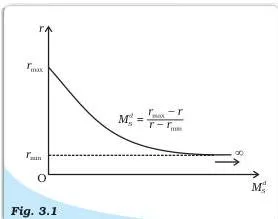
On the horizontal axis is the speculative demand for money; on the vertical axis is the rate of interest (p. 46). Read the curve in three steps:
- When the rate is at its maximum \( r_{\max} \), speculative demand is zero (p. 46). The rate is so high that everyone expects it to fall, which means capital gains on bonds — so everyone has converted money into bonds.
- As the rate falls, more people expect a future rise and therefore a capital loss on bonds, so they convert bonds back into money. The demand curve slopes down (pp. 45-46).
- At the floor \( r_{\min} \), the curve turns horizontal. The economy is in a liquidity trap: everyone expects the rate to rise and bond prices to fall, so any additional money is held as cash instead of buying bonds, and the rate cannot fall further. Here the speculative money demand function is infinitely elastic (p. 46).
This is also the diagram behind the chapter’s policy logic: with an increased supply of money, people buy bonds with the extra money, bond prices rise, and the interest rate falls — unless the economy is already in the trap (p. 46).
Formulas in the Chapter, Decoded
These formulas look intimidating on first read because of the fractions and subscripts. The table below names each one, says what it means in words, and points to the NCERT page where it appears; the worked example after the table shows the one relationship students find most counter-intuitive.
Here are the key formulas from the chapter:
| Formula | What it says in words | NCERT page |
|---|---|---|
| \( \text{Assets} = \text{Reserves} + \text{Loans} \) | A bank’s assets are what it holds as reserves plus what it is owed as loans. | p. 39 |
| \( \text{Liabilities} = \text{Deposits} \) | A bank owes its depositors the deposits they have placed with it. | p. 39 |
| \( \text{Net Worth} = \text{Assets} – \text{Liabilities} \) | The balancing entry when assets and liabilities differ. | p. 40 |
| \( M = \text{Currency} + \text{Deposits} \) | In the simple one-bank model, total money supply is currency plus bank deposits. | pp. 40, 42 |
| \( \text{Money Multiplier} = \frac{1}{\text{CRR}} \) | Each rupee of reserves supports \( 1/\text{CRR} \) rupees of deposits. | p. 42 |
| \( M_T^d = kT \) | Transaction demand is a positive fraction of the value of nominal transactions. | p. 44 |
| \( M_T^d = kPY \) | Transaction demand rises with real GDP and with the price level. | p. 44 |
| \( v = \frac{1}{k} \) | Velocity is the inverse of the fraction of transactions held as money. | p. 44 |
| \( M_S^d = \frac{r_{\max} – r}{r – r_{\min}} \) | Speculative demand rises as the interest rate falls from its maximum to its minimum. | p. 46 |
| \( M^d = kPY + \frac{r_{\max} – r}{r – r_{\min}} \) | Total money demand is transaction demand plus speculative demand. | p. 47 |
| \( M1 = CU + DD \) | Narrow money is currency with the public plus net demand deposits. | p. 48 |
| \( S = \frac{a}{1 – r} \) | Sum of an infinite geometric series, where \( 0 \lt r \lt 1 \); this underpins the multiplier’s mathematics. | p. 51 |
The symbols used above: \( k \) is a positive fraction of transactions held as money; \( T \) is total nominal transactions per period; \( Y \) is real GDP; \( P \) is the general price level; \( CU \) is currency (notes plus coins) with the public; \( DD \) is net demand deposits of commercial banks; \( r \) is the market rate of interest; \( r_{\max} \) and \( r_{\min} \) are its upper and lower limits (pp. 44, 46, 48).
Worked example: bond prices and the rate of interest. Take a two-year bond with face value Rs 500 and an 8 per cent coupon — it pays Rs 40 at the end of year 1 and Rs 540 (the last coupon plus the face value) at the end of year 2. The bond’s price equals the present value of these payments, discounted at the market rate (p. 45).
If the market rate is 6 per cent:
\[ PV = \frac{40}{1.06} + \frac{540}{(1.06)^2} = 37.74 + 480.60 \approx \text{Rs } 518 \]
If the market rate rises to 9 per cent:
\[ PV = \frac{40}{1.09} + \frac{540}{(1.09)^2} = 36.70 + 454.51 \approx \text{Rs } 491 \]
The same bond is worth about Rs 518 when the rate is 6 per cent and about Rs 491 when the rate is 9 per cent — a higher interest rate means a lower bond price (p. 46).
This inverse relationship is the engine of the speculative motive: expectations of rate changes create expectations of bond-price changes, and that is why people shift between bonds and money.
Appendix 3.1 (p. 51) shows the geometric-series mathematics behind the multiplier. It derives \( S = a/(1-r) \) by multiplying the series by \( r \) and subtracting, and that sum is what lets \( 1/\text{CRR} \) capture an infinite chain of deposits.
Definitions: From Fiat Money to Broad Money
These are the terms the chapter itself lists as its key concepts (p. 49). If you can define each one in a single sentence without looking, you own the chapter’s vocabulary.
| Term | Student definition |
|---|---|
| Barter exchange | Exchange of goods and services without the mediation of money (p. 35). |
| Double coincidence of wants | Finding a trading partner whose surplus exactly matches your need and who needs exactly your surplus (p. 35). |
| Money | The commonly accepted medium of exchange (p. 35). |
| Medium of exchange | The function of money as the good used to settle transactions (p. 35). |
| Unit of account | Expressing the value of all goods and services in monetary units (p. 35). |
| Store of value | Carrying wealth into the future in a form that does not perish (p. 36). |
| Bonds | Papers promising a future stream of monetary returns over a stated period, issued to borrow from the public (p. 45). |
| Rate of interest | The market return on bonds; also the opportunity cost, or price, of holding money (pp. 45-46). |
| Liquidity trap | The situation at the floor interest rate where everyone expects rates to rise, so additional money is held as cash and speculative demand becomes infinite (p. 46). |
| Fiat money | Currency notes and coins whose value rests on the issuing authority’s guarantee, not on intrinsic value (p. 47). |
| Legal tender | Money that cannot be refused by any citizen for settling a transaction; only currency and coins (p. 47). |
| Demand deposits | Savings and current account deposits payable by the bank on demand, usable through cheques (p. 47). |
| Time deposits | Deposits with a fixed period to maturity, such as fixed deposits (p. 47). |
| Narrow money | The M1 and M2 measures of money supply (p. 48). |
| Broad money | The M3 and M4 measures of money supply (p. 48). |
| Aggregate monetary resources | Another name for M3, the most commonly used measure of money supply (p. 48). |
| High-powered money | Currency issued by the central bank, held by the public or by banks; also called reserve money or monetary base (p. 38). |
| Lender of last resort | The central bank’s readiness to lend to banks at all times (p. 42). |
| Open market operation | Buying and selling of government bonds by the central bank in the open market to change reserves (p. 42). |
| Bank rate | The rate at which the RBI lends to commercial banks (p. 43). |
| Cash Reserve Ratio (CRR) | The legal percentage of deposits a bank must keep as cash reserves (p. 40). |
| Repo rate | The interest rate on short-term lending by the RBI to banks under a repurchase agreement (p. 43). |
| Reverse repo rate | The rate at which the RBI borrows from banks under a reverse repurchase agreement (p. 43). |
The four money supply measures, from the RBI’s definitions (p. 48):
| Measure | What it includes | Liquidity |
|---|---|---|
| M1 | Currency with the public (CU) + net demand deposits of commercial banks (DD) | Most liquid |
| M2 | M1 + savings deposits with Post Office savings banks | Second |
| M3 | M1 + net time deposits of commercial banks | Third |
| M4 | M3 + total deposits with Post Office savings organisations (excluding National Savings Certificates) | Least liquid |
M1 and M2 are narrow money; M3 and M4 are broad money. The measures run in decreasing order of liquidity, and M3 — also called aggregate monetary resources — is the most commonly used (p. 48). “Net” demand deposits means only the public’s deposits count; interbank deposits are excluded (p. 48).
Common Mistakes in Money and Banking
Most errors in this chapter are not arithmetic — they are habits of thinking that the chapter’s own distinctions correct. The table below names each trap, why it is wrong, and the rule that fixes it.
| Common mistake | Why it is wrong | The rule to remember |
|---|---|---|
| Treating demand deposits as legal tender. | Only currency notes and coins are legal tender; a cheque can be refused as a mode of payment (pp. 47-48). | Demand deposits are money for transactions, but they are not legal tender (p. 47). |
| Ordering the money measures backwards. | M1 is easiest to use for transactions, M4 the least liquid (p. 48). | Liquidity falls from M1 to M4; M3 is the most commonly used measure (p. 48). |
| Thinking the bank lends the same deposit over and over, so the multiplier is unlimited. | The reserve requirement is recalculated on the new deposit total every round, so each round’s loan shrinks (pp. 40-41). | The process stops when reserves equal CRR × total deposits; total deposits = initial reserve × (1/CRR) (p. 42). |
| Assuming speculative demand for money is high when interest rates are high. | A high rate is expected to fall, giving capital gains on bonds — so people buy bonds and hold little money (p. 46). | Speculative demand is inversely related to the rate of interest (p. 46). |
| Mixing up bank rate, repo rate and reverse repo rate. | They operate at different terms and in different directions of lending. | Bank rate = RBI lends to banks; repo = RBI lends short-term with a buy-back; reverse repo = RBI borrows (pp. 42-43). |
| Treating money as a guaranteed store of value. | A rising price level erodes what money can buy (p. 36). | Money stores value well only when its value is stable (p. 36). |
| Saying barter’s only problem is the absence of a common medium. | The deeper problem is the double coincidence of wants — finding the mirror-image trading partner (p. 35). | Barter fails because search costs become prohibitive as the economy grows (p. 35). |
How to Revise This Chapter for the Exam
The chapter’s eleven exercises test three skills in combination: defining terms, working the multiplier, and stating the direction of each policy tool. Revision should target exactly those three.
Each exercise is answered by a specific part of the text:
| Exercise | It draws on | NCERT pages |
|---|---|---|
| Q1 — barter system and its drawbacks | Functions of money; barter and double coincidence of wants | pp. 35-36 |
| Q2 — main functions of money | Medium of exchange, unit of account, store of value | pp. 35-36 |
| Q3 — transaction demand for money | Box 3.1, the transaction motive | pp. 43-44 |
| Q4 — alternative definitions of money supply | Narrow and broad money measures | p. 48 |
| Q5 — legal tender and fiat money | Currency notes and coins vs demand deposits | p. 47 |
| Q6 — high-powered money | Central bank functions | p. 38 |
| Q7 — functions of a commercial bank | Deposit and loan business, the spread | pp. 38-39 |
| Q8 — money multiplier | Limits to credit creation | pp. 40-42 |
| Q9 — instruments of monetary policy | Policy tools to control money supply | pp. 42-43 |
| Q10 — the bank as creator of money | Lala story and the multiplier chain | pp. 39-42 |
| Q11 — lender of last resort | Central bank as bank for banks | pp. 42-43 |
Three things to practise, in this order: (1) run the multiplier chain from a CRR you choose yourself, all the way to the final deposit total; (2) write M1 to M4 from memory, with what each adds; (3) for each RBI tool, say whether it changes reserves first, and therefore whether the money supply rises or falls.
The Key Concepts table on page 49 is the chapter’s own checklist — if you can define every term in it, you have the vocabulary section covered.
The appendices (pp. 51-52) are reference material: Appendix 3.1 is the mathematics behind the multiplier, and the RBI data tables show the trend — money supply has grown in every year shown, and the gap between M3 and M1 reflects time deposits (p. 51). Read them once; do not memorise the figures.
A practical caution: textbook contents and the examinable syllabus are not always identical — check the current official Class 12 Economics syllabus before you decide what to skip.
Chapter Summary in Plain Words
This is what remains after the details — the ideas the chapter itself summarises on page 49. If you can explain each line without looking, you know the chapter.
- Exchange without money is barter, and barter fails on the double coincidence of wants (p. 49).
- Money is the commonly accepted medium of exchange, and it also serves as a unit of account and a store of value (p. 49).
- People hold money for two motives: the transaction motive and the speculative motive (p. 49).
- The supply of money combines currency notes and coins with the demand and time deposits held by commercial banks (p. 49).
- Money supply is classified as narrow money (M1, M2) and broad money (M3, M4) in decreasing order of liquidity (p. 49).
- In India, the Reserve Bank of India is the monetary authority that regulates money supply (p. 49).
- Changes in money supply come from the actions of the public, the commercial banks and the RBI (p. 49).
- The RBI regulates money supply by controlling high-powered money, the bank rate and the reserve requirements of commercial banks (p. 49).
- The RBI also uses open market operations and sterilises the money supply against external shocks (p. 49).
Related Resources
Continue from this chapter to the rest of the Class 12 economics material:
- The Class 12 Economics chapter notes hub collects notes for both the macroeconomics and microeconomics books.
- The Class 12 study hub covers every subject of the board year.
- The full CBSE notes library is organised by class and subject.
- The next chapter, Determination of Income and Employment, builds directly on the income-money link introduced here.
- From the companion microeconomics book, the theory of consumer behaviour notes cover the demand side of markets.
One reminder that applies to every chapter: a chapter in the textbook and the examinable syllabus are not always identical, so check the current official syllabus on cbse.gov.in before final revision.
Sources and Data Verification
This page describes Chapter 3, “Money and Banking”, of the NCERT Class 12 Economics textbook Introductory Macroeconomics, as published on ncert.nic.in. All page references use the textbook’s printed pages 35 to 52.
This page covers this one NCERT chapter; it does not describe the full CBSE Class 12 Economics curriculum. NCERT settles textbooks, editions and PDFs; CBSE settles curriculum, syllabus and examinations. The appendix data tables (pp. 51-52) are reproduced by the textbook from the Reserve Bank of India’s Handbook of Statistics on Indian Economy, 2026-27 edition.
Reference: NCERT Class 12 Economics textbook (Introductory Macroeconomics), chapter 3, official edition on ncert.nic.in.
FAQs: Money and Banking Class 12
Short answers to the questions students ask most about this chapter, each grounded in the textbook.
What is the money multiplier and how is it calculated?
The money multiplier is the number of rupees of deposits that each rupee of reserves supports: it equals \( 1/\text{CRR} \) (NCERT, p. 42). For example, with a cash reserve ratio of 25 per cent, the multiplier is \( 1/0.25 = 4 \), so reserves of Rs 200 support total deposits of Rs 800 (p. 42).
What is the difference between M1 and M3 money supply?
M1 is currency with the public plus net demand deposits of commercial banks (\( M1 = CU + DD \)); M3 adds net time deposits of commercial banks to M1 (NCERT, p. 48). M1 is narrow money and the most liquid; M3 is broad money, also called aggregate monetary resources, and the difference between the two is time deposits (p. 48).
Are demand deposits legal tender like currency notes?
No. Only currency notes and coins are legal tender, which no citizen can refuse for settling a transaction. Cheques drawn on demand deposits can be refused as a mode of payment, so demand deposits are money but not legal tender (NCERT, pp. 47-48).
Why is the RBI called the lender of last resort?
Because the RBI stands ready to lend to commercial banks at all times when they need funds. Since the central bank is the bank for the banking system, a bank that runs short of reserves always has this final source of borrowing (NCERT, p. 42).
What is a liquidity trap in the money market?
A liquidity trap is the situation at the floor interest rate \( r_{\min} \): everyone expects the rate to rise and bond prices to fall, so nobody wants bonds, and any additional money is simply held as cash. The speculative demand for money is infinite at this point and the rate cannot fall further (NCERT, p. 46).
How do banks create money when they give loans?
When a bank lends, it opens a new deposit in the borrower’s name, and that deposit is part of the money supply. Each new loan adds a deposit, and the process repeats until the reserve requirement binds: with a CRR of 20 per cent, reserves of Rs 100 support deposits of Rs 500, so the bank’s maximum loan is Rs 400 (NCERT, pp. 40-42).
Explore Class 12 Economics Books
Related chapters: