
This page covers Chapter 13, Project Based Learning, in the NCERT Class 12 Computer Science textbook. In the printed book the chapter runs 8 pages, from NCERT page 240 to page 247, and it is organised around four syllabus sections: Introduction, Approaches for Solving Projects, Teamwork, and Project Descriptions.
The official PDF is published by NCERT: download the Project Based Learning Class 12 Computer Science chapter PDF from the NCERT textbook page to read the chapter exactly as printed, including Figure 13.1 and all three project descriptions with their full specifications.
| What the chapter holds | Count | Where it is used |
|---|---|---|
| Printed pages | 8 | |
| Sections in the chapter | 4 | |
| Figures with NCERT captions | 1 | |
| Exercise questions | not fully captured | our text of this chapter is incomplete; the printed book has more |
| Official NCERT PDF | Download the chapter PDF | the chapter exactly as NCERT publishes it |
Project Based Learning Class 12: Chapter 13 at a Glance
The chapter is organised into four syllabus sections. The table below maps each section to the NCERT page where it begins and summarises what it teaches.
| Section | What it covers | NCERT page |
|---|---|---|
| Introduction | What project based learning is, the steps it involves, and how data is collected and results reported | p. 241 |
| Approaches for Solving Projects | The modular, top down and bottom up approaches; the five-step model in Figure 13.1 | pp. 242-243 |
| Teamwork | The definition of teamwork and its six components | pp. 243-245 |
| Project Descriptions | Three ready project briefs: restaurant billing, a Minesweeper-style game, and a Match the Sum game | pp. 245-247 |
The chapter ends without exercise questions. Instead, each project description ends with its own specifications checklist, and that checklist is the target the working group has to meet.
What This Chapter Covers: From Project Idea to Peer-Reviewed Outcome
This chapter is not only about writing code. It teaches how to organise a real software project in a team — deciding what to build, splitting the work among members, and delivering an outcome that is reviewed and improved.
The book sets the basic rhythm of project work: analyse the problem, formulate it into small modules, apply a method to solve each module, and integrate the module solutions into the complete solution (NCERT, p. 241). Data is collected in a particular format, and the results are reported in a predetermined format.
The chapter names three approaches for executing a project: modular, top down and bottom up (NCERT, p. 242). It explains the modular approach in detail, because that is the approach it emphasises.
A structured or modular approach divides a project into manageable modules. Each module has a well-defined task, takes a set of inputs, and produces a set of outputs that, when integrated, lead to the desired outcome.
For example, the restaurant billing project can be divided by function: order logic, menu maintenance, and report generation. That works better than dividing by who finishes first or who codes faster, and it matches the modular approach the chapter recommends.
The Five Steps in Project Based Learning (Figure 13.1)
The five-step model is the chapter’s core framework, and the five steps in project based learning live on NCERT pages 242 to 243. The teamwork section begins on page 243.
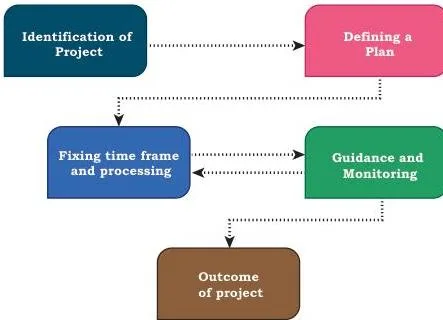
The circular flow diagram in Figure 13.1 shows the order in which the steps must be applied. A project begins with identification, moves through planning and processing, and ends with the outcome. Because the outcome comes last, it can be peer reviewed and modified on feedback (NCERT, p. 243).
- Identification of a project — the idea comes from a real-life situation; the book’s example is organising a seminar. The group must understand the usefulness of the project and its impact, and students are encouraged to undertake interdisciplinary projects (NCERT, p. 242).
- Defining a plan — one project leader is identified, and the roles of the leader and of every member are clearly defined. Specific activities are assigned to members, the tools for those activities are known, and the group thinks of extreme situations to reach a better solution (NCERT, p. 242).
- Fixing a time frame and processing — every activity in a project requires time, so the time frame must be well structured and at the same time flexible: fixed deadlines with room for members who get stuck (NCERT, p. 242).
- Providing guidance and monitoring — when members get stuck, guidance comes from books, websites and field experts. The project leader ensures monitoring of the project, and the guide teacher helps with it (NCERT, p. 243).
- Outcome of a project — the outcome can be single or multiple. It can be peer reviewed and modified as per feedback from the guide teacher or other users (NCERT, p. 243).
Teamwork and Its Six Components
Many real-life tasks are too complex for one person, so projects are completed in groups. The chapter defines teamwork as the collective effort made by individuals to accomplish a task (NCERT, p. 243).
The cricket example makes the idea concrete: a bowler may bowl a good ball, but if the fielder cannot take the catch, the wicket is not taken. Winning a match needs contributions from batting, bowling and fielding, just as a project needs contributions from every member (NCERT, p. 243).
Beyond technical skill, the chapter lists six components of teamwork on NCERT pages 244 to 245:
- Communicate with Others — through e-mails, telephones or group meetings, so members understand each other and sort out problems.
- Listen to Others — understand others’ ideas in group meetings and follow the steps the team agreed upon.
- Share with Others — share ideas, images and tools; a member well versed in an area shares that expertise with the rest.
- Respect for Others — treat every member’s thoughts and ideas with consideration; ignoring one member’s views may stop them giving their best.
- Help Others — a helping hand from every member is key to success, and help may also come from people outside the team.
- Participate — members encourage each other to take part in the project and in discussions, so each one feels their importance in the team.
One way to remember the list is as six actions: communicate, listen, share, respect, help and participate. The chapter labels them (A) to (F), so Participate is the sixth component, listed right after Help Others.
The Three Project Descriptions in the Chapter
The chapter ends with three complete sample project descriptions on pages 245 to 247. Each description comes with its own specification checklist; a group may also choose any other project in consultation with the guide teacher (NCERT, p. 245).
Restaurant “Stay Healthy”: order processing and billing
A new restaurant, “Stay Healthy”, wants application software that automates order placing and the processes around it. The team builds the application with two login options, customer kiosks at reception, soft bills with order numbers, and manager functions such as menu changes, order deletion and sales reports (NCERT, p. 245).
Minesweeper-style puzzle game
A puzzle game in Python that presents a grid of cells, some hiding bombs. The player clears the board using the clues that safe cells reveal, without detonating a bomb (NCERT, p. 246).
Match the Sum edutainment game
An edutainment game for children aged 5 to 7 that sharpens summing skills. Players form the number 10 by adding 2 or 3 visible digits, while new digits keep entering from the right (NCERT, pp. 246-247).
| Project | Type of application | Key specification to remember |
|---|---|---|
| Restaurant “Stay Healthy” | Order processing and billing | Bill ID combines date and order number; order number restarts every day |
| Minesweeper-style game | Puzzle game in Python | 6 by 6 grid with 6 bombs; clue numbers count adjacent bombs |
| Match the Sum | Edutainment game for ages 5-7 | Digits shift left with every new digit; remove digits that sum to 10 |
What Each Project Specification Actually Demands
These specifications are the closest thing the chapter has to practice questions. A guide teacher checks the finished program against the same list, so go through each point before calling the project complete.
Restaurant “Stay Healthy” specification (NCERT, p. 245)
- Two login options: one for the manager of the joint, one for the customer.
- Customer kiosk(s) placed at reception; the opening screen displays the menu for placing orders.
- Customers enter item code(s) and the quantity desired.
- After placing an order, a soft copy of the bill with an Order Number appears on the kiosk.
- Every bill has a unique identification, such as a combination of the date and the day’s order number, and is saved in the data file or database.
- The order number starts from 1 every day.
- Manager login allows entry or change of the menu, deletion of an order on demand, and a report summarising the sales made on a day; the program should accept the date for which the summary is required.
- Teams must add at least one more relevant report of their choice.
Minesweeper specification (NCERT, p. 246)
- Player clicks a cell: if the cell contains a bomb, the game finishes.
- If the cell is safe, it reveals a number — the clue — giving the count of bombs hidden in the adjacent cells around it, up to the eight neighbouring cells.
- Play any Minesweeper game five times before coding, so the project is properly understood.
- To reduce complexity, fix the grid at 6 by 6 cells and the number of bombs at 6.
- The note under the specification: handle the various exceptions that may occur while playing the game.
Match the Sum specification (NCERT, pp. 246-247)
- Display a list of 15 cells, each holding a digit from 1 to 9.
- Generate a digit at a time and place it in the rightmost cell, at equal intervals of time.
- With every new digit, the already existing digits shift left by one cell.
- The player types 2 or 3 digits, one at a time, from the cells currently displayed.
- If the sum of those digits is 10, the digits are removed from the list.
- The game continues until there is an empty cell to insert a digit.
- The note under the specification: take care of the situation when the digits displayed in the list of cells do not add up to 10.
Definitions in This Chapter
Three terms carry the chapter’s ideas. Learn each one in your own words, keeping the page reference in mind.
| Term | Plain-language definition | NCERT page |
|---|---|---|
| Project based learning | Practical exposure to a real problem: students organise the project, use time effectively, and learn working together, problem solving, decision making and investigating | p. 241 |
| Modular approach | Dividing a project into manageable modules, each with a well-defined task, a set of inputs and a set of outputs, integrated to reach the desired outcome | p. 242 |
| Teamwork | The collective effort made by individuals to accomplish a task | p. 243 |
Common Mistakes Students Make in This Chapter
This chapter has no formulas to slip on, but the project work has traps. The table below pairs each mistake with the rule that fixes it and a way to check your own work.
| Mistake | Correct rule | How to check your work |
|---|---|---|
| Jumping into coding without defining a plan, so no leader is identified and roles stay undefined (NCERT, p. 242) | Identify one project leader and assign specific roles to every member before coding | Your plan checklist names a leader and one task per member |
| Forgetting to think about extreme situations (NCERT, p. 242) | Ask what happens in extreme situations while planning, to reach a better solution | For the restaurant: what happens at closing time, or when an item is out of stock? |
| Building the bill ID from the order number alone (NCERT, p. 245) | Every bill ID combines the date with that day’s order number, which starts from 1 each day | Two bills from different days never share an ID |
| Coding Minesweeper before playing it (NCERT, p. 246) | Play any Minesweeper game five times before starting to code | You can explain how clues work from experience, not guesswork |
| No exception handling in the game (NCERT, p. 246) | Handle the exceptions that may occur while playing | Feeding the wrong input type or wrong cell never crashes the program |
| Treating Match the Sum cells as static (NCERT, p. 247) | Existing digits shift left by one cell with every new digit added from the right | Simulate one insertion on paper before writing the list logic |
| Not handling the case where visible digits cannot make 10 (NCERT, p. 247) | Take care of the situation when displayed digits do not add up to 10 | If no 2 or 3 visible digits sum to 10, the game still behaves sensibly |
How to Approach the Chapter for Exams and Practical Work
The chapter is short and mostly conceptual, so revision means recalling structured lists rather than solving problems. There are no numerical exercises in these pages.
- The five-step model is the natural frame for a short-answer question: reproduce the steps in order, from identification of a project to outcome of a project, with one line of explanation each (NCERT, pp. 242-243).
- The six teamwork components make another likely list question: communicate, listen, share, respect, help and participate, each with a one-line explanation (NCERT, pp. 244-245).
- For the approaches, be ready to name the three — modular, top down, bottom up — and to explain that the chapter emphasises the modular approach, in which a project is divided into manageable modules.
- The term definitions, project based learning (NCERT, p. 241) and teamwork (NCERT, p. 243), are the chapter’s definition-type material.
- The three project descriptions connect the chapter to practical file work: a group is expected to build one of these projects in Python, and the specification checklist is what the guide teacher checks against.
One honest caution: textbook contents and the examinable syllabus are not always identical. For the exact list of what is examinable this session, check the current official CBSE syllabus along with your school’s instructions.
Chapter 13 in Brief: The Revision Summary
- Project based learning means learning by doing a real project in a group: analyse the problem, divide it into small modules, solve each module, integrate the solutions, and report results in a predetermined format.
- The five steps are: identification of a project; defining a plan; fixing of a time frame and processing; providing guidance and monitoring; and outcome of a project.
- The chapter recommends the modular approach — splitting the project into manageable modules — over top down and bottom up.
- Teamwork is the collective effort of individuals to accomplish a task; its six components are communicate, listen, share, respect, help and participate.
- The three project examples are the restaurant billing application, the Minesweeper-style puzzle game and the Match the Sum edutainment game (NCERT, pp. 245-247).
Related Resources
This listing is maintained for the 2026-27 academic session using the NCERT textbook information available to us. NCERT remains the authority for confirming the latest edition.
If you are working through the rest of the subject, the Class 12 Computer Science notes page collects the chapters in one place, and the Class 12 notes hub covers every subject.
The previous chapter, Chapter 12, comes just before this one in the book, while the main CBSE notes index is the starting point for material across all classes.
Sources and Data Verification
This page describes the NCERT Class 12 Computer Science textbook, Chapter 13 (Project Based Learning), official edition published on ncert.nic.in. Page numbers cited here are the printed NCERT page numbers, pages 240 to 247, as they appear in the book.
The listing is maintained for the current academic session. NCERT settles textbook editions, chapter contents and official PDFs; CBSE settles curriculum, syllabus and examinations.
Reference: NCERT Class 12 Computer Science textbook, chapter 13, official edition on ncert.nic.in.
Frequently Asked Questions
What is project based learning in Class 12 Computer Science?
Project based learning gives students practical exposure to a real problem. Students organise the project, use time effectively, and learn skills such as working together, problem solving, decision making and investigating. The problem is analysed, formed into small modules, each module is solved, and the solutions are integrated (NCERT, p. 241).
What are the five steps in project based learning according to NCERT?
The five steps are: identification of a project; defining a plan; fixing of a time frame and processing; providing guidance and monitoring; and outcome of a project. They appear in the same order in Figure 13.1 and are explained on NCERT pages 242 to 243.
What are the six components of teamwork in this chapter?
The six components are: communicate with others, listen to others, share with others, respect for others, help others, and participate (NCERT, pp. 244-245).
Which three project descriptions are given in Chapter 13?
The chapter gives three: the restaurant “Stay Healthy” order processing and billing application (NCERT, p. 245), a Minesweeper-style puzzle game (NCERT, p. 246), and the Match the Sum edutainment game for children aged 5 to 7 (NCERT, pp. 246-247).
Does Chapter 13 of Class 12 Computer Science have exercise questions?
No. The chapter closes with project descriptions rather than exercise questions. Each project description ends with its own specifications checklist, and a group may also choose any other project in consultation with the guide teacher (NCERT, p. 245).
Explore Class 12 Computer Science Books
Related chapters:
- Exception Handling in Python
- Querying and SQL Functions
- File Handling in Python