
This is the Staffing Class 12 chapter — Chapter 6 of the NCERT Business Studies Part I textbook, which begins on NCERT page 138 and runs for about 30 printed pages. It explains what staffing means and why it matters, walks through the eight-step staffing process, and then treats the three aspects of staffing in detail: recruitment, selection, and training and development.
The official NCERT chapter PDF is right below.
Download the Official Staffing Class 12 Chapter PDF
Download the Staffing Class 12 NCERT Business Studies Chapter 6 PDF — this is the official chapter file, published by NCERT exactly as it appears in the book, so you can read the full text, its case studies and its exercises in one document, with the same page numbering this page cites.
All other chapters of the book are available the same way from the official NCERT website.
| What the chapter holds | Count | Where it is used |
|---|---|---|
| Printed pages | 30 | |
| Figures with NCERT captions | 1 | |
| Tables | 1 | |
| In-text questions | 2 | |
| Official NCERT PDF | Download the chapter PDF | the chapter exactly as NCERT publishes it |
Chapter 6 Staffing at a Glance
Staffing opens with the case that frames the whole chapter — how Infosys treats its human resources as assets that “walk out of the door each evening”, as former CEO Narayana Murthy put it (NCERT, pp. 138–140). The learning objectives follow on NCERT page 140.
The chapter then moves through the meaning of staffing (pp. 140–141), its importance (pp. 141–142), staffing as part of human resource management (pp. 142–143), and how HRM evolved (pp. 143–145).
The middle of the chapter is the eight-step staffing process (pp. 144–149), followed by the three aspects of staffing in detail: recruitment with its internal and external sources (pp. 149–155), the selection process (pp. 155–159), and training and development with both method families (pp. 160–164).
Two real newspaper excerpts appear inside this section — one on employee-referral hiring on NCERT page 156 and one on 15–20% pay hikes on page 157 — showing recruitment and retention as they happen in actual companies. The chapter closes with Key Terms, a Summary (pp. 164–166), and three blocks of questions: Very Short, Short and Long Answer (pp. 167–169).
What the Staffing Chapter Covers, Section by Section
Think of the chapter as three movements: what staffing is and why it matters, how the staffing process runs, and then the three detailed aspects — recruitment, selection, training. The six parts below follow that order, with page references so you can open the exact spread.
Part 1 — Meaning, Importance and Why Staffing Is Part of HRM
Staffing is “putting people to jobs”. More formally, the book describes it as the managerial function of filling and keeping filled the positions in the organisation structure (NCERT, p. 140). The function begins with workforce planning and continues through recruitment, selection, training, development, promotion, compensation and performance appraisal.
In a new enterprise, staffing comes after planning and organising. In an existing enterprise it is a continuous process, because new jobs are created and existing employees leave (NCERT, p. 141).
Proper staffing gives an organisation five benefits (NCERT, pp. 141–142):
- discovers and obtains competent personnel for various jobs;
- makes for higher performance by putting the right person on the right job;
- ensures continuous survival and growth through succession planning for managers;
- ensures optimum utilisation of human resources, avoiding both overmanning and shortages;
- improves job satisfaction and morale through objective assessment and fair reward.
The chapter calls staffing the most fundamental and critical driver of organisational performance. If the right people are missing, materials, time and effort get wasted, productivity falls, and products can no longer be sold profitably (NCERT, p. 142).
Staffing is a function every manager performs, not a job that belongs to one department. In a small organisation the manager handles everything — hiring, training, salaries and welfare. As the organisation grows, a specialist human resource department appears, and in very large firms it holds specialists for each function (NCERT, p. 142).
The book lists the duties of that department: recruitment; job analysis and job descriptions; compensation and incentive plans; training and development; labour relations; handling grievances; employee welfare; and defending the company in legal matters (NCERT, p. 143).
Part 2 — How Human Resource Management Evolved
This short history explains a one-mark favourite: why the book concludes that staffing is both a line activity and a staff activity.
The roles changed as industry changed (NCERT, pp. 143–145):
- Labour welfare officer — emerged from the trade-union movement as a link between owners and workers; limited to welfare activities, and looked down on by both sides.
- Personnel officer — appeared when factories employed thousands under one roof and hiring was given to one person.
- Personnel manager — the role grew as recruitment, selection and placement became recognised functions.
- Human resource manager — as technology demanded new skills and the human-relations approach recognised people as a developable resource, the scope widened again.
The conclusion: staffing is both a line activity (an essential function of every manager) and a staff activity (an advisory role of the HR department) (NCERT, p. 145). You cannot manage without people in positions, and the HR department exists to advise on how to get and keep them.
Part 3 — The Eight-Step Staffing Process
The staffing process is the backbone of the chapter. Each step feeds the next, and questions often ask you to reproduce the sequence in order. The eight steps run like this (NCERT, pp. 144–149):
- Estimating manpower requirements (p. 145) — workload analysis decides how many and what types of people are needed; workforce analysis reveals how many are available. The comparison shows whether the firm is understaffed, overstaffed or optimally staffed.
- Recruitment (p. 146) — searching for prospective employees and stimulating them to apply, creating a pool of candidates.
- Selection (p. 146) — choosing the best person from that pool through tests and interviews.
- Placement and orientation (p. 147) — placement is the employee occupying the post; orientation is introducing the new employee to colleagues and the rules of the organisation. First impressions here are lasting.
- Training and development (pp. 147–148) — continuing learning so employees perform better and can rise; what people want is a career, not just a job.
- Performance appraisal (p. 148) — evaluating current or past performance against predetermined standards, with feedback to the employee.
- Promotion and career planning (p. 148) — moving employees to positions of increased responsibility, bringing more pay, status and satisfaction.
- Compensation (pp. 148–149) — all forms of pay: direct (wages, salaries, incentives, commissions, bonuses) and indirect (employer-paid insurance, vacations); time-based or performance-based plans.
A mnemonic for the order — E-R-S-P-T-P-P-C: Every Resource Selects Proper Trained People, Paying Correctly.
Seen as a whole, staffing is a process of acquisition, retention, development, appraisal, promotion and compensation of the organisation’s human capital (NCERT, p. 149).
Part 4 — Recruitment: Internal and External Sources
Recruitment is the process of searching for prospective employees and stimulating them to apply for jobs in the organisation (NCERT, p. 149). Its object is to attract enough suitable applicants; selection then filters them.
Internal sources fill posts from within the organisation through two routes (NCERT, pp. 150–151):
- Transfer — a horizontal shift from one job, department or shift to another, without a substantive change in status or pay. It moves surplus staff into vacancies and is also used as training.
- Promotion — a vertical shift to a higher position with more responsibility, status, pay and facilities; it motivates the promoted employee and can create a chain of promotions below.
Merits of internal sources (NCERT, p. 151): motivated and loyal employees; simpler, more reliable and economical selection because candidates are already known; no induction training needed; transfers shift surplus staff to where they are needed; and filling jobs internally is cheaper.
Limitations (NCERT, pp. 151–152): risk of “inbreeding” — no fresh talent enters; employees may grow lethargic expecting time-bound promotions; a new enterprise cannot use internal sources at all; competition weakens; and frequent transfers can reduce productivity.
External sources — the ten avenues the book lists (NCERT, pp. 152–154):
- Direct recruitment — a notice on the notice-board, selection on the spot; workers are casual or badli workers on daily wages; very inexpensive.
- Casual callers — databases of unsolicited applicants kept by reputed firms; reduces the cost of recruiting.
- Advertisement — newspapers and professional journals; gives wider choice and more information, but may draw a flood of unsuitable responses.
- Employment exchanges — government-run, useful for unskilled and skilled operative jobs; records are often not up to date.
- Placement agencies and management consultants — agencies match demand and supply for a fee; consultants specialise in middle- and top-level executive placements.
- Campus recruitment — from management and technology institutes; an established practice for technical, professional and managerial jobs.
- Employee recommendations — present employees introduce candidates; a form of preliminary screening because employees know both sides.
- Labour contractors — supply unskilled workers at short notice; risky because workers may leave if the contractor leaves.
- Advertising on television — job details and the company profile publicised on TV.
- Web publishing — dedicated job websites visited by both job-seekers and organisations.
Merits of external sources (NCERT, p. 155): qualified and trained people, wider choice, fresh talent or “new blood”, and a competitive spirit that pushes existing staff to work harder. Limitations (NCERT, p. 155): dissatisfaction among existing staff, a lengthy process, and the cost of advertising and processing applications.
The table below pairs each source with the situation it suits best, so you can match a case-study fact to the right source:
| Source | Type | Situation it suits (NCERT page) |
|---|---|---|
| Transfer / promotion | Internal | Motivating existing staff and filling a vacancy cheaply from a surplus department (pp. 150–151) |
| Direct recruitment | External | Casual vacancies, unskilled or semi-skilled work, sudden rush of orders (p. 152) |
| Casual callers | External | Reputed firms with a database of unsolicited applicants screened as vacancies arise (p. 152) |
| Advertisement | External | Senior positions where wider choice and more information are needed (p. 153) |
| Employment exchange | External | Unskilled and skilled operative jobs; compulsory notification in some cases (p. 153) |
| Placement agencies / consultants | External | Technical, professional and managerial posts needing extensive screening (p. 153) |
| Campus recruitment | External | Entry-level technical, professional and managerial talent from institutes (p. 153) |
| Employee recommendations | External | When background checking matters and a trusted employee vouches for the candidate (p. 154) |
| Labour contractors | External | Unskilled workers needed at short notice in large numbers (p. 154) |
| Television advertising / web publishing | External | Reaching a wide audience fast with detailed job and company information (p. 154) |
Recruitment and selection are steps that follow each other but do different work — this is the chapter’s most-asked distinction. Compare them directly:
| Basis | Recruitment | Selection |
|---|---|---|
| Definition | Searching for prospective employees and stimulating them to apply (p. 146) | Choosing the best person from the pool of candidates (pp. 146, 155) |
| Purpose | Build a pool of applicants | Shrink the pool to the right person |
| Nature | Attracts and invites applications | Eliminates candidates at each stage until the right one remains |
| Order | Comes first | Comes after recruitment |
| Techniques | Advertising, campus visits, agencies | Tests, interviews, reference checks, medical examination |
Part 5 — Selection: From Preliminary Screening to the Contract
Selection is the process of identifying and choosing the best person out of a number of prospective candidates for a job (NCERT, p. 155). Candidates take a series of tests and interviews, and at every stage some are eliminated until the right type is found.
The process runs in this exact order (NCERT, pp. 155–159):
- Preliminary screening (p. 155) — application forms and preliminary interviews eliminate unqualified or unfit job-seekers quickly.
- Selection tests (pp. 156–157) — employment tests measure characteristics such as intelligence, aptitude, personality, trade skill and interests.
- Employment interview (p. 158) — a formal, in-depth conversation to judge suitability; the interviewer seeks information and the interviewee provides it.
- Reference and background checks (p. 158) — verifying information through previous employers, teachers or known persons.
- Selection decision (pp. 158–159) — the final choice among those who passed; the concerned manager’s view counts because that manager is responsible for the new employee’s performance.
- Medical examination (p. 159) — a fitness test after the decision and before any job offer.
- Job offer (p. 159) — an appointment letter containing a date for reporting on duty.
- Contract of employment (p. 159) — the attestation form plus a written contract covering job title, duties, pay, hours, leave, grievance and disciplinary procedures, and termination.
The five employment tests are a frequent match-the-following item. Compare them side by side:
| Test | What it measures | NCERT page |
|---|---|---|
| Intelligence test | Intelligence quotient — learning ability, ability to make decisions and judgments | p. 156 |
| Aptitude test | Potential for learning new skills — the capacity to develop | p. 156 |
| Personality test | Emotions, reactions, maturity and value system — the overall personality | p. 157 |
| Trade test | Existing skills — level of knowledge and proficiency already possessed | p. 157 |
| Interest test | Pattern of interests or involvement of a person | p. 157 |
The distinction to hold: an aptitude test measures the potential to acquire skills, while a trade test measures the actual skills possessed (NCERT, p. 157).
The book closes the selection discussion with a sobering point: every selection decision has four possible outcomes (NCERT, pp. 158–159):
- Correct acceptance — predicted successful, and proved successful on the job.
- Correct rejection — predicted unsuccessful, and would have performed poorly if hired.
- Reject error — a candidate who would have performed successfully is rejected.
- Accept error — a candidate who ultimately performs poorly is accepted.
An original example: a courier firm tests five riders. Two are hired and perform exactly as predicted (correct acceptance). One applicant is judged unreliable and is not hired, and later behaves the same way in another job (correct rejection).
A careful rider rejected for a stammer becomes a star performer elsewhere — a reject error the firm never sees in its own records. The fifth rider is hired but mishandles parcels and loses customers — an accept error. Both errors are costly, which is why the chapter insists selection decisions matter.
Part 6 — Training and Development: The Two Method Families
Training and development is an attempt to improve current or future performance by increasing an employee’s ability through learning (NCERT, p. 160). The chapter opens the topic with its proverb: plan for a year, sow seeds; plan for ten years, plant trees; plan for a lifetime, develop people.
Benefits to the organisation (NCERT, pp. 160–161):
- systematic learning beats trial-and-error, which wastes effort and money;
- higher productivity in quantity and quality, hence higher profits;
- future managers ready to take over in emergencies;
- higher morale, lower absenteeism and lower employee turnover;
- effective response to fast technological and economic change.
Benefits to the employee (NCERT, p. 161): a better career, higher earnings from improved performance, safer handling of machines with fewer accidents, and greater satisfaction and morale.
The book insists that training, education and development are distinct even though they overlap (NCERT, pp. 161–162):
| Basis | Training | Education | Development |
|---|---|---|---|
| Focus | Increases skills and abilities to perform specific jobs | Increases knowledge and understanding | Provides learning opportunities that help employees grow |
| Scope | Job-specific, tied to organisational goals | Broader — develops a logical, rational mind rather than giving definite answers | Whole person — personality, maturity, potential |
| Time frame | Short-term | — | Ongoing process that includes training |
In the book’s own two-way comparison, training is job-oriented and enables the employee to do the current job better; development is career-oriented and enables the overall growth of the employee (NCERT, p. 162).
Training methods fall into two families. On-the-job methods mean learning while doing; off-the-job methods mean learning before doing (NCERT, p. 162).
On-the-job methods (NCERT, pp. 162–163):
- Apprenticeship programmes — the trainee works under a master worker to acquire a higher level of skill; plumbers, electricians and iron-workers train this way.
- Coaching — the superior guides the trainee like a coach, setting goals, reviewing progress and suggesting changes; the trainee is often groomed to replace the senior.
- Internship training — a joint programme where educational institutions and business firms cooperate; the candidate studies and works to gain practical knowledge.
- Job rotation — shifting the trainee from one department or job to another for a broader understanding of how the whole organisation functions.
Off-the-job methods (NCERT, pp. 163–164): classroom lectures and conferences for rules and procedures; films that demonstrate skills; the case-study method, where trainees analyse real managerial problems and propose solutions; computer modelling, which simulates the work environment without the risk of real mistakes; vestibule training, where employees learn on the actual equipment but away from the work floor, usually for sophisticated machinery; and programmed instruction, where material is broken into logical units from simple to complex and the trainee answers questions as they go.
Key Concepts in Staffing You Need to Hold On To
These are the ideas that reappear in nearly every question this chapter asks — hold these and the details hang together:
- Right person for the right job — the phrase the chapter returns to again and again (NCERT, p. 140).
- Staffing is both a line and a staff activity — an essential function of every manager AND an advisory role of the HR department (NCERT, p. 145).
- Staffing is a process, not one action — acquisition, retention, development, appraisal, promotion and compensation of human capital (NCERT, p. 149).
- Recruitment builds the pool, selection shrinks it (NCERT, pp. 146, 155).
- Internal sources motivate but risk inbreeding; external sources bring fresh talent but cost more (NCERT, pp. 151, 155).
- Training improves the current job; development grows the whole person (NCERT, p. 161).
- On-the-job means learning while doing; off-the-job means learning before doing (NCERT, p. 162).
The Recruitment Figure on NCERT Page 149, Explained
The chapter uses a single figure to fix what recruitment actually does. The caption on NCERT page 149 reads: “The object of recruitment is to attract potential employees with the necessary characteristics or qualification, in the adequate number for the jobs available.”
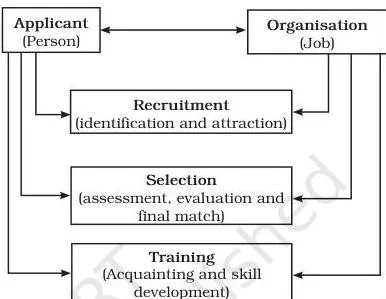
Think of the figure as a magnet: recruitment’s only job is to pull in an adequate number of suitable applicants. Everything before selection is a pull — identifying sources of labour, advertising the vacancy, inviting applications. Selection then acts as a filter, reducing that pool stage by stage until the right person remains (NCERT, pp. 146, 155).
The practical point: if recruitment attracts too few people, or the wrong kinds of people, selection cannot rescue the process — the firm can only choose from the pool that exists.
Definitions: Key Terms with Their NCERT Pages
A quick lookup table of the terms the chapter defines, each rewritten in plain words with the page where the book defines it:
| Term | What it means | NCERT page |
|---|---|---|
| Staffing | Filling and keeping filled the positions in the organisation structure — putting people to jobs | p. 140 |
| Recruitment | Searching for prospective employees and stimulating them to apply for jobs | p. 146 |
| Selection | Choosing the best person from the pool of prospective candidates | pp. 146, 155 |
| Placement | The employee occupying the position or post for which he or she was selected | p. 147 |
| Orientation | Introducing the selected employee to other employees and familiarising them with the rules and policies of the organisation | p. 147 |
| Performance appraisal | Evaluating an employee’s current or past performance against predetermined standards | p. 148 |
| Compensation | All forms of pay or rewards going to employees — direct and indirect | p. 148 |
| Promotion | Shifting an employee to a higher position carrying more responsibility, status and pay | p. 148 |
| Transfer | Shifting an employee from one job, department or shift to another without a substantive change in status or pay | p. 150 |
| Training | Process by which aptitudes, skills and abilities to perform specific jobs are increased | p. 161 |
| Education | Process of increasing the knowledge and understanding of employees | p. 161 |
| Development | Learning opportunities designed to help employees grow — personality, maturity and potential | p. 161 |
Common Mistakes Students Make in Staffing
Most errors in this chapter come from blurring pairs of terms the book carefully separates. Watch for these six:
| Mistake | Correct rule | How to check your answer |
|---|---|---|
| Writing recruitment and selection as the same thing | Recruitment searches for candidates and stimulates them to apply; selection chooses the best from the pool (pp. 146, 155) | Ask: does this step create candidates or remove them? |
| Treating transfer and promotion as identical | Transfer is horizontal — duties may change, status and pay largely do not; promotion is vertical — higher responsibility, status and pay (p. 150) | Ask which direction the employee moves in the structure |
| Swapping aptitude and trade tests | Aptitude measures potential to learn new skills; trade measures skills already possessed (p. 157) | Ask: is the test measuring a future skill or an existing one? |
| Blurring training, education and development | Training is job-specific and short-term; education widens knowledge and understanding; development is the ongoing growth of the person (pp. 161–162) | Ask: current job, general knowledge, or whole person? |
| Assuming all vacancies can be filled internally | A new enterprise cannot use internal sources at all; existing staff may be insufficient or lack the eligibility (pp. 151–152) | Ask whether the organisation has enough suitable internal people |
| Getting the selection order wrong | Medical examination comes before the job offer; the contract of employment closes the process (pp. 158–159) | Recite the order: screening → tests → interview → checks → decision → medical → offer → contract |
Exam Notes: What the Chapter’s Own Questions Demand
This section maps the chapter’s end questions to the concepts they test, so your revision targets the right material.
Very Short Answer (NCERT, pp. 167–168) tests definitions and quick applications: what staffing means; the two sources of recruitment; and three factory scenarios — workers unable to operate new machines (answer: training), production below standards because workers do not know the machinery (answer: training), and idle workers with hi-tech machines causing high overheads (answer: vestibule training).
Short Answer (NCERT, p. 168) tests distinctions and applications: recruitment vs selection; the security-services firm that needs reliable candidates (selection process steps); a paper-plates company facing a festival rush of an extra 50,000 units (direct recruitment); training vs development; why internal sources are economical; and explaining the “right kind of people” statement.
Long Answer (NCERT, pp. 168–169) tests the chapter’s case studies. Map each case to its concept:
| Case study (NCERT page) | Concept it tests |
|---|---|
| naukaripao.com portal for senior management professionals (p. 168) | Web publishing as an external source of recruitment |
| Xylo limited setting up a new auto-components plant (p. 168) | The complete staffing process, choice of recruitment sources, and the selection process |
| Insurance company recruiting data entry staff with soft skills but weak hard skills (p. 168) | Recruitment difficulty plus the need for training |
| Ms. Jayshree as HR manager of a steel company expanding from 800 to 1,000 employees (pp. 168–169) | Functions and duties of the human resource department |
The habit every case-study answer needs: state the concept, apply it to the facts given, then justify your application.
A note: textbook contents and the examinable syllabus are not always identical — check the current official CBSE syllabus for what is examinable this session.
Staffing on One Page: The Full Chapter Compressed
A fast revision pass built from the chapter’s closing Summary (NCERT, pp. 164–166). Everything above in nine lines:
- Meaning — staffing fills and keeps filled the positions in the organisation structure: identify the workforce required, then recruit, select, place, promote, appraise and develop the people (p. 164).
- Need and importance — the right people determine whether an organisation achieves its goals; staffing matters more today because of technology, organisation size and human complexity (p. 164).
- Staffing and HRM — every manager staffs; as firms grow, a specialist human resource department takes over the specialised duties (pp. 164–165).
- Evolution of HRM — labour welfare officer → personnel officer → personnel manager → human resource manager; staffing is therefore both a line and a staff activity (p. 165).
- Staffing process — estimate manpower requirements (workload plus workforce analysis), recruit, select, place and orient, train and develop (p. 165).
- Sources of recruitment — internal: transfers and promotions; external: ten avenues from direct recruitment to web publishing (p. 166).
- Selection process — screening, tests (intelligence, aptitude, personality, trade, interest), interview, reference checks, decision, medical exam, job offer, contract (p. 166).
- Training, education and development — training sharpens skills for a specific job; education widens knowledge; development grows the whole person and is ongoing (p. 166).
- Training methods — on-the-job: apprenticeship, coaching, internship, job rotation; off-the-job: lectures, films, case study, computer modelling, vestibule training, programmed instruction (p. 166).
Related Resources for Class 12 Business Studies
This listing is maintained for the 2026-27 academic session using the NCERT textbook information available to us. NCERT remains the authority for confirming the latest edition.
Staffing sits between Organising and Directing in the book, and all of Class 12 Business Studies lives under the notes hub:
- Class 12 Business Studies notes — the hub for every chapter of the subject.
- Organising notes — Class 12 Chapter 5 — the chapter before Staffing, which covers the organisation structure that staffing fills.
- Directing notes — Class 12 Chapter 7 — the chapter after Staffing, covering leadership, motivation and communication.
- Class 12 notes hub — study material for all subjects of Class 12.
- CBSE notes index — everything on the site, by class.
Sources and Data Verification
This page describes the NCERT Business Studies Part I textbook for Class 12, Chapter 6 “Staffing”, in its current official edition published on ncert.nic.in. It covers this one chapter; the book’s other chapters have their own pages. This page is maintained for the current academic session from the NCERT information available to us.
NCERT settles textbooks, editions and PDFs; CBSE settles curriculum, syllabus and examinations.
Reference: NCERT Class 12 Business Studies textbook, chapter 6, official edition on ncert.nic.in.
FAQs: Staffing Class 12 Questions Answered
Fast answers to the long-tail questions students actually search, each grounded in the chapter.
What is the difference between recruitment and selection in Class 12 Business Studies?
Recruitment is the process of searching for prospective employees and stimulating them to apply for jobs in the organisation (NCERT, p. 146). Selection is the process of choosing the best person from the pool of candidates that recruitment created (NCERT, pp. 146, 155).
Recruitment comes first and expands the applicant pool; selection follows and filters the pool down through tests and interviews until the right person remains.
What are the steps of the staffing process in the Class 12 NCERT chapter?
There are eight steps, in this order: estimating manpower requirements, recruitment, selection, placement and orientation, training and development, performance appraisal, promotion and career planning, and compensation (NCERT, pp. 144–149). To recall them, use the mnemonic E-R-S-P-T-P-P-C: Every Resource Selects Proper Trained People, Paying Correctly.
What is the difference between training and development?
Training is a short-term, job-oriented process that increases the skills and abilities needed to perform a specific job (NCERT, p. 161). Development is an ongoing, career-oriented process of growth of the individual in all respects, and it includes training (NCERT, pp. 161–162). Training enables the employee to do the current job better; development enables the overall growth of the employee (NCERT, p. 162).
What is the difference between an aptitude test and a trade test?
An aptitude test measures an individual’s potential for learning new skills — the capacity to develop (NCERT, p. 156). A trade test measures the level of knowledge and proficiency already possessed — the actual skills the person has (NCERT, p. 157). In short: aptitude is future potential, trade test is existing skill.
Why are internal sources of recruitment considered more economical?
Because candidates are already known to the organisation, they can be evaluated more accurately and economically; people recruited internally need no induction training; transfers move surplus staff into vacancies; and filling jobs internally is simply cheaper than advertising and processing external applications (NCERT, p. 151).
Is staffing a line activity or a staff activity?
Both. Staffing is an essential function of every manager — a line activity — and also an advisory role played by the human resource department — a staff activity (NCERT, p. 145). Every manager must fill positions and keep them occupied with qualified people; the HR department advises on how to do that well.
Explore Class 12 Business Studies Books
Related chapters:
- Nature and Significance of Management
- Principles of Management
- Business Environment